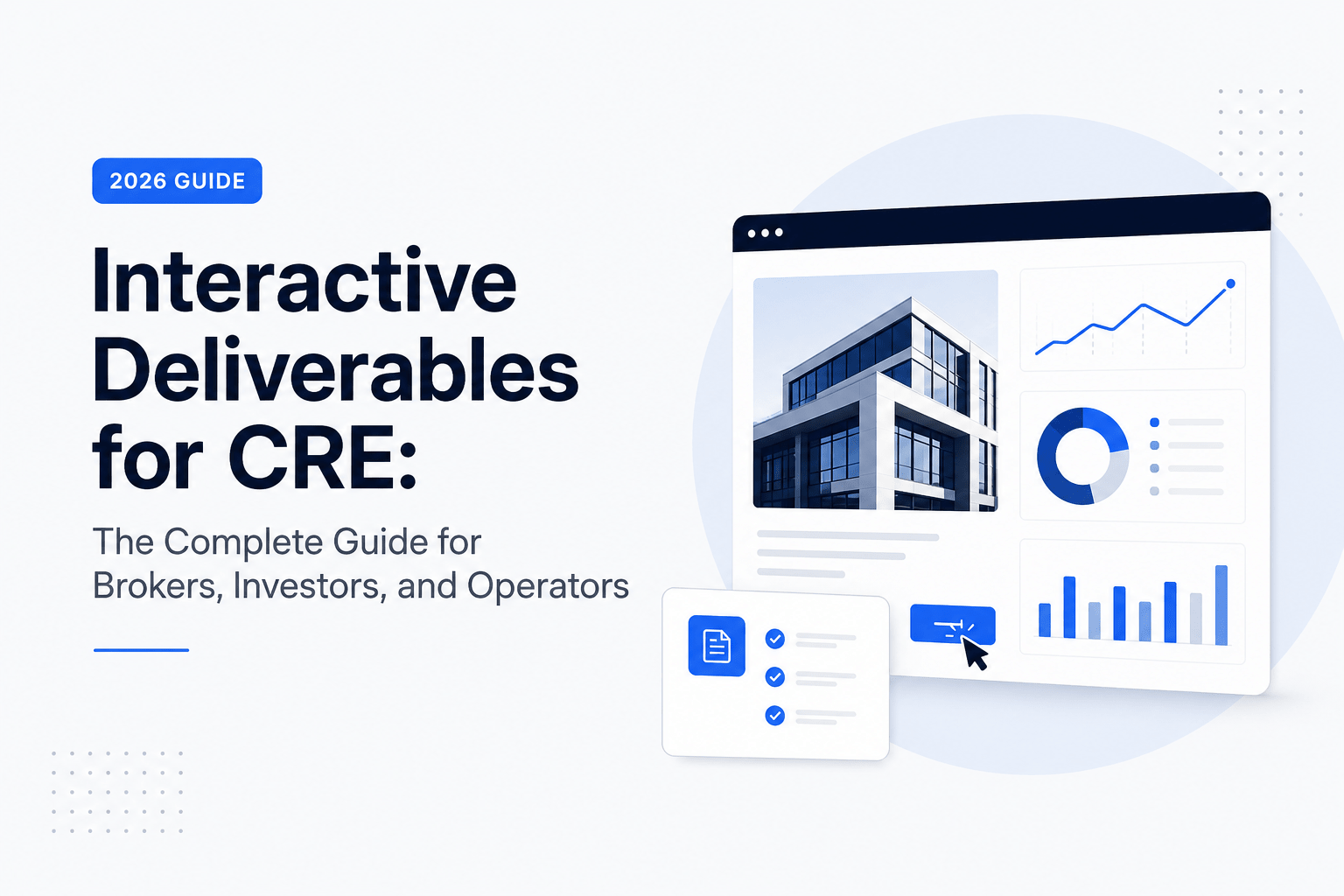
Interactive Deliverables for CRE: The Complete Guide for Brokers, Investors, and Operators (2026)
For decades, commercial real estate professionals followed the same playbook. They built a PDF, attached it to an email, and hoped the prospect would read it. That approach still exists today. However, it is becoming less effective as expectations change. Owners, investors, and operators want faster answers. They want transparency. More importantly, they want to explore opportunities themselves instead of relying solely on static presentations. This shift is creating a new opportunity for commercial real estate professionals through Interactive CRE Pitch Deliverables.
Rather than sending a traditional PDF or slide deck, brokers and investors can now deliver interactive websites, dashboards, calculators, and AI-powered tools that allow prospects to engage directly with the information. A property owner can test valuation assumptions. An investor can adjust return projections. A building owner can explore operational scenarios before making a decision.
As a result, interactive deliverables create stronger engagement, build trust faster, and help professionals stand out in a competitive market. In 2026, they are quickly becoming one of the most effective ways to win listings, raise capital, secure management contracts, and close deals.
What Are Interactive CRE Pitch Deliverables?
Interactive CRE Pitch Deliverables are digital experiences designed to replace static reports, presentations, and marketing materials.
Unlike traditional PDFs, they allow prospects to interact with information instead of simply reading it.
For example, a Broker Opinion of Value may include:
-
Live valuation calculators
-
Adjustable cap rate assumptions
-
Interactive comparable sales maps
-
Hold versus sell analysis
-
Marketing timelines
Similarly, an LP presentation may include:
-
Return calculators
-
Distribution waterfalls
-
Sensitivity analysis tools
-
Investment scenario modeling
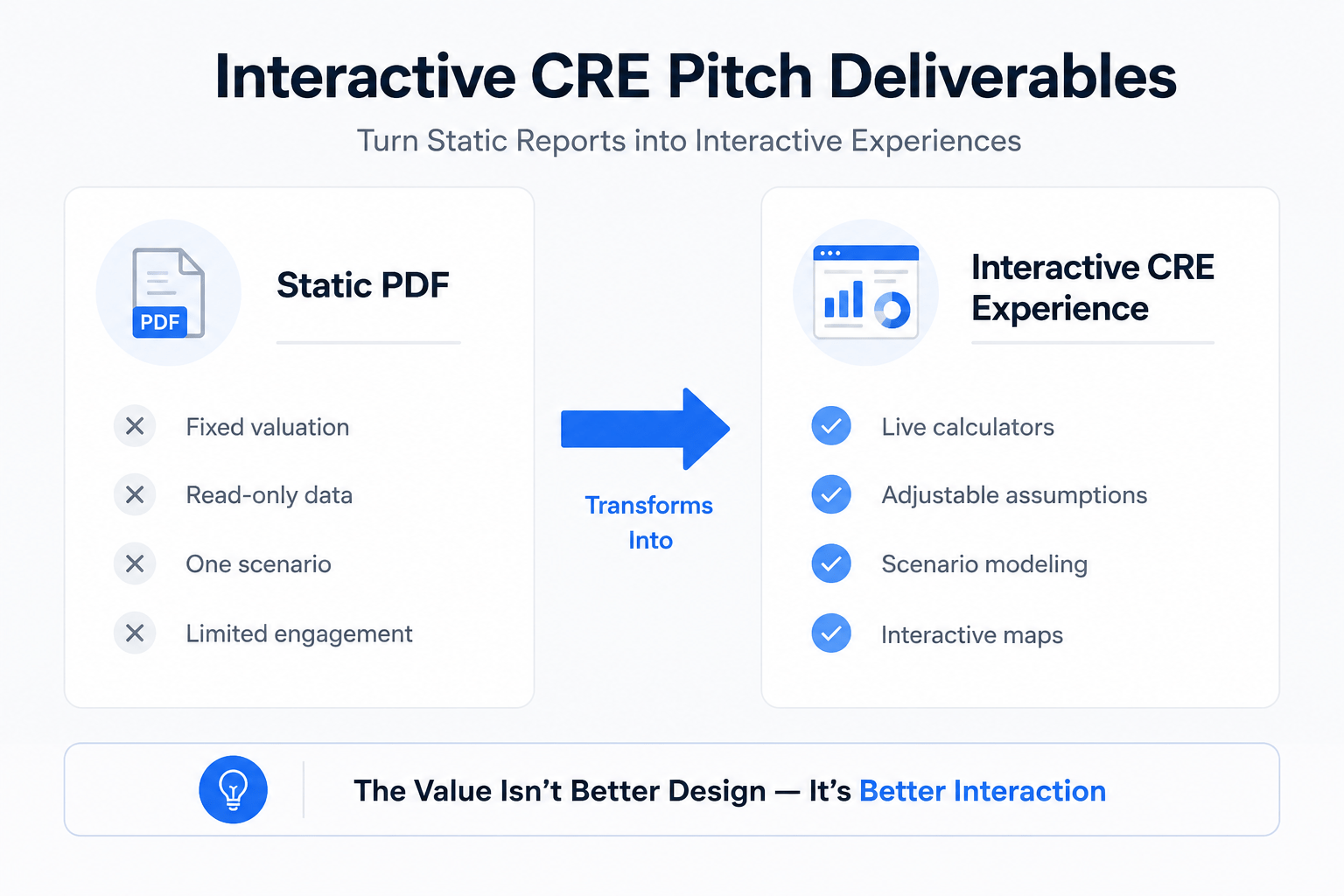
The defining feature is not visual design. The defining feature is interactivity. Users can explore information on their own terms and gain confidence in the analysis.
That fundamentally changes how CRE professionals communicate opportunities.
Why Interactive CRE Pitch Deliverables Are Replacing PDFs
Traditional PDFs present information. Interactive deliverables create experiences.
That distinction is becoming increasingly important as commercial real estate becomes more data-driven.
They Immediately Differentiate Your Business
Most brokers, developers, and operators still rely on static presentations. When a prospect receives an interactive deliverable, it creates an immediate impression.
Instead of reviewing another document, they experience something unique.
This differentiation can be particularly valuable when competing for:
-
Listing assignments
-
Investment opportunities
-
Joint venture partnerships
-
Property management contracts
-
Institutional relationships
In many cases, the format alone becomes memorable.
They Increase Transparency
Commercial real estate decisions often involve significant risk. As a result, prospects want to understand assumptions before making commitments.
Interactive deliverables provide that transparency. Rather than accepting your valuation or projections, users can test assumptions themselves.
They can adjust:
-
Vacancy rates
-
Rental growth
-
Expense growth
-
Exit cap rates
-
Hold periods
When the analysis continues to perform under different scenarios, confidence increases.
They Shorten Decision Cycles
Traditional presentations often create delays. Prospects review information, schedule meetings, ask follow-up questions, and request additional analysis.
Interactive deliverables reduce this friction. Many questions can be answered directly within the platform.
As a result, decision-makers move through the evaluation process more quickly.
Interactive Deliverables vs Traditional PDFs
| Feature | Interactive Deliverable | Traditional PDF |
|---|---|---|
| Real-Time Analysis | Yes | No |
| Scenario Testing | Yes | No |
| Mobile Experience | Strong | Moderate |
| User Engagement | High | Low |
| Transparency | High | Moderate |
| Data Exploration | Interactive | Static |
| Analytics Tracking | Available | Limited |
| User Experience | Dynamic | Passive |
The Five Most Valuable Use Cases in Commercial Real Estate
Interactive deliverables can be applied across nearly every stage of the CRE lifecycle. However, certain applications generate significantly higher value.
1. Broker Opinion of Value Presentations
This is currently one of the strongest use cases. Property owners want more than a valuation number. They want to understand how that number changes under different market conditions.
If you’re curious how top brokers are using AI to differentiate listing presentations, this example shows exactly how technology is changing the way CRE professionals compete for assignments.
An interactive BOV can include:
-
Valuation sensitivity models
-
Comparable property maps
-
Buyer profiles
-
Marketing timelines
-
Tax impact calculators
Owners spend more time reviewing these presentations because they can actively engage with the data. For example, many brokers are now replacing traditional valuation packages with interactive BOV presentations that allow owners to test assumptions, compare scenarios, and explore buyer demand in real time.
2. Capital Raise Presentations
Investors increasingly expect transparency. Interactive fundraising presentations help LPs understand opportunities more quickly.
These deliverables often include:
-
Distribution waterfalls
-
Return projections
-
Preferred return calculators
-
Risk scenarios
-
Portfolio performance dashboards
Instead of reviewing dozens of slides, investors can explore information directly.
3. Development Project Presentations
Development projects contain significant complexity. Interactive deliverables simplify information by organizing it into intuitive experiences.
Examples include:
-
Development timelines
-
Construction budgets
-
Leasing projections
-
Sensitivity analyses
-
Market demand dashboards
This allows partners and capital providers to evaluate opportunities more efficiently.
4. Property Management Proposals
Winning management contracts often requires demonstrating operational expertise. Interactive proposals make this easier.
A management proposal may include:
-
NOI improvement scenarios
-
Budget builders
-
Tenant retention strategies
-
Service timelines
-
Operational reporting examples
These features help owners visualize outcomes rather than simply reading about them.
5. Interactive Property Marketing Sites
Many firms are replacing static Offering Memorandums with interactive marketing experiences.
Potential buyers can:
-
Explore property details
-
Analyze returns
-
Review documents
-
View market data
-
Submit inquiries
This creates a more engaging buyer experience while generating better lead intelligence.
The Technology Making Interactive Deliverables Possible
Until recently, building interactive experiences required developers, designers, and significant budgets. That has changed.
AI-powered platforms now allow CRE professionals to create sophisticated deliverables in a fraction of the time.
Platform Comparison
| Platform | Strengths | Weaknesses | Best Use Case |
|---|---|---|---|
| Claude Code | Strong design quality, reliable output | Requires quality prompts | Client-ready presentations |
| Manus | Extensive features and automation | More debugging required | Comprehensive prototypes |
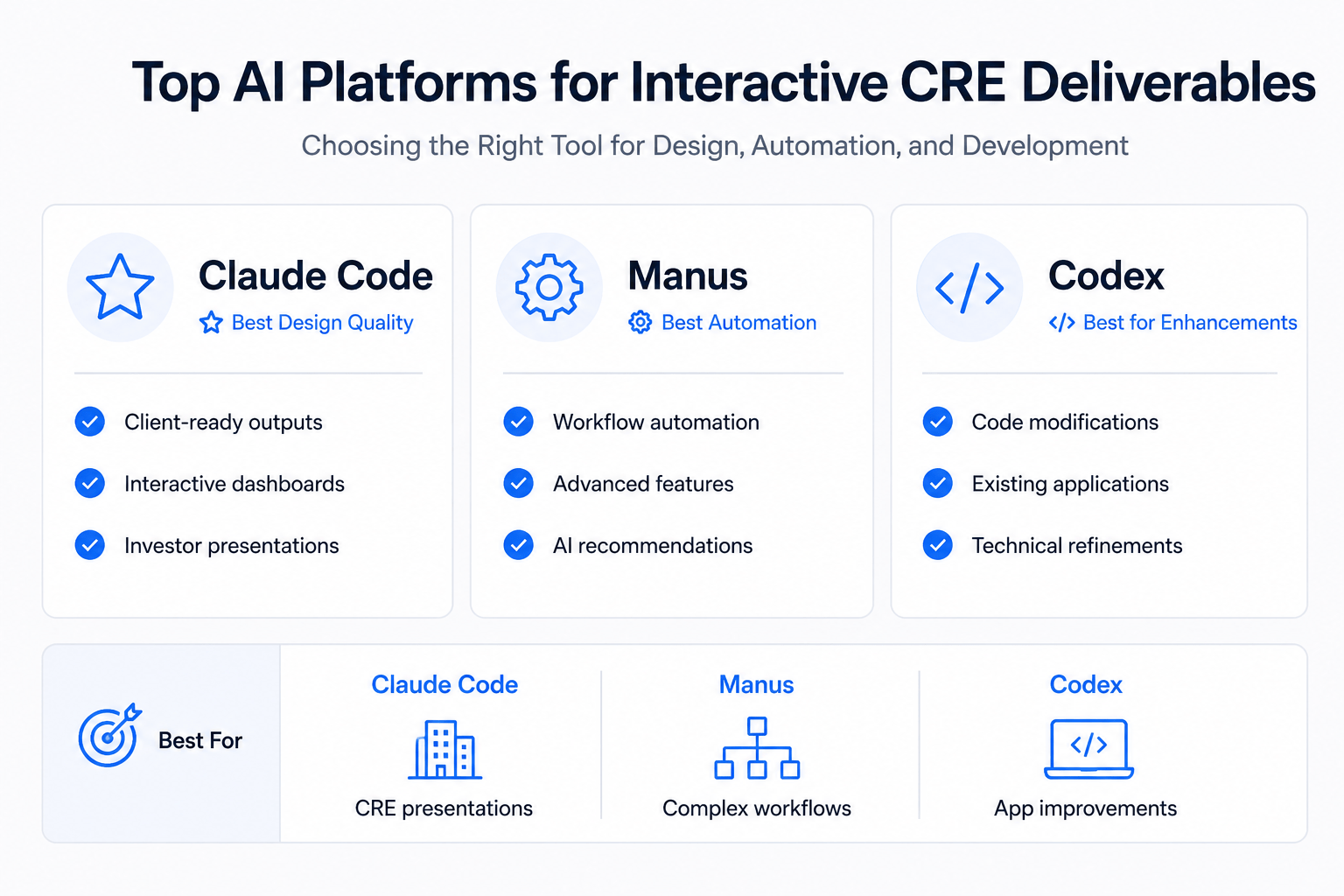
| Codex | Helpful for code modifications | Less reliable for complete projects | Existing project enhancements |
Claude Code
Claude Code currently delivers some of the most polished outputs available.
It performs particularly well when creating:
-
Investor presentations
-
BOV platforms
-
Marketing websites
-
Interactive dashboards
For many CRE professionals, it represents the best balance of quality and efficiency.
Manus
Manus focuses heavily on feature completeness.
It often produces deliverables containing:
-
Additional automation
-
Enhanced workflows
-
Expanded functionality
-
AI-generated recommendations
The tradeoff is that more testing is typically required.
Codex
Codex performs best when modifying existing applications. While capable, it is generally more useful for refinement than full project creation.
How to Build Interactive CRE Pitch Deliverables
The process is surprisingly straightforward. Most professionals can complete their first project within a few hours.
Step 1: Gather Source Materials
Start by collecting all relevant information.
Examples include:
-
Rent rolls
-
Financial statements
-
Offering memorandums
-
Market reports
-
Property photos
-
Investor presentations
The quality of your source materials directly affects the final deliverable.
Step 2: Define the Objective
Every deliverable should focus on one primary goal.
Examples include:
-
Win a listing
-
Raise capital
-
Secure a management contract
-
Attract buyers
-
Present a development opportunity
A clear objective improves the user experience.
Step 3: Create a Detailed Prompt
The prompt acts as the blueprint.
Include:
-
Audience description
-
Desired outcome
-
Required features
-
Design preferences
-
User experience goals
Strong prompts produce significantly better results.
Step 4: Generate the Deliverable
Upload the prompt and supporting documents. The AI platform will process the information and begin creating the experience.
Depending on complexity, this may take anywhere from a few minutes to half an hour.
Step 5: Verify All Data
This step cannot be skipped.
Review:
-
Financial calculations
-
Charts
-
Assumptions
-
Maps
-
Tax projections
AI remains imperfect.
Human oversight is essential.
Step 6: Publish and Present
Once finalized:
-
Add security controls
-
Publish the deliverable
-
Schedule a walkthrough
-
Gather feedback
This helps maximize engagement and conversion.
What Features Should Every Interactive Deliverable Include?
Not every project requires advanced functionality. However, several features consistently improve results.
Recommended Feature Matrix
| Feature | BOV | LP Pitch | Management Proposal | Development Pitch |
|---|---|---|---|---|
| Interactive Valuation | Yes | No | No | Yes |
| Scenario Analysis | Yes | Yes | Yes | Yes |
| Interactive Maps | Yes | Yes | Yes | Yes |
| Financial Models | Yes | Yes | Yes | Yes |
| AI Chatbot | Optional | Recommended | Optional | Optional |
| Timeline Visualization | Yes | Optional | Yes | Yes |
Executive Summary
Every deliverable should begin with a concise overview.
Prospects should understand:
-
The opportunity
-
The objective
-
The recommended action
Within the first few minutes.
Scenario Analysis
This is often the most valuable feature. Users should be able to test assumptions and see results instantly. This dramatically improves engagement.
Mobile Optimization
Many users will access deliverables on mobile devices.
Ensure that:
-
Navigation is intuitive
-
Load times are fast
-
Charts remain readable
-
Buttons function properly
Mobile performance matters.
Common Mistakes to Avoid
Many professionals overcomplicate their first projects. That usually creates more problems than benefits.
Trying to Build Everything at Once
A simple deliverable often outperforms a complex one.
Start with:
-
One objective
-
A few key features
-
Clear navigation
Then expand over time.
Ignoring User Experience
Users should not need instructions. Navigation should feel intuitive. If prospects become confused, engagement drops.
Failing to Verify Calculations
AI can generate impressive experiences. However, calculations still require review.
Always verify:
-
NOI
-
Cap rates
-
Returns
-
Tax estimates
Accuracy remains critical.
Overloading the Design
Too many charts, widgets, and features create distraction. Focus on clarity. Simple experiences generally perform better.
Pricing and Cost Comparison
One of the biggest advantages of AI-generated deliverables is affordability. What once required large budgets can now be produced at a fraction of the cost.
| Approach | Timeline | Typical Cost |
|---|---|---|
| Agency Development | 3–6 Weeks | $15,000–$50,000 |
| Internal Team | 2–3 Weeks | $5,000–$15,000 |
| AI Agent Workflow | 20–30 Minutes | $20–$100 |
This allows smaller firms to compete with much larger organizations. Presentation quality is no longer limited by budget.
The Future of Interactive CRE Presentations
The trend toward interactive experiences is accelerating. Client expectations continue to rise.
Meanwhile, AI development continues to improve.
Several factors are driving adoption:
-
Faster creation times
-
Lower costs
-
Better user experiences
-
Increased transparency
-
Greater accessibility
Today, interactive deliverables provide differentiation. Within a few years, they may become the industry standard.
The firms adopting them now will likely have a meaningful competitive advantage.
Turn Interactive Deliverables Into a Competitive Advantage
Interactive CRE Pitch Deliverables are more than a technology trend. They represent a shift in how commercial real estate professionals communicate opportunities, build trust, and win business. Whether you are pursuing listings, raising capital, marketing properties, or securing management contracts, interactive experiences help prospects understand value faster and engage more deeply with your analysis.
If you want practical examples, proven workflows, and real-world implementation strategies, join the AI for CRE Collective. More than 600+ CRE professionals are actively testing AI tools on live deals and sharing what works. To stay ahead of emerging CRE technology trends and receive actionable insights, subscribe to the newsletter and learn how top professionals are using AI to improve results.
Conclusion
Commercial real estate has always been a relationship-driven industry. However, the way professionals present information is changing rapidly. Static PDFs and traditional slide decks are no longer the only option.
Interactive deliverables give prospects the ability to explore assumptions, analyze scenarios, and engage directly with opportunities. As a result, they create stronger trust, better transparency, and faster decision-making.
Perhaps most importantly, the barriers to adoption have largely disappeared. AI-powered tools now allow brokers, investors, developers, and operators to create experiences that would have required significant budgets only a few years ago.
The opportunity is available today. The technology is accessible. The competitive advantage belongs to those who start first.
FAQs Regarding Interactive Deliverables for CRE
1. What are interactive deliverables in commercial real estate?
Interactive deliverables are digital presentations, dashboards, websites, and web applications that allow users to engage with commercial real estate data instead of simply viewing static information. They are commonly used for listing presentations, investment pitches, development proposals, and property marketing campaigns.
-
Allow users to adjust assumptions and view results instantly
-
Improve engagement compared to traditional PDFs
-
Help prospects understand opportunities through hands-on exploration
Conclusion: Interactive deliverables transform passive presentations into engaging decision-making tools.
2. Why are interactive CRE pitch deliverables better than traditional PDFs?
Interactive CRE pitch deliverables provide a more engaging and transparent experience than static PDFs because users can explore data, test assumptions, and analyze scenarios in real time. This helps prospects gain confidence in the information being presented.
-
Increase user engagement and time spent reviewing materials
-
Provide greater transparency through live calculations
-
Reduce the need for multiple follow-up meetings
Conclusion: Interactive deliverables create stronger engagement and often accelerate decision-making.
3. How do brokers use interactive deliverables to win listing assignments?
Brokers use interactive deliverables to present Broker Opinion of Value reports, marketing plans, and valuation analyses in a more compelling format. Property owners can explore assumptions, review comparable properties, and test different scenarios.
-
Showcase expertise through interactive market analysis
-
Demonstrate valuation assumptions transparently
-
Differentiate from competitors using static presentations
Conclusion: Interactive deliverables help brokers stand out and build trust with property owners.
4. Can interactive deliverables help raise capital for commercial real estate projects?
Yes, interactive deliverables can significantly improve fundraising efforts by allowing investors to review returns, projections, and risk scenarios through a dynamic digital experience.
-
Present investment opportunities more clearly
-
Enable investors to test return assumptions
-
Improve transparency throughout the due diligence process
Conclusion: Interactive presentations can make fundraising more efficient and investor-friendly.
5. What features should be included in an interactive CRE presentation?
The most effective interactive CRE presentations focus on helping users understand key information quickly while allowing them to explore deeper details when needed.
-
Executive summary and investment highlights
-
Interactive financial models and calculators
-
Maps, charts, and scenario analysis tools
Conclusion: The best presentations combine clear storytelling with useful interactive features.
6. How much does it cost to build an interactive CRE deliverable?
Costs vary based on complexity and the tools used. AI-powered platforms have dramatically reduced the cost of creating professional-quality interactive experiences.
-
AI-generated projects may cost less than $100
-
Internal development teams may spend thousands of dollars
-
Agency-built solutions can cost tens of thousands
Conclusion: Interactive deliverables are now affordable for firms of almost any size.
7. Are interactive deliverables secure enough for confidential deal information?
Interactive deliverables can be highly secure when proper hosting, password protection, and access controls are implemented. Security should always be a priority when sharing sensitive information.
-
Use private hosting environments
-
Restrict access with passwords and permissions
-
Review all uploaded data before publishing
Conclusion: Properly configured interactive deliverables can safely handle confidential CRE information.
8. Which AI tools are best for creating interactive CRE pitch deliverables?
Several AI tools can create interactive CRE experiences, but each has different strengths depending on the desired outcome and level of complexity.
-
Claude Code excels at polished client-facing presentations
-
Manus often produces feature-rich deliverables
-
Codex can assist with customization and code improvements
Conclusion: The best platform depends on whether design quality, functionality, or customization is the priority.
9. Will interactive deliverables replace offering memorandums and pitch decks?
Interactive deliverables are becoming increasingly popular, but traditional offering memorandums and pitch decks still have a place in commercial real estate workflows.
-
Many firms use both formats together
-
Some investors still prefer downloadable documents
-
Interactive tools provide a more engaging first impression
Conclusion: Interactive deliverables are likely to complement and gradually replace many traditional presentations.
10. What is the future of interactive deliverables in commercial real estate?
The future of interactive deliverables is closely tied to advances in artificial intelligence, automation, and data visualization technologies. Adoption is growing rapidly across the industry.
-
More firms are experimenting with AI-powered presentations
-
User expectations continue to increase
-
Interactive experiences are becoming easier to create
Conclusion: Interactive deliverables are positioned to become a standard tool for commercial real estate professionals over the next several years.