9 Distress Signals That Surface Off-Market CRE Deals
Most off-market deals don’t show up in your inbox. They show up in public records, court filings, and a small set of data sources that most investors simply don’t track consistently. This is where cre distress signal sourcing creates a real advantage.
Instead of reacting to listings, you identify early signs of distress before a property ever reaches the market. That shift from reactive to proactive is what separates average deal flow from consistent off-market opportunities.
I recently built an automated weekly prospecting workflow for distressed retail in Los Angeles. On a typical run, it surfaces around 193 properties. These are not listed assets. These are early signals.
Below are the 9 distress signals that consistently uncover off-market CRE deals, why each one matters, and how to use them effectively, whether you’re sourcing manually or running an AI-driven system.
Why Distress Signals Matter for CRE Sourcing
The investors who win off-market deals are not waiting for brokers to send opportunities. They are tracking problems before those problems become issues.
Distress is a leading indicator.
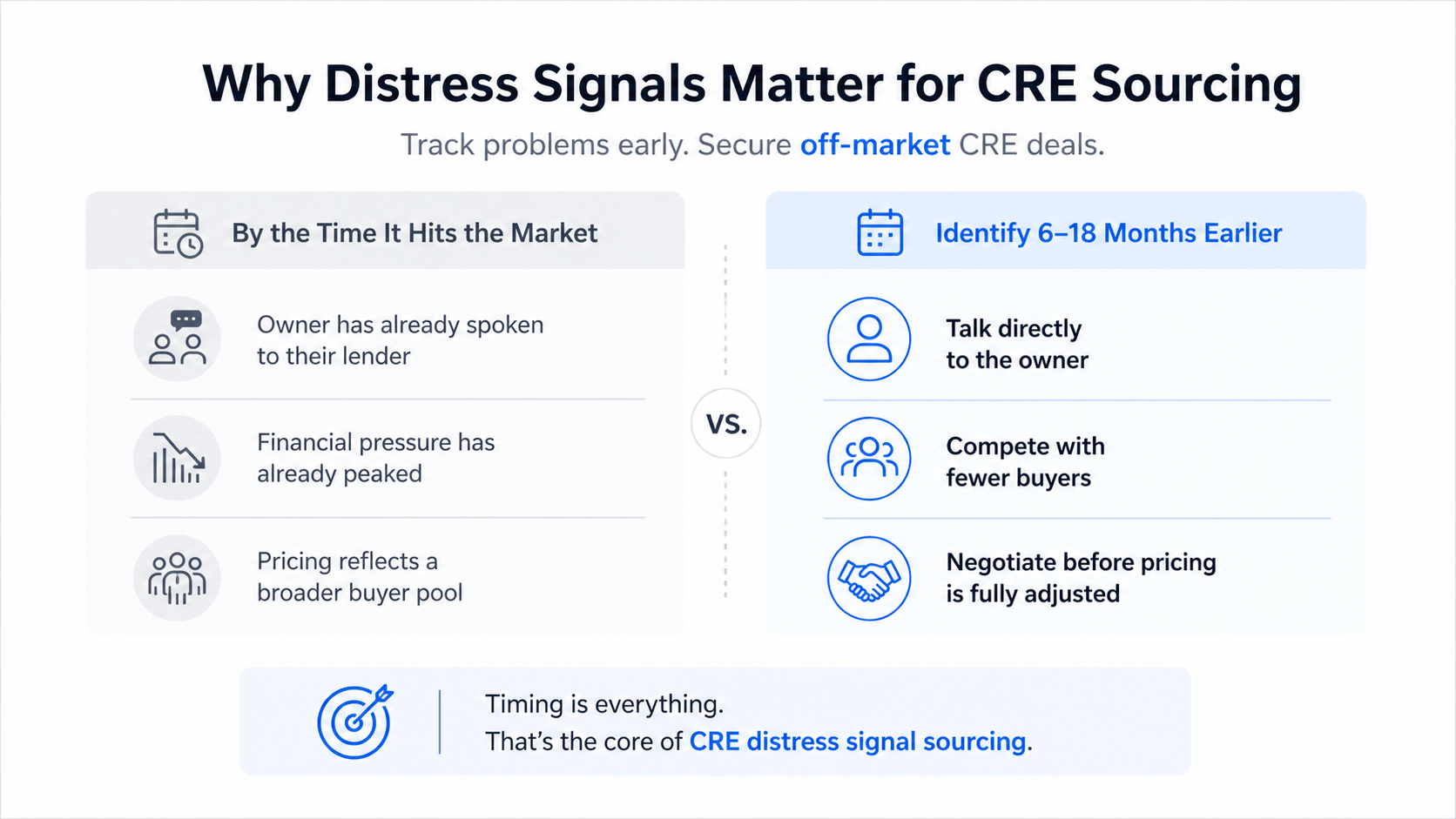
By the time a property hits the market:
-
The owner has already spoken to their lender
-
Financial pressure has already peaked
-
Pricing reflects a broader buyer pool
However, if you identify that same asset 6 to 18 months earlier, the dynamic changes completely.
You are:
-
Talking directly to the owner
-
Competing with fewer buyers
-
Negotiating before pricing is fully adjusted
That timing advantage is the core of cre distress signal sourcing.
The 9 Distress Signals
Each of these signals represents a different type of pressure. Individually, they are useful. Combined, they create a powerful sourcing system.
1. Tax Delinquency
Tax delinquency is one of the cleanest and most actionable distress signals. Property tax records are public and easy to track. When an owner falls behind for multiple years, it typically indicates deeper financial issues.
In a recent Los Angeles dataset:
-
74 properties surfaced from tax delinquency alone
-
Several had over $150,000 in unpaid taxes
This level of pressure rarely resolves without a major decision, often a sale. For example, if you want to go deeper into how to systematically find these opportunities, this guide on how to find distressed properties with AI breaks down the exact workflow step-by-step.
2. Code Enforcement and Permit Violations
Open violations signal deferred maintenance or lack of capital.
These issues tend to escalate over time:
-
Fines increase
-
Repair costs grow
-
Compliance pressure builds
Owners often reach a point where selling becomes more attractive than fixing the problem.
These are early-stage signals that often appear before any broker involvement.
3. Probate Filings
Probate creates one of the most predictable sale scenarios in CRE.
When ownership transfers after death:
-
Heirs typically want liquidity
-
Operational expertise is limited
-
Emotional attachment is low
This leads to faster, cleaner transactions often off-market.
4. Divorce and Dissolution Filings
Real estate tied to partnerships or marriages frequently becomes a liquidation asset during disputes.
In these cases:
-
Speed becomes more important than price
-
Decision-making is forced
-
Ownership alignment disappears
These conditions create motivated sellers with a clear need to exit.
5. Vacant and Dark Retail
Vacancy is one of the most visible distress signals.
Empty retail spaces mean:
-
Lost income
-
Ongoing operating costs
-
Increased leasing risk
Dark big-box stores, vacant restaurants, and empty strip units all indicate cash flow disruption.
These properties often transition into off-market opportunities before formal listing.
6. Out-of-State and Absentee Owners
Absentee ownership reduces engagement.
These owners:
-
Visit the property less frequently
-
Have weaker local relationships
-
Often rely on third-party management
Over time, this increases the likelihood of sale, especially when combined with other distress signals.
7. Legacy and Long-Term Hold Ownership
Owners holding assets for 20+ years often face a different type of pressure.
Their challenges are not operational; they are strategic:
-
Tax exposure
-
Estate planning
-
Succession decisions
Many of these owners are not actively selling, but they are open to the right conversation.
These are some of the most overlooked opportunities in cre distress signal sourcing.
8. Anchor Tenant Departures and SBA Defaults
Losing an anchor tenant fundamentally changes a property’s economics.
It impacts:
-
Occupancy
-
Valuation
-
Financing stability
SBA loan defaults add another layer of pressure.
In one dataset:
-
Over 40 properties were flagged through SBA defaults alone
These are high-priority leads with immediate financial stress.
9. Loan Maturities
Loan maturities create forced decision points.
In a higher-rate environment:
-
Refinancing becomes difficult
-
Debt service increases
-
Equity requirements rise
Not all owners can meet new terms. Many choose to sell instead.
While full data often requires paid platforms like Trepp, even partial visibility provides a meaningful edge.
Distress Signal Comparison
| Signal | Type of Pressure | Strength | Timing Advantage |
|---|---|---|---|
| Tax Delinquency | Financial | High | Early |
| Code Violations | Operational | Medium | Early |
| Probate | Ownership | High | Early |
| Divorce | Ownership | High | Immediate |
| Vacancy | Cash Flow | High | Immediate |
| Absentee Owner | Behavioral | Medium | Medium |
| Legacy Ownership | Strategic | Medium | Early |
| SBA Default | Financial | High | Immediate |
| Loan Maturity | Financial | High | Medium |
How to Track These Signals Without Burning Your Week
Tracking these signals manually across one market is already time-intensive. Across multiple markets, it becomes unsustainable.
This is where automation becomes essential. If you want to see how this actually works in practice, this live demo walks through how AI can automate CRE prospecting from start to finish.
AI tools can:
-
Monitor public records
-
Pull structured datasets
-
Aggregate signals into a single list
-
Run on a weekly schedule
Instead of manual tracking, you receive a fresh pipeline automatically.
However, there is an important limitation: AI can only access what is publicly available unless connected to paid data sources.
This means:
-
Public records → fully automatable
-
Loan-level data → partially restricted
Even with that limitation, the system captures the majority of high-value signals.
What to Do With the List
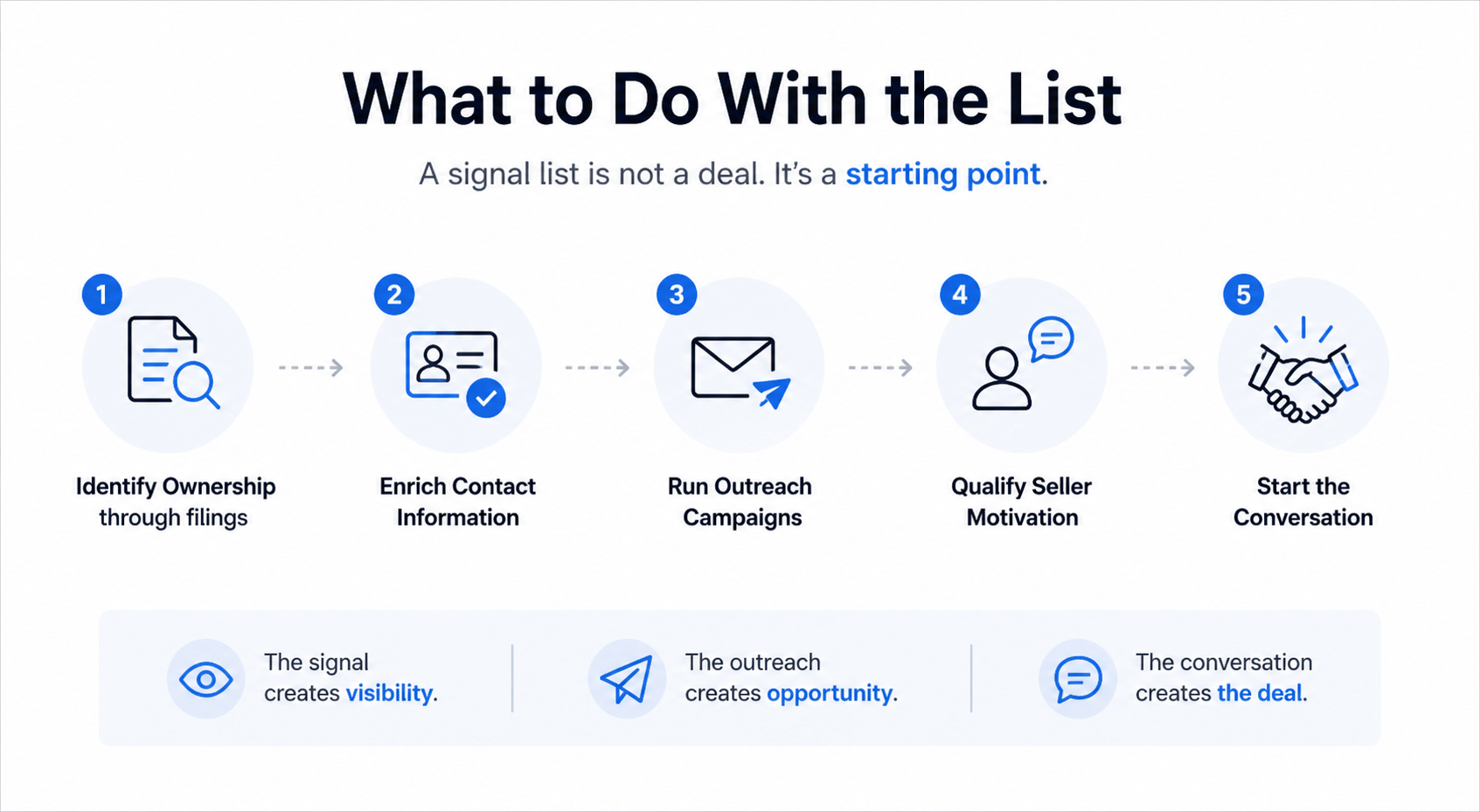
A signal list is not a deal. It is a starting point.
Execution determines results.
The next steps include:
-
Identifying ownership through filings
-
Enriching contact information
-
Running outreach campaigns
-
Qualifying seller motivation
The signal creates visibility. The outreach creates opportunity. The conversation creates the deal.
Building a Repeatable CRE Sourcing System
The real advantage is consistency.
Instead of running isolated searches, you build a system that continuously surfaces opportunities.
With strong cre distress signal sourcing, you:
-
Control your pipeline
-
Reduce dependence on brokers
-
Create proprietary deal flow
This is where long-term advantage is built.
Conclusion
Off-market deals are not hidden. They are simply overlooked.
The investors who find them early are not relying on luck. They are tracking signals.
Each distress indicator represents a moment where ownership is under pressure. When you combine those signals into a system, you create a consistent source of opportunities.
That is the power of cre distress signal sourcing.
Build a Smarter Off-Market Pipeline
The difference between average deal flow and consistent opportunity is the process. Inside the AI for CRE Collective, you’ll see how 600+ CRE professionals are building systems like this to source deals earlier and more efficiently.
If you want to move beyond manual prospecting and build a repeatable pipeline, this is where it starts. Instead of chasing listings, you can create your own deal flow. The next step is simple: subscribe to the newsletter and start applying these workflows immediately.
FAQs Regarding CRE Distress Signal Sourcing
1. What is cre distress signal sourcing in commercial real estate?
Cre distress signal sourcing is the process of identifying early indicators of financial or operational stress in properties before they are listed for sale.
-
Uses public records, filings, and data sources
-
Focuses on early-stage signals like tax delinquency or vacancy
-
Helps investors find off-market opportunities
Conclusion: It allows investors to identify deals before competition enters the market.
2. Why is cre distress signal sourcing more effective than waiting for listings?
It gives investors access to opportunities before they become widely known.
-
Reduces competition from other buyers
-
Creates direct access to property owners
-
Allows negotiation before pricing is optimized
Conclusion: Early access creates better pricing and stronger negotiating leverage.
3. What are the most important distress signals to track?
Some signals carry stronger predictive value than others.
-
Tax delinquency and loan defaults indicate financial stress
-
Vacancy and tenant loss show income disruption
-
Probate and divorce filings indicate ownership transitions
Conclusion: Financial and ownership-related signals typically provide the strongest deal opportunities.
4. How often should you track distress signals in CRE markets?
Consistency is critical for success in sourcing.
-
Weekly tracking is ideal for active markets
-
Monthly tracking may work for smaller markets
-
Real-time monitoring provides the best advantage
Conclusion: Regular tracking ensures you catch opportunities before they are widely known.
5. Can cre distress signal sourcing be automated with AI?
Yes, many parts of the process can be automated effectively.
-
AI can monitor public records and filings
-
It can aggregate and organize data into lead lists
-
Scheduled workflows can run without manual input
Conclusion: Automation significantly reduces effort while increasing deal flow consistency.
6. What are the limitations of AI in distress signal sourcing?
AI is powerful but not complete on its own.
-
Cannot access certain paid data sources without integration
-
May miss nuanced context behind ownership situations
-
Requires validation before outreach
Conclusion: AI improves efficiency, but human judgment is still required.
7. What should you do after identifying distressed properties?
Finding signals is only the first step in the process.
-
Identify and verify ownership details
-
Enrich contact information
-
Begin outreach through multiple channels
-
Qualify seller motivation
Conclusion: Execution after sourcing determines whether a lead becomes a deal.
8. How does cre distress signal sourcing create a long-term advantage?
It builds a consistent and proprietary deal pipeline.
-
Reduces reliance on brokers and listings
-
Creates repeatable sourcing systems
-
Improves deal quality over time
Conclusion: A structured sourcing system compounds results and strengthens your competitive edge.