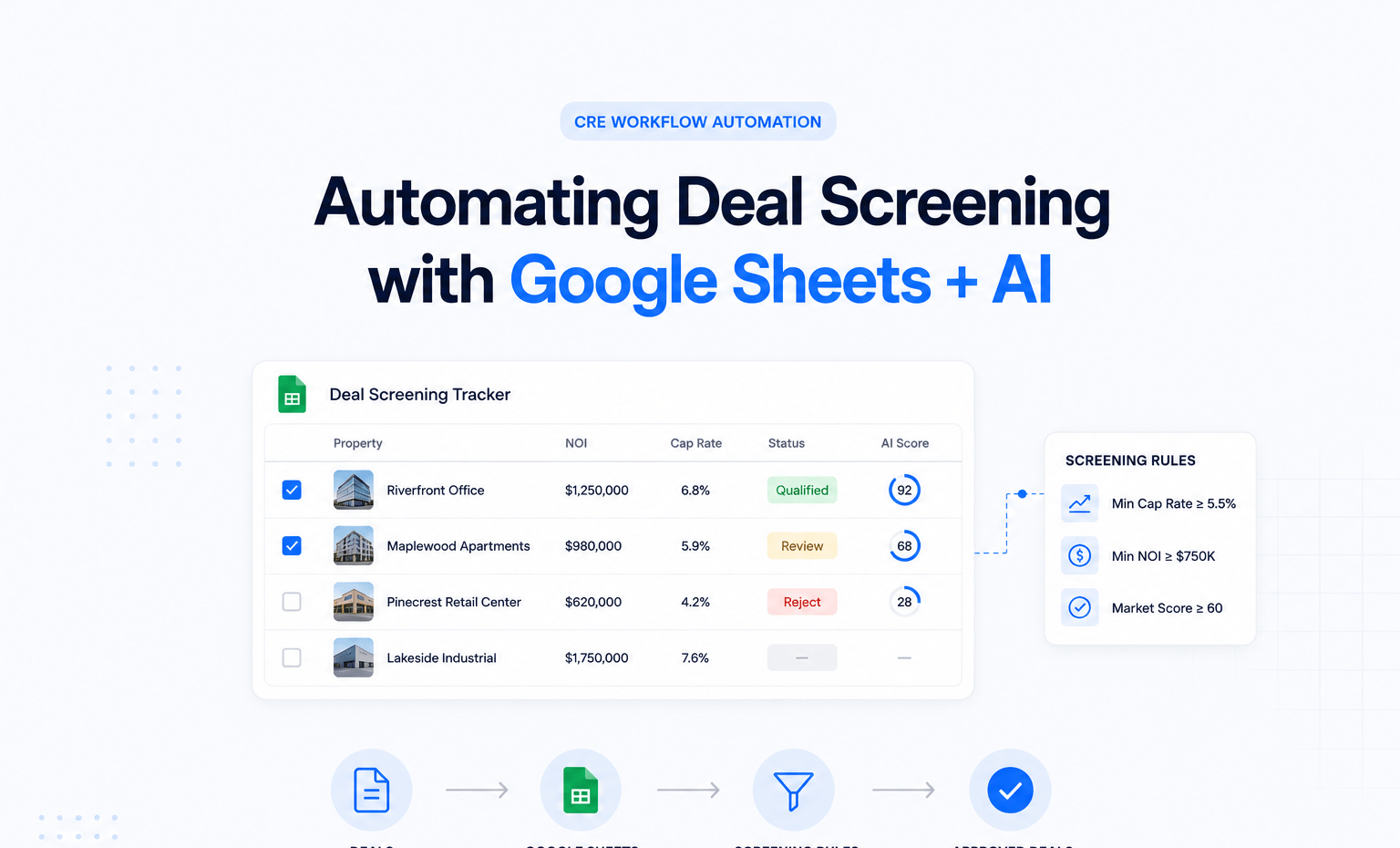
Automating deal screening with Google Sheets + AI
If you spend hours reviewing property leads, spreadsheets, broker emails, and offering memorandums, you are not alone. Many commercial real estate professionals still rely on manual processes to evaluate opportunities. The problem is that deal volume keeps growing while available time does not.
This is where automated deal screening can make a real difference.
Instead of opening every file, checking every number, and manually comparing opportunities, you can build a system that reviews deals automatically. With Google Sheets and AI, brokers, investors, analysts, and developers can identify strong opportunities in minutes instead of hours.
The goal is not to replace human judgment. The goal is to eliminate repetitive work so you can focus on decisions that actually matter.
For example, imagine receiving twenty property opportunities in a week. Rather than reviewing each one manually, an automated system can:
-
Extract important property data
-
Calculate key investment metrics
-
Flag deals that meet your criteria
-
Highlight potential risks
-
Rank opportunities automatically
As a result, you spend more time analyzing the best deals and less time sorting through the wrong ones.
The good news is that building an automated deal screening workflow no longer requires a software development team. Most CRE professionals can create a practical system using tools they already know.
Google Sheets serves as the database and workflow hub. AI handles data extraction, summaries, classifications, and analysis. Together, they create a simple but powerful process that scales as deal volume increases.
In this guide, you will learn exactly how the process works, which tools are worth using, and how to build a practical workflow that fits into your existing acquisition process.
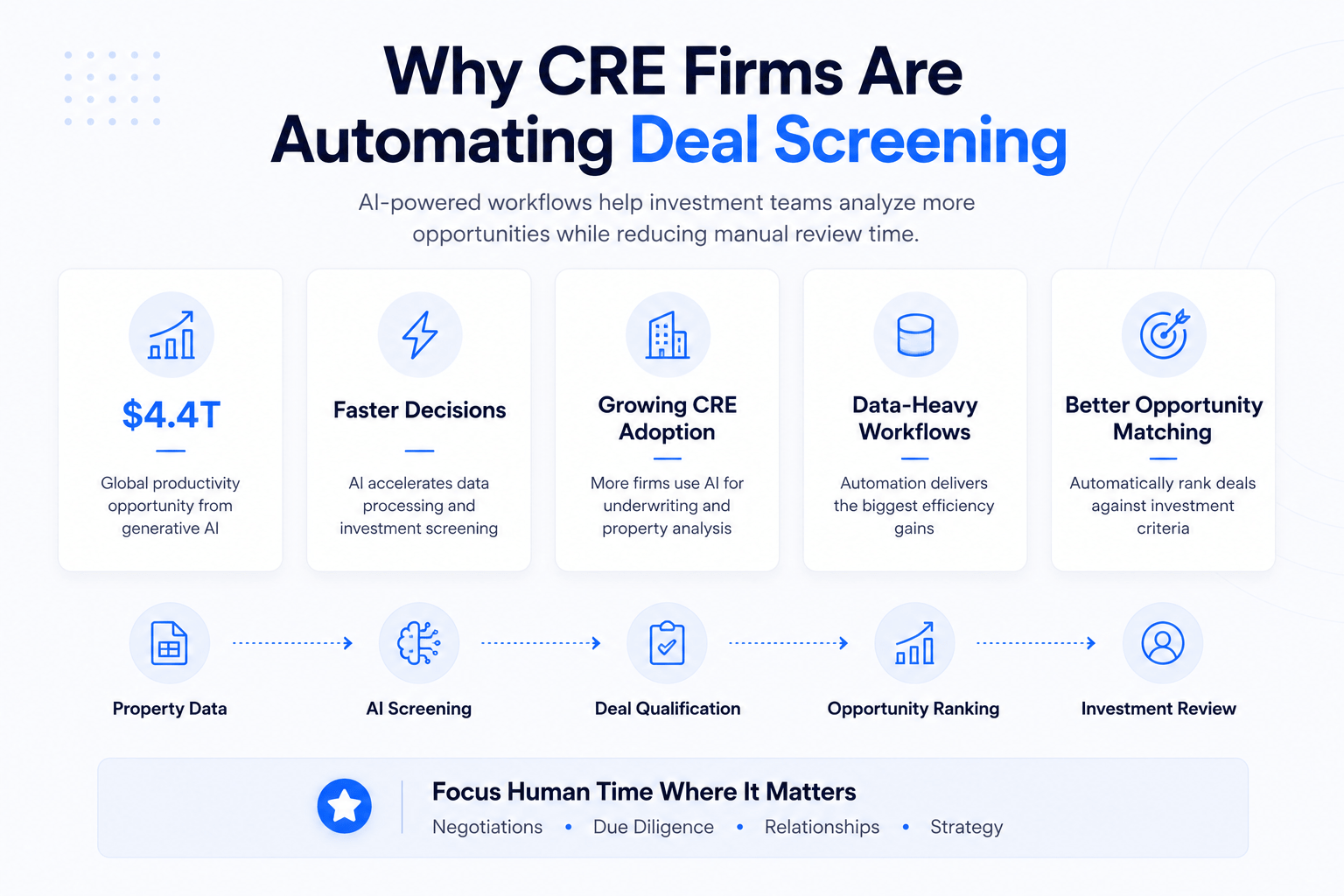
Key AI & CRE Productivity Statistics
The adoption of AI across business functions continues to grow, especially in industries that depend heavily on data analysis and decision-making.
Here are several important statistics that show why CRE firms are investing in automation:
-
McKinsey estimates generative AI could add up to $4.4 trillion annually in productivity gains globally.
-
Deloitte reports AI adoption continues to increase across operational and analytical business functions.
-
PwC research shows AI can significantly improve workforce productivity and decision speed.
-
Commercial real estate firms increasingly use AI for underwriting, market research, and property analysis.
-
Data-heavy workflows often experience the largest efficiency gains from automation technologies.
These trends matter because automated deal screening sits directly at the intersection of data processing, workflow automation, and investment analysis.
When hundreds of property records, rent rolls, financial statements, and broker emails need review, AI can help organize information much faster than traditional methods.
However, successful implementation depends on building the right workflow. Not every process should be automated. Not every AI tool delivers meaningful results. The firms seeing the biggest gains focus on repetitive screening tasks first.
Those tasks typically include:
-
Lead qualification
-
Property data collection
-
Initial underwriting
-
Market data aggregation
-
Investment criteria matching
-
Opportunity ranking
Once these activities become automated, teams can focus on negotiation, relationship building, due diligence, and strategic decisions. That is where the real value appears.
What Is Automated Deal Screening?
Automated deal screening is the process of using technology to evaluate potential investment opportunities before a human performs a detailed review.
Think of it as a first-pass filter. Instead of reviewing every property manually, software evaluates opportunities based on predefined rules and criteria.
The system then identifies which deals deserve further attention.
In commercial real estate, this process often includes:
-
Purchase price analysis
-
Cap rate calculations
-
Cash flow evaluation
-
Market comparisons
-
Property type classification
-
Investment criteria matching
-
Risk identification
Traditionally, analysts performed these tasks manually. Today, AI can complete many of them automatically. For example, a broker email arrives with a new multifamily opportunity.
An automated deal screening workflow can:
-
Read the email.
-
Extract property information.
-
Populate a Google Sheet.
-
Calculate investment metrics.
-
Compare the deal against the acquisition criteria.
-
Assign a score.
-
Notify the team if the deal qualifies.
The result is a faster and more consistent review process.
Manual Screening vs Automated Screening
Comparison of Traditional and Automated Deal Screening Processes
| Task | Manual Process | Automated Process |
|---|---|---|
| Data Entry | Manual input | Automatic extraction |
| Property Classification | Human review | AI categorization |
| Metric Calculations | Spreadsheet formulas | Automated calculations |
| Deal Ranking | Manual comparison | AI scoring system |
| Screening Speed | Hours per deal | Minutes per deal |
| Consistency | Varies by analyst | Standardized rules |
| Scalability | Limited | High |
| Error Risk | Higher | Lower |
The biggest benefit is not speed alone. Consistency often becomes even more valuable. When multiple analysts review opportunities manually, screening standards can vary.
One person may prioritize the cap rate. Another may focus on market growth. A third may emphasize occupancy. An automated deal screening workflow applies the same criteria every time. That creates cleaner data and more reliable decision-making.
Want to see what automated deal screening looks like in practice? This live demonstration shows how an AI-powered deal screener can evaluate opportunities and rank deals in seconds.
Common CRE Data Used in Automated Screening
Most screening workflows evaluate a combination of financial, operational, and market information.
Typical inputs include:
Property Information
-
Property type
-
Square footage
-
Year built
-
Unit count
-
Occupancy rate
Financial Metrics
-
Asking price
-
NOI
-
Cap rate
-
Rent growth
-
Operating expenses
Market Factors
-
Population growth
-
Employment trends
-
Vacancy rates
-
New construction activity
Investment Criteria
-
Target markets
-
Asset classes
-
Return requirements
-
Risk tolerance
-
Portfolio strategy
AI can collect, organize, and evaluate much of this information automatically. That is why more acquisition teams are adopting automated deal screening as a standard part of their workflow.
Why Google Sheets Works So Well for Automated Deal Screening
Many CRE professionals assume they need expensive software to implement automated deal screening. In reality, Google Sheets is often the best starting point.
Most teams already use spreadsheets for underwriting, acquisition tracking, and pipeline management. That means there is almost no learning curve.
More importantly, Google Sheets connects easily with AI tools, APIs, automation platforms, and data sources. You can start simple and gradually add more automation over time.
Benefits of Using Google Sheets as Your Screening Hub
Google Sheets provides several advantages for CRE workflows:
-
Familiar interface
-
Low implementation cost
-
Easy collaboration
-
Cloud-based access
-
Real-time updates
-
Flexible formulas
-
Strong integration options
Unlike specialized software, Sheets allows you to customize the workflow around your investment criteria rather than adapting your process to a vendor’s platform. For many acquisition teams, that flexibility is a major advantage.
What Google Sheets Can Automate
A properly configured spreadsheet can handle much more than basic calculations.
Examples include:
-
Property intake
-
Deal scoring
-
Data validation
-
Lead tracking
-
Investment ranking
-
Market comparisons
-
Pipeline management
-
Team collaboration
When AI is added to the process, capabilities expand significantly.
For example, AI can:
-
Read broker emails
-
Summarize offering memorandums
-
Extract financial data
-
Categorize opportunities
-
Flag potential risks
-
Generate investment summaries
This combination makes automated deal screening both practical and affordable.
Typical Workflow Architecture
Most successful CRE screening systems follow a simple structure.
Step 1: Data Collection
Information enters the system from:
-
Broker emails
-
Property listing platforms
-
Offering memorandums
-
CRM records
-
Internal databases
Step 2: AI Data Extraction
AI identifies key information such as:
-
Asset type
-
Purchase price
-
NOI
-
Occupancy
-
Location
-
Cap rate
Step 3: Google Sheets Processing
The spreadsheet:
-
Stores deal with data
-
Calculates metrics
-
Applies formulas
-
Scores opportunities
-
Ranks investments
Step 4: Decision Layer
Qualified opportunities are:
-
Flagged for review
-
Assigned to team members
-
Sent to acquisition managers
-
Added to active pipelines
This structure creates a repeatable, automated deal screening process that can scale as deal volume grows.
Building Your Automated Deal Screening Workflow
The best workflows are often the simplest. Many CRE professionals make the mistake of overbuilding from day one.
Instead, start with one clear objective:
“Can this system identify good deals faster than my current process?”
If the answer is yes, then additional automation can come later.
Step 1: Define Your Investment Criteria
Before adding AI, determine exactly what qualifies as a good opportunity. Without clear criteria, automation becomes ineffective.
Create a screening framework that includes:
| Screening Category | Example Criteria |
|---|---|
| Asset Type | Multifamily, Industrial |
| Market | Target MSAs Only |
| Purchase Price | $2M–$25M |
| Cap Rate | Minimum 6% |
| Occupancy | Above 90% |
| NOI Growth | Positive Trend |
| Year Built | After 1990 |
| Risk Level | Moderate |
These criteria become the foundation of your automated deal screening system.
Step 2: Create a Central Deal Database
Your Google Sheet should function as a single source of truth.
Include columns for:
-
Deal name
-
Property address
-
Market
-
Asset type
-
Asking price
-
NOI
-
Occupancy
-
Cap rate
-
Deal source
-
Screening score
-
Review status
Avoid collecting unnecessary information. Focus only on metrics that influence investment decisions.
Step 3: Build Automated Scoring Rules
Scoring helps prioritize opportunities.
Instead of reviewing every deal equally, the system ranks them automatically.
For example:
-
Cap rate above target = +10 points
-
Occupancy above 95% = +10 points
-
Preferred market = +15 points
-
Strong rent growth = +10 points
-
Outside target market = -15 points
A total score can quickly separate high-priority opportunities from weaker ones.
This is one of the most valuable parts of automated deal screening because it creates consistency across every opportunity.
Step 4: Add Conditional Alerts
Once scores are calculated, set rules that trigger notifications.
Examples include:
-
Score above 80
-
NOI exceeds target
-
New opportunity in the preferred market
-
Cap rate above threshold
These alerts help acquisition teams react faster when strong opportunities appear.
Step 5: Track Outcomes
Many firms stop after automation is implemented.
That is a mistake.
Track:
-
Deals reviewed
-
Deals qualified
-
Deals underwritten
-
LOIs submitted
-
Deals closed
This data helps determine whether your automated deal screening process is improving actual investment performance.
AI Tools That Work Well With Google Sheets
Not every AI tool fits a CRE workflow. Some are designed for content creation rather than data analysis. Others promise automation but require extensive setup. The best tools typically focus on practical workflow improvements.
ChatGPT
Useful for:
-
Property summaries
-
OM analysis
-
Data extraction
-
Deal scoring recommendations
-
Investment memo drafts
Strengths:
-
Flexible
-
Easy to use
-
Strong reasoning capabilities
Limitations:
-
Requires workflow design
-
May need validation for financial calculations
Claude
Useful for:
-
Long document reviews
-
Offering memorandum analysis
-
Lease abstraction
-
Investment summaries
Strengths:
-
Handles large documents well
-
Strong contextual understanding
Limitations:
-
Limited direct workflow automation
Zapier
Useful for:
-
Workflow automation
-
Email processing
-
CRM integration
-
Spreadsheet updates
Strengths:
-
Easy integrations
-
No-code setup
Limitations:
-
Costs increase with volume
Make
Useful for:
-
Advanced automation
-
Multi-step workflows
-
AI integrations
Strengths:
-
Highly flexible
-
Strong automation capabilities
Limitations:
-
Slightly steeper learning curve
The most effective automated deal screening systems often combine Google Sheets, AI models, and workflow automation platforms rather than relying on a single tool.
Real-World Example of Automated Deal Screening in CRE
Understanding the theory is useful. However, seeing the process in action makes implementation much easier.
Let’s walk through a realistic example. Imagine a multifamily investment firm receives 40 property opportunities every week.
Before implementing automated deal screening, analysts manually reviewed every broker email, entered property details into spreadsheets, calculated metrics, and ranked opportunities.
The process required:
-
Several hours per day
-
Multiple team members
-
Frequent data entry errors
-
Inconsistent screening standards
The firm decided to automate the first stage of deal evaluation.
Before Automation
The old workflow looked like this:
-
Broker sends property email.
-
Analyst opens attachments.
-
Property details entered manually.
-
Metrics calculated manually.
-
Deal compared against investment criteria.
-
Team reviews qualified opportunities.
Average screening time:
-
20–30 minutes per deal
-
Approximately 15–20 hours weekly
As deal volume increased, bottlenecks became obvious. Strong opportunities sometimes sat untouched for days.
After Automation
The new workflow used:
-
Gmail
-
Google Sheets
-
AI extraction tools
-
Workflow automation software
The process became:
-
Broker email arrives.
-
AI extracts property information.
-
Google Sheets updates automatically.
-
The screening score calculates instantly.
-
Qualified deals receive alerts.
-
Team reviews only top-ranked opportunities.
Average screening time:
-
Less than 5 minutes per deal
-
Approximately 3–5 hours weekly
The firm reduced manual review time significantly while increasing consistency. This is exactly where automated deal screening creates value.
The goal is not to replace analysts. The goal is to ensure analysts spend time on the best opportunities. For example, if your team reviews dozens of opportunities each week, this guide on how to screen multiple CRE deals at once with AI shows a practical workflow for ranking and prioritizing opportunities automatically.
Before vs After Productivity Comparison
Impact of Automated Deal Screening on Acquisition Workflows
| Metric | Before Automation | After Automation |
|---|---|---|
| Weekly Deals Reviewed | 40 | 40 |
| Manual Data Entry | High | Minimal |
| Average Review Time | 20–30 Minutes | Under 5 Minutes |
| Analyst Hours Weekly | 15–20 Hours | 3–5 Hours |
| Screening Consistency | Moderate | High |
| Error Rate | Higher | Lower |
| Response Speed | Delayed | Near Real-Time |
| Opportunity Visibility | Limited | Complete |
The biggest improvement was not speed. It was visibility. Every opportunity entered the same process and received the same evaluation standards.
Common Mistakes When Building Automated Deal Screening Systems
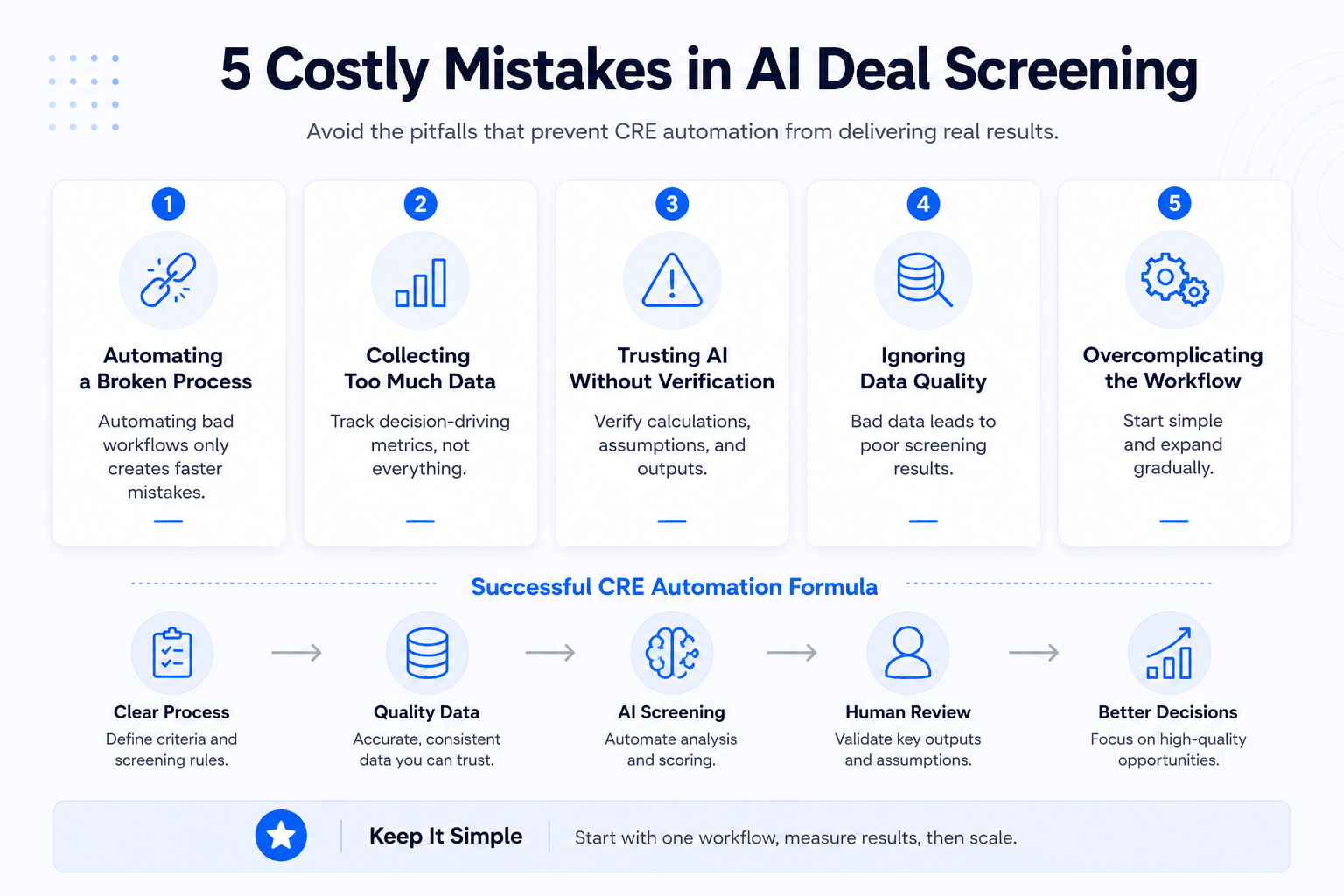
Many CRE teams adopt AI tools but fail to achieve meaningful results. Usually, the technology is not the problem. The workflow design is. Here are the most common mistakes.
Automating a Broken Process
Automation does not fix poor workflows. If the acquisition criteria are unclear, AI will simply process bad inputs faster.
Before implementing automated deal screening, define:
-
Target markets
-
Asset classes
-
Return requirements
-
Risk thresholds
-
Deal scoring rules
Good automation starts with good processes.
Collecting Too Much Data
Many teams try to track everything. This creates unnecessary complexity. Instead, focus on the information that influences decisions.
Examples include:
-
NOI
-
Cap rate
-
Occupancy
-
Purchase price
-
Rent growth
-
Market location
If a metric rarely impacts investment decisions, remove it. Simple systems are easier to maintain.
Trusting AI Without Verification
AI is powerful. It is not perfect.
Always validate:
-
Financial calculations
-
Extracted numbers
-
Market assumptions
-
Property classifications
Think of AI as an analyst assistant rather than a final decision-maker. Human review remains important.
Ignoring Data Quality
Even the best automated deal screening workflow depends on accurate information. Poor inputs create poor outputs.
Regularly review:
-
Spreadsheet formulas
-
Imported data
-
Source accuracy
-
Integration performance
Data quality directly affects screening quality.
Overcomplicating the Workflow
Some firms build systems with dozens of automations before proving value. This often creates maintenance problems.
A better approach:
-
Start simple
-
Automate one process
-
Measure results
-
Expand gradually
Most successful CRE AI implementations begin with a small workflow that solves one clear problem.
What Most CRE Professionals Get Wrong About AI
AI adoption is growing quickly. However, many misconceptions still exist. These misunderstandings often prevent firms from getting real value.
AI Does Not Replace Investment Expertise
One common misconception is that AI makes investment decisions. It does not. AI can process information. It can identify patterns. It can organize data.
The investment team still determines whether a deal is worth pursuing. The best automated deal screening systems combine human expertise with machine efficiency.
More Automation Is Not Always Better
Some professionals assume every process should be automated. That approach rarely works. Certain activities still benefit from human judgment.
Examples include:
-
Negotiations
-
Relationship management
-
Investment committee decisions
-
Strategic planning
-
Final underwriting reviews
Automation works best for repetitive tasks.
AI Is Only Valuable for Large Firms
This belief is becoming outdated. Many modern tools are affordable. Small teams often benefit the most because they have limited resources.
A two-person acquisition team can achieve significant productivity gains through automated deal screening without hiring additional staff.
AI Is Not Just About Saving Time
Time savings matter. However, consistency often delivers greater value.
A standardized process:
-
Reduces bias
-
Improves visibility
-
Creates better reporting
-
Supports scaling
Those benefits continue long after implementation.
How to Implement Automated Deal Screening in 24 Hours
Many professionals assume automation projects take weeks. A basic version can often be built in a single day.
Morning: Define Screening Criteria
Create clear acquisition requirements.
Include:
-
Asset type
-
Market selection
-
Pricing thresholds
-
Cap rate requirements
-
Occupancy targets
This becomes the foundation of the workflow.
Midday: Build the Google Sheet
Create columns for:
-
Property name
-
Market
-
Asset type
-
Purchase price
-
NOI
-
Occupancy
-
Cap rate
-
Deal score
-
Status
Keep the structure simple.
Afternoon: Add AI and Automation
Connect:
-
Email inbox
-
AI extraction tool
-
Google Sheets
Automate:
-
Data capture
-
Metric calculations
-
Opportunity scoring
End of Day: Test the Process
Run several recent opportunities through the system.
Check:
-
Data accuracy
-
Scoring logic
-
Alerts
-
Reporting
Make adjustments where necessary.
By the end of the day, most teams can have a functioning automated deal screening workflow that immediately reduces manual work and improves deal visibility.
Future Trends in Automated Deal Screening
The current generation of automated deal screening tools already saves time and improves consistency. However, the next few years will bring even more capabilities to CRE acquisition teams.
The firms that start building workflows today will be in a stronger position as AI tools continue to improve. The goal is not to chase every new technology. Instead, focus on understanding where the industry is heading and which tools can create practical value.
AI-Powered Deal Ranking Will Become More Sophisticated
Today’s systems typically rely on predefined rules.
For example:
-
Cap rate above 6%
-
Occupancy above 90%
-
Preferred market
-
Target asset class
Future systems will evaluate opportunities using broader datasets.
These may include:
-
Historical portfolio performance
-
Market trends
-
Economic indicators
-
Rent growth forecasts
-
Competitive property data
As a result, automated deal screening will become more predictive rather than simply rule-based.
Instead of identifying deals that match criteria, AI may help estimate which opportunities have the highest probability of meeting investment objectives.
Market Intelligence Will Be Integrated Automatically
Many acquisition teams currently gather market data manually.
This often involves reviewing:
-
Census reports
-
Economic data
-
Local news
-
Brokerage research
-
Industry publications
Future workflows will automatically pull this information into screening models.
For example, a property submitted for review could automatically receive:
-
Population growth scores
-
Employment growth metrics
-
Housing demand indicators
-
Market risk assessments
This creates a more complete picture during the early screening phase.
AI Agents May Handle Initial Deal Reviews
AI agents are becoming increasingly capable.
In CRE, future systems may:
-
Review broker emails
-
Analyze offering memorandums
-
Extract financial information
-
Evaluate investment criteria
-
Produce acquisition summaries
Rather than simply moving data between systems, these tools may perform preliminary analysis independently. However, human oversight will remain critical.
The best use case is helping teams evaluate more opportunities without increasing headcount.
Portfolio-Level Screening Will Improve
Many investors currently evaluate deals individually. Future systems will likely assess opportunities against existing portfolio performance.
Questions may include:
-
Does this deal improve diversification?
-
Does it increase concentration risk?
-
Does it support a long-term strategy?
-
Does it improve projected returns?
This could make automated deal screening more strategic rather than purely operational.
Conclusion
Commercial real estate professionals face an ongoing challenge. Deal volume continues to grow, but time remains limited. Manually reviewing every opportunity is no longer practical for many acquisition teams.
That is why automated deal screening is becoming an increasingly important part of modern CRE workflows.
By combining Google Sheets with AI, firms can:
-
Reduce repetitive work
-
Improve consistency
-
Evaluate opportunities faster
-
Standardize investment criteria
-
Scale acquisition processes efficiently
The most successful implementations are usually the simplest. Start with clear investment criteria. Build a straightforward spreadsheet. Automate data collection. Add scoring rules.
Then, improve the workflow over time. You do not need a complex technology stack to see meaningful results. In many cases, a basic automated deal screening workflow can save hours every week while helping teams focus on the opportunities that matter most.
Ready to Put AI to Work in Your CRE Business?
Learning about AI is helpful. Implementing it successfully is where the real value comes from.
At AI for CRE Collective, we help commercial real estate professionals move beyond experimentation and build practical AI workflows that save time, improve productivity, and support better decision-making.
Inside our community, you’ll get access to:
-
CRE-specific AI workflows
-
A database of 600+ AI tools
-
Copy-and-paste prompt libraries
-
Step-by-step video tutorials
-
Live Q&A sessions
-
Real-world case studies
-
Training designed specifically for CRE professionals
Whether you’re a broker, investor, analyst, developer, or operator, you’ll find proven systems you can start using immediately.
Get practical AI tips and workflow ideas delivered to your inbox
Learn more about AI for CRE Collective
Common Questions About Automated Deal Screening
1. What is automated deal screening in commercial real estate?
Automated deal screening is the process of using software, spreadsheets, and AI tools to evaluate property opportunities before a detailed review takes place. Instead of manually analyzing every deal, the system collects information, applies investment criteria, calculates metrics, and identifies opportunities that deserve further attention.
Benefits include:
-
Faster deal evaluation
-
Consistent screening standards
-
Reduced manual data entry
-
Improved acquisition efficiency
-
Better visibility into deal flow
For CRE teams handling large volumes of opportunities, automated deal screening helps prioritize the most promising investments while reducing time spent on unqualified deals.
2. How does AI improve deal screening?
AI improves deal screening by processing large amounts of information quickly and consistently. It can extract data from broker emails, offering memorandums, rent rolls, and financial statements without requiring manual entry.
AI can also:
-
Summarize property information
-
Categorize opportunities
-
Identify missing data
-
Highlight potential risks
-
Score deals against investment criteria
This allows acquisition teams to focus on analysis and decision-making rather than repetitive administrative tasks.
3. Why is Google Sheets a good platform for deal screening?
Google Sheets remains one of the most practical platforms for deal screening because it is affordable, flexible, and easy to customize.
Advantages include:
-
Real-time collaboration
-
Cloud-based access
-
Simple integrations
-
Familiar interface
-
Powerful formulas
-
Automation compatibility
Many CRE professionals already use spreadsheets for underwriting and pipeline management, making Google Sheets a natural starting point for automation projects.
4. Can small real estate firms benefit from automated deal screening?
Yes. Small firms often benefit the most because they typically operate with limited staff and resources.
Automated deal screening can help smaller teams:
-
Review more opportunities
-
Reduce manual workload
-
Respond faster to deals
-
Maintain consistent evaluation standards
-
Scale operations without hiring additional analysts
Even a basic workflow can create meaningful productivity improvements for boutique investment firms and independent sponsors.
5. What information should be included in a deal screening model?
A strong screening model focuses on data that directly impacts investment decisions.
Common inputs include:
-
Property type
-
Purchase price
-
Net operating income
-
Cap rate
-
Occupancy rate
-
Market location
-
Rent growth
-
Asset age
-
Deal source
Keeping the model focused on essential metrics helps improve accuracy and simplifies ongoing maintenance.
6. How much time can automated deal screening save?
The amount of time saved depends on deal volume and workflow design.
Many acquisition teams reduce initial screening time from 20–30 minutes per opportunity to just a few minutes.
Time savings often come from:
-
Automated data collection
-
Instant calculations
-
Automated scoring
-
Faster reporting
-
Reduced spreadsheet work
Over time, these savings can add up to dozens of hours each month.
7. Does automated deal screening replace underwriting?
No. Automated deal screening is designed to support underwriting, not replace it.
The screening process helps identify which opportunities deserve detailed analysis. Once a deal qualifies, underwriters still perform:
-
Financial modeling
-
Due diligence
-
Risk assessment
-
Market evaluation
-
Investment recommendations
The goal is to reduce unnecessary work before full underwriting begins.
8. What AI tools are commonly used for deal screening?
Several AI tools can support commercial real estate acquisition workflows.
Popular options include:
-
ChatGPT
-
Claude
-
Google Gemini
-
Zapier
-
Make
-
Google Apps Script
Many firms combine multiple tools to create a complete workflow that automates data extraction, scoring, reporting, and notifications.
9. How accurate is AI for analyzing real estate opportunities?
AI can be highly effective when supported by accurate data and well-designed workflows. However, no system is perfect.
Accuracy depends on:
-
Data quality
-
Input consistency
-
Workflow design
-
Validation processes
Human oversight remains essential, especially when reviewing financial information and investment decisions.
10. What are the biggest benefits of automated deal screening?
The most significant benefits include improved efficiency and consistency.
Organizations often see:
-
Faster deal reviews
-
Better prioritization
-
Reduced manual work
-
Improved reporting
-
Higher productivity
-
Better use of analyst time
These improvements help acquisition teams focus on opportunities with the highest potential value.
11. Can automated deal screening work for multifamily properties?
Yes. Multifamily assets are among the most common property types used in automated screening systems.
Workflows can evaluate:
-
Unit counts
-
Occupancy levels
-
Rent growth
-
Expense ratios
-
NOI performance
-
Market trends
The same approach can also be adapted for industrial, retail, office, and mixed-use properties.
12. What mistakes should firms avoid when implementing AI workflows?
Many firms struggle because they automate unclear processes.
Common mistakes include:
-
Poor investment criteria
-
Inaccurate data sources
-
Overly complex workflows
-
Lack of validation
-
Excessive automation
Successful implementations usually start with simple, clearly defined processes.
13. How does automated deal scoring work?
Deal scoring assigns numerical values to opportunities based on investment criteria.
For example:
-
Preferred market = +15 points
-
Cap rate above target = +10 points
-
Occupancy above 95% = +10 points
-
Strong rent growth = +10 points
The final score helps acquisition teams prioritize which deals deserve immediate attention.
14. Can AI read offering memorandums automatically?
Yes. Modern AI tools can review offering memorandums and extract key information.
Common outputs include:
-
Property summaries
-
Financial metrics
-
Occupancy data
-
Rent information
-
Investment highlights
-
Potential concerns
This significantly reduces the time required to review marketing materials manually.
15. How often should the screening criteria be updated?
Most firms review screening criteria quarterly or whenever market conditions change significantly.
Updates may be required due to:
-
Interest rate changes
-
Market shifts
-
Portfolio strategy adjustments
-
New investment goals
-
Economic conditions
Regular reviews help ensure the system remains aligned with current acquisition objectives.
16. What role does automation play in commercial real estate acquisitions?
Automation helps eliminate repetitive tasks throughout the acquisition process.
Examples include:
-
Lead intake
-
Data collection
-
Property classification
-
Metric calculations
-
Reporting
-
Notifications
By automating these activities, teams can focus more on strategic decision-making and relationship building.
17. Is automated deal screening expensive to implement?
Not necessarily. Many workflows can be built using tools that firms already use.
A basic setup may require:
-
Google Sheets
-
AI software
-
Automation platform
-
Email integration
Compared to hiring additional staff or purchasing enterprise software, implementation costs can be relatively low.
18. How can brokers use automated deal screening?
Brokers can use automated screening to qualify opportunities before presenting them to clients.
Benefits include:
-
Faster property evaluation
-
Better opportunity matching
-
Improved client service
-
More organized pipelines
-
Reduced administrative work
This allows brokers to spend more time building relationships and closing transactions.
19. What metrics are most important during deal screening?
The most important metrics vary by investment strategy, but common examples include:
-
Cap rate
-
Net operating income
-
Occupancy rate
-
Purchase price
-
Cash flow
-
Rent growth
-
Market performance
The best screening models focus only on metrics that directly influence investment decisions.
20. What is the future of automated deal screening in CRE?
The future of automated deal screening will likely include more predictive analysis, deeper market intelligence, and greater workflow automation.
Emerging capabilities may include:
-
AI-powered investment recommendations
-
Automated market research
-
Portfolio optimization analysis
-
Predictive risk assessments
-
Advanced acquisition scoring
While technology will continue to improve, successful firms will still combine AI efficiency with human expertise and investment judgment.