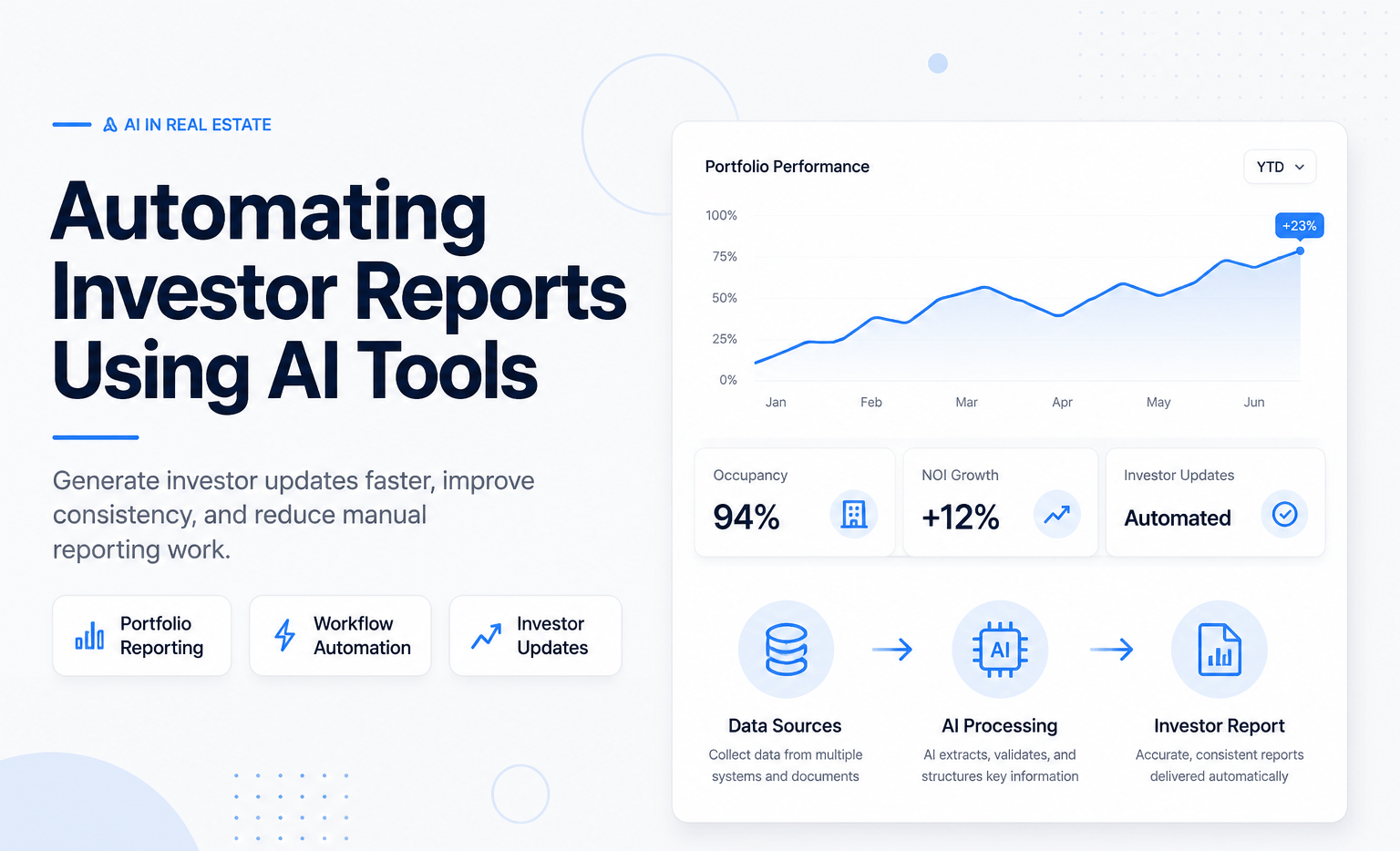
Investor reporting is one of the most important responsibilities in commercial real estate. Investors expect clear updates, accurate numbers, and timely communication. However, creating those reports often takes hours of manual work.
Many CRE teams still collect information from spreadsheets, property management systems, accounting software, emails, and market reports. Then someone must organize the data, write summaries, build charts, format documents, and send everything to investors. The process works, but it is slow. This is where AI investor reporting is changing the workflow.
Today, firms can use artificial intelligence to collect information, summarize performance, draft investor updates, and prepare reports much faster than before. Instead of spending days on repetitive reporting tasks, teams can focus more on asset performance, investor relationships, and business growth.
That does not mean AI replaces human expertise. Investors still expect professional judgment and accurate analysis. However, AI can remove much of the repetitive work that slows reporting teams down.
For CRE professionals, the goal is simple. Use technology to produce better reports in less time while maintaining quality and consistency.
In this guide, we will explain how AI investor reporting works, what can be automated, and how commercial real estate firms can begin implementing these systems today.
Several studies show why firms are investing heavily in automation and artificial intelligence.
McKinsey estimates generative AI could create up to $4.4 trillion in annual productivity gains across industries.
Knowledge workers can automate a significant portion of repetitive administrative tasks using AI tools.
Deloitte reports growing adoption of AI technologies across commercial real estate organizations.
Real estate firms continue to increase technology spending to improve operational efficiency and reporting processes.
Many organizations report measurable productivity improvements after implementing AI-powered workflows.
These findings highlight a growing trend. Teams are no longer using AI only for experimentation. They are using it to solve practical business problems.
Investor reporting is one area where the benefits can be seen quickly because reporting involves repetitive processes, large amounts of data, and recurring communication.
Table: Why AI Fits Investor Reporting
Reporting Requirement
Traditional Process
AI-Assisted Process
Data collection
Manual gathering from multiple sources
Automated data aggregation
Performance summaries
Written manually for each report
Drafted automatically using AI
Report formatting
Time-intensive document creation
Standardized templates and automation
Investor updates
Created each cycle individually
Generated consistently from workflows
Report distribution
Multiple manual steps
Automated delivery and scheduling
Data validation
Manual review and cross-checking
Faster review with AI assistance
Scalability
More reports require more staff time
Easily scales across larger portfolios
Reporting speed
Hours or days to complete
Minutes or a few hours
Consistency
Varies by team member
Standardized across reports
Focus of the team
Administrative reporting tasks
Analysis and investor relationships
For many CRE firms, reporting is repeated every month, quarter, and year. Because the process follows similar patterns, it becomes an ideal candidate for automation.
70%
Knowledge work activities can be automated with AI
$4.4T
Annual productivity opportunity from AI
60%
Time reduction in repetitive reporting tasks
24/7
Investor reporting availability with automation
Why Investor Reporting Takes So Much Time
Investor reports may look simple when finished. However, producing them requires many steps behind the scenes.
A typical report includes property performance, occupancy metrics, leasing activity, capital expenditures, market updates, financial summaries, and investment outlooks. Each section often comes from a different source.
⚠️
Data Collection
Most reporting delays start here.
⚠️
Portfolio Summaries
Repeated writing consumes hours.
⚠️
Formatting
Manual document preparation slows teams.
⚠️
Review Cycles
Multiple revisions create bottlenecks.
Data Is Spread Across Multiple Systems
Most firms do not keep all reporting information in one location. An asset manager may pull occupancy figures from a property management platform.
Financial data may come from accounting software. Leasing information might sit inside a CRM. Market updates often come from third-party research providers.
As a result, teams spend considerable time gathering information before report writing even begins.
Common data sources include:
Excel models
Property management software
CRM platforms
Accounting systems
Market research databases
Internal emails
Asset management reports
When information lives in multiple systems, reporting becomes slower and more prone to mistakes.
Manual Report Creation Creates Bottlenecks
After collecting data, someone still needs to build the report.
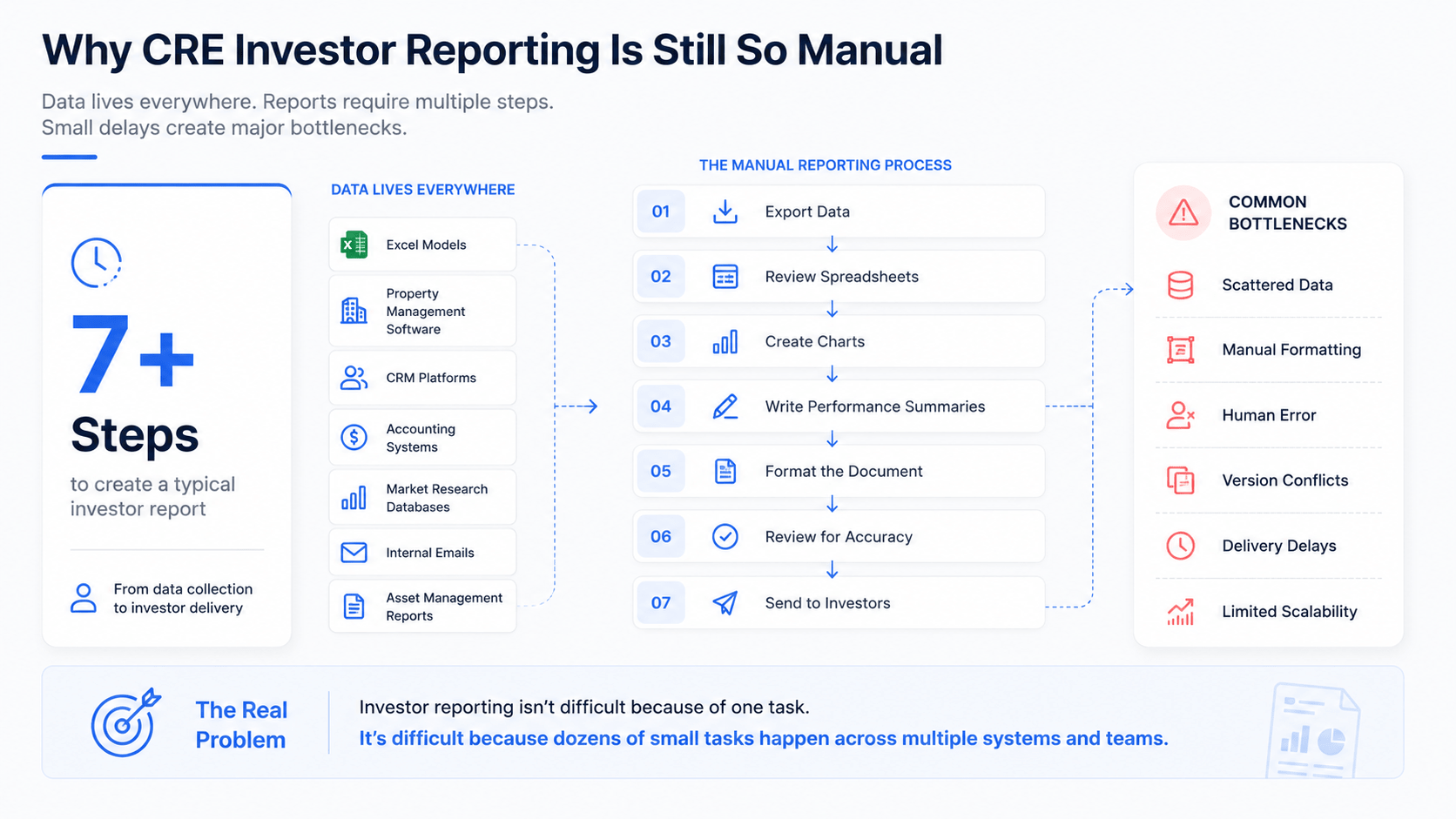
Many teams continue using a process that looks like this:
Export data.
Review spreadsheets.
Create charts.
Write performance summaries.
Format the document.
Review for accuracy.
Send to investors.
Each step may seem small on its own. Together, they can consume several hours or even days. The biggest challenge is often writing narrative sections. Investors want more than numbers. They want explanations.
For example, if occupancy increased, investors want to know why. If expenses rose, they expect context. If leasing activity slowed, they want to understand the market conditions behind the change.
Writing these summaries manually every reporting period requires significant effort.
Common Reporting Pain Points for CRE Teams
Many commercial real estate professionals experience similar reporting challenges.
Inconsistent Formatting
Different team members may prepare reports differently. This creates inconsistencies between reporting periods.
Human Error
Copying information between systems increases the risk of mistakes. Even small errors can damage investor confidence.
Version Control Problems
Multiple report versions often circulate between teams. Finding the latest version becomes difficult.
Delayed Delivery
Manual workflows frequently cause reporting deadlines to slip.
Limited Scalability
As portfolios grow, reporting demands increase. Yet reporting teams rarely grow at the same pace. These challenges explain why more firms are exploring AI investor reporting solutions.
The goal is not simply to reduce workload. The goal is to create a reporting process that remains accurate, consistent, and scalable as portfolios expand.
When implemented correctly, AI can help eliminate repetitive reporting tasks while allowing investment professionals to focus on higher-value activities such as portfolio strategy, acquisitions, asset management, and investor relationships.
The next step is understanding exactly which parts of investor reporting can be automated and where AI creates the greatest impact.
Commercial real estate investor reporting often requires gathering data from multiple systems, reviewing spreadsheets, creating charts, writing summaries, and formatting reports. This manual workflow increases the risk of errors, delays, and inefficiencies, making reporting difficult to scale as portfolios grow.
What AI Can Automate in Investor Reporting
Many CRE professionals hear about automation and assume AI can create an entire investor report without human involvement. That is not how most successful firms use it.
Instead, they automate specific tasks that consume the most time. The result is a faster reporting process while keeping human review and decision-making in place.
Today, AI investor reporting can help with data collection, report writing, performance summaries, investor communications, and presentation creation. When these tasks are combined into a workflow, reporting becomes much more efficient.
Data Collection
One of the biggest reporting challenges is gathering information from multiple systems.
AI-powered workflows can pull information from:
Property management software
Accounting platforms
CRM systems
Leasing databases
Market research sources
Internal spreadsheets
Instead of manually searching through different systems, teams can centralize reporting data automatically. This reduces preparation time and creates a more consistent reporting process.
Performance Summaries
Many investor reports include recurring performance discussions.
For example:
Occupancy changes
Revenue growth
Expense trends
Leasing activity
Capital improvement progress
AI can analyze data points and generate first drafts of these summaries. Rather than staring at a blank page, asset managers receive a structured draft that can be reviewed and refined.
This is often one of the fastest wins in AI investor reporting because report writing typically consumes several hours every reporting cycle.
Portfolio Updates
Investors want a clear understanding of portfolio performance.
AI can help create:
Property-level summaries
Portfolio-wide performance updates
Occupancy reports
Leasing highlights
Acquisition updates
Development progress reports
Instead of writing each property update from scratch, teams can generate standardized summaries using the same reporting framework. This improves consistency across portfolios.
Market Commentary
Market updates are another common section in investor reports. Traditionally, teams spend time reviewing reports from research providers and summarizing key trends.
AI can help by:
Extracting important findings
Summarizing market reports
Identifying notable trends
Drafting commentary sections
The final analysis should still be reviewed by experienced professionals, but AI can significantly reduce preparation time.
Market updates are often one of the most time-consuming sections of investor reporting. This walkthrough shows how CRE professionals automate recurring market reports using AI workflows.
Risk Analysis Summaries
Investors often want visibility into risks that could affect performance.
Examples include:
Rising interest rates
Vacancy increases
Construction delays
Regulatory changes
Market slowdowns
AI tools can organize information, identify recurring themes, and draft risk summaries that managers can review before distribution.
AI can draft these communications using approved templates and portfolio data. This helps teams maintain consistent messaging while reducing manual work.
Presentation Creation
Many investors prefer visual presentations alongside written reports.
AI tools can assist with:
Slide creation
Executive summaries
Performance highlights
Data visualization
Meeting preparation
Instead of building presentations from scratch, teams can generate a starting draft and make final adjustments.
Table: Investor Reporting Tasks AI Can Automate
Reporting Task
Manual Effort
AI Automation Potential
Data collection
High
High
Performance summaries
High
High
Portfolio updates
High
High
Investor email drafting
Medium
High
Market commentary
Medium
Medium
Risk analysis summaries
Medium
Medium
Presentation creation
High
High
Report formatting
High
High
Compliance review
High
Low
Investment decisions
High
Low
Investor relationship management
High
Low
The most successful firms automate repetitive tasks while keeping strategic decisions in human hands.
Data Collection
Report Drafting
Portfolio Updates
Market Commentary
Compliance Review
Step-by-Step Workflow for Automating Investor Reports Using AI Tools
A common mistake is trying to automate everything at once. Instead, firms should start with a simple workflow and improve it over time. The following process works for most commercial real estate organizations regardless of portfolio size.
Step 1 — Centralize Reporting Data
Before automation can work, reporting information must be organized.
Start by identifying:
Financial data sources
Property performance systems
Leasing databases
CRM platforms
Market research providers
Create a central reporting location where information can be accessed consistently.
Many firms use:
Airtable
Notion
Excel
Google Sheets
Data warehouses
The goal is simple. Create one source of truth.
Step 2 — Connect Data Sources
Once reporting data is organized, connect systems using automation tools.
Common options include:
Zapier
Make
Microsoft Power Automate
Native software integrations
These tools automatically move information between systems. As a result, reporting teams spend less time copying and pasting data.
Step 3 — Create Reporting Templates
Templates are critical for successful AI investor reporting.
Create standard templates for:
Monthly reports
Quarterly reports
Fund updates
Development reports
Investor presentations
Consistent templates improve report quality and simplify automation.
Step 4 — Generate Executive Summaries
After data is collected, AI can create first drafts of reporting narratives.
A typical prompt may include:
Portfolio performance metrics
Occupancy figures
Revenue changes
Leasing activity
Capital project updates
The output becomes a starting point for review rather than a finished report.
Step 5 — Build Charts and Dashboards
Visual reporting remains important.
AI-assisted tools can help create:
Occupancy charts
Revenue trends
Leasing pipelines
Portfolio dashboards
Capital expenditure tracking
Investors often understand performance faster through visuals than through long text sections.
Step 6 — Review and Verify Outputs
Human review remains essential.
Before distribution:
Verify numbers
Check calculations
Confirm assumptions
Review language
Validate charts
No AI system should send investor reports without approval.
Step 7 — Distribute Reports Automatically
After approval, reports can be delivered through automated workflows.
Examples include:
Email delivery
Investor portals
CRM systems
Reporting dashboards
This reduces administrative effort and helps maintain consistent reporting schedules.
Workflow Checklist
Before implementing an automated reporting process, confirm that you have:
Centralized reporting data
Standardized report templates
Approved AI prompts
Automation software connections
Review procedures
Investor delivery process
Security controls
Organizations that follow this process typically see results much faster than those trying to automate every reporting task immediately.
Best AI Tools for Investor Reporting
The market now offers hundreds of AI products. However, only a handful are practical for investor reporting workflows.
The best solution depends on your reporting process, portfolio size, and existing software stack. Most CRE firms do not use one tool for everything. Instead, they combine several tools to create an efficient workflow.
The goal is not to find the most advanced platform. The goal is to find tools that save time, improve consistency, and fit into existing operations.
As a result, many teams use the same workflows behind AI-powered investment memos to streamline investor reporting and portfolio communication.
ChatGPT
ChatGPT is one of the most widely used tools for report drafting.
It can help with:
Executive summaries
Investor updates
Market commentary
Portfolio summaries
Meeting preparation
Presentation content
Many CRE teams use it as a writing assistant rather than a complete reporting solution.
Claude
Claude performs particularly well with long documents.
It is useful for:
Quarterly reports
Fund updates
Research summaries
Large data reviews
Multi-property reporting
Because it can process large amounts of information, it works well when multiple property reports must be combined into one investor update.
Microsoft Copilot
Many real estate firms already operate inside Microsoft’s ecosystem.
Copilot integrates with:
Excel
Word
Outlook
PowerPoint
Teams
This makes it attractive for firms that want reporting automation without changing their existing software environment.
Gemini
Gemini is often useful for organizations heavily invested in Google Workspace.
It supports:
Google Docs
Sheets
Gmail
Drive
For smaller teams, this can create a relatively simple reporting workflow.
Zapier
Zapier is not a writing tool. It is an automation platform. It helps connect different systems together.
For example:
Move data from CRM systems into reporting databases.
Trigger report generation.
Send reports automatically.
Update dashboards.
Many successful AI investor reporting workflows rely on Zapier behind the scenes.
Notion AI
Notion AI works well for internal reporting systems.
Common uses include:
Internal reporting templates
Asset management notes
Reporting workflows
Team collaboration
Smaller firms often use Notion as a central reporting hub.
Airtable AI
Airtable combines database functionality with automation features.
This makes it useful for:
Property tracking
Reporting pipelines
Portfolio management
Data organization
For firms managing large amounts of information, Airtable can simplify reporting workflows significantly.
Long reports, portfolio summaries, document analysis
High
Excellent
Moderate
Microsoft Copilot
Microsoft-based reporting workflows
High
Excellent
Moderate
Gemini
Google Workspace reporting environments
Medium
Good
Moderate
Zapier
Workflow automation and system integrations
Very High
Limited
Moderate
Notion AI
Internal reporting systems and collaboration
Medium
Good
Low
Airtable AI
Data organization and reporting databases
High
Good
Moderate
Table Caption: Comparison of popular AI tools used in commercial real estate investor reporting workflows.
No single tool wins in every category.
Most CRE firms achieve the best results by combining:
A reporting database
An automation platform
A content generation tool
This approach creates a more flexible reporting system.
Before vs After AI Reporting Automation
One of the easiest ways to understand reporting automation is to compare the traditional process with an AI-assisted process. Most reporting teams spend substantial time on repetitive administrative work. The actual analysis often represents only a small portion of the overall effort.
Traditional Reporting Process
A traditional workflow usually includes:
Gathering information from multiple systems
Cleaning data
Updating spreadsheets
Writing summaries
Building charts
Formatting documents
Emailing reports
Each reporting cycle starts almost from the beginning. As portfolios grow, reporting demands grow as well.
AI-Assisted Reporting Process
An automated workflow changes how work is completed. Instead of manually repeating the same tasks every month or quarter, teams use predefined workflows.
AI can:
Pull information automatically
Generate first drafts
Populate templates
Build visual summaries
Assist with communication
Human review still happens, but much of the repetitive work disappears.
Benefits Beyond Time Savings
Most discussions about AI investor reporting focus on speed. However, other benefits are equally important.
These include:
Better consistency
Fewer manual errors
Improved scalability
Faster investor communication
More standardized reporting
As investor expectations continue increasing, these advantages become increasingly valuable.
Real-World CRE Use Cases
Investor reporting looks different across property types and investment strategies. However, the underlying process remains similar. The following examples show where AI can create practical value.
Quarterly Investor Updates
Quarterly reports are among the most common reporting requirements.
AI can help generate:
Executive summaries
Portfolio highlights
Leasing updates
Market observations
Property performance discussions
Instead of spending days preparing narratives, teams can generate first drafts within minutes.
Fund Performance Reports
Fund managers often report on:
Returns
Cash flow
Acquisitions
Dispositions
Portfolio growth
AI can organize performance information and create structured summaries that managers can review before distribution.
Development Project Reports
Development investors frequently require project updates.
These reports may include:
Construction progress
Budget tracking
Schedule updates
Leasing activity
Risk assessments
AI can summarize project information into a consistent reporting format.
Asset Management Reporting
Asset managers spend significant time preparing recurring updates.
Automation can help with:
Occupancy reporting
Revenue analysis
Leasing summaries
Capital expenditure reporting
This allows managers to spend more time improving asset performance.
Multifamily Portfolio Reporting
Multifamily investors often receive recurring operational updates.
AI can help summarize:
Occupancy trends
Rent growth
Lease renewals
Property improvements
Market conditions
Because these reports follow similar structures each month, they are well-suited for automation.
REIT Reporting Processes
Larger organizations often face even greater reporting demands.
AI can support:
Executive reporting
Portfolio summaries
Internal stakeholder updates
Investor communication workflows
While human oversight remains essential, automation can reduce administrative workload significantly.
Copy-Paste AI Prompts for Investor Reports
One reason firms struggle with AI implementation is poor prompting. The quality of outputs often depends on the quality of instructions. The following examples provide practical starting points.
Executive Summary Prompt
“Review the following portfolio performance data and create a professional executive summary for investors. Highlight major wins, challenges, occupancy trends, leasing activity, and overall portfolio performance.”
Portfolio Performance Prompt
“Analyze the provided portfolio metrics and summarize changes in occupancy, revenue, expenses, and net operating income. Explain key drivers behind the results.”
Market Commentary Prompt
“Review the market data below and create a concise investor-friendly summary explaining current market conditions and notable trends.”
Risk Analysis Prompt
“Evaluate the information below and identify key risks that may affect portfolio performance over the next quarter.”
Quarterly Update Prompt
“Create a quarterly investor update using the supplied portfolio information. Use a professional tone and focus on performance, operations, leasing, and outlook.”
LP Communication Prompt
“Draft an investor communication explaining recent portfolio developments and upcoming priorities.”
Development Progress Prompt
“Summarize the current development project status, including milestones achieved, budget updates, construction progress, and next steps.”
Investor Presentation Prompt
“Create slide content for an investor presentation covering portfolio performance, market trends, risks, opportunities, and future outlook.”
The best prompts are usually simple. Clear instructions often produce better outputs than long, complicated requests.
For example, if your team also prepares investor presentations alongside reports, our guide on AI-generated investor decks shows how to turn reporting data into polished presentation materials much faster.
What Most CRE Professionals Get Wrong About AI Reporting
Many organizations fail to achieve results because they approach automation incorrectly. Technology alone does not solve reporting problems. The underlying process must also be effective.
Expecting Fully Automated Reports
One common misconception is that AI can replace reporting teams. In reality, successful firms use AI to support professionals rather than replace them. Human judgment remains essential.
Ignoring Data Quality
Poor data leads to poor outputs. If source information is inaccurate, automation will simply produce inaccurate reports faster. Data quality should always come first.
Using Generic Prompts
Many teams receive disappointing results because prompts lack context.
Good prompts include:
Clear objectives
Reporting requirements
Audience expectations
Relevant data
More context generally produces better reports.
Skipping Human Review
Investor reports contain important financial information. Every report should be reviewed before distribution. This step remains critical regardless of how advanced the automation process becomes.
Automating Without Standard Processes
Some firms automate inefficient workflows. This creates faster inefficiency. Before implementing automation, standardize reporting procedures first. Once a process is documented and repeatable, automation becomes much easier and far more effective.
How to Implement AI Reporting in 24 Hours
Many CRE professionals assume reporting automation requires months of planning and expensive software. In reality, you can build a basic reporting workflow in a single day.
The goal is not to create a perfect system immediately. The goal is to eliminate repetitive work and establish a process that can improve over time. A simple reporting workflow can often save several hours during every reporting cycle.
Data Sources
↓
Automation Layer
↓
AI Draft Creation
↓
Human Review
↓
Investor Delivery
First 2 Hours: Identify Your Reporting Process
Start by documenting how reports are currently created.
List:
Data sources
Report templates
Team members involved
Manual tasks
Approval requirements
Many firms discover that most reporting time is spent on repetitive administrative work rather than analysis.
This exercise also helps identify the easiest automation opportunities.
Questions to answer:
Where does reporting data come from?
Who prepares reports?
Which tasks are repeated every month or quarter?
Which tasks require human judgment?
Which tasks follow the same process every time?
The answers become the foundation of your automation plan.
Hours 3–6: Organize Reporting Data
Next, centralize reporting information. Even the best AI tools struggle when data is scattered across multiple systems. Create a single location for reporting inputs.
Common options include:
Airtable
Excel
Google Sheets
Notion
Internal databases
Focus on organizing:
Occupancy metrics
Revenue figures
Expense data
Leasing activity
Capital project updates
Market information
The cleaner the data, the better the reporting output.
Hours 7–12: Build Templates and Prompts
Once information is organized, create reporting templates.
A typical investor report contains:
Executive summary
Property performance
Portfolio performance
Market commentary
Risk considerations
Outlook
Standardized templates make automation significantly easier.
At the same time, create prompt libraries for recurring reporting tasks.
Examples include:
Quarterly summaries
Leasing updates
Occupancy reviews
Market analysis
Investor communications
The same prompts can often be reused throughout the year with only minor changes.
Hours 13–24: Test and Refine
Run a complete reporting cycle using the new workflow. Start with one report.
Review:
Data accuracy
Narrative quality
Formatting consistency
Time savings
Investor readability
Do not focus on perfection. Focus on identifying areas for improvement. Most successful AI investor reporting systems improve gradually over several reporting cycles.
24-Hour Implementation Checklist
Before launching your workflow, confirm the following:
Reporting data is centralized
Templates are standardized
AI prompts are documented
Team responsibilities are clear
Review procedures exist
Security requirements are addressed
The distribution process is defined
Organizations that start small often achieve better long-term results than those attempting large-scale automation projects immediately.
Security, Compliance, and Investor Trust
Reporting automation creates efficiency, but it also introduces responsibility. Investor reports often contain sensitive information.
This may include:
Financial performance
Ownership structures
Investment returns
Capital plans
Development budgets
Investor information
Because of this, security should be considered from the beginning.
Protecting Sensitive Investor Data
Not all AI tools handle information the same way.
Before using any platform, review:
Data retention policies
Privacy controls
Security certifications
User permissions
Storage practices
Many organizations establish internal policies that define what information can and cannot be processed through AI tools. This reduces risk and improves consistency.
AI Governance Best Practices
Governance simply means creating rules for how AI is used. A basic governance framework should address:
Approved AI tools
Data handling procedures
User permissions
Review requirements
Compliance expectations
Clear guidelines help prevent confusion and reduce operational risk.
Review and Approval Workflows
Automation should never eliminate review procedures. Investor reports affect decisions, relationships, and credibility.
Before reports are distributed:
Verify calculations
Review narratives
Confirm assumptions
Check formatting
Validate supporting data
This process helps maintain confidence in reporting outputs.
Human-in-the-Loop Reporting
One of the most effective approaches is known as human-in-the-loop reporting.
Under this model:
AI assists with preparation.
Humans review outputs.
Final approval remains with professionals.
This balances efficiency and accountability. For most CRE firms, this approach delivers the best results. Investors benefit from faster reporting while still receiving expert analysis and oversight.
Future of AI-Powered Investor Reporting
Investor reporting will continue changing over the next several years. The biggest shift will not be faster report writing. It will be how information is delivered and consumed.
Real-Time Reporting
Many investors no longer want to wait for quarterly updates. They want visibility into portfolio performance throughout the year. As reporting systems become more connected, real-time reporting will become increasingly common.
Investors will have faster access to:
Occupancy data
Leasing activity
Revenue trends
Development updates
Portfolio performance
This reduces reporting delays and improves transparency.
AI Agents for Investor Relations
AI agents are becoming a major area of interest. Unlike traditional tools, agents can perform multiple tasks automatically.
Examples may include:
Gathering portfolio data
Preparing summaries
Drafting communications
Scheduling report delivery
Answering common investor questions
While adoption remains early, many firms are actively testing these capabilities.
Interactive Dashboards
Static PDF reports are unlikely to disappear completely. However, many investors increasingly prefer interactive dashboards.
These dashboards provide:
Live performance metrics
Custom reporting views
Portfolio comparisons
Trend analysis
AI can help generate insights directly from dashboard data.
Personalized Investor Updates
Different investors often focus on different metrics. Some care about income growth. Others focus on development progress. Some prioritize risk management.
Future reporting systems may automatically customize updates based on investor preferences. This creates a more relevant reporting experience.
Predictive Portfolio Reporting
Most reports describe what happened in the past. Future systems may place greater emphasis on what could happen next.
AI models can help identify:
Potential risks
Leasing trends
Revenue forecasts
Occupancy projections
Capital planning opportunities
These insights may help investors make more informed decisions. The future of AI investor reporting is not simply automation. It provides faster access to information, improved communication, and better decision-making.
Conclusion
Investor reporting remains one of the most important responsibilities in commercial real estate. Unfortunately, it is also one of the most time-consuming. Teams often spend hours collecting data, writing summaries, formatting documents, and preparing investor communications. As portfolios grow, these challenges become even greater.
This is why more firms are adopting AI investor reporting workflows. AI can help automate repetitive tasks such as data collection, performance summaries, portfolio updates, investor emails, and presentation creation. At the same time, professionals remain responsible for review, analysis, and decision-making.
The most successful firms are not replacing expertise with technology. They are using technology to support expertise. Start small. Standardize your reporting process. Automate repetitive work. Then, improve the workflow over time. The result is a reporting system that is faster, more consistent, and easier to scale as your portfolio grows.
Build Faster CRE Workflows With AI
Join CRE professionals using tested AI systems,
real-world workflows, prompt libraries, and live training.
AI investor reporting is the use of artificial intelligence to automate parts of the investor reporting process, including data collection, report writing, performance summaries, and investor communications.
In commercial real estate, AI helps teams gather information from multiple systems, generate draft reports, and create consistent updates faster. It does not replace human review. Instead, it reduces repetitive work so asset managers and investment professionals can focus on analysis, strategy, and investor relationships. Most firms use AI to support reporting workflows rather than fully automate them.
How can AI help create investor reports?
AI can help create investor reports by collecting data, generating summaries, drafting narratives, and assisting with report formatting.
For example, AI can summarize occupancy changes, leasing activity, revenue performance, and market trends. It can also generate executive summaries and investor communications. This reduces manual work and shortens reporting cycles. However, all reports should still be reviewed for accuracy before being shared with investors.
Can AI write quarterly investor updates?
Yes, AI can draft quarterly investor updates using performance data, operational metrics, and market information.
Most AI tools can create executive summaries, portfolio updates, leasing highlights, and outlook sections. The output serves as a first draft that reporting teams can review and refine. This often saves several hours compared to writing every update manually while maintaining consistency across reporting periods.
Which AI tool is best for investor reporting?
The best AI tool depends on your workflow and existing software systems.
ChatGPT is commonly used for report writing and investor communications. Claude performs well with long reports and large documents. Microsoft Copilot works well for firms using Excel, Word, and Outlook. Many organizations also use Zapier, Airtable, or Notion alongside AI writing tools to automate reporting workflows from start to finish.
How much time can AI save on investor reporting?
AI can significantly reduce the time required for repetitive reporting tasks.
Many CRE teams use AI to automate data gathering, report drafting, summary creation, and investor communications. While savings vary by organization, firms often report reducing reporting preparation time from several hours or days to a fraction of that effort. The biggest gains usually come from automating recurring reporting processes.
Is AI investor reporting accurate?
AI investor reporting can be highly accurate when supported by reliable data and human review.
AI generates content based on the information it receives. If source data contains errors, those errors may appear in the report. This is why successful firms use AI for drafting and automation while maintaining approval processes. Human oversight remains essential for verifying financial information and ensuring investor confidence.
Can AI analyze commercial real estate portfolio performance?
Yes, AI can analyze commercial real estate portfolio performance using operational and financial data.
It can identify occupancy trends, revenue changes, leasing activity, expense patterns, and property-level performance indicators. AI can also summarize findings into investor-friendly language. While AI assists with analysis, investment professionals should still interpret results and make final decisions based on business objectives.
What data can be used in AI investor reporting?
AI investor reporting can use information from property management software, accounting systems, CRM platforms, spreadsheets, and market research sources.
Common inputs include occupancy rates, rent collections, leasing activity, operating expenses, capital expenditures, development progress, and portfolio performance metrics. Centralized and organized data generally produces better reporting results and more reliable outputs.
Can AI create investor presentation slides?
Yes, AI can help create investor presentation slides by generating summaries, organizing information, and drafting slide content.
Many firms use AI to prepare quarterly review presentations, fund updates, development reports, and portfolio performance decks. AI can speed up preparation, but teams should still review visuals, numbers, and messaging before presenting information to investors.
What are the risks of using AI for investor reporting?
The biggest risks include inaccurate source data, insufficient review processes, privacy concerns, and overreliance on automation.
Organizations should establish clear approval workflows and security policies before implementing AI reporting systems. AI should support reporting teams rather than replace professional judgment. When used responsibly, these risks can be managed effectively.
How do CRE firms automate investor communications?
CRE firms automate investor communications by combining AI tools with workflow automation platforms.
Data is collected from internal systems, AI generates report content, and automation software distributes updates through email, investor portals, or reporting dashboards. This creates a more efficient communication process while improving consistency and reducing manual effort.
Can small real estate firms use AI investor reporting?
Yes, small real estate firms can implement AI investor reporting without large technology budgets.
Many affordable tools provide reporting automation capabilities. Small firms often begin with AI-generated summaries, standardized templates, and basic workflow automation. Starting with a simple process usually delivers faster results than attempting complex enterprise-level implementations.
Will AI replace investor relations professionals?
No, AI is unlikely to replace investor relations professionals.
Investor relationships depend on trust, communication, judgment, and strategic decision-making. AI can automate administrative tasks and reporting workflows, but investors still expect human expertise and personalized communication. Most firms use AI to improve productivity rather than replace relationship-focused roles.
How do you start implementing AI investor reporting?
The best way to start is by identifying repetitive reporting tasks and standardizing existing processes.
Most firms begin by centralizing reporting data, creating templates, building prompt libraries, and testing one reporting workflow. After proving success on a small scale, additional automation can be added gradually. This approach reduces risk and improves adoption.
What is the future of AI investor reporting?
The future of AI investor reporting includes real-time reporting, automated workflows, personalized investor updates, and AI-assisted portfolio analysis.
Future systems will likely combine reporting automation, dashboard technology, and predictive insights. Investors will gain faster access to information while firms benefit from more efficient reporting processes. Human oversight will remain important, but reporting workflows are expected to become increasingly automated over time.