How to Build an IC Memo with AI in 20 Minutes
Today, AI commercial IC memos are changing how acquisition teams operate. Instead of manually building presentations from scratch, CRE professionals can now create branded, data-rich investment committee memos in roughly 20 minutes using AI workflows, reusable templates, and underwriting integrations.
Across major CRE markets like Dallas, Miami, and Phoenix, firms are already testing AI-generated memo systems to evaluate more deals with smaller teams. The biggest advantage is not only speed. It is consistency, scalability, and cleaner investment communication.
What Are AI Commercial IC Memos?
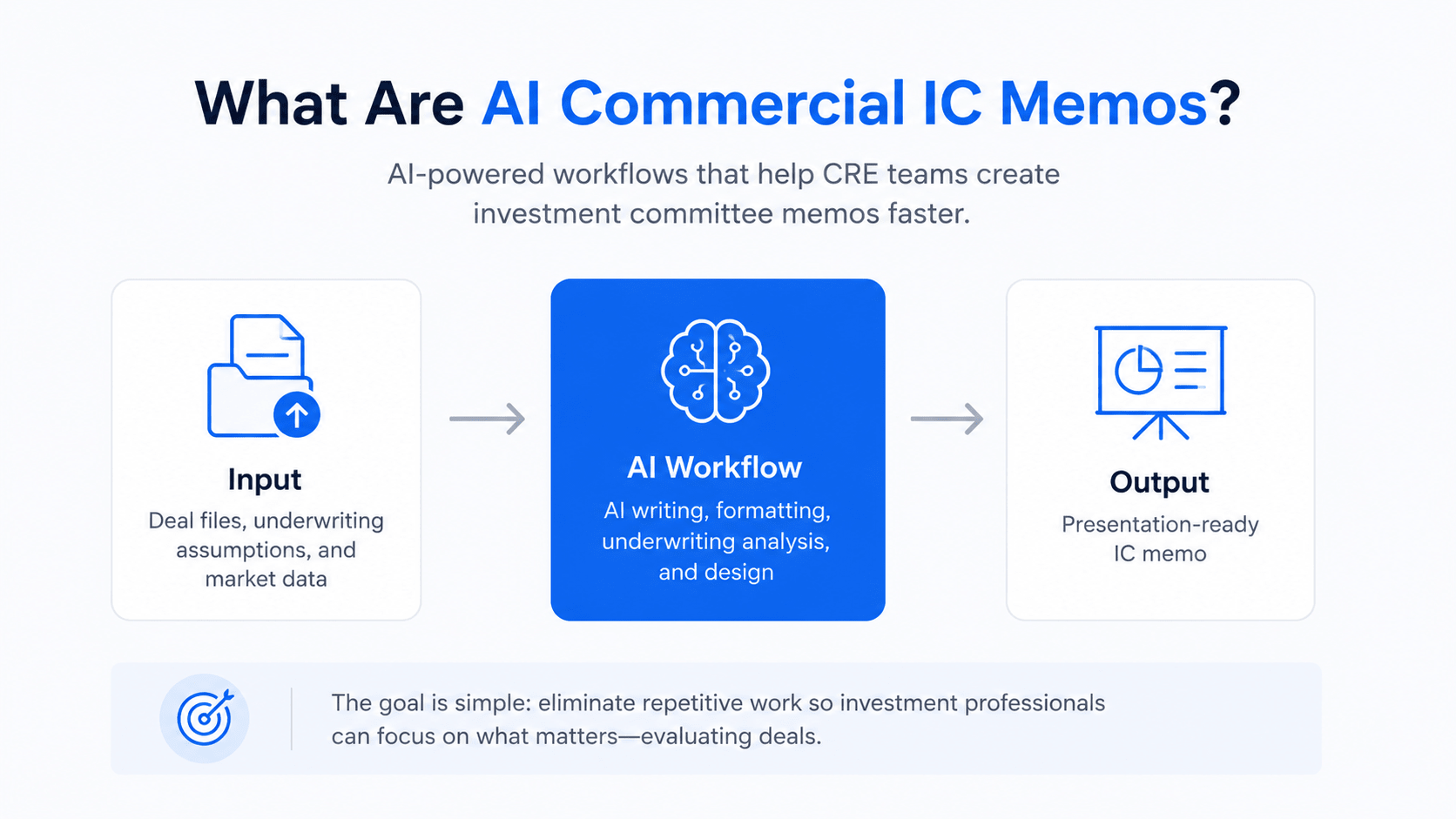
AI commercial IC memos are investment committee presentations generated or supported by artificial intelligence systems. These workflows combine AI writing, formatting automation, underwriting analysis, and presentation design to help CRE teams produce institutional-quality memos much faster than traditional workflows.
Instead of manually formatting PowerPoint slides or Word documents, acquisitions teams can upload deal files, underwriting assumptions, and market data into AI systems that automatically generate presentation-ready outputs.
Most AI commercial IC memos include:
-
Executive summaries
-
Deal snapshots
-
Market analysis
-
Underwriting assumptions
-
Sensitivity analyses
-
Capital stack visuals
-
Investment recommendations
-
Risk summaries
-
Return projections
The objective is not to replace analysts. The objective is to eliminate repetitive formatting and administrative work so investment professionals can spend more time evaluating deals.
Why Traditional IC Memo Workflows Slow Down CRE Teams
Most commercial real estate acquisition teams still rely heavily on manual processes.
A typical workflow often looks like this:
-
Download the offering memorandum
-
Pull the rent roll data into Excel
-
Build or update underwriting
-
Create presentation slides
-
Copy charts manually
-
Write narrative summaries
-
Reformat branding elements
-
Revise the presentation repeatedly
This process creates serious inefficiencies.
Analysts can spend four to eight hours building a single polished IC memo. During active acquisition periods, this becomes a major operational bottleneck.
The problem becomes even worse when multiple analysts follow different formatting standards. Investment committees end up reviewing inconsistent presentations with varying chart styles, layouts, and recommendation structures.
Common Problems With Manual IC Memo Workflows
| Problem | Operational Impact | Result |
|---|---|---|
| Manual formatting | Excess analyst time | Slower deal review |
| Inconsistent branding | Unclear presentations | Reduced professionalism |
| Rebuilding charts repeatedly | Duplicate work | Lower efficiency |
| Fragmented workflows | Multiple revisions | Communication delays |
| Manual summary writing | Slower approvals | Reduced scalability |
AI commercial IC memos help solve many of these workflow inefficiencies.
How AI Commercial IC Memos Actually Work
Modern AI workflows combine several systems together to automate different parts of the investment committee process.
These workflows typically include:
-
AI writing tools
-
Design automation software
-
Spreadsheet integrations
-
Template systems
-
Data visualization engines
Some AI systems specialize in narrative summaries. Others focus on visual presentation design. The strongest CRE workflows combine both capabilities together.
For example, many CRE acquisition teams now combine an AI offering memorandum workflow with automated IC memo generation to speed up underwriting summaries, formatting, and investment narratives across multiple deals.
That type of workflow is becoming increasingly common across acquisition teams.
Step-by-Step Process to Build AI Commercial IC Memos
Step 1: Create Your Brand System
Before generating your first memo, establish your company branding system.
This usually includes:
-
Company logo
-
Brand colors
-
Font styles
-
Cover page design
-
Disclaimer language
-
Standardized layouts
The first setup may take 15 to 20 minutes, but it only needs to happen once. After that, future presentations automatically inherit the same branding standards.
This creates consistency across every deal presentation.
Step 2: Organize Your Deal Materials
AI systems work best when given structured inputs.
Useful files typically include:
-
Offering memorandums
-
Rent rolls
-
T-12 operating statements
-
Internal underwriting spreadsheets
-
Debt quotes
-
Market reports
-
Capex budgets
The quality of the output depends heavily on the quality of the uploaded data. Poor source material leads to weaker presentations.
Step 3: Define the Memo Structure
Most investment committee memos follow a repeatable format.
Typical sections include:
-
Executive summary
-
Deal overview
-
Property analysis
-
Market commentary
-
Financial assumptions
-
Capital stack breakdown
-
Sensitivity analysis
-
Investment thesis
-
Risks and mitigants
-
Final recommendation
Once this framework is defined, the AI system can reuse it repeatedly across future deals. This is one of the biggest operational advantages.
Step 4: Generate the Initial Draft
After uploading the deal files and selecting a template, the AI system creates the first draft automatically.
This usually includes:
-
Branded layouts
-
Investment summaries
-
Return projections
-
Charts and tables
-
Sensitivity matrices
-
Recommendation language
Instead of spending hours formatting slides, analysts now spend more time reviewing assumptions and refining underwriting. That is a major shift in workflow efficiency.
Step 5: Review and Refine the Underwriting
AI-generated outputs should never be accepted without review.
Experienced acquisitions professionals should validate:
-
Exit cap rates
-
Rent growth assumptions
-
Debt sizing
-
Vacancy assumptions
-
Operating expense projections
-
Renovation budgets
AI accelerates assembly.
Human judgment still drives investment decisions.
The Most Important Sections in AI Commercial IC Memos
Executive Summary
The executive summary is the most important section in the memo. It should immediately answer one core question:
Should the firm pursue the deal?
This section usually includes:
-
Purchase price
-
Levered IRR
-
Equity multiple
-
Hold period
-
Investment thesis
-
Recommendation
The best executive summaries are concise and highly focused. Investment committees typically prefer short summaries over lengthy narratives.
Deal-at-a-Glance Section
This section provides a quick overview of the opportunity.
| Metric | Example |
|---|---|
| Asset Type | Multifamily |
| Units | 240 |
| Purchase Price | $52M |
| Year Built | 2018 |
| Market | Phoenix |
| Levered IRR | 14.5% |
| Equity Multiple | 1.95x |
| Hold Period | 5 Years |
Strong summary tables improve readability and accelerate decision-making.
Market Analysis
This section explains why the market matters.
AI systems can summarize:
-
Population growth
-
Employment trends
-
Supply pipelines
-
Occupancy performance
-
Rental demand
-
Economic drivers
Market commentary helps investment committees evaluate long-term opportunity and downside risk.
Capital Stack Breakdown
Investment committees want immediate visibility into financing assumptions.
This section usually outlines:
-
Senior debt
-
Preferred equity
-
LP equity
-
GP equity
-
Mezzanine financing
Well-designed visualizations improve understanding quickly.
Sensitivity Analysis
Sensitivity analysis is often the most valuable part of the presentation.
AI systems can automatically generate:
-
Exit cap sensitivity matrices
-
IRR stress tests
-
Rent growth scenarios
-
Debt coverage analysis
These charts help committees evaluate downside risk more effectively.
Major Benefits of AI Commercial IC Memos
Faster Deal Review Cycles
The biggest advantage is speed. Instead of spending six hours formatting presentations, acquisitions teams can review significantly more opportunities each week. This improves overall deal throughput.
Better Consistency Across Presentations
Reusable templates standardize:
-
Branding
-
Layouts
-
Financial tables
-
Recommendation structures
-
Chart styling
That consistency becomes extremely valuable during active acquisition periods.
Reduced Administrative Work
Junior analysts often spend too much time on formatting tasks instead of underwriting.
AI shifts its focus toward:
-
Scenario modeling
-
Market research
-
Risk evaluation
-
Investment strategy
That improves overall team productivity.
Institutional-Quality Design
Modern AI systems can produce clean, professional-looking presentations with:
-
Better typography
-
Improved spacing
-
Consistent chart formatting
-
Professional visual hierarchy
This is especially useful for smaller sponsors without dedicated design resources.
If you want to see how CRE teams are producing institutional-quality presentations with AI, this walkthrough shows how quickly branded real estate decks can now be created using Claude Design.
Comparing Manual vs AI IC Memo Workflows
| Workflow Factor | Traditional Workflow | AI Workflow |
|---|---|---|
| Time Required | 4–8 hours | 20–45 minutes |
| Branding Consistency | Variable | Standardized |
| Chart Creation | Manual | Automated |
| Memo Reuse | Difficult | Simple |
| Formatting Work | Heavy | Minimal |
| Analyst Focus | Administrative | Strategic |
| Scalability | Limited | High |
The operational difference becomes significant when acquisition teams evaluate multiple opportunities every week.
Best Use Cases for AI Commercial IC Memos
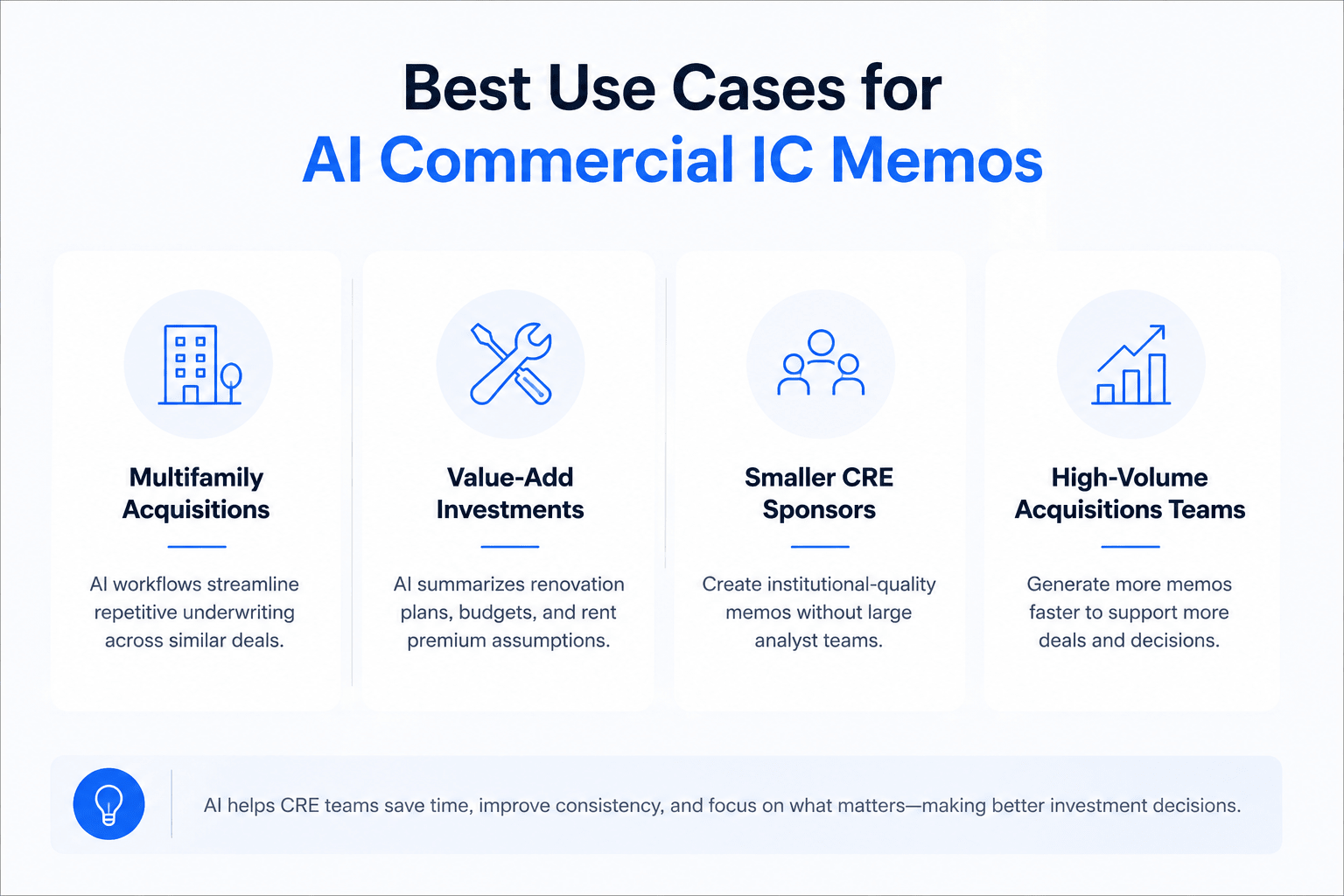
Multifamily Acquisitions
Multifamily underwriting follows repeatable patterns.
That makes it ideal for AI-generated workflows.
Common sections include:
-
Unit mix analysis
-
Renovation assumptions
-
Occupancy trends
-
Rent growth projections
Value-Add Investments
AI systems can summarize:
-
Renovation budgets
-
Interior upgrade plans
-
Rent premium assumptions
-
Timeline projections
This speeds up investment analysis significantly.
Smaller CRE Sponsors
Smaller firms can now create institutional-quality presentations without building large analyst teams. This improves fundraising and investment communication.
High-Volume Acquisitions Teams
Large acquisition groups screening many deals weekly benefit heavily from memo automation. AI standardizes early-stage screening presentations and improves consistency across teams.
Where AI Commercial IC Memos Still Fall Short
AI tools are improving rapidly, but limitations still exist.
Underwriting Accuracy Depends on Inputs
Weak source materials create weak outputs. If broker assumptions are unrealistic, AI may generate overly optimistic projections. That is why analyst oversight remains essential.
AI Can Misinterpret Broker Data
Offering memorandums often contains aggressive assumptions. Without review, AI systems may treat those projections as realistic underwriting inputs.
Complex Development Deals Still Need Human Expertise
Ground-up development projects involve:
-
Entitlement risk
-
Construction escalation
-
Lease-up uncertainty
-
Financing complexity
These factors still require experienced human judgment.
Export Formatting May Need Cleanup
Some AI-generated presentations still require small revisions.
Common issues include:
-
Page spacing
-
Chart sizing
-
Table alignment
-
PDF formatting inconsistencies
The technology continues improving, but perfection is not guaranteed.
How to Improve the Quality of AI Commercial IC Memos
Use Better Prompts
Specific instructions dramatically improve output quality.
Strong prompts usually define:
-
Asset type
-
Investment strategy
-
Hold period
-
Audience
-
Required sections
-
Return thresholds
The more context provided, the better the final memo becomes.
Upload Internal Underwriting Models
Do not rely only on broker marketing materials.
Upload:
-
Internal cash flow models
-
Debt assumptions
-
Stress tests
-
Renovation budgets
-
Exit assumptions
This improves financial reliability significantly.
Build Standardized Templates
Create reusable templates for:
-
Multifamily
-
Industrial
-
Retail
-
Office
-
Development
Standardization improves operational scalability.
Maintain Human Review Processes
Every AI-generated memo should pass through:
-
Underwriting review
-
Investment review
-
Legal review
-
Formatting review
AI improves speed, but human oversight still matters.
AI Commercial IC Memos by Asset Class
Different asset classes require different presentation structures.
Multifamily
Multifamily presentations usually focus on:
-
Renovation plans
-
Occupancy performance
-
Unit mix
-
Rent growth assumptions
Industrial
Industrial memos emphasize:
-
Tenant credit
-
Lease duration
-
Distribution demand
-
Logistics infrastructure
Office
Office underwriting often focuses on:
-
Lease rollover risk
-
Tenant concentration
-
Capital improvements
-
Hybrid work trends
Retail
Retail investment memos typically analyze:
-
Traffic patterns
-
Tenant mix
-
Anchor tenant stability
-
Demographic performance
Hospitality
Hospitality underwriting requires:
-
Occupancy projections
-
ADR growth assumptions
-
Tourism trends
-
Revenue management analysis
Building a Repeatable AI IC Workflow
The most successful firms treat AI memo generation as a repeatable system rather than a one-time experiment.
Create Standard Operating Procedures
Document:
-
Required files
-
Prompt structures
-
Naming conventions
-
Approval workflows
-
Review checklists
This reduces confusion and improves consistency.
Build a Template Library
Create separate templates for:
-
Preliminary screening
-
Full investment committee review
-
Debt committee presentations
-
Investor reporting
Over time, this becomes a major operational advantage.
Assign Clear Team Roles
Strong AI workflows still require defined responsibilities across the acquisitions team. Analysts upload files and assumptions. Associates review underwriting.
Vice presidents validate investment recommendations. Investment committees make final decisions. Clear workflows improve operational efficiency significantly.
AI Commercial IC Memos vs Traditional PowerPoint Workflows
Traditional PowerPoint workflows create major inefficiencies.
Common problems include:
-
Repetitive formatting
-
Manual chart creation
-
Version confusion
-
Design inconsistency
-
Slow collaboration
These problems scale poorly as acquisition volume increases.
AI workflows automate:
-
Slide generation
-
Layout formatting
-
Chart styling
-
Narrative summaries
-
Design consistency
That reduces low-value manual work across acquisitions teams. However, certain high-stakes presentations still benefit from human design refinement, especially institutional fundraising decks and investor roadshows.
In those cases, AI creates the first draft while humans polish the final presentation.
The Future of AI Commercial IC Memos
AI commercial IC memos are only the beginning of broader workflow automation in commercial real estate.
Future systems will likely include:
-
Real-time market data integration
-
Automatic underwriting extraction
-
Predictive investment scoring
-
Dynamic dashboard reporting
-
AI-generated risk analysis
Over time, static PDF investment memos may evolve into fully interactive investment dashboards.
Several platforms are already testing:
-
Rent roll parsing
-
Debt market integrations
-
Geographic demand forecasting
-
Portfolio-level risk modeling
-
Automated investment scoring
These systems could dramatically reduce underwriting and presentation time across CRE acquisition teams.
Common Mistakes CRE Firms Make With AI IC Memos
Blindly Trusting AI Outputs
AI-generated recommendations should never replace investment judgment. Every assumption still requires human validation.
Using Weak Source Materials
Incomplete offering memorandums reduce output quality significantly. Always provide complete supporting documents.
Ignoring Standardization
Without standardized templates, firms lose many of the operational benefits AI provides.
Overloading Presentations With Data
Investment committees value clarity. Too many charts and excessive detail weaken presentations. Strong memos prioritize the most important information first.
Best Practices for Better AI Commercial IC Memos
Keep Executive Summaries Short
Decision-makers prefer concise recommendations. One-page summaries typically perform best.
Use Strong Visual Hierarchy
Well-designed presentations prioritize:
-
Headlines
-
Key metrics
-
Charts
-
Recommendation boxes
This improves readability significantly.
Focus on Investment Decisions
Strong IC memos answer four questions clearly:
-
Why this deal?
-
Why now?
-
What are the risks?
-
What returns are expected?
Everything else should support those answers.
How Much Time Can AI Really Save?
The first setup takes the longest. Initial template configuration may require:
-
20 minutes for branding
-
20 minutes for template design
-
10 minutes for prompt refinement
After that, future presentations become dramatically faster. Acquisitions teams can reduce memo preparation time from several hours to roughly 20 to 45 minutes, depending on complexity.
That efficiency improvement becomes extremely valuable during active acquisition periods.
Should CRE Firms Replace Analysts With AI?
No.
The strongest workflows combine human expertise with automation.
Experienced analysts still provide:
-
Market judgment
-
Risk interpretation
-
Negotiation strategy
-
Sponsor evaluation
-
Capital markets expertise
AI simply removes repetitive administrative work.
The firms that benefit most will combine:
-
Strong underwriting discipline
-
Experienced acquisitions teams
-
AI workflow automation
-
Standardized memo systems
That combination improves both speed and decision quality.
Build Smarter CRE Investment Workflows
Commercial real estate firms that adopt AI commercial IC memos early will likely gain a major operational advantage over the next several years. Faster deal reviews, cleaner presentations, and repeatable underwriting workflows allow acquisitions professionals to spend more time evaluating investments instead of formatting slides. Inside AI for CRE Collective, 600+ CRE professionals are already testing practical AI workflows for acquisitions, underwriting, investor reporting, and deal sourcing.
If your team wants to improve how it evaluates opportunities, now is the time to build a repeatable AI process. The firms learning these systems today will likely move faster as AI becomes more integrated into commercial real estate operations. Join the conversation, compare workflows with other operators, and subscribe to the newsletter to stay updated on what is actually working across the industry.
Conclusion
AI commercial IC memos are rapidly transforming how commercial real estate acquisition teams prepare investment committee presentations.
Instead of rebuilding layouts manually for every deal, firms can now generate branded, data-rich memos in a fraction of the time. The biggest advantage is not only speed. It is consistency, scalability, and cleaner communication across acquisition workflows.
By combining AI tools with strong underwriting discipline, commercial real estate firms can evaluate more opportunities, improve presentation quality, and reduce administrative workload significantly.
The firms that succeed with AI will not treat it as a replacement for investment professionals. They will use it to eliminate repetitive work so analysts and acquisitions teams can focus on strategy, risk evaluation, and execution.
As AI technology continues improving, investment committee workflows will likely become faster, more standardized, and increasingly data-driven across the CRE industry.
FAQs Regarding How to Build an IC Memo with AI in 20 Minutes
1. What is an AI investment committee memo?
An AI investment committee memo is a CRE presentation generated using artificial intelligence tools that automate formatting, summaries, and financial analysis.
-
It speeds up acquisition workflows
-
It improves presentation consistency
-
It reduces repetitive formatting work
Conclusion: AI IC memos help CRE firms evaluate deals faster and more efficiently.
2. How long does it take to create AI commercial IC memos?
Most AI-generated IC memos can be created within 20 to 45 minutes after the template is configured.
-
Initial setup takes longer
-
Reusable templates improve speed
-
Analyst review is still necessary
Conclusion: AI significantly reduces memo preparation time compared to manual workflows.
3. Can AI replace CRE acquisition analysts?
No, AI cannot fully replace acquisition analysts because investment judgment still requires human expertise.
-
Analysts validate assumptions
-
Humans evaluate market risks
-
Negotiation strategy remains manual
Conclusion: AI works best as a productivity tool rather than a replacement.
4. What software can create AI commercial IC memos?
Several AI writing and design platforms now support automated memo generation.
-
AI writing tools summarize information
-
Design tools automate layouts
-
Spreadsheet integrations improve analysis
Conclusion: The best workflows combine writing, design, and underwriting automation.
5. Are AI-generated IC memos accurate?
Accuracy depends heavily on the quality of uploaded underwriting and deal materials.
-
Broker assumptions may be aggressive
-
Human review is still required
-
Better source materials improve outputs
Conclusion: AI improves speed, but underwriting verification remains essential.
6. What sections should an IC memo include?
Most IC memos include executive summaries, market analysis, financial assumptions, and investment recommendations.
-
A deal overview is essential
-
Sensitivity analysis improves clarity
-
Recommendations should stay concise
Conclusion: Strong IC memos balance visuals, underwriting, and investment reasoning.
7. Why are AI commercial IC memos becoming popular?
CRE firms want to reduce repetitive formatting work and review more deals faster.
-
Teams save analyst hours
-
Presentations become standardized
-
Workflow efficiency improves
Conclusion: AI adoption is growing because it improves operational scalability.
8. Can AI create sensitivity analysis charts?
Yes, many AI systems can automatically generate sensitivity matrices and return scenarios.
-
IRR stress testing is common
-
Exit cap scenarios improve analysis
-
Charts improve readability
Conclusion: Sensitivity analysis is one of the strongest AI-generated outputs.
9. Do small CRE firms benefit from AI IC memo workflows?
Yes, smaller firms can create institutional-quality presentations without large acquisition teams.
-
Automation reduces workload
-
Templates improve consistency
-
Smaller teams scale faster
Conclusion: AI is especially valuable for lean CRE operators.
10. What are the risks of using AI for IC memos?
The biggest risks involve inaccurate assumptions and insufficient human review.
-
AI may misread broker projections
-
Source materials may be incomplete
-
Poor underwriting reduces reliability
Conclusion: AI outputs should always be reviewed carefully before investment decisions.