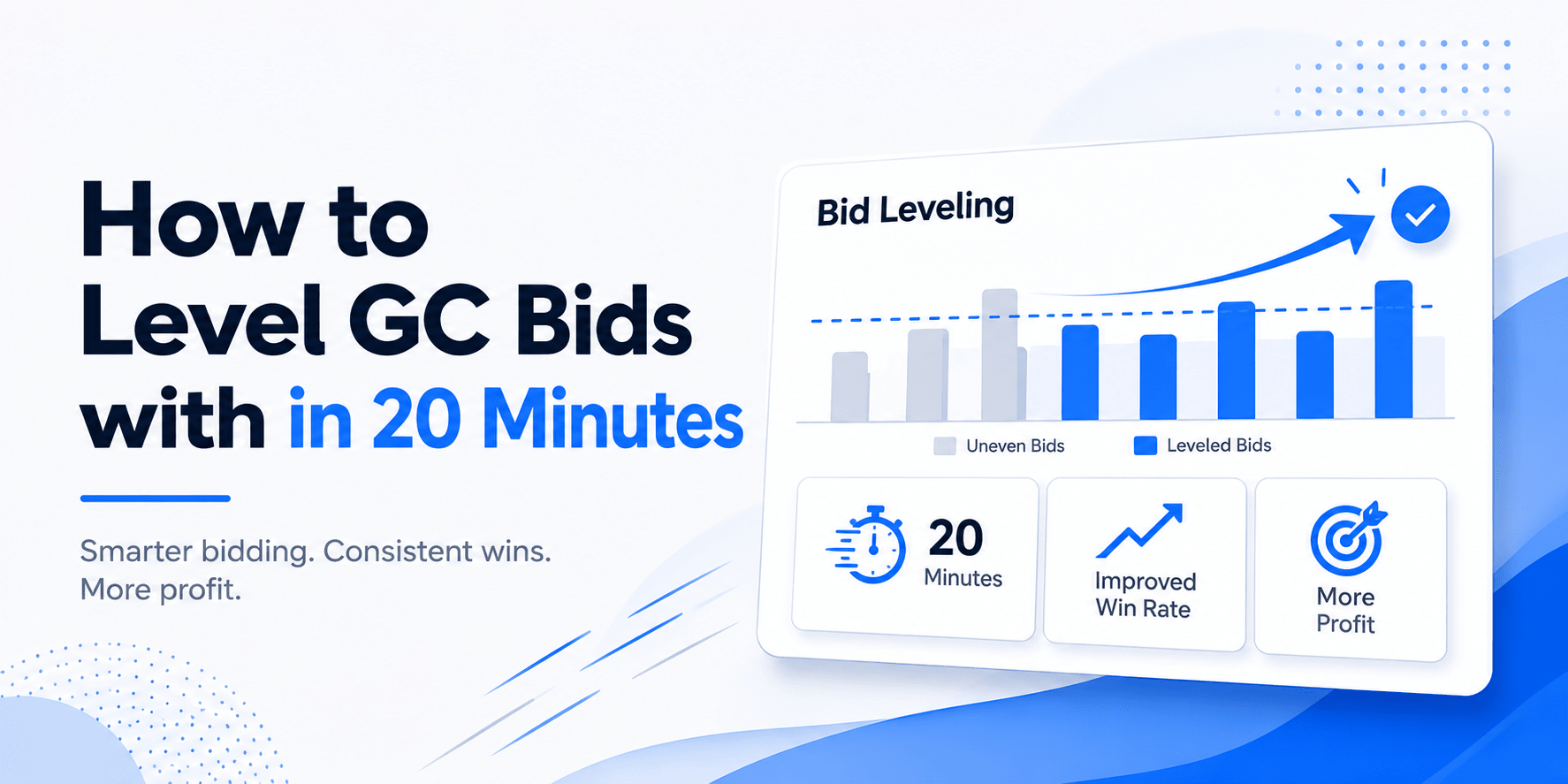
How to Level GC Bids with AI in 20 Minutes
Comparing general contractor bids is one of the most time-consuming tasks in real estate development and construction. With AI General Contractor Leveling, project teams can dramatically reduce the time required to evaluate competing proposals while improving accuracy. Traditionally, a project team may spend days reviewing schedules of values, exclusions, allowances, and assumptions before they can confidently determine which contractor offers the best value. The challenge is that no two bids are organized the same way. One contractor may include site improvements, while another excludes them entirely. A third contractor may use large allowances that make the proposal appear cheaper than it really is.
This is where AI General Contractor Leveling is changing the game. Instead of spending multiple days manually comparing documents, developers can now use artificial intelligence to analyze bid packages, identify scope gaps, normalize pricing, and create apples-to-apples comparisons in roughly 20 minutes. The result is faster decision-making, fewer surprises during construction, and a more reliable contractor selection process.
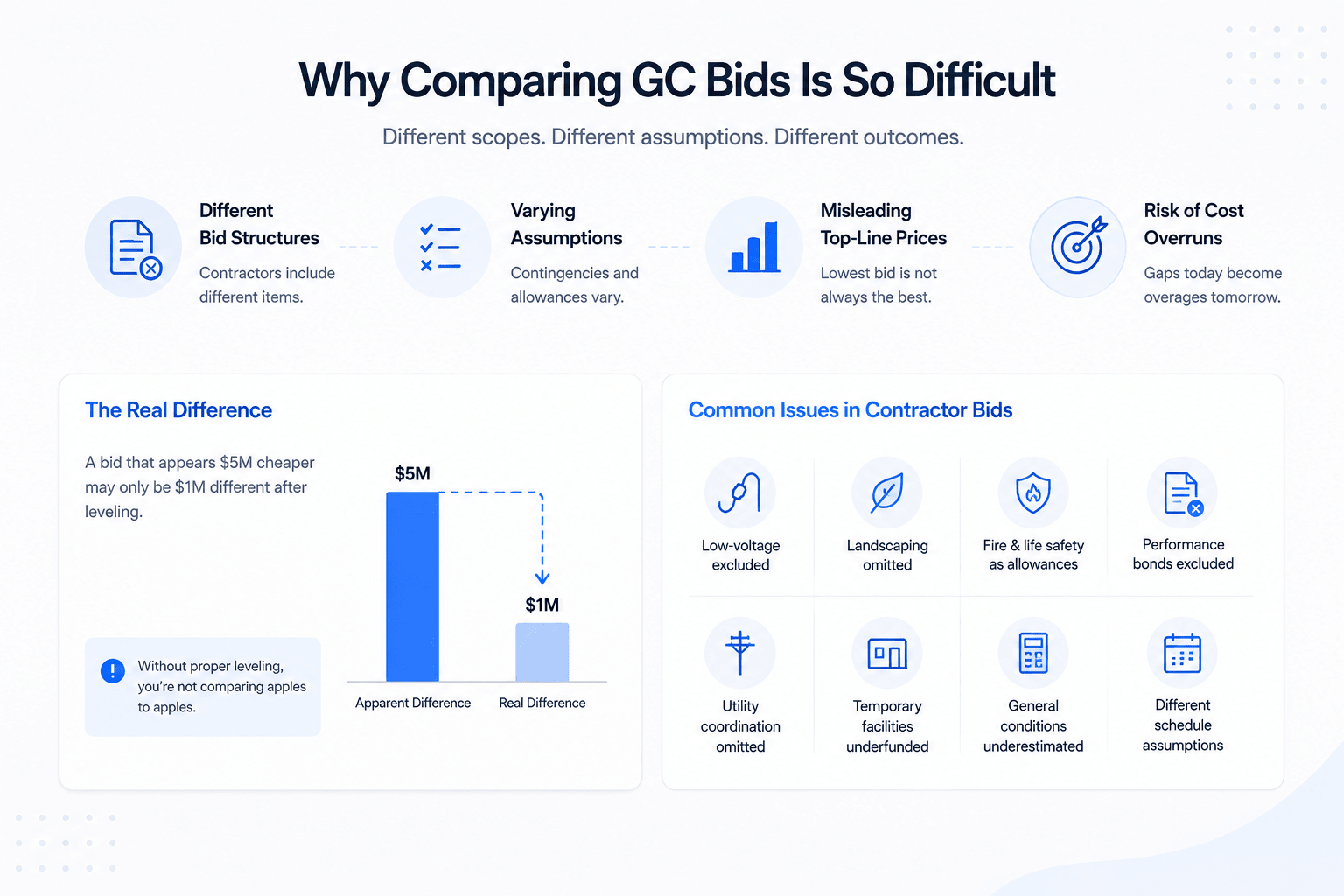
Why Comparing GC Bids Is So Difficult
Most developers assume comparing bids is simply a matter of looking at the bottom-line number. Unfortunately, that approach often leads to costly mistakes.
Contractors frequently structure bids differently. Some include items that others exclude. Certain bidders carry realistic contingency amounts, while others use aggressive assumptions to reduce their headline price.
As a result, the lowest bid is not always the best bid.
Consider a multifamily development project receiving three proposals. One contractor may appear $5 million cheaper than competitors. However, after reviewing exclusions and assumptions, the real difference may only be $1 million.
Without proper leveling, project teams risk selecting contractors based on incomplete information.
Common Issues Found in Contractor Bids
Some of the most common inconsistencies include:
-
Low-voltage systems excluded
-
Landscaping omitted
-
Fire and life safety carried as allowances
-
Performance bonds excluded
-
Utility coordination omitted
-
Temporary facilities underfunded
-
General conditions underestimated
-
Different schedule assumptions
Each of these items can significantly affect project costs.
Because of this, bid leveling exists to create a fair comparison.
Why Scope Gaps Matter
Scope gaps are among the most expensive problems in construction. When a contractor excludes work that another contractor includes, the project owner eventually pays for that missing scope one way or another.
Sometimes the missing scope appears as a change order. Other times it becomes a budget overrun. Either way, ownership absorbs the risk. The earlier these gaps are identified, the better.
How Bid Leveling Traditionally Works
Before AI became practical, construction managers and owners’ representatives handled bid leveling manually.
The process was straightforward but extremely labor-intensive.
Typical steps included:
-
Review each proposal.
-
Extract pricing data.
-
Map CSI divisions.
-
Compare inclusions and exclusions.
-
Calculate equalization adjustments.
-
Identify pricing anomalies.
-
Create comparison spreadsheets.
-
Draft recommendation memos.
For a large multifamily or mixed-use project, this process often requires several days.
In some cases, it could take a week or more.
Challenges of Manual Bid Leveling
Manual analysis creates several problems.
Time Consumption
Construction teams spend valuable time performing repetitive tasks rather than making strategic decisions.
Human Error
Large bid packages contain hundreds of line items. Mistakes are inevitable when comparing information manually.
Inconsistent Reporting
Different analysts may organize comparisons differently, making future reviews difficult.
Slow Decision-Making
Owners, lenders, and investors often wait days for recommendations. This can delay procurement and project schedules.
How AI General Contractor Leveling Works
AI dramatically reduces the time required to compare contractor bids.
Instead of reviewing documents line by line, AI can analyze multiple files simultaneously and organize information into structured outputs.
Want to see this process in action? In the video below, three real contractor bid packages are analyzed using AI to uncover scope gaps, pricing inconsistencies, and contractor risks that would normally take hours to identify manually.
The process is surprisingly simple.
Step 1: Gather Bid Documents
Create a folder containing all contractor submissions.
Typical documents include:
-
Proposal narratives
-
Schedules of values
-
Clarification logs
-
Scope documents
-
Contractor qualifications
The more complete the document set, the better the analysis.
Step 2: Provide Project Information
AI performs best when the project context is clearly defined.
Important information includes:
-
Project name
-
Address
-
Building type
-
Number of units
-
Square footage
-
Construction type
This context helps the model understand what should reasonably be included.
Step 3: Define the AI’s Role
Role-based prompting improves results.
For example:
“You are an experienced owner’s representative and construction cost manager helping level three GC bids.”
This immediately establishes expectations.
Step 4: Request Specific Deliverables
Instead of asking AI to compare bids, request precise outputs.
Examples include:
-
Bid leveling matrix
-
Scope gap report
-
Variance analysis
-
Recommendation memo
Specific deliverables produce significantly better results.
Step 5: Review and Validate
AI should support decision-making, not replace professional judgment. Construction managers should always validate findings before award recommendations are finalized.
The Four Deliverables Every Developer Should Request
The quality of the output depends heavily on what is requested. The following four reports provide the greatest value.
Core AI Bid Leveling Deliverables
| Deliverable | Purpose | Primary Benefit |
|---|---|---|
| Leveled Bid Comparison | Compare costs by division | Apples-to-apples pricing |
| Scope Gap Matrix | Identify exclusions | Reduce change-order risk |
| Variance Analysis | Flag unusual pricing | Detect bid abnormalities |
| Recommendation Memo | Summarize findings | Faster decisions |
1. Leveled Bid Comparison
This becomes the primary analysis document. Each contractor’s costs are mapped into the same structure.
Developers can quickly identify differences between bids and determine where pricing varies significantly.
2. Scope Gap Matrix
This report identifies everything that is included, excluded, or carried as an allowance. Many teams consider this the most valuable output. Scope gaps often explain why bids differ.
3. Variance Analysis
Variance reports identify line items that deviate significantly from the group average. These outliers frequently require clarification.
Examples include:
-
Underpriced concrete
-
Excessive contingencies
-
Unusually low supervision costs
-
Aggressive sitework assumptions
4. Recommendation Memo
The final memo summarizes findings and provides award recommendations.
This document can be shared directly with:
-
Ownership groups
-
Investors
-
Lenders
-
Development partners
What AI Finds That Teams Often Miss
One of the biggest advantages of AI General Contractor Leveling is its ability to review large amounts of information quickly. As a result, hidden risks become easier to identify.
For example, many of the same scope gaps and pricing inconsistencies identified during bid leveling also appear during AI construction cost estimating, especially when evaluating multifamily development budgets before contractor selection.
Missing Scope
Many contractors intentionally exclude certain work packages.
Examples include:
-
Security systems
-
Low voltage
-
Signage
-
Landscaping
-
Testing and inspections
If these exclusions are overlooked, costs appear later.
Underfunded General Conditions
General conditions often reveal important clues. A contractor proposing a 13-month schedule with unusually low supervision costs may be underestimating project requirements. AI can flag these discrepancies immediately.
Unrealistic Allowances
Allowances create uncertainty. A contractor carrying a $50,000 allowance may appear less expensive than one carrying a $250,000 allowance.
However, the larger allowance may be more realistic. AI helps normalize these assumptions.
Bonding Differences
Performance and payment bonds protect project ownership. If bonding costs are omitted, the bid comparison becomes distorted. AI identifies these inconsistencies quickly.
AI vs Traditional Bid Leveling
The difference between manual and AI-assisted workflows becomes obvious when comparing time and output quality.
Traditional vs AI General Contractor Leveling
| Category | Traditional Process | AI-Assisted Process |
|---|---|---|
| Document Review | Several Days | Minutes |
| Scope Analysis | Manual | Automated |
| Variance Detection | Spreadsheet-Based | Automated |
| Reporting | Manual Creation | Automated Drafting |
| Recommendation Memo | Hours | Minutes |
| Consistency | Analyst Dependent | Standardized |
The time savings alone can justify implementation. However, consistency often provides even greater long-term value.
Organizations can establish repeatable processes and improve procurement quality across projects.
Building a 20-Minute Workflow
A repeatable workflow is critical. Without a defined process, teams may struggle to achieve consistent results. Fortunately, a practical framework is easy to implement.
Organize Bid Documents
Store all contractor submissions in a dedicated folder. Ensure documents are clearly labeled.
Examples include:
-
GC-A Proposal
-
GC-A Schedule of Values
-
GC-B Proposal
-
GC-B Schedule of Values
This improves document processing accuracy.
Use Detailed Prompts
Prompt quality matters.
Strong prompts include:
-
Project description
-
Contractor names
-
Bid amounts
-
Requested outputs
-
Evaluation criteria
The more context provided, the more useful the analysis becomes.
Standardize Outputs
Every project should produce the same reporting structure. Consistency improves decision-making and allows teams to compare projects more effectively.
Example AI Prompt Components
| Prompt Component | Purpose |
|---|---|
| Project Information | Establish context |
| AI Role Definition | Set expertise level |
| Contractor Details | Organize comparison |
| Deliverables | Define outputs |
| Evaluation Criteria | Guide analysis |
Following this framework helps ensure reliable results.
Best Practices for Using AI in Construction Procurement
Organizations seeing the greatest success typically follow several best practices.
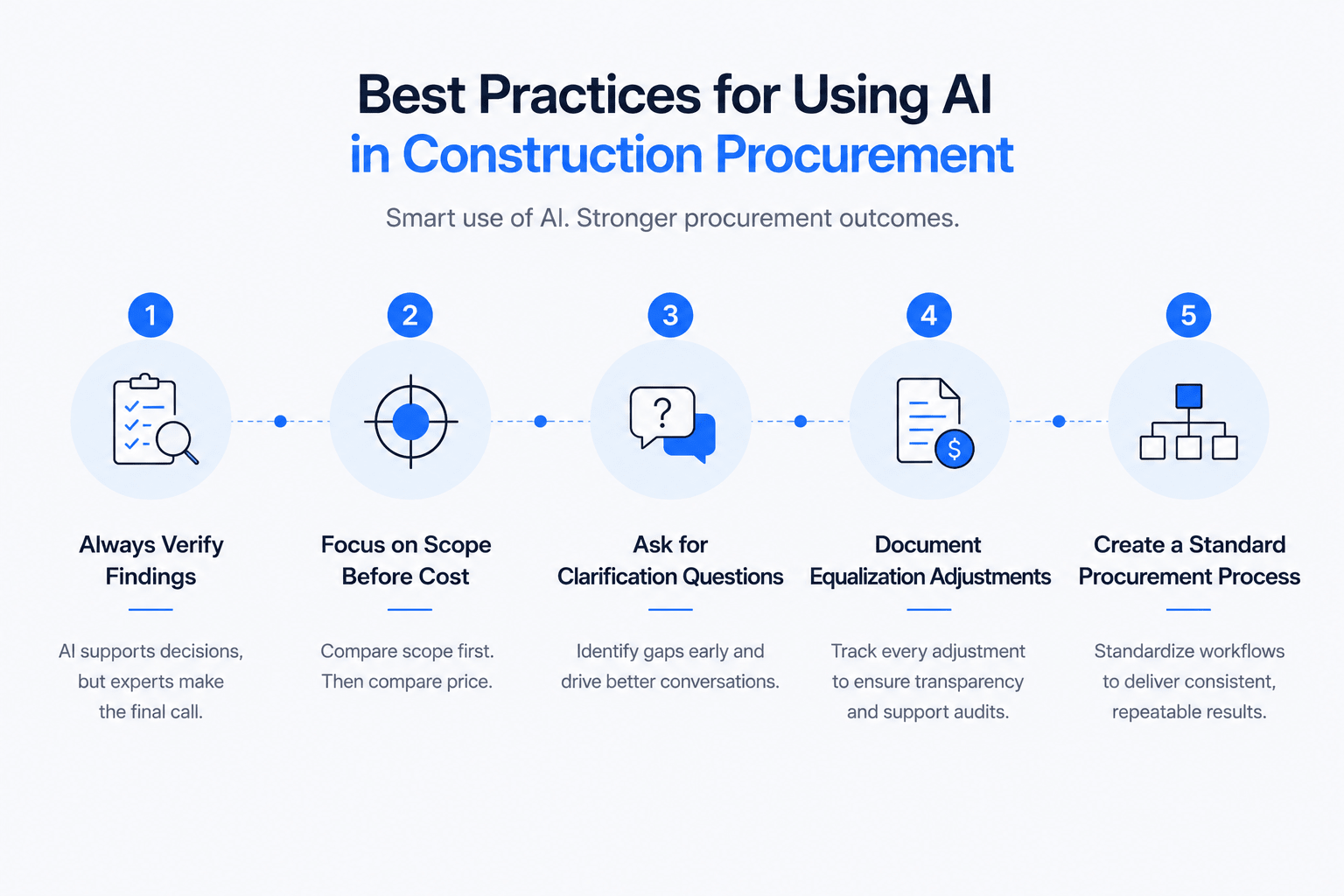
Always Verify Findings
AI should not replace professional expertise. Important recommendations should always be reviewed.
Focus on Scope Before Cost
Price comparisons are meaningless if the scope differs. Always evaluate inclusions and exclusions first.
Ask for Clarification Questions
AI can identify areas requiring further discussion. This creates more productive bidder interviews.
Document Equalization Adjustments
Every adjustment should be tracked. This creates transparency and supports future audits.
Create a Standard Procurement Process
Repeatable workflows produce repeatable outcomes. Organizations should document successful procedures and use them consistently.
Future Applications of AI Bid Leveling
Today’s tools primarily analyze contractor submissions. Future systems will likely go much further.
Potential capabilities include:
-
Drawing review
-
Specification comparison
-
Quantity validation
-
BIM integration
-
Schedule analysis
-
Procurement forecasting
Eventually, AI may compare contractor bids directly against project drawings and specifications. This would allow teams to identify discrepancies before contracts are signed. The potential impact on project risk management is significant.
Who Should Use AI General Contractor Leveling?
This workflow benefits nearly every participant in the construction process.
Developers
Developers gain faster procurement decisions and improved visibility into project costs.
Owner’s Representatives
Owner’s reps can review more bids in less time while improving consistency.
Construction Managers
Construction managers can focus on strategy instead of administrative tasks.
General Contractors
GCs can use similar techniques to compare subcontractor bids.
Homeowners
Even residential projects can benefit from bid normalization. Whenever multiple proposals exist, leveling adds value.
Expected Benefits of AI Bid Leveling
| Benefit Area | Impact |
|---|---|
| Time Savings | Faster bid reviews |
| Risk Reduction | Better scope visibility |
| Cost Accuracy | More realistic comparisons |
| Decision Speed | Faster awards |
| Reporting Quality | Improved communication |
These benefits compound across multiple projects throughout the year.
Improve Construction Procurement with Smarter AI Workflows
The most successful development teams are not simply adopting AI tools. They are creating repeatable workflows that improve procurement, reduce risk, and help stakeholders make better decisions. Bid leveling is one of the clearest examples because it removes hours of manual work while improving the quality of contractor evaluations. Whether you are reviewing multifamily, industrial, hospitality, or mixed-use projects, AI can provide a more structured path to selecting the right contractor.
The AI for CRE Collective brings together 600+ CRE professionals who are actively testing practical AI workflows across development, construction, acquisitions, and asset management. If you want real-world examples, implementation strategies, and proven prompts that work, consider joining the community and subscribe to the newsletter to stay informed about emerging AI applications in commercial real estate.
Conclusion
General contractor bid leveling has always been necessary, but it has never been particularly efficient. Traditional methods require extensive spreadsheet work, detailed document reviews, and multiple rounds of analysis before teams can confidently compare competing bids.
AI General Contractor Leveling changes that process dramatically. By identifying scope gaps, normalizing pricing assumptions, highlighting risk areas, and generating decision-ready reports, AI helps project teams move from raw proposals to actionable recommendations in a fraction of the time.
The greatest value is not simply speed. It has improved clarity. When bids are properly leveled, owners can make decisions based on complete information rather than misleading headline prices. As AI continues to evolve, bid leveling is likely to become one of the most widely adopted applications in construction procurement and development management.
FAQs Regarding How to Level GC Bids with AI in 20 Minutes
1. What is AI General Contractor Leveling?
AI General Contractor Leveling is the process of using artificial intelligence to compare multiple contractor bids and convert them into an apples-to-apples comparison. Instead of manually reviewing hundreds of pages of proposals, schedules of values, exclusions, and assumptions, AI can identify differences automatically and organize them into structured reports.
-
Compares pricing across contractors
-
Identifies scope gaps and exclusions
-
Normalizes allowances and contingencies
Conclusion: AI General Contractor Leveling helps developers make faster and more informed contractor selection decisions while reducing the risk of overlooking important scope differences.
2. Why is bid leveling important before selecting a general contractor?
Bid leveling is important because contractors rarely submit proposals with identical scopes of work. One contractor may include landscaping, security systems, and utility coordination, while another excludes those items entirely. Comparing only the total bid amount can lead to incorrect conclusions.
-
Prevents misleading price comparisons
-
Identifies missing scope items
-
Reduces future change-order risk
Conclusion: Proper bid leveling ensures that project teams evaluate contractors based on equalized scope rather than headline pricing alone.
3. How does AI reduce the time required for bid analysis?
Traditional bid leveling often requires construction managers and owner’s representatives to spend several days reviewing documents and building comparison spreadsheets. AI can automate much of this process by analyzing multiple documents simultaneously and generating structured reports.
-
Reviews hundreds of pages quickly
-
Creates comparison matrices automatically
-
Drafts recommendation summaries
Conclusion: AI can reduce bid review timelines from several days to less than an hour while maintaining consistency across evaluations.
4. What documents are required for AI bid leveling?
The quality of AI analysis depends heavily on the quality of the input documents. Most workflows begin by uploading all contractor submissions into a single folder for review.
-
Proposal narratives
-
Schedules of values (SOVs)
-
Scope assumptions and exclusions
Conclusion: The more complete the bid package, the more accurate and valuable the AI-generated comparison will be.
5. Can AI identify scope gaps that humans miss?
Yes. One of the biggest advantages of AI is its ability to review large volumes of information without fatigue. Scope gaps hidden deep within proposal narratives or exclusion lists can often be overlooked during manual reviews.
-
Finds missing work packages
-
Flags inconsistent assumptions
-
Highlights contractor exclusions
Conclusion: AI improves visibility into hidden scope differences and helps reduce costly surprises during construction.
6. What is a scope gap matrix and why is it valuable?
A scope gap matrix is a report that shows which contractor includes, excludes, or carries an allowance for specific work items. It is often considered the most valuable output in the entire leveling process.
-
Organizes inclusions and exclusions
-
Reveals pricing differences
-
Supports equalization adjustments
Conclusion: A scope gap matrix allows owners to quickly understand why bids differ and what adjustments are needed for a fair comparison.
7. Can AI compare contractor schedules as well as pricing?
Yes. Modern AI tools can analyze contractor schedules, staffing assumptions, and general conditions costs in addition to pricing information. This helps teams evaluate whether proposed timelines are realistic.
-
Reviews project durations
-
Evaluates staffing levels
-
Compares schedule-related costs
Conclusion: Schedule analysis provides additional context that helps owners understand both cost and execution risk.
8. How accurate is AI for construction bid leveling?
AI can be highly accurate when provided with complete documents and detailed instructions. However, it should not replace experienced construction professionals. Human review remains essential before making award decisions.
-
Accuracy depends on data quality
-
Better prompts improve results
-
Professional oversight remains necessary
Conclusion: AI is best used as a powerful analysis tool that supports expert decision-making rather than replacing it.
9. What are the biggest risks of choosing the lowest bid?
The lowest bid often appears attractive, but it may exclude important project scope or contain unrealistic assumptions. These omissions frequently lead to change orders and budget overruns later in the project.
-
Hidden exclusions
-
Underfunded allowances
-
Unrealistic schedules
Conclusion: Evaluating scope completeness and risk factors is often more important than simply choosing the lowest price.
10. Can AI help reduce construction change orders?
While AI cannot eliminate all change orders, it can help identify missing scope and inconsistent assumptions before contracts are awarded. This allows project teams to address issues during procurement rather than after construction begins.
-
Finds scope gaps early
-
Improves contractor clarification
-
Supports more complete contracts
Conclusion: Better bid leveling typically results in fewer avoidable change orders and more predictable project costs.