How to Use AI for Construction Cost Estimating in Multifamily
Commercial real estate is no longer just about location, capital, and timing. Today, it’s about the speed of decision-making, and that’s where AI construction cost estimation is changing how deals are evaluated. The faster you can estimate renovation costs, compare scenarios, and validate assumptions, the better your investment decisions become.
Traditionally, getting a construction estimate meant waiting days for contractor bids or spending hours building spreadsheets manually. But now, AI tools can generate detailed, line-item cost estimates from property photos in minutes. That shift isn’t just about speed; it’s about having better data earlier in the deal process.
What Is AI Construction Cost Estimation?
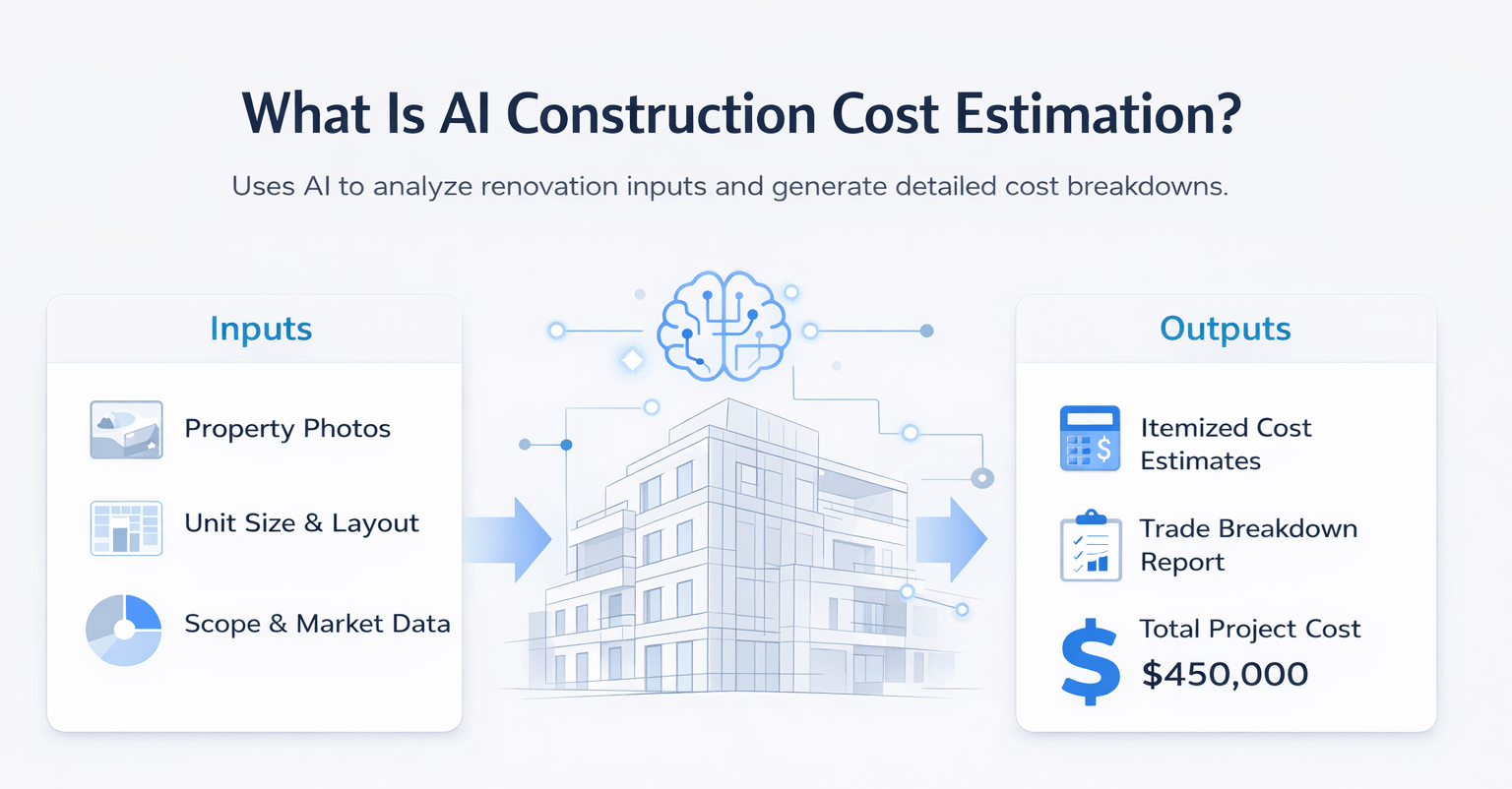
AI construction cost estimation is the process of using artificial intelligence to generate detailed renovation cost breakdowns based on property inputs.
These inputs include:
-
Property photos
-
Unit size and layout
-
Scope of renovation
-
Market assumptions
The output typically includes:
-
Line-item cost estimates
-
Trade-based breakdowns
-
Total project cost
-
Cost distribution summaries
AI construction cost estimation automates the process of generating renovation budgets, helping CRE professionals evaluate deals faster and more accurately.
The Traditional Cost Estimation Problem
Before AI, operators had only two options:
-
Wait for contractor bids (slow)
-
Build estimates manually (time-consuming)
Both approaches have major limitations.
Table 1: Traditional vs AI Estimation
| Method | Time Required | Accuracy | Scalability |
|---|---|---|---|
| Contractor Bids | Days–Weeks | High | Low |
| Manual Spreadsheets | Hours | Medium | Low |
| AI Estimation | Minutes | High* | High |
What the AI Estimate Actually Looks Like
In this test, the AI generated a full Excel-based estimate organized by CSI divisions.
Key Cost Breakdown
-
Demolition: ~$4,450
-
Plumbing: ~$8,600
-
Electrical: ~$8,100
-
HVAC: ~$8,700
-
Kitchen: ~$16,000
-
Finishes and fixtures: itemized
Total base cost: ~$82,000 before overhead and contingency.
The output also included a summary dashboard with cost distribution visuals, making it useful for presentations.
Where AI Estimates Are Accurate (and Where They Aren’t)
AI performs well in structured, repeatable cost categories but can misjudge strategic decisions.
Where It Works Well
-
Demolition pricing
-
Basic finishes
-
Standard fixture costs
-
Trade-level breakdowns
Where It Struggles
-
Material selection (often too premium)
-
Overbuilding scope
-
Market-specific pricing nuances
Table 2: Accuracy Breakdown
| Category | Accuracy Level |
|---|---|
| Demolition | High |
| Plumbing | High |
| Electrical | High |
| Finishes | Medium |
| Materials | Variable |
The Real Power: Scenario Comparison
This is where AI becomes a true decision-making tool.
Instead of a single estimate, you can generate multiple strategies instantly.
Scenario 1: Full Gut Renovation
-
Cost: ~$82,000
-
Timeline: 8–10 weeks
-
Permits required
-
Full system upgrades
Scenario 2: Cosmetic Rehab
-
Cost: ~$15,250
-
No permits required
-
Faster execution
-
Retains core systems
Table 3: Scenario Comparison
| Factor | Full Renovation | Cosmetic Rehab |
|---|---|---|
| Cost | High | Low |
| Timeline | Long | Short |
| Permits Required | Yes | No |
| ROI Efficiency | Lower | Higher |
Why Cosmetic Rehab Often Wins
The difference between the two scenarios in this case was $67,000.
But the rent increase from a full renovation might only be:
-
$200–$400/month
That leads to a long payback period.
Key Insight
-
Higher spend ≠ better returns
-
Over-improving reduces ROI
-
Matching scope to tenant profile is critical
How to Use AI Estimates with Contractors
AI is not a replacement; it’s leverage. If you want to see how AI is actually being used in real CRE workflows from underwriting to deal execution, this example shows how operators are replacing hours of manual work with automated systems.
Before the Walkthrough
Send the AI estimate first.
This shifts the conversation:
-
You set the baseline
-
Contractor responds to your numbers
After Receiving Bids
Compare line items:
-
Identify discrepancies
-
Ask targeted questions
-
Avoid lump-sum negotiations
This becomes even more powerful when combined with systems for automated deal underwriting using AI, where cost assumptions directly impact returns.
Table 4: AI vs Contractor Workflow
| Step | Without AI | With AI |
|---|---|---|
| Initial Estimate | Contractor-led | Investor-led |
| Negotiation | General | Line-item specific |
| Transparency | Low | High |
How to Get Started
To use this workflow:
-
Take detailed unit photos
-
Use structured prompts (RCTF)
-
Generate estimates
-
Run multiple scenarios
-
Validate with the contractor
This creates a repeatable system across deals.
Conclusion
AI construction cost estimation is transforming how CRE professionals analyze renovation costs. Instead of waiting days for contractor bids or building spreadsheets manually, you can now generate detailed, structured estimates in minutes.
The real advantage comes from speed, scenario comparison, and better decision-making. When used correctly, AI helps you reduce risk, improve ROI, and operate more efficiently across your portfolio.
Build Smarter CRE Investment Decisions
If you’re serious about improving how you evaluate deals, AI isn’t just a tool; it’s a competitive advantage. Inside the AI for CRE Collective, 600+ CRE professionals are actively testing workflows like AI construction cost estimation on real deals, sharing what works and what doesn’t.
From underwriting to renovation planning, these workflows help you move faster, reduce risk, and make better investment decisions. If you want to stay ahead in today’s market, subscribe to the newsletter and start applying these systems to your deals.
FAQs Regarding AI Construction Cost Estimation
What is AI construction cost estimation, and how is it used in CRE?
AI construction cost estimation is a method of generating detailed renovation budgets using AI tools based on property inputs like photos and unit details.
-
It analyzes property data and generates line-item estimates
-
It organizes costs by trade and construction category
-
It provides quick insights for deal evaluation
Conclusion: It allows CRE professionals to estimate renovation costs faster and more efficiently.
How accurate are AI-generated construction cost estimates?
AI estimates are generally reliable for baseline analysis but not perfect.
-
Strong for standard cost categories like demolition and plumbing
-
May overestimate finishes or materials
-
Accuracy improves with better inputs
Conclusion: AI estimates are useful for planning but should always be validated with contractors.
How much time does AI save in construction cost estimation?
AI significantly reduces the time required for estimating costs.
-
Manual estimates can take hours
-
Contractor bids can take days or weeks
-
AI produces results in minutes
Conclusion: AI dramatically speeds up the early-stage decision-making process.
Can AI help compare renovation strategies effectively?
Yes, this is one of its most powerful features.
-
Generates multiple cost scenarios instantly
-
Allows comparison of full vs cosmetic renovations
-
Helps evaluate ROI before committing
Conclusion: Scenario comparison makes investment decisions faster and more data-driven.
Can AI replace contractor estimates completely?
No, AI should not replace contractors entirely.
-
Provides baseline estimates
-
Helps guide conversations
-
Supports negotiation
Conclusion: AI complements contractors but does not replace them.
Why do AI estimates sometimes appear higher than expected?
AI often assumes mid-range or premium materials.
-
Defaults to higher-quality finishes
-
Includes full replacements instead of partial upgrades
-
Lacks tenant-specific optimization
Conclusion: Adjust estimates based on your target market and strategy.
Is AI construction cost estimation scalable across multiple properties?
Yes, scalability is one of its biggest advantages.
-
The same workflow can be reused
-
Standardizes estimates across deals
-
Saves time across portfolios
Conclusion: AI makes it easier to evaluate multiple deals quickly.
What inputs are needed for accurate AI cost estimates?
Better inputs lead to better outputs.
-
Clear property photos
-
Accurate unit size and layout
-
Defined renovation scope
Conclusion: Detailed inputs significantly improve estimate accuracy.
Can AI help reduce renovation costs?
Yes, indirectly through better planning.
-
Prevents overbuilding
-
Reduces change orders
-
Improves contractor clarity
Conclusion: Better planning leads to lower overall project costs.
What is the biggest advantage of AI in construction estimation?
Speed and decision clarity.
-
Faster analysis
-
Better comparisons
-
More informed decisions
Conclusion: AI transforms cost estimation into a strategic advantage.