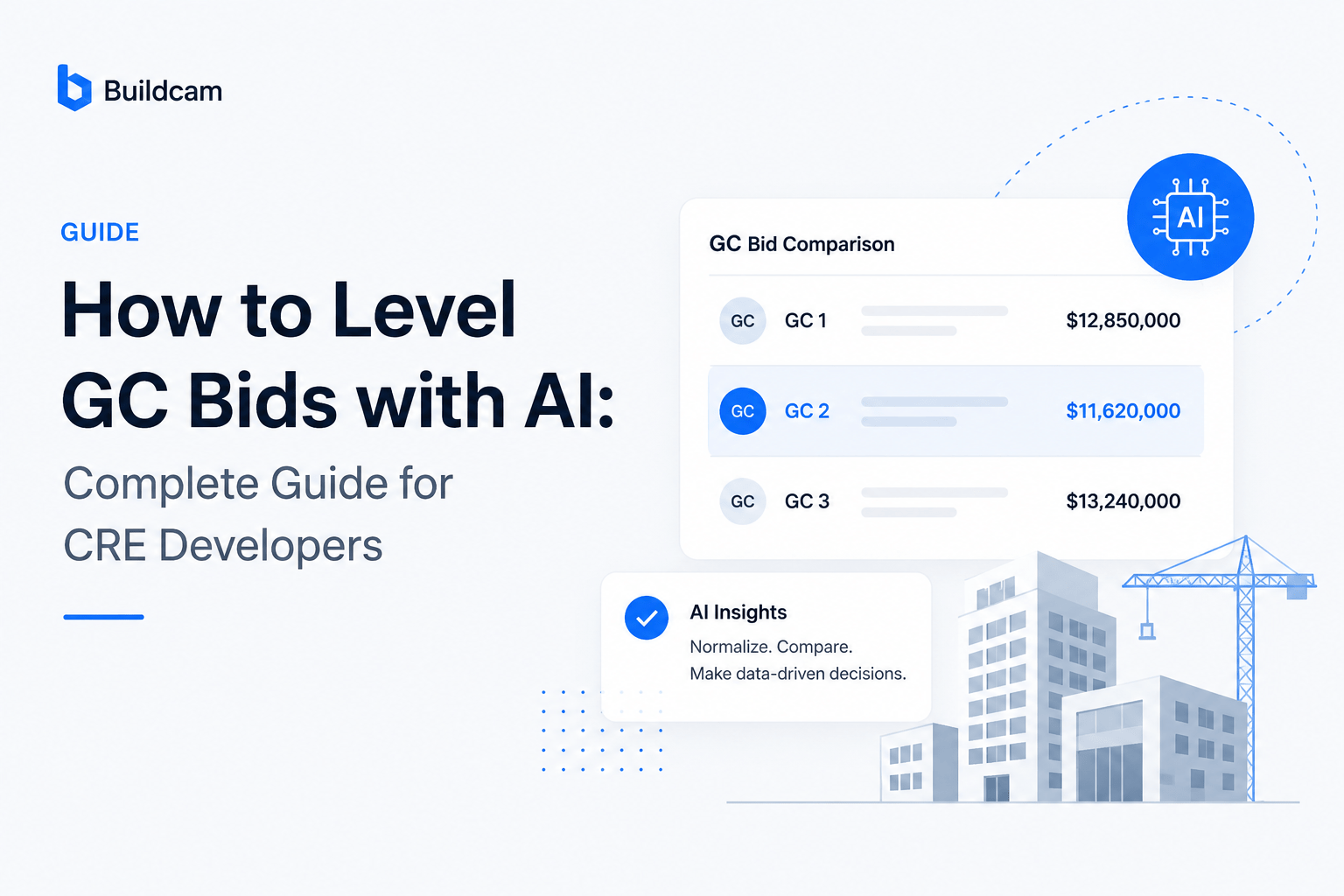
How to Level GC Bids with AI: Complete Guide for CRE Developers
Bid leveling is one of the most time-consuming tasks in commercial real estate development. It is also one of the most important. Developers often spend days comparing contractor estimates, reviewing schedules of values, identifying exclusions, and analyzing scope gaps across multiple bids. The process is slow. It is repetitive. And on larger projects, it becomes difficult to manage manually. This is where AI bid leveling works differently. Instead of manually comparing every line item, developers can now use AI workflows to organize contractor bids, identify exclusions, analyze scope gaps, and generate recommendation memos automatically.
In markets like Los Angeles, where multifamily construction costs remain volatile, faster bid analysis can significantly reduce construction risk and unexpected change orders. This guide explains how AI bid leveling works, what outputs developers can expect, where the process still needs human oversight, and how CRE teams are using AI to evaluate contractor bids more efficiently.
What Bid Leveling Actually Means
Bid leveling is the process of comparing contractor bids on an equal basis.
When multiple general contractors submit proposals for the same project, each bid usually includes:
-
Different scope assumptions
-
Different exclusions
-
Different schedule assumptions
-
Different contingency structures
-
Different line item formats
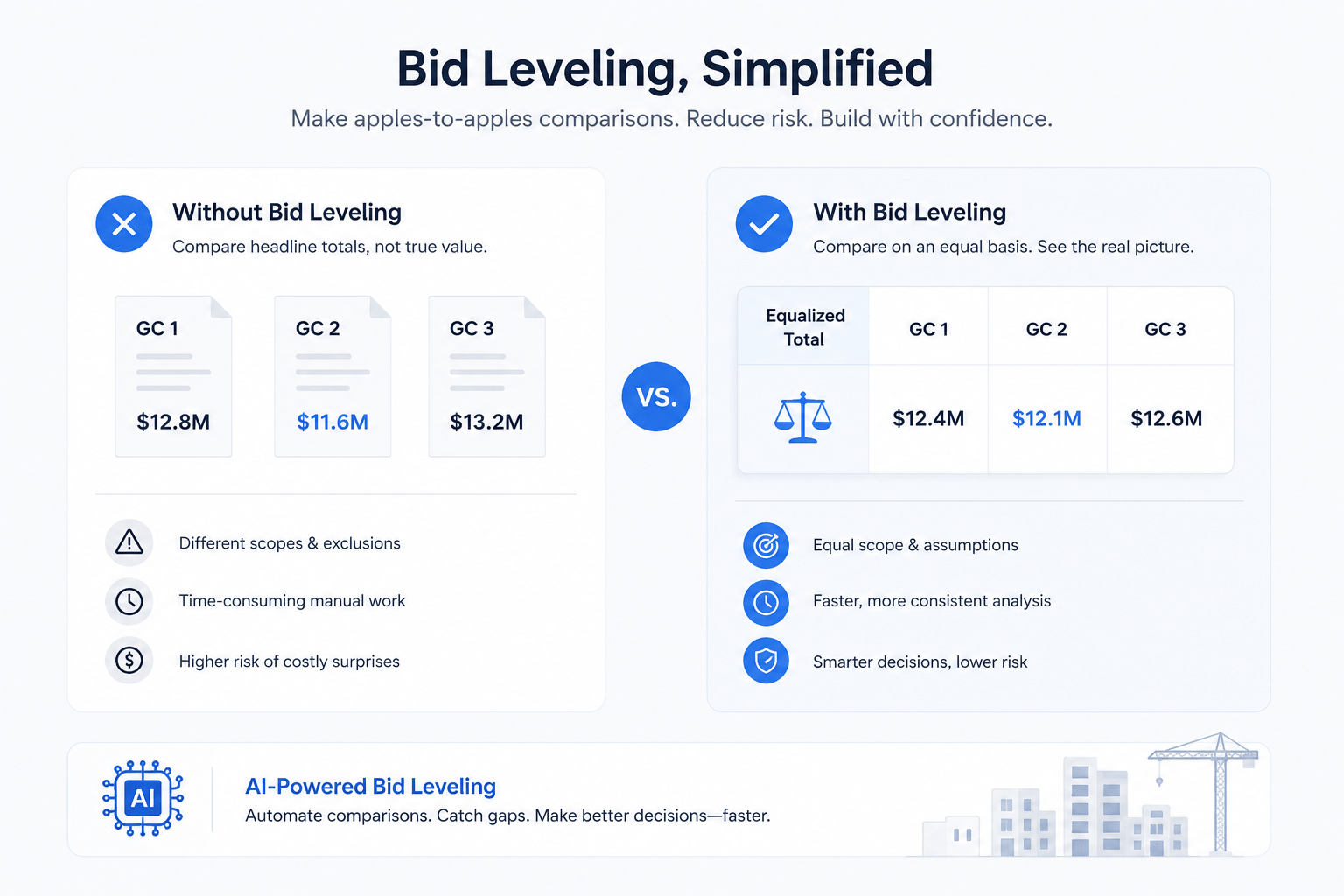
The lowest bid is not always the cheapest project.
A contractor may exclude major scope items that later appear as change orders during construction. Without proper leveling, developers often compare headline totals instead of actual scope coverage. That creates risk.
Why Many Developers Skip Proper Bid Leveling
Most developers understand the importance of bid leveling.
The problem is time.
A full comparison across three contractors can require:
-
Reviewing schedules of values
-
Mapping CSI divisions
-
Identifying exclusions
-
Comparing allowances
-
Calculating equalization adjustments
-
Writing summary recommendations
For large multifamily or mixed-use projects, this can easily take 40 to 60 hours manually. As a result, many teams rely on high-level comparisons and contractor conversations instead of full scope analysis. That shortcut often becomes expensive later.
Why Scope Gap Analysis Matters
Scope gaps are one of the biggest causes of construction cost overruns.
A contractor may intentionally or unintentionally exclude important items from the bid.
Examples include:
-
Low-voltage systems
-
Fire and life safety
-
Site utilities
-
Temporary protections
-
General conditions
-
Permit coordination
Those exclusions eventually become change orders.
And change orders usually cost significantly more than competitively bid work.
Real Construction Risk
A low bidder may initially appear millions of dollars cheaper.
However, once the excluded scope is added back into the proposal, the pricing gap often shrinks substantially.
AI bid leveling helps developers identify:
-
Missing scope
-
Unrealistic schedules
-
Underpriced divisions
-
Structurally unbalanced bids
-
Owner risk exposure
This allows acquisitions and development teams to evaluate contractor pricing more realistically before awarding the contract.
What You Need Before Starting
The setup process is relatively simple.
Most workflows only require:
-
Contractor bid packages
-
Proposal narratives
-
Schedules of values
-
Basic project information
-
AI document analysis software
The strongest workflows also include construction drawings.
Without plans, AI compares bids against each other.
With plans, AI can also compare the bids against the actual project scope.
Recommended Project Information
Before starting, organize:
-
Project address
-
Asset type
-
Unit count
-
Construction type
-
Building height
-
Contractor names
-
Bid totals
-
Schedule assumptions
This helps AI evaluate pricing and schedule reasonableness more accurately.
Organizing Bid Packages for AI Review
The first step is creating a centralized project folder.
Most teams place all contractor documents into one directory.
Typical files include:
-
Proposal PDFs
-
Schedule of values spreadsheets
-
Bid narratives
-
Scope clarifications
-
Alternates
-
Addenda
The folder structure itself does not need to be complicated.
The main goal is to keep all bid materials organized before analysis begins.
Example Bid Package Structure
| File Type | Purpose |
|---|---|
| Proposal narrative | Scope assumptions and exclusions |
| Schedule of values | Line-item pricing |
| Addenda | Updated bid information |
| Clarification letters | Contractor notes and assumptions |
| Drawings | Scope validation |
Once the files are organized, AI tools can process them together instead of reviewing documents individually.
Writing Better AI Prompts for Bid Leveling
The quality of the output depends heavily on the prompt structure.
Weak prompts produce generic comparisons.
Detailed prompts create actionable analysis.
Important Prompt Components
The strongest prompts include:
-
Role assignment
-
Project context
-
Deliverable instructions
-
Required tabs
-
Output formatting requirements
-
Risk analysis requests
For example, instead of saying:
“Compare these bids.”
A stronger instruction would be:
“Create a leveled bid comparison workbook with scope gaps, equalized pricing adjustments, unbalanced line item analysis, and a risk-weighted contractor recommendation.”
Specific instructions improve output consistency significantly.
How AI Parses Contractor Bids
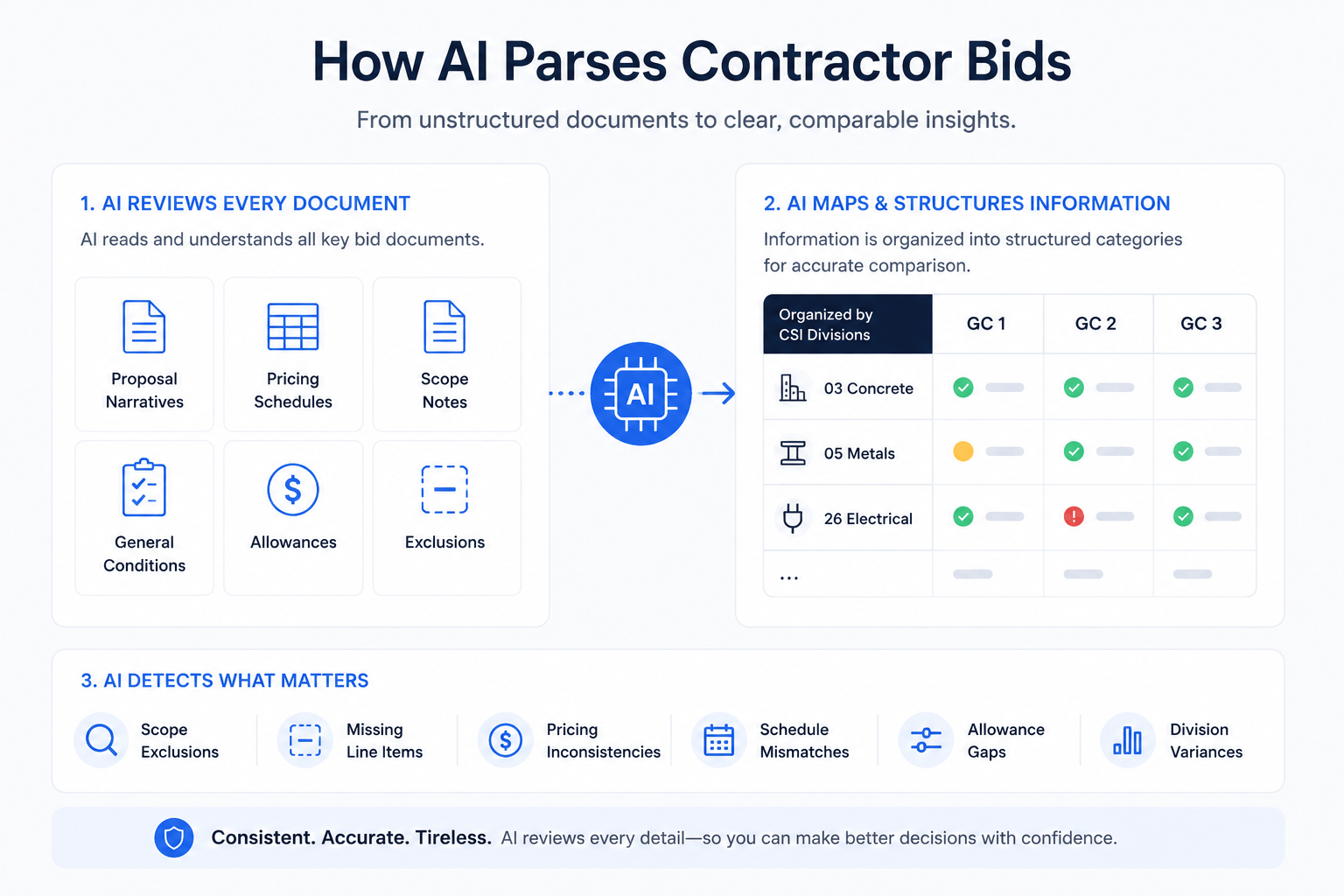
Once processing begins, AI reviews every uploaded document.
This usually includes:
-
Proposal narratives
-
Pricing schedules
-
Scope notes
-
General conditions
-
Allowances
-
Exclusions
The system then maps the information into structured categories.
Most workflows organize comparisons using CSI divisions.
What AI Detects Well
AI performs especially well at identifying:
-
Scope exclusions
-
Missing line items
-
Pricing inconsistencies
-
Schedule mismatches
-
Allowance gaps
-
Division variances
Unlike manual review, AI does not become fatigued after reading dozens of pages.
That consistency becomes valuable on larger projects with multiple contractors and extensive bid documentation.
Reviewing the Leveled Bid Comparison
The first major deliverable is usually the leveled bid comparison workbook.
This workbook compares pricing across every CSI division.
Each contractor receives:
-
Division pricing
-
Notes
-
Exclusion comments
-
Variance analysis
This creates a true apples-to-apples comparison.
Common Red Flags AI Identifies
AI frequently flags:
-
Unrealistic schedules
-
Missing low-voltage scope
-
Weak general conditions
-
Incomplete life safety pricing
-
Aggressive allowances
-
Missing temporary protections
These issues may not appear obvious during a quick manual review.
However, they become highly visible once all bids are standardized into the same structure.
Understanding the Scope Gap Matrix
The scope gap matrix is often the most valuable output. This section identifies every missing scope item and estimates the cost required to equalize each contractor’s bid.
In addition, many multifamily developers combine AI cost estimating tools with bid leveling workflows to create more accurate equalization adjustments before contract award.
Typical Scope Gap Categories
| Scope Gap | Potential Risk |
|---|---|
| Low-voltage exclusions | Future owner cost |
| Fire/life safety allowances | Pricing uncertainty |
| Underpriced general conditions | Schedule overrun risk |
| Missing site work | Change orders |
| Incomplete permitting scope | Delays and soft costs |
The matrix transforms headline pricing into equalized pricing. That often changes the ranking of the bids entirely.
A low bidder may become significantly less attractive once the missing scope is added back into the analysis.
Unbalanced Line Item Analysis
AI also identifies line items that vary significantly from competing bids.
These are often called unbalanced line items.
For example:
-
One contractor may heavily underprice drywall
-
Another may overprice furnishings
-
A third may underbudget temporary protections
Large deviations usually require clarification meetings.
Why This Matters
Unbalanced bids may indicate:
-
Scope misunderstandings
-
Pricing mistakes
-
Aggressive bidding strategies
-
Future change-order exposure
AI organizes these variances automatically, allowing developers to prioritize contractor follow-up conversations more efficiently.
Risk-Weighted Contractor Recommendations
The final deliverable is often a recommendation memo.
This combines:
-
Equalized pricing
-
Schedule analysis
-
Scope completeness
-
Risk assessment
-
Contractor ranking
The recommendation is usually far more useful than simply reviewing raw bid totals. For example, understanding the broader CRE underwriting process helps development teams evaluate how contractor pricing decisions impact overall project feasibility and investor returns.
What Strong Recommendation Memos Include
Most recommendation reports contain:
-
Executive summaries
-
Equalized bid tables
-
Scope concerns
-
Schedule risk analysis
-
Clarification requests
-
Suggested negotiation items
This creates a cleaner decision-making process for:
-
Investment committees
-
Development partners
-
Lenders
-
Ownership groups
What AI Gets Right
AI performs extremely well in repetitive document analysis. If you want a fast overview of how AI is changing underwriting and construction analysis across CRE, this short breakdown explains the core workflows clearly.
Major Strengths
Consistency: AI reviews every page with the same attention level.
Speed: Large bid comparisons can be completed in minutes instead of days.
Structured Organization: The output is often cleaner than manual spreadsheets.
Scope Identification: AI is very effective at spotting exclusions and inconsistencies.
Reporting: Recommendation memos are usually presentation-ready with minimal editing.
Where AI Still Falls Short
AI is powerful, but it is not a replacement for construction expertise.
Missing Drawings Create Limitations
Without plan sets, AI can only compare bids against each other. If every contractor excludes the same item, AI may not recognize the missing scope.
Cost Estimates Are Approximate
Equalization costs are directional estimates. Independent estimators may produce different numbers.
Construction Judgment Still Matters
AI can flag aggressive schedules. However, experienced developers still need to decide whether those schedules are realistic for the specific market and project type.
Best Practices for AI Bid Leveling
The strongest workflows combine AI efficiency with human oversight.
Include Construction Drawings
Plans improve scope validation significantly.
Use Detailed Prompt Instructions
Specific deliverables create better output.
Review Initial Parsing Carefully
Always verify headline totals before analysis continues.
Validate Equalization Costs
AI estimates should still be reviewed by experienced teams.
Use AI as an Internal Tool
Most developers use the output internally rather than sharing raw AI reports directly with contractors.
AI Bid Leveling Beyond Multifamily Development
These workflows are not limited to large apartment projects.
AI bid leveling also works for:
-
Industrial developments
-
Office renovations
-
Retail construction
-
Hospitality projects
-
Subcontractor comparisons
-
Property management vendor bids
The underlying process remains the same:
-
Standardize scope
-
Compare pricing
-
Identify exclusions
-
Evaluate risk
That flexibility makes AI bid leveling useful across nearly every construction-related CRE workflow.
Build Smarter Construction Workflows
AI bid leveling is helping developers reduce construction risk, improve contractor analysis, and identify scope gaps before change orders impact the project budget. Instead of relying only on headline bid totals, CRE teams can now use structured AI workflows to create more accurate contractor comparisons and faster preconstruction decision-making.
The AI for CRE Collective includes 600+ CRE professionals actively testing AI workflows for development, underwriting, acquisitions, construction management, and project analysis. If you want practical CRE AI workflows and real implementation examples, subscribe to the newsletter and stay current with how AI is reshaping commercial real estate operations.
Conclusion
Bid leveling has always been one of the most important parts of construction risk management. It has also been one of the most time-consuming AI changes that has undergone dramatic process changes.
Instead of spending days reviewing contractor bids manually, developers can now generate structured comparisons, identify scope gaps, evaluate pricing inconsistencies, and produce recommendation memos in a fraction of the time.
The technology does not replace experienced development teams. However, it significantly improves operational efficiency and reduces the likelihood of overlooking expensive construction risks.
For developers managing multiple bids across large projects, AI bid leveling is quickly becoming one of the highest-ROI workflows in commercial real estate development.
FAQs Regarding AI Bid Leveling for CRE Development
What is AI bid leveling in commercial real estate development?
AI bid leveling is the process of using artificial intelligence to compare contractor bids, identify scope gaps, and normalize pricing across multiple proposals. Instead of manually reviewing hundreds of line items, developers can use AI tools to organize schedules of values, detect exclusions, and generate structured comparison reports.
AI bid leveling usually helps teams:
-
Compare bids across CSI divisions
-
Identify missing scope items
-
Flag unrealistic schedules
-
Detect unbalanced pricing
-
Create recommendation memos
The biggest advantage is speed. Traditional bid leveling can take several days for a large multifamily or mixed-use project. AI workflows can reduce that process to under an hour while still producing highly detailed analysis. However, experienced construction oversight is still necessary to validate assumptions and contractor risk.
Why is bid leveling important before awarding a construction contract?
Bid leveling helps developers compare contractor proposals fairly before signing a construction agreement. Without leveling, teams often compare only the total bid amount instead of evaluating the actual scope included in each proposal.
A lower bid may exclude:
-
Low-voltage systems
-
Site utilities
-
Fire and life safety
-
Temporary protections
-
General conditions
Those exclusions usually return later as change orders during construction. That increases the total project cost and creates schedule delays.
Proper bid leveling helps developers:
-
Reduce owner risk
-
Identify scope inconsistencies
-
Improve contractor negotiations
-
Prevent hidden costs
-
Create apples-to-apples comparisons
The process is especially important on large multifamily, industrial, and mixed-use projects where missing scope items can create millions of dollars in overruns.
What documents are needed for AI bid leveling?
Most AI bid leveling workflows require contractor bid packages and supporting construction documents. The stronger the input data, the more accurate the output becomes.
Typical required documents include:
-
Proposal narratives
-
Schedule of values (SOV)
-
Bid alternates
-
Clarification letters
-
Addenda
-
Construction drawings
-
Project specifications
Construction drawings are especially valuable because AI can cross-reference contractor pricing against the actual scope shown in the plans.
Without drawings, AI compares bids against each other. With drawings, the system can also identify scope items missing across all contractors.
Most CRE teams organize all documents into a single project folder before uploading them into the AI workflow.
Can AI identify construction scope gaps accurately?
AI is very effective at identifying construction scope gaps, especially when reviewing multiple contractor proposals simultaneously. The system compares inclusions, exclusions, allowances, and pricing structures across all bids.
AI commonly detects:
-
Missing scope categories
-
Incomplete life safety coverage
-
Low-voltage exclusions
-
Underpriced general conditions
-
Schedule inconsistencies
-
Allowance-heavy pricing
The technology performs particularly well because it reviews every document line-by-line without fatigue.
However, AI accuracy improves significantly when construction drawings are included. If every contractor excludes the same scope item, AI may not flag it unless it can compare the bids against the actual plans.
Most developers still review major findings manually before relying on final recommendations.
How does AI compare contractor schedules and pricing?
AI analyzes contractor schedules and pricing by organizing proposal information into standardized categories. Most systems use CSI divisions to align bids side-by-side.
The analysis typically includes:
-
Division pricing comparisons
-
Schedule assumptions
-
General conditions
-
Allowances
-
Exclusions
-
Equalization adjustments
AI also calculates variances between contractors to identify unusually high or low line items.
For example, if one contractor prices general requirements substantially below competitors, the system may flag the schedule as unrealistic or structurally underfunded.
This allows developers to focus on high-risk areas quickly instead of manually reviewing every spreadsheet. The final output usually includes equalized totals that provide a more realistic project cost comparison.
What is a scope gap matrix in bid leveling?
A scope gap matrix is a structured comparison table that identifies missing or excluded work across contractor bids. It also estimates the cost required to equalize each proposal to the same scope standard.
The matrix usually includes:
-
Excluded scope items
-
Estimated equalization costs
-
Owner risk commentary
-
Contractor-specific notes
-
Source references
This analysis is one of the most important parts of bid leveling because it reveals whether a low bidder is truly cheaper or simply excludes major project scope.
For example, a contractor may exclude low-voltage systems or carry life safety as an allowance only. Once those costs are added back into the proposal, the bid ranking may change significantly.
The matrix helps developers reduce future change-order exposure before contract award.
Can AI replace construction managers or owners’ representatives?
AI can improve construction analysis workflows, but it does not replace experienced construction professionals. The technology is strongest when handling repetitive document review and structured comparisons.
AI helps with:
-
Bid organization
-
Scope comparisons
-
Pricing analysis
-
Schedule review
-
Recommendation memos
However, experienced teams still handle:
-
Contractor negotiations
-
Constructability reviews
-
Schedule validation
-
Risk assessment
-
Final award decisions
Construction professionals also apply local market knowledge that AI may not fully understand. For example, determining whether a 13-month podium construction schedule is realistic often requires direct field experience.
Most successful workflows combine AI efficiency with human construction oversight.
What are unbalanced line items in construction bids?
Unbalanced line items are pricing categories that vary significantly from competing contractor bids. These variances often indicate hidden scope gaps, pricing mistakes, or aggressive bidding strategies.
Examples include:
-
Extremely low drywall pricing
-
Overpriced furnishings
-
Underfunded general conditions
-
Missing temporary protections
AI systems usually compare each line item against the median or average pricing across all contractors. Large deviations are automatically flagged for clarification.
Unbalanced bids create risk because contractors may later attempt to recover those costs through change orders or schedule extensions.
Developers typically use the flagged items as discussion points during preconstruction meetings to better understand contractor assumptions and pricing strategy.
How accurate are AI-generated recommendation memos?
AI-generated recommendation memos are usually very useful as starting points for construction decision-making. The reports often summarize:
-
Equalized bid totals
-
Scope concerns
-
Schedule risks
-
Contractor rankings
-
Clarification requests
-
Suggested negotiation items
The structure is typically professional and presentation-ready. Many developers use the memo internally for partner reviews or investment committee discussions.
However, the recommendations should still be reviewed carefully because AI may not fully understand local market conditions, labor availability, or contractor reputation.
The strongest results usually come when experienced development teams combine AI-generated reports with their own project knowledge and independent construction review before making award decisions.
What types of CRE projects benefit most from AI bid leveling?
AI bid leveling works across nearly every construction-related commercial real estate project. The biggest advantages usually appear on projects with large bid packages and multiple contractors.
Common use cases include:
-
Multifamily development
-
Industrial construction
-
Office repositioning
-
Retail redevelopment
-
Hospitality projects
-
Mixed-use developments
The workflow also works for subcontractor comparisons and property management vendor proposals.
Larger projects benefit the most because the document volume becomes difficult to review manually. AI significantly reduces the time required to organize pricing, compare scope, and identify exclusions.
As construction costs continue to rise, more CRE teams are using AI workflows to improve preconstruction analysis and reduce risk before contract execution.