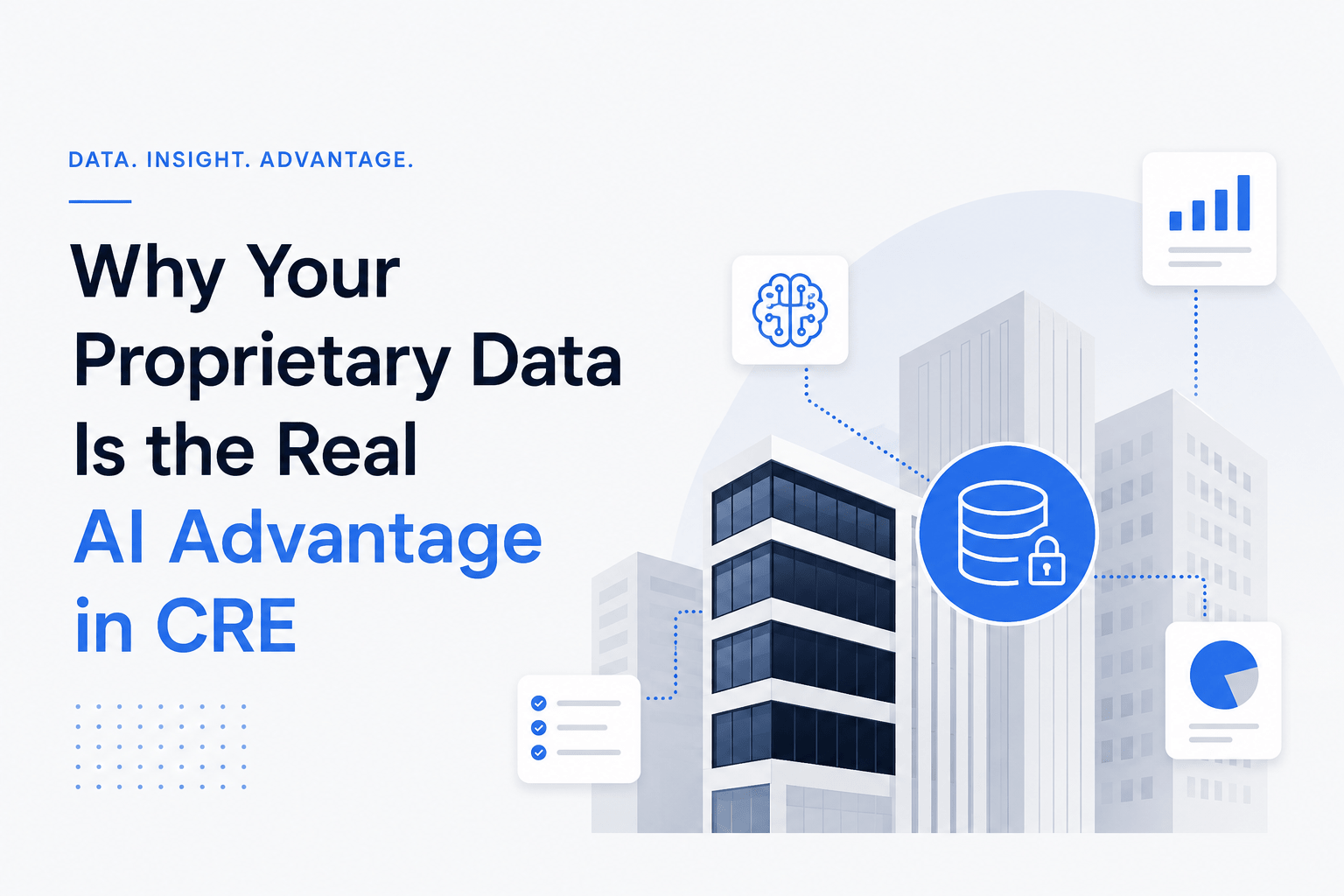
Why Your Proprietary Data Is the Real AI Advantage in CRE
Artificial intelligence is changing commercial real estate faster than most professionals expected. New tools appear every month. Existing platforms become more powerful. Tasks that once required hours can now be completed in minutes. Yet there is one reality many CRE professionals are missing. The real competitive edge is not the AI tool itself. It is the information behind it. Today, nearly every investor, broker, developer, lender, and asset manager can access powerful AI systems. As a result, the firms building a proprietary data AI advantage are creating a lead that competitors cannot easily replicate.
While many organizations focus on prompts and software subscriptions, the most forward-thinking firms are organizing their internal knowledge, deal history, market intelligence, and operational data into systems that AI can understand and use.
Commercial real estate has always been an information business. The professionals who possess better information often make better decisions. AI amplifies this reality. Instead of replacing expertise, AI increases the value of proprietary knowledge. The organizations that successfully connect their data to AI systems will unlock insights, efficiencies, and opportunities that generic AI alone cannot provide.
The AI Revolution Is Creating a New Competitive Landscape
Commercial real estate has entered a new technological era. Just a few years ago, AI adoption was limited. Most CRE professionals relied on spreadsheets, email, and traditional software platforms. Today, AI can review leases, summarize investment memos, analyze financial statements, draft marketing content, and assist with underwriting.
The technology is impressive. However, something important is happening beneath the surface. For readers looking for a broader view of how technology is reshaping the industry, our guide on AI in commercial real estate explores the tools, workflows, and trends driving adoption across CRE firms today.
AI Tools Are Becoming Commodities
Historically, technology advantages lasted for years. Today, they often last months. Large AI providers are rapidly improving their products. Features that once differentiated one platform quickly appear elsewhere. Costs continue to decline while accessibility increases.
As a result:
-
AI capabilities are becoming standardized.
-
More professionals have access to advanced models.
-
Competitive advantages based solely on software are shrinking.
-
Tool selection matters less than information quality.
This trend creates an important question. If everyone can access similar AI tools, what creates separation? The answer is data.
The Shift From Tool Advantage to Data Advantage
Think about commercial real estate investing. Two investors can purchase the same financial modeling software. Yet one consistently outperforms the other.
Why?
Because software does not create expertise. Knowledge does. The same principle applies to AI. AI becomes significantly more valuable when it can access information specific to your business. That is where the proprietary data AI advantage emerges.
Why This Matters Now
The organizations that begin organizing data today are creating a compounding asset. Every deal reviewed, every property analyzed. And every broker conversation.
Every operating report. Each piece of information increases future AI effectiveness.
Firms that delay implementation risk falling behind competitors who are already building institutional intelligence systems.
| Competitive Factor | Easy to Copy | Long-Term Advantage |
|---|---|---|
| AI Software | Yes | Low |
| AI Prompts | Yes | Low |
| AI Workflows | Somewhat | Medium |
| Proprietary Data | No | High |
| Institutional Knowledge | No | Very High |
Understanding the Proprietary Data AI Advantage
To understand why proprietary information matters, it helps to define what proprietary data actually means. This example shows what happens when years of transaction history become part of the underwriting process. It is one of the clearest demonstrations of how proprietary data can become a competitive advantage.
What Is Proprietary Data?
Proprietary data refers to information that is owned, collected, and controlled by a business. Unlike public information, proprietary data is not readily available to competitors.
Examples in CRE include:
-
Historical acquisitions
-
Internal underwriting models
-
Rent roll performance
-
Operating statements
-
Tenant communications
-
Property inspection reports
-
Broker relationships
-
Vendor databases
-
Financing records
-
Market observations
This information reflects real-world experience.
That experience is extremely valuable.
Why AI Needs Context
Generic AI models are trained on public information. They understand concepts, they understand language, and they understand patterns.
However, they do not understand your business. Without context, AI can only provide generalized responses.
For example, asking an AI:
“Should I acquire this industrial property?”
will generate a broad answer.
But connecting AI to:
-
Your investment criteria
-
Historical acquisitions
-
Existing portfolio
-
Return thresholds
-
Financing preferences
creates a much more useful result. The difference is context.
Direct Answer
The proprietary data AI advantage comes from combining powerful AI systems with unique business information that competitors cannot access, creating better insights, decisions, and automation opportunities.
Most Commercial Real Estate Data Is Sitting Unused
Many CRE firms already possess the information needed to build a powerful AI advantage. The challenge is organization. Most data remains fragmented across multiple systems.
Where Valuable Data Typically Lives
Commercial real estate companies often store information in:
-
Email inboxes
-
Shared drives
-
Property management software
-
CRM platforms
-
Excel workbooks
-
PDFs
-
Investment memos
-
Local folders
-
Cloud storage systems
Each system contains valuable information.
Unfortunately, AI cannot effectively use information that remains disconnected.
The Hidden Cost of Fragmentation
Data fragmentation creates several challenges.
-
First, information becomes difficult to find.
-
Second, institutional knowledge remains trapped inside individual employees.
-
Third, teams repeatedly perform the same research.
-
Fourth, decision-making slows.
These inefficiencies create high costs over time.
Knowledge Loss Is a Growing Problem
Many organizations underestimate the value of institutional knowledge. When experienced employees leave, they often take years of expertise with them. Important insights disappear.
Relationships weaken. Historical context becomes inaccessible. An organized AI-ready knowledge system helps preserve that expertise. Instead of relying on memory, businesses can capture and retain valuable information.
Examples of Untapped Data Assets
Consider the information already available within most CRE firms:
Deal Pipelines
Every evaluated opportunity contains lessons.
Even rejected deals provide useful insights.
Property Performance Records
Historical financials reveal trends.
They show what worked and what failed.
Market Research
Years of market observations often remain buried in reports and presentations.
Communication History
Broker and lender conversations frequently contain valuable intelligence.
Most firms never systematically organize this information.
| Untapped Data Source | Potential AI Value |
|---|---|
| Deal History | Investment comparisons |
| Financial Statements | Performance forecasting |
| Broker Notes | Market intelligence |
| Lease Data | Tenant analysis |
| Vendor Records | Operational efficiency |
| Investment Memos | Risk assessment |
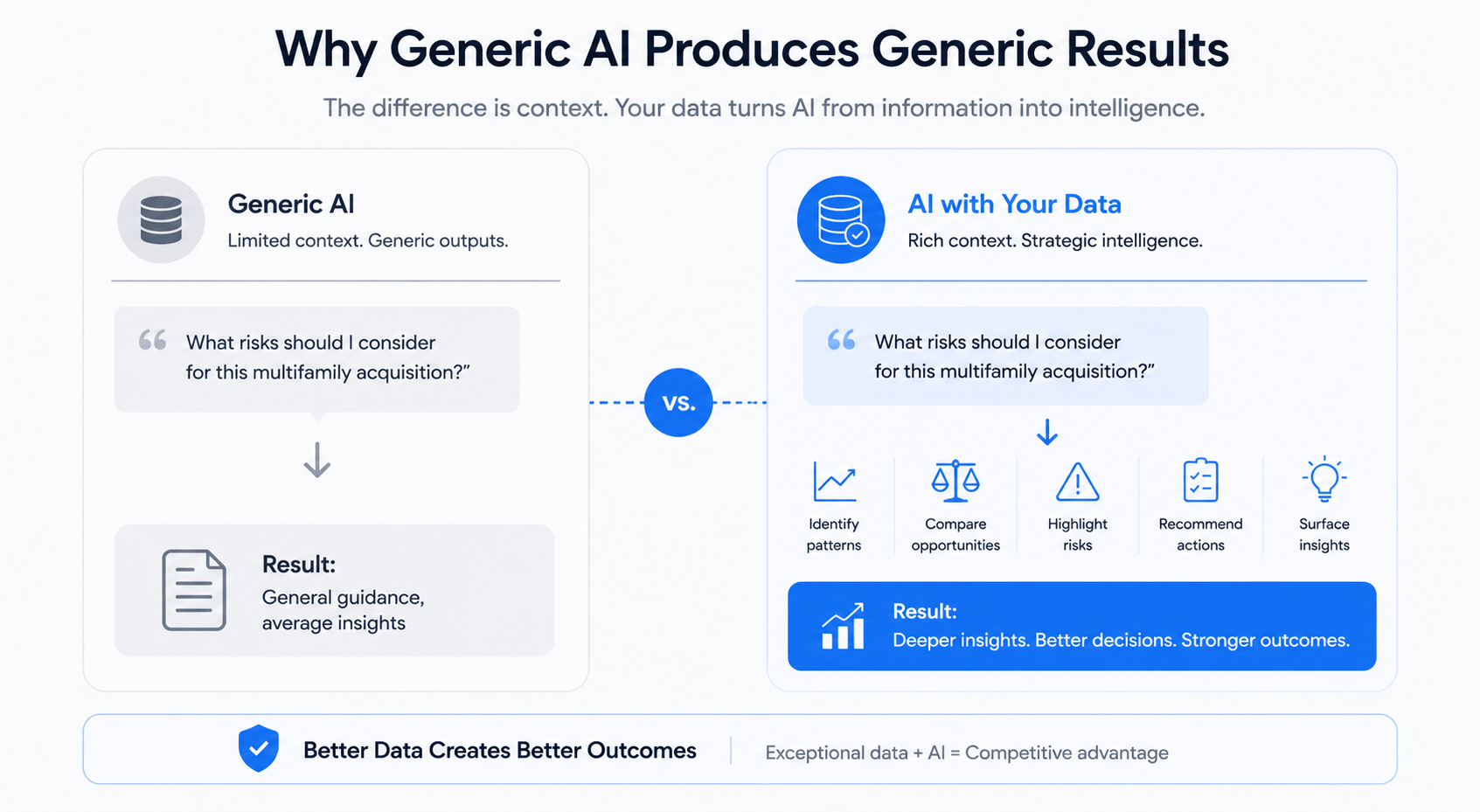
Why Generic AI Produces Generic Results
Many organizations expect AI to generate transformative insights immediately. Instead, they receive average results. The reason is simple. Generic AI produces generic outputs.
For example, firms that organize operating statements and rent rolls into clean underwriting models give AI far more context than firms relying solely on public market information.
The Context Problem
Imagine asking AI:
“What risks should I consider for this multifamily acquisition?”
Without access to your portfolio, AI provides general guidance.
Now imagine AI has access to:
-
Similar acquisitions
-
Historical occupancy trends
-
Previous underwriting assumptions
-
Internal risk assessments
-
Market-specific data
The answer becomes dramatically more valuable.
From Information Retrieval to Strategic Intelligence
The goal is not simply faster access to information. The goal is enhanced decision-making.
AI connected to proprietary information can:
-
Identify patterns
-
Compare opportunities
-
Highlight risks
-
Recommend actions
-
Surface hidden insights
This transforms AI from a productivity tool into a strategic asset.
Better Data Creates Better Outcomes
Organizations often focus on improving AI models. In reality, improving data frequently generates greater returns. An average AI model with exceptional data often outperforms an advanced model with poor data.
That principle will become increasingly important as AI tools continue to converge.
Building a Second Brain for Your CRE Business
The concept of a second brain has gained significant attention in recent years.
In commercial real estate, the idea is especially powerful.
What Is a Second Brain?
A second brain is a centralized knowledge system that stores and organizes information so both humans and AI can access it efficiently. Think of it as a digital extension of your organization’s collective knowledge.
Instead of searching through dozens of systems, information becomes available through a single interface.
Components of a CRE Second Brain
A comprehensive CRE knowledge system might include:
-
Acquisition history
-
Asset management records
-
Market reports
-
Property documents
-
Lease abstracts
-
Construction records
-
Financing information
-
Operating statements
-
Meeting notes
-
Vendor contacts
Benefits of a Centralized System
A properly organized knowledge system creates several advantages.
-
Faster Decisions
-
Teams spend less time searching for information.
-
Better Consistency
-
Processes become standardized.
-
Stronger Collaboration
-
Knowledge becomes accessible across departments.
-
Improved AI Performance.
AI gains access to richer contextual information.
Example Workflow
Imagine receiving a new acquisition opportunity.
Instead of manually gathering information, AI could:
-
Identify similar historical transactions.
-
Review prior underwriting assumptions.
-
Compare financial performance.
-
Analyze market trends.
-
Generate a recommendation summary.
Tasks that once consumed hours become significantly faster.
| Second Brain Feature | Business Benefit |
|---|---|
| Centralized Documents | Faster retrieval |
| Searchable Knowledge | Reduced research time |
| Historical Comparisons | Better investments |
| AI Integration | Higher productivity |
| Knowledge Preservation | Lower dependency risk |
Why Owning Your Data Matters More Than Owning a Platform
One of the biggest strategic mistakes businesses can make is becoming dependent on a single AI vendor. The AI market is changing rapidly. Platforms evolve constantly.
The Vendor Dependency Problem
When all organizational knowledge resides within one platform, several risks emerge.
These include:
-
Pricing changes
-
Feature removals
-
Vendor restrictions
-
Data migration challenges
-
Platform discontinuation
Businesses lose flexibility.
Staying Model-Agnostic
A smarter approach involves maintaining ownership of data.
Many organizations store information in:
-
Structured databases
-
Open file systems
-
Knowledge repositories
-
Markdown files
-
Document management platforms
This approach allows multiple AI systems to access the same information. If a superior model appears tomorrow, the transition becomes easier.
Future-Proofing Your AI Strategy
Technology will continue changing. Data remains. Organizations should focus on building durable information assets rather than becoming overly attached to specific tools.
Direct Answer
The most sustainable AI strategy is owning your data while remaining flexible about which AI platforms access it.
Creating an AI-Ready Data Layer
Building an AI-ready organization does not require a massive technology project. It requires structure.
Step 1: Identify High-Value Information
Start with the data that influences decisions.
Examples include:
-
Property financials
-
Acquisition analyses
-
Market research
-
Lease information
Step 2: Standardize Documentation
Consistency improves AI usability. Standard formats reduce confusion.
Step 3: Centralize Information
Create a single source of truth. Reduce fragmentation wherever possible.
Step 4: Improve Searchability
Information has little value if nobody can find it. Tagging, metadata, and organization become critical.
Step 5: Establish Maintenance Processes
An AI-ready system must remain current. Regular updates ensure long-term value.
| Data Layer Stage | Primary Objective |
|---|---|
| Collection | Gather information |
| Standardization | Create consistency |
| Storage | Centralize knowledge |
| Searchability | Improve access |
| Automation | Increase efficiency |
How Proprietary Data Transforms Every CRE Function
The benefits extend across the entire organization.
Acquisitions
AI can compare opportunities against historical transactions.
Benefits include:
-
Faster screening
-
Improved underwriting
-
Better risk analysis
Asset Management
Property performance becomes easier to monitor.
Benefits include:
-
Trend analysis
-
Budget forecasting
-
Operational improvements
Brokerage
Relationship intelligence becomes more accessible.
Benefits include:
-
Better prospecting
-
Improved client service
-
Faster research
Lending
Financial institutions can leverage proprietary information to improve decision-making.
Benefits include:
-
Better risk evaluation
-
Faster approvals
-
Stronger portfolio management
Development
Developers gain access to valuable historical project data.
Benefits include:
-
Cost forecasting
-
Vendor evaluation
-
Project benchmarking
The Next Evolution: Automated Intelligence
The future of AI in CRE extends beyond question-and-answer systems. Automation represents the next major opportunity.
What Automated Intelligence Looks Like
Imagine an AI workflow that:
-
Monitors incoming deals
-
Extracts key property details
-
Reviews financial information
-
Compares opportunities
-
Updates databases automatically
-
Generates reports
This level of automation is becoming increasingly realistic.
Why Early Adoption Matters
Data advantages compound. Every document organized improves future performance, and every workflow automated increases efficiency. Every insight captured strengthens institutional intelligence.
Organizations that begin today will benefit from years of accumulated knowledge. Competitors starting later cannot immediately replicate that advantage.
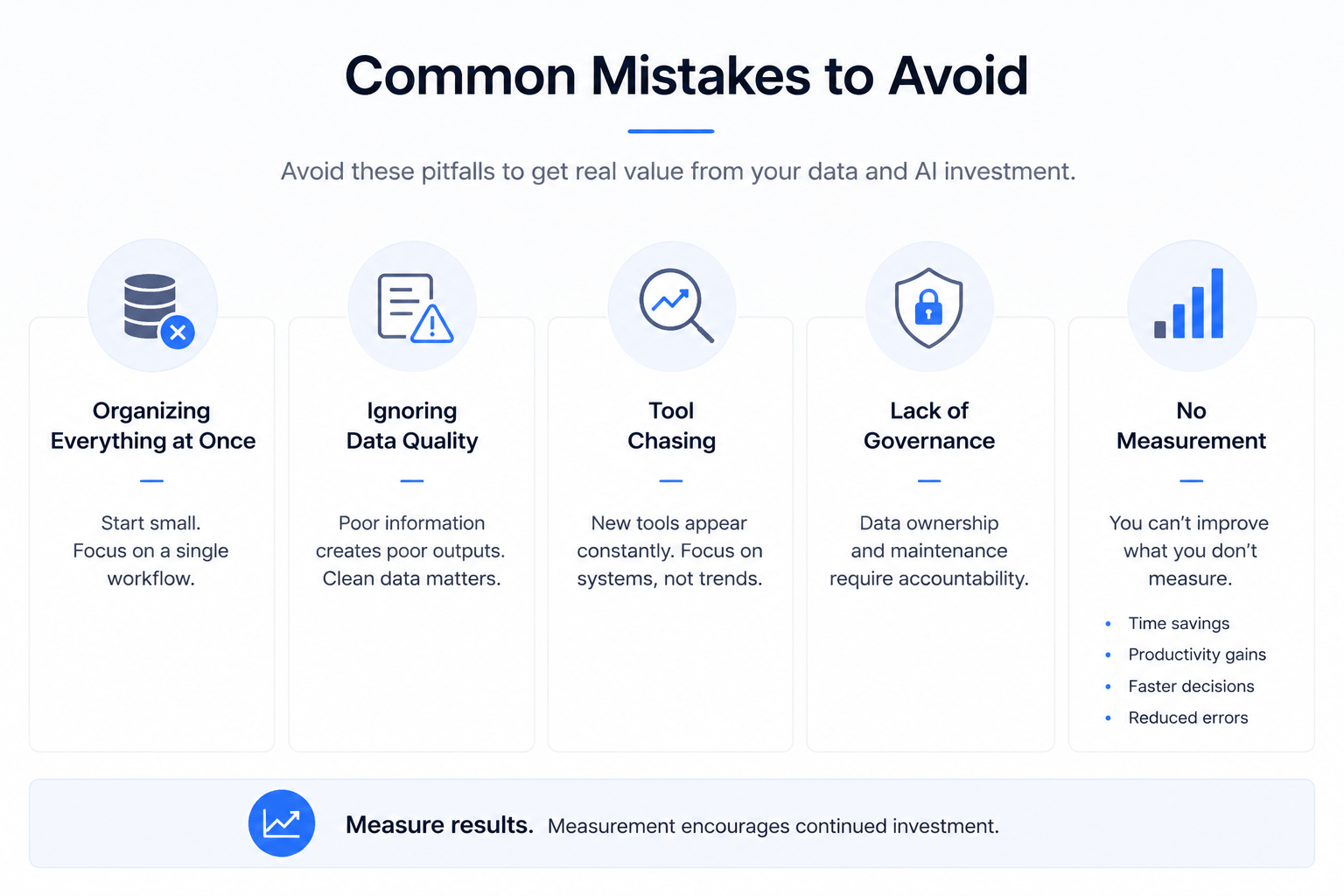
Common Mistakes to Avoid
Organizing Everything at Once
Start small. Focus on a single workflow.
Ignoring Data Quality
Poor information creates poor outputs. Clean data matters.
Tool Chasing
New tools appear constantly. Focus on systems rather than trends.
Lack of Governance
Data ownership and maintenance require accountability.
No Measurement
Track results such as:
-
Time savings
-
Productivity gains
-
Faster decisions
-
Reduced errors
Measurement encourages continued investment.
How to Start This Week
Many firms delay implementation because they believe the project is too large. It is not. Choose one area.
Examples include:
-
Active portfolio
-
Contact database
-
Recent acquisitions
-
Market research library
-
Organize the information.
-
Standardize the structure.
-
Make it searchable.
-
Then connect AI.
-
The goal is progress, not perfection.
-
Small improvements compound over time.
The organizations building AI-ready knowledge systems today are laying the foundation for long-term competitive advantage.
Turn Your CRE Data Into a Competitive Advantage
The commercial real estate firms seeing the strongest AI results are not necessarily using different tools. Instead, they are building systems that allow AI to access proprietary business knowledge. As more organizations adopt AI, the separation between leaders and followers will increasingly depend on how effectively information is organized, maintained, and leveraged. The members of the AI for CRE Collective are already applying these concepts across acquisitions, asset management, lending, and brokerage operations.
If you want proven frameworks for building your own AI-ready data layer, connect with a community of 600+ CRE professionals actively implementing these strategies. You can also subscribe to the newsletter for practical workflows, implementation guides, and real-world examples designed specifically for commercial real estate professionals.
Conclusion
The commercial real estate industry is entering a new era of competition. Access to AI tools is no longer enough. As AI capabilities become increasingly available to everyone, the true source of differentiation shifts toward proprietary information.
The firms creating a proprietary data AI advantage are building systems that transform historical knowledge into actionable intelligence. They are preserving institutional expertise, improving decision-making, increasing productivity, and preparing for a future where automation becomes standard.
The opportunity already exists within most organizations. Years of deal history.
-
Operating statements.
-
Broker relationships.
-
Market intelligence.
-
Financial records.
Together, these assets form the foundation of a powerful AI strategy. The firms that start organizing their data today will create advantages that compound for years. The firms that wait may eventually discover that having access to the same AI tools was never enough.
FAQs Regarding Why Proprietary Data Is the Real AI Advantage in CRE
What is proprietary data in commercial real estate?
Proprietary data in commercial real estate refers to information that a company owns and collects through its operations. This can include historical deal data, underwriting assumptions, rent rolls, operating statements, broker relationships, tenant performance records, and internal market research. Unlike public data, proprietary information is unique to a business and can create a lasting competitive advantage when used effectively with AI.
Why is proprietary data more valuable than AI tools?
AI tools are becoming increasingly accessible, which means competitors can often use the same technology. Proprietary data, however, cannot be easily copied. While software platforms may be similar across the industry, each firm’s historical transactions, portfolio performance, and operational knowledge are unique. This makes proprietary data one of the most valuable long-term assets in a modern CRE business.
How does AI use proprietary data in commercial real estate?
AI uses proprietary data to provide more accurate and context-aware insights. Instead of generating generic responses, AI can analyze historical acquisitions, compare current opportunities against existing assets, identify operational trends, and support investment decisions based on real company experience. The more relevant data AI can access, the more useful its recommendations become.
What types of proprietary data should CRE firms organize first?
Most CRE firms should begin with high-value data sources that directly impact decision-making. These typically include deal histories, property financial statements, rent rolls, acquisition memos, market research reports, lender contacts, and broker communications. Organizing these datasets first often produces the fastest return on investment when implementing AI workflows.
What is an AI data layer in commercial real estate?
An AI data layer is a structured system that stores and organizes company information in a format that AI can easily access and analyze. It acts as the foundation for AI-powered workflows by connecting property records, financial data, operational documents, and institutional knowledge into a searchable environment that supports faster and more informed decision-making.
How can commercial real estate firms prepare their data for AI?
The first step is centralizing information that is currently spread across multiple systems. Firms should standardize file naming conventions, organize documents consistently, eliminate duplicate records, and establish a searchable repository. Once the data is structured and accessible, AI tools can begin delivering significantly more accurate and valuable outputs.
Can small commercial real estate firms benefit from proprietary data strategies?
Yes. Small firms often benefit even more because they can move faster and implement changes without large organizational barriers. By organizing historical deals, market research, and client relationships into an AI-ready system, smaller operators can improve productivity and compete more effectively against larger firms with greater resources.
What is a second brain for a commercial real estate company?
A second brain is a centralized knowledge management system that stores critical business information and makes it easily accessible. In commercial real estate, a second brain may contain acquisition histories, underwriting models, property records, market reports, and operational procedures. When connected to AI, it allows teams to retrieve information instantly and preserve institutional knowledge.
Why are AI-generated answers often too generic?
AI-generated answers become generic when the system lacks access to company-specific information. Most public AI models rely on broad datasets and general knowledge. Without proprietary data, they cannot understand a firm’s portfolio, investment criteria, operating history, or market experience. Providing AI with internal context dramatically improves the relevance and usefulness of its outputs.
What are the biggest mistakes CRE firms make when implementing AI?
Many firms focus exclusively on selecting AI tools while ignoring the quality and organization of their data. Other common mistakes include relying on fragmented systems, failing to document institutional knowledge, neglecting data governance, and expecting immediate results without building a structured information foundation. Successful implementation starts with data, not software.
Will proprietary data become more important as AI evolves?
Yes. As AI models continue improving and becoming more widely available, access to the technology itself will matter less. The primary differentiator will increasingly be the quality, depth, and organization of proprietary information. Firms with well-structured data assets will be able to generate insights and efficiencies that competitors cannot easily replicate.
How does proprietary data improve investment decision-making?
Proprietary data improves investment decisions by providing historical context that public information cannot offer. AI can analyze previous acquisitions, compare operating performance, evaluate market conditions, and identify trends based on actual company experience. This helps investors make more informed decisions while reducing reliance on assumptions and incomplete market data.