How to Use ChatGPT to Write Property Descriptions
Writing great property listings used to take hours, but today you can use ChatGPT to write property descriptions faster and more effectively than ever. Instead of struggling to find the right words, real estate agents can use ChatGPT to write property descriptions that highlight key features, attract buyers, and drive more showings in minutes.
Whether you are a solo real estate agent, a property manager, or part of a large brokerage, ChatGPT can help you create polished, compelling listings in minutes. This guide walks you through everything, from understanding why good descriptions matter to writing your first AI-powered listing to using advanced prompting strategies that get real results.
According to the National Association of Realtors, 97% of home buyers use the internet during their home search. That means your listing description is often the first impression a buyer gets. A weak description leads to fewer clicks. A strong one drives showings, offers, and faster closings.
“Real estate agents who use AI tools like ChatGPT are already saving 5–10 hours per week on content creation.” — HousingWire
Why Property Descriptions Matter More Than You Think
The First Impression Happens Online, Not in Person
Most buyers today start their search on platforms like Zillow, Realtor.com, or Redfin. They scroll through dozens of listings in a single session. Your listing description has about 8 to 10 seconds to grab their attention before they move on. This means every word counts. A well-written description does not just list features. It tells a story. It helps the buyer picture themselves cooking in that kitchen, relaxing on that patio, or walking their dog in that neighborhood. Emotional connection is what turns a casual browser into a serious buyer.
Studies show that listings with longer, more detailed descriptions sell for up to 1.5% more than listings with minimal copy. On a $400,000 home, that is an extra $6,000 in your client’s pocket, just from better writing. That is the power of words in real estate.
Common Mistakes Agents Make When Writing Listings
Many agents fall into the same traps when writing property descriptions. These mistakes make listings sound generic, boring, or even suspicious to buyers who have seen too many “cozy” homes and “motivated sellers.”
Here are the most common errors real estate agents make:
- Using overused buzzwords like ‘charming,’ ‘cozy,’ or ‘must-see’ without explaining why
- Listing features in a boring, robotic order with no storytelling or flow
- Forgetting to mention the neighbourhood, nearby schools, or commute access
- Writing descriptions that are too short and leave buyers with too many questions
- Using vague language instead of specific, measurable details like square footage or upgrades
ChatGPT solves all of these problems. When you give it the right information, it produces descriptions that are specific, emotional, and compelling. The key is knowing how to prompt it correctly, and that is exactly what this guide covers.
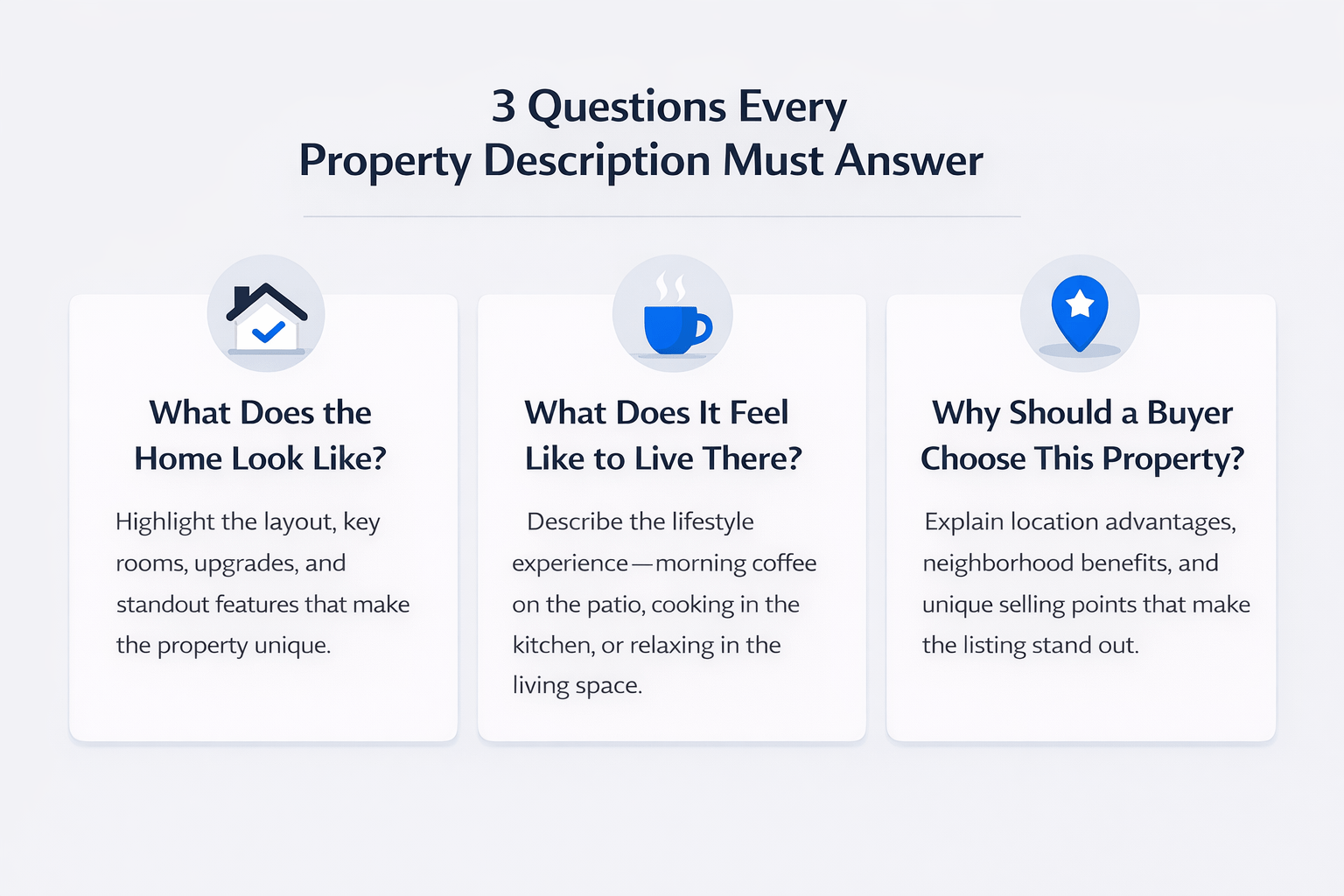
Pro Tip: The best real estate descriptions answer three questions: What does this home look like? What does it feel like to live here? Why should I buy this one over the others?
Getting Started: How ChatGPT Works for Real Estate
What Is ChatGPT and Why Should Real Estate Agents Use It?
ChatGPT is an AI writing tool created by OpenAI. It can write, edit, summarize, and generate content based on simple text instructions called ‘prompts.’ You do not need any coding skills or technical background to use it. If you can type a sentence, you can use ChatGPT. For real estate agents, ChatGPT is like having a professional copywriter on call 24/7. You give it the details about a property, and it turns those details into a polished, reader-friendly listing. You can even tell it to write in a specific tone, luxury, family-friendly, or investor-focused, and it will adjust accordingly.
The tool is available at chat.openai.com. The free version (GPT-3.5) works well for basic descriptions. The paid version, ChatGPT Plus at $20 per month, gives you access to GPT-4, which is significantly better at nuanced writing, longer descriptions, and following complex instructions.
There is also a dedicated tool built specifically for this: the Real Estate Property Description Generator on ChatGPT, a custom GPT trained to write real estate content with minimal prompting.
Setting Up ChatGPT for Maximum Real Estate Results
Before you write your first listing, take five minutes to set up ChatGPT correctly. This small investment saves you time on every future description. Follow these steps:
- Step 1: Create a free or paid account at chat.openai.com
- Step 2: Start a new conversation and set the context with a system-level instruction
- Step 3: Tell ChatGPT your role, your audience, and your preferred tone
- Step 4: Always provide complete, specific property details before asking for a description
- Step 5: Review, edit, and personalize the output before publishing
The table below summarizes the key steps for setting up ChatGPT effectively for real estate listing descriptions.
| Step | What To Do | Why It Matters |
|---|---|---|
| Create an account | Sign up at chat.openai.com | Allows access to AI writing tools |
| Start a new conversation | Begin a fresh chat session | Keeps prompts organized |
| Set writing context | Tell ChatGPT you are a real estate agent | Improves output relevance |
| Provide property details | Include features, location, and buyer type | Produces more accurate descriptions |
| Review the output | Edit and verify facts before publishing | Ensures accuracy and compliance |
A simple context-setting prompt you can use at the start of every session looks like this: ‘You are an expert real estate copywriter. I will give you property details, and you will write a compelling MLS listing description in [X] words. Write in a [tone] voice aimed at [audience].’ This sets the stage. ChatGPT will remember this context for the rest of your conversation, so all your follow-up requests stay consistent. You can always adjust the tone or length of instructions mid-conversation if needed.
Step-by-Step Guide to Writing Property Descriptions with ChatGPT
Step 1 — Gather the Right Property Details Before You Prompt
The quality of your ChatGPT output depends entirely on the quality of information you give it. Garbage in, garbage out. Before you type your prompt, collect the following details about the property:
- Property type: single-family home, condo, townhouse, multi-family, commercial
- Bedrooms and bathrooms: exact count, including half baths
- Square footage: total living space and lot size
- Year built and any major renovations with dates
- Key features: kitchen upgrades, flooring, appliances, smart home tech
- Outdoor features: yard size, pool, deck, patio, garage
- Neighbourhood highlights: school districts, walkability, nearby parks, transit
- Unique selling points: views, natural light, custom finishes, and location
The more specific you are, the better the description. Instead of saying ‘updated kitchen,’ say ‘fully renovated kitchen with quartz countertops, a waterfall island, stainless steel Bosch appliances, and under-cabinet LED lighting.’ That specificity is what makes descriptions pop.
Step 2 — Write a Powerful Prompt Using the CPAP Formula
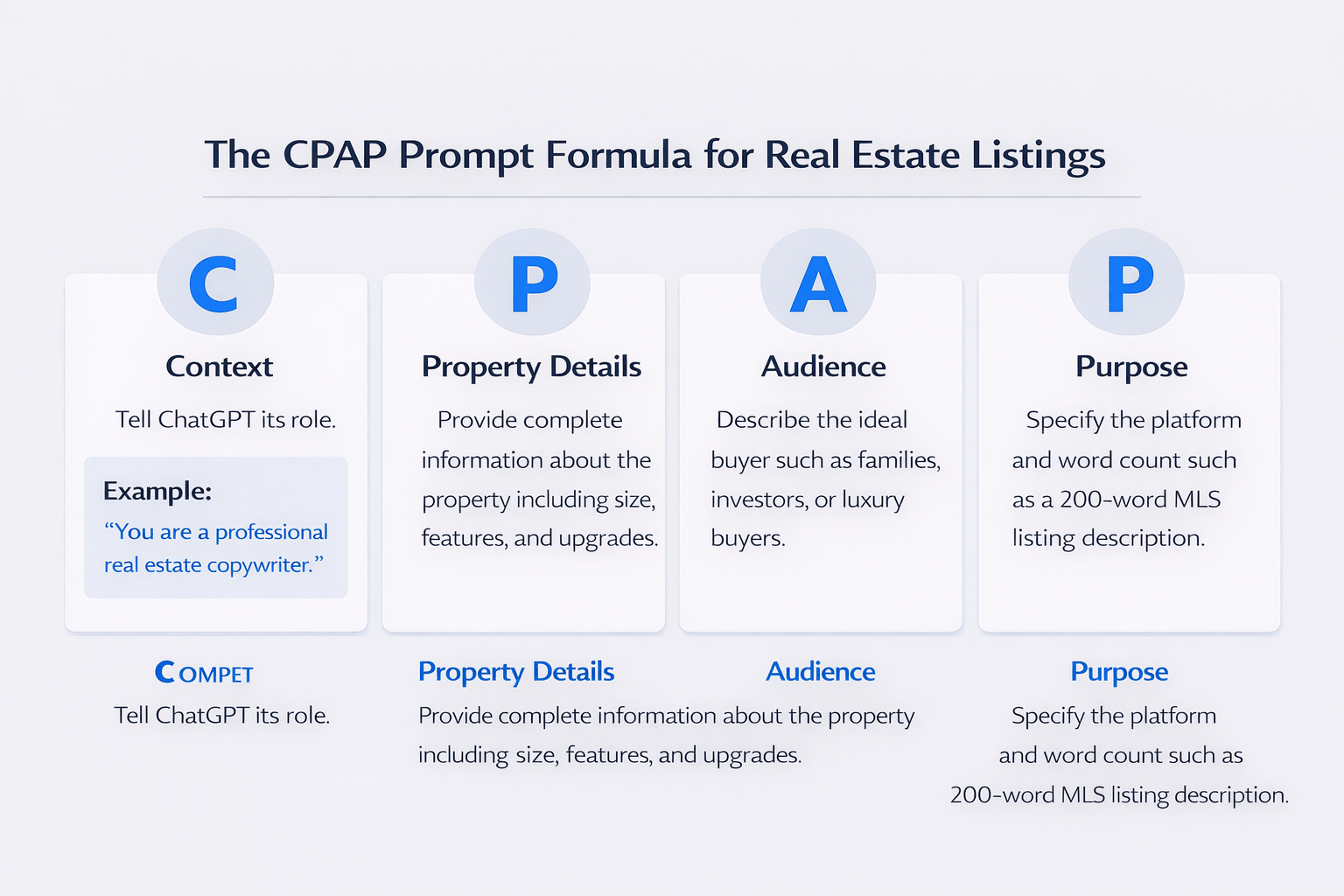
The CPAP Formula stands for Context, Property details, Audience, and Purpose. It is a simple framework for writing prompts that get great results every single time. Here is how it works:
Context: Tell ChatGPT who it is. | Property: Give full details. | Audience: Describe the ideal buyer. | Purpose: Specify the platform and word count.
Here is a complete example prompt using the CPAP Formula:
‘You are a professional real estate copywriter. Write a compelling 200-word MLS property description for a 4-bedroom, 3-bathroom single-family home in Austin, Texas. The home was built in 2019, has 2,400 sq ft, an open-concept layout, a chef’s kitchen with quartz countertops, a primary suite with spa bath, and a covered outdoor entertaining area with built-in BBQ. It is in the highly rated Westlake school district. Target buyers are families relocating from out of state who want move-in ready luxury.’
When you submit this kind of prompt, ChatGPT has everything it needs. The result is typically a description that reads like it was written by a seasoned professional — because, in a sense, it was. The AI has been trained on millions of examples of great real estate writing. For even more prompt ideas specifically for real estate, check out Nodalview’s list of 10 ChatGPT Prompts for Real Estate Agents, which includes prompts for listing descriptions, follow-up emails, social media posts, and more.
Step 3 — Review, Edit, and Add Your Personal Touch
ChatGPT is a starting point, not a finished product. Always review the output carefully. Check for accuracy first, and make sure every detail mentioned matches the actual property. AI occasionally adds or assumes details you did not provide.
Next, look for anything that sounds too generic. Replace vague phrases with specific ones. If ChatGPT wrote ‘a beautiful backyard,’ rewrite it as ‘a landscaped backyard with mature oak trees and a 400-square-foot composite deck.’ Specificity builds credibility and trust with buyers. Finally, add your local market knowledge. ChatGPT does not know that the coffee shop two blocks away is a neighbourhood institution, or that the school just won a state award. That personal insight is what separates an agent’s description from something any tool could generate. Add those details, and the description becomes truly powerful.
ChatGPT Prompt Comparison: Which Prompts Get the Best Property Descriptions?
Not all prompts are created equal. The table below compares different prompt styles, from weak to strong, showing exactly what kind of output you can expect from each approach. Use this as your quick reference guide every time you sit down to write a listing.
| Prompt Type | Example Prompt | Output Quality | Best Use Case | Time to Edit |
| Basic/Weak | ‘Write a property description for a 3-bed house.’ | Generic, vague, unusable | Never — too little information | 30+ minutes |
| Intermediate | ‘Write a 150-word MLS listing for a 3-bed, 2-bath home in Denver with a new kitchen and backyard.’ | Decent but lacks personality | Quick drafts needing heavy editing | 15–20 minutes |
| CPAP Formula | ‘You are a real estate copywriter. Write a 200-word luxury MLS listing for…’ (full details) | Strong, specific, emotional | Primary MLS listings | 5–10 minutes |
| Audience-Targeted | …same as above, but specifying ‘target first-time buyers on a budget.’ | Highly tailored and persuasive | Segmented marketing campaigns | 5 minutes |
| Tone-Specific | …same as CPAP but adding ‘Write in a warm, welcoming tone for families’ | Human, emotional, compelling | Lifestyle properties and family homes | 3–5 minutes |
| Multi-Platform | ‘Write three versions: 1 for MLS (200 words), 1 for Instagram (50 words), 1 for email (100 words)’ | Maximum efficiency, all channels | Full marketing campaigns | Under 5 minutes total |
As the table shows, the more detail and context you provide, the better your results. The CPAP Formula consistently delivers the best balance between quality and editing time. Audience-targeted and tone-specific prompts are worth the extra setup when you have a specific buyer persona in mind.
The multi-platform prompt is a game-changer for busy agents. Instead of writing separate content for your MLS listing, Instagram post, and email newsletter, you get all three in one ChatGPT session. This alone can save 2–3 hours per listing.
Advanced ChatGPT Strategies for Real Estate Professionals
Using ChatGPT to Write Luxury Property Descriptions
Luxury real estate requires a different writing style. Buyers in the high-end market expect elegance, exclusivity, and precision. They respond to words that evoke lifestyle, not just a list of features. ChatGPT handles this beautifully when you guide it correctly. For luxury properties, add these elements to your prompt: the architect or builder’s name if notable, designer finishes and brand names (Sub-Zero, Thermador, Waterworks), gated community or neighborhood prestige, views or waterfront access, and privacy features. Always ask for a ‘refined, sophisticated tone’ or ‘editorial style like a luxury magazine.’
Here is an example prompt for a luxury listing: ‘Write a 250-word luxury real estate description for a 6-bedroom, 7-bath oceanfront estate in Malibu, California. Built in 2022, the home features Venetian plaster walls, a chef’s kitchen with Sub-Zero refrigeration, a 1,200-bottle wine cellar, infinity pool, and private beach access. Write in an elevated, aspirational tone for ultra-high-net-worth buyers.’
For a deeper look at how AI is changing luxury real estate marketing, read this insightful analysis from HousingWire on ChatGPT for Real Estate.
Writing Descriptions for Challenging or Unusual Properties
Not every listing is a dream home. Sometimes you are selling a fixer-upper, a commercial property, an unusual layout, or a home in a less desirable location. These listings are actually where ChatGPT shines the brightest, because framing challenging properties requires creative writing skill. For fixer-uppers, tell ChatGPT to emphasize ‘investment potential,’ ‘solid bones,’ ‘opportunity for customization,’ and ‘priced to sell.’ For properties in transitioning neighbourhoods, ask it to focus on ’emerging area,’ ‘upcoming development,’ and ‘early buyer advantage.’ These framings are truthful and still compelling.
For unusual floor plans or property types, be very descriptive about what makes the space special. A converted warehouse becomes ‘an urban loft with soaring 18-foot ceilings and exposed brick.’ A small lot becomes ‘a low-maintenance lock-and-leave lifestyle property.’ ChatGPT helps you find the language that turns a perceived weakness into a selling point.
Remember: ChatGPT is not a magic wand. It cannot hide problems or mislead buyers. Your descriptions must be accurate and honest. Use it to communicate value clearly, not to obscure issues.
Creating a Content Library with ChatGPT for Your Real Estate Business
One of the smartest things you can do as a real estate professional is use ChatGPT to build a content library, a collection of templates, prompts, and description frameworks you can reuse and adapt for every listing type you regularly encounter.
Start by creating master prompt templates for your most common listing types. A template for 3-bedroom suburban homes, one for downtown condos, one for rural acreage, and one for commercial spaces. Save these in a Google Doc or Notion page. Each time you get a new listing of that type, copy the template, fill in the specific details, and run it through ChatGPT. Over time, you will build a system that lets you produce high-quality descriptions in under 10 minutes per listing. Combined with a tool like the AI for CRE Collective platform at
Over time, you will build a system that lets you produce high-quality descriptions in under 10 minutes per listing. Combine this with tools and resources from AI for CRE Collective to stay ahead of AI adoption in commercial real estate. The agents who build these systems now will have a massive competitive advantage as AI becomes the new standard in the industry.
Common Questions About Using ChatGPT for Property Descriptions
Is ChatGPT Content Accurate Enough to Use for MLS Listings?
Yes, but only if you verify every detail. ChatGPT generates text based on the information you provide. It does not have access to your MLS database, tax records, or inspection reports. If you tell it the home has a 2-car garage and it writes ‘spacious 2-car garage,’ that is accurate. But if it adds a detail you did not mention, like mentioning a finished basement when you never said the basement was finished, that is a problem.
Always treat ChatGPT output as a first draft. Read it carefully. Cross-check every factual claim against the property disclosure, your notes, and the MLS data sheet. Remove or correct anything inaccurate. The final description should be 100% truthful and defensible if a buyer questions a claim after purchase. The good news is that with a well-structured prompt, ChatGPT rarely adds unsupported claims. When you give it comprehensive, specific information, it focuses on what you provided rather than inventing details. This is another reason why detailed prompts are always better than vague ones.
How Do You Make ChatGPT Descriptions Sound More Human?
This is one of the most common concerns agents raise. AI writing can sometimes feel a little flat or formulaic. Here are five easy ways to make your ChatGPT descriptions sound more natural and human:
- Ask for a ‘conversational’ or ‘warm’ tone in your prompt
- Add a personal sentence or two at the end that reflects your voice or local knowledge
- Replace any passive voice sentences with active voice alternatives
- Read the description out loud. If it sounds robotic, ask ChatGPT to ‘rewrite in a more natural, spoken style.’
- Use the ‘Regenerate’ button to get a different version if the first one feels too stiff
You can also ask ChatGPT to ‘write this as if a friendly, knowledgeable local real estate agent is talking to a potential buyer.’ That simple instruction often produces a noticeably warmer and more authentic result. For visual learners, there is a great walkthrough on YouTube showing how to use ChatGPT for real estate property descriptions step by step, highly recommended for agents who are new to AI tools.
What Are the Limitations of ChatGPT for Real Estate Writing?
ChatGPT is powerful, but it is not perfect. Understanding its limitations helps you use it more effectively and avoid mistakes that could harm your reputation or your client’s transaction.
First, ChatGPT does not know your local market. It cannot tell buyers about the new Whole Foods opening nearby, the school district rankings this year, or the neighbourhood’s HOA history. You have to provide that context. The tool’s knowledge has a training cutoff, meaning it may not reflect very recent market conditions.
Second, ChatGPT can be repetitive if you do not vary your prompts. If you run the same basic prompt for every listing, you may notice patterns in the output — similar sentence structures, repeated phrases. To avoid this, rotate your prompts, ask for a ‘fresh’ version, or use different tone instructions for each listing.
Third, AI writing still lacks true emotional intelligence. It can produce emotional language, but it cannot genuinely feel what makes a home special. Your role as a professional is to bring that authentic human perspective. The best listing descriptions combine AI efficiency with human insight, and that combination is unbeatable.
Real Examples: Before and After ChatGPT Property Descriptions
Example 1 — Standard Suburban Home Transformation
Let us look at a real before-and-after comparison. Here is a typical agent-written description for a suburban family home before using ChatGPT:
BEFORE: ‘3 bed, 2 bath home in a good neighbourhood. Updated kitchen. Nice backyard. Close to schools. Won’t last long.’
Now here is what you get after using a well-structured ChatGPT prompt:
AFTER: ‘Welcome home to this beautifully updated 3-bedroom, 2-bathroom residence nestled in one of Naperville’s most sought-after neighbourhoods. The heart of the home is a chef-inspired kitchen featuring granite countertops, stainless steel appliances, and a custom tile backsplash that flows effortlessly into the open dining area. Step outside to your private backyard retreat — a spacious, tree-lined haven perfect for weekend gatherings or quiet morning coffee. Families will love the walkability to top-rated District 204 schools, with the elementary school just two blocks away. Move-in ready and priced to sell, this one checks every box.’
The second version is 92 words longer. It is specific, emotional, and informative. It answers the buyer’s key questions: What does it look like? What does it feel like? Why should I act now? That is the power of ChatGPT when used correctly.
Example 2 — Luxury Condo Description Upgrade
Here is another example, this time for a luxury downtown condo. The previous version is painfully common in high-end listings:
BEFORE: ‘Stunning luxury condo with amazing views. High-end finishes. Building amenities. Perfect for professionals.’
AFTER: ‘Perched on the 34th floor of downtown Chicago’s iconic Aqua Tower, this 2-bedroom, 2-bath residence offers unobstructed panoramic views of Lake Michigan and the city skyline. Indulge in a sophisticated lifestyle with wide-plank white oak hardwood floors, floor-to-ceiling windows, and a gourmet kitchen appointed with Miele appliances and an oversized waterfall island. The primary suite features a spa-inspired en-suite with a soaking tub and a rain shower. Building amenities include a rooftop pool, private fitness center, and 24-hour concierge. For the discerning professional who refuses to compromise on luxury or location.’
Notice how the second version names the building, gives the exact floor, specifies the appliance brand, and paints a lifestyle picture for the ideal buyer. Every word is doing work. This is exactly the kind of output you get when you invest a few extra minutes in your prompt.
Integrating ChatGPT Into Your Full Real Estate Marketing Workflow
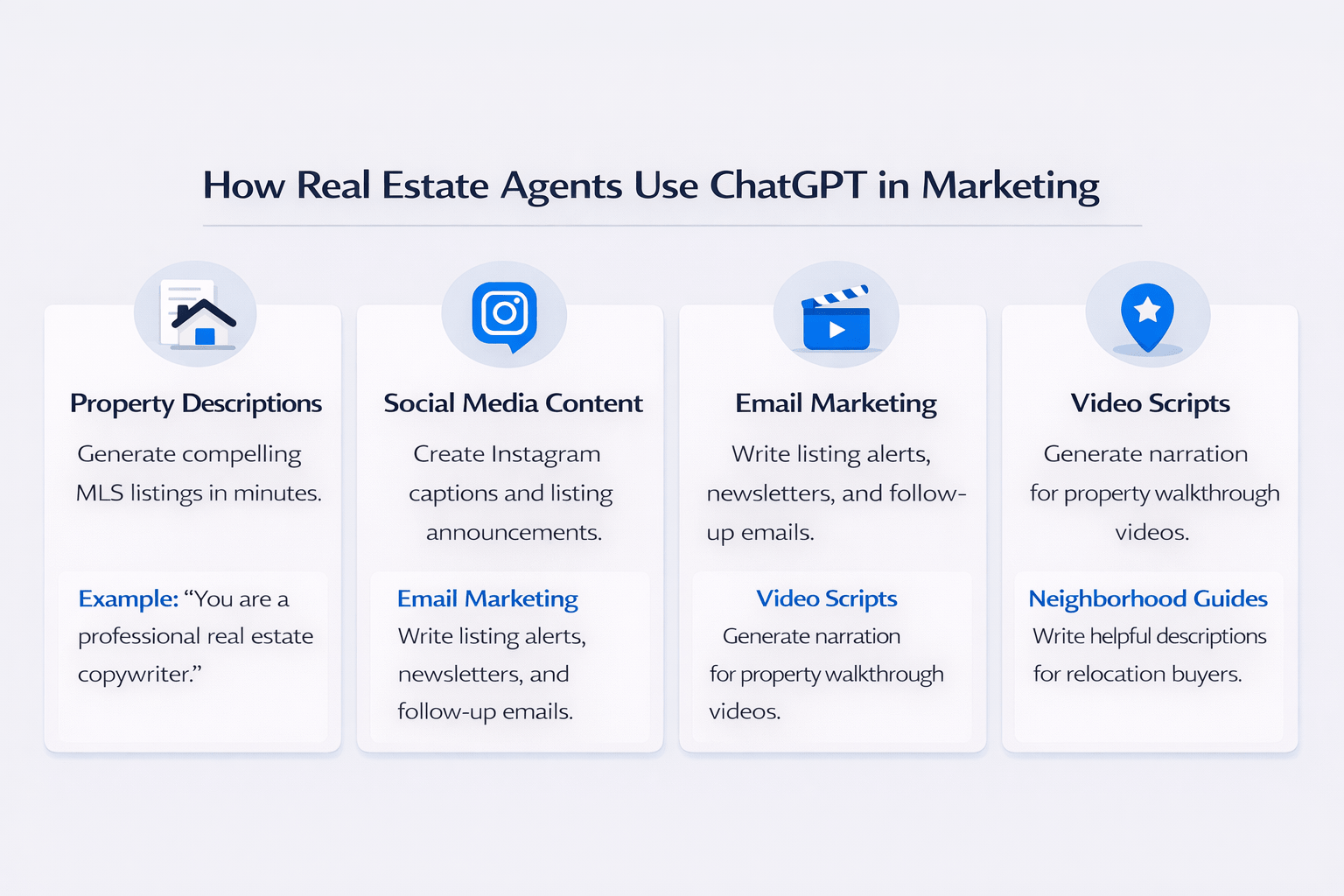
Writing the MLS description is just the beginning. ChatGPT can support your entire listing marketing workflow. Think of it as your full-service content engine:
- Property Descriptions: MLS listings, Zillow, Realtor.com, and your own website
- Social Media Posts: Instagram captions, Facebook listing announcements, LinkedIn posts for commercial properties
- Email Marketing: Just-listed announcements, open house invitations, follow-up sequences
- Neighbourhood Guides: Area overviews for relocation buyers that highlight schools, dining, transit, and lifestyle
- Video Scripts: Walkthrough video narrations and virtual tour scripts for YouTube
- Buyer FAQs: Anticipated questions and answers to include in your listing presentation
ChatGPT can support multiple parts of a real estate marketing workflow. The table below shows common ways agents use AI to create listing content faster
| Marketing Channel | Example Content Created with ChatGPT | Benefit for Agents |
|---|---|---|
| MLS Listings | Property descriptions and feature summaries | Faster listing preparation |
| Social Media | Instagram captions and listing announcements | More engagement and reach |
| Email Marketing | Just-listed announcements and follow-ups | Stronger lead nurturing |
| Video Scripts | Virtual tour narration and walkthrough scripts | Professional marketing videos |
| Neighborhood Guides | Area descriptions for relocation buyers | Helps buyers understand the local lifestyle |
When you use ChatGPT across all of these touchpoints, your marketing becomes consistent, professional, and fast. You spend less time writing and more time doing what matters most, building relationships, showing homes, and closing deals.
To explore more AI tools and strategies designed specifically for real estate professionals, visit AI for CRE Collective — a platform dedicated to helping agents and brokers harness AI for competitive advantage in today’s market.
Key Takeaways: How to Use ChatGPT to Write Property Descriptions
ChatGPT is not replacing real estate agents. It is making great agents even better. Automating the most time-consuming part of listing preparation, it frees you to focus on strategy, relationships, and service. Here is a quick summary of everything covered in this guide:
- Great property descriptions are the difference between a listing that sits and one that sells
- ChatGPT works best when you give it complete, specific, and structured information
- The CPAP Formula — Context, Property, Audience, Purpose — is your best prompting framework
- Always review and personalize AI-generated content before publishing
- Use ChatGPT across your full marketing workflow to save hours every week
- Build a content library of prompt templates for your most common listing types
- Combine AI efficiency with your local knowledge and personal voice for the best results
The real estate agents who win in the next five years will not necessarily be the ones who work the hardest. They will be the ones who work the smartest, using tools like ChatGPT to deliver better service, more consistently, in less time. Start with one listing this week. Take the property details, build a CPAP prompt, and see what ChatGPT produces. Then compare it to your current process. The difference will speak for itself.
Final Thoughts: Start Using ChatGPT to Write Property Descriptions That Sell Faster
Learning how to use ChatGPT to write property descriptions is one of the most practical skills you can pick up right now. The process is simple: give it the right details, follow the prompt structure, spend five minutes editing, and you have listing copy that gets buyers through the door. No tech background needed. No steep learning curve. The agents pulling ahead today are not necessarily the most experienced. They are the ones who move faster, show up on every platform, and produce marketing that connects with real buyers. ChatGPT helps you do exactly that.
Keep Learning With the AI for CRE Collective
Writing better property descriptions is just the starting point. The AI for CRE Collective is a community of 600+ real estate professionals sharing tested AI workflows, real prompts, and practical strategies that work on actual deals. Join and get a Top 50 Prompt Library on Day 1, weekly live Q&A calls, and role-specific workflows built for brokers, investors, and developers. Prefer to start free?
Subscribe to The Vertical, our weekly newsletter covering the latest AI tools and workflows built specifically for real estate professionals. The gap between agents using AI well and those still figuring it out grows every month. Come close to it inside the Collective.
FAQ’S About How to Use ChatGPT to Write Property Descriptions That Sell Faster
Can ChatGPT write real estate property descriptions?
Yes, ChatGPT can write professional, detailed, and compelling real estate property descriptions. You simply provide the key details of the property — such as the number of bedrooms and bathrooms, location, key features, and target buyer — and ChatGPT generates polished listing copy within seconds. Most agents find that ChatGPT’s output needs only minor edits before it’s ready to publish on MLS, Zillow, or other platforms.
How do I use ChatGPT to write a property description?
Start by opening ChatGPT at chat.openai.com. Then write a clear, detailed prompt that includes the property type, size, location, standout features, target buyer, and the tone you want. For example: ‘Write a 180-word property description for a 3-bed, 2-bath home in Austin, Texas. Features include an open floor plan, renovated kitchen, and a large backyard. Target buyer: young families. Tone: warm and lifestyle-focused.’ ChatGPT will produce a full description you can refine and publish.
Is ChatGPT free to use for writing property descriptions?
ChatGPT offers a free tier that gives you access to the GPT-3.5 model. This version works well for basic property descriptions. However, for more nuanced, high-quality, and emotionally persuasive listing copy, ChatGPT Plus — which runs on GPT-4 — is highly recommended. ChatGPT Plus costs $20 per month and gives you significantly better writing quality, more accurate instructions following, and faster output. For real estate agents managing multiple listings, the $20/month investment pays for itself quickly.
What information should I give ChatGPT to write a good property description?
The more detail you provide, the better the result. Always include: the property type (single-family home, condo, townhome, etc.), number of bedrooms and bathrooms, square footage, location and neighborhood highlights, key interior and exterior features (e.g., renovated kitchen, hardwood floors, backyard deck), any recent upgrades or unique selling points, the ideal buyer profile (first-time buyer, investor, luxury buyer, etc.), and the tone you want (warm, professional, upscale, casual). Think of it as briefing a new copywriter; the more they know, the better they write.
How long should a ChatGPT-generated property description be?
The ideal length depends on the platform. MLS listings usually perform best with 200 to 250 words that are detailed, factual, and keyword-rich. Zillow and Realtor.com descriptions typically work well at around 150 to 200 words. On social media platforms like Instagram, shorter descriptions under 100 words tend to perform better. Email newsletters usually work best with concise descriptions between 75 and 100 words. In your ChatGPT prompt, always specify the word count so the AI stays within your target range. Most agents use a 180-word description as their base and then adapt shorter versions from it.
What is a good ChatGPT prompt for a real estate listing?
A strong ChatGPT prompt for a real estate listing follows this structure: property details + top features + target buyer + tone + word count. Here’s a ready-to-use example: “Write a 185-word MLS property description for a 4-bedroom, 2.5-bathroom colonial home in Naperville, Illinois. Features include a chef’s kitchen with granite countertops, a finished basement, a two-car garage, and a landscaped backyard. Located near top-rated schools and walking trails. Target buyer: growing family. Tone: warm, inviting, and neighborhood-focused.” Use this framework every time, and you’ll get consistently great output.
Does ChatGPT-generated content need to be edited before publishing?
Yes, always edit ChatGPT-generated property descriptions before publishing. Even though the AI produces high-quality content, it can occasionally include overused phrases like ‘stunning property’ or ‘you won’t want to miss this.’ You should also add any personal details the AI might not know — like how the morning light fills the kitchen, or that the neighborhood has a popular farmers market every Saturday. Additionally, always run your final description through a fair housing compliance check to ensure the language doesn’t violate any Fair Housing Act guidelines.
Can ChatGPT help write luxury property descriptions?
Absolutely. ChatGPT is particularly effective at writing luxury property descriptions when you give it the right instructions. Use premium, aspirational language in your prompt. For example: ‘Write a 200-word luxury property description in an upscale, sophisticated, and exclusive tone for a 5-bedroom estate in Scottsdale, Arizona, featuring a resort-style pool, smart home automation, Wolf appliances, and panoramic mountain views.’ The key is telling ChatGPT exactly what tone to use. For luxury listings, words like ‘curated,’ ‘bespoke,’ ‘resort-inspired,’ and ‘panoramic’ signal the right register.
Is it ethical for real estate agents to use AI to write property descriptions?
Yes, using AI to write property descriptions is widely accepted in the real estate industry and is not considered unethical. Just as agents use professional photographers, marketing agencies, or copywriters to create listing content, using AI is simply a modern tool for producing that same content more efficiently. What matters is accuracy — you must ensure everything in the description is truthful and fair. The National Association of Realtors has acknowledged AI as a legitimate tool in real estate marketing, provided agents review outputs and maintain accuracy.
Will ChatGPT’s property descriptions pass plagiarism checks?
Yes. ChatGPT generates original content based on your unique property details and prompts. It does not copy text from existing listings. Each description written is freshly generated. However, if two agents use very similar prompts for similar properties, the output may sound alike in structure or tone. To ensure your listings feel unique, always add specific local details, personal touches, and brand-specific language that only you would know. Run the final copy through a tool like Grammarly or Copyscape if you want extra assurance of originality.
Can ChatGPT write property descriptions for commercial real estate?
Yes, ChatGPT handles commercial real estate descriptions very well. Whether you’re listing office spaces, retail units, industrial warehouses, or mixed-use developments, ChatGPT can craft appropriate copy when given the right inputs. For commercial listings, include details like usable square footage, zoning classification, lease terms, parking capacity, loading dock access, proximity to highways or transit hubs, and the ideal tenant or buyer profile. The tone for commercial listings tends to be more data-driven and opportunity-focused, so specify that in your prompt.
How can I make ChatGPT sound more like me when writing listings?
The best way to make ChatGPT match your voice is to provide examples of your past writing in the prompt. You can paste two or three of your favorite listing descriptions and say: ‘Write in the same style and tone as these examples.’ You can also describe your brand voice in words — for instance: ‘Write in a warm, conversational tone that feels personal and neighborhood-focused, like a trusted local expert is sharing a recommendation.’ The more context you give about how you communicate, the closer ChatGPT will get to sounding like you.
Are there ChatGPT tools specifically made for real estate property descriptions?
Yes. OpenAI’s GPT Store features a purpose-built tool called the Real Estate Property Description Generator, which is fine-tuned specifically for writing listing copy. It requires less setup than the base ChatGPT and produces real estate-specific content faster. Other AI tools built for real estate include Jasper, Copy.ai, Writesonic, and Narrato — all of which offer real estate listing templates. For commercial real estate specifically, the AI for CRE Collective platform provides guidance on integrating AI tools into your broader business workflow.
Can I use ChatGPT to write property descriptions for Zillow, Realtor.com, and MLS?
Yes. ChatGPT can write property descriptions tailored to any platform. For MLS, ask for a detailed, factual 200 to 250-word description. For Zillow or Realtor.com, ask for a lifestyle-focused 150 to 200-word version. You can even ask ChatGPT to produce all three platform versions in one prompt: ‘Write three versions of this property description — one for MLS at 220 words, one for Zillow at 175 words, and one for Realtor.com at 160 words.’ This saves significant time and ensures consistency across all your listing platforms.
Does ChatGPT know about fair housing laws when writing property descriptions?
ChatGPT has general knowledge of fair housing laws, but it does not always apply them automatically in listing copy. This means you must review all AI-generated descriptions yourself to ensure compliance with the Fair Housing Act. Avoid language that implies preference for or against any protected class — this includes phrases like ‘perfect for families,’ ‘quiet neighborhood,’ ‘walking distance to church,’ or ‘ideal for professionals.’ Always run your descriptions through your brokerage’s fair housing compliance checklist before publishing.
How many property descriptions can ChatGPT write in a day?
With ChatGPT, there is no meaningful daily limit for listing descriptions. A well-crafted prompt takes about 2 to 3 minutes to type. ChatGPT returns a description within seconds. So in a single hour, you could realistically generate 15 to 20 fully drafted property descriptions. With ChatGPT Plus, you get higher usage limits and faster response times. This makes it ideal for agents managing large portfolios or property managers overseeing dozens of units. Compare this to 2 to 4 hours per listing manually — the time savings are dramatic.
Can ChatGPT write descriptions in different languages for multilingual real estate markets?
Yes. ChatGPT is highly capable of writing property descriptions in multiple languages, including Spanish, French, Mandarin, Arabic, Portuguese, and many others. This is a significant advantage for real estate agents working in multilingual markets or targeting international buyers. Simply end your prompt with: ‘Write this description in [language].’ For markets like Miami, Los Angeles, Houston, and New York — where multilingual buyers are common — this feature can meaningfully expand your marketing reach without additional translation costs.
What’s the difference between using ChatGPT free vs. ChatGPT Plus for property descriptions?
ChatGPT Free uses the GPT-3.5 model. It can write basic property descriptions but may produce more generic results, miss nuance, or struggle with complex prompts. ChatGPT Plus ($20/month) uses GPT-4, which produces noticeably better writing — more natural, emotionally persuasive, and better at following detailed instructions. For professional real estate agents, Plus is strongly recommended. The $20 monthly cost is minimal compared to what you’d spend on a freelance copywriter ($50 to $200 per listing), and the quality difference is significant.
Can ChatGPT help improve existing property descriptions that aren’t performing well?
Yes, this is one of the most underrated uses of ChatGPT for real estate. If you have a listing that’s getting views but no inquiries, the description may be the problem. Paste your current description into ChatGPT and use a prompt like: ‘Rewrite this property description to be more emotionally engaging, lifestyle-focused, and buyer-centered. Keep all facts the same but improve the hook, tone, and call to action.’ ChatGPT will return a stronger version that you can compare to your original. This is a great way to refresh stale listings without starting from scratch.
How do I use ChatGPT to write property descriptions for social media?
Social media property descriptions require a shorter, punchier format than MLS listings. For Instagram, ask ChatGPT for 60 to 80 words, an attention-grabbing opener, one standout feature, a call to action, and 5 to 8 relevant hashtags. While for Facebook, aim for 100 to 130 words with a conversational tone and a question to drive engagement. For LinkedIn (commercial properties), keep it professional and data-focused at around 100 to 150 words. You can generate all three formats in a single ChatGPT session by asking for each platform version in the same prompt, saving you significant time across your marketing channels.
External Resources Referenced in This Article
- Nodalview: 10 ChatGPT Prompts for Real Estate Agents — nodalview.com/blog
- HousingWire: ChatGPT for Real Estate — housingwire.com
- ChatGPT Real Estate Property Description Generator — chatgpt.com/g/real-estate-generator
- ChatGPT• YouTube Video Walkthrough — youtube.com/watch?v=OpzKt55ZYzk