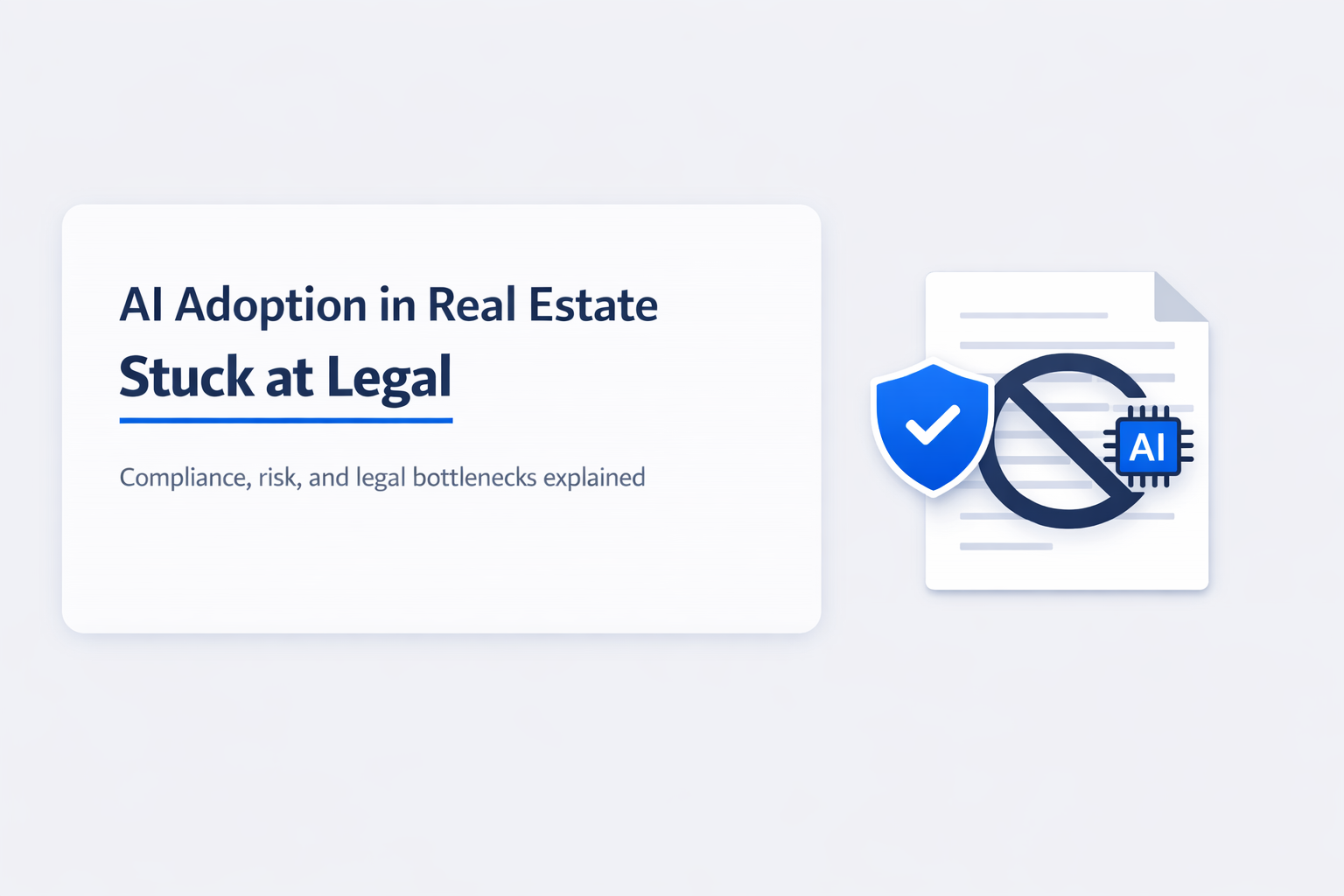
Why Enterprise Real Estate Firms Can’t Get AI Past Legal
Enterprise AI adoption in CRE is no longer a future concept; it’s a current competitive necessity. Across commercial real estate firms, leaders are actively exploring how artificial intelligence can streamline underwriting, automate lease abstraction, and accelerate market research. The interest is real, and the use cases are proven.
However, despite this momentum, most firms struggle to move beyond experimentation. The challenge is not whether AI works; it clearly does. The real difficulty lies in navigating internal barriers like legal approvals, security concerns, and organizational resistance.
In major real estate markets, firms that delay adoption risk losing efficiency, speed, and insight advantages. Meanwhile, agile competitors are already embedding AI into daily workflows.
Understanding Enterprise AI Adoption in CRE
Enterprise AI adoption in CRE refers to integrating artificial intelligence into core real estate workflows to improve efficiency, accuracy, and scalability.
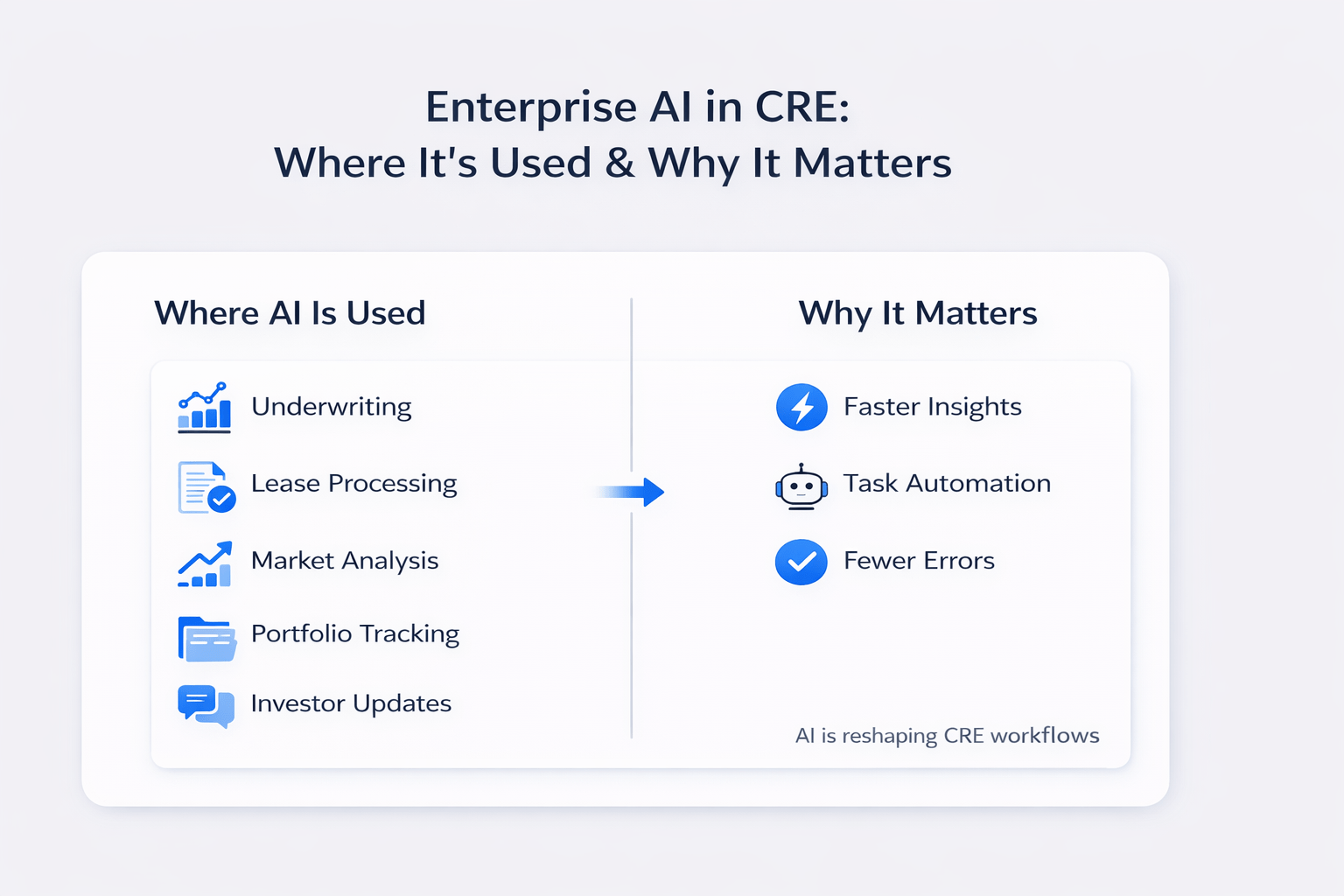
Where AI Is Being Used Today
-
Deal underwriting and financial modeling
-
Lease abstraction and document processing
-
Market research and trend analysis
-
Portfolio monitoring and reporting
-
Investor communication
AI transforms these processes by reducing manual work and enabling faster, data-driven decisions.
Why It Matters Now
Commercial real estate has always been data-intensive. Traditionally, professionals spend hours analyzing spreadsheets, reading leases, and compiling reports. AI changes that equation by:
-
Automating repetitive tasks
-
Delivering insights faster
-
Reducing human error
-
Increasing operational capacity
The Real Barriers to Enterprise AI Adoption in CRE
The biggest misconception is that technology is the bottleneck. In reality, most delays come from internal processes and risk management concerns, not tool capability.
Legal and Data Privacy Challenges
Legal teams must ensure that sensitive deal data is protected.
Key concerns include:
-
Where data is stored
-
Whether vendors train on proprietary data
-
Liability in case of data breaches
These reviews often take months, especially at institutional firms.
Security and IT Constraints
IT departments evaluate how AI tools interact with internal systems.
Typical issues:
-
System integration risks
-
Data access control
-
API security
These checks are necessary but often slow down adoption.
Executive Hesitation
Leadership hesitation is another major barrier.
Common reasons:
-
Limited understanding of AI
-
Fear of incorrect outputs
-
Concern over reputational risk
As a result, decisions are often delayed or avoided entirely.
Table 1: Key Barriers vs Business Impact
| Barrier Type | Impact on Adoption | Typical Delay | Complexity Level |
|---|---|---|---|
| Legal & Compliance | Very High | Long | High |
| Security Reviews | High | Medium | High |
| Executive Buy-in | Medium | Medium | Medium |
| Organizational Inertia | Very High | Long | High |
What Actually Works: Proven Implementation Strategies
While many firms are stuck, others are making real progress. Their approach is structured, focused, and practical.
Start with Contained Pilot Programs
Successful firms avoid large-scale rollouts in the beginning. Instead, they:
-
Use small teams (4–6 people)
-
Focus on a single workflow
-
Set a 30-day timeline
-
Track measurable results
This approach minimizes risk while proving value quickly. Here’s a real example of what a successful AI pilot workflow looks like in practice:
Involve Legal Teams Early
Instead of debating hypothetical risks, leading firms:
-
Review actual vendor contracts
-
Focus on real data policies
-
Address concerns with specifics
This significantly reduces delays.
Define Clear Data Boundaries
Clarity around data usage is critical.
For example:
-
Allowed: public data, market reports
-
Restricted: investor information, sensitive deal data
This simplifies both legal and security reviews.
Appoint an Internal Champion
AI initiatives need ownership. A strong internal champion:
-
Drives implementation
-
Bridges the technical and business teams
-
Keeps momentum moving forward
Without this role, projects often stall.
Small Firms vs Large Firms: Why Adoption Speeds Differ
Enterprise AI adoption in CRE varies significantly based on company size.
Why Smaller Firms Move Faster
Smaller and mid-sized firms have a clear advantage:
-
Fewer approval layers
-
Faster decision-making
-
Greater flexibility
-
Lower compliance burden
They can test, iterate, and scale quickly.
Why Enterprise Firms Lag
Larger firms face structural challenges:
-
Multiple stakeholders
-
Complex approval processes
-
Higher regulatory requirements
-
Risk-averse culture
As a result, even simple decisions can take months.
Table 2: Small vs Enterprise CRE Firms
| Factor | Small Firms | Enterprise Firms |
|---|---|---|
| Decision Speed | Fast | Slow |
| Approval Layers | Minimal | Multiple |
| Risk Tolerance | Higher | Lower |
| Implementation Speed | High | Moderate |
| Flexibility | High | Limited |
High-Impact Use Cases to Start With
To succeed in enterprise AI adoption in CRE, firms must begin with use cases that deliver value without introducing significant risk.
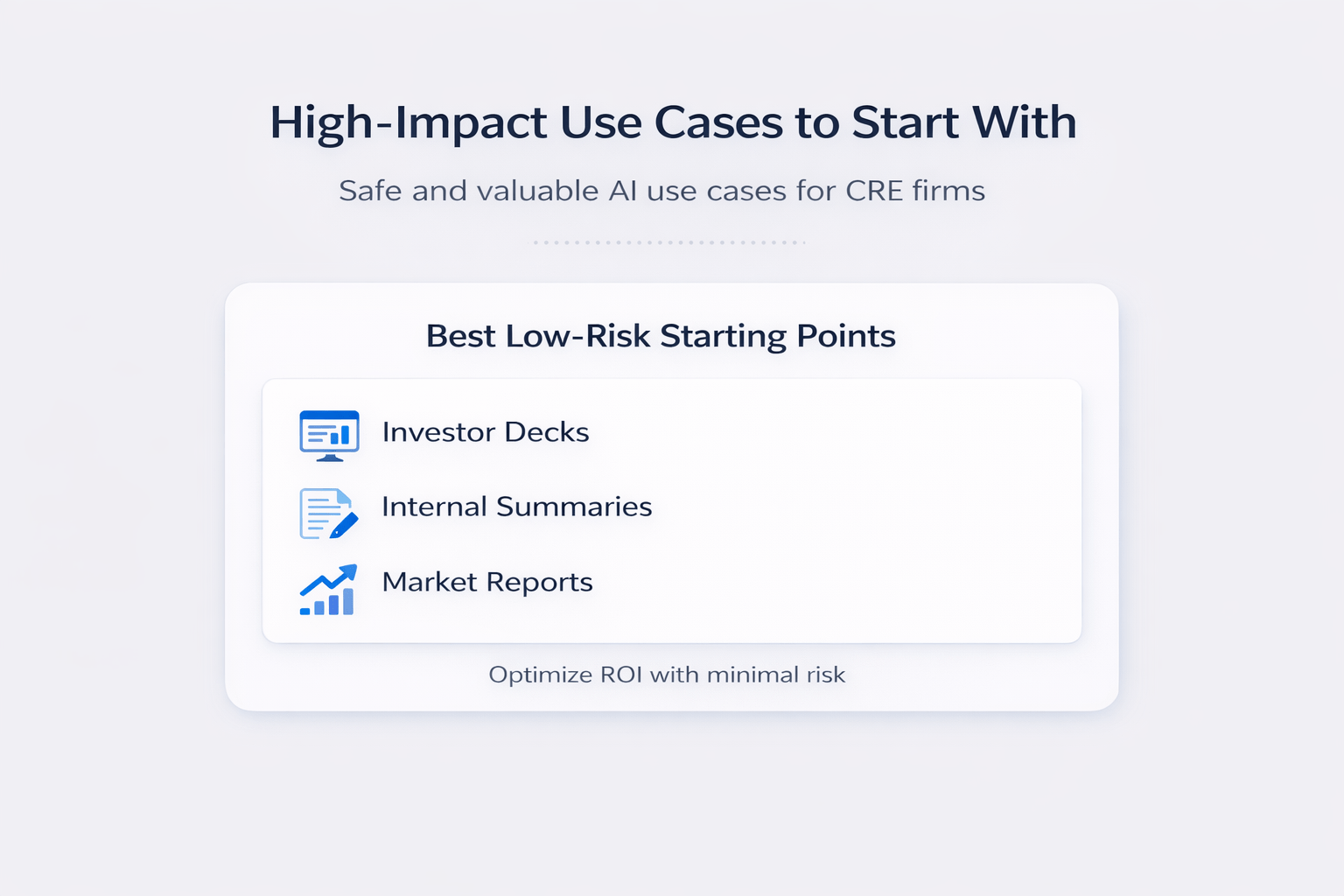
Best Low-Risk Starting Points
Market Research Automation, AI can quickly summarize reports, extract insights, and identify trends. Comparable Analysis, AI helps identify and standardize comps, reducing manual analysis time.
Presentation and Reporting, AI can quickly summarize reports, extract insights, and identify trends using tools like Perplexity Pro for CRE market research
AI can generate:
-
Investor decks
-
Internal summaries
-
Market reports
These use cases provide immediate ROI with minimal risk exposure.
Step-by-Step Framework for Enterprise Implementation
A structured approach is essential for scaling AI successfully.
Step 1: Identify a High-Value Use Case
Choose a workflow that is:
-
Repetitive
-
Time-consuming
-
Measurable
Step 2: Select the Right Tools
Evaluate tools based on:
-
Security standards
-
Ease of integration
-
Output reliability
Step 3: Run a Pilot Program
Define:
-
Clear success metrics
-
A fixed timeline
-
A small test group
Step 4: Measure ROI
Track:
-
Time savings
-
Cost reductions
-
Output improvements
Step 5: Scale Gradually
Only expand after proven success.
Table 3: AI Implementation Workflow
| Stage | Key Action | Outcome |
|---|---|---|
| Planning | Define use case | Clear objective |
| Pilot | Test with a small team | Performance data |
| Evaluation | Measure ROI | Actionable insights |
| Scaling | Expand implementation | Efficiency gains |
Risk Mitigation in Enterprise AI Adoption in CRE
Risk management is essential for long-term success.
Key Risk Controls
-
Limit sensitive data exposure
-
Use strict access permissions
-
Maintain human oversight
-
Ensure vendor compliance
Direct Answer
Risk in enterprise AI adoption in CRE is minimized by combining controlled pilots, strict data policies, and continuous human validation.
Future Outlook: The Next 12–18 Months
The direction of enterprise AI adoption in CRE is clear.
What’s Coming Next
-
Increased enterprise-level adoption
-
Standardized compliance frameworks
-
Deeper AI integration into workflows
-
Competitive pressure is accelerating change
Firms that act early will build operational advantages that are difficult to replicate.
Conclusion
Enterprise AI adoption in CRE is no longer limited by technology; it is defined by execution. Firms that focus on practical implementation, controlled risk, and incremental scaling are the ones seeing real results.
The opportunity is immediate. The only question is whether your organization is ready to act.
Accelerate Your CRE AI Strategy Today
The firms winning in enterprise AI adoption in CRE are not waiting for perfect conditions; they are testing, learning, and scaling what works. If you stay in planning mode too long, you risk falling behind competitors who are already improving efficiency and decision-making with AI.
Join the AI for CRE Collective, and connect with 600+ CRE professionals actively implementing AI in underwriting, research, and operations. If you want real workflows and actionable insights, this is where you start: subscribe to the newsletter and stay ahead.
FAQs Regarding Enterprise AI Adoption in CRE
1. What is enterprise AI adoption in CRE?
Enterprise AI adoption in CRE is the integration of artificial intelligence into commercial real estate workflows to automate tasks, enhance analysis, and improve decision-making at scale.
-
Covers underwriting, lease abstraction, market research, and reporting
-
Uses AI tools to process large datasets faster than manual methods
-
Helps teams focus on strategy instead of repetitive work
Conclusion: It enables CRE firms to operate more efficiently while improving the quality and speed of decisions.
2. What are the biggest barriers to enterprise AI adoption in CRE?
The primary barriers are legal, security, and organizational—not technological.
-
Legal concerns around data privacy and vendor agreements
-
IT/security reviews for system integration and access control
-
Internal resistance due to risk aversion and a lack of understanding
Conclusion: Firms must solve operational and compliance challenges before AI can scale successfully.
3. How can CRE firms start AI adoption safely?
The safest way is to begin with controlled, low-risk pilot programs.
-
Start with non-sensitive workflows like market research
-
Limit access to a small team with defined roles
-
Use clear success metrics to measure outcomes
Conclusion: A structured pilot reduces risk while proving value before wider implementation.
4. What is the best first use case for AI in CRE?
Market research and reporting are ideal starting points because they offer high value with minimal risk.
-
Use publicly available data to avoid compliance issues
-
Automate report summaries and trend analysis
-
Generate insights faster for decision-making
Conclusion: These use cases deliver immediate ROI without exposing sensitive information.
5. How long does enterprise AI adoption in CRE typically take?
Initial adoption can happen quickly, but full-scale implementation takes time.
-
Pilot programs: 2–4 weeks
-
Evaluation and iteration: 1–2 months
-
Enterprise rollout: several months, depending on complexity
Conclusion: Firms that start with pilots can accelerate adoption significantly compared to full-scale launches.
6. How do CRE firms measure ROI from AI adoption?
ROI is measured through efficiency, cost savings, and output quality improvements.
-
Reduction in time spent on manual tasks
-
Faster turnaround for analysis and reporting
-
Improved consistency and accuracy of outputs
Conclusion: Clear, measurable gains make it easier to justify scaling AI across teams.
7. Is AI secure enough for commercial real estate data?
AI can be secure when implemented with proper controls and policies.
-
Restrict sensitive data inputs
-
Use enterprise-grade tools with strong data protection terms
-
Implement access controls and monitoring systems
Conclusion: Security risks are manageable when firms establish clear boundaries and governance.
8. Why are smaller CRE firms adopting AI faster than large enterprises?
Smaller firms benefit from simpler structures and faster decision-making.
-
Fewer approval layers and compliance hurdles
-
Greater flexibility to experiment with new tools
-
Faster implementation cycles
Conclusion: Agility allows smaller firms to gain a competitive advantage while larger firms move more slowly.
9. What role does leadership play in enterprise AI adoption in CRE?
Leadership is critical in driving adoption and overcoming internal resistance.
-
Sets priorities and allocates resources
-
Encourages experimentation and innovation
-
Aligns teams around strategic goals
Conclusion: Without strong leadership support, AI initiatives often stall before delivering results.
10. What is the future of enterprise AI adoption in CRE?
AI adoption will become standard across CRE workflows in the near future.
-
Increased integration into daily operations
-
Stronger compliance frameworks from vendors
-
Competitive pressure is forcing faster adoption
Conclusion: Firms that adopt early will gain lasting advantages in efficiency, speed, and decision-making.