Cost vs benefit of AI tools in CRE firms
Commercial real estate firms are under pressure. Margins are tighter, competition is faster, and deals move quickly. In this environment, many firms are turning to artificial intelligence. But the big question remains: what is the cost vs benefit of AI tools in CRE firms?
At first glance, AI seems affordable. Many tools cost less than a monthly software subscription. However, when firms stack multiple tools, train teams, and adjust workflows, costs add up quickly. On the other hand, the potential upside is massive. AI can reduce manual work, speed up deal cycles, and improve decision-making accuracy.
This creates a gap between perception and reality. Some firms overspend on tools they never use. Others underinvest and miss major efficiency gains. The truth lies somewhere in the middle.
This guide breaks it down clearly. You will learn where AI actually saves money, where it drains budgets, and how to use it profitably. The focus is not on theory. It is a real-world application for brokers, investors, and CRE operators.
What “Cost” Actually Means in AI for CRE Firms
When most CRE professionals think about AI costs, they focus on subscription pricing. This is only one part of the equation. The real cost structure is broader and often misunderstood.
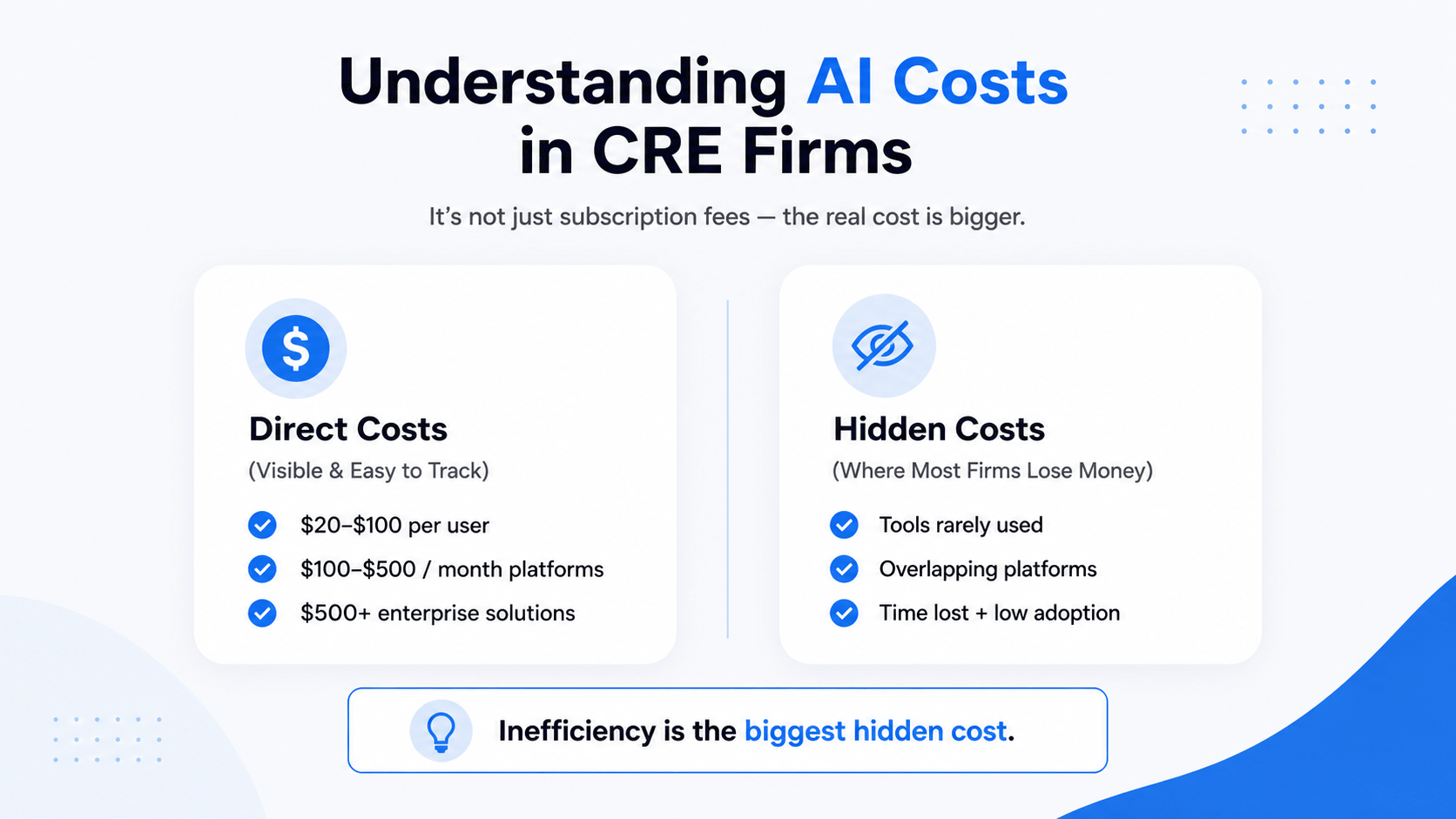
Direct Costs (Most Firms Focus Here)
Direct costs are visible and easy to track. They include monthly subscriptions, enterprise platforms, and API usage. For most firms, this looks manageable at first.
A typical CRE firm might spend:
-
$20–$100 per user for basic AI tools
-
$100–$500 per month for workflow platforms
-
$500+ for enterprise-grade solutions
-
Additional API costs for custom integrations
Individually, these costs seem small. However, when multiple tools are combined, the total can reach thousands per month.
Another key factor is scaling. As teams grow, costs multiply quickly. What starts as a small investment can turn into a significant operational expense.
Hidden Costs (Where Most Firms Lose Money)
The biggest issue is not the direct cost. It is inefficiency. Many CRE firms adopt AI tools without a clear strategy. This leads to wasted spend and low ROI.
Common hidden costs include:
-
Paying for tools that are rarely used
-
Overlapping tools solving the same problem
-
Time lost in learning multiple systems
-
Poor team adoption due to a lack of training
-
Fragmented workflows that slow down operations
For example, a brokerage team might use three different AI writing tools. Each one performs similar functions. Instead of improving productivity, this creates confusion and redundancy.
Another hidden cost is time. If a tool takes hours to learn but only saves minutes, the ROI becomes negative. This is where many firms struggle.
Checklist: True AI Cost Audit
To understand real cost, CRE firms need a structured audit. This helps identify waste and optimize spending.
Use this checklist:
-
List every AI tool currently in use
-
Track how often each tool is used
-
Identify overlapping features
-
Calculate cost per employee
-
Measure time saved vs time spent learning
-
Remove tools with low usage or impact
This simple audit often reveals surprising insights. Many firms discover they are overpaying without realizing it.
Real Benefits of AI Tools in CRE Firms
While costs can be confusing, the benefits of AI are more straightforward. When implemented correctly, AI delivers measurable gains across multiple areas. Here’s a real example of how AI can dramatically reduce costs while speeding up analysis.
Time Savings (Biggest ROI Driver)
Time is the most valuable resource in CRE. AI directly impacts how quickly work gets done. Tasks that once took hours can now be completed in minutes.
For example, underwriting a deal manually can take several hours. With AI, much of this process can be automated. The same applies to document review and market research.
This creates a compounding effect. Saving one hour per day per employee adds up quickly across a team.
Revenue Growth
AI does not just reduce workload. It also increases revenue potential. Faster workflows mean more deals can be processed. Better data insights improve decision-making.
CRE firms using AI often see:
-
Increased deal flow
-
Faster response to opportunities
-
Higher conversion rates in marketing
-
Improved client communication
These factors directly impact revenue growth.
Operational Efficiency
AI also improves how firms operate internally. Processes become more structured and consistent. This reduces errors and improves output quality.
Examples include:
-
Automated reporting systems
-
CRM workflow automation
-
Standardized deal analysis templates
These improvements reduce dependency on manual work and make operations more scalable.
Competitive Advantage
The CRE market is highly competitive. Speed and accuracy matter. Firms that adopt AI gain an edge over those that do not.
AI enables:
-
Faster response times to clients
-
Better insights from large data sets
-
Ability to handle more deals with fewer people
Over time, this creates a gap between AI-driven firms and traditional ones. That gap continues to grow.
Cost vs Benefit Breakdown (Side-by-Side Table)
Understanding the balance between cost and benefit is essential. The table below highlights how different factors compare.
Table: AI Cost vs Benefit in CRE Firms
| Category | Cost Impact | Benefit Impact |
|---|---|---|
| Tools Subscription | Medium | High |
| Training Time | High (initial) | High (long-term) |
| Workflow Integration | Medium | Very High |
| Team Adoption | Risk Factor | Multiplier Effect |
| Automation | Low Cost | Massive ROI |
This comparison shows a key insight. Most costs are short-term. Most benefits are long-term. Firms that focus only on upfront cost often miss the bigger picture.
Before vs After AI in CRE Workflows
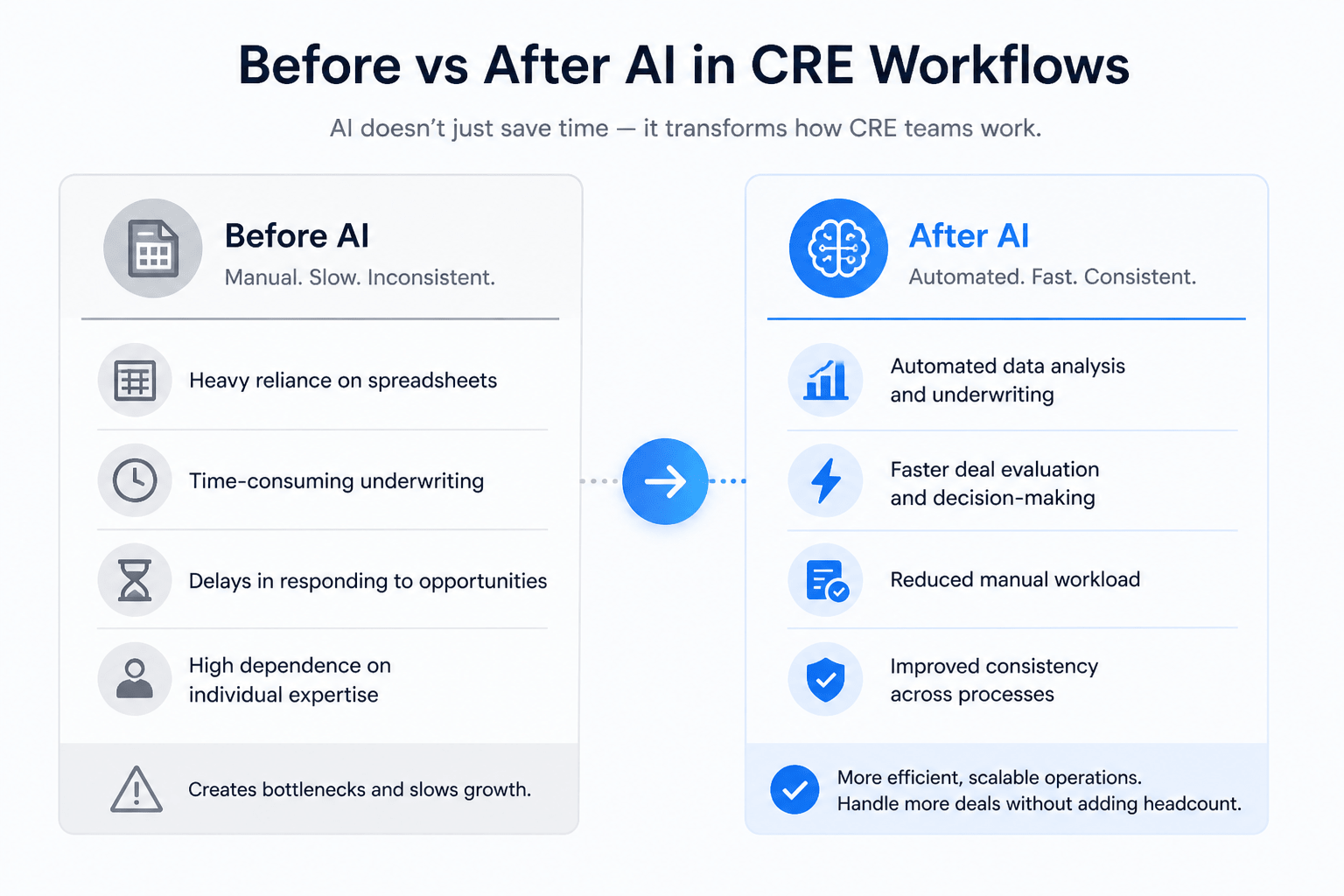
To understand the real impact, it helps to compare workflows before and after AI adoption. The difference is not small. It changes how firms operate at a fundamental level. Similarly, many firms now use AI to compare CRE deals with AI, allowing faster and more consistent underwriting decisions across multiple opportunities.
Before AI
Before AI, most CRE workflows relied heavily on manual effort. Teams spend significant time gathering data, analyzing deals, and preparing reports. This process is slow and often inconsistent.
Typical challenges include:
-
Heavy reliance on spreadsheets
-
Time-consuming underwriting processes
-
Delays in responding to opportunities
-
High dependence on individual expertise
This creates bottlenecks. As deal volume increases, teams struggle to keep up.
After AI
After implementing AI, workflows become more streamlined. Repetitive tasks are automated, and teams focus on higher-value work.
Key improvements include:
-
Automated data analysis and underwriting
-
Faster deal evaluation and decision-making
-
Reduced manual workload
-
Improved consistency across processes
The result is a more efficient and scalable operation. Teams can handle more deals without increasing headcount.
Tools That Actually Deliver ROI vs Hype
Not all AI tools create value. Many look impressive but fail in real CRE workflows. The difference between high ROI and wasted spend often comes down to practical use. Tools must solve a daily problem, not just showcase features.
High-performing tools share a few traits. They integrate into workflows, save time consistently, and are easy for teams to adopt. On the other hand, overhyped tools often require too much setup or lack CRE-specific relevance.
High ROI Tools
These tools consistently deliver value when used correctly. They are flexible, widely adopted, and easy to integrate into CRE workflows.
-
ChatGPT for deal analysis, summaries, and communication
-
Notion AI for internal workflows and knowledge management
-
Reonomy for property data and insights
-
Zapier for automating repetitive processes
These tools work because they replace real tasks. They reduce manual effort without adding complexity. For example, a broker can draft outreach emails in minutes instead of hours. An analyst can summarize market reports instantly.
Low ROI / Overhyped Tools
Some tools promise automation but fail to deliver real impact. They often look powerful but lack practical application.
-
Generic AI dashboards with no CRE focus
-
Redundant writing tools with similar capabilities
-
Complex platforms requiring heavy setup
-
Tools that do not integrate with existing systems
These tools create friction instead of efficiency. Teams spend more time learning them than using them productively.
Checklist: How to Evaluate AI Tools
Before adopting any tool, CRE firms should evaluate it carefully. A simple framework can prevent wasted spend.
-
Does it save time on a daily basis?
-
Does it replace a manual task?
-
Is it used consistently by the team?
-
Does it improve revenue or efficiency?
-
Can it integrate into existing workflows?
If a tool does not meet these criteria, it is unlikely to deliver a strong ROI.
Real-World Use Cases (CRE Firms)
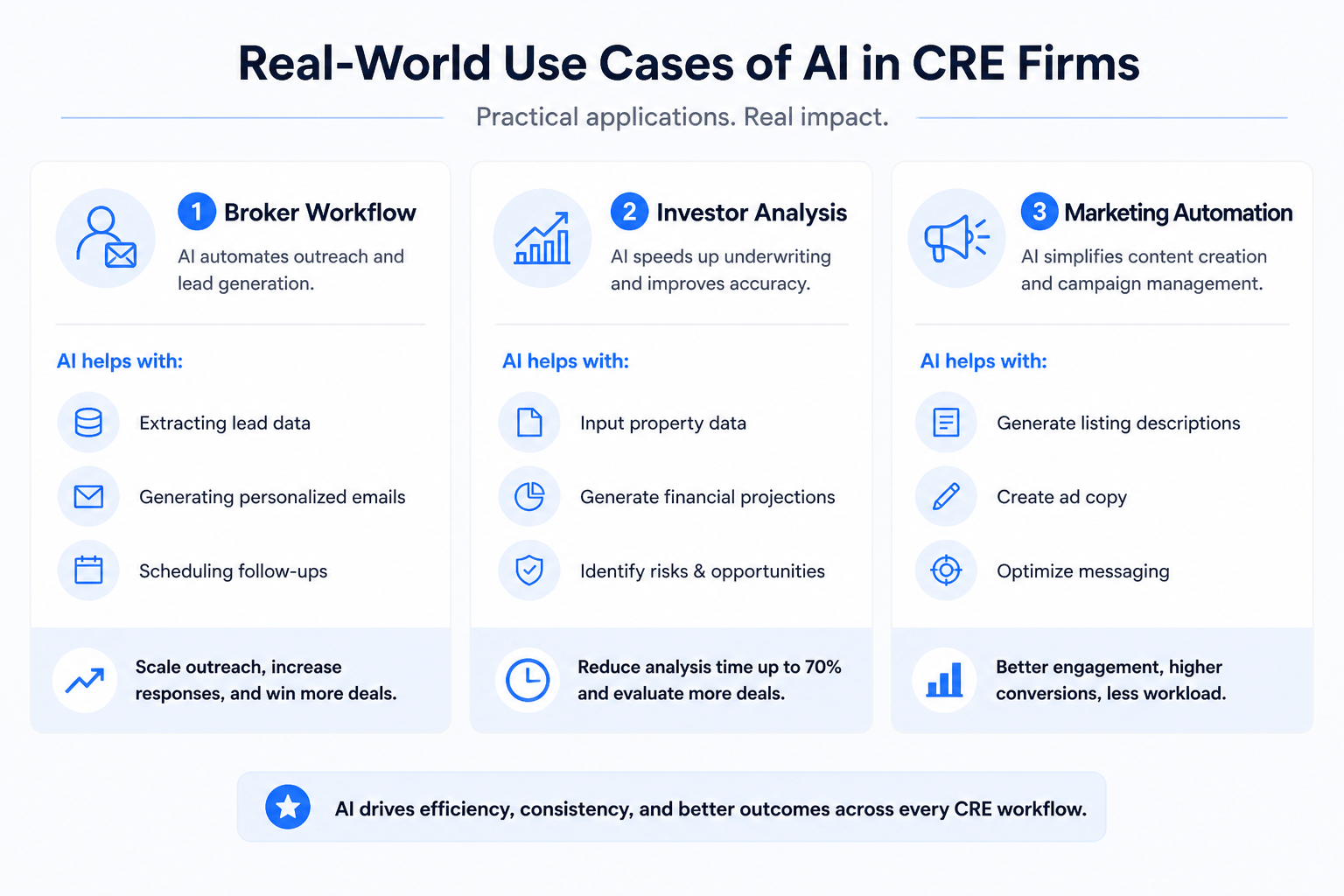
Understanding theory is helpful, but real-world examples provide clarity. AI delivers the most value when applied to specific workflows. Below are practical use cases from CRE professionals.
Use Case 1: Broker Workflow
Brokers spend a large portion of their time on outreach and lead generation. AI can automate much of this process.
A typical workflow includes:
-
Extracting lead data from multiple sources
-
Generating personalized outreach emails
-
Scheduling follow-ups automatically
With AI, brokers can scale their outreach significantly. Instead of sending 20 emails per day, they can send 100 or more. This leads to higher response rates and more deal opportunities.
The key benefit is consistency. AI ensures that outreach is continuous and structured, not dependent on manual effort.
Use Case 2: Investor Analysis
Investors rely on accurate and fast deal analysis. AI can reduce the time required for underwriting and evaluation.
A streamlined workflow looks like this:
-
Input property data into an AI system
-
Generate financial projections automatically
-
Identify risks and opportunities using AI insights
This reduces analysis time by up to 70%. It also improves accuracy by reducing human error.
Investors can evaluate more deals in less time. This increases the chances of finding high-quality opportunities.
Use Case 3: Marketing Automation
Marketing is another area where AI delivers strong ROI. CRE firms often spend hours creating listings and campaigns.
AI simplifies this process:
-
Generate listing descriptions quickly
-
Create ad copy for different platforms
-
Optimize messaging based on audience data
This leads to better engagement and higher conversion rates. It also allows teams to test multiple campaigns without increasing workload.
What Most CRE Professionals Get Wrong About AI
Despite the benefits, many CRE professionals struggle with AI adoption. The issue is not the technology itself. It is how it is used.
One common mistake is believing that AI replaces jobs. In reality, AI enhances existing roles. It allows professionals to focus on higher-value tasks rather than repetitive work.
Another mistake is tool overload. Firms often adopt too many tools at once. This creates confusion and reduces efficiency. A smaller, focused tool stack is usually more effective.
Training is another overlooked factor. Without proper guidance, teams fail to use AI effectively. This leads to low adoption and wasted investment.
Many firms also expect instant results. AI requires time to integrate into workflows. The biggest gains come after consistent use and optimization.
Finally, some professionals chase trends instead of solving problems. They adopt tools because they are popular, not because they are useful. This approach rarely delivers strong ROI.
How to Implement AI in CRE Firms (24-Hour Plan)
AI implementation does not need to be complex. In fact, the best results often come from simple, focused actions. A structured approach can help firms see results quickly.
Step-by-Step Workflow
-
Audit current workflows: Identify tasks that are repetitive and time-consuming. Focus on areas like underwriting, outreach, and reporting.
-
Select 2–3 core tools: Avoid overloading your stack. Choose tools that directly address your main challenges.
-
Define clear use cases: Assign each tool a specific role. For example, use one tool for analysis and another for automation.
-
Build simple automation flows: Connect tools where possible. Automate tasks such as data entry or email follow-ups.
-
Train your team: Provide clear instructions and examples. Focus on practical use rather than theory.
-
Measure results: Track time saved, deals processed, and efficiency improvements. Use this data to refine your approach.
This process can be completed within 24 hours. The key is to start small and scale gradually.
Copy-Paste AI Prompts for CRE Workflows
Prompts are the bridge between AI tools and real results. Well-structured prompts improve accuracy and save time. Below are practical prompts tailored for CRE workflows.
Deal Analysis Prompt
“Analyze this commercial property deal. Provide financial projections, risks, and key opportunities. Use clear bullet points and highlight assumptions.”
Market Research Prompt
“Summarize the current market trends for [location]. Include demand drivers, pricing trends, and investment outlook.”
Email Outreach Prompt
Write a professional outreach email for a commercial property owner. Keep tone concise, persuasive, and personalized.”
Investment Summary Prompt
“Create a one-page investment summary for this property. Include financial metrics, risks, and growth potential.”
Listing Description Prompt
Write a compelling listing description for a commercial property. Highlight key features, location advantages, and investment potential.”
These prompts are effective because they are specific. They guide the AI to produce relevant and actionable outputs.
Common Mistakes That Kill AI ROI
Even with the right tools, mistakes can reduce ROI. These issues are common across many CRE firms.
-
Using too many tools without a clear strategy
-
Failing to define workflows
-
Ignoring team training
-
Not measuring performance
-
Chasing trends instead of solving real problems
Each of these mistakes creates inefficiency. Over time, they reduce the value of AI adoption.
The solution is simple. Focus on clarity, consistency, and measurable outcomes.
Future Trends: AI Cost vs Benefit in CRE
The relationship between cost and benefit is evolving. AI tools are becoming more accessible, while their capabilities continue to improve. One major trend is cost reduction. As competition increases, tool pricing is becoming more affordable. This lowers the barrier to entry for smaller firms.
At the same time, customization is increasing. More tools are being built specifically for CRE. This improves relevance and ROI. Automation is also expanding. Entire workflows can now be automated, not just individual tasks. This creates new opportunities for efficiency.
The competitive gap is widening. Firms that adopt AI early gain a long-term advantage. Those who delay risk falling behind.
Conclusion
The conversation around AI often focuses on price. In reality, price is only a small part of the equation. The real question is how effectively AI is used within daily CRE workflows.
When you break down the cost vs benefit of AI tools in CRE firms, a clear pattern emerges. Costs are mostly short-term and manageable. Benefits are long-term and compound over time. Firms that approach AI with a clear strategy consistently see stronger returns.
The biggest gains come from three areas. First, workflow integration ensures tools are used consistently. Second, team adoption turns AI into a daily habit rather than an occasional experiment. Third, focused tool selection prevents unnecessary spending.
It is also important to recognize that AI is not a one-time setup. It requires ongoing refinement. Firms that track performance and adjust their approach continue to improve efficiency over time.
Ultimately, AI is not expensive. Poor implementation is. When used correctly, AI becomes one of the highest ROI investments a CRE firm can make. It reduces manual work, improves decision-making, and allows teams to scale without increasing headcount.
If the goal is to stay competitive, AI is no longer optional. It is becoming a core part of how modern CRE firms operate.
Ready to Use AI in Your CRE Workflows?
If you are serious about using AI in CRE, the next step is not more research. It is implementation.
At AI for CRE Collective, we focus on real-world workflows that brokers, investors, and operators actually use. You get access to proven systems, prompt libraries, tool breakdowns, and step-by-step tutorials designed specifically for commercial real estate.
Instead of guessing which tools work, you can see exactly how they are used in real deals and daily workflows.
Join the community and explore real AI systems used by CRE professionals
Get weekly insights, tools, and workflows in your inbox
FAQs
Is AI expensive for CRE firms?
AI can appear expensive at first, but the actual cost depends on how it is implemented. Most CRE firms start with low-cost tools, often ranging from $20 to $100 per month per user. However, costs increase when multiple tools are added without a clear plan.
The key factor is not price but efficiency. A single tool that saves hours of work each week delivers more value than several unused subscriptions. Firms that focus on solving specific problems tend to keep costs under control.
To manage expenses effectively:
-
Limit the number of tools in use
-
Focus on high-impact workflows
-
Track usage and performance regularly
When used strategically, AI often reduces overall operational costs rather than increasing them.
What is the ROI of AI in commercial real estate?
The return on investment from AI in CRE comes from both time savings and revenue growth. Tasks that previously took hours can now be completed in minutes. This allows teams to process more deals and respond faster to opportunities.
ROI is often seen in:
-
Faster deal analysis and underwriting
-
Increased lead generation and outreach
-
Improved marketing performance
In many cases, firms report measurable gains within weeks. However, the highest returns come over time as workflows become more refined.
To evaluate ROI:
-
Measure time saved per task
-
Track the increase in deal volume
-
Monitor improvements in conversion rates
AI delivers the strongest ROI when integrated into daily operations.
Which AI tools are best for CRE professionals?
The best AI tools for CRE professionals are those that directly support core workflows. These include deal analysis, market research, communication, and automation.
Effective tool categories include:
-
Writing and analysis tools for reports and communication
-
Data platforms for property insights
-
Automation tools for repetitive tasks
The ideal setup is small and focused. Most firms benefit from using two to four core tools rather than a large stack.
When selecting tools:
-
Choose solutions that integrate easily
-
Prioritize tools with clear use cases
-
Avoid tools that require complex setup
The goal is not to use more tools. It is to use the right ones effectively.
How long does it take to see ROI from AI?
The timeline for seeing ROI from AI varies based on implementation. In many cases, firms begin to notice improvements within the first few weeks. Simple tasks such as email drafting or data summarization deliver immediate results.
However, larger gains take longer. Workflow automation and team adoption require time and consistency. Most firms see significant ROI within three to six months.
Factors that influence ROI speed include:
-
Clarity of use cases
-
Level of team training
-
Integration into daily workflows
The faster AI becomes part of routine operations, the quicker the returns appear.
Can small CRE firms afford AI tools?
Yes, small CRE firms can afford AI tools, especially with the current pricing landscape. Many high-quality tools are available at low monthly costs. This makes AI accessible even for teams with limited budgets.
The key is to start small. Instead of investing in multiple tools, firms should focus on one or two that address their biggest challenges.
A practical approach includes:
-
Selecting affordable, high-impact tools
-
Testing use cases before scaling
-
Avoiding unnecessary subscriptions
Small firms often benefit the most from AI because it allows them to compete with larger organizations without increasing headcount.
What are the hidden costs of AI tools?
Hidden costs are one of the biggest challenges in AI adoption. These costs are not always visible but can significantly impact ROI.
Common hidden costs include:
-
Time spent learning new tools
-
Low adoption by team members
-
Overlapping tools with similar functions
-
Inefficient workflows
For example, if a tool takes hours to learn but saves only minutes, the net benefit is negative. Similarly, unused subscriptions add unnecessary expense.
To reduce hidden costs:
-
Conduct regular tool audits
-
Focus on simplicity and usability
-
Provide clear training for teams
Understanding these factors helps firms make better decisions and avoid waste.
Does AI replace brokers or analysts?
AI does not replace brokers or analysts. Instead, it enhances their capabilities. It handles repetitive and time-consuming tasks, allowing professionals to focus on higher-value work.
For example:
-
Brokers can spend more time building relationships
-
Analysts can focus on strategic insights rather than data entry
AI acts as a support system rather than a replacement. It improves efficiency but still relies on human expertise for decision-making.
Firms that use AI effectively often see improved performance from their teams. The combination of human judgment and AI efficiency creates stronger outcomes.
How do you measure AI success in CRE?
Measuring AI success requires clear metrics. Without measurement, it is difficult to understand whether AI is delivering value.
Key performance indicators include:
-
Time saved on specific tasks
-
Increase in deal volume
-
Improvement in response times
-
Reduction in operational costs
It is also important to track qualitative improvements. These include better decision-making and improved workflow consistency.
A structured approach involves:
-
Setting baseline metrics before implementation
-
Tracking changes over time
-
Adjusting strategies based on results
This ensures that AI adoption remains aligned with business goals.
What mistakes should CRE firms avoid with AI?
Many CRE firms make similar mistakes when adopting AI. These errors often reduce ROI and create frustration.
Common mistakes include:
-
Adopting too many tools at once
-
Failing to define clear workflows
-
Ignoring team training
-
Expecting immediate results
These issues can be avoided with a focused approach. Firms should start small, define clear use cases, and build gradually.
Consistency is more important than speed. Long-term success comes from steady improvement rather than quick wins.
How many AI tools should a CRE firm use?
The ideal number of AI tools depends on the size and needs of the firm. However, most CRE firms benefit from a small, focused tool stack.
In many cases, two to four tools are sufficient. These should cover core functions such as analysis, communication, and automation.
Using too many tools creates complexity. It increases costs and reduces efficiency. A streamlined setup is easier to manage and more effective.
To optimize your tool stack:
-
Eliminate redundant tools
-
Focus on high-impact use cases
-
Ensure team adoption
The goal is not to maximize tools. It is to maximize results.
Is AI worth it for deal sourcing?
AI can significantly improve deal sourcing. It allows firms to analyze more data, identify opportunities faster, and reach out to potential leads more efficiently.
Benefits include:
-
Faster identification of potential deals
-
Improved targeting of property owners
-
Increased outreach capacity
AI also helps maintain consistency. Instead of relying on manual effort, firms can build structured sourcing systems.
While AI does not replace relationship-building, it enhances the process. It ensures that no opportunities are missed due to time constraints.
How do you train teams on AI tools?
Training is a critical part of successful AI adoption. Without proper guidance, teams may not use tools effectively.
A practical training approach includes:
-
Demonstrating specific use cases
-
Providing simple, repeatable workflows
-
Offering ongoing support and feedback
It is important to focus on real tasks rather than theory. Teams learn faster when they see immediate value.
Regular practice and reinforcement help build confidence. Over time, AI becomes a natural part of daily work.