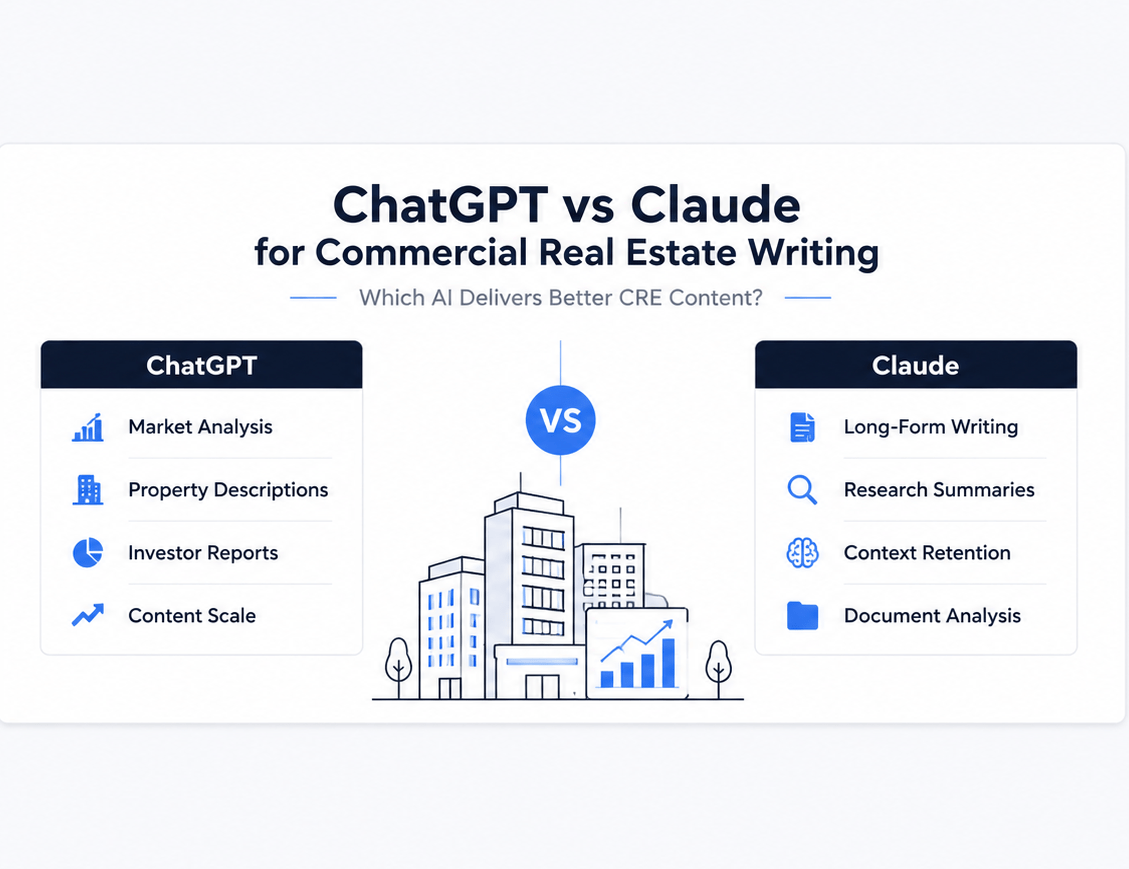
ChatGPT vs Claude for Commercial Real Estate Writing Which Is Better?
The debate around ChatGPT vs Claude CRE has become much more common over the past year. Commercial real estate professionals are using AI tools for everything from broker emails and offering memorandums to market reports and investment summaries. As adoption grows, many professionals are asking the same question: Which platform is actually better for CRE writing?
The answer is not as simple as choosing one winner. Both ChatGPT and Claude can save time and can create content quickly. Both can help brokers, investors, developers, analysts, and operators work more efficiently.
However, each platform has different strengths. Some CRE professionals prefer Claude because its writing often sounds more natural and professional. Others prefer ChatGPT because it offers more tools, integrations, and workflow options.
That difference becomes important when you are creating documents that influence investors, lenders, partners, and clients. Commercial real estate writing is different from general content creation. A property description, investment committee memo, or market report requires accuracy, clear communication, and industry knowledge. The AI tool you choose can affect both the quality of the output and the amount of editing required afterward.
This guide examines the ChatGPT vs Claude CRE discussion from a practical perspective. Instead of focusing on technical benchmarks, we will look at real-world commercial real estate tasks and evaluate which platform performs better for each one.
By the end of this guide, you will understand:
-
Where ChatGPT performs best
-
Where Claude performs best
-
Which tool creates stronger CRE documents
-
Which platform provides better productivity gains
-
Whether using both tools together makes sense
The goal is simple. Help you choose the right AI tool for your commercial real estate workflow.
Key AI & CRE Productivity Statistics
Artificial intelligence is becoming a regular part of business operations across many industries, including commercial real estate.
Firms are using AI to reduce repetitive work, speed up research, improve communication, and create documents more efficiently.
Several recent studies highlight why AI adoption continues to grow.
Key Statistics
-
McKinsey estimates generative AI could create up to $4.4 trillion in annual economic value.
-
PwC projects AI could contribute approximately $15.7 trillion to the global economy by 2030.
-
Deloitte reports growing enterprise adoption of generative AI across departments and business functions.
-
Commercial real estate firms increasingly use AI for research, reporting, and document creation.
-
AI-assisted workflows can significantly reduce the time spent on administrative and writing tasks.
How AI Supports Common CRE Activities
| CRE Activity | Traditional Approach | AI-Assisted Approach |
|---|---|---|
| Broker Outreach | Write emails manually | Generate drafts quickly |
| Market Reports | Research and write from scratch | Summarize and organize findings |
| Investment Memos | Manual document preparation | Faster first drafts |
| Property Marketing | Create content manually | Generate descriptions instantly |
| Investor Updates | Prepare reports manually | Draft updates faster |
| Document Reviews | Review every page individually | Summarize large documents quickly |
The key takeaway is that AI works best as a productivity tool.
Successful CRE professionals do not rely entirely on AI-generated content. Instead, they use AI to create first drafts, organize information, and reduce repetitive work before applying their own expertise.
That approach produces the best results.
Understanding ChatGPT and Claude Before Comparing Them
Before comparing performance, it is important to understand what each platform does well.
While the ChatGPT vs Claude CRE discussion often focuses on writing quality, both platforms offer much broader capabilities.
What Is ChatGPT?
ChatGPT is an AI assistant developed by OpenAI. It is one of the most widely used AI platforms in the world and supports a wide range of business applications.
Commercial real estate professionals often use ChatGPT for:
-
Market research
-
Property descriptions
-
Investor communications
-
Broker outreach
-
Content marketing
-
Spreadsheet analysis
-
Workflow automation
One of ChatGPT’s biggest strengths is flexibility. Users can upload files, build custom GPTs, automate processes, connect external tools, and create repeatable workflows.
For many firms, these additional capabilities make ChatGPT more than just a writing assistant. It becomes part of a larger productivity system.
What Is Claude?
Claude is an AI assistant developed by Anthropic. The platform has gained attention because of its ability to generate natural-sounding writing and handle large documents effectively.
Many users believe Claude requires less editing when producing professional business content.
In commercial real estate, Claude is commonly used for:
-
Offering memorandums
-
Investment committee memos
-
Market reports
-
Lease summaries
-
Property narratives
-
Investment analyses
Claude also performs well when reviewing lengthy files and maintaining context across large documents.
This makes it especially useful for acquisitions teams, analysts, and investment professionals who regularly work with extensive reports and property packages.
Why CRE Professionals Compare These Two Tools
The ChatGPT vs Claude CRE comparison exists because both tools can complete many of the same tasks.
Both platforms can:
-
Write content
-
Analyze information
-
Summarize reports
-
Review documents
-
Improve existing content
-
Assist with research
However, differences become noticeable during daily use. Many CRE professionals find that Claude produces stronger first drafts for formal documents.
Meanwhile, ChatGPT often provides greater flexibility because of its broader feature set and integrations. As a result, the right choice depends on your priorities.
If your primary goal is creating polished CRE documents, one platform may offer an advantage. If your goal is building AI-powered workflows across your business, the other may be a better fit.
Quick Verdict: Which AI Is Better for CRE Writing?
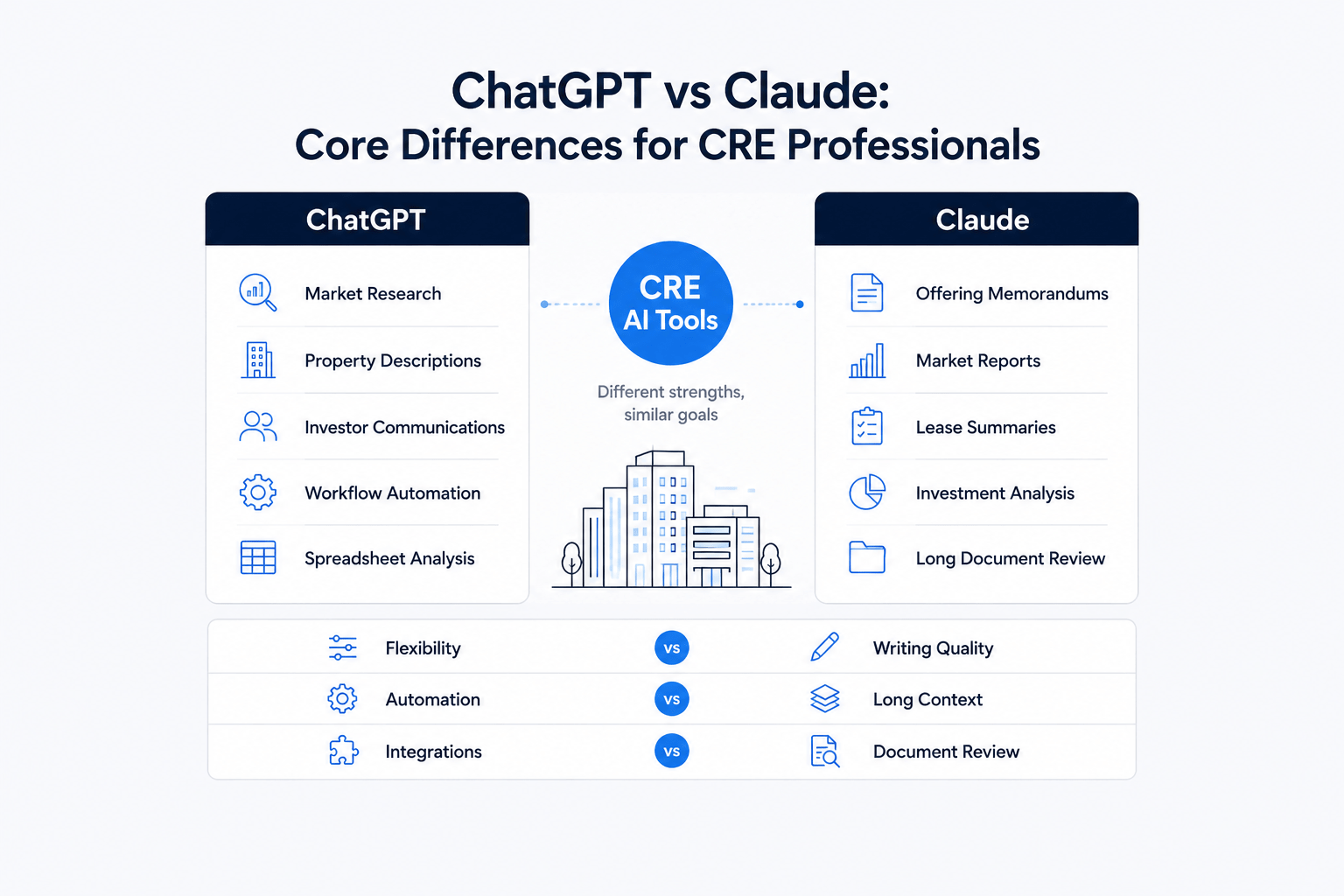
If you want a short answer to the ChatGPT vs Claude CRE debate, Claude usually produces better commercial real estate writing right out of the box.
Its writing tends to sound more professional, natural, and polished. For many CRE documents, that means less editing before sending content to investors, clients, or partners.
However, that does not automatically make Claude the best choice for every CRE professional.
ChatGPT offers more flexibility. It can help with writing, research, workflow creation, spreadsheet analysis, custom GPTs, and business automation. For many firms, those additional capabilities create more overall value.
The reality is that most advanced CRE teams do not choose one platform exclusively. Instead, they use each tool where it performs best.
ChatGPT vs Claude CRE Quick Comparison
| Category | ChatGPT | Claude |
|---|---|---|
| Writing Quality | Very Good | Excellent |
| Professional Tone | Very Good | Excellent |
| Long Documents | Good | Excellent |
| Market Research | Excellent | Very Good |
| Workflow Automation | Excellent | Good |
| Custom Tools | Excellent | Limited |
| Property Narratives | Very Good | Excellent |
| Investment Memos | Very Good | Excellent |
| Learning Curve | Easy | Easy |
| Overall CRE Writing | Very Good | Excellent |
When ChatGPT Is the Better Choice
ChatGPT is often the better option when your work includes:
-
Market research
-
Content marketing
-
Business automation
-
Spreadsheet analysis
-
Custom workflow creation
-
Multi-step projects
-
Team productivity systems
For example, a brokerage team creating prospecting systems may gain more value from ChatGPT’s broader capabilities than from slightly better writing quality.
When Claude Is the Better Choice
Claude is often the better option when your work focuses heavily on:
-
Offering memorandums
-
Investment committee memos
-
Investor reports
-
Market reports
-
Property narratives
-
Long-form business writing
Many CRE professionals report that Claude’s first drafts feel closer to something written by an experienced analyst or marketing professional. As a result, editing time is often lower.
The Real Winner
The winner depends on your workflow. If writing quality is your primary concern, Claude generally has an edge.
If productivity across multiple business functions is more important, ChatGPT often provides more value.
That is why the ChatGPT vs Claude CRE discussion continues. Each platform solves a different problem.
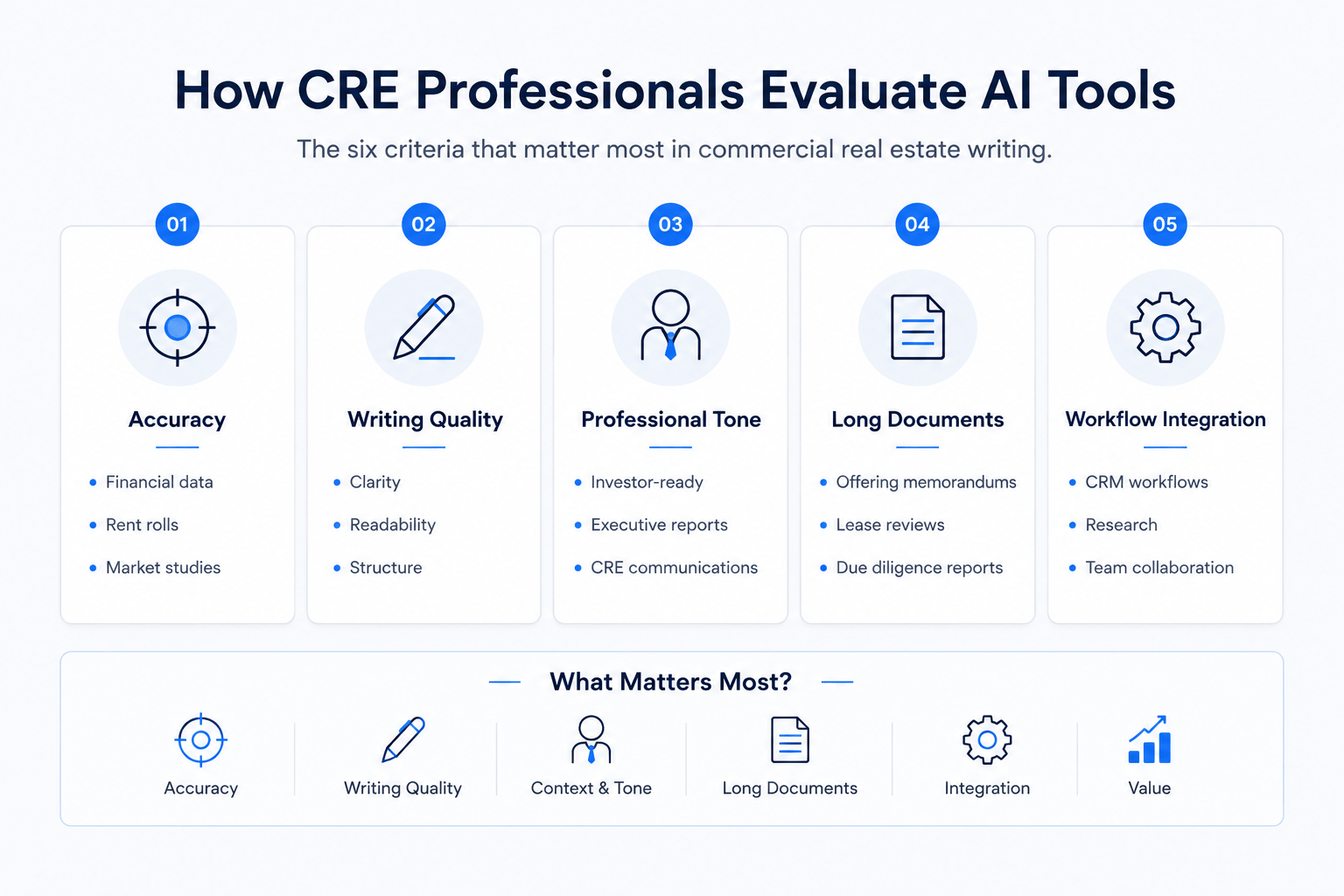
Evaluation Criteria Used in This Comparison
To fairly compare both tools, we need to evaluate them using real commercial real estate requirements rather than general AI benchmarks. Most CRE professionals care about practical outcomes.
They want better documents, faster workflows, and fewer hours spent editing. The following categories matter most when evaluating AI writing tools for commercial real estate.
Accuracy
Accuracy is one of the most important factors in CRE writing. An AI-generated mistake in an investor memo or market report can create credibility issues and potentially affect business decisions.
Both platforms occasionally make mistakes. Neither should be trusted without review. However, both can help organize information and produce strong first drafts when given accurate source material.
When working with:
-
Rent rolls
-
Financial statements
-
Offering memorandums
-
Market studies
-
Investment analyses
Human review remains essential.
Writing Quality
Writing quality refers to how natural, clear, and professional the content feels.
Commercial real estate writing requires:
-
Clear communication
-
Professional tone
-
Logical structure
-
Strong readability
This is where many users notice a difference between ChatGPT and Claude. Claude often produces smoother sentences and stronger transitions.
ChatGPT remains highly capable, but some outputs may require more editing to achieve the same level of polish.
Professional Tone
CRE documents often target sophisticated audiences.
These may include:
-
Institutional investors
-
Lenders
-
Developers
-
Equity partners
-
Asset managers
The writing must sound professional without becoming overly technical. A strong AI tool should understand that balance.
Tone becomes especially important when creating:
-
Investment summaries
-
Executive reports
-
Offering memorandums
-
Investor communications
Long Document Handling
Commercial real estate professionals frequently work with large files.
Examples include:
-
Market studies
-
Property due diligence reports
-
Appraisal reports
-
Offering memorandums
-
Lease agreements
A useful AI platform should maintain context across long documents and generate consistent outputs.
This area has become a major part of the ChatGPT vs Claude CRE comparison because many professionals use AI to review extensive reports.
CRE Context Understanding
General writing ability is not enough. The platform must also understand commercial real estate terminology.
Examples include:
-
Cap rates
-
NOI
-
IRR
-
Debt yield
-
Lease structures
-
Occupancy metrics
-
Market absorption
-
Rent growth
The better an AI understands CRE language, the less time users spend correcting outputs.
Workflow Integration
Writing is only one part of a CRE professional’s day. Many firms also need tools that connect with broader business processes.
This includes:
-
Research workflows
-
CRM activities
-
Data analysis
-
Content creation
-
Team collaboration
A platform that integrates smoothly into existing systems can create significant productivity gains.
Cost and Overall Value
Price matters, but value matters more. The best AI tool is not necessarily the cheapest option.
Instead, firms should ask:
-
How much time does it save?
-
How much editing does it reduce?
-
How much productivity does it create?
-
How easily can teams adopt it?
These questions often matter more than monthly subscription costs.
ChatGPT vs Claude for CRE Emails
Email remains one of the most common writing tasks in commercial real estate. Brokers send prospecting emails. Investors communicate with partners.
Property managers provide updates. Leasing teams follow up with tenants. Because of this, email performance plays a major role in the ChatGPT vs Claude CRE comparison.
Broker Prospecting Emails
Prospecting emails need to feel personal. They should sound like they came from a real broker, not a marketing template. Many users find that Claude creates more natural outreach emails with less effort.
Its writing style often feels conversational without sounding overly casual. This can help improve engagement and response rates. ChatGPT can also create strong prospecting emails, especially when detailed instructions are provided.
However, it sometimes requires additional prompting to achieve the same natural tone.
Investor Communication
Investor emails require a different approach. The tone must be professional, concise, and informative.
Examples include:
-
Quarterly updates
-
Acquisition announcements
-
Market insights
-
Capital raising communications
Both platforms perform well here. However, Claude often produces cleaner first drafts that require fewer edits.
Follow-Up Sequences
Consistent follow-up is critical in commercial real estate. Whether pursuing a tenant, buyer, lender, or investor, follow-up messages must remain professional without becoming repetitive.
ChatGPT performs particularly well in this area because it can generate:
-
Multi-step sequences
-
Different tone variations
-
Multiple subject lines
-
Personalized versions
This flexibility makes it useful for larger outreach campaigns.
Leasing Outreach Campaigns
Leasing professionals often need:
-
Tenant outreach emails
-
Renewal communications
-
Broker announcements
-
Property marketing messages
Both tools perform strongly. The choice usually depends on whether the user values natural writing quality or broader workflow functionality.
Email Writing Winner
For pure email writing quality, Claude has a slight advantage. Its outputs often feel more human and require fewer revisions.
However, for teams building larger outreach systems and automation workflows, ChatGPT can provide more overall value.
Winner: Claude (by a small margin)
The next major comparison is where many CRE professionals notice the biggest difference: offering memorandums.
ChatGPT vs Claude for Offering Memorandums
Offering memorandums is one of the most important marketing documents in commercial real estate. A strong OM can influence investor interest, support broker credibility, and help communicate the value of an opportunity. Because of that, writing quality matters.
This is also where many professionals first notice significant differences in the ChatGPT vs Claude CRE comparison.
Many CRE professionals use Claude to create investor-facing materials because of its writing quality and consistency. This walkthrough shows how Claude can help produce professional CRE presentations and marketing materials.
Executive Summaries
The executive summary is often the first section investors read. It must communicate the opportunity quickly while highlighting the most important investment points.
A good executive summary should:
-
Explain the opportunity clearly
-
Highlight key strengths
-
Present the investment thesis
-
Maintain a professional tone
Claude generally performs very well in this area. Its summaries tend to read like professional business writing and often require fewer revisions. ChatGPT can also create strong summaries, but it may need more detailed prompting to reach the same level of polish.
Property Narratives
Property narratives help explain why an asset stands out in the market.
They often include:
-
Location advantages
-
Tenant strengths
-
Market positioning
-
Property improvements
-
Investment potential
Claude typically excels at creating smooth and readable narratives. Its writing often feels more natural and less repetitive.
ChatGPT performs well, too, especially when provided with detailed property information. However, some users find that its outputs can occasionally sound more structured and less conversational.
Market Positioning Sections
Market positioning is critical in most offering memoranda.
Investors want to understand:
-
Market fundamentals
-
Growth trends
-
Demand drivers
-
Competitive advantages
This section often requires blending research with persuasive writing. ChatGPT performs particularly well when gathering and organizing information. It can help structure market analysis efficiently.
Claude often turns that information into more polished written content. As a result, many professionals use ChatGPT for research and Claude for final writing.
Investment Highlights
Investment highlights are usually presented as concise bullet points.
Examples include:
-
Strong tenant roster
-
Attractive location
-
Value-add potential
-
Long-term lease stability
-
Market growth
Both platforms perform well in this area.
The difference is relatively small because investment highlights tend to follow a standard format.
Risk Analysis Sections
Professional investors expect balanced discussions of risk.
Common risks include:
-
Market competition
-
Lease rollover exposure
-
Economic uncertainty
-
Tenant concentration
Both platforms can identify potential risks when provided with accurate information. However, Claude often produces more balanced and readable explanations. This can be useful when preparing investment materials for sophisticated audiences.
Writing Consistency Across Large OMs
Many offering memorandums exceed 20 or 30 pages. Maintaining a consistent voice across the entire document is important. This is one area where Claude often receives positive feedback from CRE professionals.
It tends to maintain tone and style consistently throughout longer documents. That consistency can reduce editing time significantly.
OM Writing Quality Comparison
| OM Component | ChatGPT | Claude |
|---|---|---|
| Executive Summary | Very Good | Excellent |
| Property Narrative | Very Good | Excellent |
| Market Overview | Excellent | Very Good |
| Investment Highlights | Excellent | Excellent |
| Risk Discussion | Very Good | Excellent |
| Long Document Consistency | Very Good | Excellent |
| Overall OM Quality | Very Good | Excellent |
Winner and Why
When evaluating offering memorandums specifically, Claude generally performs better. Its writing feels more natural, more professional, and more investor-friendly.
ChatGPT remains highly capable and often provides stronger support for research and content organization. However, for pure OM writing quality, Claude earns the advantage.
Winner: Claude
ChatGPT vs Claude for Investment Committee Memos
Investment committee memos require a different style of writing. Unlike marketing materials, IC memos focus on analysis, risks, assumptions, and recommendations.
The audience is usually internal decision-makers rather than potential buyers. Because of that, clarity and structure become even more important.
Deal Summaries
The first section of most IC memos summarizes the transaction.
This includes:
-
Property overview
-
Purchase price
-
Business plan
-
Target returns
-
Key assumptions
Both platforms perform well here. They can organize information logically and create concise summaries. Claude often produces slightly cleaner business writing, while ChatGPT may offer more structured outputs.
Investment Risks
Risk assessment is a critical part of any investment committee presentation.
Examples include:
-
Market risk
-
Leasing risk
-
Financing risk
-
Operational risk
-
Execution risk
Both tools can help identify and explain risks. However, Claude frequently provides more nuanced discussions that resemble analyst-level writing. This makes the content easier for decision-makers to review.
Market Analysis
Market analysis often combines:
-
Demographic trends
-
Supply and demand
-
Occupancy levels
-
Rent growth
-
Economic drivers
ChatGPT performs particularly well when organizing large amounts of market information. It can quickly summarize reports and structure findings. This is one reason many analysts prefer using ChatGPT during the research stage.
Recommendation Writing
Every IC memo eventually answers a simple question: Should the firm pursue the investment?
The recommendation section must clearly explain why.
Strong recommendations include:
-
Key opportunities
-
Key risks
-
Investment rationale
-
Supporting evidence
Claude often creates more persuasive and readable recommendation sections. Its writing style feels closer to what many investment committees expect.
Long Context Performance
IC memos often reference:
-
Financial models
-
Market reports
-
Due diligence findings
-
Property documents
Maintaining context across large amounts of information is important. Claude generally performs well in this area, especially when handling lengthy documents.
Investment Committee Memo Comparison
| Category | ChatGPT | Claude |
|---|---|---|
| Deal Summaries | Excellent | Excellent |
| Risk Analysis | Very Good | Excellent |
| Market Analysis | Excellent | Very Good |
| Recommendations | Very Good | Excellent |
| Long Document Review | Very Good | Excellent |
| Final Memo Quality | Very Good | Excellent |
Which Produces Better Executive-Level Writing?
Investment committee members often prefer concise and direct communication. Claude tends to produce writing that feels more polished and executive-focused. Many users report spending less time editing Claude-generated memos before sharing them internally.
ChatGPT remains extremely useful for research, analysis, and information gathering. However, when evaluating final memo quality, Claude typically comes out ahead.
Winner: Claude
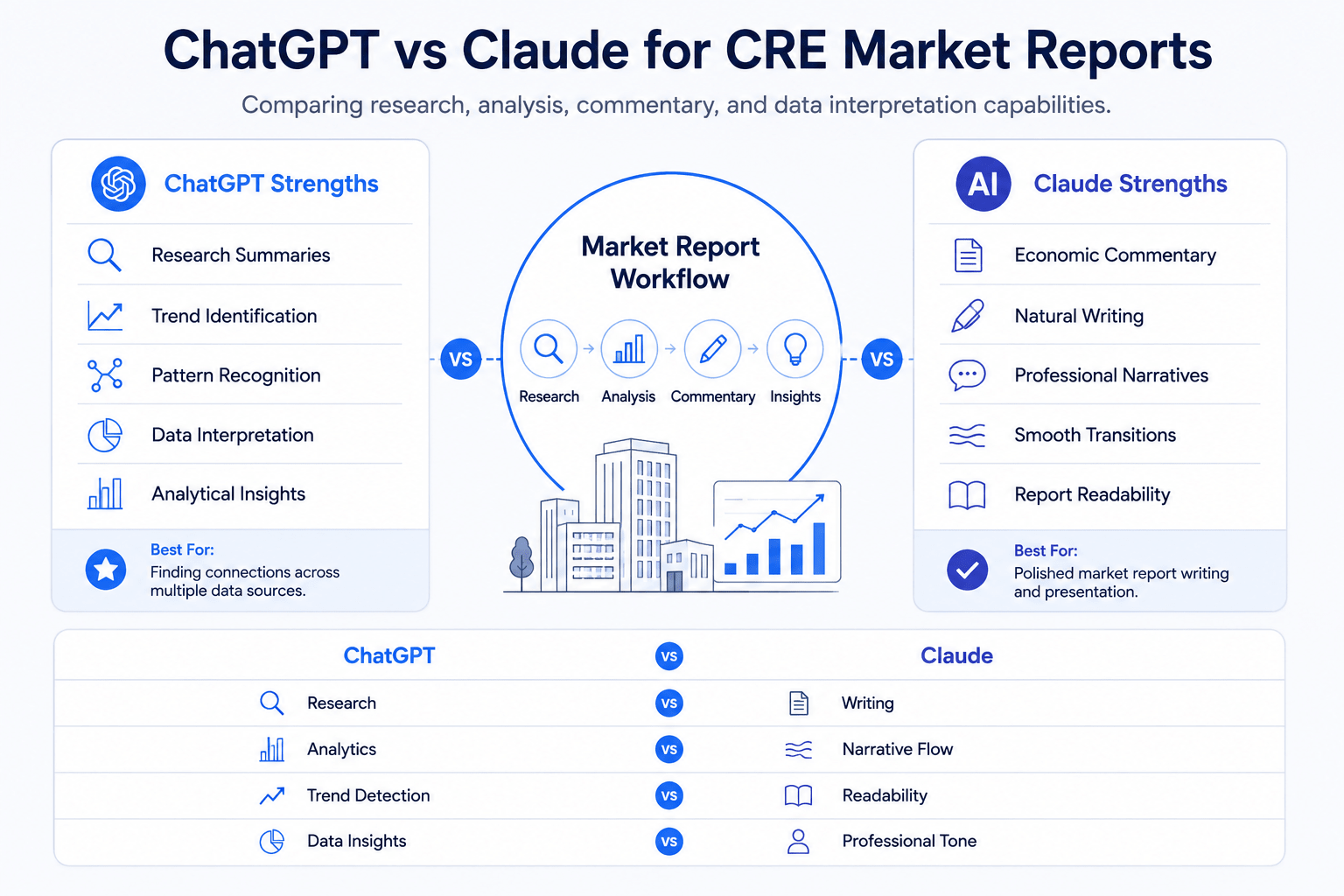
ChatGPT vs Claude for Market Reports
Market reports are among the most time-consuming documents in commercial real estate.
Creating a quality report often requires:
-
Market research
-
Data interpretation
-
Trend analysis
-
Written commentary
-
Visual presentation
AI can reduce a significant portion of that workload. The question is which platform performs better.
Market Research Summaries
Market reports often begin with extensive research.
Professionals must review:
-
Economic reports
-
Industry studies
-
Local market data
-
Property performance metrics
ChatGPT excels at summarizing research and organizing findings into logical sections. This makes it a valuable research assistant.
Submarket Analysis
Submarket sections typically discuss:
-
Vacancy trends
-
Rent growth
-
New supply
-
Demand drivers
-
Competitive positioning
Both platforms can produce strong summaries.
The difference often comes down to writing style rather than information quality.
Trend Identification
Identifying trends is one of the most valuable parts of a market report.
Examples include:
-
Migration patterns
-
Employment growth
-
Development activity
-
Capital market conditions
ChatGPT performs particularly well when asked to identify patterns across multiple sources. This analytical strength can help accelerate report preparation.
Economic Commentary
Economic commentary must be balanced and professional. Overly promotional language can reduce credibility. Claude often produces stronger economic narratives because its writing style tends to feel more natural and analytical.
Data Interpretation
Numbers alone do not tell the full story. Market reports must explain what the data means and why it matters. This is where both tools perform well.
ChatGPT often provides stronger analytical explanations. Claude often provides a stronger written presentation. The result is a very close competition.
Claude’s Biggest Advantages for Commercial Real Estate Writing
Although both platforms are strong, Claude has several advantages that make it popular among CRE professionals.
In addition, firms looking to move beyond document creation can explore these Claude automation routines to build repeatable processes across research, reporting, and internal CRE workflows.
More Natural Writing
One of Claude’s biggest strengths is readability.
The writing usually feels:
-
More conversational
-
More professional
-
Less robotic
-
Less repetitive
This is especially helpful for investor-facing documents.
Better Long-Form Content
Commercial real estate often involves long documents.
Examples include:
-
Offering memorandums
-
Investment committee memos
-
Market reports
-
Due diligence summaries
Claude generally maintains consistency throughout longer documents and requires fewer edits.
Stronger Context Retention
When working with large reports, Claude tends to keep track of information more effectively. This helps reduce inconsistencies and repetitive content.
Better First Drafts
Many CRE professionals report that Claude’s first draft is closer to a finished document. That means less time spent rewriting sections before sharing them with clients or investors.
Where Claude Fits Best
Claude is often the preferred choice for:
-
Offering memorandums
-
Investment memos
-
Market reports
-
Property narratives
-
Investor communications
For pure writing quality, Claude remains difficult to beat.
ChatGPT’s Biggest Advantages for Commercial Real Estate Writing
While Claude often wins on writing quality, ChatGPT offers several advantages that make it extremely valuable for CRE teams. For example, if you’re evaluating how Claude fits into daily CRE operations beyond writing, our guide on Claude workflows for CRE explores practical use cases, automation opportunities, and where Claude delivers the most value for commercial real estate professionals.
Better Research Support
ChatGPT performs very well when gathering, organizing, and explaining information.
Many professionals use it to:
-
Summarize research
-
Review market trends
-
Generate ideas
-
Analyze information
This can significantly reduce research time.
More Workflow Flexibility
One reason many firms choose ChatGPT is its broader feature set.
It can support:
-
File analysis
-
Workflow automation
-
Custom GPTs
-
Data interpretation
-
Process creation
This makes it useful beyond writing tasks.
Better for Content Marketing
Many CRE firms create:
-
Blog articles
-
Social media content
-
Newsletters
-
Marketing campaigns
ChatGPT often performs very well across these content formats.
Strong Business Productivity Tool
The Claude vs ChatGPT CRE discussion often focuses on writing, but many firms need more than writing assistance. ChatGPT can become part of a larger productivity system that supports multiple departments and workflows.
Where ChatGPT Fits Best
ChatGPT is often ideal for:
-
Market research
-
Content marketing
-
Workflow automation
-
Team productivity
-
Process development
-
Business operations
For firms looking beyond document creation, ChatGPT offers significant value.
Best Tool by CRE Task
| CRE Task | Best Tool |
|---|---|
| Offering Memorandums | Claude |
| Investment Memos | Claude |
| Market Reports | Claude |
| Property Narratives | Claude |
| Broker Emails | Claude |
| Market Research | ChatGPT |
| Content Marketing | ChatGPT |
| Workflow Automation | ChatGPT |
| Business Productivity | ChatGPT |
| Overall Writing Quality | Claude |
The biggest takeaway is simple. Claude is usually the better writer, while ChatGPT is usually the more versatile business tool.
What Most CRE Professionals Get Wrong About AI Writing
Many commercial real estate professionals expect AI to create perfect documents with a single prompt. That rarely happens. The best results come from treating AI as an assistant rather than a replacement for industry expertise.
Expecting Perfect First Drafts
Even the best AI tools make mistakes. Property details, financial assumptions, and market information should always be reviewed before sharing documents externally.
Using Generic Prompts
The quality of the output often depends on the quality of the instructions.
Instead of asking AI to “write an offering memorandum,” provide:
-
Property details
-
Target audience
-
Investment highlights
-
Market information
-
Desired tone
More context usually produces better results.
Skipping Human Review
AI can improve speed, but it cannot replace professional judgment.
CRE professionals should always verify:
-
Financial data
-
Market statistics
-
Property information
-
Investment assumptions
The final responsibility remains with the user.
Choosing One Tool for Everything
Many professionals try to find a single winner in the Claude vs ChatGPT CRE debate. In reality, some of the best workflows use both platforms.
For example:
-
Use ChatGPT for research and analysis.
-
Use Claude for the final document writing.
This approach often delivers the strongest results.
Conclusion
The answer to the Claude vs ChatGPT CRE question depends on what type of work you do most often. If your primary goal is creating high-quality commercial real estate documents, Claude generally performs better. Its writing is more natural, professional, and consistent across longer reports.
If your goal is broader productivity, ChatGPT offers more flexibility. It supports research, automation, workflow creation, and business operations beyond writing. For many CRE professionals, the best solution is not choosing one platform over the other. Instead, it is understanding where each tool provides the most value.
A broker creating offering memoranda may prefer Claude. A team building AI-powered workflows may prefer ChatGPT. The most advanced firms often use both. The important thing is not which tool you choose. The important thing is creating a repeatable process that saves time while maintaining professional standards.