How to Automate Weekly CRE Research for Better Deals
Most commercial real estate professionals conduct market research only when they urgently need answers. A lease renewal approaches, an acquisition opportunity appears, or a refinancing deadline looms, and suddenly hours are spent searching listing platforms, permit databases, and market reports. The problem is that important market changes rarely happen overnight. They unfold gradually over weeks and months. That’s why many investors, operators, brokers, and asset managers are beginning to Automate Weekly CRE Research instead of relying on reactive research sessions.
By creating a recurring research workflow that runs automatically every week, CRE professionals can monitor competitors, track market movements, identify emerging opportunities, and make better-informed decisions before everyone else notices the changes.
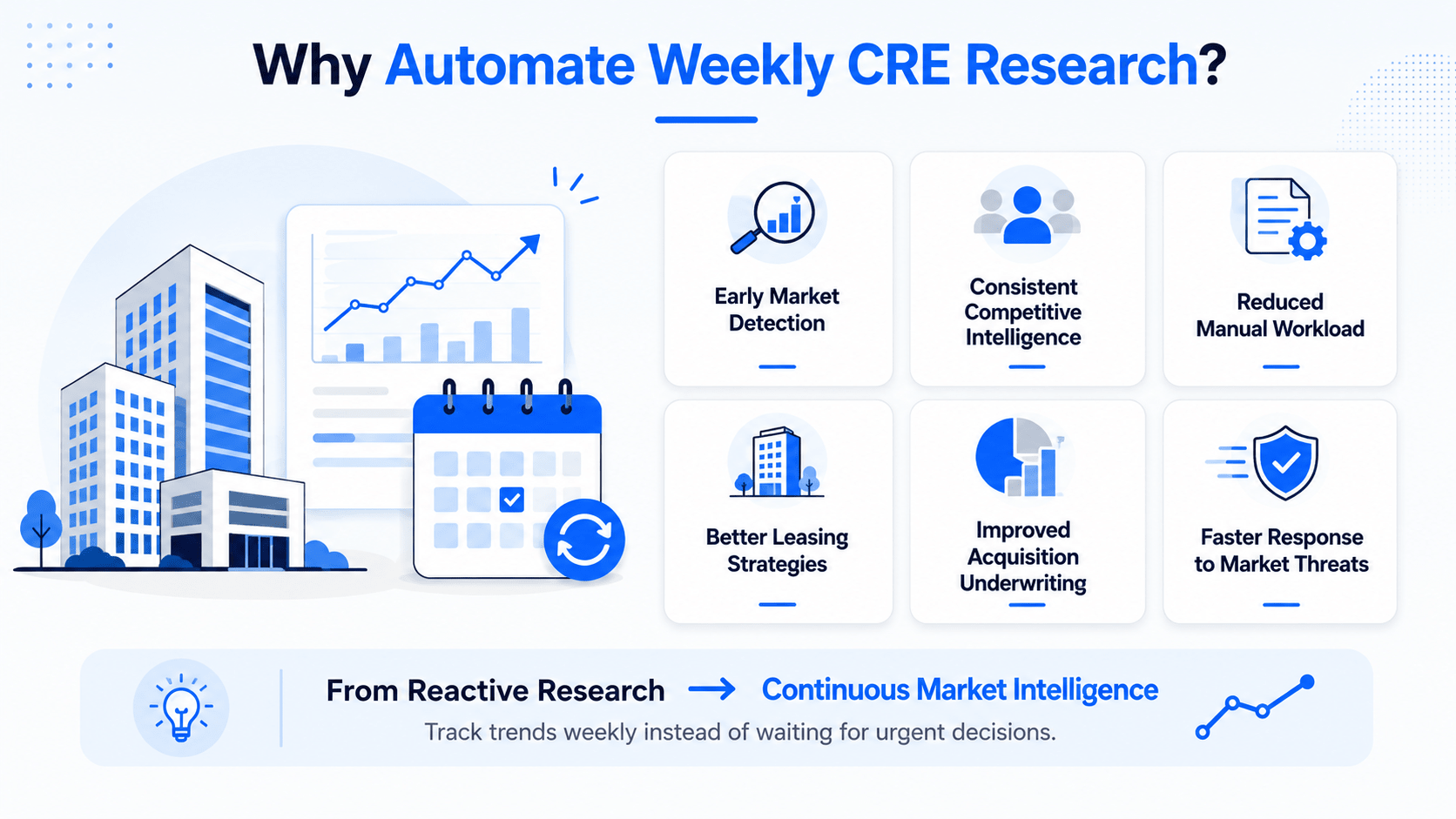
Why Automate Weekly CRE Research Instead of Reacting?
Traditional market research is often event-driven. Professionals gather information only when a transaction, financing event, or leasing decision demands it. However, market shifts occur continuously.
A competing property may introduce concessions. A nearby owner may reduce asking rents. A developer may file permits for a major project. These changes can influence pricing, leasing, and acquisition decisions long before they become obvious.
When you automate research on a weekly schedule, you gain visibility into market trends as they develop.
Benefits of Weekly Automated Research
-
Earlier detection of market changes
-
Consistent competitive intelligence
-
Reduced manual workload
-
Better leasing strategies
-
Improved acquisition underwriting
-
Faster response to market threats
-
More reliable historical trend tracking
Instead of gathering information during moments of urgency, you build an ongoing intelligence system.
What Market Data Should You Track?
Not every data point deserves ongoing monitoring. The goal is to focus on information that directly influences investment and operational decisions.
For apartment owners and operators, using AI for multifamily market research can make it easier to monitor rents, concessions, occupancy trends, and competitive positioning across an entire submarket.
Core Competitive Intelligence Metrics
| Data Category | Why It Matters | Update Frequency |
|---|---|---|
| Asking Rents | Reveals pricing trends | Weekly |
| Concessions | Indicates leasing pressure | Weekly |
| Vacancy Levels | Shows market strength | Weekly |
| New Listings | Identifies competition | Weekly |
| Permit Activity | Signals future supply | Weekly |
| Ownership Changes | Reveals investment activity | Weekly |
| Management Changes | Indicates operational shifts | Weekly |
Rental Trends
Asking rents remain one of the strongest indicators of market direction.
Tracking weekly rent changes allows you to identify:
-
Emerging rent reductions
-
Aggressive pricing strategies
-
Premium positioning
-
Seasonal leasing trends
Even small rent adjustments can signal larger market shifts.
Concessions and Specials
Concessions often appear before rent reductions.
Many operators prefer offering:
-
One month free
-
Reduced deposits
-
Gift card incentives
-
Waived application fees
Monitoring concessions helps identify hidden leasing challenges within competing properties.
Vacancy and Availability
A property with growing vacancies may be struggling despite maintaining published rental rates. Tracking available units over time provides valuable insight into actual demand conditions.
Building Your Competitive Property List
The quality of your research depends heavily on your input data.
Start With True Competitors
Many owners make the mistake of tracking too many properties. Instead, focus on assets that genuinely compete with yours.
Consider:
-
Location
-
Unit mix
-
Building age
-
Property class
-
Amenities
-
Tenant demographics
For many multifamily operators, monitoring 10–15 strong competitors provides better intelligence than following 50 loosely related assets.
Information to Include
Create a spreadsheet containing:
-
Property name
-
Address
-
Website
-
Unit count
-
Asset class
-
Ownership information
-
Management company
-
Submarket
This becomes the foundation of your automated workflow.
How to Automate Weekly CRE Research Effectively
Automation works best when the process is clearly defined.
Step 1: Define Your Research Objectives
Ask yourself:
-
What decisions will this research support?
-
Which competitors matter most?
-
Which indicators influence pricing?
-
Which signals reveal market opportunities?
Clear objectives prevent information overload.
Step 2: Establish Data Sources
Good automation depends on reliable sources.
Common sources include:
-
Property websites
-
Listing platforms
-
Municipal permit portals
-
Planning commission records
-
Local business journals
-
County assessor databases
-
Commercial brokerage reports
The more trustworthy the source, the more valuable the insights.
Step 3: Create Standardized Reporting
A consistent report format makes trends easier to identify.
Include:
-
Weekly changes
-
New findings
-
Significant alerts
-
Market summaries
-
Competitive analysis
Consistency improves decision-making.
Step 4: Schedule the Workflow
This is where many professionals fail. Research only becomes transformative when it runs automatically.
Most operators schedule reports:
-
Monday morning
-
Weekly
-
Before office hours
-
Delivered to email or dashboard
The report should already be waiting when the workday begins.
Tools That Help Automate Weekly CRE Research
Various technologies can support recurring market intelligence.
AI Research Agents
AI-powered agents can:
-
Search multiple sources simultaneously
-
Extract relevant information
-
Compare historical findings
-
Generate summaries
-
Highlight anomalies
This dramatically reduces manual effort.
Data Aggregation Platforms
These systems consolidate:
-
Listings
-
Sales activity
-
Market trends
-
Ownership records
-
Property performance indicators
They provide a centralized research environment.
Workflow Automation Tools
Automation platforms can:
-
Trigger research schedules
-
Compile reports
-
Send alerts
-
Update spreadsheets
-
Store historical data
The objective is to remove repetitive manual work.
Example Weekly CRE Research Workflow
One of the biggest advantages of automation is scale. This example shows how AI can research dozens of property owners simultaneously and return structured findings that would otherwise require hours of manual work.
The following framework illustrates how a recurring research process might operate.
| Stage | Action | Outcome |
|---|---|---|
| Input | Load competitor list | Target properties identified |
| Research | Collect market data | Updated intelligence gathered |
| Analysis | Compare against the prior week | Changes identified |
| Verification | Review unusual findings | Errors reduced |
| Reporting | Generate a summary report | Actionable insights delivered |
| Distribution | Send to stakeholders | Faster decision-making |
Monday Morning Report Example
A report might include:
Rent Changes
-
Building A reduced rent by 3%
-
Building B increased rents by 2%
New Concessions
-
One month free at Property C
-
Reduced deposits at Property D
Permit Activity
-
New renovation permits filed
-
Expansion projects approved
Ownership News
-
Property E was sold to a new investor
-
Management company change at Property F
Instead of spending hours gathering information, decision-makers immediately receive actionable intelligence.
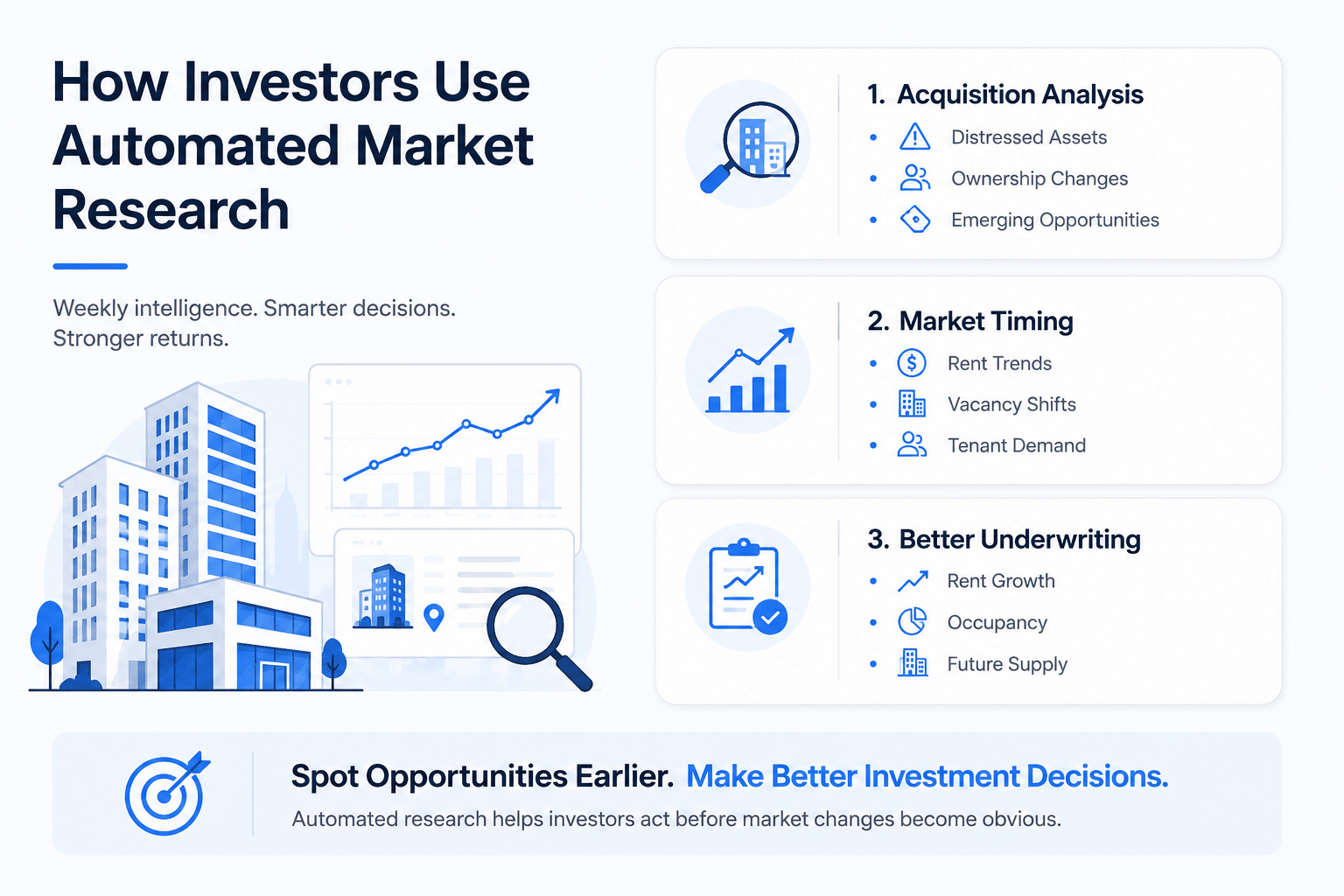
How Investors Use Automated Market Research
Investors often focus on identifying opportunities before competitors do.
Acquisition Analysis
Weekly monitoring can reveal:
-
Distressed assets
-
Underperforming properties
-
Ownership transitions
-
Emerging sales opportunities
These signals frequently appear before listings become widely marketed.
Market Timing
Tracking trends consistently helps investors recognize:
-
Rent growth slowdowns
-
Vacancy increases
-
Development surges
-
Changing tenant demand
This improves acquisition timing decisions.
Underwriting Improvements
Automated intelligence helps create more accurate assumptions regarding:
-
Rent growth
-
Occupancy
-
Competitive positioning
-
Future supply
Better assumptions lead to stronger investment decisions.
How Property Operators Benefit
Operators can use automation to improve day-to-day performance.
Leasing Strategy
Competitive tracking helps answer questions like:
-
Are competitors offering concessions?
-
Are rents increasing or declining?
-
Which properties are filling units fastest?
These insights support more effective leasing decisions.
Revenue Management
Weekly monitoring enables proactive pricing adjustments. Instead of reacting months later, operators can adjust pricing strategies immediately.
Capital Planning
Permit activity often reveals upcoming renovations and redevelopment projects. Understanding nearby improvements helps prioritize capital expenditures.
Common Mistakes When You Automate Weekly CRE Research
Automation is powerful, but it is not perfect.
Tracking Too Much Data
More information does not always create better decisions. Focus on the metrics that matter most.
Ignoring Data Quality
Poor inputs create poor outputs.
Verify:
-
Property lists
-
Source reliability
-
Report accuracy
Overlooking Human Review
Research automation should support decision-making, not replace it. Every important finding should be validated before major action is taken.
Chasing Every Market Signal
Not every change matters. Successful operators focus on patterns rather than isolated events.
Human Verification Still Matters
One of the biggest misconceptions about AI-powered research is that automation eliminates the need for human involvement. In reality, automation improves efficiency while human judgment provides context.
Suppose a report identifies a vacant unit that has supposedly remained available for eight months.
Several explanations could exist:
-
The property is struggling
-
The listing is outdated
-
Renovations are underway
-
Marketing information was not updated
Without verification, conclusions may be inaccurate.
The Best Approach
Use automation for:
-
Data collection
-
Monitoring
-
Summarization
-
Trend detection
Use humans for:
-
Verification
-
Interpretation
-
Strategy
-
Decision-making
The combination creates the strongest results.
Advanced Applications Beyond Competitor Tracking
Once the system is working, many CRE professionals expand their monitoring programs. The same philosophy applies to sourcing opportunities. Many investors now rely on a weekly prospecting schedule instead of running owner searches only when they actively need deals.
Development Monitoring
Track:
-
Zoning applications
-
Permit filings
-
Planning approvals
-
New construction activity
This provides early visibility into future supply.
Owner Watchlists
Monitor:
-
Major investors
-
Institutional owners
-
Local competitors
Ownership activity often reveals strategic market shifts.
Debt Maturity Tracking
Monitoring debt maturities can uncover:
-
Refinancing pressure
-
Potential distress
-
Acquisition opportunities
Market News Intelligence
Automated weekly news scans can monitor:
-
Interest rates
-
Economic trends
-
Regulatory changes
-
CRE transactions
This creates a broader market intelligence framework.
Measuring Success
To determine whether your automation efforts are working, monitor key performance indicators.
| Metric | Purpose | Success Indicator |
|---|---|---|
| Time Saved | Efficiency improvement | Significant reduction |
| Research Frequency | Consistency | Weekly completion |
| Insights Generated | Value creation | Actionable findings |
| Market Awareness | Competitive knowledge | Improved decisions |
| Opportunity Detection | Investment advantage | Earlier identification |
The goal is not simply to produce reports. The goal is to make better decisions faster.
Turn Weekly Market Intelligence Into a Competitive Advantage
If you’re serious about building repeatable systems that improve commercial real estate decision-making, the AI for CRE Collective provides practical workflows designed specifically for real-world CRE operations. From automated market research to acquisition analysis and asset management workflows, members gain access to tested strategies that reduce manual work while improving visibility into market activity.
Join a community of 600+ CRE professionals who are actively implementing AI across their businesses. Whether you’re an investor, operator, broker, or analyst, you’ll find proven frameworks you can deploy immediately. To stay current on emerging CRE automation strategies, subscribe to the newsletter and receive new workflows, case studies, and implementation guides directly in your inbox.
Conclusion
Commercial real estate markets reward professionals who identify change early. The challenge is that meaningful market intelligence requires consistency, and consistency is difficult when research depends on available time and memory.
By choosing to Automate Weekly CRE Research, investors, operators, and brokers can build a system that continuously monitors competitors, tracks market developments, and surfaces actionable insights before they become obvious to everyone else.
The most successful approach combines automation with human judgment. Let technology handle repetitive research while experienced professionals focus on analysis, strategy, and execution.
When done correctly, weekly automated research becomes more than a productivity tool it becomes a long-term competitive advantage.
FAQs Regarding How to Automate Weekly Market Research in CRE
1. How can I automate commercial real estate market research every week?
You can automate commercial real estate market research by creating a recurring workflow that collects and analyzes market data on a fixed schedule. Most CRE professionals use AI tools, automation platforms, and data sources to track competitors, rents, vacancies, concessions, permits, and local market activity without manually performing the same research each week.
-
Create a list of target properties or competitors
-
Define the market data you want to monitor
-
Schedule weekly reports and alerts
Conclusion: Weekly automation helps CRE professionals stay informed while reducing repetitive research work.
2. What is the easiest way to track CRE competitors automatically?
The easiest way to track CRE competitors automatically is to maintain a predefined list of competing properties and have an automated system monitor them regularly. This approach allows you to identify pricing changes, new concessions, occupancy trends, renovation activity, and ownership changes without constantly checking multiple websites manually.
-
Monitor the same properties every week
-
Compare current findings with historical data
-
Focus on meaningful changes instead of daily fluctuations
Conclusion: Consistent competitor tracking provides valuable market intelligence that supports better investment and operating decisions.
3. Can AI monitor commercial real estate competitors?
Yes, AI can monitor commercial real estate competitors by scanning multiple public and proprietary sources, identifying updates, and summarizing findings into easy-to-read reports. AI is especially useful for repetitive research tasks that would otherwise require hours of manual effort each week.
-
Tracks pricing and listing updates
-
Identifies market changes faster
-
Generates summaries and alerts
Conclusion: AI can significantly improve research efficiency while helping professionals stay ahead of market developments.
4. What information should I track in a weekly CRE market report?
A weekly CRE market report should focus on data that directly affects leasing, investment, acquisition, and asset management decisions. The goal is to monitor indicators that reveal changes in demand, competition, and future market conditions.
-
Asking rents and rent changes
-
Concessions and leasing incentives
-
Vacancy and availability trends
-
Permit activity and new developments
-
Ownership and management changes
Conclusion: Tracking the right information consistently provides a clearer understanding of market conditions over time.
5. Why should commercial real estate investors conduct market research every week?
Commercial real estate investors should conduct market research every week because important market changes often occur gradually rather than all at once. Regular monitoring allows investors to identify opportunities, risks, and emerging trends before they become widely recognized by the broader market.
-
Detect shifts in pricing and demand
-
Identify acquisition opportunities earlier
-
Monitor competitive activity
Conclusion: Weekly research helps investors make more informed decisions based on current market conditions rather than outdated information.
6. How does automated market research save time for CRE professionals?
Automated market research saves time by eliminating repetitive tasks such as checking listings, reviewing competitor websites, searching permit databases, and compiling reports manually. Instead, the system performs these activities automatically and delivers a summary of relevant findings.
-
Reduces manual data collection
-
Streamlines reporting processes
-
Allows teams to focus on analysis and strategy
Conclusion: Automation increases productivity by handling routine research tasks that consume valuable time.
7. What are the benefits of AI-powered market research in commercial real estate?
AI-powered market research helps commercial real estate professionals gather information faster, identify trends earlier, and maintain a consistent research process. It can process large amounts of information quickly while highlighting the most relevant changes.
-
Improves research speed
-
Enhances competitive intelligence
-
Supports data-driven decisions
-
Provides ongoing market visibility
Conclusion: AI-powered research enables CRE professionals to make faster and more informed decisions.
8. Can automated CRE research help find acquisition opportunities?
Yes, automated CRE research can help identify acquisition opportunities by continuously monitoring ownership changes, distressed assets, pricing adjustments, permit activity, and other market signals. These insights can reveal opportunities before they are widely marketed.
-
Tracks properties showing signs of distress
-
Identifies emerging investment opportunities
-
Monitors changes within target markets
Conclusion: Automated research can provide an early-warning system for potential acquisitions.
9. How accurate is AI-generated commercial real estate research?
AI-generated commercial real estate research can be highly effective for identifying trends, changes, and opportunities, but important findings should always be verified before making investment or operational decisions. Data sources can occasionally contain outdated or incomplete information.
-
Useful for gathering and organizing information
-
Effective for detecting patterns
-
Requires human verification for critical decisions
Conclusion: AI works best as a research assistant rather than a replacement for professional judgment.
10. What is the best way to automate weekly market research in CRE?
The best way to automate weekly market research in CRE is to build a repeatable workflow that monitors competitors, tracks key market indicators, and delivers a structured report on a recurring schedule. Successful systems focus on a small number of meaningful metrics rather than collecting excessive amounts of data.
-
Start with a focused competitor list
-
Use reliable data sources
-
Schedule reports consistently
-
Review findings each week
Conclusion: A simple, consistent workflow often produces better results than a complex system that is difficult to maintain.