How AI Zoning Analysis Works Across 23,000 Municipalities
If you’ve ever spent hours calling a planning department just to confirm setback rules, you already know how slow zoning research can be. However, an AI zoning analysis workflow is changing how land teams handle this process.
Instead of spending days verifying codes across different jurisdictions, you can now access structured zoning data in minutes.
Why Zoning Research Slows Down Deals
Zoning verification is one of the biggest bottlenecks in land acquisition.
Common Challenges
-
Every municipality uses different formats
-
Some codes are online, others require calls
-
Information is not standardized
-
Research takes hours per site
As a result, scaling across multiple markets becomes difficult.
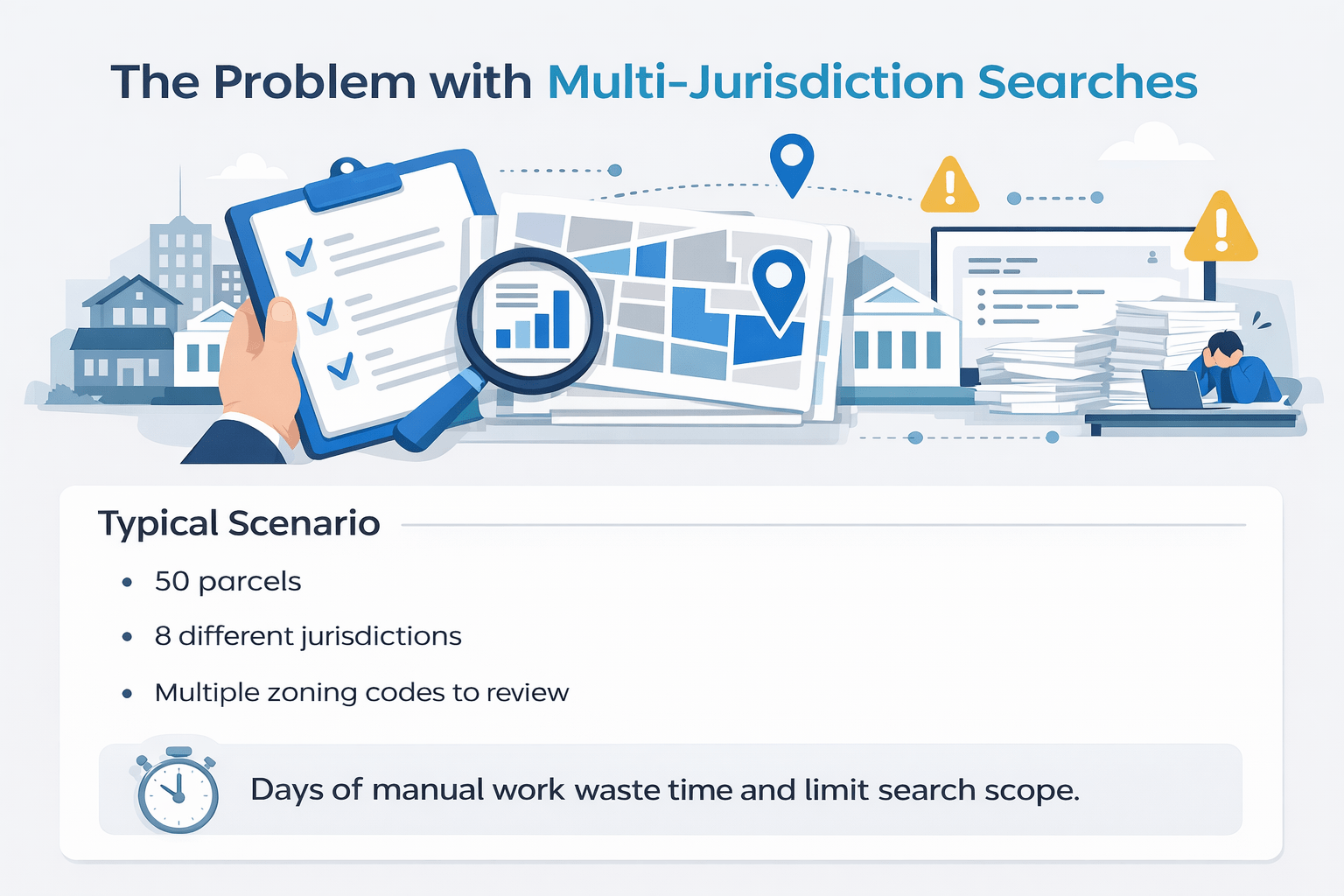
The Problem with Multi-Jurisdiction Searches
For a single parcel, zoning research is manageable. However, most land teams evaluate dozens of sites.
Typical Scenario
-
50 parcels
-
8 different jurisdictions
-
Multiple zoning codes to review
This quickly turns into days of manual work. Therefore, teams often delay or limit their search scope.
How AI Zoning Analysis Works
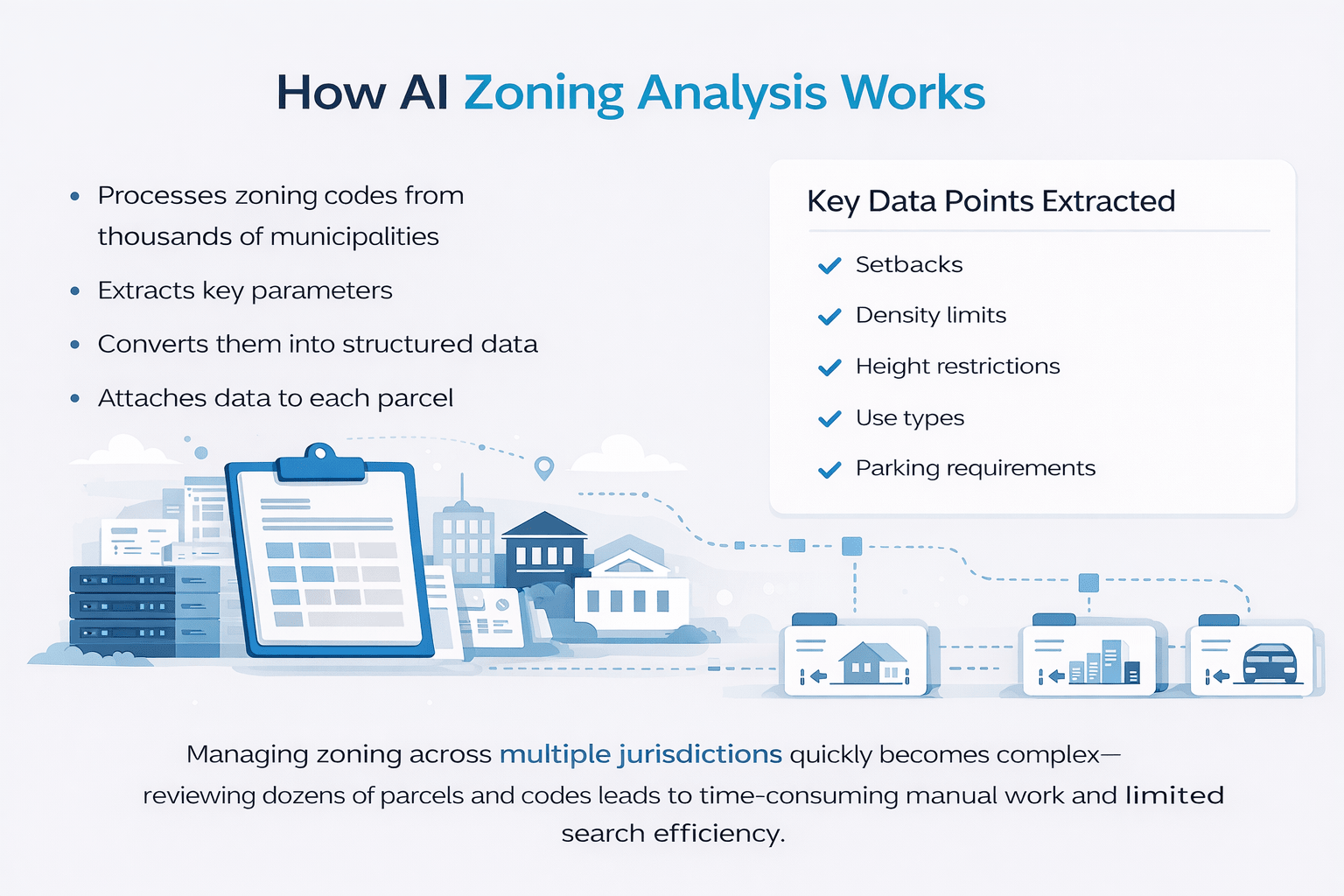
Instead of standardizing data manually, AI reads zoning documents directly.
What the System Does
-
Processes zoning codes from thousands of municipalities
-
Extracts key parameters
-
Converts them into structured data
-
Attaches data to each parcel
Key Data Points Extracted
-
Setbacks
-
Density limits
-
Height restrictions
-
Use types
-
Parking requirements
Because of this, you can evaluate sites without digging through raw zoning documents.
How This Changes Land Searches
The biggest shift is speed and scale.
Traditional Workflow
-
Identify parcels
-
Research zoning one by one
-
Verify details manually
-
Repeat across jurisdictions
AI Workflow
-
Draw a search area
-
Filter by zoning criteria
-
Instantly view viable parcels
-
Compare across jurisdictions
Workflow Comparison Table
| Factor | Traditional Research | AI Workflow |
|---|---|---|
| Time per Parcel | Hours | Seconds |
| Data Consistency | Low | High |
| Scalability | Limited | High |
| Research Effort | Manual | Automated |
Why This Matters for Land Teams
This AI zoning analysis workflow allows teams to move faster and make better decisions.
Key Benefits
-
Faster site screening
-
Reduced manual research
-
Better multi-market coverage
-
Improved deal pipeline efficiency
Instead of reacting to zoning constraints, you can filter for them upfront.
The Impact on Off-Market Outreach
Zoning data also improves acquisition strategy.
What Changes
-
Outreach becomes more specific
-
Letters reference real zoning potential
-
Sellers see informed buyers
Result
Response rates increase significantly when outreach includes:
-
Density potential
-
Development use
-
Site-specific insights
This makes your communication more credible and effective.
Limitations to Understand
AI is powerful, but it is not perfect.
Key Limitations
-
Zoning updates may lag
-
Overlay districts add complexity
-
Special conditions require review
-
Variances cannot be predicted
Because of this, final verification with municipalities is still necessary.
When to Use AI Zoning Tools
This workflow is most valuable when:
-
You are evaluating multiple sites
-
You operate across jurisdictions
-
You need faster screening
-
You want to scale acquisitions
How to Get Started
You can test this quickly with your own deals.
Steps
-
Select a recent land search
-
Run it through an AI zoning tool
-
Compare results with manual research
-
Verify accuracy
-
Measure time saved
This will show you the real impact immediately.
Time & Efficiency Impact
| Factor | Manual Process | AI Workflow |
|---|---|---|
| Research Time | Days | Minutes |
| Accuracy | Variable | High |
| Coverage | Limited | Broad |
| Decision Speed | Slow | Fast |
FAQs Regarding AI Zoning Analysis Workflow
Can AI accurately analyze zoning codes?
Yes, AI can extract key zoning data from complex documents.
-
Reads multiple formats
-
Identifies key parameters
-
Structures data
-
Speeds up research
You can explore document AI capabilities at Google AI (https://ai.google/).
How does AI handle different municipalities?
AI processes each code individually without needing standardization.
-
Works across jurisdictions
-
Adapts to formats
-
Extracts consistent outputs
-
Improves scalability
Data processing insights are available at Databricks (https://www.databricks.com/).
Does AI replace zoning verification?
No, final verification is still required.
-
Helps with early screening
-
Reduces workload
-
Needs confirmation
-
Improves efficiency
Urban planning insights can be found at Lincoln Institute (https://www.lincolninst.edu/).
What data can AI extract from zoning codes?
AI can pull key development parameters.
-
Density limits
-
Setbacks
-
Use types
-
Height restrictions
GIS data concepts are explained at QGIS (https://qgis.org/).
Can AI handle zoning updates?
Yes, but updates may not be instant.
-
Processes new codes
-
Updates databases
-
May have delays
-
Requires checks
Data update systems are discussed at Snowflake (https://www.snowflake.com/).
Is this useful for small developers?
Yes, it helps teams of all sizes.
-
Saves time
-
Reduces research effort
-
Improves decisions
-
Scales easily
Startup workflow tools are covered at Y Combinator (https://www.ycombinator.com/).
Can AI improve land acquisition strategies?
Yes, it enhances site selection and outreach.
-
Identifies better sites
-
Improves targeting
-
Speeds analysis
-
Increases response rates
Market insights are available at Redfin (https://www.redfin.com/).
How fast is AI zoning analysis?
It reduces research time dramatically.
-
Instant data access
-
Quick filtering
-
Faster decisions
-
Efficient workflows
Tech efficiency trends are covered at TechCrunch (https://techcrunch.com/).
Find Viable Sites Faster
Join the AI for CRE Collective, where 600+ CRE professionals are using workflows like this to cut through zoning complexity, identify development-ready sites faster, and stay ahead in competitive land markets.
Get access to real demos, tool breakdowns, and the 12-month Perplexity Pro access—and start making smarter land acquisition decisions in minutes, not days.