How AI Underwriting Is Changing Commercial Real Estate
Commercial real estate underwriting takes time. Teams review leases, rent rolls, operating costs, debt terms, and market reports before making a deal decision. Most of this work still happens in spreadsheets. That process works, but it is slow. Analysts often spend hours cleaning data, checking formulas, and updating assumptions. Small errors can also create bigger problems later. In fast-moving markets, delays can cost firms good deals. That is why more companies are using AI underwriting commercial real estate tools. These systems help CRE teams analyze deals faster, organize data automatically, and spot risks earlier.
AI is not replacing real estate professionals. Instead, it removes repetitive work. That gives analysts, brokers, lenders, and investors more time to focus on strategy and decision-making.
The biggest benefit is speed. However, consistency matters too. AI tools help teams follow a more structured underwriting process. That can reduce mistakes and improve reporting across the company.
At the same time, many CRE professionals still feel confused about AI. Some think it is too technical. Others think it only works for large firms. In reality, many small and mid-sized teams already use AI tools every day.
This guide explains how AI underwriting is changing commercial real estate today. You will learn where AI helps most, which tasks still need human judgment, and how firms are using these tools in real deals.
What Is AI Underwriting in Commercial Real Estate
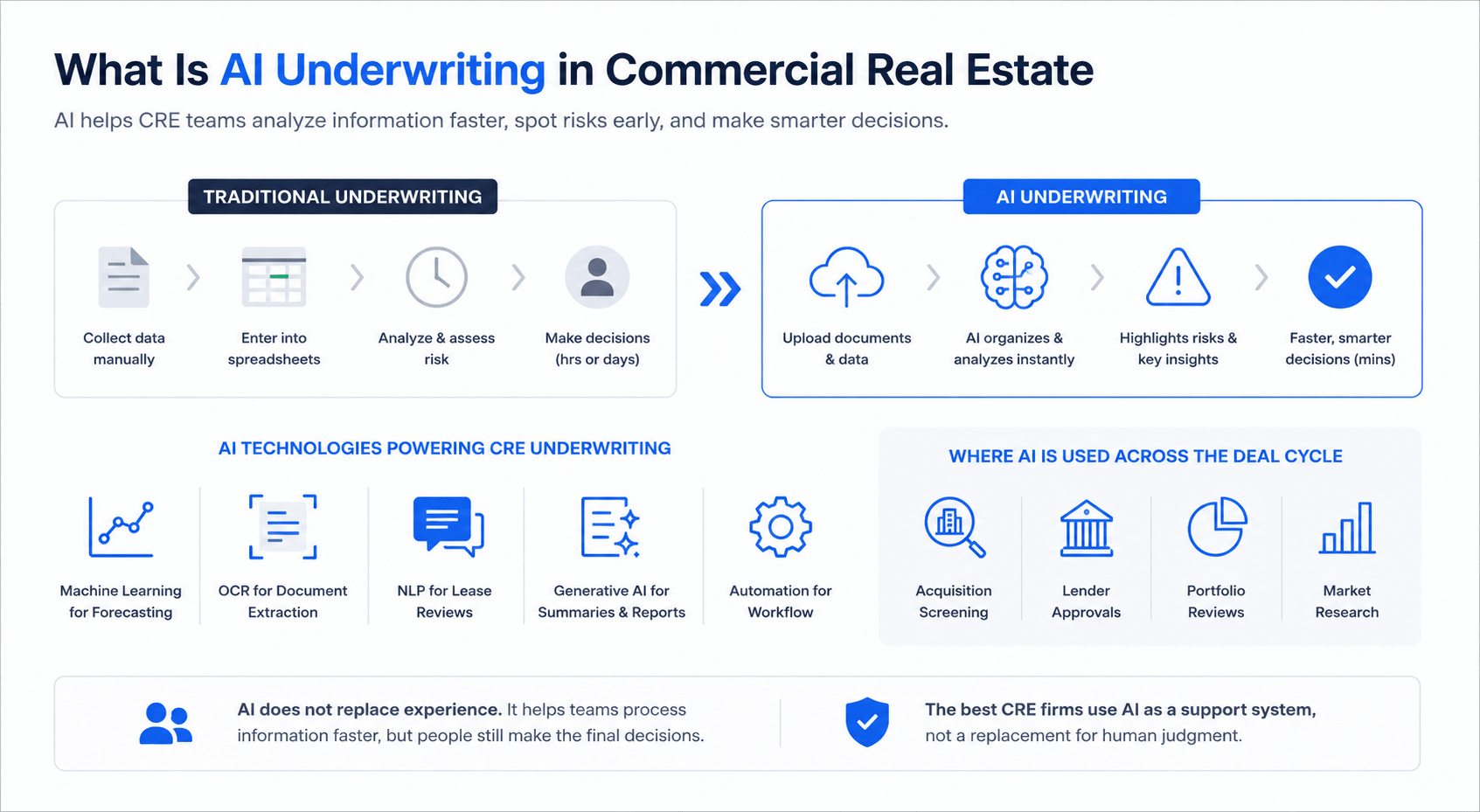
Traditional underwriting depends on manual work. Analysts collect financial statements, rent rolls, lease agreements, and market data. Then they enter everything into spreadsheets to estimate risk and returns.
AI changes how that work gets done.
Instead of reviewing every file manually, AI systems can organize and analyze information automatically. Many platforms now extract lease data, summarize financial reports, and identify missing details within minutes.
This saves time during early deal review.
For example, an analyst may upload a rent roll and operating statement into an AI tool. The platform can quickly highlight vacancy issues, unusual expenses, or lease rollover risk. In a traditional workflow, that same review could take hours.
Several types of AI support CRE underwriting today:
-
Machine learning for forecasting
-
OCR tools for document extraction
-
Natural language processing for lease reviews
-
Generative AI for summaries and reports
-
Automation tools for workflow management
AI also supports different parts of the deal cycle.
Some firms use AI for acquisition screening. Others use it for lender approvals, portfolio reviews, or market research. Multifamily operators often use AI to study rent growth trends. Industrial investors may use it to analyze logistics demand and occupancy patterns.
Still, AI does not replace experience.
Real estate remains relationship-driven. Local knowledge still matters. Market timing also matters. AI helps teams process information faster, but people still make the final decisions.
The best CRE firms use AI as a support system, not a replacement for human judgment.
Why Traditional Underwriting Is Slowing CRE Teams Down
Most underwriting teams still rely on spreadsheets. That approach feels familiar, but it creates several problems.
The biggest issue is manual data entry.
Analysts spend large amounts of time moving numbers between PDFs, Excel sheets, and reports. This work is repetitive and easy to get wrong. Even a small mistake can affect an entire model.
Version control is another challenge. Multiple people often work on the same deal at once. One team member updates assumptions while another changes formulas. Soon, nobody knows which version is correct.
The process also becomes harder as portfolios grow.
Reviewing leases across hundreds of units takes time. The same happens with lender packages, expense reports, and operating statements. Many firms struggle to scale because underwriting remains too manual.
Traditional underwriting also depends heavily on individual analysts. Two people may review the same deal and produce different conclusions. One may use aggressive rent assumptions. Another may take a conservative approach.
That creates inconsistency.
Here are several common problems in traditional underwriting workflows:
-
Manual lease reviews
-
Spreadsheet errors
-
Slow reporting
-
Repetitive data entry
-
Delayed approvals
-
Inconsistent assumptions
-
Time-consuming sensitivity analysis
These delays affect real business outcomes.
A broker may lose a buyer because the analysis takes too long. A lender may miss financing opportunities during rate changes. Investors may also overlook risks hidden inside large datasets.
Today’s CRE market moves quickly. Interest rates change fast. Tenant demand shifts rapidly. Investors expect quicker answers from acquisition teams.
As a result, more firms are turning toward AI-driven underwriting systems.
These tools reduce repetitive work and speed up analysis. Analysts can spend less time organizing data and more time evaluating deals.
That shift improves both productivity and decision-making.
How AI Underwriting Commercial Real Estate Changes Deal Analysis
AI changes underwriting by speeding up the early stages of deal review. Instead of handling everything manually, teams can automate many repetitive tasks.
Financial modeling is one major example.
AI tools can organize property data, calculate NOI trends, and prepare basic underwriting assumptions automatically. Analysts still review the numbers, but they save hours during setup.
Lease abstraction is another area that is changing quickly.
Traditionally, analysts read leases one by one. They search for expiration dates, rent escalations, tenant obligations, and renewal options manually. AI platforms can now extract that information within minutes.
That saves significant time in larger deals.
AI also improves risk analysis. These systems review large amounts of market and property data much faster than humans. They can identify unusual patterns, declining occupancy trends, or tenant concentration risks early in the process.
Many firms now use AI for:
-
Rent roll analysis
-
Lease abstraction
-
Investment memo creation
-
Market research
-
Sensitivity testing
-
Risk scoring
-
Cash flow forecasting
Another advantage is real-time market insight.
Traditional underwriting often depends on older reports. AI tools can process newer information faster. That helps firms react more quickly to market shifts.
For example, a multifamily investor may use AI to study migration trends and rental demand. An industrial buyer may analyze transportation access and warehouse absorption rates before making an offer.
AI also helps smaller firms compete.
Lean teams can review more deals without hiring large analyst departments. That creates a strong advantage in competitive markets.
Still, successful implementation requires structure. Firms need clean data, standardized workflows, and human oversight. AI works best when experienced operators guide the process.
Stop wasting hours in spreadsheets. Join CRE professionals using real AI underwriting workflows inside the community:
Before vs After AI Underwriting Workflows
The biggest difference between traditional underwriting and AI underwriting is speed. However, the workflow changes matter just as much.
Most CRE teams still follow a manual process. Analysts download files, clean spreadsheets, review leases, and update assumptions one by one. That takes time. It also increases the chance of errors.
AI changes the first part of that workflow.
Instead of spending hours organizing information, teams can upload files into an AI system. The platform extracts the data automatically and highlights key risks. Analysts then review the results and adjust assumptions where needed.
This does not remove underwriting expertise. It simply reduces repetitive work.
Here is how a traditional underwriting workflow usually looks:
-
Download deal documents
-
Review rent rolls manually
-
Enter data into spreadsheets
-
Check lease terms individually
-
Build financial models
-
Create investment memos
-
Present findings internally
Now compare that with a modern AI-assisted workflow:
-
Upload OM and property files
-
AI extracts lease and financial data
-
The system identifies missing information
-
AI generates a draft underwriting model
-
Analysts validate assumptions
-
Team reviews risks and opportunities
-
Investment memo created faster
The time savings can be significant. Some firms reduce early-stage underwriting work from several hours to less than one hour.
Here is a simple comparison:
Table Caption: Traditional CRE Underwriting vs AI Underwriting
| Task | Traditional Process | AI-Assisted Process |
|---|---|---|
| Lease abstraction | Manual review | Automated extraction |
| Data entry | Spreadsheet-heavy | AI-assisted |
| Market analysis | Manual research | Faster AI summaries |
| Risk analysis | Analyst dependent | Pattern-based insights |
| Investment memos | Manual drafting | AI-generated drafts |
| Deal screening | Slow | Faster qualification |
AI also improves consistency across teams. Everyone follows a similar structure. That helps firms standardize reporting and decision-making.
Still, the best firms do not rely fully on automation. Human review remains critical, especially during acquisitions and lending decisions.
What AI Can Automate vs What Humans Still Must Do
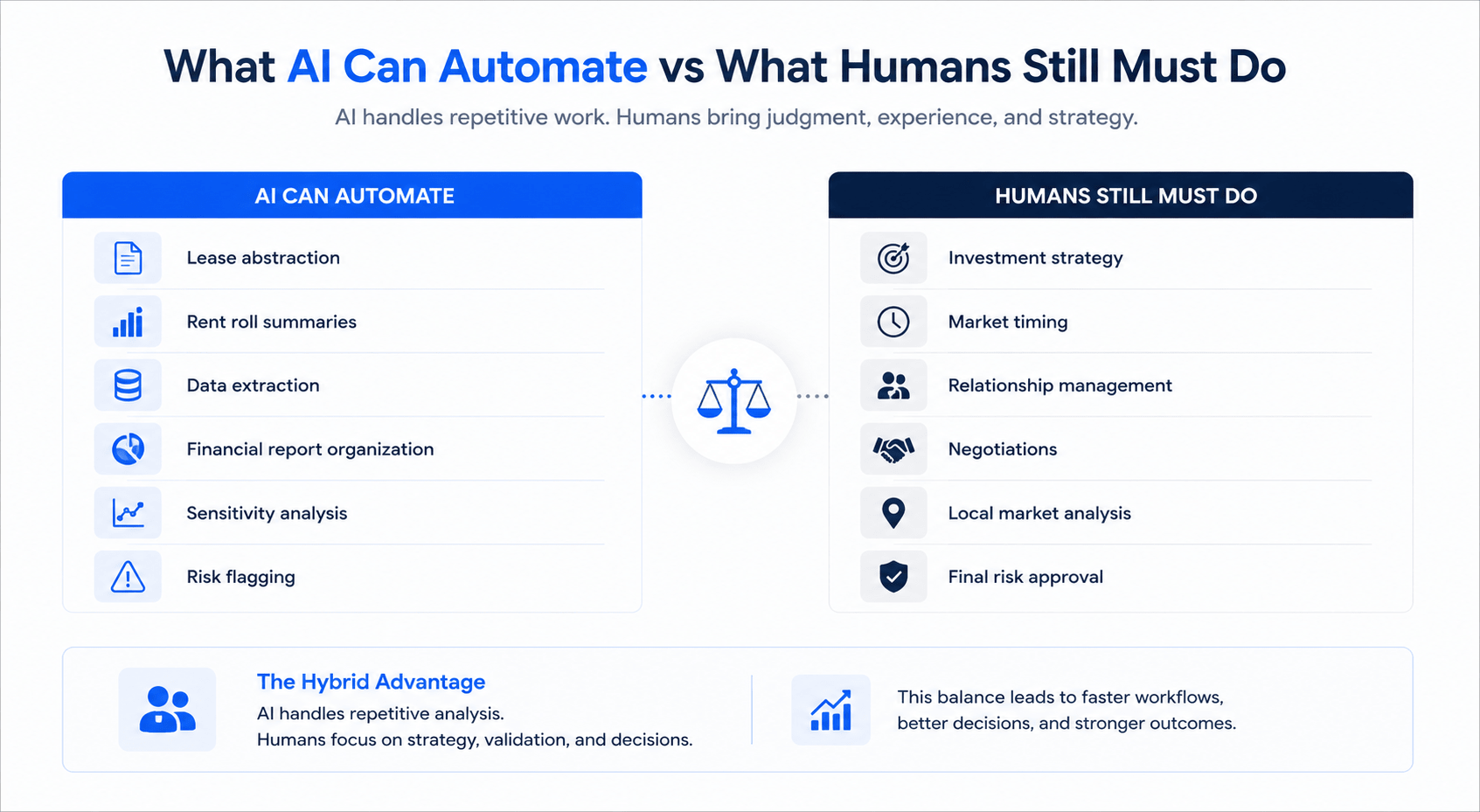
AI handles repetitive tasks well. That is where most productivity gains happen.
For example, AI can extract lease information, summarize operating statements, and organize property data quickly. These tasks follow patterns, so automation works effectively.
However, commercial real estate is not only about numbers. Relationships, local knowledge, and negotiation strategy still matter.
That is why human oversight remains essential.
Here are several underwriting tasks AI handles well today:
-
Lease abstraction
-
Rent roll summaries
-
Data extraction
-
Financial report organization
-
Sensitivity analysis
-
Draft investment memos
-
Market trend summaries
-
Risk flagging
These tasks usually consume large amounts of analyst time. AI reduces that workload significantly.
Still, many responsibilities require human judgment.
CRE professionals still make the final decisions around:
-
Investment strategy
-
Market timing
-
Relationship management
-
Capital structure decisions
-
Negotiations
-
Local market analysis
-
Final risk approval
For example, AI may flag a retail property as risky because of declining foot traffic. However, a local investor may know a major redevelopment project is about to increase demand in that area.
That type of insight rarely exists inside the data alone.
Human oversight also protects firms from bad assumptions. AI systems depend on the information they receive. Poor data can create misleading results.
This is why experienced analysts still matter.
The strongest underwriting teams now follow a hybrid model. AI handles repetitive analysis. Humans focus on strategy, validation, and decision-making.
That balance creates better outcomes. For example, many CRE firms now build repeatable AI underwriting workflows to reduce manual spreadsheet work and improve consistency across acquisition teams.
Best AI Underwriting Tools for CRE Teams
The CRE AI market is growing quickly. New tools appear almost every month. However, not every platform delivers real value.
Some tools improve workflows immediately. Others create more complexity than efficiency.
The best approach is to start with simple use cases first. Focus on tools that solve real underwriting problems instead of chasing hype.
Several AI platforms now support commercial real estate underwriting directly.
AI Deal Analysis Platforms
These tools focus on property data, investment analysis, and market intelligence.
| Tool | Best For | Main Strength |
|---|---|---|
| Cherre | Enterprise data integration | Property intelligence |
| Reonomy | Property research | Ownership data |
| Enodo | Multifamily analysis | Predictive analytics |
| Prophia | Lease abstraction | Document extraction |
| Skyline AI | Investment analysis | Market forecasting |
These platforms often work best for larger firms with active deal pipelines.
Smaller teams usually combine general AI tools with existing workflows instead.
General AI Tools Used in Underwriting
Many CRE professionals now use everyday AI tools during analysis.
| Tool | Common Use |
|---|---|
| ChatGPT | Investment memos and analysis |
| Claude | Long document review |
| Gemini | Research support |
| Perplexity | Market research |
These tools help summarize information quickly. They also support brainstorming, reporting, and early-stage deal screening.
However, outputs still require human review.
Workflow Automation Platforms
Some firms focus more on automation than predictive analytics.
Popular workflow tools include:
-
Zapier
-
Make
-
Airtable AI
-
Notion AI
These systems connect different software tools together. For example, a brokerage team may automate OM uploads into a CRM and an underwriting dashboard.
The goal is not just AI adoption. The goal is operational efficiency.
Many CRE teams fail because they buy too many tools too quickly. Instead, firms should focus on solving one workflow problem at a time.
That approach creates better adoption across teams.
Stop wasting time testing random AI tools. Learn which workflows actually work inside commercial real estate teams:
How CRE Firms Are Using AI Underwriting Today
AI underwriting is no longer experimental. Many CRE firms already use AI during acquisitions, lending, and portfolio management.
The biggest difference is how each sector applies the technology.
Multifamily investment firms often focus on forecasting. They use AI to analyze rent growth, occupancy trends, and operating performance across large portfolios.
For example, a multifamily operator may upload historical property data into an AI system. The platform then predicts possible vacancy risks and identifies units with below-market rents.
Commercial lenders use AI differently.
Many banks and lending groups now automate parts of the loan review process. AI helps organize borrower documents, summarize financial statements, and speed up early-stage approvals.
This creates faster turnaround times for borrowers and lending teams.
Brokerage firms also benefit from AI underwriting workflows.
Brokers regularly review offering memoranda and market reports. AI tools help summarize opportunities faster, identify investment highlights, and prepare client-ready materials.
Several common brokerage use cases include:
-
OM analysis
-
Investment summaries
-
Market comparisons
-
Deal qualification
-
Investor reporting
Institutional investors often take AI adoption even further.
Large firms use AI to monitor entire portfolios in real time. These systems track occupancy changes, market shifts, tenant risk, and operational performance continuously.
That helps firms react faster when market conditions change.
However, most successful firms still keep humans involved throughout the process. AI supports analysis, but experienced operators make the final calls.
That balance remains critical in commercial real estate.
Real-World CRE AI Underwriting Use Cases
AI underwriting looks different across property types. Each sector has different risks, data points, and investment goals. That is why firms usually build workflows around their specific needs.
In multifamily deals, AI often focuses on rent growth and occupancy trends. Operators use these tools to compare unit pricing, identify turnover patterns, and forecast future NOI.
For example, a multifamily investor may upload rent rolls from several properties. The AI system can quickly identify underpriced units, lease expiration clusters, and tenant retention risks. That helps the acquisition team review opportunities faster.
Office investors use AI differently.
Many office owners now study tenant stability and lease rollover risk more closely than before. AI tools help analyze lease expiration schedules, occupancy trends, and local demand patterns.
This matters because office markets remain uncertain in many cities.
Retail underwriting also benefits from AI-based analysis. Investors can combine tenant data, demographic reports, and traffic patterns into one system. AI then highlights areas with declining consumer activity or stronger growth potential.
Industrial real estate teams often focus on logistics data.
AI tools can analyze transportation access, warehouse demand, shipping trends, and regional supply chain activity. These insights help firms understand long-term tenant demand more clearly.
Common real-world AI underwriting use cases include:
-
Lease abstraction
-
Tenant risk analysis
-
Market forecasting
-
Rent growth projections
-
Expense anomaly detection
-
Portfolio performance tracking
-
Investment memo creation
-
Deal screening automation
Many firms also use AI during early-stage acquisitions.
Instead of fully underwriting every opportunity, teams first use AI to filter deals quickly. That saves time and allows analysts to focus on higher-quality opportunities.
This is becoming especially important as deal volume increases.
Still, firms must stay realistic. AI improves efficiency, but it cannot fully predict market behavior. Human judgment remains essential when evaluating location quality, relationships, and long-term investment strategy.
Common Mistakes CRE Professionals Make With AI Underwriting
Many firms rush into AI without a clear plan. They buy tools quickly, but they do not change their workflows. As a result, adoption fails.
The biggest mistake is expecting AI to replace human expertise.
Commercial real estate depends on local knowledge, relationships, and market timing. AI can support analysis, but it cannot fully understand neighborhood dynamics or negotiation strategy.
Another common issue is poor data quality.
AI systems rely on accurate information. If rent rolls contain errors or financial statements are incomplete, the output becomes unreliable. Many firms underestimate how important clean data is.
Some teams also over-automate client communication.
Investors still want thoughtful insights from real people. Automated reports alone rarely build trust. AI should support communication, not replace it.
Here are several common AI underwriting mistakes:
-
Using bad property data
-
Ignoring human review
-
Buying too many tools
-
Automating everything too quickly
-
Trusting AI outputs blindly
-
Failing to train teams properly
-
Expecting instant ROI
Another problem is tool overload.
Some firms subscribe to several AI platforms at once. Soon, employees become overwhelmed. Nobody knows which tool to use or how workflows should operate.
The better approach is simpler.
Start with one use case. Focus on solving a clear operational problem first. Once the team sees value, expand gradually.
Training also matters.
Many CRE professionals struggle with prompting and workflow design. Firms should create standard processes so teams use AI consistently.
The companies seeing the best results usually treat AI like operational infrastructure. They build repeatable systems around it instead of chasing trends.
That creates long-term efficiency gains.
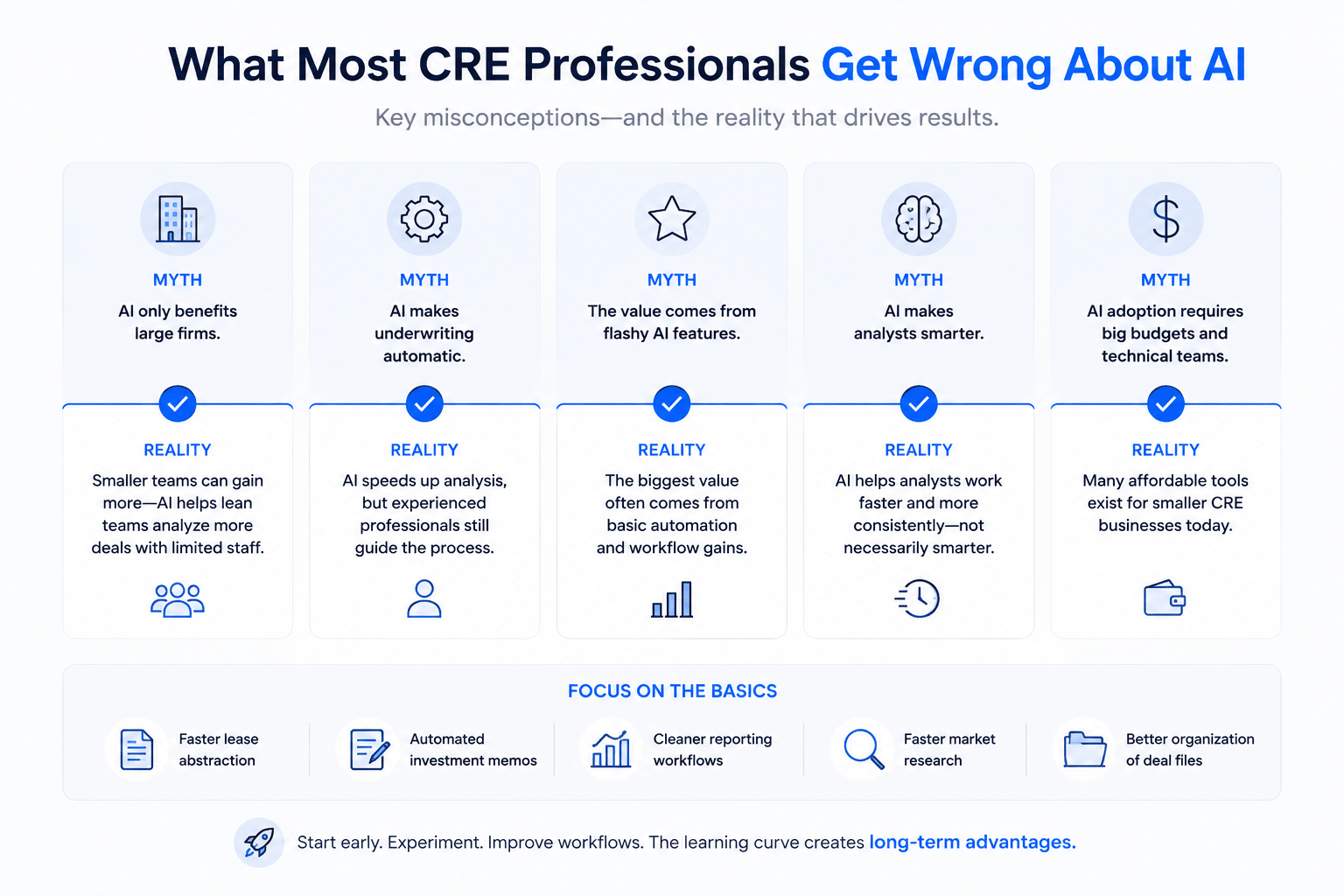
What Most CRE Professionals Get Wrong About AI
Many people think AI only benefits large institutional firms. That is no longer true.
Smaller teams may actually gain more from AI because they often operate with limited staff. Automation allows lean firms to analyze more deals without hiring large analyst teams.
Another misconception is that AI makes underwriting “automatic.”
It does not.
AI speeds up analysis, but experienced professionals still guide the process. The strongest firms combine automation with human oversight.
Some CRE professionals also focus too much on flashy AI features. They look for advanced forecasting models while ignoring simpler workflow improvements.
In reality, the biggest value often comes from basic automation.
For example:
-
Faster lease abstraction
-
Automated investment memos
-
Cleaner reporting workflows
-
Faster market research
-
Better organization of deal files
These changes may seem small individually, but together they save significant time.
Another misunderstanding involves productivity.
AI does not necessarily make analysts smarter. Instead, it helps them work faster and more consistently. That distinction matters.
An experienced analyst using AI often becomes far more productive. However, an inexperienced analyst still needs training and oversight.
Some firms also wait too long to start.
They assume AI adoption requires large budgets or technical teams. Today, many affordable tools already exist for smaller CRE businesses.
The firms gaining the most advantage are usually the ones experimenting early. They learn gradually and improve workflows over time.
That learning curve creates long-term operational advantages.
Copy-Paste AI Prompts for CRE Underwriting
Good prompts improve AI outputs significantly. Weak prompts create generic responses that add little value.
The best underwriting prompts provide context, clear instructions, and specific goals. They also explain the role the AI should play.
Below are several practical prompts CRE professionals can use today.
Deal Screening Prompt
Use this prompt when reviewing offering memorandums quickly.
Review this commercial real estate deal package. Summarize the investment strengths, major risks, tenant concerns, occupancy trends, and possible underwriting red flags. Keep the response concise and investor-focused.
Lease Review Prompt
This helps speed up lease abstraction.
Analyze these lease documents. Extract expiration dates, escalation clauses, renewal options, tenant responsibilities, and any unusual lease terms that may affect underwriting risk.
Investment Committee Memo Prompt
Use this when preparing internal acquisition summaries.
Create a commercial real estate investment memo using the uploaded underwriting data. Include property overview, market summary, financial highlights, major risks, upside opportunities, and investment recommendation.
Sensitivity Analysis Prompt
This prompt helps test downside scenarios.
Analyze this underwriting model. Show the impact if occupancy declines by 10%, interest rates increase by 1%, and operating expenses rise faster than projected.
Market Research Prompt
Use this for submarket analysis.
Compare this submarket against historical rent growth, vacancy trends, supply pipeline activity, and tenant demand. Highlight risks and growth opportunities for investors.
Strong prompts improve consistency across underwriting teams. Many firms now create internal prompt libraries so analysts follow the same structure during reviews.
That helps standardize reporting and reduce confusion.
How to Implement AI Underwriting in 24 Hours
Many CRE firms delay AI adoption because they think implementation will be difficult. In reality, most teams can start much faster.
The key is keeping the process simple.
Do not try to automate everything at once. Start with one repetitive task that already slows down the team.
The first step is reviewing your current workflow.
Look for tasks that consume large amounts of analyst time. Lease abstraction, rent roll analysis, and investment memo drafting are usually strong starting points.
Next, choose a simple AI stack.
Most firms do not need enterprise software immediately. A combination of ChatGPT, spreadsheet automation, and document extraction tools is often enough to begin.
Here is a practical implementation process:
-
Audit current underwriting workflows
-
Identify repetitive manual tasks
-
Select one AI use case first
-
Build standard prompts for analysts
-
Test outputs carefully
-
Measure time savings
-
Expand gradually into other workflows
Training matters during this stage.
Teams should learn how to write effective prompts and validate AI-generated outputs. Standardization also improves adoption across departments.
Many firms see immediate productivity gains after implementation.
Tasks that once took hours may only require minutes. Analysts can review more opportunities without increasing workload.
However, successful implementation still depends on oversight. AI should improve existing processes, not replace underwriting discipline.
The goal is smarter workflows, not blind automation. This walkthrough shows how CRE professionals are using AI inside Excel to analyze deals much faster without changing their full workflow.
AI Underwriting Risks and Compliance Concerns
AI underwriting creates major efficiency gains, but it also introduces new risks. CRE firms must understand these issues before automating critical workflows.
One of the biggest concerns is data quality.
AI systems rely on the information they receive. If rent rolls contain errors or lease documents are incomplete, the analysis becomes unreliable. Poor inputs can create misleading projections and weak investment decisions.
Data privacy is another major issue.
Commercial real estate deals often include sensitive financial information. Loan files, tenant records, and investor data must stay protected. Firms should review how AI vendors store and process information before uploading documents.
Compliance risks also matter, especially for lenders.
Banks and lending groups must follow strict underwriting standards. If AI systems create biased recommendations or unsupported assumptions, firms may face regulatory problems later.
Several important compliance concerns include:
-
Data privacy protection
-
Fair lending practices
-
Audit trail documentation
-
Model transparency
-
Human review requirements
-
Secure file handling
Bias is another growing concern.
AI models learn from historical data. If older datasets contain bias, the system may repeat those patterns. This creates risk during tenant screening, lending reviews, or market analysis.
That is why human oversight remains critical.
Experienced professionals should review all major investment decisions before approval. AI should support underwriting teams, not replace them completely.
Audit trails also matter.
Firms need clear documentation showing how decisions were made. Many institutional investors and lenders now require human checkpoints throughout automated workflows.
The strongest CRE companies treat AI like a decision-support tool. They combine automation with governance, oversight, and compliance review.
That balance helps firms improve efficiency while reducing operational risk.
The Future of AI Underwriting Commercial Real Estate
AI underwriting is still evolving. Most firms remain in the early stages of adoption. However, the technology is improving quickly.
Over the next few years, underwriting workflows will likely become more automated and connected.
Today, analysts still spend time moving information between systems. In the future, many platforms will update data automatically in real time. Property performance, market shifts, and tenant risks may appear instantly inside underwriting dashboards.
Predictive analytics will also improve.
AI systems will likely become better at forecasting occupancy changes, rent growth, and operational risks. Investors may use these tools to stress-test deals faster before acquisitions.
Portfolio monitoring is another growing area.
Large firms already use AI to track portfolio performance continuously. These systems monitor expenses, occupancy trends, lease rollover schedules, and market conditions automatically.
This creates faster decision-making across asset management teams.
Several trends will shape the future of AI underwriting commercial real estate:
-
Real-time underwriting dashboards
-
Automated investment memos
-
Faster portfolio analysis
-
Smarter risk forecasting
-
AI-assisted investment committees
-
Integrated market intelligence systems
Human expertise will still matter.
Commercial real estate remains relationship-driven. Local market knowledge cannot fully be replaced by software. Negotiation strategy, capital relationships, and investment experience will continue to shape outcomes.
Instead of replacing analysts, AI will likely change their role.
Analysts may spend less time cleaning spreadsheets and more time reviewing strategy, validating assumptions, and advising decision-makers.
This shift could improve both productivity and job quality across CRE teams.
Firms that learn these systems early may gain long-term advantages. They will move faster, analyze more deals, and operate more efficiently than competitors relying only on traditional workflows.
Conclusion
Commercial real estate underwriting is changing quickly. AI tools now help firms analyze deals faster, organize information more efficiently, and improve consistency across teams.
The biggest advantage is not full automation. It is operational efficiency.
AI reduces repetitive work so analysts, lenders, brokers, and investors can focus on higher-value decisions. Tasks like lease abstraction, rent roll analysis, and investment memo creation now take far less time than before.
At the same time, human expertise still matters. Local market knowledge, negotiation skills, and investment judgment remain critical in CRE.
The firms seeing the best results are combining both strengths. They use automation to improve workflows while keeping experienced professionals involved throughout the process.
As adoption grows, AI underwriting commercial real estate will likely become standard across the industry. Teams that start learning these systems now may gain a major competitive advantage over the next few years.
Most CRE teams are still figuring this out. The opportunity is not just about using AI. The real advantage comes from implementing it correctly.
Most CRE teams are experimenting with AI. Few are implementing it correctly. Explore real underwriting workflows, prompts, and automations used by CRE professionals inside the community:
-
Membership: Join AI for CRE Collective
FAQs About AI Underwriting in Commercial Real Estate
What is AI underwriting in commercial real estate?
AI underwriting in commercial real estate uses artificial intelligence to analyze property data, financials, leases, and market trends faster than traditional methods. Instead of reviewing every document manually, AI tools organize and process information automatically.
Many CRE firms now use AI to support:
-
Deal screening
-
Lease abstraction
-
Risk analysis
-
Market research
-
Investment memo creation
The goal is not to replace analysts. The goal is to reduce repetitive work and improve efficiency. Analysts still review assumptions and make final decisions.
AI underwriting works best when combined with human experience, local market knowledge, and strong investment judgment.
How does AI improve commercial real estate underwriting?
AI improves underwriting by reducing manual work and speeding up analysis. Traditional underwriting often takes hours because analysts review spreadsheets, leases, and financial reports manually.
AI tools automate many of those tasks.
For example, AI can:
-
Extract lease data automatically
-
Summarize operating statements
-
Identify unusual risks
-
Forecast occupancy trends
-
Create draft investment summaries
This allows teams to analyze more deals in less time. AI also improves consistency because every analyst follows a more structured process.
However, human oversight still matters. AI supports decision-making, but experienced professionals still validate assumptions and evaluate market conditions carefully.
Can AI replace commercial real estate analysts?
AI cannot fully replace CRE analysts because commercial real estate depends heavily on human judgment.
Analysts do more than review numbers. They understand local markets, tenant behavior, negotiation strategy, and investment risk. AI tools cannot fully replicate those skills.
Instead, AI changes how analysts work.
Many repetitive tasks have now become automated, including:
-
Data entry
-
Lease abstraction
-
Market summaries
-
Initial deal screening
This gives analysts more time to focus on strategy and investment decisions.
Most successful firms now use a hybrid approach where AI handles repetitive work while analysts manage final underwriting reviews and investment recommendations.
What are the biggest benefits of AI underwriting?
The biggest advantage of AI underwriting is efficiency. CRE teams can process deals much faster than before.
Traditional underwriting often involves repetitive tasks like updating spreadsheets and reviewing leases manually. AI reduces that workload significantly.
Other major benefits include:
-
Faster deal analysis
-
Reduced manual errors
-
Improved reporting consistency
-
Better workflow organization
-
Faster market research
-
Quicker investment memos
AI also helps smaller firms compete more effectively. Lean teams can analyze more opportunities without expanding headcount.
Still, AI works best when firms combine automation with experienced professionals who review and validate every major decision.
What types of CRE firms use AI underwriting?
Many types of commercial real estate firms now use AI underwriting tools.
These include:
-
Investment firms
-
Commercial lenders
-
Brokerage teams
-
Developers
-
Asset managers
-
Multifamily operators
Different firms use AI in different ways.
Lenders often automate document reviews and borrower analysis. Investment firms use AI for market research and forecasting. Brokers use AI to summarize deals and prepare investor materials.
Large institutional firms tend to use more advanced systems. However, smaller companies increasingly adopt affordable AI tools for everyday workflows.
AI adoption is growing because the technology improves productivity across nearly every part of commercial real estate operations.
Is AI underwriting accurate?
AI underwriting can improve accuracy, but the results depend heavily on data quality and human review.
AI systems analyze large datasets quickly and identify patterns that humans may miss. This reduces many common spreadsheet and manual entry errors.
However, AI still depends on correct inputs.
If rent rolls, financial statements, or lease documents contain mistakes, the AI output may also become unreliable.
That is why professional oversight remains essential.
Several factors affect underwriting accuracy:
-
Data quality
-
Market information
-
Human validation
-
Workflow structure
-
Model assumptions
Firms should treat AI as a decision-support tool rather than a fully automated investment system.
How do lenders use AI underwriting?
Commercial lenders increasingly use AI to improve loan review workflows and reduce approval times.
Traditionally, underwriting teams reviewed borrower financials, leases, operating statements, and market data manually. AI tools now automate much of that process.
Many lenders use AI for:
-
Borrower document analysis
-
Loan package organization
-
Risk scoring
-
Financial summaries
-
Property performance forecasting
This helps lenders process applications faster while improving operational efficiency.
However, banks still require human oversight for compliance and final approvals. AI supports the underwriting process, but experienced lending professionals continue making final credit decisions.
What are the risks of AI underwriting?
AI underwriting creates several operational and compliance risks if firms implement it incorrectly.
One major concern is poor data quality. AI systems depend on accurate information. If uploaded reports contain errors, the analysis may become misleading.
Other risks include:
-
Data privacy concerns
-
Model bias
-
Overreliance on automation
-
Weak human oversight
-
Incomplete market context
Commercial real estate also involves local knowledge and relationship-driven decision-making. AI cannot fully understand those factors.
That is why firms should combine AI automation with experienced underwriting review processes.
The safest approach is using AI to support decisions instead of replacing human expertise completely.
What AI tools are best for commercial real estate underwriting?
The best AI tools depend on a firm’s workflow and investment strategy.
Some platforms focus specifically on CRE underwriting, while others support general productivity and automation.
Popular CRE-focused tools include:
-
Cherre
-
Reonomy
-
Enodo
-
Prophia
-
Skyline AI
Many professionals also use general AI tools such as:
-
ChatGPT
-
Claude
-
Gemini
-
Perplexity
Workflow automation tools like Zapier and Make also help connect underwriting systems together.
The best approach is to start with one clear use case first instead of buying too many tools at once.
Can small CRE firms use AI underwriting tools?
Yes. Small and mid-sized CRE firms can benefit significantly from AI underwriting tools.
Many affordable AI platforms now support basic workflows like lease reviews, market summaries, and investment memo drafting.
Smaller firms often gain the most value because they operate with lean teams. AI helps them analyze more deals without hiring additional analysts.
For example, a small acquisition team can use AI to:
-
Review offering memorandums faster
-
Organize property data
-
Automate reporting
-
Improve deal screening
This creates operational leverage and improves productivity.
Firms do not need enterprise software to start. Many teams begin with simple AI tools before expanding into more advanced systems later.
How does AI help with lease abstraction?
Lease abstraction is one of the most time-consuming parts of underwriting. Analysts often review leases manually to identify key terms.
AI tools now automate much of this process.
These systems can extract:
-
Lease expiration dates
-
Rent escalations
-
Renewal options
-
Tenant obligations
-
Security deposit details
This saves significant time during acquisitions and portfolio reviews.
For large multifamily, office, or retail portfolios, automation becomes especially valuable because firms may need to review hundreds of leases quickly.
However, analysts should still verify important clauses manually before making final investment decisions.
How does AI improve CRE risk analysis?
AI improves risk analysis by processing large amounts of market and property data quickly.
Traditional underwriting relies heavily on manual reviews and analyst assumptions. AI systems can identify trends and unusual patterns faster.
For example, AI may detect:
-
Rising vacancy trends
-
Tenant concentration risks
-
Declining submarket demand
-
Expense anomalies
-
Lease rollover exposure
These insights help firms identify problems earlier in the underwriting process.
Still, AI does not fully understand local market conditions or future economic changes. Human judgment remains essential when evaluating long-term investment risk.
What is the future of AI underwriting in commercial real estate?
AI underwriting will likely become more automated and integrated over the next several years.
Future systems may combine:
-
Real-time market data
-
Automated forecasting
-
Live portfolio monitoring
-
Predictive analytics
-
AI-generated investment reports
Analysts may spend less time updating spreadsheets and more time reviewing strategy and investment opportunities.
However, commercial real estate will still depend on human expertise. Relationships, negotiation skills, and local market knowledge remain critical parts of the business.
The firms that adapt early may gain long-term competitive advantages through faster analysis and more efficient workflows.
How can CRE firms start using AI underwriting?
The best way to start is with one simple workflow.
Many firms fail because they try to automate everything immediately. Instead, teams should focus on one repetitive task first.
Strong starting points include:
-
Lease abstraction
-
Market research
-
Investment memo drafting
-
Deal screening
-
Rent roll analysis
Once the team sees value, firms can expand gradually into other workflows.
Training also matters. Analysts should learn how to validate AI outputs and create strong prompts for consistent results.
The goal is improving operational efficiency, not replacing underwriting discipline.
Why are more CRE firms investing in AI now?
Commercial real estate markets move faster than before. Firms face pressure to analyze deals quickly while controlling costs.
AI helps solve that problem.
These systems reduce repetitive work, improve reporting speed, and help teams process more opportunities without expanding headcount.
Several market trends are driving adoption:
-
Rising labor costs
-
Increased deal competition
-
Larger data volumes
-
Faster investor expectations
-
Better AI accessibility
AI tools have also become easier to use and more affordable for smaller firms.
As adoption grows, AI underwriting may become a standard part of commercial real estate operations across the industry.