AI-Generated Site Plans and Yield Estimates for Land Developers
Evaluating land has always been slow and expensive. However, AI site planning tools are changing that process entirely. Traditionally, getting a preliminary site plan required hiring engineers, spending thousands of dollars, and waiting weeks.
Now, developers can generate yield estimates and layouts in minutes. As a result, land acquisition teams can evaluate more deals faster and make better decisions earlier. This shift is not just about speed—it also improves how teams manage deal flow and reduce risk.
The Traditional Site Planning Process
Before AI, preliminary site analysis followed a predictable and time-consuming workflow.
Key Steps in the Traditional Approach
- Identify a target parcel
- Pull zoning and entitlement data
- Send details to an engineer or planner
- Wait 1–2 weeks for results
- Pay $2,000–$5,000 per site
While this method works, it becomes inefficient when evaluating multiple properties. Therefore, scaling acquisition efforts becomes both costly and slow.
Traditional vs AI Site Planning
| Factor | Traditional Method | AI Site Planning Tools |
|---|---|---|
| Time Required | 1–2 weeks | Minutes |
| Cost per Site | $2,000–$5,000 | Minimal |
| Volume Capability | Limited (2–3 sites) | High (20+ sites/day) |
| Flexibility | Low | High |
| Decision Speed | Slow | Fast |
How AI Site Planning Tools Work
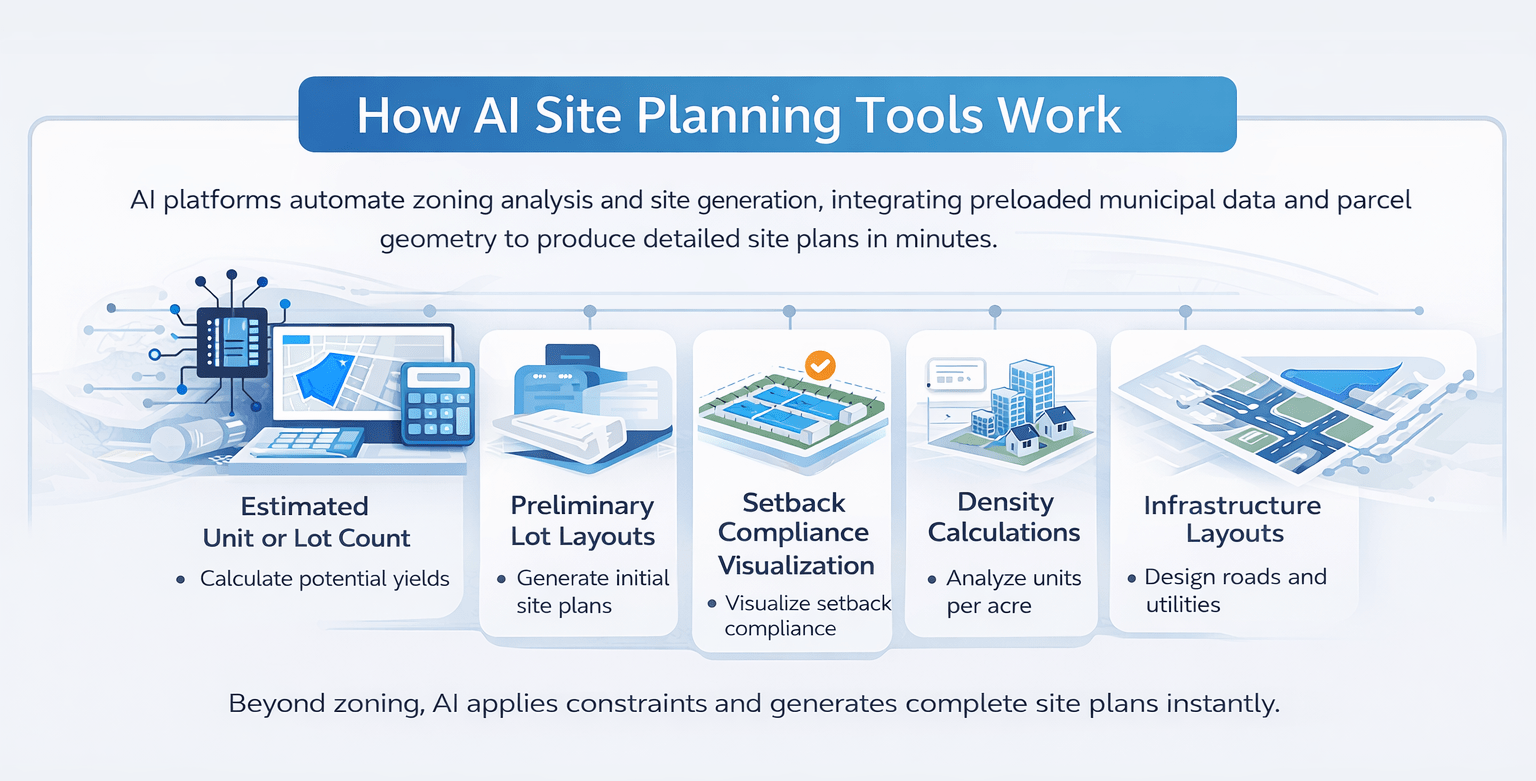
AI platforms automate zoning analysis and site layout generation. Instead of starting from scratch, they rely on preloaded municipal data and parcel geometry.
During a live demo, a platform generated a 547-home yield estimate for a 786-acre site instantly.
What AI Site Plans Include
- Estimated unit or lot count
- Preliminary lot layouts
- Setback compliance visualization
- Density calculations
- Basic infrastructure layouts (roads and access points)
Because zoning data is already integrated, the system applies constraints instantly and produces usable outputs within minutes.
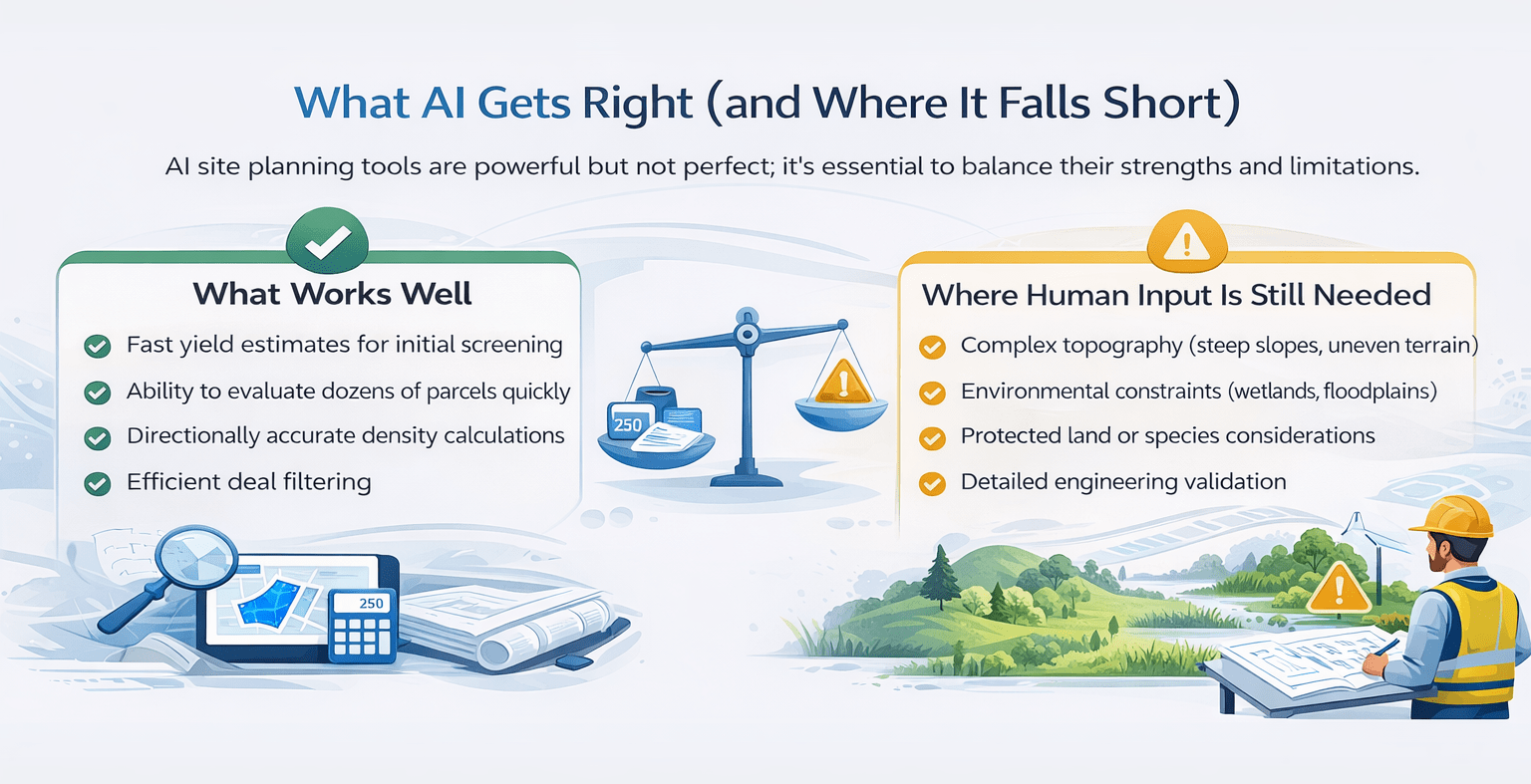
What AI Gets Right (and Where It Falls Short)
Although AI site planning tools are powerful, they are not perfect. Therefore, understanding both strengths and limitations is essential.
What Works Well
- Fast yield estimates for initial screening
- Ability to evaluate dozens of parcels quickly
- Directionally accurate density calculations
- Efficient deal filtering
For example, if AI estimates 40–50 lots and engineers confirm 45, the tool delivers strong value.
Where Human Input Is Still Needed
- Complex topography (steep slopes or uneven terrain)
- Environmental constraints (wetlands, floodplains)
- Protected land or species considerations
- Detailed engineering validation
As a result, AI should support early-stage decisions, while engineers handle final validation.
A Modern Land Acquisition Workflow
The most effective strategy combines AI efficiency with human expertise at the right stages.
Stage-Based Workflow
Initial AI Screening
- Scan multiple jurisdictions
- Apply zoning filters
- Identify viable parcels quickly
Rapid Yield Analysis
- Generate layouts for top candidates
- Eliminate non-viable sites early
Engineering Validation
- Send top 5–10 sites to the engineers
- Develop accurate preliminary plans
Targeted Outreach Optimization
- Focus on high-potential parcels
- Use data-driven seller outreach
Workflow Efficiency Comparison
| Stage | Traditional Workflow | AI-Enhanced Workflow |
|---|---|---|
| Initial Screening | Manual research | Automated filtering |
| Site Evaluation | Limited samples | High-volume analysis |
| Engineering Use | Early & expensive | Focused & efficient |
| Deal Outreach | Broad & generic | Targeted & data-driven |
Why AI Site Planning Tools Matter
The adoption of AI site planning tools by major builders signals a major shift in the industry. Large-scale developers evaluate thousands of sites annually. Therefore, they need tools that are both fast and reliable.
As a result, AI is becoming a competitive advantage in land acquisition.
Key Benefits
- Faster deal evaluation
- Reduced upfront costs
- Better resource allocation
- Improved pipeline efficiency
Overall, teams that adopt AI can analyze more opportunities without increasing overhead.
How to Start Using AI Site Planning Tools
If your team still relies entirely on traditional methods, it may be time to test AI solutions.
Simple Steps to Begin
- Run previously evaluated parcels through AI tools
- Compare results with engineer outputs
- Measure time and cost savings
- Integrate AI into early-stage screening
This approach helps validate accuracy while improving overall efficiency.
FAQs Regarding AI Site Planning Tools
What are AI site planning tools?
AI site planning tools automate land analysis and generate preliminary layouts quickly.
- They use zoning and parcel data
- Provide instant yield estimates
- Reduce manual work
Conclusion: They streamline early-stage land evaluation.
How accurate are AI-generated site plans?
They are directionally accurate but not final.
- Good for screening
- Require engineering validation
- May miss site-specific constraints
Conclusion: Use them as a first step, not final approval.
Can AI replace civil engineers?
No, AI complements engineers rather than replacing them.
- Handles early analysis
- Engineers refine details
- Final plans still require experts
Conclusion: AI improves efficiency, not expertise replacement.
https://www.asce.org
What data do AI tools use?
They rely on zoning, parcel geometry, and municipal data.
- Preloaded zoning codes
- GIS-based parcel mapping
- Regulatory overlays
Conclusion: Data integration enables fast results.
https://www.esri.com
Are AI site planning tools expensive?
Most are significantly cheaper than traditional methods.
- Lower per-site cost
- Subscription-based pricing
- Reduced engineering expenses
Conclusion: They offer strong ROI for developers.
https://www.mckinsey.com
What types of projects benefit most?
Large-scale land acquisition projects benefit the most.
- Residential developments
- Subdivisions
- Mixed-use projects
Conclusion: High-volume deal flow sees the biggest gains.
https://www.nar.realtor
Do AI tools consider environmental constraints?
Not fully—manual verification is still needed.
- Wetlands may be missed
- Flood zones need validation
- Environmental studies required
Conclusion: Always confirm with experts.
https://www.epa.gov
How quickly can AI analyze a site?
Most tools generate results in minutes.
- Instant yield estimates
- Real-time layout generation
- Rapid comparisons
Conclusion: Speed is the biggest advantage.
https://www.forbes.com
Build Consistency Into Your Workflow
Join AI for CRE, where 663+ CRE professionals are already using tools like AI site planning to evaluate deals faster, reduce costly bottlenecks, and standardize acquisition workflows.
Get access to real-world demos, proven evaluation frameworks, and step-by-step workflows that help you turn early-stage site analysis into a repeatable, scalable system. Instead of guessing which parcels are worth pursuing, you can build a consistent pipeline backed by data and speed.