How to Build an AI Second Brain for CRE: The Complete Guide
An AI Second Brain CRE framework helps commercial real estate professionals centralize information, eliminate knowledge silos, and make better decisions with AI. Commercial real estate has always been an information business. Success depends on how quickly you can collect, organize, analyze, and act on information. Yet most CRE professionals still operate with fragmented knowledge spread across emails, offering memorandums, rent rolls, lender packages, spreadsheets, CRM systems, property management software, and countless folders.
The challenge becomes even greater as firms adopt artificial intelligence. AI tools are incredibly powerful, but they suffer from one major limitation: they lack deep, persistent knowledge of your business. Every new conversation often starts from scratch. You explain your investment criteria again, and you upload the same property documents again. You remind the AI about your portfolio, lenders, investors, and underwriting assumptions again.
This repeated process creates a hidden productivity cost that grows every day. The solution is not another AI tool. The solution is building an AI Second Brain CRE system.
An AI second brain creates a centralized knowledge repository that stores everything your business knows in a structured format that AI can access, understand, and use. Instead of depending on chatbot memory, you build a permanent intelligence layer that remains valuable regardless of which AI platform you choose.
For acquisition teams, asset managers, operators, lenders, syndicators, developers, and investment firms, an AI second brain can become one of the most valuable competitive advantages available today.
What Is an AI Second Brain CRE System?
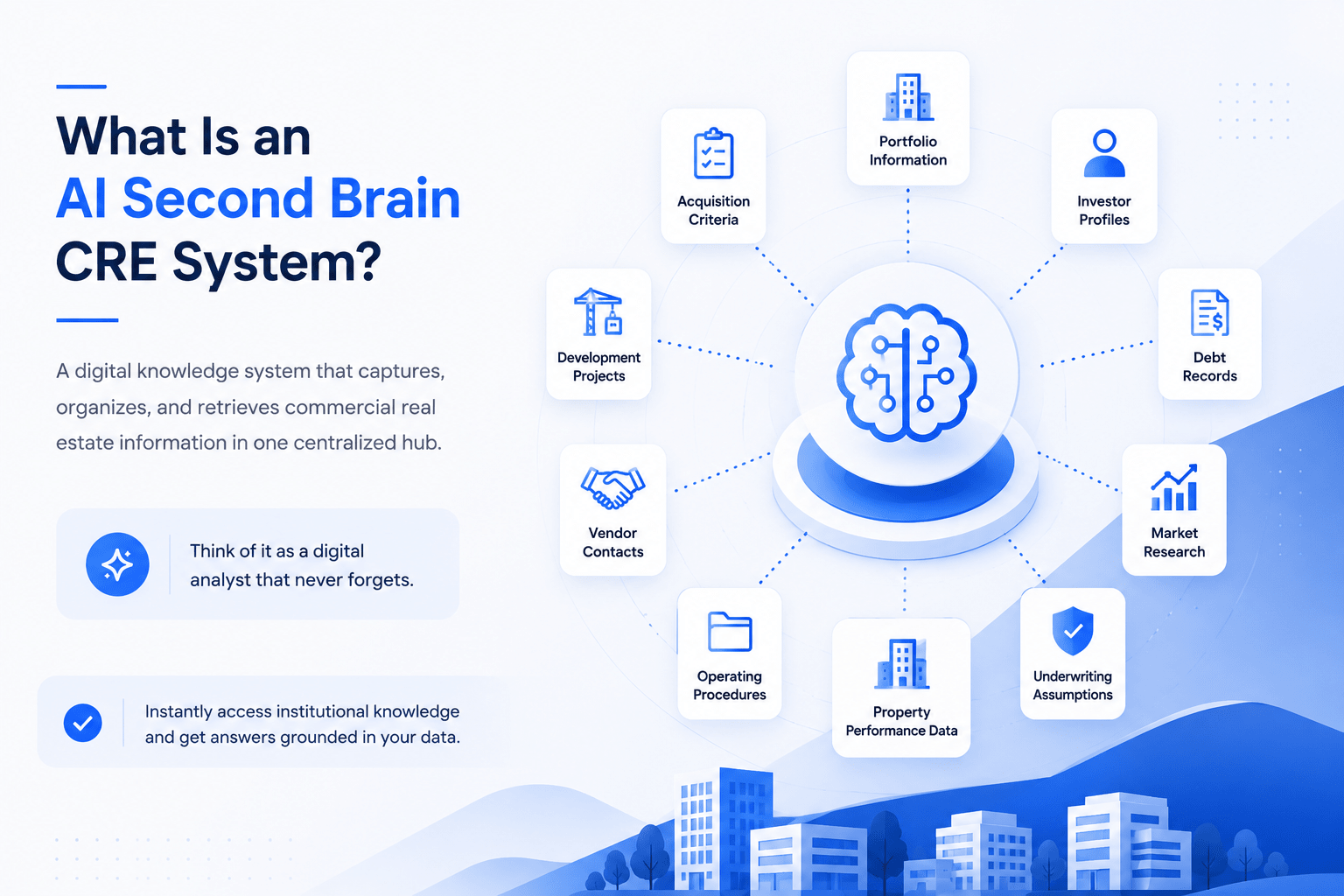
An AI second brain is a digital knowledge system designed to capture, organize, and retrieve information efficiently.
In commercial real estate, it acts as a centralized intelligence hub that stores everything important about your business.
Rather than keeping knowledge trapped inside software platforms, emails, spreadsheets, or individual employees, the information is documented in a structured repository that can be accessed by both people and AI systems.
Think of it as creating a digital analyst who never forgets.
The system can contain:
-
Portfolio information
-
Acquisition criteria
-
Investor profiles
-
Debt records
-
Market research
-
Property performance data
-
Operating procedures
-
Vendor contacts
-
Development projects
-
Underwriting assumptions
The result is a business that can access institutional knowledge instantly.
Instead of searching through dozens of folders, you simply ask questions and receive answers grounded in your actual data.
Why Commercial Real Estate Firms Need an AI Second Brain
Commercial real estate generates enormous amounts of information throughout the lifecycle of every property.
A single multifamily acquisition may involve:
-
Offering memorandums
-
Rent rolls
-
T12 financials
-
Appraisals
-
Loan documents
-
Market studies
-
Inspection reports
-
Investor presentations
-
Legal agreements
Multiply that across an entire portfolio, and the information burden becomes overwhelming.
Many firms experience the same problems:
-
Lost information
-
Duplicate work
-
Slow decision-making
-
Knowledge silos
-
Inefficient onboarding
-
Inconsistent reporting
An AI second brain solves these issues by creating a single source of truth.
The Hidden Cost of Information Fragmentation
Most CRE professionals underestimate how much time they spend searching for information.
Consider a typical acquisition team.
Before evaluating a new opportunity, they often need to find:
-
Historical deal performance
-
Existing lender relationships
-
Market research
-
Portfolio benchmarks
-
Investor preferences
This information frequently exists but is difficult to locate.
When knowledge is fragmented, employees spend more time searching than analyzing.
That inefficiency compounds across every department.
Why AI Alone Isn’t Enough
Many professionals assume ChatGPT or Claude can solve the problem. However, AI tools are only as effective as the context they receive. Without access to your firm’s knowledge, AI can only provide generic advice.
With access to a structured repository, AI becomes dramatically more useful because it understands:
-
Your portfolio
-
Your markets
-
Your investment strategy
-
Your operating assumptions
-
Your historical performance
That difference changes everything.
The Core Architecture of an AI Second Brain CRE System
The most successful systems share a common design principle. They separate knowledge into two categories.
Reference Knowledge
Reference knowledge changes slowly.
Examples include:
-
Company information
-
Investment criteria
-
Portfolio overview
-
Team members
-
Standard operating procedures
-
Investor profiles
-
Vendor relationships
This information forms the foundation of the repository.
Active Knowledge
Active knowledge changes constantly.
Examples include:
-
Live acquisitions
-
Current underwriting
-
Ongoing renovations
-
Capital projects
-
Financing discussions
-
Quarterly reporting
Separating active information from reference information helps AI understand what is current and what serves as background context.
This distinction significantly improves output quality.
Example Structure
| Knowledge Layer | Typical Contents | Update Frequency |
|---|---|---|
| Reference Layer | Company, portfolio, investors | Monthly |
| Active Layer | Live deals, projects, reports | Daily |
| Research Layer | Market studies, trends | Weekly |
| Templates Layer | SOPs, forms, workflows | Quarterly |
Choosing the Right Technology Stack
The good news is that building an AI second brain does not require expensive software. The best systems are often surprisingly simple.
Knowledge Repository
Most CRE professionals prefer a local-first platform.
Popular choices include:
-
Obsidian
-
Notion
-
Google Drive
-
SharePoint
-
Local file systems
Obsidian has become especially popular because it stores information as plain text files. This creates long-term flexibility.
AI Layer
The repository should work with multiple AI tools.
Examples include:
-
ChatGPT
-
Claude
-
Gemini
-
Local LLMs
-
Future AI platforms
Avoid building a system tied exclusively to one vendor. Technology changes quickly. Your knowledge should remain portable.
Document Sources
Start with high-value documents:
-
Portfolio summaries
-
Offering memorandums
-
Debt schedules
-
Investor reports
-
Property overviews
-
Market research
You do not need hundreds of files on day one. Start small and grow gradually.
Building the Foundation: Folder Structure and Organization
A common mistake is creating too many folders. Complexity reduces usability. The best systems are surprisingly simple.
Recommended Folder Structure
| Folder | Purpose |
|---|---|
| Company | Business information |
| Portfolio | Existing assets |
| Acquisitions | Deal pipeline |
| Debt & Capital | Loans and financing |
| Investors | Investor records |
| Contacts | Brokers, lenders, vendors |
| Markets | Research and reports |
| Templates | SOPs and workflows |
This structure covers most commercial real estate operations.
Create a Master README
Your README acts as the operating manual.
It should explain:
-
Folder purposes
-
Naming conventions
-
Data standards
-
Filing rules
-
Workflow instructions
Every AI assistant should review this file before performing tasks. Think of it as onboarding a new employee. The better the README, the better the AI performance.
Establish Naming Standards
Consistency matters. Property files should follow a standard format.
For example:
Property Name – Asset Type – City
Loan files should follow:
Property Name – Lender – Maturity Date
Standardization improves searchability and AI understanding.
Creating Knowledge Objects That AI Can Understand
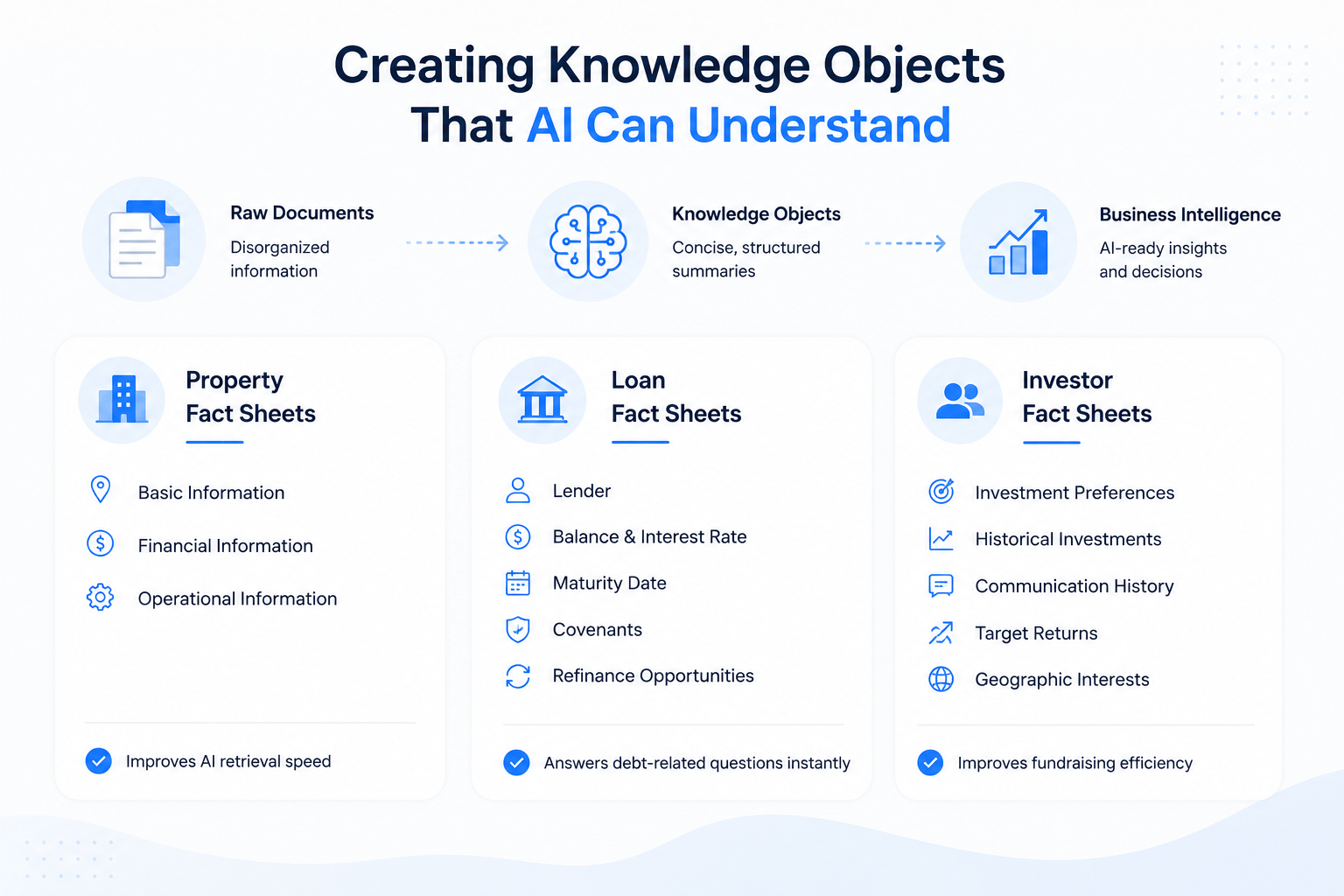
One of the biggest breakthroughs in AI-powered knowledge management is the concept of knowledge objects. Rather than forcing AI to read hundreds of pages, you create concise summaries. These become the building blocks of your second brain.
Once these knowledge objects are organized, they can power reporting workflows across acquisitions, asset management, and investor updates. Our NotebookLM CRE Reporting Workflow Guide shows how structured documentation can be transformed into usable business intelligence.
Property Fact Sheets
Every property should have its own summary file.
Typical information includes:
Basic Information
-
Property name
-
Address
-
Market
-
Asset class
-
Unit count
Financial Information
-
Purchase price
-
Current value
-
NOI
-
Debt balance
-
Cash flow
Operational Information
-
Occupancy
-
Renovation status
-
Key risks
-
Property manager
Property fact sheets dramatically improve AI retrieval speed.
Loan Fact Sheets
Debt is often overlooked.
Each loan should have:
-
Lender
-
Balance
-
Interest rate
-
Maturity date
-
Covenants
-
Refinance opportunities
This allows AI to answer questions instantly.
Investor Fact Sheets
Investor profiles may include:
-
Investment preferences
-
Historical investments
-
Communication history
-
Target returns
-
Geographic interests
This improves fundraising efficiency.
Using an AI Second Brain for Acquisitions
Acquisitions are one of the highest-impact use cases. Every deal requires gathering and comparing information from multiple sources. An AI second brain streamlines the process.
Deal Screening
When a new opportunity arrives, AI can compare it against:
-
Buy box criteria
-
Historical acquisitions
-
Market performance
-
Existing portfolio benchmarks
This accelerates initial screening.
Offering Memorandum Analysis
Instead of reading hundreds of pages manually, AI can:
-
Extract key metrics
-
Identify risks
-
Summarize assumptions
-
Compare opportunities
This enables faster decision-making.
Investment Committee Preparation
AI can generate:
-
Deal summaries
-
Risk assessments
-
Market overviews
-
Portfolio comparisons
This reduces preparation time significantly.
Acquisition Workflow Example
| Stage | Traditional Process | AI Second Brain Process |
|---|---|---|
| Deal intake | Manual review | Automated summary |
| Market analysis | Separate research | Repository lookup |
| Portfolio comparison | Spreadsheet analysis | Instant query |
| IC preparation | Hours of work | AI-generated draft |
Using an AI Second Brain for Asset Management
Asset management requires constant access to information. An AI second brain becomes a powerful operational assistant.
Portfolio Reviews
Instead of collecting information manually, AI can summarize:
-
Occupancy trends
-
Revenue performance
-
Operating expenses
-
Capital projects
This saves significant time.
Debt Management
Loan maturities often create risk.
AI can proactively identify:
-
Upcoming maturities
-
Refinance opportunities
-
Interest rate exposure
-
Covenant concerns
Capital Expenditure Tracking
Large portfolios often struggle to monitor projects consistently.
AI can track:
-
Budget progress
-
Vendor performance
-
Construction updates
-
Project timelines
This creates greater visibility.
Investor Reporting
Reporting is often repetitive.
AI can generate:
-
Quarterly updates
-
Performance summaries
-
Property highlights
-
Market commentary
While human review remains necessary, preparation time decreases substantially.
Automating Information Ingestion
Knowledge systems fail when updates become difficult. The solution is automation.
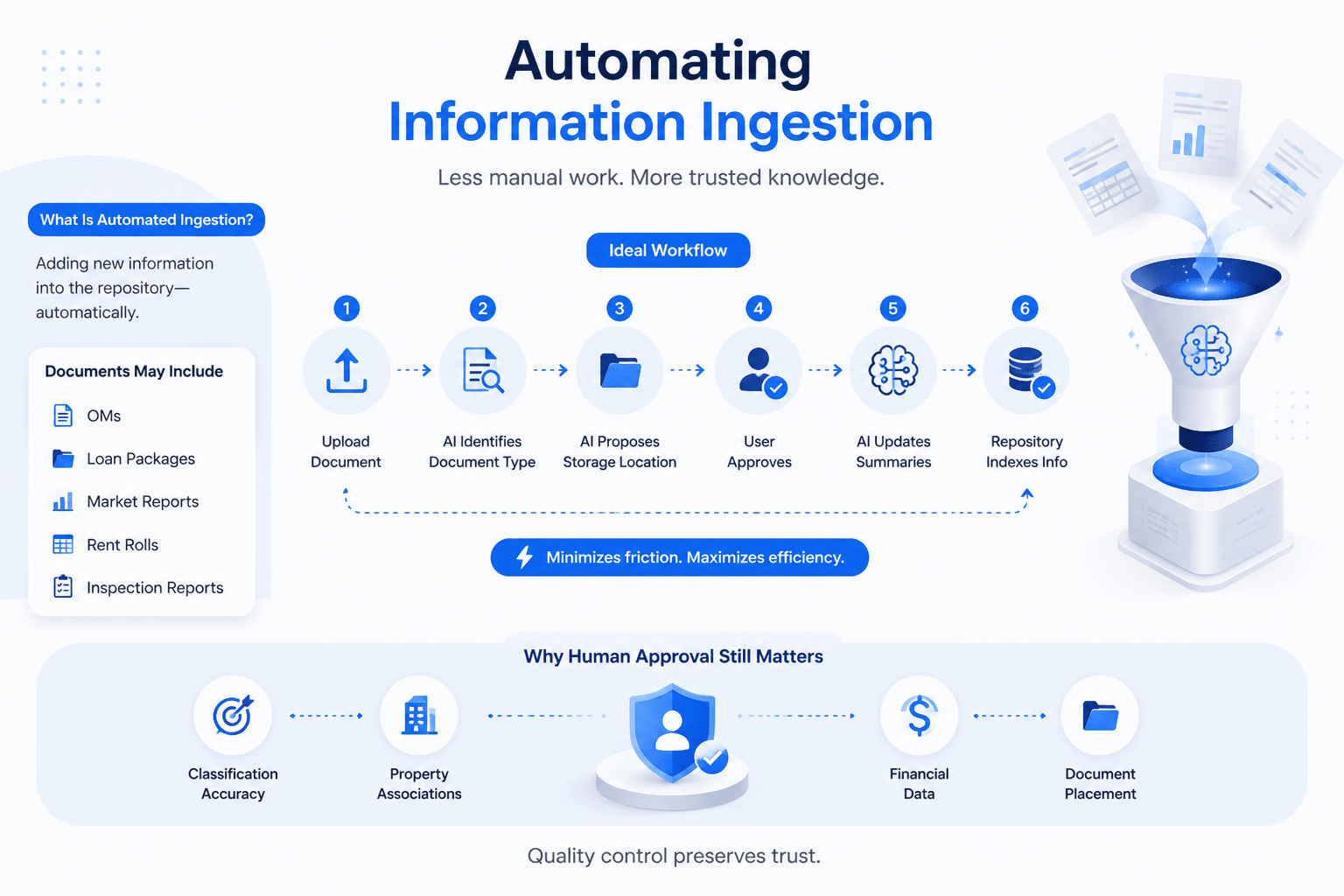
What Is Automated Ingestion?
Ingestion refers to the process of adding new information into the repository.
Documents may include:
-
OMs
-
Loan packages
-
Market reports
-
Rent rolls
-
Inspection reports
Instead of filing manually, AI performs much of the work.
Ideal Workflow
-
Upload document
-
AI identifies document type
-
AI proposes a storage location
-
User approves
-
AI updates summaries
-
Repository indexes new information
This workflow minimizes friction.
Why Human Approval Still Matters
Automation should not eliminate oversight.
Humans should verify:
-
Classification accuracy
-
Property associations
-
Financial data
-
Document placement
Quality control preserves trust.
Advanced Automation Opportunities
Once the foundation exists, automation can expand significantly. As firms mature their AI second brain, many begin connecting it to AI agents that can monitor documents, process incoming information, and automate repetitive workflows. Our guide on AI Agents for Commercial Real Estate: Complete Guide to Automating CRE Workflows explores what that next stage looks like.
Email Monitoring
AI can scan acquisition emails and automatically identify:
-
New opportunities
-
Broker communications
-
Lender updates
Relevant information enters the repository automatically.
Market Intelligence Collection
AI can gather:
-
Market reports
-
Economic indicators
-
Development activity
-
Rent growth data
The repository becomes increasingly valuable over time.
Daily Portfolio Monitoring
Future systems may automatically track:
-
Occupancy changes
-
Delinquency trends
-
Debt events
-
Lease expirations
This creates continuous portfolio intelligence.
An AI second brain becomes even more powerful when combined with AI agents that can access, retrieve, and act on stored knowledge. This example shows how agent-based workflows are beginning to automate tasks that previously required weeks of manual effort.
Common Mistakes When Building an AI Second Brain
Many projects fail because of poor design choices.
Overengineering
Too many folders create confusion. Keep structures simple.
Inconsistent Data
AI depends on clean information. Standardization matters.
Neglecting Maintenance
A repository must remain current. Stale information creates poor outputs.
Storing Everything
Not every document deserves permanent storage. Focus on high-value information.
Vendor Dependence
Never build your knowledge exclusively inside one AI platform. Ownership matters.
Measuring ROI from an AI Second Brain CRE System
The benefits become clear quickly.
Time Savings
Most teams experience dramatic reductions in:
-
Information retrieval
-
Report generation
-
Document filing
-
Deal screening
Better Decisions
AI can identify patterns that humans may overlook. This improves investment quality.
Improved Scalability
Knowledge becomes reusable. Growth no longer requires proportional increases in administrative effort.
Long-Term Competitive Advantage
Perhaps the greatest benefit is cumulative intelligence. Every document adds value, every deal improves future analysis, and every interaction strengthens institutional knowledge.
Over time, the repository becomes a unique competitive asset that competitors cannot easily replicate.
Build a Smarter CRE Business with AI
An AI Second Brain CRE system is more than a productivity tool. It becomes the foundation for how your organization captures, preserves, and leverages knowledge across acquisitions, asset management, capital markets, and operations. As AI capabilities continue advancing, firms with organized data and structured knowledge will gain the greatest advantage because they can provide AI with the context needed to generate meaningful insights.
The professionals seeing the biggest results are not necessarily using the most advanced AI models. They are the ones creating systems that make those models smarter. Inside the AI for CRE Collective, more than 600+ CRE professionals are exploring practical AI workflows, implementation strategies, and real-world use cases for commercial real estate. If you want to stay ahead of where the industry is heading, subscribe to the newsletter and begin building your AI-driven operating system today.
Conclusion
Commercial real estate has entered an era where information is becoming the most valuable asset inside a firm. The challenge is no longer collecting data. The challenge is organizing knowledge so it can be used effectively.
An AI Second Brain CRE system solves this problem by creating a centralized repository that preserves institutional knowledge, improves operational efficiency, accelerates acquisitions, supports asset management, and enhances decision-making.
The firms that build these systems today will create a lasting competitive advantage tomorrow. Rather than repeatedly teaching AI about their business, they will provide AI with structured knowledge that grows smarter over time.
The future of commercial real estate will not belong to organizations with the most data. It will belong to organizations that know how to turn data into usable intelligence. That is exactly what an AI second brain is designed to do.
Frequently Asked Questions About Building an AI Second Brain for CRE
What is an AI second brain for commercial real estate?
An AI second brain for commercial real estate is a centralized knowledge system that stores portfolio information, acquisition data, investor records, lender relationships, market research, and operating procedures in a format that AI can understand. Instead of repeatedly providing context to AI tools, CRE professionals create a permanent repository that allows AI to deliver more accurate and business-specific insights.
Why are commercial real estate firms building AI second brains?
Commercial real estate firms are building AI second brains because information is often scattered across emails, spreadsheets, property management systems, CRM platforms, and shared drives. A centralized knowledge system reduces information silos, improves productivity, accelerates decision-making, and helps teams use AI more effectively across acquisitions, asset management, and investor relations.
What information should be included in a CRE AI second brain?
A CRE AI second brain should contain the information your team references most frequently. This typically includes property profiles, acquisition criteria, debt schedules, investor records, market research, operating procedures, broker contacts, lease information, and portfolio performance data. The goal is to create a single source of truth that supports both human users and AI systems.
How does an AI second brain improve commercial real estate acquisitions?
An AI second brain improves acquisitions by giving AI access to historical deals, underwriting assumptions, portfolio benchmarks, lender relationships, and market intelligence. This allows acquisition teams to screen opportunities faster, identify risks earlier, compare deals against existing assets, and prepare investment committee materials more efficiently.
Can an AI second brain analyze offering memorandums automatically?
Yes. Modern AI tools can review offering memorandums and extract key property details, financial metrics, market information, tenant data, and investment risks. When connected to a structured knowledge repository, AI can also compare new opportunities against previous acquisitions and portfolio performance, making deal analysis significantly faster.
What is the difference between an AI second brain and a CRM?
A CRM is designed to manage relationships and track interactions with prospects, investors, brokers, and clients. An AI second brain manages organizational knowledge. While a CRM focuses on contact records and activities, an AI second brain stores broader intelligence such as investment strategies, portfolio history, underwriting assumptions, market research, and operational procedures.
Is Obsidian the best tool for building an AI second brain?
Obsidian is one of the most popular options because it stores information as local markdown files that remain under your control. However, the best platform depends on your workflow. Many firms also use Notion, Google Drive, SharePoint, or other knowledge management systems. The most important factor is creating a structure that AI can access and understand consistently.
How long does it take to build an AI second brain for CRE?
Most commercial real estate professionals can build a basic AI second brain in a few hours. The initial setup usually involves creating a folder structure, defining data standards, and uploading key documents. The real value develops over time as additional deals, properties, market reports, and operational information are added to the repository.
Can multiple team members use the same AI second brain?
Yes. Many firms create shared repositories that allow acquisitions, asset management, finance, and leadership teams to access the same knowledge base. A shared AI second brain improves collaboration, reduces duplicate work, and ensures that everyone is working from consistent information.
How secure is an AI second brain for commercial real estate data?
Security depends on where the repository is stored and how access is managed. Local-first systems provide greater control because files remain under the firm’s ownership. Organizations can further improve security through permissions, encryption, backup procedures, and private cloud environments designed for sensitive real estate information.
Can AI agents use a commercial real estate second brain?
Yes. AI agents become significantly more useful when connected to a structured knowledge repository. Instead of operating on generic internet information, they can access portfolio data, property records, lender relationships, and operating procedures to complete tasks with greater accuracy and business relevance.
What are the biggest mistakes when building an AI second brain?
The most common mistakes include creating overly complex folder structures, storing inconsistent information, failing to maintain documentation standards, and relying entirely on one AI platform. Successful systems are simple, organized, regularly updated, and designed to remain useful regardless of which AI tools are used in the future.
Will AI second brains replace real estate analysts?
No. AI second brains are designed to enhance analysts rather than replace them. They reduce time spent searching for information, organizing documents, and preparing reports. Human expertise remains essential for investment decisions, relationship management, negotiation, and strategic thinking.
What is the future of AI second brains in commercial real estate?
The future of AI second brains will likely include autonomous document processing, automated market monitoring, portfolio intelligence dashboards, and AI agents capable of completing complex workflows. Firms that begin organizing their knowledge today will be better positioned to take advantage of these advancements as AI capabilities continue to evolve.