AI Renderings for Value-Add CRE
Early-stage real estate visualization has always been a frustrating trade-off. You need compelling visuals to communicate a deal’s potential, but spending thousands of dollars before securing a property often feels premature. That tension is exactly why AI renderings for CRE deals are rapidly gaining traction among developers, investors, and brokers.
Instead of relying solely on architects or rendering firms, professionals can now generate realistic concepts in minutes. Whether it’s a strip center renovation, a mixed-use site plan, or an ADU conversion, AI allows you to tell a visual story before committing serious capital.
In competitive markets like Austin, Los Angeles, and Miami, where speed often determines who wins a deal, this shift isn’t just helpful; it’s becoming essential.
What Are AI Renderings for CRE Deals?
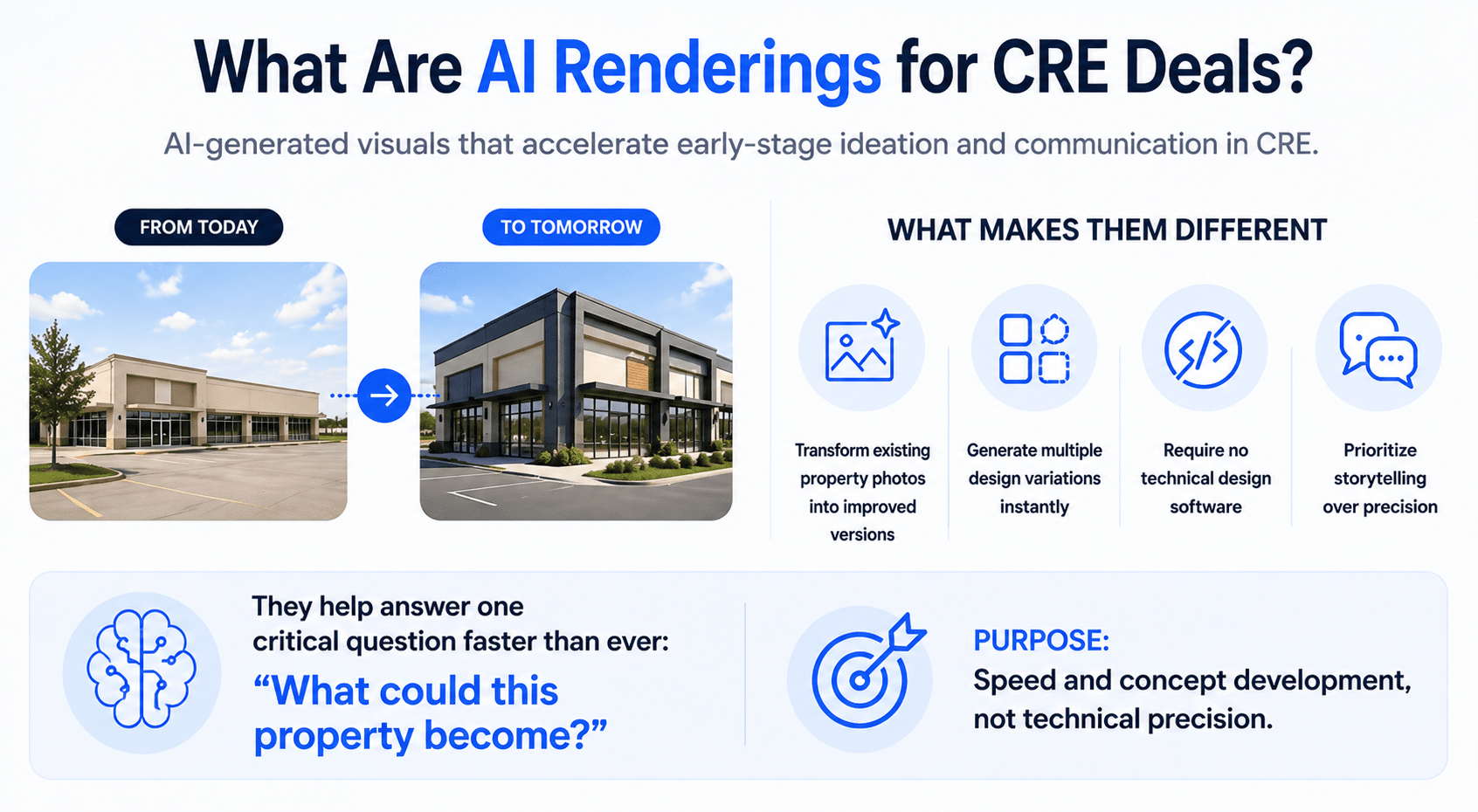
AI renderings for CRE deals are visual outputs generated using artificial intelligence tools based on text prompts, property images, or both. Unlike traditional architectural renderings, these are designed for speed and concept development rather than technical precision.
They sit at a very specific point in the deal lifecycle: early-stage ideation and communication.
If you want to see how AI is already replacing early-stage feasibility work, this breakdown is worth watching.
What Makes Them Different
-
They can transform existing property photos into improved versions
-
They allow multiple design variations instantly
-
They require no technical design software
-
They prioritize storytelling over precision
In simple terms, they help answer one critical question faster than ever:
“What could this property become?”
The Problem with Traditional Early-Stage Renderings
Before AI tools became viable, early-stage visualization had several constraints:
-
High upfront costs ($500–$3,000 per rendering)
-
Slow turnaround times (days or weeks)
-
Limited flexibility once delivered
-
Risk of spending money before deal certainty
This created a gap in the workflow. Many deals moved forward without strong visuals, forcing stakeholders to rely on imagination rather than clarity.
That’s a problem because in CRE, perception often drives decision-making.
How AI Renderings for CRE Deals Change the Workflow
AI doesn’t replace traditional rendering; it shifts when and how visuals are used.
New Workflow Structure
| Stage | Traditional Approach | AI-Enhanced Approach |
|---|---|---|
| Initial Deal Review | Text + assumptions | Visual concepts generated instantly |
| Investor Pitch | Limited visuals | Multiple scenarios are shown clearly |
| Design Iteration | Slow revisions | Real-time adjustments |
| Decision Making | Delayed | Accelerated |
Key Shift
Instead of waiting until later stages, visualization now happens at the very beginning of the deal.
That fundamentally changes:
-
How quickly are deals evaluated
-
How confidently investors engage
-
How effectively opportunities are communicated
Use Case 1: Renovation Concepts for Value-Add Deals
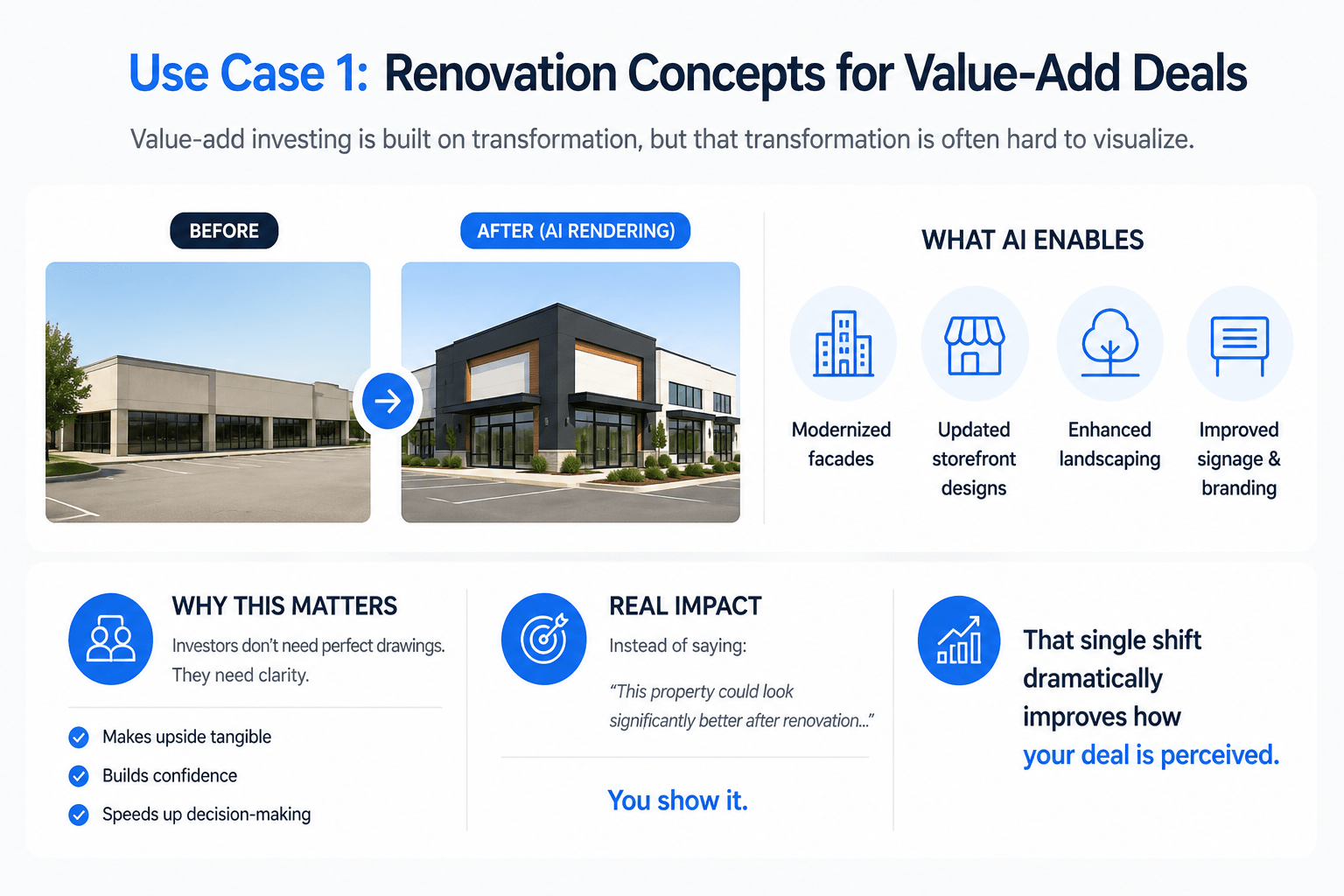
Value-add investing is built on transformation, but that transformation is often hard to visualize. For example, many developers are now combining these visuals with AI-generated investor decks to clearly communicate value-add potential and secure capital faster.
What AI Enables
With AI renderings for CRE deals, you can take an existing property image and instantly generate:
-
Modernized facades
-
Updated storefront designs
-
Enhanced landscaping
-
Improved signage and branding
Why This Matters
In early conversations, especially at the LOI stage, investors don’t need perfect drawings. They need clarity.
A strong visual concept:
-
Makes upside tangible
-
Builds confidence
-
Speeds up decision-making
Real Impact
Instead of saying:
“This property could look significantly better after renovation…”
You show it.
That single shift dramatically improves how your deal is perceived.
Use Case 2: Mixed-Use Site Plans
Mixed-use developments are inherently complex. They combine multiple asset classes, require careful layout planning, and depend heavily on spatial understanding.
What AI Can Generate
-
Apartments over retail configurations
-
Basic massing layouts
-
Street alignment and site context
-
Functional layout distributions
Why It’s Powerful
Even a conceptual site plan can answer key questions:
-
How dense can the development be?
-
How does retail interact with the street?
-
What does the overall footprint look like?
Key Insight
At early stages, precision isn’t the priority; clarity is.
AI renderings for CRE deals provide just enough detail to move conversations forward without slowing them down.
Use Case 3: ADU Conversions and Multifamily Optimization
ADUs (Accessory Dwelling Units) are one of the most overlooked opportunities in multifamily real estate, largely because they’re difficult to visualize.
Where AI Excels
AI can quickly illustrate:
-
Tuck-under parking conversions
-
Garage-to-unit transformations
-
Backyard ADU additions
-
Multiple layout configurations
Why This Is Game-Changing
ADU strategies often live in spreadsheets and verbal explanations. That makes them harder to “sell” to investors.
With AI:
-
You show exactly where units go
-
You demonstrate spatial feasibility
-
You remove ambiguity
Result
More confident investors, faster approvals, and stronger deal narratives.
Traditional vs AI Cost and Time Breakdown
| Category | Traditional Renderings | AI Renderings |
|---|---|---|
| Cost per Concept | $500–$3,000 | Included in subscription |
| Turnaround Time | 3–10 days | 2–5 minutes |
| Revision Cost | Additional fees | Unlimited |
| Scalability | Limited | High |
Strategic Takeaway
The economics alone make a compelling case, but the real advantage is speed.
In CRE, speed is leverage.
When to Use AI Renderings for CRE Deals
AI renderings are most effective at specific stages of the deal lifecycle.
Ideal Scenarios
-
LOI-stage deal presentations
-
Early investor discussions
-
Broker marketing for value-add listings
-
Internal feasibility analysis
Not Suitable For
-
Permit submissions
-
Construction documentation
-
Engineering validation
Key Principle
Use AI for exploration and communication, not execution.
AI vs Traditional Tools: Where Each Wins
| Criteria | AI Renderings | Traditional Renderings |
|---|---|---|
| Speed | Extremely fast | Slow |
| Cost | Low | High |
| Precision | Moderate | High |
| Flexibility | Very high | Limited |
| Best Use | Early-stage | Late-stage |
Insight
This is not a replacement; it’s a rebalancing. AI dominates early stages. Traditional tools dominate the final stages.
The professionals who combine both will outperform those who rely on only one.
Advanced Strategy: Combining AI with Human Expertise
The most effective CRE professionals are not choosing between AI and traditional methods; they’re integrating both.
Optimized Workflow
-
Generate early concepts using AI
-
Test feasibility internally
-
Refine strategy based on visuals
-
Engage architects for the final design
Why This Works
-
Reduces wasted design costs
-
Improves clarity before committing capital
-
Aligns stakeholders earlier
This hybrid model is quickly becoming the industry standard.
Common Mistakes to Avoid
Overestimating Accuracy
AI outputs are conceptual, not precise.
Using Generic Prompts
Vague instructions lead to weak results.
Ignoring Local Constraints
Zoning and code compliance still require expert review.
Relying Only on Visuals
Strong deals combine visuals with financial and operational analysis.
Conclusion
AI renderings for CRE deals are transforming how early-stage real estate decisions are made. By enabling fast, cost-effective visualization of renovation concepts, site plans, and ADU opportunities, they eliminate one of the biggest bottlenecks in the deal process.
They don’t replace architects. They don’t replace technical design. But they dramatically improve how ideas are communicated, evaluated, and refined before significant capital is deployed.
In a competitive environment where speed and clarity drive outcomes, adopting AI isn’t just an advantage; it’s quickly becoming a necessity.
Turn Concepts Into Competitive Advantage Faster
In today’s market, the difference between winning and losing deals often comes down to how clearly and quickly you can communicate potential. That’s exactly where AI renderings create an edge. Inside the AI for CRE Collective, you’ll find real-world workflows used by 600+ CRE professionals who are actively applying these tools to live deals, not just experimenting with them.
If you want to move faster, present stronger, and make smarter decisions earlier in the deal cycle, this is where you start. Instead of figuring it out alone, you can plug into proven systems and strategies that are already working. The next step is simple: newsletter and begin integrating AI into your real estate workflow immediately.
FAQs Regarding AI Renderings for CRE Deals
1. What are AI renderings for CRE deals, and how do they actually work?
AI renderings for CRE deals are computer-generated property visuals created using text prompts, images, or both to simulate potential real estate outcomes.
-
AI analyzes prompts describing renovations, layouts, or design intent
-
It can enhance existing property images or generate new concepts
-
Outputs are produced in minutes and can be iterated instantly
Conclusion: AI renderings work as a rapid visualization layer that helps professionals explore and communicate property potential before investing in formal design.
2. When should you use AI renderings instead of traditional architectural renderings?
AI renderings are best used during the earliest stages of a deal when speed and cost efficiency matter more than technical precision.
-
Ideal for LOI-stage presentations and investor discussions
-
Useful for testing multiple development scenarios quickly
-
Not suitable for permitting, construction, or engineering
Conclusion: Use AI renderings for exploration and storytelling, and transition to traditional renderings once the deal is validated.
3. How do AI renderings improve investor presentations and capital raising?
AI renderings make investment opportunities easier to understand by turning abstract ideas into visual concepts.
-
Investors can instantly see renovation potential or site layouts
-
Reduces reliance on verbal explanations and assumptions
-
Builds confidence by making the upside tangible
Conclusion: Strong visuals created with AI can significantly increase investor clarity, engagement, and willingness to move forward.
4. Are AI renderings accurate enough to make real estate decisions?
AI renderings are accurate enough for conceptual decision-making but not for technical validation.
-
Provide realistic layouts and design direction
-
Help evaluate feasibility at a high level
-
Must be validated by architects and engineers
Conclusion: They are reliable for early-stage decisions but should always be followed by professional review before execution.
5. What types of CRE deals benefit the most from AI renderings?
AI renderings are especially valuable for deals that depend on repositioning, redevelopment, or creative value-add strategies.
-
Retail strip center renovations
-
Mixed-use development concepts
-
Multifamily upgrades, including ADUs
Conclusion: Any deal where “future potential” needs to be visualized quickly will benefit significantly from AI renderings.
6. How do AI renderings reduce costs in commercial real estate projects?
AI eliminates the need for expensive early-stage rendering services while allowing unlimited concept generation.
-
No per-render fees compared to traditional firms
-
Reduces unnecessary spending before deal certainty
-
Allows testing multiple scenarios without added cost
Conclusion: By lowering upfront visualization costs, AI enables smarter capital allocation in early deal stages.
7. What are the biggest limitations of AI renderings for CRE deals?
Despite their advantages, AI renderings have clear limitations that users must understand.
-
Lack of zoning, code, and regulatory awareness
-
No engineering or structural validation
-
Outputs may require refinement for realism
Conclusion: AI is a powerful conceptual tool, but it must be combined with professional expertise for real-world execution.
8. How can CRE professionals integrate AI renderings into their workflow effectively?
The most effective approach is to use AI as an early-stage tool and combine it with traditional processes later.
-
Start with AI to generate concepts and test ideas
-
Use visuals to align investors and stakeholders
-
Transition to architects for detailed design and approvals
Conclusion: A hybrid workflow that blends AI speed with human expertise delivers the best results in modern CRE development.