How Generative AI Is Changing Real Estate Marketing
Real estate marketing looks very different today. Teams create content faster. Brokers respond to leads more quickly. Investors expect updates in real time. Much of this change comes from generative AI.
Many real estate firms once spent days writing listings, building presentations, and planning campaigns. Now, AI tools help teams finish the same work in a few hours. That speed matters in a competitive market.
This shift is happening across commercial real estate. Brokers use AI to write listings. Marketing teams create email campaigns with AI support. Analysts summarize reports faster. Developers use AI to prepare investor updates and market research.
That is why generative AI is changing real estate marketing so quickly. It removes repetitive work and helps teams focus on strategy, relationships, and deals.
Still, AI is not a replacement for experience. Real estate remains a relationship-driven business. People still make the final decisions. AI simply helps professionals work faster and more efficiently.
This guide explains how real estate teams use generative AI today. It also covers practical workflows, useful tools, common mistakes, and future trends.
What Generative AI Means in Real Estate Marketing
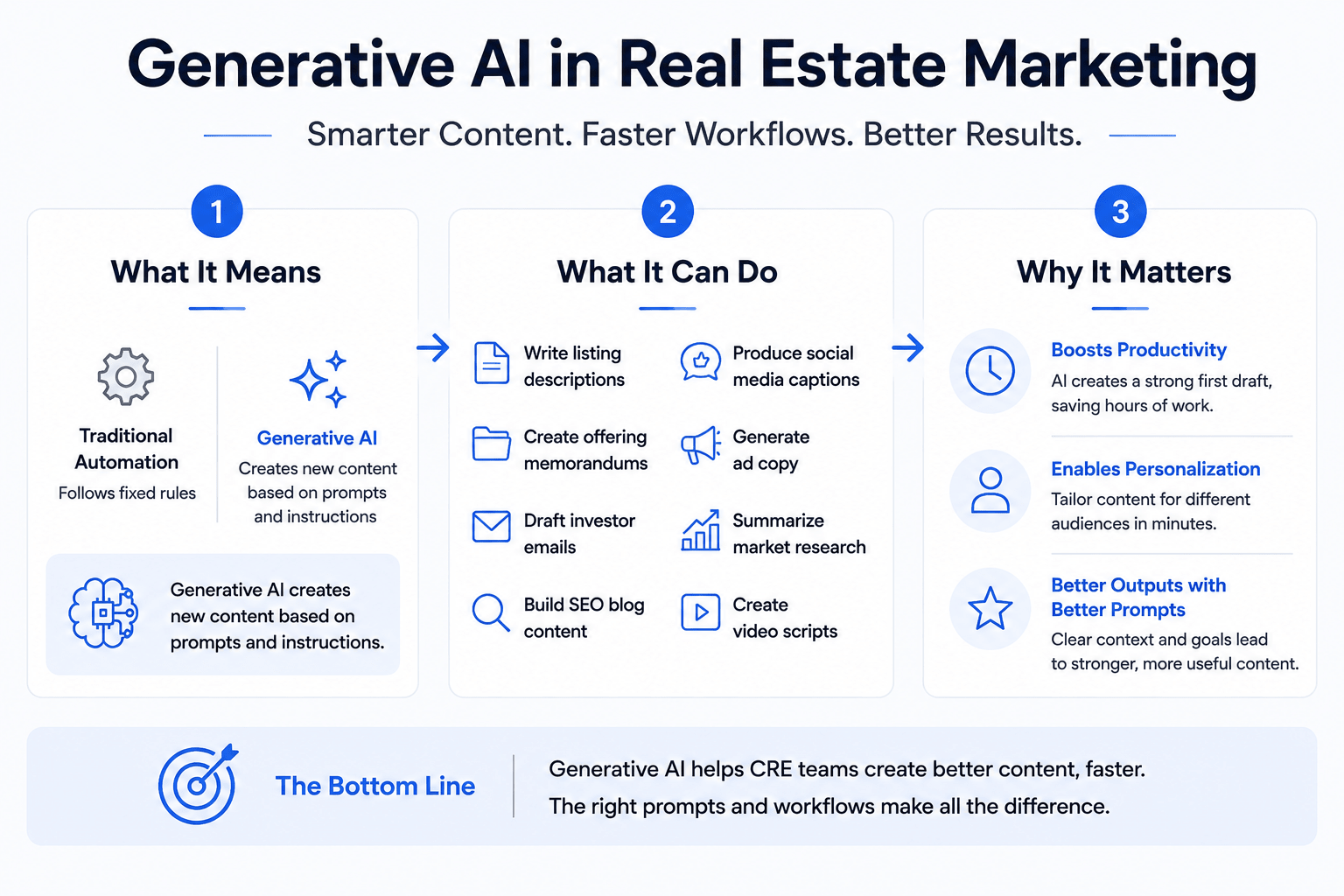
Many people hear the word AI and think about automation. However, generative AI works differently. Traditional automation follows fixed rules. Generative AI creates new content based on prompts and instructions.
For example, a CRM tool may send emails automatically. Meanwhile, tools like ChatGPT or Claude can actually write those emails. They can also create listing descriptions, summarize reports, and generate marketing ideas.
This matters because real estate marketing depends heavily on content. Teams constantly create:
-
Property listings
-
Investor updates
-
Social media posts
-
Market reports
-
Email campaigns
-
Presentations
-
Video scripts
Before AI, these tasks took a lot of time. Now, teams can complete them much faster.
Real estate is a good fit for AI because many marketing tasks repeat daily. Brokers often write similar listings. Marketing teams reuse the same campaign structure. Analysts summarize similar market data every week.
AI speeds up those repetitive tasks.
Today, CRE firms use generative AI in several ways:
-
Writing listing descriptions
-
Creating offering memorandums
-
Drafting investor emails
-
Building SEO blog content
-
Producing social media captions
-
Generating ad copy
-
Summarizing market research
-
Creating video scripts
The biggest advantage is productivity. Teams no longer waste hours starting from a blank page. Instead, AI creates a strong first draft. Then, professionals review and improve the final version.
This process saves time while maintaining high quality.
Another major benefit is personalization.
AI helps firms tailor content for different audiences. A broker can create one version of a campaign for investors and another for tenants within minutes.
That level of customization was harder before AI tools became common.
Still, the quality depends on how people use the technology. Weak prompts often create generic content. Strong prompts create useful and realistic outputs.
For example, this prompt is too basic:
-
“Write a real estate listing.”
This prompt works much better:
-
“Write a professional industrial property listing for a 150,000-square-foot warehouse in Houston. Highlight highway access, loading docks, and distribution advantages. Keep the tone investor-focused.”
The second prompt gives context, audience details, and clear goals. That usually produces stronger content.
Because of this, many CRE firms now train employees on prompt writing and workflow design.
How Generative AI Is Changing Listing Creation
Listing creation is one of the biggest areas where AI saves time. In the past, brokers spent hours writing and editing descriptions manually. Today, AI tools can create strong drafts in minutes.
This is one of the clearest examples of how generative AI is changing real estate marketing.
AI-generated listing descriptions help teams move faster. They also improve consistency across properties and campaigns.
Different property types need different messaging. AI can adjust tone based on the audience and asset class.
For example:
-
Multifamily listings may focus on amenities and lifestyle
-
Industrial listings may highlight logistics access
-
Retail listings may focus on traffic and demographics
-
Office listings may emphasize flexibility and tenant experience
Instead of writing every listing from scratch, brokers now edit and improve AI-generated drafts.
Traditional Listing Workflow vs AI Workflow
| Task | Traditional Method | AI-Assisted Method |
|---|---|---|
| First draft writing | 1–2 hours | 10–15 minutes |
| SEO optimization | Manual | AI-assisted |
| Editing process | Multiple revisions | Faster revisions |
| Scaling content | Difficult | Easier |
| Branding consistency | Uneven | More consistent |
These time savings become important for firms handling multiple listings every month.
AI also helps smaller teams compete with larger companies. A lean marketing team can now produce more content without hiring extra staff.
However, AI still needs human review. Some AI-generated listings sound generic or exaggerated. Others may include incorrect details.
That creates problems for credibility and compliance.
Common mistakes include:
-
Using vague buzzwords
-
Forgetting fact checks
-
Publishing without editing
-
Ignoring fair housing language
-
Overusing sales-heavy language
The best firms treat AI as a support tool. AI creates the draft. Humans handle the final review.
Effective AI Prompts for Listings
Strong prompts create stronger results. Good prompts include context, audience details, and clear instructions.
Prompt for Industrial Listings
“Write a professional industrial property listing for a 120,000-square-foot warehouse in Dallas. Highlight freeway access, loading capacity, and logistics advantages. Use a professional investor-focused tone.”
Prompt for Multifamily Marketing
“Create a modern multifamily property description targeting young professionals. Focus on amenities, walkability, and remote work features.”
Prompt for LinkedIn Promotion
“Turn this office property description into a LinkedIn post for CRE investors. Keep it under 120 words with a professional tone.”
These prompts work because they give AI enough direction. Generic prompts usually produce weak results.
How AI Is Improving Real Estate Lead Generation
Lead generation has also changed quickly. Many CRE firms now use AI to improve response speed, outreach, and campaign personalization.
In the past, brokers often wrote outreach emails one by one. That process took hours. Today, AI tools create customized email campaigns in minutes.
This helps brokers scale outreach without losing personalization.
For example, a broker targeting industrial tenants can create messaging focused on:
-
Distribution access
-
Warehouse efficiency
-
Transportation routes
-
Labor availability
Meanwhile, another campaign may target office tenants with messaging around flexibility and employee experience.
AI also improves advertising workflows. Marketing teams can quickly generate multiple versions of ads and test performance faster.
Popular AI lead generation tasks include:
-
Writing Google Ads copy
-
Creating LinkedIn campaigns
-
Generating follow-up emails
-
Building landing page drafts
-
Creating investor outreach sequences
-
Automating CRM responses
AI chatbots are also improving. Older bots felt robotic and frustrating. Newer AI systems handle more natural conversations.
Many firms now use AI chat tools to:
-
Answer property questions
-
Schedule tours
-
Qualify leads
-
Route inquiries
-
Capture contact information
This improves response speed significantly. Faster responses often lead to better conversion rates because prospects receive answers quickly.
At the same time, AI helps marketing teams analyze campaign performance faster. Teams can identify which messages perform best and adjust campaigns more efficiently.
That makes marketing more data-driven instead of relying only on guesswork.
Generative AI for Real Estate Content Marketing
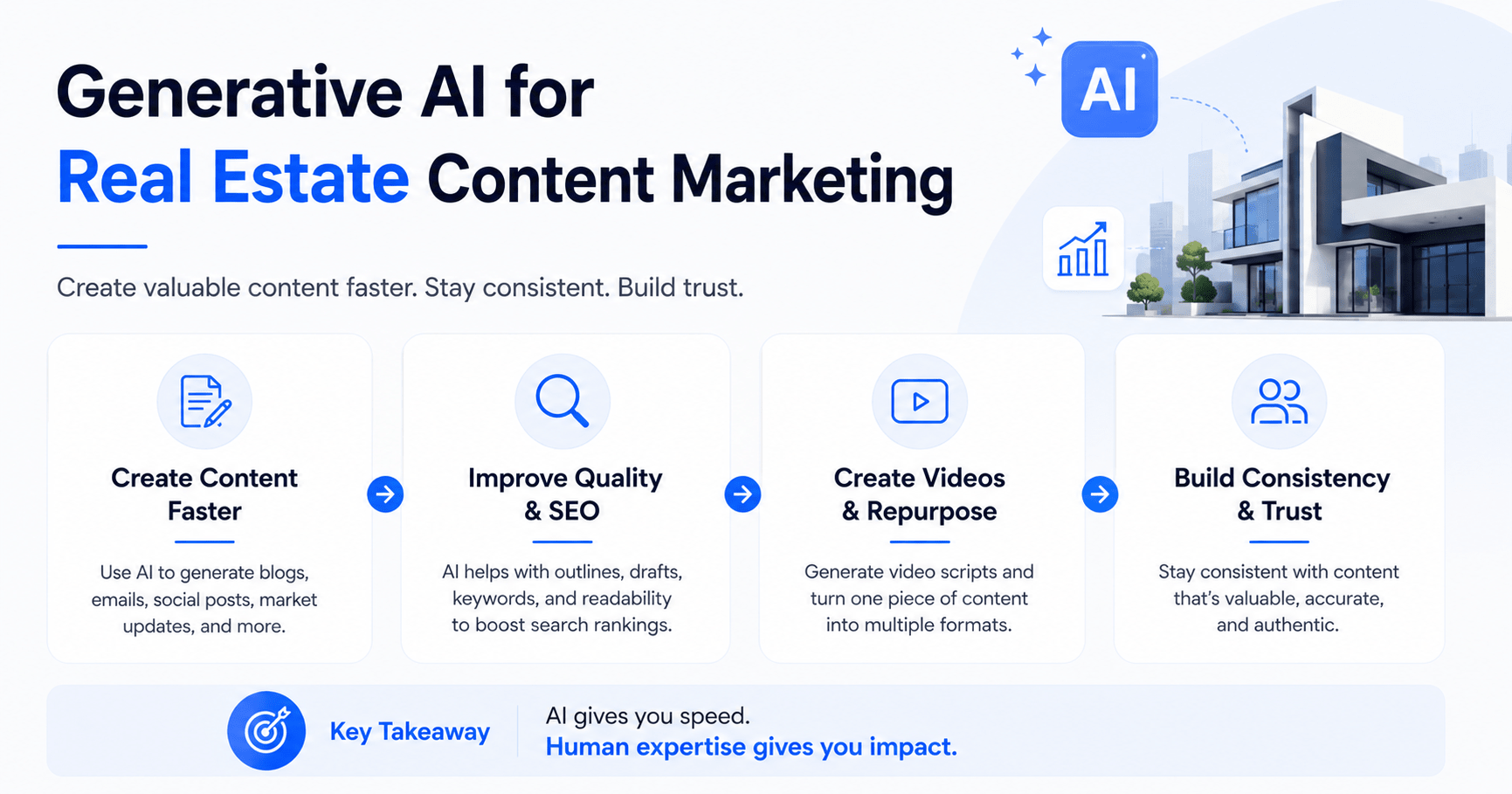
Content marketing has become a major part of real estate growth. Brokers, developers, and investors all compete for attention online. Firms publish blogs, newsletters, videos, market updates, and social posts every week.
That creates pressure on marketing teams. Many small CRE firms do not have enough staff to produce content consistently. This is where AI helps most.
Generative AI speeds up content production without forcing teams to start from scratch every time. Instead of spending hours brainstorming ideas, teams can focus on editing, strategy, and quality control.
Today, many firms use AI to support:
-
SEO blog writing
-
Email newsletters
-
LinkedIn posts
-
Property videos
-
Market summaries
-
Investor updates
-
Podcast outlines
-
Webinar scripts
The biggest advantage is consistency. Firms that publish useful content regularly often build stronger trust online. AI makes it easier to maintain that publishing schedule.
However, quality still matters more than quantity. Publishing generic AI content rarely performs well. Readers want practical insights, local knowledge, and real experience.
That is why the best-performing firms combine AI efficiency with human expertise.
AI SEO Blogging for CRE Firms
SEO content takes time. Teams must research keywords, organize topics, and write helpful explanations. AI tools simplify much of this process.
For example, a CRE marketing team can use AI to:
-
Build blog outlines
-
Create article drafts
-
Generate title ideas
-
Write meta descriptions
-
Organize FAQs
-
Improve readability
-
Suggest semantic keywords
This helps firms produce educational content faster.
Still, AI-generated blogs need editing. Search engines reward expertise and clarity. They do not reward generic writing. Teams should always add:
-
Local market knowledge
-
Real-world examples
-
Expert commentary
-
Accurate data
-
Original insights
Without those elements, the content often feels robotic.
Many CRE firms now use AI as a research assistant instead of a full replacement for writers. That approach usually produces better results.
You can also review practical AI workflows here:
AI Video Scripts and Property Tours
Video marketing continues to grow in real estate. Investors and tenants now expect visual content before scheduling calls or tours.
AI helps teams create video scripts faster. Instead of manually writing every scene, marketers can generate structured scripts in minutes.
Common AI video uses include:
-
Property walkthrough scripts
-
Investor presentation videos
-
Market update videos
-
Social media reels
-
YouTube educational content
For example, a broker can upload property details and ask AI to create:
-
A 60-second Instagram reel script
-
A professional YouTube walkthrough
-
A voiceover for a drone video
-
A short investor teaser
This reduces production time significantly.
AI tools also help repurpose content. A single market report can become:
-
A blog article
-
A LinkedIn carousel
-
An email newsletter
-
A video script
-
Several social posts
That helps firms maximize the value of existing content.
AI Social Media Workflows for Brokers
Many brokers struggle with social media consistency. They know visibility matters, but content creation takes time. AI simplifies that process.
Instead of creating every post manually, brokers can build repeatable workflows.
AI Social Media Checklist
-
Generate weekly content ideas
-
Turn listings into social posts
-
Repurpose newsletters into LinkedIn content
-
Create short captions for Instagram
-
Build carousel post outlines
-
Schedule content automatically
-
Rewrite long-form content into shorter updates
This process saves hours every week.
Still, social media content should feel personal. Audiences connect more with authentic opinions and local insights. AI should support the process, not completely replace the human voice.
What Most Real Estate Teams Get Wrong About AI Content
Many firms adopt AI too quickly without building standards first. As a result, the content often feels repetitive and generic.
The most common mistake is publishing raw AI output without editing.
That creates several problems:
-
Weak brand voice
-
Incorrect information
-
Generic messaging
-
Poor readability
-
Low trust
Another problem is overproduction. Some teams believe more content automatically means better marketing. However, low-quality content rarely builds authority.
Strong CRE marketing still depends on:
-
Clear expertise
-
Accurate market knowledge
-
Useful insights
-
Strong storytelling
-
Human editing
The best teams use AI carefully. They focus on efficiency while protecting quality.
AI Tools That Actually Work for Real Estate Marketing
The AI market changes fast. New tools launch every week. However, only a small group of tools truly helps real estate teams improve productivity.
Some platforms save time immediately. Others create more confusion than value.
The best approach is simple. Start with a few core tools and build repeatable workflows around them.
Most CRE firms only need:
-
One writing tool
-
One design tool
-
One automation tool
-
One video tool
That setup handles most marketing tasks effectively.
Best AI Writing Tools for CRE Marketing
AI writing tools help with listings, blogs, emails, presentations, and research summaries.
AI Writing Tools Comparison
| Tool | Best Use Case | Strengths | Weaknesses | Best For |
|---|---|---|---|---|
| ChatGPT | General CRE marketing | Flexible and fast | Needs strong prompts | Brokers and marketers |
| Claude | Long-form writing | Strong readability | Smaller ecosystem | Reports and blogs |
| Gemini | Google integration | Research support | Less creative tone | Google-based workflows |
| Jasper | Marketing teams | Templates and branding | Higher cost | Agencies and teams |
| Copy.ai | Quick marketing copy | Easy to use | Limited depth | Short-form campaigns |
Most CRE professionals start with ChatGPT because it handles many workflows well.
However, results depend heavily on prompt quality. Strong prompts create stronger outputs.
Best AI Design and Image Tools
Visual marketing matters in real estate. AI image tools now help teams create graphics, presentations, and branding assets faster.
Popular tools include:
-
Canva AI
-
Midjourney
-
Adobe Firefly
-
DALL·E
These platforms help with:
-
Social graphics
-
Property marketing visuals
-
Presentation slides
-
Branding materials
-
Ad creatives
Canva AI works especially well for smaller CRE teams because it combines templates with automation.
Best AI Video and Audio Tools
Video content usually takes significant time to produce. AI tools now reduce editing and scripting work dramatically.
Popular tools include:
-
Synthesia
-
HeyGen
-
Descript
-
Runway
These tools help teams create:
-
AI voiceovers
-
Video edits
-
Avatar presentations
-
Podcast clips
-
Training videos
For example, a broker can turn a market update into a short video without hiring a full production team.
AI Tools That Are Mostly Hype
Not every AI tool provides real value. Many platforms overpromise and underdeliver.
Be careful with tools that claim to:
-
Fully automate SEO
-
Replace brokers entirely
-
Generate perfect leads automatically
-
Run marketing without human review
These systems often create low-quality output.
The best AI workflows still involve human oversight. Real estate requires trust, accuracy, and relationship-building. No tool can fully replace that.
How CRE Firms Are Using AI for Investor Marketing
Investor communication takes time. Teams prepare reports, presentations, offering memorandums, and updates constantly.
AI helps firms speed up those workflows while improving consistency.
This matters because investors expect faster communication today. Delays often hurt credibility. Here’s a practical example of how AI speeds up underwriting and investor analysis workflows inside real CRE operations.
Many CRE firms now use AI to support:
-
Offering memorandum drafting
-
Quarterly reports
-
Investor summaries
-
Market research
-
Portfolio updates
-
Meeting preparation
One major benefit is organization. AI tools help teams summarize large amounts of information quickly.
For example, analysts can upload research reports and ask AI to:
-
Extract key trends
-
Summarize market conditions
-
Compare competitors
-
Identify investment risks
-
Organize talking points
That saves hours of manual review.
AI for Offering Memorandums
Offering memorandums requires detailed writing and formatting. AI helps accelerate the early drafting process.
Teams now use AI to create:
-
Property summaries
-
Market overviews
-
Location descriptions
-
Tenant highlights
-
Investment narratives
This speeds up production significantly.
However, financial details still require careful review. AI should never replace underwriting accuracy or legal verification.
You can also explore related workflows here:
How to Implement Generative AI in 24 Hours
Many real estate professionals delay AI adoption because they think the process is complicated. In reality, most firms can launch basic AI workflows in one day.
The key is starting small.
You do not need dozens of tools. You also do not need a full automation team. Most CRE firms see results by improving just a few repetitive tasks first.
The goal is simple. Save time without lowering quality.
A good starting point is identifying where your team repeats the same work every week. Those tasks usually create the fastest AI wins.
Common examples include:
-
Writing listings
-
Creating email campaigns
-
Building social posts
-
Summarizing reports
-
Drafting investor updates
-
Creating meeting notes
Once you identify those tasks, you can build repeatable workflows around them.
Step 1: Identify Repetitive Marketing Tasks
Start by reviewing your current process. Look for work that repeats often and follows a similar structure.
For example, many brokers rewrite the same property features repeatedly. Marketing teams also reuse similar campaign formats every month.
That makes these workflows ideal for AI support.
Focus on tasks that:
-
Take too much time
-
Require repetitive writing
-
Follow a predictable format
-
Slow down deal execution
-
Create bottlenecks
Do not try to automate everything immediately. Instead, focus on one or two areas first.
For many CRE firms, the easiest starting point is listing creation or email marketing.
Step 2: Choose 2–3 Core AI Tools
Many teams fail because they adopt too many tools at once. That creates confusion and weak adoption.
Keep the setup simple.
Most firms only need:
| Tool Type | Purpose | Example Tools |
|---|---|---|
| Writing Tool | Listings, blogs, emails | ChatGPT, Claude |
| Design Tool | Graphics and visuals | Canva AI |
| Automation Tool | Workflow automation | Zapier, Make |
This combination handles most real estate marketing workflows effectively.
ChatGPT works well for writing tasks. Canva AI helps with visual content. Automation tools connect systems together.
For example, a workflow could:
-
Generate listing copy with AI
-
Send content into Canva templates
-
Push approved posts into social scheduling software
That entire process can happen in minutes instead of hours.
Step 3: Build Prompt Templates
Prompt quality matters more than tool selection.
Weak prompts create weak results. Strong prompts create useful outputs.
The best prompts include:
-
Audience details
-
Tone instructions
-
Property information
-
Desired format
-
Clear business goals
Good prompts also reduce editing time.
Essential CRE Marketing Prompts
Investor Email Prompt
“Write a professional investor update for a multifamily property in Austin. Highlight occupancy growth, rent trends, and operational improvements. Keep the tone confident but realistic.”
LinkedIn Post Prompt
“Create a LinkedIn post for commercial real estate brokers about rising industrial demand in Dallas. Keep the tone professional and conversational.”
Market Report Prompt
“Summarize the latest office leasing trends in Miami using simple language for investors. Include risks and opportunities.”
Listing Prompt
“Write a polished retail property description for a mixed-use development in Nashville. Focus on walkability, demographics, and visibility.”
These prompts work because they provide context and direction.
Generic prompts usually create generic content.
Step 4: Train Team Members
AI tools only work well when teams understand how to use them properly.
That is why training matters.
Most CRE firms now train employees on:
-
Prompt writing
-
Fact checking
-
Editing standards
-
Compliance review
-
Workflow organization
This improves output quality significantly.
Without training, teams often publish inaccurate or repetitive content. That hurts credibility and weakens brand trust.
The best firms create internal AI guidelines before scaling usage.
Those guidelines should explain:
-
Which tools can employees use
-
How to review AI-generated content
-
What information should never be uploaded
-
Brand voice expectations
-
Compliance requirements
Clear standards reduce mistakes.
Step 5: Measure Productivity Improvements
AI adoption should improve measurable business outcomes. Otherwise, the workflow may not be worth maintaining.
Track performance carefully.
AI Marketing KPI Tracking
| KPI | What to Measure |
|---|---|
| Content Production Speed | Time saved per campaign |
| Lead Response Time | Faster inquiry handling |
| Campaign Output | Number of campaigns launched |
| Marketing Costs | Reduced outsourcing expenses |
| Engagement Metrics | Clicks, replies, and shares |
Many firms see improvements within the first few weeks.
The biggest gains usually come from faster execution and reduced manual work.
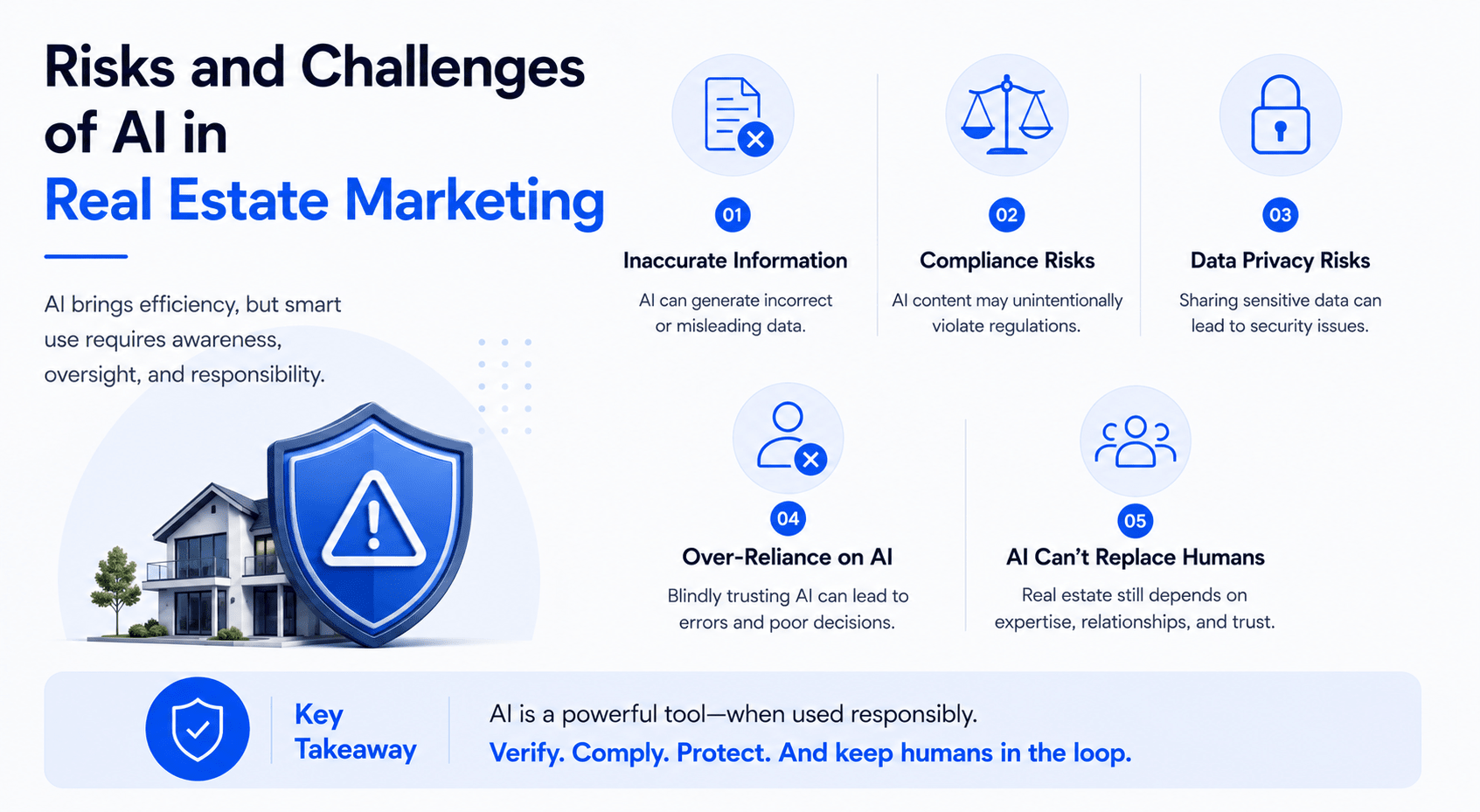
Risks and Challenges of AI in Real Estate Marketing
AI improves efficiency, but it also creates risks. Real estate firms should understand those challenges before scaling adoption.
The biggest mistake is trusting AI blindly.
AI tools sometimes produce inaccurate information. They may invent statistics, misinterpret property details, or generate misleading claims.
That becomes dangerous in real estate because accuracy matters.
A small mistake in:
-
Square footage
-
Lease terms
-
Market data
-
Financial projections
-
Property features
can create serious credibility problems.
That is why human review remains essential.
AI Hallucinations and Incorrect Information
AI hallucinations happen when systems generate false or misleading content confidently.
This problem appears often in:
-
Market summaries
-
Research reports
-
Listing descriptions
-
Demographic analysis
For example, an AI tool may cite incorrect rent growth data or invent nearby amenities.
Because of this, firms should always verify:
-
Statistics
-
Addresses
-
Financial numbers
-
Property details
-
Market claims
AI should speed up research, not replace verification.
Compliance and Fair Housing Risks
Real estate marketing must follow strict regulations. AI-generated content sometimes creates compliance concerns unintentionally.
This is especially important in residential marketing.
For example, AI may accidentally generate language that suggests demographic preferences or biased targeting.
That creates fair housing risks.
To reduce problems:
-
Review all AI-generated copy
-
Avoid discriminatory wording
-
Use compliance checklists
-
Train teams on legal standards
Human oversight remains critical.
Data Privacy and Security Concerns
Many firms upload sensitive information into AI systems without understanding platform policies.
That creates privacy risks.
Potentially sensitive data includes:
-
Investor documents
-
Tenant information
-
Financial records
-
Internal presentations
-
Acquisition plans
CRE firms should create clear rules about what employees can upload to AI tools.
Some companies now use enterprise AI systems with stronger privacy controls.
That approach reduces security concerns significantly.
Why Human Oversight Still Matters
Some people believe AI will replace real estate professionals completely. That is unlikely.
Real estate still depends heavily on:
-
Relationships
-
Negotiation
-
Trust
-
Local expertise
-
Strategic thinking
AI cannot replace those skills.
Instead, AI changes how professionals spend time. It removes repetitive tasks and allows teams to focus on higher-value work.
The best firms use AI to support human expertise, not eliminate it.
Future Trends in AI Real Estate Marketing
AI adoption in real estate is still early. Many workflows will become more advanced over the next few years.
One major trend is hyper-personalization.
Future AI systems will create highly customized campaigns for specific investor profiles, tenant industries, and geographic markets.
For example, AI may automatically adjust:
-
Messaging tone
-
Property recommendations
-
Market reports
-
Investment summaries
-
Ad creatives
based on user behavior and preferences.
That level of personalization will improve engagement significantly.
AI Video Avatars and Virtual Brokers
AI-generated video avatars are also becoming more common.
These systems create realistic presenters for:
-
Property walkthroughs
-
Market updates
-
Investor summaries
-
Training videos
While human-led videos still perform best for trust, AI avatars may help firms scale educational content faster.
Predictive Marketing Campaigns
Future AI tools will likely improve predictive marketing.
Instead of reacting to leads manually, systems may identify:
-
High-intent prospects
-
Likely investors
-
Tenant demand shifts
-
Market timing opportunities
before teams notice themselves.
That could improve campaign targeting dramatically.
AI-Native Real Estate Firms
Some firms are already building operations around AI-first workflows.
These companies often operate with:
-
Smaller marketing teams
-
Faster content production
-
Leaner operations
-
More automation
-
Lower outsourcing costs
However, the strongest firms still combine technology with experienced professionals.
AI alone is not an advantage. Strong implementation is the real advantage.
Conclusion
Generative AI is changing real estate marketing faster than most firms expected. Teams now create listings, campaigns, reports, and investor content much more efficiently.
The biggest benefit is speed. AI removes repetitive work and helps professionals focus on strategy, relationships, and deal execution. Still, technology alone is not enough.
The firms seeing the best results combine AI efficiency with human expertise. They review content carefully, build strong workflows, and focus on practical implementation instead of hype. Most importantly, they start small and improve gradually.
As adoption grows, firms that learn these systems early will likely move faster than competitors. That is one reason why generative AI is changing real estate marketing across every major asset class today.
Ready to Use AI in Commercial Real Estate?
Most CRE professionals are still testing AI randomly. Join a community focused on real workflows, practical implementation, and proven systems used by commercial real estate professionals every day.
How is generative AI used in real estate marketing?
Generative AI helps real estate teams create content faster and improve marketing efficiency. Most firms use it for listings, email campaigns, market reports, investor updates, and social media content.
For example, brokers use AI to draft property descriptions in minutes instead of hours. Marketing teams use it to create ad copy, newsletters, and LinkedIn posts. Analysts use AI to summarize market research and organize large amounts of data.
AI also helps with personalization. A firm can create different marketing messages for investors, tenants, and brokers without rewriting everything manually.
Common use cases include:
-
Listing descriptions
-
Offering memorandums
-
Investor updates
-
SEO blog content
-
Lead nurturing emails
-
Property video scripts
However, strong results still require human review. AI works best as a productivity tool, not a full replacement for expertise and strategy.
Can AI replace real estate marketers?
AI can automate repetitive marketing tasks, but it cannot fully replace experienced real estate professionals.
Real estate depends heavily on relationships, trust, negotiation, and local knowledge. AI cannot replicate those skills. Instead, it helps marketers and brokers work faster by reducing manual work.
For example, AI can:
-
Draft listings
-
Create social posts
-
Write email campaigns
-
Summarize reports
-
Organize research
However, humans still need to:
-
Review content
-
Verify accuracy
-
Build relationships
-
Make strategic decisions
-
Understand local markets
The strongest CRE firms use AI to support their teams, not replace them. This approach improves productivity while keeping quality and trust high.
Over time, job responsibilities may shift. Professionals who understand AI workflows will likely gain a competitive advantage.
What are the best AI tools for real estate marketing?
The best AI tools depend on the workflow and business goals. Most CRE firms start with a few core platforms instead of adopting too many tools at once.
Popular AI writing tools include:
-
ChatGPT
-
Claude
-
Gemini
-
Jasper
These tools help with listings, blogs, investor emails, and marketing campaigns.
For design and visual content, many firms use:
-
Canva AI
-
Midjourney
-
Adobe Firefly
These platforms help create graphics, presentations, and social media visuals.
Video-focused tools include:
-
Synthesia
-
HeyGen
-
Descript
They support video scripts, editing, and AI-generated presentations.
The most important factor is not the tool itself. Workflow quality matters more. Firms should focus on practical implementation instead of chasing every new AI platform.
Is AI-generated real estate content good for SEO?
AI-generated content can perform well in search engines when it includes expertise, accuracy, and useful information.
Search engines reward content that helps readers solve problems. They do not reward low-quality AI writing filled with generic language.
That means AI-assisted SEO content should always include:
-
Human editing
-
Accurate information
-
Market expertise
-
Clear explanations
-
Original insights
For example, a generic AI-generated market report may struggle to rank. However, a detailed article with local data, expert analysis, and practical examples can perform very well.
Strong SEO content also needs:
-
Good readability
-
Clear headings
-
Helpful FAQs
-
Internal links
-
Proper keyword usage
The best approach is to use AI as a drafting and research tool while keeping human oversight throughout the process.
How do brokers use AI for lead generation?
Many brokers now use AI to improve lead generation workflows and response speed.
AI helps create personalized outreach campaigns much faster than traditional methods. Instead of writing every email manually, brokers can generate targeted campaigns within minutes.
For example, brokers may use AI to:
-
Write investor outreach emails
-
Create LinkedIn campaigns
-
Build follow-up sequences
-
Generate ad copy
-
Qualify leads with chatbots
AI chat systems also help answer property questions and schedule tours automatically.
This improves response time significantly. Faster responses often increase conversion rates because prospects receive information quickly.
Some firms also use AI to analyze campaign performance and identify which messaging performs best.
However, successful lead generation still depends on relationship-building and trust. AI improves efficiency, but strong communication remains essential.
What risks come with AI in real estate marketing?
AI offers many benefits, but it also creates several risks.
One major issue is inaccurate information. AI systems sometimes generate false statistics, incorrect property details, or misleading claims. This problem is often called hallucination.
That creates serious concerns in real estate marketing because accuracy matters.
Other common risks include:
-
Fair housing compliance issues
-
Data privacy concerns
-
Weak brand messaging
-
Generic content
-
Over-automation
For example, AI-generated residential marketing copy may accidentally use language that creates compliance problems.
To reduce risk, firms should:
-
Review all AI-generated content
-
Verify statistics and market data
-
Create internal AI guidelines
-
Train employees properly
-
Protect confidential information
Human oversight remains critical in every workflow.
How much can AI reduce marketing workload?
The workload reduction depends on how firms implement AI. However, many teams save several hours each week after building basic workflows.
The largest gains usually come from repetitive tasks like:
-
Listing creation
-
Email campaigns
-
Social media content
-
Market summaries
-
Presentation drafting
For example, a property description that once took two hours may now take 15 minutes with AI assistance.
Marketing teams also reduce outsourcing costs because they can produce more content internally.
Still, AI does not eliminate all work. Teams still need to:
-
Edit content
-
Verify information
-
Manage strategy
-
Maintain brand voice
The goal is not full automation. The goal is faster execution and better productivity.
Can AI create offering memorandums?
AI can help create parts of an offering memorandum, but it should not fully replace human review.
Many CRE firms now use AI to draft:
-
Property summaries
-
Market overviews
-
Location descriptions
-
Tenant highlights
-
Investment narratives
This speeds up the early stages of OM production significantly.
However, financial analysis, underwriting details, and legal information still require careful human verification.
AI works best as a support tool for:
-
Writing assistance
-
Content organization
-
Research summaries
-
Formatting ideas
Experienced professionals should always review final materials before distribution.
This approach improves efficiency while protecting accuracy and credibility.
How can small real estate teams start using AI?
Small teams should begin with simple workflows instead of trying to automate everything immediately.
The best starting point is identifying repetitive tasks that consume too much time.
Examples include:
-
Writing listings
-
Creating email campaigns
-
Posting social content
-
Summarizing reports
After identifying those tasks, teams should choose one or two AI tools and build repeatable processes around them.
Most small firms only need:
-
One writing tool
-
One design platform
-
One automation system
Training also matters. Teams should learn prompt writing, editing, and compliance review before scaling AI usage.
Starting small usually leads to better long-term adoption because employees feel less overwhelmed.
Does AI help commercial real estate marketing specifically?
Yes. AI fits commercial real estate especially well because CRE marketing involves large amounts of repetitive content and research.
Many CRE firms use AI for:
-
Investor communication
-
Market research
-
Offering memorandums
-
Lease marketing
-
Broker outreach
-
Property listings
AI also helps summarize long reports and organize large datasets quickly.
For example, analysts can upload market research and ask AI to extract trends, risks, and opportunities in minutes.
This saves time while improving productivity.
Commercial real estate also benefits from AI because different asset classes require different messaging. AI helps teams personalize campaigns for industrial, retail, office, and multifamily audiences more efficiently.
What is the biggest mistake real estate firms make with AI?
The biggest mistake is publishing AI-generated content without proper editing or review.
Many firms adopt AI tools quickly but fail to create quality standards. As a result, the content often feels generic or inaccurate.
Common mistakes include:
-
Overusing buzzwords
-
Ignoring fact checks
-
Publishing repetitive content
-
Forgetting compliance review
-
Trusting AI blindly
Another major mistake is focusing only on automation instead of strategy.
AI should improve productivity, not replace expertise.
The strongest firms use AI carefully. They combine automation with human review, market knowledge, and strong brand positioning.
That balance usually produces the best long-term results.
Will AI change CRE marketing jobs in the future?
Yes. AI will likely change how CRE marketing teams operate over the next several years.
Many repetitive tasks will become more automated. Teams may spend less time writing first drafts or organizing reports manually.
Instead, professionals will focus more on:
-
Strategy
-
Relationship-building
-
Brand positioning
-
Market analysis
-
Creative direction
At the same time, firms will likely expect employees to understand AI workflows and automation tools.
This does not mean marketing jobs disappear completely. Instead, responsibilities will evolve.
Professionals who learn how to combine AI with strong communication and market expertise will likely become more valuable.