AI for Predictive Maintenance in CRE Buildings
AI predictive maintenance is changing how commercial buildings manage equipment and maintenance. In fact, a commercial building never stops running. The heating and cooling system works all day. Meanwhile, elevators go up and down hundreds of times. In addition, electrical systems, pipes, boilers, and fire safety equipment run every hour of every day. However, most building owners still wait for something to break before fixing it.
However, neither approach works well. Waiting for things to break is very expensive. For example, emergency repairs cost three to five times more than planned ones. In addition, following a fixed schedule wastes money too. You end up replacing parts that still have a lot of life left. Both ways are blind. They deal with problems after they happen — not before.
However, AI predictive maintenance changes all of that. First, it watches every building system in real time. Then it spots early warning signs of a problem. Then it tells your team weeks before something fails. The savings are real. It cuts maintenance costs by 25 to 30 percent. It reduces surprise breakdowns by up to 50 percent. And it makes building equipment last longer — which protects your income and keeps tenants happy.
According to a 2024 McKinsey report shared by SmartDev, 40% of CRE firms are already using AI for predictive maintenance. Meanwhile, another 30% plan to start by 2025. The PropTech market behind this is growing from $7.24 billion in 2024 to $79.7 billion by 2034. That is a growth rate of 27% per year. This is not a future idea. It is happening right now.
In this guide, everything is explained in plain language. First, you will learn what AI predictive maintenance is. Then you will see how it works step by step. Find out which building systems need it most. And you will see what the real return on investment looks like for CRE owners and operators.
What Is AI Predictive Maintenance and Why Do CRE Buildings Need It
A Simple Way to Understand AI Predictive Maintenance
AI predictive maintenance in commercial real estate uses artificial intelligence and machine learning. It watches over building systems. It collects data from equipment and studies it. Then it tells you when something needs fixing — before it breaks. It is the difference between waiting for a problem and stopping it before it starts. To see why this matters, look at all four ways buildings handle maintenance. The table below shows each one side by side. It compares cost, downtime risk, and where each approach works best.
Maintenance Approaches Used in Commercial Buildings
| Type | How It Works | Cost Impact | Downtime Risk | Best For |
| Reactive Maintenance | Fix it after it breaks | Very high — emergency repairs cost 3–5x more | Very high — tenants are affected right away | No one — this is the most expensive way to manage a building |
| Scheduled Maintenance | Fix or replace on a set calendar date | Medium — some parts get replaced too early | Medium — reduces some failures but misses others | Simple buildings without sensor systems |
| Condition-Based Maintenance | Act when sensor data crosses a set limit | Lower — only acts when a problem is spotted | Low to medium — better but still reactive | Buildings that already have a BMS in place |
| AI Predictive Maintenance | Predict failures weeks before they happen using AI and IoT data | Lowest — cuts maintenance costs by 25–30% | Very low — problems caught early every time | Any CRE building that wants to protect NOI and keep tenants happy |
As a result, the table makes the comparison clear. Reactive maintenance costs the most in the long run. Scheduled maintenance is more predictable, but still wastes money. AI predictive maintenance is at the top. It costs more to set up at the start. But it has the lowest long-term costs and causes the least trouble for tenants.
As The AI Consulting Network explains in their CRE predictive maintenance guide, AI predictive maintenance removes two big problems at once. It stops unnecessary scheduled replacements. And it prevents costly emergency repairs. The result is a 25 to 30 percent cut in total maintenance spending for commercial properties.
How AI Predictive Maintenance Works — The Simple Version
In practice, AI predictive maintenance works in a continuous loop. It never stops. First, it collects data from your building systems. Then it looks for patterns in that data. Next, it predicts when something is going to fail. Finally, it triggers the right maintenance action — automatically. This happens around the clock, across every system being monitored in the building.
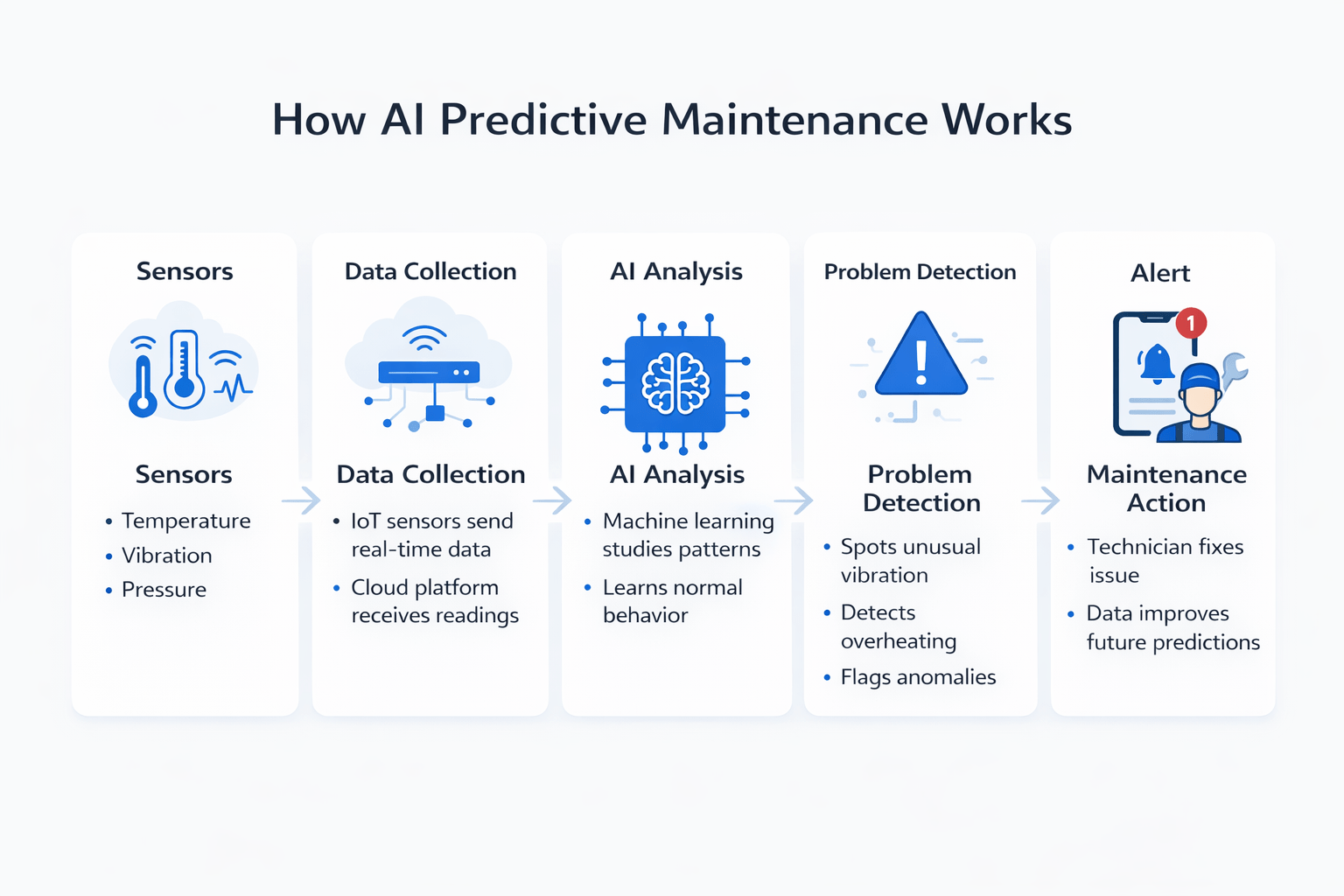
The 6-Step AI Predictive Maintenance Process
Here is each step explained simply:
Step 1 — Sensor installation:
Small IoT sensors are placed on important building equipment. Temperature sensors track heat levels. Vibration sensors spot mechanical problems. Current sensors watch electrical systems. Pressure sensors monitor plumbing. Modern sensors are small, wireless, and cost $50 to $200 each. Most commercial buildings need 50 to 200 sensors
Step 2 — Continuous data transmission:
Sensors send readings non-stop to a cloud platform or on-site server. This runs 24 hours a day, 7 days a week. No one needs to check it manually
Step 3 — AI pattern analysis:
Machine learning models study the data coming in. They learn what normal looks like for each piece of equipment in your building. They also account for seasonal changes, how many people are in the building, and how equipment is used day to day
Step 4 — Anomaly detection:
The AI spots anything that looks different from normal. A compressor about to fail shows unusual vibration weeks before it breaks. A boiler with a buildup problem shows rising temperatures. The AI catches these warning signs early — before damage occurs
Step 5 — Automated alert:
When the AI finds a likely failure, it creates a work order automatically. The work order includes the location, sensor data, how serious the problem is, and the recommended fix. It goes straight to the maintenance team’s phone
Step 6 — Continuous learning:
Every completed repair is fed back into the AI model. The system learns and gets better over time. After 6 to 12 months of building-specific data, predictions become much more accurate
As Visitt’s predictive maintenance glossary puts it, this continuous loop takes raw building data and turns it into smart maintenance decisions. It watches every building system as it runs and builds a full picture of how healthy your entire portfolio is.
Which Building Systems Need AI Predictive Maintenance the Most
However, not every system needs the same level of attention. The best results come from watching the systems where failures cost the most, upset tenants the most, or are hardest to spot before they happen.
AI Predictive Maintenance Use Cases by Building System
| Building System | What AI Monitors | Common Failures Detected | Benefit |
|---|---|---|---|
| HVAC Systems | Temperature, vibration, airflow | Compressor failure, refrigerant leaks | Prevent costly downtime |
| Elevators | Motor load, door cycles | Motor wear, door faults | Fewer breakdowns |
| Electrical Systems | Voltage, current loads | Overloads, wiring issues | Prevent safety incidents |
| Plumbing Systems | Pressure, flow rates | Hidden leaks, pressure loss | Avoid water damage |
| Boilers | Heat transfer, pressure | Scaling, overheating | Extend equipment life |
| Roof & Envelope | Image analysis, moisture | Cracks, water intrusion | Prevent structural damage |
Key Building Systems That Benefit From AI Monitoring
- HVAC systems (top priority): HVAC makes up 30 to 40 percent of all building operating costs. AI watches compressors, chillers, cooling towers, and air handlers. One retail company using AI detected problems with 85% accuracy across 50 malls. Emergency HVAC repairs dropped by 30%. They saved $1.2 million every year
- Elevators and escalators: High-traffic buildings need reliable vertical transport. AI watches motor efficiency, door operation, and cable tension. One hotel chain cut elevator failures by 30% after adding AI monitoring
- Electrical systems: Current sensors on panels and switchgear spot early signs of wiring problems and overloads — before safety incidents happen
- Plumbing systems: Pressure sensors detect slow pressure drops that signal developing leaks. AI finds unusual water usage patterns before visible water damage appears
- Boilers and water heating: Thermal sensors spot buildup problems and heat transfer issues weeks before the system fails
- Building envelope and roof: Computer vision AI studies photos or drone footage. It finds small cracks and water entry points before they become major repairs
Key Stat: HVAC systems give the highest ROI for AI predictive maintenance. They make up 30–40% of building operating costs and produce clear data signals before failure. — The AI Consulting Network, 2025
How to Set Up AI Predictive Maintenance in Your CRE Building Step by Step
Typical Cost Breakdown for AI Predictive Maintenance Setup
| Component | Estimated Cost | Notes |
|---|---|---|
| IoT Sensors | $50–$200 per sensor | 50–200 sensors per building |
| Sensor Installation | $5,000–$15,000 | Depends on building size |
| AI Platform Subscription | $500–$5,000 / month | Based on portfolio size |
| BMS Integration | $5,000–$15,000 | One-time setup cost |
| Maintenance & Support | $2,000–$10,000 yearly | Optional service plans |
Phase 1 — Check Your Building and Set Clear Goals
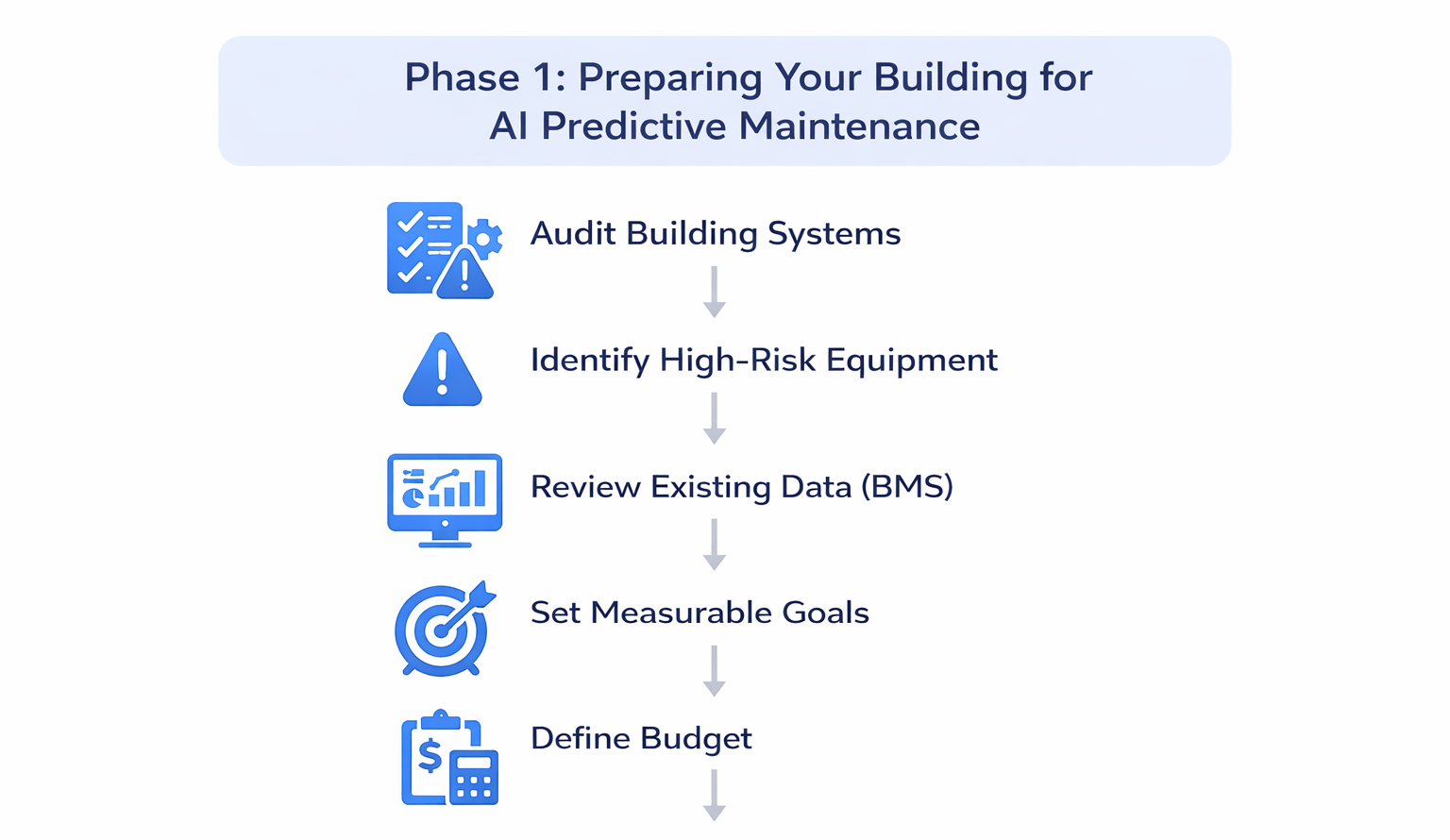
Setting up AI predictive maintenance does not start with buying sensors or signing up for a platform. It starts with looking at your building and setting a clear, measurable goal. A vague goal like ‘improve maintenance’ does not help you measure success. A specific goal like ‘cut HVAC emergency repairs by 30% in 6 months’ gives you something real to track.
Here is how to complete Phase 1:
- List all your building systems: Write down every major mechanical, electrical, and plumbing system. Note the make, model, age, any known failure history, and how often each is currently maintained. This becomes your asset list
- Find your highest-risk systems: Focus first on systems where failures cost the most or upset tenants the most. HVAC, elevators, and electrical panels are almost always first
- Check your existing data: Does your building already have a Building Management System (BMS)? Most major BMS platforms from Johnson Controls, Honeywell, and Siemens already collect equipment data. Using this existing data cuts sensor costs and speeds up AI training
- Set measurable goals: Write down what success looks like. For example, cut emergency repair costs by 25% in 12 months. Or catch at least 3 potential HVAC failures with 2 weeks’ advance notice in the first 6 months
- Set your budget: Each sensor costs $50 to $200. A mid-size commercial building might spend $15,000 to $50,000 on a full sensor setup. Platform subscriptions run $500 to $5,000+ per month, depending on building size
Pro Tip: Always start with your HVAC system. It has the highest share of building operating costs. It also produces the clearest failure signals for AI to catch. One successful HVAC pilot builds the business case for expanding to all other systems.
For a detailed guide on checking your building before starting AI implementation, BuildingLogix’s guide to AI-powered predictive maintenance covers the full assessment process for CRE operators of every size.
Phase 2 — Install Sensors and Connect Your AI Platform
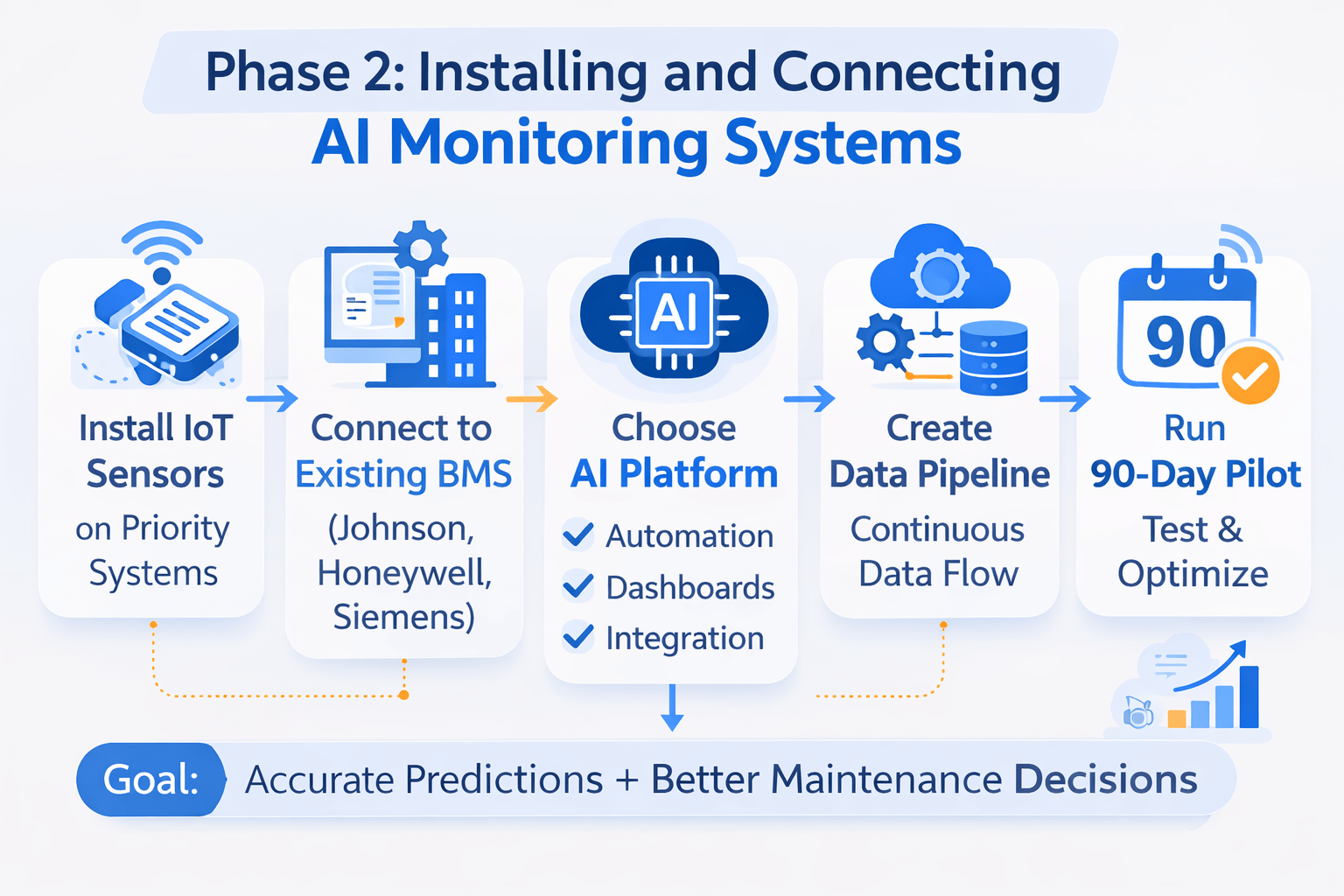
Once your building check is done and your priorities are clear, Phase 2 moves into action. This is where you install the physical sensors and connect the AI platform to your building’s data. The goal is to get clean, non-stop data flowing into one platform where the AI can start learning your building’s normal patterns.
How to Install and Connect AI Monitoring Systems
- Install IoT sensors on priority systems: Place temperature, vibration, pressure, current, and humidity sensors on your most important assets first. Modern sensors are wireless and easy to add — they do not need new wiring or major installation work. Label each sensor with the asset ID and location
- Connect to your existing BMS: If your building already has a BMS, connect it to your AI platform first. This gives the AI immediate access to historical data, speeding up model training. Most AI platforms integrate with Johnson Controls, Honeywell, Siemens, and Schneider Electric
- Pick your AI platform: Choose a platform with pre-built detection models so you do not need a data science team to get started. Key things to look for: automated analysis, mobile work order delivery, real-time dashboards, and multi-system integration. Cloud platforms from AWS IoT, Microsoft Azure IoT, and Google Cloud IoT work well for large portfolios
- Set up your data pipeline: Make sure data flows non-stop from sensors to the cloud or on-site server. Data quality is the most important factor in AI accuracy. Check that every sensor is sending clean, steady readings
- Run a pilot before going building-wide: Test the AI on a small group of assets first. Most guides recommend a 90-day pilot on 2 to 4 key systems. This lets you check prediction accuracy, train staff, and show ROI to ownership before a full rollout
According to LinkedIn’s analysis of AI predictive maintenance in commercial buildings, connecting IoT sensors with AI platforms is now a standard capability in CRE. It is no longer limited to large institutional owners. Mid-market and smaller buildings can do this too, using affordable cloud-based tools.
Phase 3 — Train Your Team and Scale Across Your Portfolio
However, technology alone does not deliver results. Your maintenance team needs to understand how to read AI alerts. They need to trust the system’s predictions. And they need to act on work orders with confidence. Phase 3 is about turning the technology into a real change in how your team works every day.
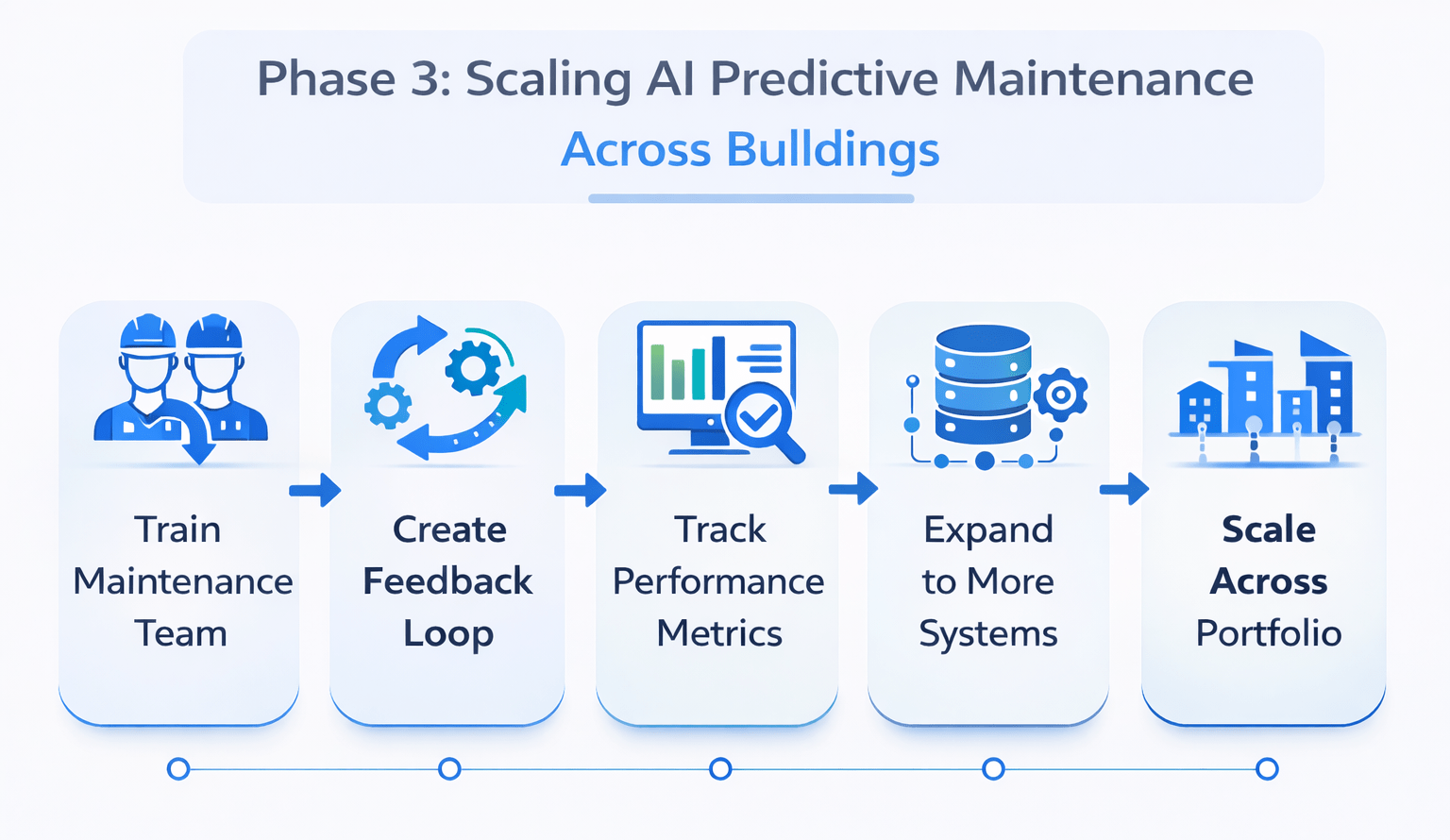
- Train your maintenance team: Show technicians how to read AI alerts and act on work orders. Explain the ‘why’ behind each AI recommendation. Training that makes sense builds trust faster than just telling people to use a new tool
- Create a feedback loop: Every completed work order should go back into the AI platform. Was the predicted failure real? What was the actual repair? This feedback makes the AI smarter for that specific asset over time
- Track your results every month: Monitor emergency repair frequency, planned vs. unplanned maintenance ratio, mean time between failures, energy costs, and tenant satisfaction. These numbers show whether the AI is delivering real value
- Expand to more systems: Once your pilot shows results, move to the next group — electrical panels, plumbing, building envelope, and elevators. Each new system adds more data and makes the AI smarter across the whole building
- Scale across your portfolio: For multi-property portfolios, one central AI platform with building-specific models gives asset managers a full view of every property. An energy bill of $100,000 per building with an 8–12% AI-driven cut saves $8,000–$12,000 per year per property — going straight to NOI
Result: Buildings using AI-driven smart building analytics report 14% energy savings and 91% occupant satisfaction scores on average. — Smart Building Technology Review, 2025
The Real Financial Benefits of AI Predictive Maintenance in CRE
How AI Predictive Maintenance Saves Money and Grows Asset Value
The financial case for AI predictive maintenance in commercial real estate is not hard to understand. The savings are real, documented, and they grow over time. Here is how the money breaks down across the areas that CRE owners and investors care about most.
Financial Impact of AI Predictive Maintenance
| Benefit Area | Typical Improvement | Example Impact |
|---|---|---|
| Maintenance Costs | 25–30% reduction | $500k budget → save $125k |
| Energy Efficiency | 8–15% reduction | $100k energy bill → save $14k |
| Equipment Lifespan | 20–40% longer | Fewer capital replacements |
| Downtime | Up to 50% reduction | Fewer tenant disruptions |
| Tenant Satisfaction | 10–20% increase | Higher lease renewals |
How to Install and Connect AI Monitoring Systems
Lower Maintenance Costs:
AI predictive maintenance cuts total maintenance spending by 25 to 30 percent. It removes unnecessary scheduled replacements. And it stops costly emergency repairs before they happen. A building spending $500,000 per year on maintenance saves $125,000 to $150,000 every year. That money goes straight to NOI.
Lower Energy Bills:
AI-optimized HVAC systems adjust automatically based on how many people are in the building, what the weather is like outside, and real-time performance data. This cuts energy costs by 8 to 15 percent. Buildings using smart analytics save about 14% on energy. On a $100,000 annual energy bill, that is $14,000 saved every year per building.
Fewer Emergency Repair Bills:
Emergency repairs cost three to five times more than planned ones. The same fix that costs $8,000 when planned costs $25,000 to $40,000 in an emergency. On top of that, there is the tenant disruption, possible business interruption, and damage to your reputation. AI predictive maintenance cuts emergency repairs sharply. One commercial office building using IBM Maximo avoided a full chiller failure that would have cost $50,000 by catching the problem early through sensor data.
Better Tenant Retention:
Tenants stay when buildings run reliably. SmartDev’s analysis of AI in CRE notes that early AI adopters cut maintenance downtime by nearly half. The retail firm using Augury AI saw a 15% jump in tenant satisfaction scores after adding predictive maintenance. Happy tenants renew leases. Lower turnover means lower vacancy costs and stronger occupancy — all of which support asset value.
Higher Property Value:
Better NOI at the same cap rate means a higher property value. A $125,000 drop in annual maintenance costs on a building with a 6.5% cap rate adds about $1.9 million to the property’s market value. That is from one operational improvement. Buildings with documented smart building programs also sell for 4 to 7 percent more in institutional markets.
ROI Summary: AI predictive maintenance cuts maintenance costs 25–30%, reduces unplanned downtime by up to 50%, lowers energy costs 8–15%, and can add millions to asset value through better NOI. — Deloitte, McKinsey, Smart Building Review, 2025
Common Problems When Setting Up AI Predictive Maintenance and How to Fix Them
Overall, AI predictive maintenance delivers strong results. But there are some common problems to watch for during setup. Knowing them before you start saves time, money, and frustration.
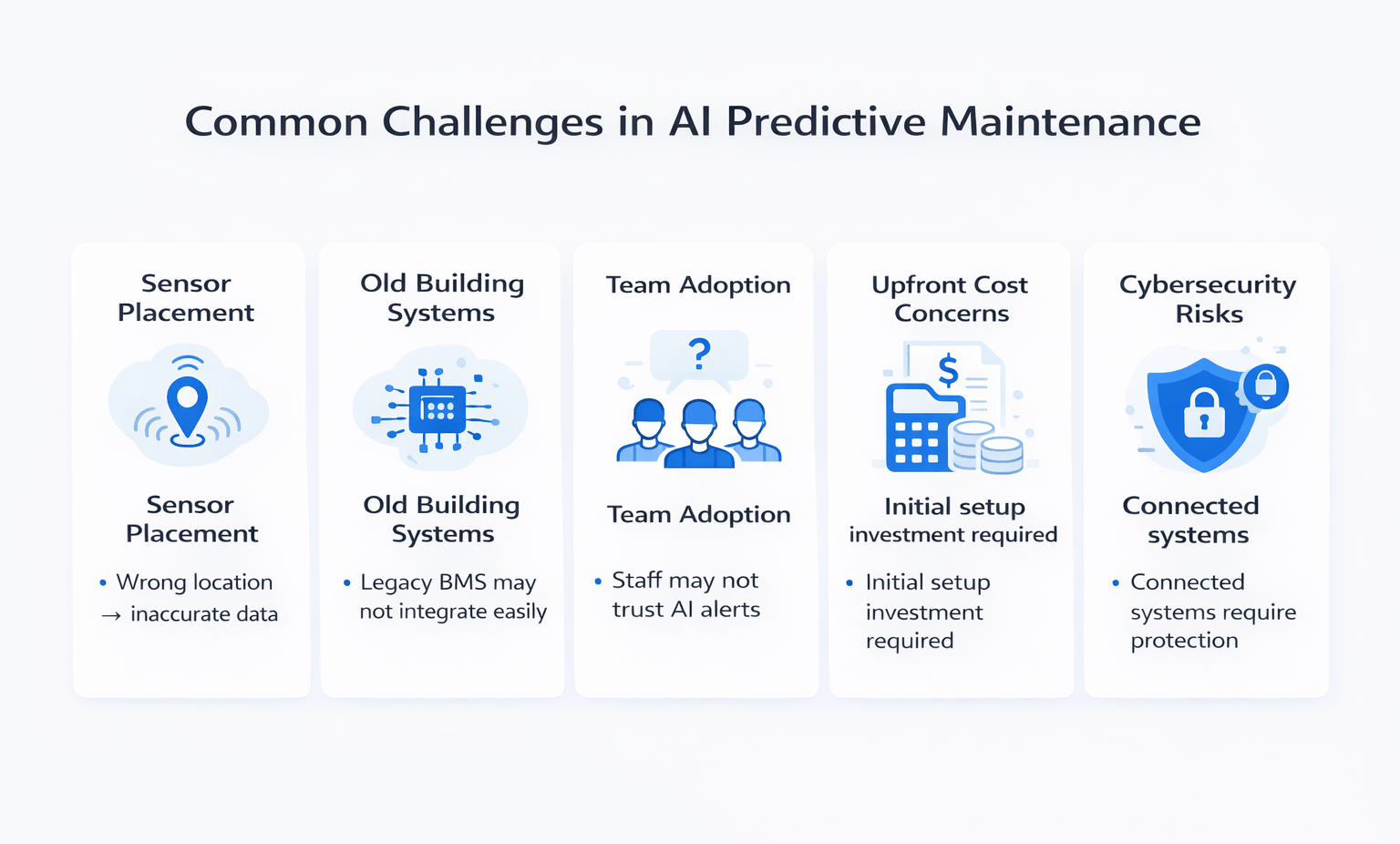
- Poor sensor placement: A sensor in the wrong spot gives bad data. Bad data means bad predictions. Work with your platform provider to find the right location for each sensor. Check and calibrate sensors regularly
- Old building systems that are hard to connect: Many CRE buildings run on older BMS platforms that were not built to share data. Use cloud-based AI tools that sit on top of old systems without needing a full replacement. Platforms like Visitt connect to existing BMS without disrupting current operations
- Staff who do not trust the new system: Maintenance teams used to fixing things after they break may resist AI alerts. Start with training that explains how predictions are made. One accurate prediction that stops an emergency repair builds more trust than any presentation
- Concerns about upfront cost: Start with one building and one system. Set one measurable goal. Document the savings. The case for expanding writes itself when the first pilot cuts maintenance costs by 25 percent
- Cybersecurity risk: Buildings connected to the internet face cyber threats. McKinsey notes that cybersecurity gaps can cost businesses millions. Always use encryption, access controls, and regular security checks as part of your AI setup from day one
Need help connecting AI tools to your existing CRE building systems? Visitt’s glossary on predictive maintenance covers exactly what you need. It explains the technical and day-to-day steps for linking AI platforms to the building systems you already have — across all types of portfolios.
What AI Predictive Maintenance Will Look Like in the Future?
Looking ahead, AI predictive maintenance is moving fast. The next three to five years will bring tools that make today’s technology look like an early draft. Knowing what is coming helps CRE operators plan ahead and avoid building on platforms that will not last.
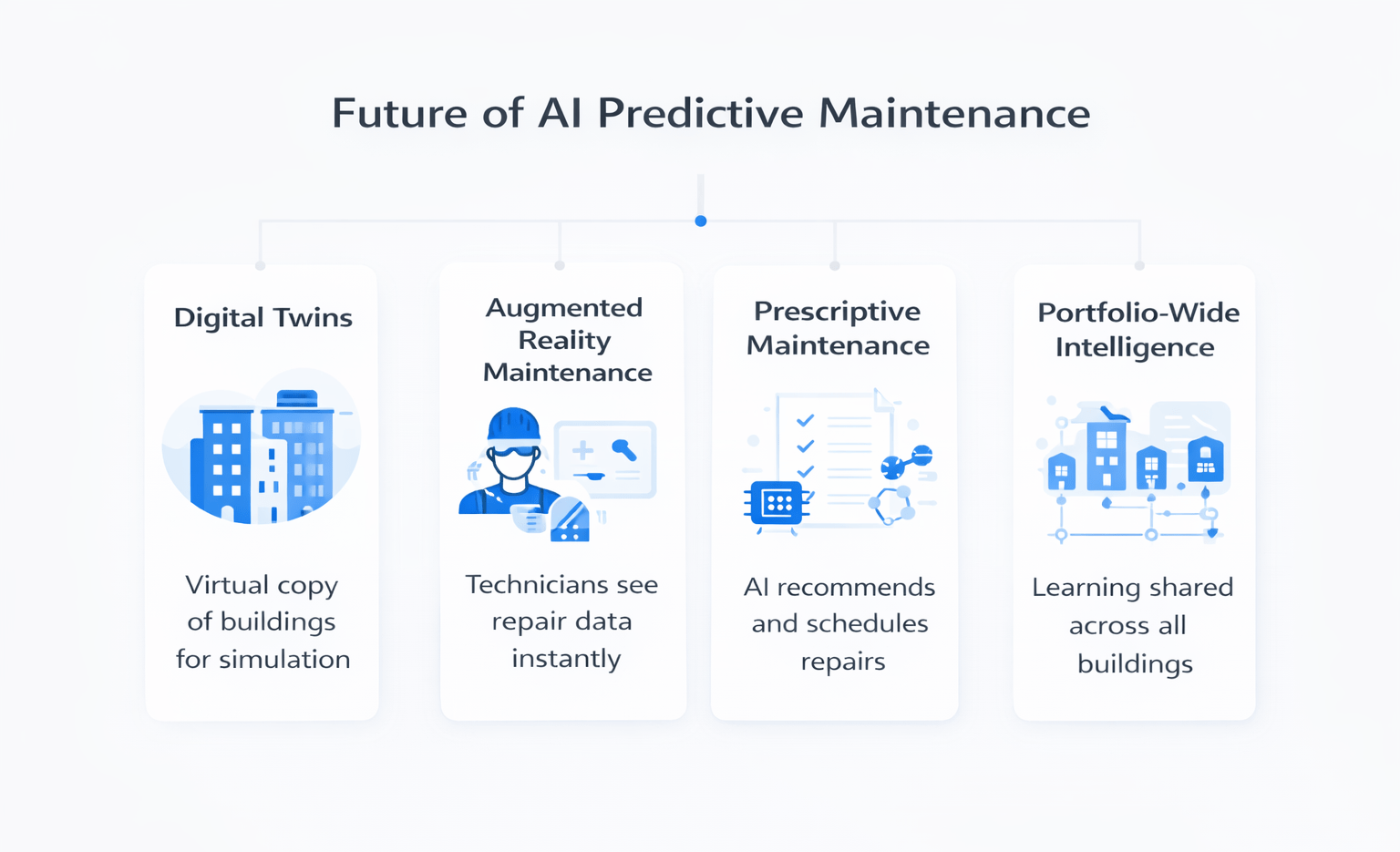
- Digital twins: AI creates a virtual copy of your physical building. Every system, sensor, and repair event is reflected in this digital model. Operators can test what happens when something fails — without touching the real building. They can also plan repairs and spending without any risk to the physical asset
- Augmented reality maintenance: Technicians will soon point AR glasses or a mobile device at a piece of equipment. They will instantly see its health status, repair history, and the recommended fix — all overlaid on the screen in real time. This cuts diagnostic time dramatically
- Prescriptive maintenance: This is the next step beyond predictive. The AI will not just warn you about a failure. It will recommend the exact repair, order the parts, schedule the right technician, and log the completed work — all automatically from start to finish
- Portfolio-wide AI intelligence: Multi-property portfolios will use one central AI platform that learns across all buildings. A pattern spotted in one building’s HVAC will immediately improve predictions for the same equipment in every other building in the portfolio
- ESG and sustainability integration: AI maintenance platforms are becoming part of ESG reporting tools. Real-time energy tracking, emissions monitoring, and automatic reporting to ENERGY STAR and LEED certification programs will become standard features in CRE maintenance platforms
For CRE professionals who want to stay ahead of where AI is taking building operations — and access tested workflows, tools, and community knowledge — AI for CRE Collective is the most focused resource available. It is a community of 600+ CRE professionals sharing practical AI strategies that work on real buildings and portfolios.
Final Thoughts: AI Predictive Maintenance Is a Smart Move for Every CRE Building
The case for AI predictive maintenance in commercial real estate is simple. Buildings that use it spend less on maintenance. They have fewer problems that disturb tenants. They use less energy. And they sell for more money. Buildings that do not use it spend more than they should. They fix problems after they happen instead of stopping them early. And they fall behind owners who have already made the switch.
To begin with, the steps to get started are clear. The technology is easy to access. Start by checking your building. Pick the system most likely to break down — almost always HVAC. Install sensors. Connect to a platform. Run a 90-day test. Write down what you find. Then grow from there. The first time AI stops an emergency repair from happening will prove the investment was worth it. Every prediction after that adds more value on top.
The PropTech market behind AI predictive maintenance is growing fast — at 27% per year. The CRE operators who build these skills now will lead the market. They will also learn how to use AI across all parts of their work. Start that journey at AI for CRE Collective.
Learn More With the AI for CRE Collective
AI predictive maintenance is just one way AI helps in commercial real estate. The AI for CRE Collective is a group of 600+ real estate professionals. They share AI tools, prompts, and strategies that actually work on real buildings and deals. When you join, you get a Top 50 Prompt Library on Day 1. You also get weekly live Q&A calls and step-by-step workflows built for asset managers, operators, investors, and developers.
Prefer to start free? Subscribe to The Vertical — our free weekly newsletter covering the latest AI tools and workflows built for CRE professionals.
Join the AI for CRE Collective on Skool →
Subscribe to The Vertical — Free Weekly Newsletter →
The gap between CRE operators using AI well and those still reacting to building failures grows every quarter. Come close it inside the Collective.
FAQs About AI for Predictive Maintenance in CRE Buildings
What is AI predictive maintenance in commercial real estate?
AI predictive maintenance uses artificial intelligence to watch over building systems and catch problems before they happen. It collects data from sensors placed on equipment. Then it studies that data. Here is what it does:
- It watches building systems like HVAC, elevators, and electrical panels all day and night
- It learns what normal looks like for each piece of equipment
- It spots early warning signs of damage or wear
- It sends an alert to your maintenance team weeks before something breaks
- It creates a work order automatically with the location, the problem, and the fix
You no longer wait for something to break. You stop it before it does.
Visitt’s predictive maintenance glossary explains how AI turns raw building data into smart maintenance decisions across all types of commercial portfolios. AI predictive maintenance is the difference between reacting to problems and stopping them before they start.
How much money can AI predictive maintenance save a CRE building?
AI predictive maintenance cuts total maintenance costs by 25 to 30 percent for most commercial buildings. Here is where the savings come from:
- Emergency repair savings: Emergency repairs cost 3 to 5 times more than planned ones. AI stops most of them before they happen
- Scheduled maintenance savings: Parts are replaced only when data says they need it — not on a calendar. This stops waste
- Energy savings: AI-optimized HVAC cuts energy bills by 8 to 15 percent
- Labor savings: Maintenance teams spend less time on surprise repairs and more time on planned, efficient work
- Downtime savings: Surprise breakdowns drop by up to 50 percent
Here is a simple example. A building that spends $500,000 per year on maintenance saves $125,000 to $150,000 every year with AI. That money goes straight to NOI.
The AI Consulting Network’s CRE predictive maintenance guide shows real cost savings outcomes across different types of commercial properties. The savings grow over time as the AI gets smarter and catches problems even earlier.
Which building systems need AI predictive maintenance the most?
HVAC systems need it the most — but several other systems are strong candidates too. Here is a simple priority list:
- HVAC (first priority): Makes up 30 to 40 percent of all building operating costs. AI watches compressors, chillers, and air handlers for heat and vibration changes
- Elevators and escalators: AI watches motor performance and door operation. One hotel chain cut elevator failures by 30 percent after adding AI monitoring
- Electrical systems: Sensors on panels detect early signs of wiring problems and overloads before safety issues happen
- Plumbing: Pressure sensors spot slow drops that mean a leak is forming — before water damage appears
- Boilers and water heating: Thermal sensors catch buildup problems weeks before the system fails
- Building envelope and roof: Computer vision AI studies photos or drone footage to find small cracks and water entry points early
Always start with HVAC. It has the highest costs and the clearest data signals for AI to work with.
BuildingLogix’s guide to AI-powered predictive maintenance covers which systems give the best results across different types of commercial buildings. Starting with the right system first is what makes a pilot program succeed.
How does AI predictive maintenance work step by step?
AI predictive maintenance works in a simple loop that runs non-stop every day.
Here is each step in plain language:
- Step 1 — Sensors go on the equipment: Small wireless sensors are placed on HVAC units, electrical panels, and other key systems. They cost $50 to $200 each
- Step 2 — Data is sent to the cloud: Sensors send readings 24 hours a day, 7 days a week. No one needs to check this manually
- Step 3 — AI studies the data: The AI learns what normal looks like for each piece of equipment in your building
- Step 4 — AI spots a problem: When something looks different from normal — like unusual vibration in a compressor — the AI flags it
- Step 5 — An alert goes to your team: A work order is created automatically. It includes the location, the sensor data, and the recommended fix. It goes straight to the technician’s phone
- Step 6 — The AI gets smarter: Every completed repair is fed back into the system. The AI improves its predictions over time
The whole process runs without anyone managing it manually.
Visitt’s predictive maintenance resource describes this loop as the core process that turns raw building data into proactive maintenance actions. The longer the system runs, the smarter and more accurate it becomes.
How much does it cost to set up AI predictive maintenance in a building?
Setup costs vary by building size — but most buildings get their money back within 12 to 18 months. Here is a simple cost breakdown:
- Each IoT sensor: $50 to $200
- Total sensors for a mid-size building: 50 to 200 sensors needed
- Full sensor setup for a mid-size building: $15,000 to $50,000 total
- AI platform subscription: $500 to $5,000+ per month depending on building size
- Connecting to an existing BMS: Usually $5,000 to $15,000 one time
Total first-year cost for a 200,000 sq ft office building: roughly $40,000 to $100,000. Annual maintenance savings at 25 to 30 percent: usually $100,000 to $200,000 or more for a building that size.
SmartDev’s overview of AI use cases in CRE covers cost ranges across different types and sizes of commercial properties. The cost of not using AI predictive maintenance — through emergency repairs and energy waste — almost always costs more than setting it up.
How long does it take to see results from AI predictive maintenance?
Most buildings start seeing real results within 90 to 180 days of setup.
Here is a simple timeline:
- Days 1 to 30: Sensors go in. Data starts flowing. The AI begins learning your building’s normal patterns
- Days 30 to 60: The AI flags its first anomalies. Small deviations from normal patterns start showing up
- Days 60 to 90: First real predictions arrive. Your maintenance team acts on AI-generated work orders for the first time
- Months 3 to 6: Prediction accuracy improves. The first documented prevented failures happen
- Months 6 to 12:</strong> ROI becomes clear. Compare emergency repairs and maintenance costs to those before AI was installed
- Year 2 and beyond:</strong> Fully trained models. Predictions arrive weeks earlier. Savings keep growing
The 90-day mark is usually when the first big prevented failure is caught — and when ownership approves a full building rollout.
BuildingLogix’s AI predictive maintenance guide explains how AI model accuracy grows steadily as it collects more building-specific data over time. The sooner you start, the sooner the AI starts getting smarter — and the sooner the savings begin.
What is the difference between predictive and preventive maintenance?
Preventive maintenance follows a fixed schedule. Predictive maintenance acts based on what the data actually shows — and that difference saves a lot of money. Here is how they compare:
- Trigger: Preventive = calendar date. Predictive = real sensor data showing wear or damage
- Cost: Preventive wastes money replacing parts that still work fine. Predictive only acts when the data says it is time
- Failure prevention: Preventive reduces some failures but miss ones that develop between scheduled visits. Predictive watches continuously
- Emergency repairs: Preventive reduces but do not stop surprise failures. Predictive cuts unplanned downtime by up to 50 percent
- What you need: Preventive needs no sensors. Predictive needs IoT sensors and an AI platform
- Cost impact: Predictive cuts maintenance costs by an extra 25 to 30 percent on top of what preventive already saves
Think of it this way. Preventive maintenance is like changing your car oil every 3,000 miles, no matter what. Predictive maintenance is like a sensor that tells you the exact right moment to change it based on the actual condition of the oil.
The AI Consulting Network’s CRE maintenance guide compares all four maintenance types — reactive, preventive, condition-based, and predictive — with real cost data for commercial buildings. The switch from preventive to predictive is where most CRE operators find their biggest savings.
What sensors are used in AI predictive maintenance for buildings?
IoT sensors are what feed the AI its data — picking the right sensor for the right system is what makes predictions accurate. Here are the most common sensor types and what they do:
- Vibration sensors: Detect mechanical problems and bearing wear in motors, compressors, and pumps. These are the first signs of most rotating equipment failures
- Temperature sensors: Monitor heat levels across HVAC, boilers, electrical panels, and server rooms
- Current sensors: Track how much electricity equipment is using. Changes signal motor wear or wiring problems
- Pressure sensors: Watch plumbing and HVAC refrigerant systems. Slow pressure drops mean a leak is forming
- Humidity sensors: Spot moisture buildup in areas prone to mold or water damage
- Acoustic sensors: Listen for high-frequency sounds that mean small cracks are forming inside mechanical parts
- Power quality sensors: Detect voltage problems that damage sensitive equipment over time
Modern sensors are small, wireless, and battery-powered. Most can be added to existing equipment without any new wiring.
LinkedIn’s analysis of AI predictive maintenance in commercial buildings covers how sensor selection changes based on building type and the systems being monitored. Picking the right sensors for the right systems is the most important technical decision you will make during setup.
Can smaller commercial buildings afford AI predictive maintenance?
Yes — AI predictive maintenance is no longer just for big buildings. Cloud-based platforms have made it affordable for mid-size and smaller commercial properties too.
Here is why smaller buildings can now do this:
- Cloud-based AI platforms remove the need for on-site servers or data science teams
- You can start with just 10 sensors on one HVAC unit — not 200 sensors across the whole building
- Monthly subscription pricing spreads the cost out instead of one large upfront payment
- Most platforms offer free trials or starter plans for buildings under 50,000 sq ft
- A smaller building spending $150,000 per year on maintenance still saves $37,500 to $45,000 per year, with a 25 to 30 percent reduction
The key is starting small. One HVAC system, one building, one measurable goal. That is all you need to prove it works.
SmartDev’s overview of AI in CRE notes that mid-market CRE operators are now among the fastest-growing users of AI predictive maintenance thanks to affordable cloud-based tools. Budget is rarely the real barrier — starting with a focused pilot on your highest-cost system removes every reason to wait.
How does AI predictive maintenance help keep tenants happy?
Buildings that run without surprise breakdowns keep tenants happy — and AI predictive maintenance is one of the best ways to make that happen. Here is how it connects to tenant satisfaction:
- Fewer HVAC failures: Tenants notice temperature problems right away. AI stops the failures that lead to uncomfortable service calls
- Better elevator reliability: For multi-story buildings, elevator downtime is a big deal for tenants. AI-monitored elevators have 30 percent fewer failures
- No surprise outages: Electrical or plumbing failures that shut down an office or store damage tenant relationships fast. AI catches these before they happen
- Faster repairs when needed: AI work orders come with built-in diagnostic data. Technicians arrive prepared and fix things faster
- Real numbers: The retail firm using Augury AI saw a 15 percent jump in tenant satisfaction scores. Buildings using smart analytics report 91 percent occupant satisfaction on average
Happy tenants renew leases. Fewer move-outs mean lower vacancy costs and more stable income.
BuildingLogix’s guide to AI building operations covers how better building reliability connects to higher tenant satisfaction and retention scores. Every prevented failure is a better tenant experience — and better tenant experiences drive lease renewals.
What AI platforms are used for predictive maintenance in commercial buildings?
Several platforms are built specifically for CRE predictive maintenance — the right one depends on your building size, existing systems, and budget. Here are the top platforms in use today:
- Augury: Focuses on rotating equipment — HVAC motors, pumps, compressors. One retail company using Augury cut emergency HVAC repairs by 30 percent and saved $1.2 million per year
- IBM Maximo: Large-scale asset management with AI prediction built in. Used by big commercial and institutional portfolios
- Visitt: Facility management platform that connects to existing BMS systems. Good fit for mid-market CRE operators
- Siemens Xcelerator: IoT-based building intelligence platform used across large commercial and mixed-use buildings
- BuildingLogix: Built for CRE building operations with AI-powered prediction and energy optimization
- Microsoft Azure IoT and AWS IoT: Cloud platforms used by large CRE operators building their own custom AI maintenance tools
Most platforms connect directly to BMS systems from Johnson Controls, Honeywell, Siemens, and Schneider Electric.
Visitt’s predictive maintenance resource explains how modern platforms connect to existing building systems without needing a full BMS replacement. Pick a platform that works with what you already have and offers a clear pilot pathway — the setup experience matters as much as the technology itself.
How does AI predictive maintenance raise the value of a CRE property?
Lower operating costs improve NOI — and better NOI at the same cap rate means a higher property value. Here is how the numbers work:
- 25 percent cut in a $500,000 maintenance budget: $125,000 more in NOI every year
- 14 percent energy savings on a $100,000 energy bill: $14,000 more in NOI every year
- Total annual NOI improvement in this example: $139,000
- At a 6.5 percent cap rate: $139,000 divided by 0.065 = about $2.14 million added to property value
- Smart building premium: Buildings with documented smart technology sell for 4 to 7 percent more in institutional markets
This is not a theory. It is simple math. Every dollar saved in operating costs becomes a multiple of that dollar in property value.
SmartDev’s analysis of AI in CRE covers how AI-driven operational savings translate directly into higher asset values for commercial real estate owners and investors. Better NOI from AI maintenance savings is one of the fastest ways to grow property value without touching the physical asset.
What are the most common problems when setting up AI predictive maintenance?
Most setup problems come down to five things — and all of them have clear fixes. Here is what to watch for:
- Bad sensor placement: A sensor in the wrong spot gives bad data. Bad data means bad predictions. Work with your platform provider to find the right location for each sensor. Calibrate them regularly
- Old building systems that do not connect easily: Many buildings run on older BMS platforms that were not built to share data. Use cloud-based AI tools that sit on top of old systems without needing a full replacement
- Staff who do not trust the new alerts: Maintenance teams used to fixing things after they break may ignore AI alerts at first. One accurate prediction that stops an emergency repair builds more trust than any training session
- Concerns about upfront cost: Start with one building and one system. Set one measurable goal. Document the savings clearly. The case for expanding writes itself
- Cybersecurity risk: Connected buildings face cyber threats. Always use encryption, access controls, and regular security checks from day one
Visitt’s predictive maintenance glossary covers the technical and day-to-day steps for connecting AI platforms to the building systems you already have — across all types of portfolios. Every one of these problems has a solution — knowing them before you start saves time, money, and frustration.
How does AI predictive maintenance help with ESG goals?
AI predictive maintenance helps CRE buildings meet ESG goals by cutting energy use, reducing waste, and making automated reporting much easier. Here is how it supports each part of ESG:
- Environment — Energy reduction: AI-optimized HVAC cuts energy use by 8 to 15 percent. Buildings using smart analytics save about 14 percent on energy, directly cutting carbon emissions
- Environment — Less waste: Condition-based replacement stops unnecessary parts disposal from over-scheduled maintenance
- Social — Better tenant wellbeing: Reliable building systems create more comfortable and healthier spaces for tenants and employees
- Governance — Automated reporting: AI platforms produce real-time energy and emissions data that connects to ENERGY STAR, LEED, and GRESB reporting — cutting the manual work involved
- Governance — Risk management: Catching failures early reduces the risk of big breakdowns that create liability, insurance claims, and regulatory problems
As ESG requirements grow across institutional real estate, documented AI-driven efficiency improvements strengthen both investor confidence and compliance records.
The AI Consulting Network’s CRE maintenance resource covers how AI-driven building efficiency connects to ESG frameworks and investor reporting standards. AI predictive maintenance is not just a cost tool — it is an ESG strategy that helps you meet compliance goals and attract better investors.
What is a digital twin, and how does it help with building maintenance?
A digital twin is a virtual copy of your physical building that mirrors every system, sensor reading, and repair event in real time. Here is what it does and why it matters:
- The digital twin creates a live virtual model of every building system and piece of equipment
- The AI studies the twins’ data to detect problems and predict failures — just like standard predictive maintenance, but with a visual 3D model
- Operators can test what happens when something breaks in the virtual model — without any risk to the real building
- Maintenance strategies can be tested virtually before being applied in real life
- A pattern spotted in one building’s digital twin can immediately improve predictions across similar assets in your portfolio
- Platforms like Matterport and IBM already offer digital twin tools for commercial real estate
Digital twins add a new layer on top of predictive maintenance. They let you see, test, and plan — not just predict.
BuildingLogix’s guide to AI building operations covers how digital twin technology is being added to AI predictive maintenance platforms across commercial real estate. Digital twins turn AI maintenance from a warning system into a full building simulation and planning tool.
How does AI predictive maintenance cut energy costs in CRE buildings?
AI cuts energy costs by watching building systems in real time and adjusting them based on who is in the building, what the weather is like, and how the equipment is actually running. Here is where the energy savings come from:
- HVAC optimization: AI adjusts heating and cooling based on occupancy and weather in real time — stopping over-conditioning of empty spaces
- Lighting control: AI-connected lighting systems dim or turn off when spaces are empty — cutting lighting energy costs by 20 to 30 percent
- Equipment efficiency monitoring: AI spots when equipment uses more energy than it should — a sign of wear — and triggers maintenance before waste gets worse
- Peak demand management: AI preconditions spaces during off-peak rate periods to lower demand charges on energy bills
- Chiller and cooling tower tuning: AI adjusts cooling equipment settings based on real-time load — one of the biggest energy wins in large commercial buildings
Buildings using smart analytics report about 14 percent energy savings on average. Best-in-class buildings with heavy HVAC use can reach 20 percent or more.
SmartDev’s AI use cases in CRE analysis cover energy optimization as one of the highest-return applications of AI in commercial real estate building operations. Energy savings from AI maintenance never stop — every month the system runs adds to the total return.
Does AI predictive maintenance work for all types of commercial properties?
Yes — AI predictive maintenance works across every major commercial property type. The systems you focus on first just change depending on what you own. Here is how it looks across the main property types:
- Office buildings: HVAC and elevator reliability come first — they affect tenant experience and lease renewal decisions the most
- Retail and shopping centers: HVAC for shopper comfort, escalators, lighting systems, and refrigeration for food tenants
- Industrial and logistics: Dock levelers, temperature-controlled warehouse HVAC, electrical systems for heavy equipment, and roof integrity
- Multifamily residential: HVAC units, plumbing systems, common area elevators, and building envelope monitoring for moisture
- Hotels and hospitality: HVAC, pool and spa mechanical systems, elevator reliability, and kitchen ventilation systems
- Healthcare buildings: HVAC and air handling are critical for sterile environments and meeting regulatory requirements
Every property type has a different risk profile. However, all property types benefit from early failure detection. AI predictive maintenance identifies equipment problems before they happen.
LinkedIn’s analysis of AI in commercial building maintenance covers property-type-specific uses of AI predictive maintenance across all major CRE asset classes. No matter what type of building you manage, the core benefit is the same — catch failures early and protect your income.
How do I run a pilot program for AI predictive maintenance?
A focused 90-day test on one system with one clear goal is the best way to start. Here is the step-by-step pilot plan:
- Step 1 — Pick one system: Start with HVAC. It has the highest cost impact and the clearest data for AI to work with
- Step 2 — Set one success goal: Example — cut HVAC emergency repairs by 30 percent in 90 days. Another goal could be identifying at least two high-probability failures. These alerts should arrive at least 14 days before the equipment fails.
- Step 3 — Install sensors: Place temperature and vibration sensors on your top 3 to 5 HVAC assets. Budget $5,000 to $15,000 for a focused pilot
- Step 4 — Connect to a platform: Pick a platform with pre-built detection models. IBM Maximo, Augury, and Visitt all offer pilot terms. Most are 30 to 90 days
- Step 5 — Train your maintenance lead: One person needs to understand how to read AI alerts and act on work orders. One hour of training is usually enough to start
- Step 6 — Write everything down: Track every alert, every repair, and every outcome. This becomes your business case for a full building rollout
The AI Consulting Network’s CRE predictive maintenance guide includes a practical framework for setting up a pilot that shows clear ROI to building ownership and investors. A clean, well-documented 90-day pilot is all you need — and most pilots pay for themselves before they are done.
How is AI predictive maintenance different from a standard Building Management System?
A Building Management System controls and monitors your building. AI predictive maintenance learns from that data and predicts what will fail next. They work best together — not as replacements for each other. Here is how they differ:
- BMS function: Controls HVAC, lighting, and access in real time. Sends an alert when a value crosses a set limit
- AI function: Studies BMS data alongside IoT sensor data to spot subtle wear patterns before any limit is crossed
- BMS limitation: Rules-based only — it reacts when a value hits an alarm point. It cannot detect that a bearing is wearing out before vibration levels reach the alarm
- AI advantage: Pattern-based — it learns what normal looks like and catches problems weeks before failure, not seconds after an alarm goes off
- How they connect: AI platforms connect to existing BMS systems from Johnson Controls, Honeywell, Siemens, and Schneider Electric — using the BMS data as part of the AI’s training input
Most CRE buildings already have a BMS. Adding AI on top of it is not a replacement. It is the intelligence layer that makes your existing BMS far more valuable.
BuildingLogix’s AI predictive maintenance platform is built to work alongside existing building management systems and add AI-powered prediction on top of what you already have. Your BMS runs the building. AI predictive maintenance protects it — you need both working together.
How do I get started with AI predictive maintenance in my CRE building today?
Getting started is simpler than most building owners think. In fact, the first step usually takes less than a day. Therefore, here is the simple starting sequence:
- Step 1 — List your highest-cost systems: Write down your HVAC, elevator, and electrical systems. Note the age, any known failures, and what you spend on maintenance each year
- Step 2 — Calculate your current emergency repair costs: What share of your maintenance budget goes to surprise repairs? This is your baseline number to beat
- Step 3 — Request demos from two or three platforms: Augury, Visitt, and BuildingLogix all offer guided demos. Ask about buildings similar to yours in size and type
- Step 4 — Set your pilot scope: One building, one system — HVAC first. One clear measurable goal before you start
- Step 5 — Install sensors and connect the platform: Most sensor setups are done in one to two days per building
- Step 6 — Run the 90-day pilot and track results: Compare emergency repairs, maintenance spend, and energy costs to those before AI was installed
- Step 7 — Build the portfolio business case: Use your pilot results to show what the savings look like across your full portfolio
For CRE professionals who want to use AI across underwriting, asset management, leasing, and building operations, AI for CRE Collective is a community of 600+ commercial real estate professionals. They share tested AI workflows and practical strategies that work on real buildings and portfolios. The best time to start AI predictive maintenance was two years ago — the second-best time is right now.
References and Further Reading
-
- The AI Consulting Network — AI Predictive Maintenance for CRE: https://www.theaiconsultingnetwork.com/blog/ai-predictive-maintenance-commercial-properties-cost-savings
- LinkedIn — Role of AI in Predictive Maintenance in Commercial Buildings: https://www.linkedin.com/pulse/role-ai-predictive-maintenance-commercial-buildings-ar75c
- SmartDev — AI Use Cases in Commercial Real Estate: https://smartdev.com/ai-use-cases-in-commercial-real-estate/
- BuildingLogix — Understanding AI-Powered Predictive Maintenance: https://buildinglogix.net/understanding-ai-powered-predictive-maintenance-building-logix/
- Visitt — Predictive Maintenance Glossary: https://visitt.io/glossary/predictive-maintenance
- McKinsey — 2024 CRE AI Adoption Report
- Deloitte — Predictive Maintenance Impact Study
- Smart Building Technology Review, 2025
- AI for CRE Collective: https://aiforcrecollective.com/