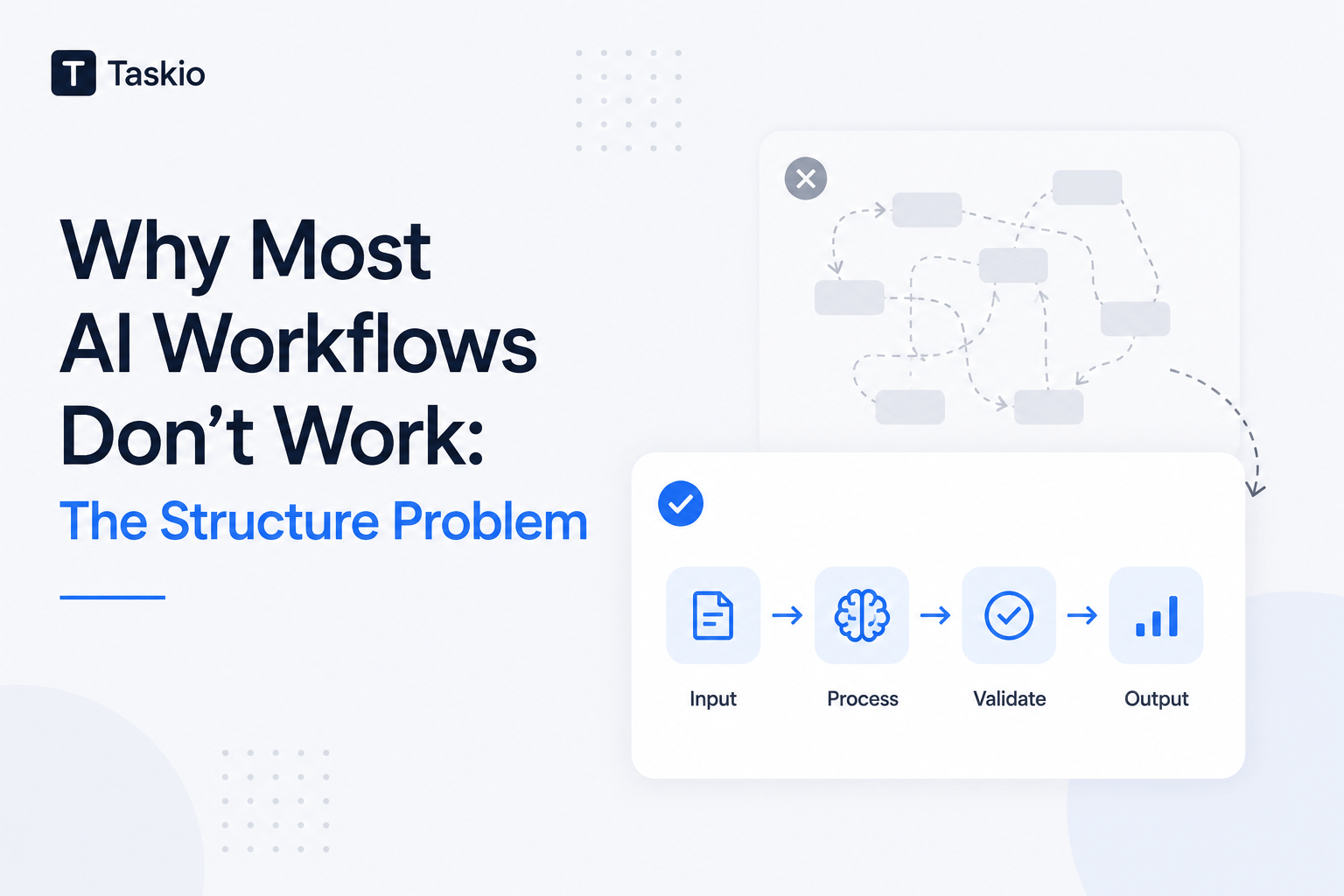
Why Most AI Workflows Don’t Work: The Structure Problem
Artificial intelligence has become one of the most talked-about productivity tools in business. From commercial real estate and finance to marketing and operations, professionals are investing significant time into platforms like Claude and ChatGPT. Yet despite the excitement, many users report the same frustration: AI outputs often feel generic, inconsistent, or unreliable. The problem usually isn’t the technology itself. In most cases, the real issue is the lack of Structure First AI Systems.
Organizations expect AI to produce expert-level results while providing little context, unclear workflows, and unorganized information. When the inputs are messy, the outputs become messy too.
The difference between a mediocre AI assistant and a highly effective AI coworker often comes down to structure, not software.
Understanding Why AI Workflows Fail
Many professionals assume AI models automatically understand their business.
They don’t. AI systems only know what users provide within a conversation, attached documents, or connected knowledge sources. Without context, AI fills gaps using general knowledge, which often produces broad and generic responses.
Consider a commercial real estate professional analyzing acquisitions. If they ask:
“Should I buy this property?”
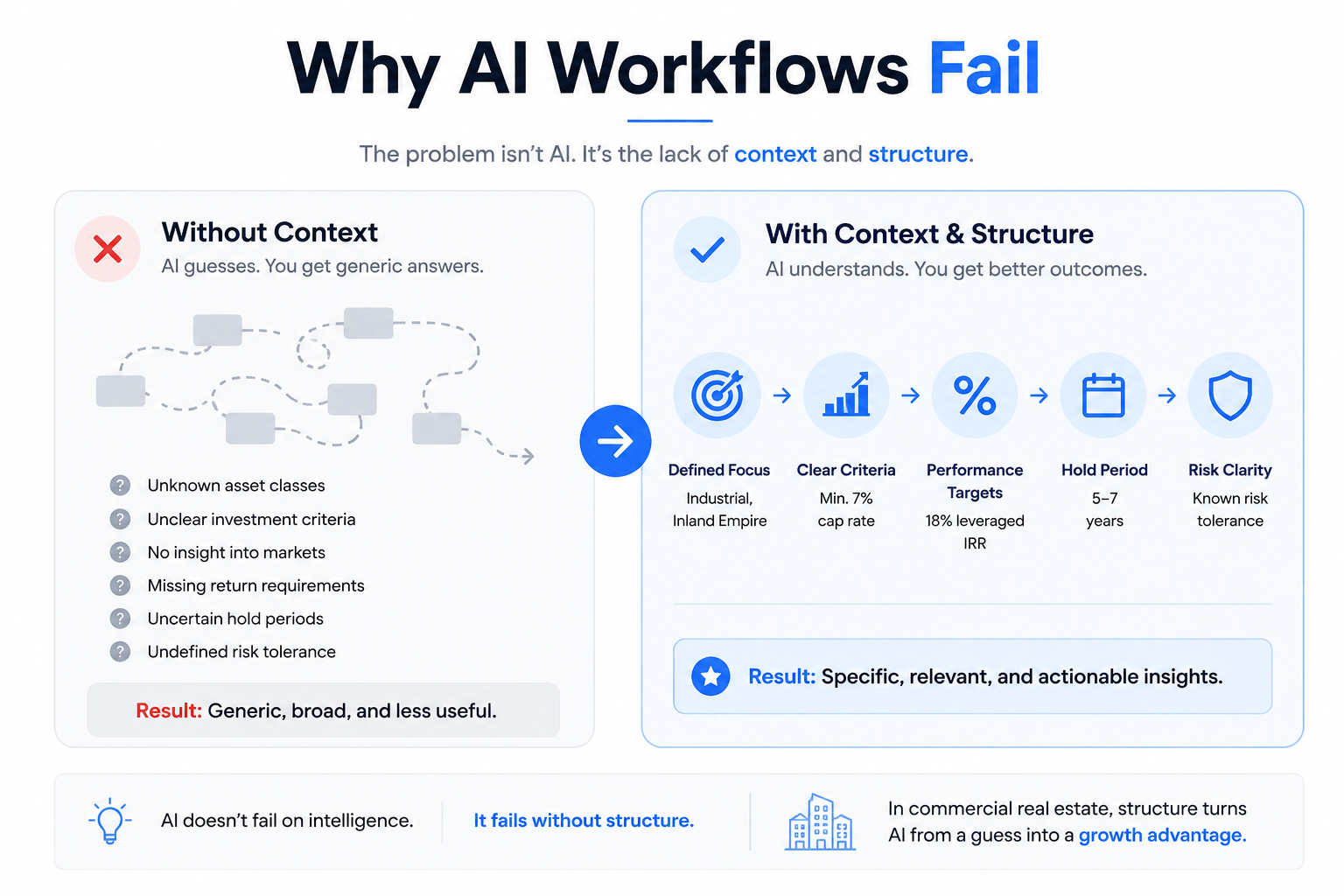
The AI has no idea:
-
What asset classes do they target
-
Their investment criteria
-
Preferred markets
-
Return requirements
-
Hold periods
-
Risk tolerance
As a result, the response becomes generic.
Now compare that with an AI system that understands:
-
Industrial properties only
-
Inland Empire focus
-
Minimum 7% cap rate
-
18% levered IRR target
-
Five-to-seven-year hold period
The recommendations become dramatically more useful. The difference isn’t intelligence. The difference is in structure. For readers looking at the bigger picture, our guide on AI in commercial real estate explores how firms are applying AI across acquisitions, asset management, research, and operations.
What Are Structure First AI Systems?
Structure First AI Systems are AI environments designed around organized information, clear workflows, and predefined operating rules. Instead of treating AI like a search engine, these systems treat AI like a trained team member.
Core Components
A structured AI environment typically includes:
-
Organized knowledge repositories
-
Defined workflow stages
-
Context documentation
-
Processing rules
-
Trigger mechanisms
-
Consistent data management
When combined, these elements create predictable and scalable AI performance.
Traditional AI vs Structured AI
| Traditional AI Usage | Structured AI Usage |
|---|---|
| Random prompts | Process-driven prompts |
| Generic responses | Context-aware outputs |
| Manual explanations every session | Persistent business context |
| Scattered files | Organized knowledge systems |
| Inconsistent quality | Reliable performance |
Organizations that implement structured systems spend less time correcting AI and more time benefiting from it.
The Hidden Cost of Random Data Dumps
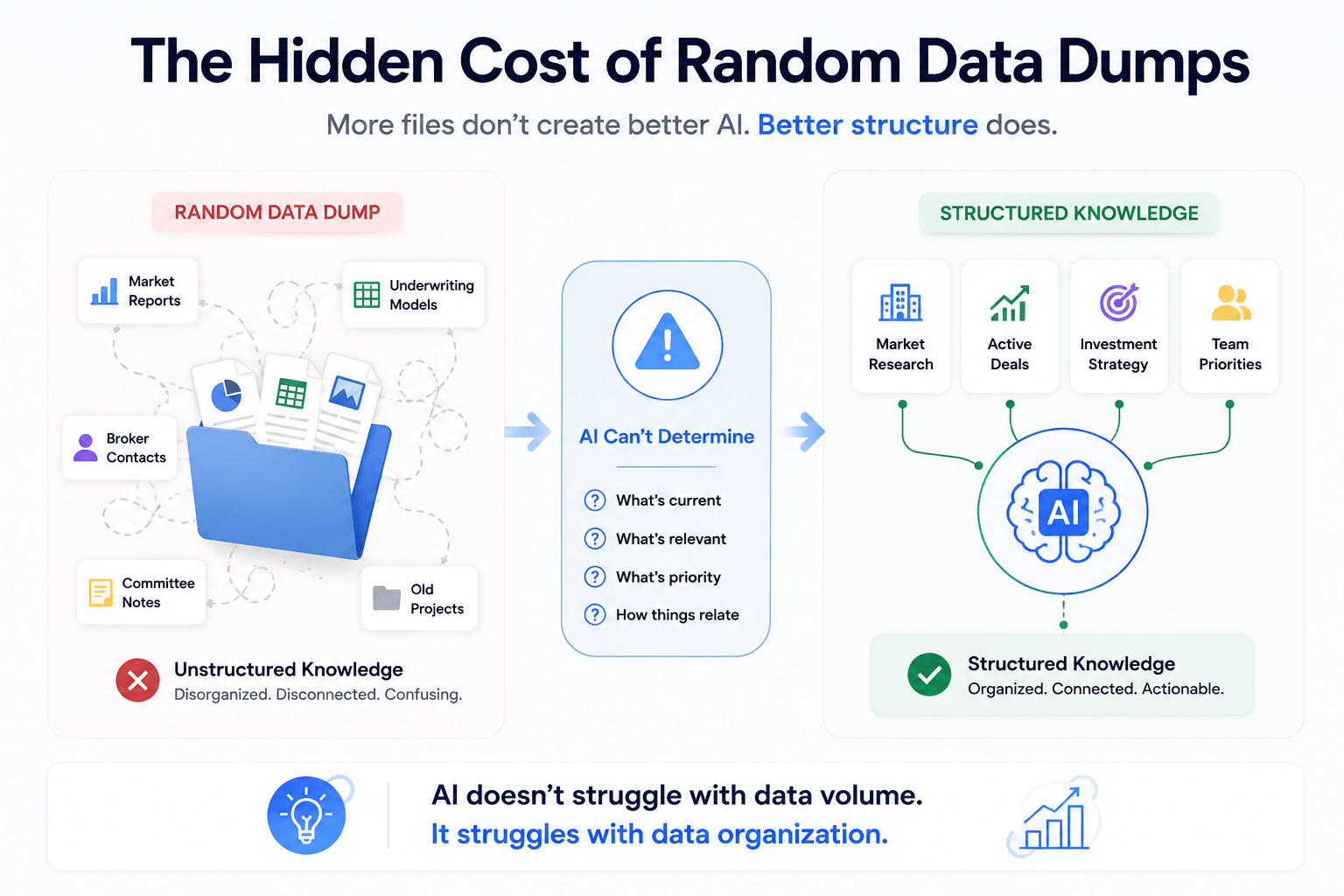
One of the most common mistakes organizations make is creating a massive folder filled with documents and expecting AI to understand everything. At first glance, this seems logical. More information should produce better outputs. In reality, the opposite often happens.
Why Unstructured Knowledge Creates Problems
AI struggles when information lacks organization.
For example:
-
Old reports sit beside current research.
-
Completed projects sit beside active projects.
-
Important files are mixed with irrelevant documents.
-
Different business functions share the same storage areas.
Without clear distinctions, AI cannot accurately determine:
-
Which information is current
-
Which information is relevant
-
Which information carries priority
-
How documents relate to one another
The result is confusion.
Real-World Example
Imagine a CRE acquisition firm storing:
-
Market reports
-
Offering memorandums
-
Underwriting models
-
Broker contacts
-
Investment committee notes
inside one large folder.
When AI accesses that environment, it sees thousands of disconnected data points.
It does not automatically understand:
-
Deal stage
-
Market focus
-
Investment strategy
-
Team priorities
This creates inconsistent recommendations and wasted time.
The Three Foundations of Effective AI Workflows
After reviewing successful implementations across multiple industries, three foundational elements consistently appear.
1. Meaningful Organizational Structure
Folders should represent business processes rather than simple storage locations. A strong AI workspace typically contains:
Inbox
The intake area for new information.
Examples:
-
New reports
-
Offering memorandums
-
Meeting notes
-
Research documents
Knowledge Base
The long-term repository of processed information.
Examples:
-
Completed analyses
-
Market intelligence
-
Historical deals
-
Reference materials
Active Projects
The current focus area.
Examples:
-
Live transactions
-
Ongoing campaigns
-
Current research initiatives
Each section serves a unique purpose. Without these distinctions, AI loses context.
Example Workspace Structure
| Folder | Purpose | AI Function |
|---|---|---|
| Inbox | New information | Intake processing |
| Knowledge Base | Long-term memory | Context retrieval |
| Active Projects | Current priorities | Operational support |
| Templates | Standardized assets | Workflow consistency |
This simple framework dramatically improves output quality.
2. A Dedicated Context File
A context file is arguably the most important component of any AI system. Many organizations overlook this step. They assume AI will infer business rules naturally. It won’t.
What a Context File Should Include
A context file defines:
-
Business objectives
-
Investment criteria
-
Workflow processes
-
Reporting standards
-
Decision-making frameworks
-
Team preferences
Think of it as an employee handbook for AI.
Example CRE Context
An industrial acquisitions team might include:
-
Target markets
-
Asset classes
-
Cap rate requirements
-
Financing assumptions
-
Hold periods
-
Preferred operators
-
Deal screening rules
Now AI has a framework for decision-making. Instead of summarizing information, it can evaluate information. That distinction is critical.
3. Reliable Trigger Mechanisms
Many AI systems fail because users cannot consistently activate the right workflow. The structure exists. The data exists. The instructions exist. Yet execution remains inconsistent.
Why Triggers Matter
Triggers tell AI which process to follow.
Examples include:
-
“Process inbox”
-
“Analyze acquisition”
-
“Create market brief.”
-
“Update knowledge base.”
Without triggers, users must repeatedly explain tasks. With triggers, workflows become repeatable. This creates operational efficiency and consistency.
Similarly, these Claude Cowork workflows show how structured knowledge bases and operating instructions can transform AI from a chatbot into a true operational assistant.
Why Context Beats Prompt Engineering
Prompt engineering has become a popular topic in AI discussions. While prompts matter, context matters far more. Many users spend hours trying to create the perfect prompt. Meanwhile, they provide almost no business information.
The Reality
A great prompt with poor context produces average results. A decent prompt with strong context often produces exceptional results. Consider these examples:
Weak Context
“Analyze this property.”
Output: General summary.
Strong Context
“Analyze this property against our industrial acquisition criteria, focusing on Inland Empire warehouse assets targeting a minimum 18% levered IRR.”
Output: Specific investment recommendations.
The difference is obvious. Context creates relevance. Prompts simply direct attention.
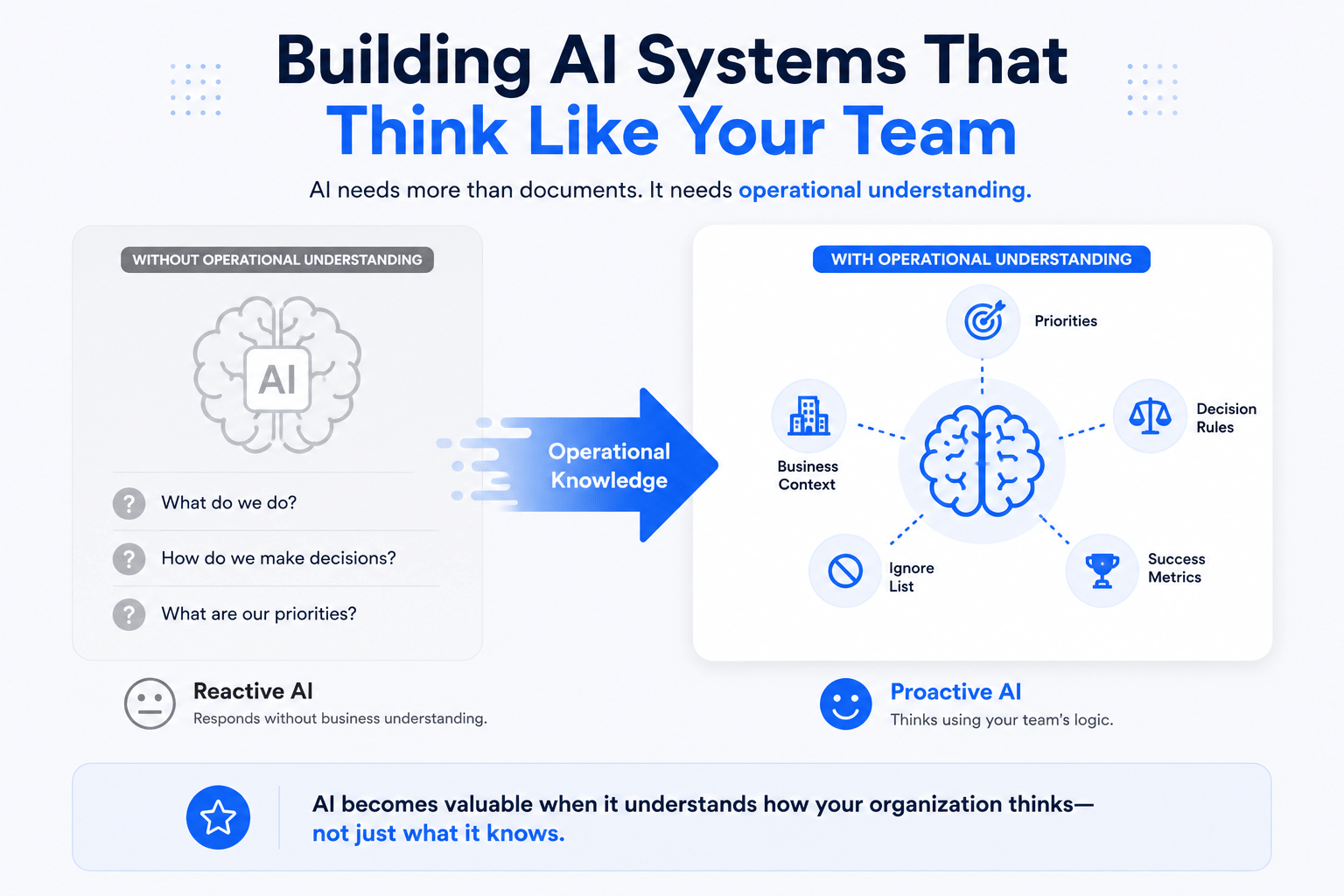
Building AI Systems That Think Like Your Team
The ultimate goal is not simply generating content faster. The goal is to create systems that operate similarly to your team members. To accomplish this, AI needs more than documents. It needs operational understanding.
Information AI Needs
Effective AI environments should answer:
-
What do we do?
-
How do we make decisions?
-
What are our priorities?
-
What qualifies as success?
-
What should be ignored?
Without these answers, AI remains reactive. With these answers, AI becomes proactive.
The Power of Question-Driven System Design
One of the most effective implementation strategies is surprisingly simple. Before building anything, have AI ask questions. Lots of questions. This approach dramatically improves system quality because it uncovers critical information that users often forget to mention.
Questions AI Should Ask
Business Questions:
-
What industry are you in?
-
What are your goals?
-
What workflows matter most?
Operational Questions:
-
How do you organize information?
-
What tools do you use?
-
What decisions happen regularly?
Performance Questions:
-
What outcomes are expected?
-
What metrics matter?
-
What constitutes success?
The answers become the foundation of the system.
Discovery Before Design
| Poor Approach | Better Approach |
|---|---|
| Build immediately | Discover requirements first |
| Generic templates | Customized workflows |
| Minimal context | Deep business understanding |
| Broad outputs | Specific recommendations |
Organizations that prioritize discovery build systems that actually fit their operations.
How Structured AI Improves Decision-Making
The biggest benefit of structured workflows isn’t efficiency. It’s decision quality. When AI understands your criteria, every recommendation becomes more aligned with your objectives.
Example: Investment Screening
A generic AI might summarize:
-
Property type
-
Location
-
Rent roll
-
Financial metrics
A structured AI might additionally provide:
-
Buy or pass recommendation
-
Alignment with acquisition criteria
-
Risk assessment
-
Comparable opportunities
-
Strategic observations
This moves AI from information provider to decision-support system.
Business Impact
Benefits include:
-
Faster evaluations
-
Reduced research time
-
Improved consistency
-
Better documentation
-
Higher-quality recommendations
Over time, these gains compound significantly.
Common Mistakes When Building AI Workflows
Even organizations committed to AI often repeat the same mistakes.
Mistake #1: Starting With Tools
People often ask:
“Should I use Claude or ChatGPT?”
This is the wrong first question.
The first question should be:
“What process am I trying to improve?”
Mistake #2: Ignoring Context
Without context, AI cannot specialize. Every response starts from zero.
Mistake #3: Poor Information Architecture
Disorganized information creates disorganized outputs.
Mistake #4: No Intake Process
New information enters the system without categorization or processing. Eventually, knowledge quality deteriorates.
Mistake #5: Lack of Maintenance
AI systems require periodic updates. Business strategies change. Markets evolve. Context files must evolve, too.
A Practical Framework for Creating Structure First AI Systems
Organizations looking to improve AI performance can follow a simple framework.
| Step | Objective | Outcome |
|---|---|---|
| Define Goals | Clarify priorities | Strategic alignment |
| Organize Information | Create structure | Better retrieval |
| Build Context File | Document rules | Consistent outputs |
| Create Triggers | Standardize actions | Reliable workflows |
| Review & Improve | Continuous refinement | Long-term effectiveness |
This framework works across industries, including commercial real estate, finance, consulting, marketing, and operations. The specific details may differ, but the principles remain the same.
Once a company defines its criteria and workflows, AI can begin making decisions within those parameters. This live example demonstrates how structured screening rules can dramatically speed up deal evaluation.
Build AI Systems That Actually Work
If you’re serious about creating reliable AI workflows, the next step isn’t testing another prompt library or switching platforms. The real opportunity is designing systems that give AI the context, structure, and operational framework needed to deliver consistent results. That’s exactly why the AI for CRE Collective has become a valuable resource for professionals looking to move beyond experimentation and build repeatable workflows.
Inside the community, 600+ CRE professionals are sharing implementation strategies, knowledge management frameworks, and real-world AI use cases. If you’re focused on improving acquisitions, research, underwriting, asset management, or operational efficiency, it’s worth exploring the available resources and subscribing to the newsletter to stay informed about emerging best practices.
Conclusion
Most AI workflows fail for a surprisingly simple reason. They lack structure. Organizations often focus on selecting the right model, crafting better prompts, or experimenting with new tools. While those elements matter, they rarely solve the underlying problem.
AI performs best when it operates inside a well-designed environment. Organized knowledge, clear context, defined workflows, and reliable triggers transform AI from a generic assistant into a specialized operational partner.
The future of effective AI adoption is not about finding smarter tools. It’s about building smarter systems. When organizations embrace Structure First AI Systems, they create a foundation that improves every conversation, every workflow, and every decision that follows.
FAQs Regarding Why Most AI Workflows Don’t Work: The Structure Problem
Why do most AI workflows fail even when using advanced tools like ChatGPT or Claude?
Most AI workflows fail because they lack structure rather than capability. AI models can process information effectively, but they depend heavily on the context, instructions, and data they receive. When users provide incomplete information or disorganized files, the AI produces generic outputs that require significant editing. A structured environment allows AI to understand priorities, workflows, and decision-making criteria, resulting in more useful responses.
What is the biggest mistake companies make when implementing AI?
The most common mistake is focusing on the tool before defining the process. Many organizations spend time comparing AI platforms but fail to establish how information should be organized, updated, and used. Without clear workflows and business rules, even the most powerful AI systems struggle to deliver consistent value.
Why is context more important than prompt engineering?
Prompt engineering helps guide AI toward a specific task, but context determines the quality of the answer. A well-written prompt cannot compensate for missing business information, unclear objectives, or incomplete data. When AI understands your goals, criteria, and workflows, even simple prompts can generate highly relevant results.
What are Structure First AI Systems?
Structure First AI Systems are AI environments built around organized knowledge, documented workflows, and clear operating instructions. Instead of relying on random prompts, these systems provide AI with a framework for understanding how a business operates. This allows the AI to deliver recommendations, analyses, and decisions that align with specific organizational goals.
Can AI replace knowledge management systems?
No. AI enhances knowledge management but does not replace it. Knowledge management systems organize information, while AI helps interpret and use that information. Without proper knowledge management, AI lacks the structure required to retrieve and apply information accurately.
How does a context file improve AI performance?
A context file acts as a reference guide that explains how the organization operates. It can include objectives, workflows, decision-making criteria, preferred formats, and operational rules. When AI has access to this information, it can generate responses that are far more accurate and aligned with business requirements.
Why do AI-generated answers often feel generic?
Generic outputs usually occur when AI lacks specific context. If a user asks a broad question without providing goals, constraints, or business requirements, the model relies on general knowledge. The more relevant information AI receives, the more tailored and actionable its responses become.
Should businesses store all their documents in one AI knowledge base?
Not without proper organization. A large collection of files can create confusion if documents are not categorized by purpose, project, stage, or relevance. Effective AI knowledge bases use structured folders, tagging systems, and clear documentation standards to help AI identify the most useful information.
What role do workflows play in AI success?
Workflows provide consistency. They define how information enters a system, how it is processed, and how it is stored. When workflows are standardized, AI can perform tasks more reliably because it understands where information belongs and what actions should occur next.
How can commercial real estate professionals use structured AI systems?
Commercial real estate professionals can use structured AI systems for market research, deal screening, underwriting support, investment memos, broker intelligence, and pipeline management. When acquisition criteria and investment objectives are documented, AI can evaluate opportunities against those standards rather than simply summarizing information.
Is more data always better for AI?
Not necessarily. Quality and organization are often more important than volume. Large amounts of unstructured information can overwhelm workflows and introduce conflicting signals. Well-organized, relevant, and current information typically produces better outcomes than massive collections of disconnected files.
How often should AI knowledge bases be updated?
AI knowledge bases should be reviewed regularly to ensure information remains accurate and relevant. Market conditions, business strategies, and operational priorities change over time. Updating documentation, workflows, and context files helps maintain the quality and reliability of AI outputs.
What is the best way to start building an AI workflow?
Start by documenting how work currently gets done. Identify key processes, decision points, information sources, and desired outcomes. Then organize supporting information into a structured system before introducing AI. This approach creates a foundation that enables long-term success.
Will AI workflows become more important in the future?
Yes. As AI becomes integrated into daily operations, organizations with structured systems will gain significant advantages. Businesses that build strong knowledge frameworks today will be able to automate more processes, make faster decisions, and scale AI capabilities more effectively than those relying on ad hoc usage.