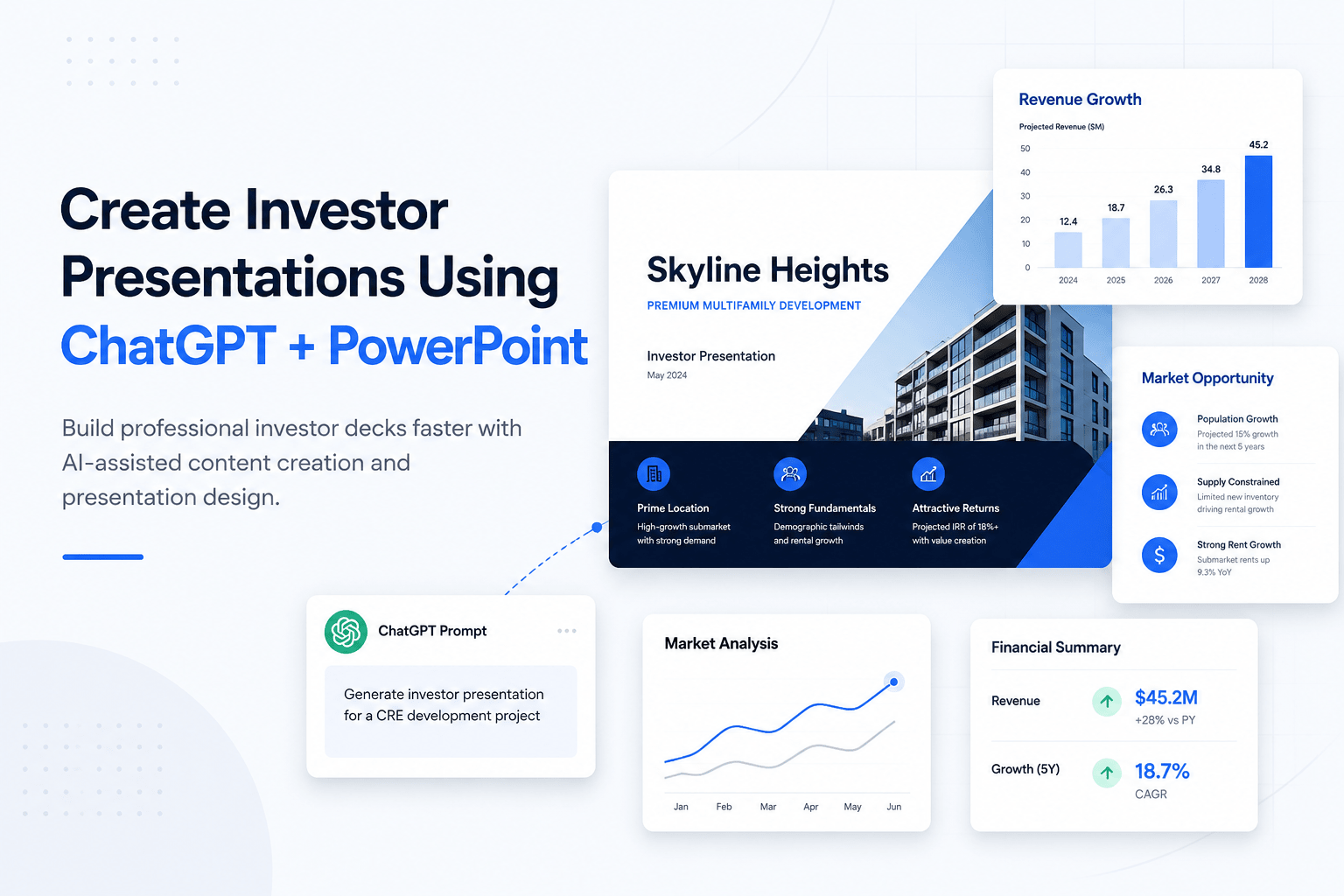
Create Investor Presentations Using ChatGPT + PowerPoint
Creating investor presentations is one of the most important tasks in commercial real estate. A strong presentation can help secure meetings, attract capital, and build confidence with investors. However, creating a presentation often takes longer than expected.
Many brokers, developers, and investors spend hours collecting data, writing slide content, organizing information, and designing visuals. The process becomes even harder when teams are managing multiple deals at the same time.
This is where AI investor presentations can make a major difference. Instead of starting with a blank PowerPoint file, professionals can use ChatGPT to create slide outlines, summarize property information, draft investment narratives, and organize research. PowerPoint can then be used to transform that content into a professional investor deck.
The goal is not to replace expertise. The goal is to remove repetitive work so teams can focus on strategy, analysis, and investor relationships. For commercial real estate professionals, this approach can reduce preparation time significantly while improving consistency across presentations.
Whether you are raising capital for a multifamily acquisition, presenting a development opportunity, marketing a property, or sharing a fund strategy, AI can help streamline the process.
In this guide, you will learn how to create AI investor presentations using ChatGPT and PowerPoint. We will focus on practical workflows that CRE professionals can implement immediately.
Recent research shows why more real estate professionals are adding AI to their workflows.
McKinsey estimates generative AI could create up to $4.4 trillion in annual productivity gains across industries.
PwC estimates AI could contribute $15.7 trillion to the global economy by 2030.
Deloitte reports growing AI adoption across commercial real estate firms for research, operations, and decision-making.
Real estate companies are increasingly investing in automation tools to improve efficiency and reduce administrative workloads.
Industry leaders continue to use AI for research, content creation, reporting, and presentation development.
What These Numbers Mean for CRE Professionals
The biggest benefit is not replacing people. Instead, AI helps teams complete routine work faster. For example, analysts can summarize market reports in minutes.
Brokers can draft presentation content more quickly. Developers can create investor updates without spending hours writing slides. As a result, teams can spend more time on activities that directly impact revenue and investor relationships.
TRADITIONAL PROCESS
Manual Deck Creation
Read reports manually
Write every slide from scratch
Multiple document versions
Several review cycles
Inconsistent presentation structure
16+ Hours
Average deck preparation time
AI-ASSISTED WORKFLOW
ChatGPT + PowerPoint
AI-generated research summaries
Instant executive summaries
Structured slide outlines
Faster revisions
Consistent investor messaging
4 Hours
Typical first-draft creation time
The time savings become even more valuable when firms manage multiple properties, acquisitions, or investor updates every month.
What Is an Investor Presentation?
An investor presentation is a structured document designed to explain an investment opportunity. It helps investors understand the opportunity, evaluate risk, and decide whether they want to move forward.
In commercial real estate, investor presentations are often called investment decks, pitch decks, offering presentations, or capital raising presentations. Regardless of the name, the purpose remains the same.
The presentation must answer a few important questions:
What is the opportunity?
Why does it matter?
What returns are expected?
What risks exist?
Why should investors trust the team?
Strong presentations answer these questions clearly and quickly.
Common Types of CRE Investor Presentations
Commercial real estate professionals create presentations for many different purposes.
Acquisition Presentations
These presentations focus on a specific property acquisition.
Typical sections include:
Property overview
Market analysis
Financial projections
Business plan
Risk factors
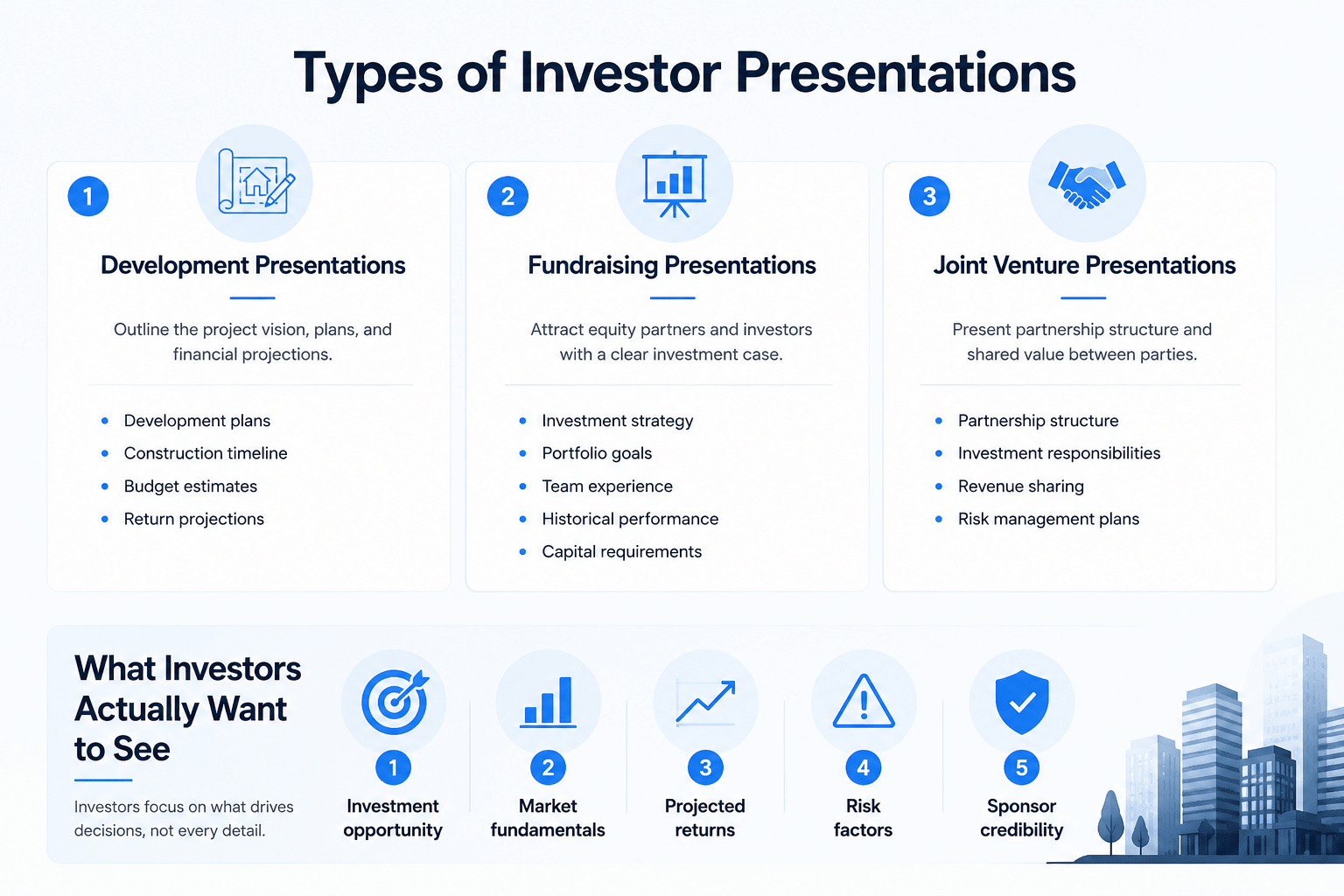
Development Presentations
Development presentations explain projects that have not been completed yet.
They often include:
Site information
Development plans
Construction timeline
Budget estimates
Return projections
Fundraising Presentations
Fundraising decks help firms attract equity partners and investors.
Common sections include:
Investment strategy
Portfolio goals
Team experience
Historical performance
Capital requirements
Joint Venture Presentations
Joint venture presentations focus on partnerships between sponsors and capital providers.
These presentations typically highlight:
Partnership structure
Investment responsibilities
Revenue sharing
Risk management plans
What Investors Actually Focus On
Most investors scan these factors first before deciding whether to continue reviewing a presentation.
Sponsor Credibility98%
Investment Thesis95%
Projected Returns91%
Market Fundamentals88%
Risk Analysis84%
AI Insight:
Most weak investor presentations focus heavily on property details while underemphasizing the investment thesis and sponsor credibility.
Many presentations fail because they focus too much on information and not enough on decision-making. Investors do not need every detail immediately. They need the most important information first.
Most investors focus on five key areas:
Investment opportunity
Market fundamentals
Projected returns
Risk factors
Sponsor credibility
A good presentation makes these points easy to understand.
A visual overview of the three primary investor presentation types—development, fundraising, and joint venture presentations—along with the five factors investors prioritize when evaluating opportunities.
The Role of ChatGPT in Investor Presentations
ChatGPT works best as a research and content assistant.
It can help create:
Executive summaries
Investment highlights
Market overviews
Risk summaries
Slide headlines
Investor FAQs
Presentation outlines
This is why many CRE professionals are beginning to use AI investor presentations as part of their workflow.
Instead of spending hours organizing information, they can create a structured first draft in minutes and spend more time improving the quality of the final presentation.
The most successful teams use AI to accelerate the process while keeping human expertise at the center of every decision.
Why Most Investor Presentations Fail
Creating a presentation is not difficult. Creating one that attracts investor interest is much harder. Many commercial real estate professionals spend days preparing a deck. Yet investors often lose interest within the first few slides.
The problem is usually not the property. It is the way the opportunity is presented. Understanding these common mistakes can help you create stronger AI investor presentations and improve investor engagement.
Too Much Information
One of the biggest mistakes is trying to include everything. Many presentations contain long paragraphs, detailed explanations, and excessive data.
While the information may be valuable, investors rarely want to read through dozens of text-heavy slides. Instead, they want clear and direct information.
A strong investor presentation should focus on:
The opportunity
Expected returns
Market fundamentals
Business strategy
Risks
Supporting information can always be provided later during due diligence. When using ChatGPT, ask it to simplify content and summarize key points. This often improves readability and makes slides easier to understand.
Weak Storytelling
Data alone does not persuade investors. Investors want to understand why an opportunity matters. Unfortunately, many presentations jump directly into financial projections without explaining the bigger picture. A good presentation tells a logical story.
For example:
What problem exists?
Why is this market attractive?
Why is this property positioned for success?
How will value be created?
What returns can investors expect?
When these questions are answered in the correct order, the presentation becomes much easier to follow.
ChatGPT can help organize information into a logical flow, but the final story should always reflect your expertise and market knowledge.
Generic Market Analysis
Another common issue is using generic market information. Many presentations include broad economic statistics that have little connection to the actual investment opportunity. For example, stating that a city has population growth is not enough.
Investors want to know:
How population growth affects the property
Why is demand increasing
What local trends support the investment thesis
How competitors compare
Specific information is usually more persuasive than general information. When creating AI investor presentations, provide ChatGPT with local market data and ask it to explain the impact on the investment opportunity.
Poor Visual Design
A presentation does not need to be beautiful. It does need to be clear.
Many investor decks contain:
Too many colors
Inconsistent fonts
Cluttered slides
Small charts
Poor image quality
These issues make information harder to process. Good design focuses on simplicity.
Best practices include:
One idea per slide
Consistent formatting
Clear headings
Readable charts
High-quality visuals
PowerPoint templates can help maintain consistency across every presentation.
No Clear Investment Thesis
The investment thesis is often the most important part of the presentation. Yet many decks never explain it clearly. An investment thesis is simply the reason the opportunity exists. Investors should understand the thesis within a few minutes.
Examples include:
Below-market rents create value-add potential
Supply constraints support future rent growth
Strong population growth increases housing demand
Property improvements can increase NOI
If investors cannot quickly identify the thesis, they may lose interest. A simple explanation is usually more effective than a complex one.
Lack of Supporting Data
Claims without evidence can reduce credibility.
For example:
The market is growing
Demand is increasing
Returns will improve
These statements need supporting data.
Strong presentations include:
Market reports
Demographic trends
Comparable properties
Historical performance
Third-party research
The goal is to support conclusions with evidence. This is especially important when raising capital from experienced investors.
Ignoring Investor Concerns
Many presentations focus only on the upside. However, investors also evaluate risk. If risks are not addressed, investors may assume the sponsor has overlooked them.
Common risk categories include:
Market risk
Construction risk
Interest rate risk
Leasing risk
Operational risk
Strong presentations acknowledge these risks and explain mitigation strategies. This approach often increases credibility.
Overcomplicating Financial Information
Financial information is important, but complexity does not always create confidence. Some presentations include large spreadsheets and difficult-to-read charts. Investors generally prefer simple summaries.
Key metrics often include:
IRR
Equity Multiple
Cash-on-Cash Return
NOI Growth
Exit Assumptions
Detailed financial models can be shared separately when requested. The presentation should focus on communicating the investment story.
How ChatGPT Changes Investor Presentation Creation
The traditional presentation process involves research, writing, editing, and formatting. This can require many hours of work. ChatGPT helps reduce the time spent on repetitive tasks while improving consistency.
The biggest benefit is speed. Instead of starting from scratch, professionals can begin with a structured first draft. For CRE professionals, this means less time building slides and more time evaluating deals, refining assumptions, and speaking with investors.
For a deeper breakdown of presentation workflows, slide structures, and real CRE examples, see our guide on AI-generated CRE investor decks.
Tasks ChatGPT Does Well
ChatGPT performs best when helping with content creation and organization.
Useful applications include:
Creating presentation outlines
Drafting executive summaries
Writing slide content
Summarizing market reports
Generating investment highlights
Organizing research findings
Creating investor FAQs
These tasks typically consume a large portion of presentation development time.
Tasks ChatGPT Should Not Do Alone
AI should support decision-making, not replace it. Certain tasks still require human review.
These include:
Financial modeling
Investment recommendations
Property valuations
Legal disclosures
Market verification
Rent projections
Capital expenditure estimates
Every statistic and assumption should be reviewed before sharing with investors.
Benefits for CRE Teams
Commercial real estate teams often manage multiple projects at the same time. A brokerage team may be marketing several listings. A developer may be raising capital for multiple projects. An investment firm may be reviewing acquisition opportunities every week.
AI can help create consistent presentations across:
Acquisition opportunities
Investor updates
Development projects
Portfolio reviews
Capital raising efforts
This consistency improves efficiency and creates a more professional experience for investors.
Popular AI Presentation Tools Comparison
AI Presentation Tool Arena
Not every AI presentation tool is built for commercial real estate workflows. Here's where each platform fits best.
ChatGPT
BEST OVERALL
Excellent for executive summaries, investor narratives, FAQs, and presentation content generation.
The exact savings depend on the project and the quality of the information provided. However, many CRE professionals report meaningful reductions in preparation time.
Tasks that often benefit most include:
Organizing research
Writing slide content
Creating summaries
Structuring presentations
Revising drafts
Instead of spending several days creating a presentation, teams can often produce a strong first draft within a few hours. That does not mean the work is finished.
Human review remains essential. The best AI investor presentations combine automation with professional judgment, market expertise, and accurate financial analysis.
When used correctly, ChatGPT becomes a productivity tool rather than a replacement for expertise.
The result is a faster process, more consistent presentations, and more time spent on activities that directly support investor relationships and deal execution.
Step-by-Step Workflow to Create Investor Presentations Using ChatGPT + PowerPoint
AI Investor Presentation Workflow
The fastest CRE teams follow a repeatable process instead of building every presentation from scratch.
1
Gather Data
Collect offering memorandums, market reports, underwriting files, and property information.
2
Create Brief
Summarize the opportunity, investment thesis, expected returns, and target audience.
3
Generate Deck
Use ChatGPT to create slide structures, summaries, investment highlights, and supporting content.
4
Build Slides
Move content into PowerPoint and create professional layouts, charts, and visuals.
5
Review & Deliver
Verify assumptions, check data accuracy, and prepare the final investor-ready presentation.
Many professionals understand that AI can help create presentations. The challenge is knowing exactly where to start.
The good news is that you do not need a complicated system. A simple workflow can dramatically reduce the time required to create high-quality AI investor presentations.
The process below works for acquisition opportunities, development projects, investment funds, portfolio updates, and capital raising presentations.
Step 1: Gather Your Source Materials
Before opening ChatGPT, collect all available information. The quality of your presentation depends on the quality of your inputs.
Useful materials include:
Offering memorandum
Underwriting model
Property photos
Rent roll
Market reports
Broker opinions
Business plan
Construction budget
Historical operating statements
Many people make the mistake of asking ChatGPT to create a presentation without providing sufficient information. The result is usually generic content. The more specific the inputs, the better the output.
Step 2: Create a Clear Project Brief
Next, summarize the opportunity in a simple format.
Provide ChatGPT with information such as:
Property name
Property type
Location
Purchase price
Investment strategy
Target investors
Expected returns
Key risks
Exit strategy
A good brief gives ChatGPT context and improves accuracy.
For example:
Property Type: Multifamily
Location: Dallas, Texas
Strategy: Value-add acquisition
Target Hold Period: 5 years
Target IRR: 18%
Investment Thesis: Renovate units and increase rents to market rates
This information creates a stronger foundation for presentation development.
Step 3: Generate the Presentation Structure
Once the brief is ready, ask ChatGPT to create a complete investor deck outline.
A common structure includes:
Cover Slide
Executive Summary
Investment Highlights
Property Overview
Market Analysis
Financial Overview
Business Plan
Risk Analysis
Team Overview
Investment Opportunity
Next Steps
This stage often saves significant time because the overall framework is already organized. Instead of wondering what slides to create, you can focus on improving the content.
Step 4: Generate Individual Slide Content
After the structure is complete, work slide by slide. This approach produces better results than generating the entire presentation at once.
For example, ask ChatGPT:
Create an executive summary slide.
Write five investment highlights.
Summarize this market report.
Create a risk analysis section.
Draft a property overview slide.
Breaking the process into smaller tasks improves quality and accuracy.
Step 5: Create Supporting Visual Recommendations
Investors process visuals faster than text. This is why strong presentations use charts, maps, timelines, and images.
ChatGPT can suggest visual elements such as:
Location maps
Rent growth charts
Population trends
Development timelines
Capital stack diagrams
Return projections
The goal is to make information easier to understand. Avoid adding visuals simply to fill space. Every graphic should support the investment story.
Step 6: Build the Presentation in PowerPoint
Once content is finalized, move into PowerPoint. Keep the design simple and consistent.
Follow these guidelines:
Use one font family
Maintain consistent colors
Limit text per slide
Use large headings
Create a visual hierarchy
Keep spacing consistent
Remember that investors often review presentations quickly. A clean design improves readability.
Step 7: Review Everything Carefully
AI-generated content should never be published without review.
Check:
Market statistics
Financial assumptions
Property details
Return projections
Dates
Names
Sources
Even small mistakes can reduce investor confidence. The final review is one of the most important parts of the process.
Checklist Before Sending an Investor Presentation
Before sharing a presentation, confirm the following:
Financial figures are accurate
Property information is verified
Charts match the underlying data
Market statistics include sources
Formatting is consistent
Grammar is correct
The investment thesis is clear
Risks are addressed
Contact information is included
Copy-Paste ChatGPT Prompt for Full Presentation Creation
Many CRE professionals struggle because they start with weak prompts. A detailed prompt typically produces better results.
Prompt Template:
“Act as a commercial real estate investment analyst. Create a professional investor presentation outline based on the following information. Include an executive summary, investment highlights, property overview, market analysis, business plan, financial overview, risk analysis, team section, and investment opportunity section. Use concise language suitable for institutional and private investors.”
Then add:
Property details
Market information
Financial assumptions
Business strategy
Target audience
This gives ChatGPT the context needed to create stronger content.
The Ideal Investor Presentation Structure for CRE
A successful presentation follows a logical sequence. Investors should not have to search for important information. Instead, each slide should answer a specific question.
Investor Deck Blueprint
Every successful investor presentation follows a predictable structure. Click each section to see why investors care about it.
1
Executive Summary
Investor Question: What is this opportunity and why should I care?
This slide provides a high-level overview of the deal, expected returns, investment strategy, and key highlights.
2
Investment Thesis
Investor Question: Why does this opportunity exist?
This section explains the core reason the investment can generate attractive returns.
3
Market Analysis
Investor Question: Is the market supporting this strategy?
Investors evaluate population growth, employment trends, supply constraints, and demand drivers.
4
Financial Overview
Investor Question: What returns should I expect?
Include IRR, equity multiple, cash-on-cash returns, and major assumptions.
5
Risk Analysis
Investor Question: What could go wrong?
Address market risk, financing risk, operational challenges, and mitigation strategies.
6
Sponsor & Team
Investor Question: Can this team execute the plan?
Show experience, track record, and relevant project history.
7
Investment Opportunity
Investor Question: What action should I take next?
Clearly present investment terms, capital requirements, and next steps.
AI Insight:
Most weak investor presentations start with property details. Strong presentations start with the investment opportunity and build supporting evidence afterward.
Executive Summary Slide
This is often the most important slide in the presentation. Many investors decide whether to continue reading based on this section alone.
Include:
Property overview
Investment strategy
Expected returns
Capital requirements
Key opportunity
Keep the summary concise.
Investment Highlights Slide
This slide explains why the opportunity deserves attention.
Common highlights include:
Attractive purchase basis
Strong demographic trends
Value-add potential
Limited new supply
Experienced sponsorship team
Focus on the strongest advantages.
Property Overview Slide
Provide a quick overview of the asset.
Include:
Property type
Location
Unit count
Building size
Occupancy
Year built
Investors should immediately understand the asset.
Market Analysis Slide
The market section supports the investment thesis.
Focus on factors such as:
Population growth
Employment growth
Income trends
Housing demand
Supply constraints
Avoid filling slides with unnecessary statistics. Only include data that supports the opportunity.
Financial Overview Slide
Present the most important financial metrics.
Key Financial Metrics Investors Commonly Review
Metric
Purpose
IRR
Measures projected annual return
Equity Multiple
Measures total return on invested capital
Cash-on-Cash Return
Measures annual cash flow performance
NOI Growth
Shows income growth potential
Exit Cap Rate
Supports valuation assumptions
Hold Period
Shows expected investment duration
Table Caption: Common performance metrics found in CRE investor presentations.
Business Plan Slide
Explain how value will be created.
Examples include:
Unit renovations
Operational improvements
Lease-up strategy
Property repositioning
Development execution
This section should connect directly to projected returns.
Risk Analysis Slide
Investors expect risk discussions.
Address topics such as:
Economic conditions
Interest rates
Construction costs
Leasing challenges
Market competition
Transparency often increases credibility.
Team Overview Slide
Investors evaluate people as much as properties.
Include:
Leadership team
Relevant experience
Past projects
Industry expertise
Track record
Keep biographies short and focused on accomplishments.
Investment Opportunity Slide
End with a clear summary.
Include:
Capital required
Investment structure
Expected returns
Timeline
Next steps
Investors should know exactly what action to take after reviewing the presentation.
A well-structured presentation makes decision-making easier. It also improves the effectiveness of AI investor presentations because ChatGPT performs best when content follows a clear and organized framework.
Copy-Paste ChatGPT Prompts for Investor Presentations
The quality of your output depends heavily on the quality of your prompt. Many CRE professionals assume ChatGPT will automatically understand their goals. In reality, generic prompts often produce generic results.
The best approach is to provide context, define the audience, and clearly explain the objective. For AI investor presentations, detailed prompts usually create stronger content, better structure, and more useful insights.
Below are practical prompts that can be adapted for acquisitions, developments, capital raises, portfolio reviews, and investor updates.
Executive Summary Prompt
Use this prompt when you need a concise overview of the opportunity.
Prompt:
“Act as a commercial real estate investment analyst. Create a one-slide executive summary for an investor presentation. Use a professional tone. Summarize the opportunity, investment strategy, target returns, key risks, and investment highlights. Keep the content concise and suitable for institutional and private investors.”
Investment Thesis Prompt
Investors want to understand why the opportunity exists.
Prompt:
“Based on the information below, create a compelling investment thesis for a commercial real estate investor presentation. Focus on market opportunity, value creation strategy, competitive advantages, and expected outcomes.”
Property Overview Prompt
This prompt helps create asset descriptions.
Prompt:
“Create a property overview slide for an investor presentation. Include property type, location, size, occupancy, condition, tenant profile, and notable features. Keep the content concise and investor-focused.”
Market Analysis Prompt
Market research often consumes significant time.
Prompt:
“Analyze the following market data and create a market overview slide. Focus on population growth, employment trends, demand drivers, supply conditions, and factors supporting the investment opportunity.”
Financial Summary Prompt
Financial slides should be simple and easy to understand.
Prompt:
“Create a financial summary section for an investor presentation. Explain projected returns, cash flow expectations, hold period, equity multiple, IRR, and key assumptions using clear investor-friendly language.”
Risk Analysis Prompt
Professional investors expect transparency.
Prompt:
“Create a risk analysis slide for a commercial real estate investment opportunity. Identify major risks and provide mitigation strategies for each risk.”
Business Plan Prompt
The business plan explains how value will be created.
Prompt:
“Create a business plan slide explaining how the investment team plans to increase property value over the holding period. Focus on operational improvements, renovations, leasing strategies, and market positioning.”
Investor FAQ Prompt
Many investor questions repeat across deals.
Prompt:
“Generate the ten most likely investor questions for this opportunity and provide concise answers suitable for an investor presentation appendix.”
Presentation Rewrite Prompt
This prompt is useful when improving existing decks.
Prompt:
“Rewrite the following presentation content using professional commercial real estate language. Improve clarity, remove repetition, and make the content easier for investors to understand.”
Institutional Investor Prompt
Institutional investors typically prefer a more analytical style.
Prompt:
“Rewrite this presentation for an institutional investor audience. Use concise language, focus on investment fundamentals, and emphasize risk-adjusted returns.”
Common Prompt Mistakes
Many users get poor results because they:
Provide limited information
Use vague instructions
Skip market data
Forget the target audience
Request an entire presentation at once
Instead, work slide by slide whenever possible.
Smaller requests often generate better outputs.
PowerPoint Features That Actually Improve Investor Presentations
A strong investor presentation is not just about content. Presentation design also affects how information is received. Many users focus on advanced design features while ignoring the basics.
The goal is not to impress investors with animations. The goal is to communicate information clearly. Several PowerPoint features can help achieve this.
Want to see a complete investor deck built with AI? This walkthrough shows how CRE professionals can create institutional-quality presentations in a fraction of the usual time.
Slide Master
Slide Master is one of the most useful PowerPoint features. It allows teams to create consistent formatting across every slide.
Benefits include:
Consistent branding
Uniform fonts
Standardized layouts
Faster editing
For firms that create multiple presentations each month, Slide Master can save substantial time.
SmartArt
SmartArt helps visualize processes and relationships.
Useful examples include:
Acquisition process diagrams
Capital stack structures
Investment timelines
Organizational charts
Complex concepts often become easier to understand when presented visually.
Charts and Graphs
Investors review data quickly. Well-designed charts can communicate information faster than paragraphs.
Common examples include:
Rent growth trends
Population growth
Revenue projections
Expense breakdowns
Return forecasts
Keep charts simple and focused.
Too much data often creates confusion.
PowerPoint Designer
PowerPoint Designer can automatically suggest layouts.
This feature works well when:
Creating presentations quickly
Testing multiple layouts
Improving visual balance
However, final decisions should still be reviewed manually.
Presenter View
Presenter View helps during live meetings.
It allows presenters to:
View speaker notes
Track time
Preview upcoming slides
This can improve delivery during investor presentations and fundraising meetings.
Images and Visuals
High-quality visuals can strengthen credibility.
Useful visual assets include:
Property photos
Site plans
Market maps
Demographic maps
Construction renderings
Avoid low-resolution images whenever possible.
Design Principles That Matter Most
Investors care more about clarity than creativity.
The best presentations typically follow simple rules:
One message per slide
Large headings
Minimal text
Consistent formatting
Clear charts
Professional visuals
Following these principles usually creates better results than adding complex design elements.
Tools That Actually Work vs Hype
The AI market is crowded. New presentation tools appear almost every week. Many claim to automate presentations completely.
In practice, some tools are genuinely useful while others produce inconsistent results. For CRE professionals, reliability is often more important than novelty.
If you want a broader comparison beyond ChatGPT and PowerPoint, review our breakdown of the best AI tools for pitch decks used by CRE professionals.
Popular AI Presentation Tools Comparison
Tool
Best For
Strengths
Limitations
ChatGPT
Content creation
Strong writing and organization
Requires fact-checking
Microsoft Copilot
PowerPoint users
Native PowerPoint integration
Requires the Microsoft ecosystem
Gamma
Fast presentation creation
Modern layouts
Limited CRE customization
Canva AI
Visual presentations
Easy design tools
Less analytical focus
Claude
Long-form content
Strong reasoning and summaries
Limited presentation features
Beautiful.ai
Slide design automation
Consistent formatting
Less flexibility
Table Caption: Comparison of common AI tools used for creating investor presentations.
ChatGPT
ChatGPT remains one of the strongest tools for creating AI investor presentations.
It performs particularly well for:
Slide content
Executive summaries
Market analysis
Investment narratives
Investor FAQs
Its flexibility makes it useful across many CRE workflows.
Microsoft Copilot
For organizations already using Microsoft products, Copilot can simplify presentation creation.
Advantages include:
PowerPoint integration
Document summarization
Content generation
Workflow efficiency
However, output quality still depends on the information provided.
Gamma
Gamma is designed specifically for presentation generation.
It can produce visually attractive presentations quickly.
It works best for:
Internal presentations
Concept presentations
Early-stage drafts
Many CRE professionals still prefer PowerPoint for investor-facing materials.
Canva AI
Canva focuses on simplicity and visual design.
Benefits include:
Easy editing
Strong visual templates
Fast collaboration
However, it is often less suitable for detailed financial presentations.
Claude
Claude performs well for:
Long reports
Market research summaries
Content analysis
Some users prefer it when working with lengthy documents.
Which Tool Is Best for CRE Professionals?
There is no single answer. The most effective approach often combines multiple tools.
A common workflow looks like this:
Use ChatGPT for content creation.
Use market research platforms for data.
Build slides in PowerPoint.
Review everything manually.
This approach balances speed, flexibility, and accuracy.
Recommended Tool Stack
For most commercial real estate professionals:
ChatGPT for writing
PowerPoint for presentations
Excel for financial analysis
CoStar or market research tools for data
Internal review for quality control
The objective is not to automate everything. The objective is to reduce repetitive work while maintaining professional standards.
When used correctly, these tools can help teams create stronger investor presentations in less time while keeping decision-making firmly in human hands.
Before vs After Productivity Comparison
Many commercial real estate professionals are interested in AI because of one question:
How much time can it actually save?
The answer depends on the quality of your process. AI will not fix a weak workflow. However, it can significantly reduce the time spent on repetitive tasks.
The biggest gains usually come from content creation, research organization, presentation planning, and editing. Traditionally, investor presentations require gathering information from multiple sources, organizing notes, writing content, designing slides, and reviewing everything for accuracy.
With AI, much of the first-draft work can be completed faster. The result is not necessarily fewer work hours overall. Instead, more time is spent on analysis, strategy, and investor communication rather than administrative work.
Manual vs AI-Assisted Investor Presentation Process
Activity
Traditional Process
AI-Assisted Process
Presentation Outline
Built manually from scratch
Generated within minutes
Executive Summary
Written manually
AI-generated first draft
Market Research Summary
Manual analysis and writing
AI-assisted summarization
Investment Highlights
Created manually
Generated from project inputs
Slide Content
Written slide by slide
Drafted and refined faster
Presentation Review
Full content review required
Review and verification required
Total Preparation Time
Often several days
Often reduced significantly
Table Caption: Comparison of traditional presentation creation versus AI-assisted presentation workflows.
Where Time Savings Matter Most
Not every task benefits equally from AI.
The largest improvements usually occur in:
Initial research summaries
Slide drafting
Presentation structure
Executive summaries
Investor communication drafts
These are tasks that follow predictable patterns. AI performs well because it can organize information quickly.
Where Human Expertise Still Matters
Commercial real estate remains a relationship-driven business.
Investors evaluate:
Experience
Judgment
Market knowledge
Execution ability
AI cannot replace these factors.
Human review remains critical for:
Investment decisions
Financial assumptions
Deal structuring
Risk evaluation
Investor relationships
The best presentations combine automation with professional expertise.
A Practical Example
Consider a multifamily acquisition presentation.
Without AI, the process may involve:
Reading market reports
Writing summaries
Creating slide outlines
Drafting content
Editing multiple versions
With AI, the workflow changes.
Market reports can be summarized quickly. Presentation structures can be generated automatically. First drafts can be created within minutes.
The professional then focuses on improving accuracy, refining the story, and validating assumptions. This often creates a better final product while reducing repetitive work.
Real-World CRE Use Cases
The value of AI becomes clearer when applied to actual commercial real estate situations. Different professionals use AI in different ways. The examples below show how AI investor presentations can support common CRE activities.
Multifamily Acquisition Presentations
Multifamily acquisitions often require investor approval before closing.
The presentation must explain:
Property details
Market opportunity
Renovation strategy
Return projections
Risk factors
ChatGPT can assist by:
Drafting executive summaries
Creating investment highlights
Summarizing market reports
Generating investor FAQs
This allows acquisition teams to spend more time evaluating the deal itself.
Development Project Presentations
Development projects often require substantial capital.
Investors want clear answers regarding:
Project timeline
Construction costs
Market demand
Exit strategy
Expected returns
AI can help organize large amounts of project information into a presentation format that is easier for investors to understand. This is particularly useful when multiple consultants and reports are involved.
Fundraising Presentations
Investment funds regularly create presentations for potential investors.
These presentations often include:
Investment strategy
Historical performance
Target markets
Team experience
Fund objectives
AI can help maintain consistency across multiple fundraising documents. It can also simplify updates when information changes.
Broker Listing Presentations
Brokers frequently create marketing presentations for property owners.
The goal is to demonstrate:
Market expertise
Property positioning
Marketing strategy
Expected outcomes
AI can assist with:
Market summaries
Property descriptions
Marketing plans
Listing presentation drafts
This can help brokers respond faster to opportunities.
Joint Venture Presentations
Joint venture opportunities require clear communication between sponsors and capital partners.
Investors want to understand:
Responsibilities
Capital structure
Revenue sharing
Risk allocation
Exit plans
AI can help organize these complex relationships into a format that is easier to review.
Investor Update Presentations
Existing investors also require communication.
Many firms provide:
Quarterly updates
Annual reviews
Project updates
Market updates
AI can accelerate these recurring reporting processes by creating first drafts from operational data. This reduces the time spent preparing routine updates.
What Most CRE Professionals Get Wrong About AI
AI adoption continues to grow across commercial real estate. However, many professionals still misunderstand how these tools should be used. The result is often disappointment or poor-quality output. Understanding common mistakes can help avoid these issues.
Assuming AI Replaces Expertise
This is the most common misconception. AI is not an investment professional. It does not have real-world transaction experience.
It cannot replace:
Deal experience
Market knowledge
Investor relationships
Professional judgment
AI should support experts, not replace them.
Using Generic Prompts
Poor prompts create poor outputs. Many users type short requests such as:
“Create an investor presentation.”
This usually generates generic content.
Instead, provide:
Property information
Market data
Target audience
Investment strategy
Financial assumptions
Detailed prompts almost always produce better results.
Trusting Every Output
AI can make mistakes.
It can:
Misinterpret information
Create inaccurate statements
Present outdated assumptions
Generate unsupported conclusions
Everything should be verified before being shared with investors.
Ignoring Presentation Structure
Some users focus entirely on content. However, structure matters. Investors prefer presentations that follow a logical sequence. A strong structure helps investors understand the opportunity more quickly.
Overloading Slides With Text
AI can generate large amounts of content. That does not mean all of it belongs in the presentation. Slides should remain concise. Investors should be able to understand the main message quickly.
Forgetting the Audience
Different investors evaluate opportunities differently. A private investor may focus on income and stability. An institutional investor may focus on risk-adjusted returns and market fundamentals. The presentation should reflect the audience.
Treating AI as a Shortcut
The strongest results come from collaboration. Professionals who review, refine, and improve AI-generated content usually produce better presentations than those who simply copy and paste outputs.
The goal is not automation for its own sake. The goal is to create better presentations more efficiently.
The Most Effective Mindset
Successful CRE professionals tend to view AI as a productivity tool.
They use it to:
Organize information
Draft content
Improve efficiency
Reduce repetitive work
At the same time, they continue to rely on their expertise for investment decisions. This balanced approach often produces the strongest AI investor presentations and creates a better experience for both sponsors and investors.
How to Implement This Workflow in 24 Hours
One of the biggest advantages of AI investor presentations is speed. Instead of spending several days creating a presentation, you can build a strong first draft in a single day if your information is organized.
The key is following a structured process rather than jumping directly into PowerPoint.
First Hour: Gather Information
Start by collecting all relevant materials.
This may include:
Offering memorandum
Financial model
Market reports
Property photos
Business plan
Investor requirements
Create a folder containing everything related to the opportunity. This will make it easier to provide accurate information to ChatGPT.
Hours 2–4: Build the Presentation Structure
Use ChatGPT to create:
Executive summary
Investment highlights
Property overview
Market analysis
Business plan
Risk section
Team overview
Focus on structure first. Do not spend time editing every sentence during this stage. The goal is to create a complete first draft quickly.
Hours 5–7: Refine the Content
Review every slide carefully.
Check:
Property information
Market statistics
Return assumptions
Investment highlights
Risk discussions
Remove unnecessary content and simplify complex explanations. Remember that investors prefer clarity over volume.
Hours 8–10: Build the PowerPoint Deck
Move the finalized content into PowerPoint.
Focus on:
Consistent branding
Clear slide layouts
Readable charts
High-quality images
Professional formatting
Keep text concise. Most slides should communicate one primary idea.
Final Review and Quality Control
Before sending the presentation, perform a final review.
Verify:
Financial projections
Market data
Property details
Team information
Contact information
Ask a colleague or team member to review the presentation if possible. A second review often catches issues that were missed during development.
A Simple 24-Hour Workflow
Stage
Objective
Hour 1
Gather project materials
Hours 2–4
Generate presentation structure and content
Hours 5–7
Edit and refine content
Hours 8–10
Design slides in PowerPoint
Final Review
Verify accuracy and presentation quality
Table Caption: Example workflow for creating an investor presentation using ChatGPT and PowerPoint within one working day.
When implemented correctly, this process helps CRE professionals create investor-ready presentations faster while maintaining quality and accuracy. The goal is not to eliminate human judgment. The goal is to spend less time on repetitive tasks and more time evaluating opportunities, refining strategy, and communicating with investors.
Key Takeaways
The biggest lesson is not that AI creates presentations. The biggest lesson is that it removes repetitive work so CRE professionals can focus on decisions that matter.
⚡
Faster Creation
ChatGPT can dramatically reduce the time required to create executive summaries, investment highlights, and presentation structures.
📊
Better Consistency
AI helps standardize messaging, formatting, and presentation structure across multiple investor opportunities.
🏢
Investor Ready
The strongest presentations combine AI efficiency with human expertise, market knowledge, and professional review.
Conclusion
Creating investor presentations has traditionally been a time-consuming process. Teams often spend days gathering information, organizing research, writing content, and building slides.
Today, AI can significantly reduce that workload.
By combining ChatGPT with PowerPoint, CRE professionals can create presentation outlines, draft slide content, summarize market research, and organize investment narratives much faster than before. This allows more time for deal analysis, investor communication, and strategic decision-making.
However, successful AI investor presentations still require human expertise. AI can help create the first draft, but professionals must review financial assumptions, verify market data, evaluate risks, and refine the overall investment story.
The most effective presentations are not the ones with the most slides. They are the ones that clearly explain the opportunity, support claims with evidence, and help investors make informed decisions.
As AI continues to improve, presentation creation will become faster and more efficient. The firms that benefit most will be those that combine automation with strong real estate knowledge, sound judgment, and a clear understanding of investor expectations.
AI FOR CRE COLLECTIVE
Stop Building Investor Decks From Scratch
Join commercial real estate professionals using proven AI workflows, investor presentation frameworks, prompt libraries, tool databases, and real-world implementation guides built specifically for CRE.
How do you create an investor presentation using ChatGPT?
To create an investor presentation using ChatGPT, provide property details, financial assumptions, market data, and investment goals. ChatGPT can generate slide outlines, executive summaries, investment highlights, risk analyses, and presentation content. After generating the content, use PowerPoint to design and organize the slides into a professional investor deck.
Can ChatGPT build an entire investor pitch deck?
Yes, ChatGPT can create a complete first draft of an investor pitch deck. It can generate presentation structures, slide content, executive summaries, market analyses, and investor FAQs. However, all financial data, projections, and investment assumptions should be reviewed and verified before sharing the deck with investors.
What information should be included in an investor presentation?
A strong investor presentation should include an executive summary, investment thesis, property overview, market analysis, financial projections, business plan, risk assessment, team information, and investment opportunity details. These sections help investors evaluate the opportunity and make informed decisions.
Is ChatGPT good for commercial real estate presentations?
Yes, ChatGPT is highly effective for commercial real estate presentations. It can summarize market reports, draft investment narratives, organize property information, and create presentation content. Many CRE professionals use it to reduce preparation time while improving consistency across investor materials.
What is the best AI tool for investor presentations?
ChatGPT is one of the most popular AI tools for investor presentations because of its flexibility and content-generation capabilities. Other tools such as Microsoft Copilot, Gamma, Canva AI, and Claude can also support presentation creation, but ChatGPT is often preferred for developing investment narratives and slide content.
How many slides should an investor presentation have?
Most investor presentations contain between 10 and 20 slides. The ideal length depends on the complexity of the opportunity. The presentation should provide enough information to explain the investment clearly without overwhelming investors with unnecessary details.
Can AI create PowerPoint presentations automatically?
Yes, AI can generate slide content, presentation structures, summaries, and visual recommendations. Some tools can also build complete slide decks automatically. However, professional review is still necessary to ensure accuracy, branding consistency, and investor readiness.
What do investors look for in a presentation?
Investors typically look for a clear investment thesis, realistic financial projections, market opportunity, risk analysis, sponsor experience, and a well-defined business plan. They want to understand both the potential returns and the risks associated with the investment.
How can ChatGPT improve investor presentations?
ChatGPT improves investor presentations by reducing the time required for research summaries, content creation, executive summaries, and slide organization. It helps teams create first drafts faster so they can focus on refining the investment story and validating assumptions.
What are the biggest mistakes in investor presentations?
The most common mistakes include too much text, weak storytelling, unsupported claims, poor visual design, unclear investment theses, and missing risk discussions. Successful presentations focus on clarity, credibility, and concise communication.
Should financial projections in AI-generated presentations be trusted?
No. Financial projections generated by AI should never be accepted without review. AI can help organize and explain projections, but investment teams should validate assumptions, underwriting models, market data, and return calculations before presenting them to investors.
Can brokers use ChatGPT for listing presentations?
Yes, brokers can use ChatGPT to create listing presentations, property summaries, market analyses, marketing plans, and client proposals. It can help streamline content creation while maintaining a professional presentation structure.
What is the difference between an investor deck and a pitch deck?
An investor deck focuses on financial performance, risk assessment, and investment opportunities. A pitch deck is often used to introduce a business or project and may focus more on vision, growth potential, and strategy. In commercial real estate, the terms are sometimes used interchangeably.
How long does it take to create an investor presentation with AI?
With organized source materials, many professionals can create a strong first draft within a few hours. The final timeline depends on the complexity of the project, data verification requirements, and presentation design needs.
Can AI help raise capital in commercial real estate?
AI can support capital-raising efforts by helping create investor presentations, investment summaries, market analyses, and communication materials. However, investor relationships, deal execution, negotiation, and fundraising decisions still rely heavily on human expertise and trust.