The One-Line Prompt That Prevents Most AI Hallucinations
AI tools are getting better every month. Yet one problem still frustrates almost everyone who uses them: hallucinations. Whether you’re building a workflow, reviewing documents, analyzing financial models, or creating software, a single incorrect assumption can quietly derail the entire result. That’s why the AI hallucination prevention prompt I use most often isn’t a complex framework or a 500-word instruction set. It’s one simple sentence that forces the AI to stop guessing and start asking.
As a third-generation real estate developer, I’ve tested AI across underwriting, plan reviews, zoning analysis, construction workflows, document review, and software development. After hundreds of experiments, I’ve found that one habit consistently produces more reliable results than almost anything else.
The solution is surprisingly simple: make the AI interview you before it starts working.
What AI Hallucinations Actually Are
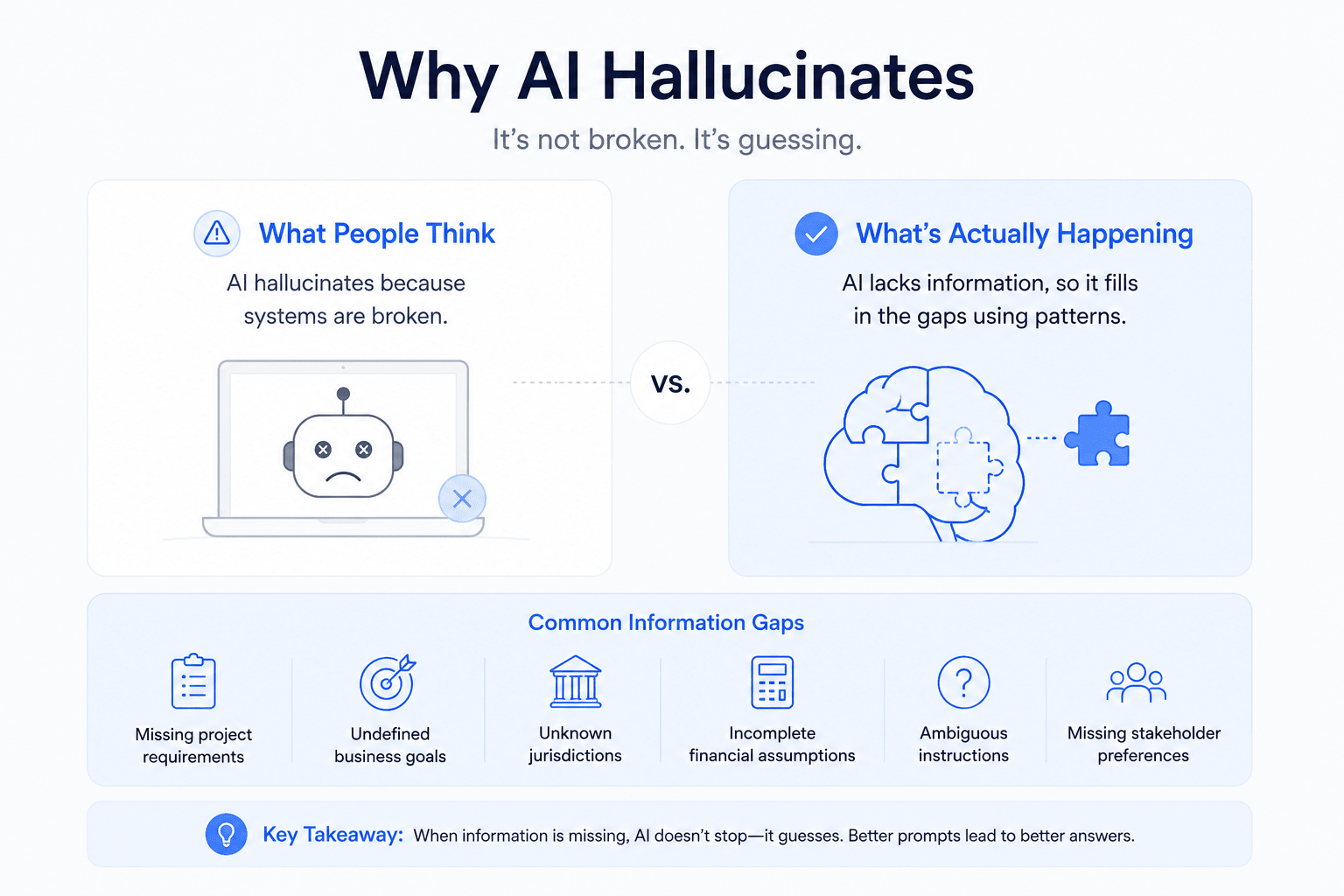
Most people think hallucinations happen because AI systems are broken.
That’s not usually true.
In most cases, hallucinations occur because the model lacks information needed to complete a task. Rather than stopping, it fills in the missing details using probability and patterns learned during training.
The result often sounds convincing.
Unfortunately, convincing does not always mean correct.
For example:
-
Missing project requirements
-
Undefined business goals
-
Unknown jurisdictions
-
Incomplete financial assumptions
-
Ambiguous instructions
-
Missing stakeholder preferences
When these gaps exist, AI frequently generates answers that appear logical while being partially inaccurate.
The Real Problem Isn’t AI
The real problem is often incomplete instructions. Imagine asking a contractor to build a house without providing dimensions, materials, or location requirements.
The contractor would immediately ask questions. AI usually doesn’t. Instead, it attempts to finish the assignment anyway. That behavior creates hallucinations.
Why Most Prompting Advice Doesn’t Fully Solve the Problem
The internet is full of advice about writing better prompts.
Some recommendations include:
-
Add more detail
-
Provide examples
-
Use role-based prompts
-
Specify output formats
-
Create multi-step instructions
These techniques certainly help. However, they don’t address the root cause.
If you forget to provide a critical piece of information, the AI still has a gap to fill.
No amount of formatting can eliminate missing context.
The Hidden Cost of Assumptions
The biggest issue isn’t obvious mistakes. It’s hidden assumptions.
Consider these examples:
| Task | Missing Information | Potential Hallucination |
|---|---|---|
| Financial model | Rent growth rate | AI assumes market growth |
| Plan review | Building code edition | AI cites wrong regulations |
| Lease abstraction | Lease type | AI interprets clauses incorrectly |
| Market analysis | Geographic boundary | AI analyzes the wrong market |
| Workflow creation | User objective | AI builds unnecessary features |
The output may look polished. Yet the foundation is wrong.
That is often more dangerous than an obvious error.
The AI Hallucination Prevention Prompt I Use Every Week
After extensive testing, I consistently use one instruction before important tasks:
“Ask me a handful of questions before we begin so you don’t make assumptions.”
That’s it.
No complex framework.
No advanced prompt engineering.
Just a simple request that changes the entire interaction.
What Happens Next
Instead of immediately producing an answer, the AI begins gathering information. It identifies missing variables. It surfaces uncertainty.
Most importantly, it transfers decision-making back to the user. Rather than guessing, the model asks. That small shift dramatically improves output quality.
How This Works in Real Projects
Let’s look at a practical example. Recently, I used AI to help design a construction plan-checking workflow.
Without clarification, the AI could have assumed dozens of important details.
Instead, it responded with questions like:
| Question | Why It Matters |
|---|---|
| Which jurisdiction applies? | Determines applicable code requirements |
| Which code edition should be used? | Different editions have different standards |
| How should uncertainty be handled? | Affects compliance recommendations |
| What output format is preferred? | Determines usability |
| Which violations are the highest priority? | Changes review focus |
Those questions took less than one minute to answer. The resulting workflow was dramatically more accurate.
Without those answers, the system would likely have produced incorrect code references and misleading recommendations.
Why the AI Hallucination Prevention Prompt Works So Well
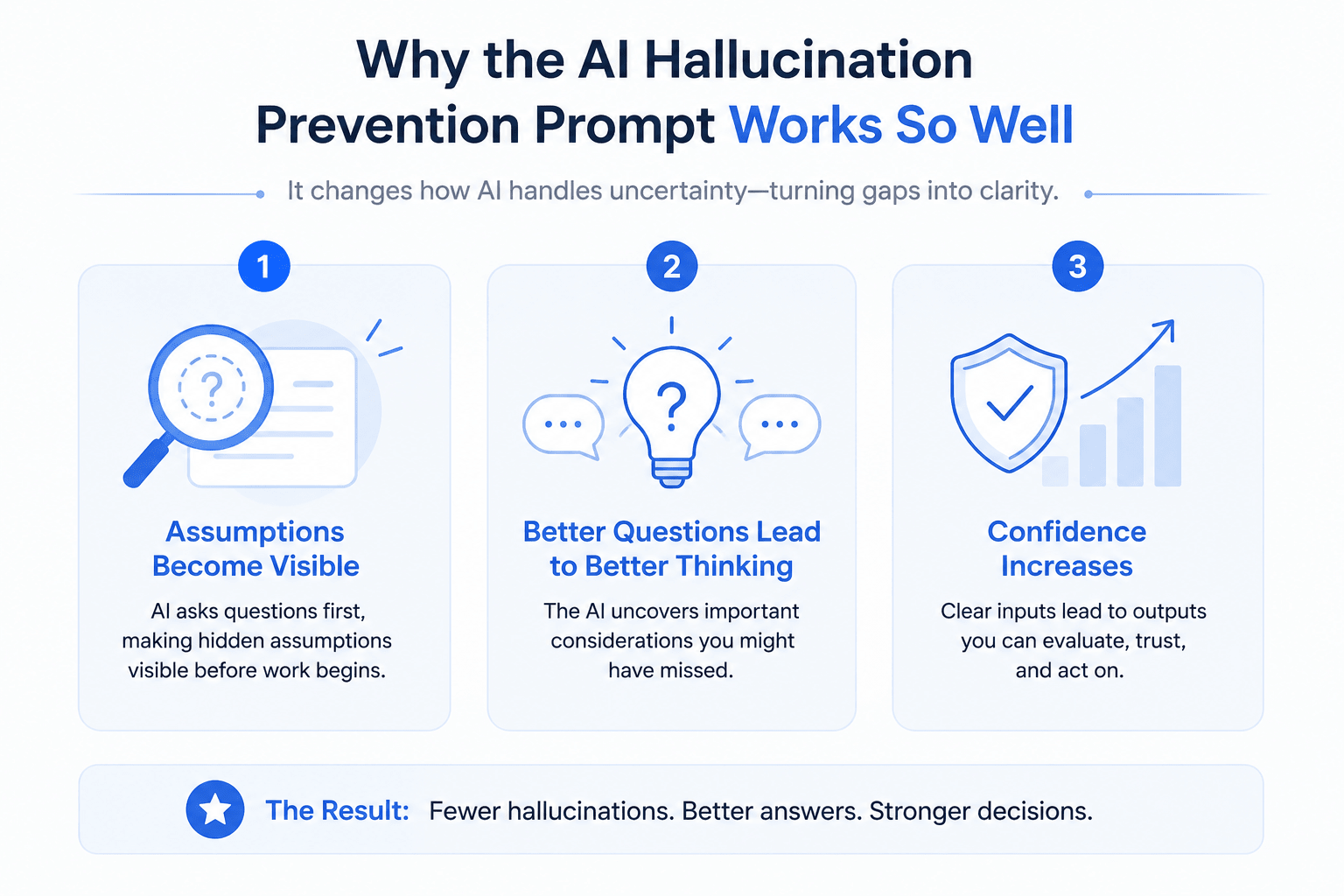
This approach succeeds because it changes how the AI approaches uncertainty. Instead of filling gaps, it identifies them. Three major benefits emerge from this process.
1. Assumptions Become Visible
Most bad outputs begin with invisible assumptions. When the AI asks questions first, those assumptions become visible before any work starts. That prevents errors from spreading throughout the project.
2. Better Questions Lead to Better Thinking
An interesting side effect appears during the questioning process. Sometimes the AI identifies considerations you hadn’t thought about.
For example:
-
Risk tolerance
-
Audience expectations
-
Compliance standards
-
Reporting requirements
-
Decision criteria
These questions often improve human thinking as much as machine performance.
3. Confidence Increases
Trust matters.
When AI explains what information it needs and receives guidance before beginning, the resulting output becomes easier to evaluate and trust.
You’re no longer wondering what assumptions were made behind the scenes. Everything is visible.
Situations Where This Prompt Creates the Biggest Impact
Not every task requires extensive clarification. However, some projects benefit enormously from question-first prompting.
Financial Modeling
Commercial real estate professionals know how sensitive models are. Small assumption changes can alter investment decisions significantly.
Before creating a model, AI should ask about:
-
Rent growth
-
Vacancy assumptions
-
Exit cap rates
-
Operating expenses
-
Renovation budgets
Construction and Plan Review
Building codes vary widely.
Jurisdiction matters.
Code editions matter.
Review standards matter.
Without clarification, compliance reviews become unreliable.
Legal and Contract Analysis
Document interpretation depends heavily on context.
Questions should address:
-
Jurisdiction
-
Contract type
-
Intended purpose
-
Risk tolerance
-
Review scope
Software Development
Developers frequently encounter hallucinated requirements.
Clarifying questions help define:
-
User needs
-
Technical constraints
-
Success criteria
-
Integration requirements
-
Security expectations
When You Can Skip This Technique
Although the prompt is powerful, it isn’t necessary for every task.
Simple activities often don’t require extensive clarification.
Examples include:
-
Grammar corrections
-
Headline generation
-
Brainstorming ideas
-
Social media captions
-
Content rewrites
-
Simple summaries
For these tasks, speed usually matters more than precision. The cost of a wrong assumption is relatively low.
A Simple Decision Framework
| Task Type | Use Question-First Prompt? |
|---|---|
| Financial decisions | Yes |
| Legal review | Yes |
| Compliance checks | Yes |
| Software development | Yes |
| Workflow design | Yes |
| Quick brainstorming | Usually no |
| Content polishing | Usually no |
| Grammar editing | Usually no |
A useful rule is simple:
If the output influences a real decision, use the prompt.
If the output is easily reversible, you can usually skip it.
Advanced Ways to Improve the Method
Once you start using the question-first approach, you can make it even stronger.
Limit the Number of Questions
Too many questions create friction.
Try:
“Ask me your five most important questions before beginning.”
This forces prioritization.
Ask for Missing Variables
You can also say:
“Identify any missing variables that could materially affect the outcome.”
This often uncovers hidden risks.
Require Confidence Checks
Another useful variation is:
“Before proceeding, tell me which assumptions you’re still making.”
This creates an additional verification layer.
Request Risk Analysis
For critical work:
“Ask questions first and identify the highest-risk assumptions.”
This helps focus attention where errors are most costly.
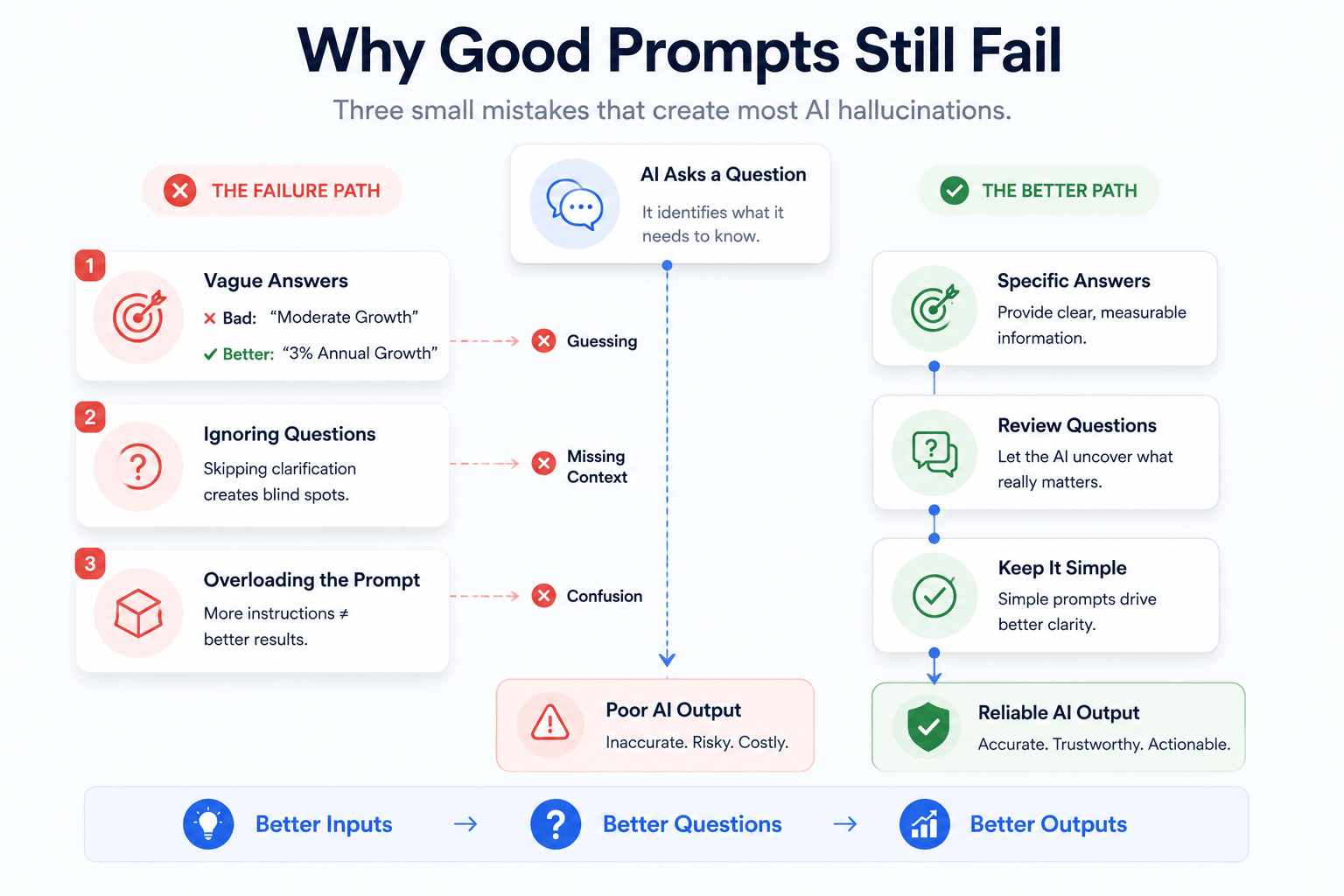
Common Mistakes People Make
Even when using an interview-first approach, several mistakes remain common.
Giving Vague Answers
If the AI asks for assumptions, answer specifically.
Bad answer:
-
Moderate growth
Good answer:
-
3% annual rent growth
Specific inputs create specific outputs.
Ignoring Important Questions
Sometimes users rush through clarifying questions. That defeats the purpose.
The questions often reveal the most important decision points.
Overloading the Prompt
Keep the instructions simple. The goal is to encourage clarification, not create a complicated process. The original version remains effective because it is short and clear.
Build Better AI Workflows With Fewer Costly Assumptions
The difference between a useful AI system and an unreliable one often comes down to how assumptions are handled. If you’re applying AI to commercial real estate, development, underwriting, construction, or operational workflows, learning how to identify missing information early can dramatically improve outcomes. That’s exactly the type of practical implementation discussed inside the AI for CRE Collective, where professionals share real-world applications instead of theoretical examples.
Join a community of 600+ CRE professionals who are actively testing AI tools on deals, documents, models, and business processes. If you want proven workflows, prompt strategies, and lessons learned from actual industry use cases, subscribe to the newsletter and stay ahead of the next wave of AI adoption in commercial real estate.
Conclusion
AI hallucinations are often misunderstood. Most aren’t random failures. They’re educated guesses created when information is missing. That’s why the most effective solution isn’t necessarily a longer prompt. Instead, it’s a better conversation.
By telling AI to ask questions before it begins, you expose assumptions, improve accuracy, and create outputs you can trust. The next time you’re working on something important, try one simple instruction:
“Ask me a handful of questions before we begin so you don’t make assumptions.”
That extra minute of clarification may save hours of correction later.
AI Prompting and Hallucination Prevention FAQs
What is the best way to prevent AI hallucinations?
The best way to prevent AI hallucinations is to make the AI ask clarifying questions before starting a task. This reduces assumptions, fills information gaps, and improves output accuracy. For high-stakes work such as financial modeling, compliance reviews, and software development, this simple prompting technique often produces more reliable results.
Why do AI models hallucinate?
AI models hallucinate when they lack information needed to complete a task. Instead of stopping, they generate likely answers based on patterns in their training data. Missing context, vague instructions, and incomplete requirements are some of the most common causes of hallucinations.
Can better prompts reduce AI hallucinations?
Yes, better prompts can significantly reduce AI hallucinations. Clear instructions, defined objectives, relevant context, and clarification questions help AI generate more accurate responses. However, even detailed prompts work best when the model is encouraged to ask questions before making assumptions.
What is a question-first AI prompt?
A question-first AI prompt instructs the model to gather missing information before completing a task. Instead of immediately generating an answer, the AI asks clarifying questions that identify assumptions and uncertainties. This approach improves reliability and decision-making quality.
When should you use an AI hallucination prevention prompt?
You should use an AI hallucination prevention prompt whenever the output affects important decisions. Financial analysis, commercial real estate underwriting, legal reviews, construction planning, software development, and compliance tasks all benefit from clarification before execution.
Are AI hallucinations always incorrect information?
Not necessarily. AI hallucinations can sometimes contain accurate information, but the issue is that the information is generated without verification. Because users cannot always distinguish between correct and incorrect assumptions, hallucinated content should be reviewed carefully.
How many questions should AI ask before starting?
For most tasks, three to five clarifying questions are enough. The goal is to uncover critical assumptions without creating unnecessary delays. Complex projects may require additional questions, while simple tasks often need none at all.
Does asking questions make AI more accurate?
Yes. Asking questions improves AI accuracy by providing missing context and reducing uncertainty. The more relevant information the AI receives before beginning a task, the less likely it is to generate incorrect assumptions or misleading outputs.
What industries benefit most from question-first prompting?
Industries with high-cost decisions benefit the most from question-first prompting. Commercial real estate, finance, construction, legal services, engineering, healthcare administration, and software development frequently use clarification-based workflows to improve accuracy and reduce risk.
What is the simplest prompt to reduce AI assumptions?
One of the simplest prompts is: “Ask me a handful of questions before we begin so you don’t make assumptions.” This instruction encourages the AI to identify missing information first, helping prevent hallucinations and improving the quality of the final output.