Using HubSpot + AI to automate CRE lead nurturing
Commercial real estate has always relied on relationships. But today, speed and consistency matter just as much. This is where AI CRE lead nurturing automation is changing how deals move forward.
Most CRE professionals still depend on manual follow-ups, scattered spreadsheets, and delayed responses. As a result, leads often go cold before a real conversation begins. At the same time, buyers and investors expect faster replies and more relevant communication.
AI helps solve this gap. It supports teams by handling repetitive tasks, tracking behavior, and sending timely follow-ups. More importantly, it allows professionals to focus on closing deals instead of chasing emails.
In this guide, you’ll learn why traditional lead nurturing struggles, how AI improves the process, and where tools like HubSpot fit into a modern CRE workflow.
Why Lead Nurturing Is Broken in Commercial Real Estate (And What’s Changing)
Lead nurturing sounds simple. You collect a lead, follow up, and move them through the deal pipeline. But in practice, the process often breaks down.
The traditional CRE lead nurturing problem
Many CRE teams still use outdated systems. These systems slow down response time and reduce efficiency.
Here are the most common issues:
-
Manual follow-ups that depend on memory
-
Long gaps between responses
-
No clear system for tracking conversations
-
Poor visibility into lead behavior
-
Time wasted on unqualified prospects
These problems create friction at every stage. For example, a broker may receive an inquiry but respond hours later. By that time, the prospect may already be speaking with another firm.
Also, most teams treat all leads the same way. There is no structured method to identify which lead is serious and which one is just browsing. This leads to wasted effort.
Over time, these small inefficiencies add up. Deals slow down. Conversion rates drop. Teams feel overwhelmed.
The shift toward AI-powered workflows in CRE
The industry is now moving toward automation and smarter systems. This shift is driven by the need for speed and accuracy.
AI tools can handle tasks that once required hours of manual work. They can also process large amounts of data in seconds.
Here’s what is changing:
-
Follow-ups are now automated and triggered by user actions
-
Lead data is collected and updated in real time
-
Systems can identify high-intent prospects quickly
-
Communication is consistent across all channels
Instead of relying on guesswork, teams can now make decisions based on data.
This is where AI CRE lead nurturing automation becomes essential. It removes delays and improves how teams interact with leads.
Traditional vs AI-powered lead nurturing
To understand the shift better, here is a simple comparison:
| Feature | Traditional CRE Nurturing | AI CRE Lead Nurturing Automation |
|---|---|---|
| Follow-ups | Manual and inconsistent | Automated and timely |
| Lead tracking | Spreadsheets or notes | Centralized CRM system |
| Lead scoring | Based on intuition | Data-driven and dynamic |
| Response time | Delayed | Instant or near real-time |
| Personalization | Limited | Scaled and behavior-based |
| Efficiency | Low | High |
This difference explains why many firms are moving toward AI-driven systems.
What Is AI Lead Nurturing in Commercial Real Estate?
Before going deeper, it’s important to define what AI actually does in this process. Here’s a quick example of how AI prospecting works in real scenarios:
Definition of AI-powered lead nurturing
AI lead nurturing refers to using intelligent systems to manage and improve how you interact with prospects over time.
Instead of handling each step manually, AI supports the entire journey:
-
Capturing leads
-
Tracking behavior
-
Sending follow-ups
-
Scoring interest levels
-
Notifying sales teams
This creates a more structured and efficient process.
At its core, AI CRE lead nurturing automation ensures that no lead is ignored and every interaction feels timely.
How AI differs from traditional CRM systems
Many CRE professionals already use CRM tools. However, traditional CRMs mainly store data. They do not actively improve workflows.
AI changes that.
Here’s the difference:
-
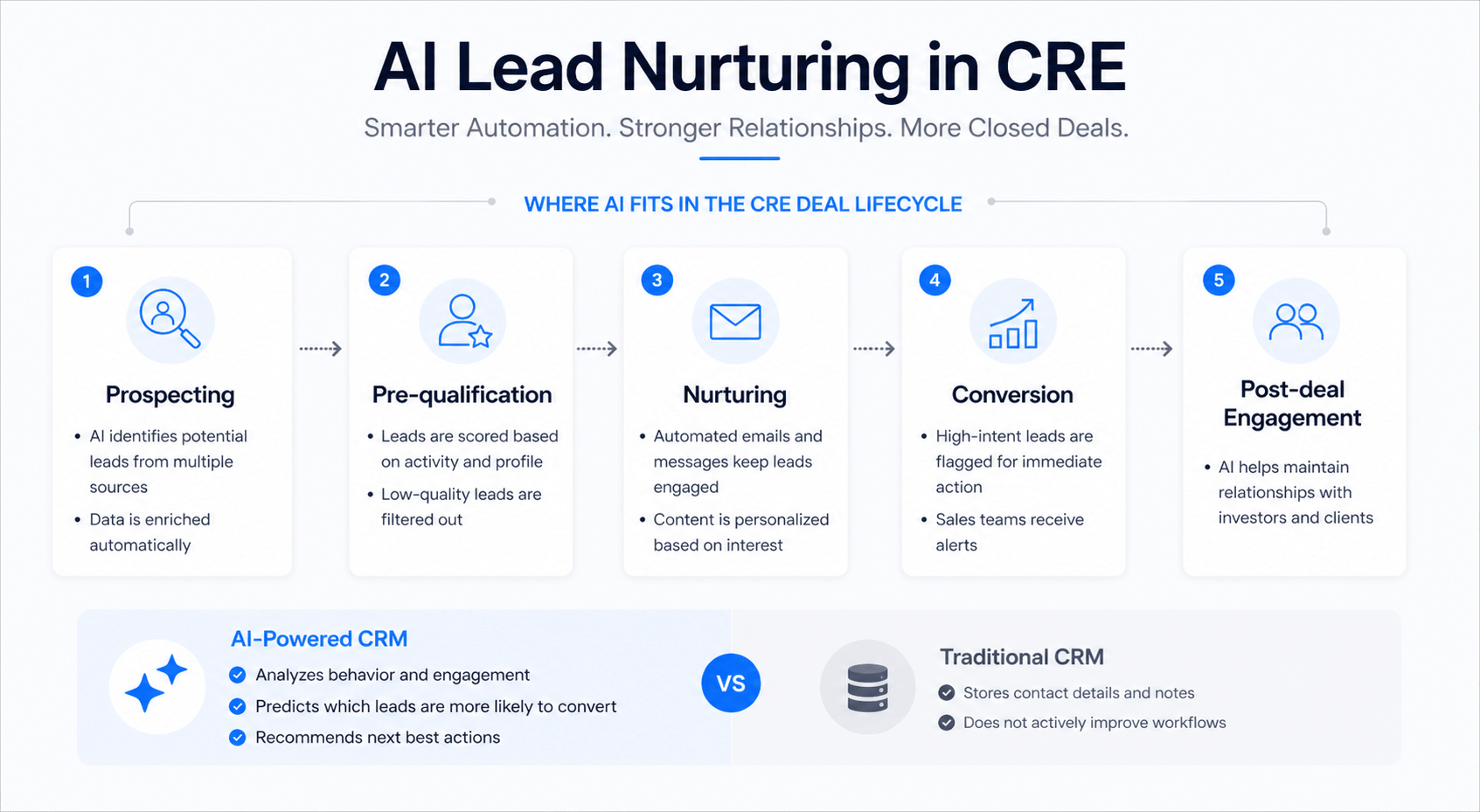
Traditional CRM: stores contact details and notes
-
AI-powered CRM: analyzes behavior and suggests next actions
AI systems can:
-
Track email opens and clicks
-
Monitor website activity
-
Identify patterns in user behavior
-
Predict which leads are more likely to convert
This allows teams to act faster and smarter.
Where AI fits in the CRE deal lifecycle
AI is not limited to one stage. It supports the full deal cycle.
1. Prospecting
-
AI tools identify potential leads from multiple sources
-
Data is enriched automatically
2. Pre-qualification
-
Leads are scored based on activity and profile
-
Low-quality leads are filtered out
3. Nurturing
-
Automated emails and messages keep leads engaged
-
Content is personalized based on interest
4. Conversion
-
High-intent leads are flagged for immediate action
-
Sales teams receive alerts
5. Post-deal engagement
-
AI helps maintain relationships with investors and clients
This full-cycle support is what makes AI CRE lead nurturing automation so valuable.
Core Benefits of Using AI for CRE Lead Nurturing
Now, let’s look at what you actually gain by using AI in your workflow.
Smarter lead scoring and prioritization
One of the biggest advantages is better lead evaluation.
Instead of guessing, AI uses real data:
-
Website visits
-
Email engagement
-
Property views
-
Inquiry frequency
This helps teams focus on leads that are more likely to convert.
As a result, time is used more effectively.
Faster response times and higher conversion rates
Speed plays a major role in real estate deals.
AI tools can respond instantly through:
-
Chatbots
-
Automated emails
-
SMS follow-ups
This ensures that leads receive a reply within minutes, not hours.
Faster responses often lead to better engagement and higher conversion rates.
Personalized communication at scale
Personalization used to require manual effort. Now it can happen automatically.
AI can:
-
Recommend relevant properties
-
Send targeted emails
-
Adjust messaging based on behavior
For example, if a user views office spaces in a specific area, the system can follow up with similar listings.
This improves the user experience without adding extra work.
Reduced operational costs and manual work
Automation reduces the need for repetitive tasks.
Teams spend less time on:
-
Data entry
-
Follow-up reminders
-
Lead tracking
Instead, they can focus on strategy and closing deals.
Over time, this leads to lower operational costs.
Improved deal pipeline visibility
AI systems provide better insights into the pipeline.
You can see:
-
Which leads are active
-
Where deals are slowing down
-
Which channels perform best
This helps teams adjust their strategy and improve results.
How HubSpot + AI Transforms CRE Lead Nurturing
By now, you’ve seen why traditional systems struggle and how AI improves the process. The next step is understanding how this works in real tools. This is where HubSpot plays a major role.
HubSpot combines CRM, marketing, and automation in one system. When you add AI features, it becomes much more than a database. It turns into an active system that supports your daily workflow.
For CRE professionals, this means fewer manual steps and more consistent engagement. It also means better tracking of every lead interaction.
Overview of the HubSpot AI ecosystem for CRE workflows
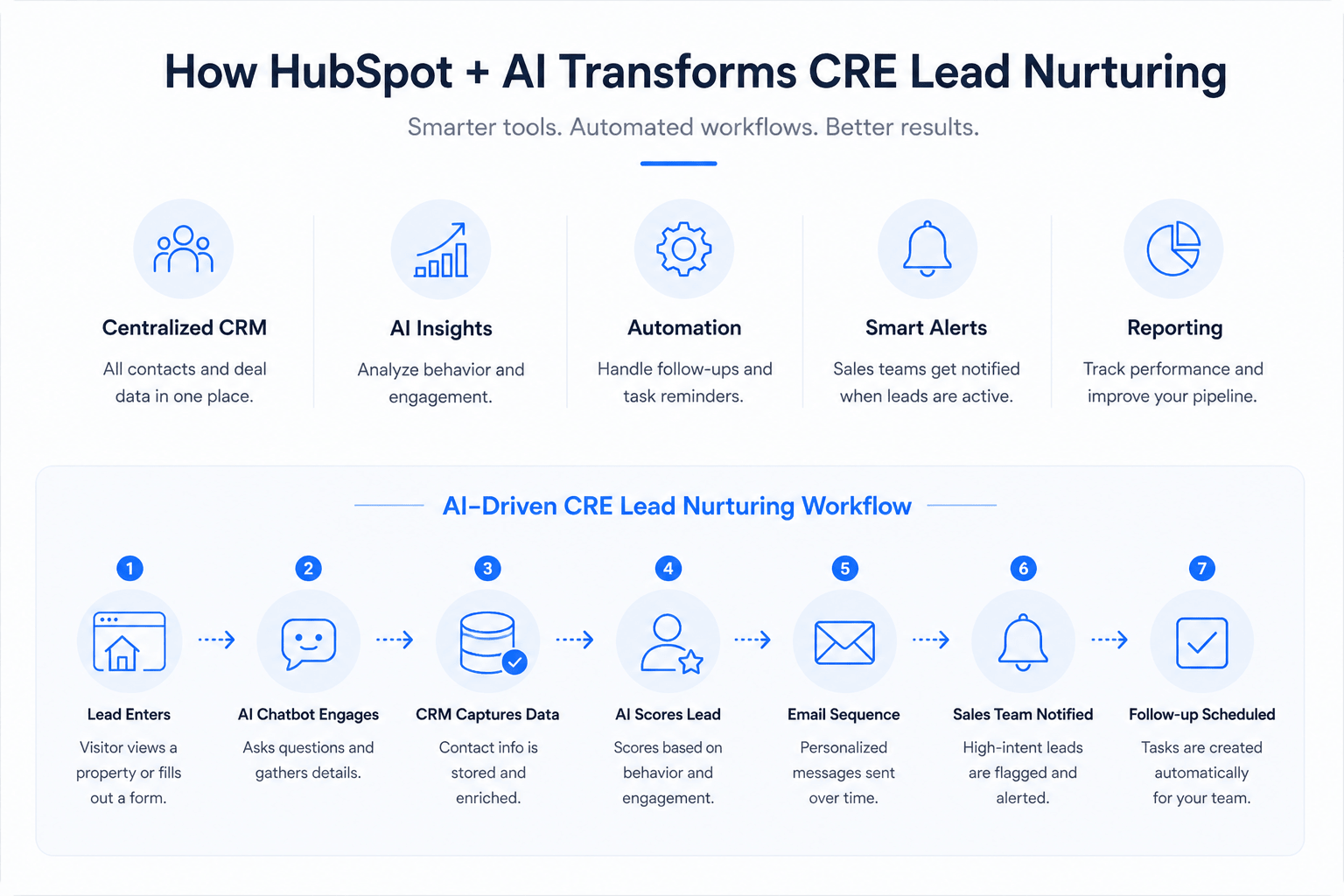
HubSpot has built AI into different parts of its platform. These features support marketing, sales, and customer communication.
Here’s how it fits into a CRE setup:
-
A centralized CRM stores all contacts and deal data
-
AI tools analyze lead behavior and engagement
-
Automation handles follow-ups and task reminders
-
Reporting tools show pipeline performance
Instead of switching between tools, everything works in one place. This reduces confusion and keeps your data clean.
More importantly, AI CRE lead nurturing automation becomes easier to manage when all systems are connected.
Automating CRE lead nurturing workflows with HubSpot
Automation is one of the strongest features in HubSpot. It allows you to create workflows that run without manual input.
Here are a few common workflows used in CRE:
-
When a lead fills out a form, they receive an instant email
-
If a lead views a property page multiple times, they get a follow-up
-
If a lead does not respond, the system sends reminders
-
Sales teams receive alerts when a lead becomes active
These workflows run in the background. This ensures that no lead is missed.
Instead of relying on memory, the system handles the timing and sequence.
AI-powered lead qualification and scoring
Not all leads are equal. Some are ready to move forward, while others are still exploring.
HubSpot uses AI to assign scores based on behavior and profile data.
This includes:
-
Number of website visits
-
Type of properties viewed
-
Email engagement
-
Form submissions
Leads with higher scores move up in priority. Sales teams can then focus on these leads first.
This improves efficiency and increases the chances of closing deals.
AI agents for outreach and engagement
AI tools can also handle direct communication.
These include:
-
Chatbots that answer questions instantly
-
Automated email replies
-
Meeting scheduling tools
For example, a chatbot on your website can:
-
Greet visitors
-
Ask qualifying questions
-
Share relevant listings
-
Book a call with your team
This creates a smooth experience for the user.
At the same time, your team saves hours of manual work.
Example: AI-driven CRE lead nurturing workflow
To make this clearer, here is a simple step-by-step flow:
Lead enters your website
-
A visitor views a property or fills out a form
AI chatbot engages
-
The system asks questions and gathers details
CRM captures and enriches data
-
Contact information is stored and updated
AI scores the lead
-
Based on behavior and engagement
Automated email sequence begins
-
Personalized messages are sent over time
The sales team is notified
-
High-intent leads are flagged
Follow-up is scheduled automatically
-
Tasks are created without manual input
This entire process runs with minimal effort from your team.
That is the real value of AI CRE lead nurturing automation. It builds a system that works continuously.
Step-by-Step Process to Implement AI Lead Nurturing in CRE
Knowing the tools is important. But implementation is what creates results.
Below is a clear process that CRE teams can follow.
Step 1: Audit your current lead pipeline
Start by reviewing your existing process.
Ask simple questions:
-
Where do leads come from?
-
How quickly do you respond?
-
What tools are you using?
-
Where do delays happen?
This helps you identify gaps.
Without this step, automation may only repeat existing problems.
Step 2: Centralize your data in a CRM
Many teams use multiple tools that do not connect well.
This leads to:
-
Duplicate data
-
Missing information
-
Confusion across teams
A centralized CRM solves this issue.
All contacts, deals, and interactions are stored in one place.
This creates a strong foundation for AI CRE lead nurturing automation.
Step 3: Set up AI-powered lead scoring
Next, define what makes a good lead.
You can base this on:
-
Budget range
-
Property interest
-
Engagement level
-
Location preferences
Then assign scores to each action.
For example:
-
Email open = low score
-
Property inquiry = higher score
-
Multiple visits = high score
AI systems can adjust these scores over time.
This keeps your process accurate.
Step 4: Build automated nurturing workflows
Now you can create workflows that guide leads through the pipeline.
Examples include:
-
Welcome email sequences
-
Property recommendation emails
-
Follow-up reminders
-
Re-engagement campaigns
Each workflow should have a clear goal.
For instance, moving a lead from inquiry to a meeting. If you also want to automate deal analysis alongside lead nurturing, this guide on automated deal underwriting with AI shows how to build a complete system.
Step 5: Deploy AI chatbots and communication tools
Communication should be fast and consistent.
AI chatbots can help with this.
They can:
-
Answer common questions
-
Capture lead details
-
Schedule meetings
You can also use:
-
SMS follow-ups
-
Automated email responses
This ensures that leads stay engaged.
Step 6: Optimize with data and analytics
Once your system is running, track performance.
Focus on key metrics:
-
Response time
-
Conversion rate
-
Email engagement
-
Lead-to-meeting ratio
Use this data to improve your workflows.
For example, if emails are not being opened, adjust the subject lines.
If leads drop off early, review your follow-up timing.
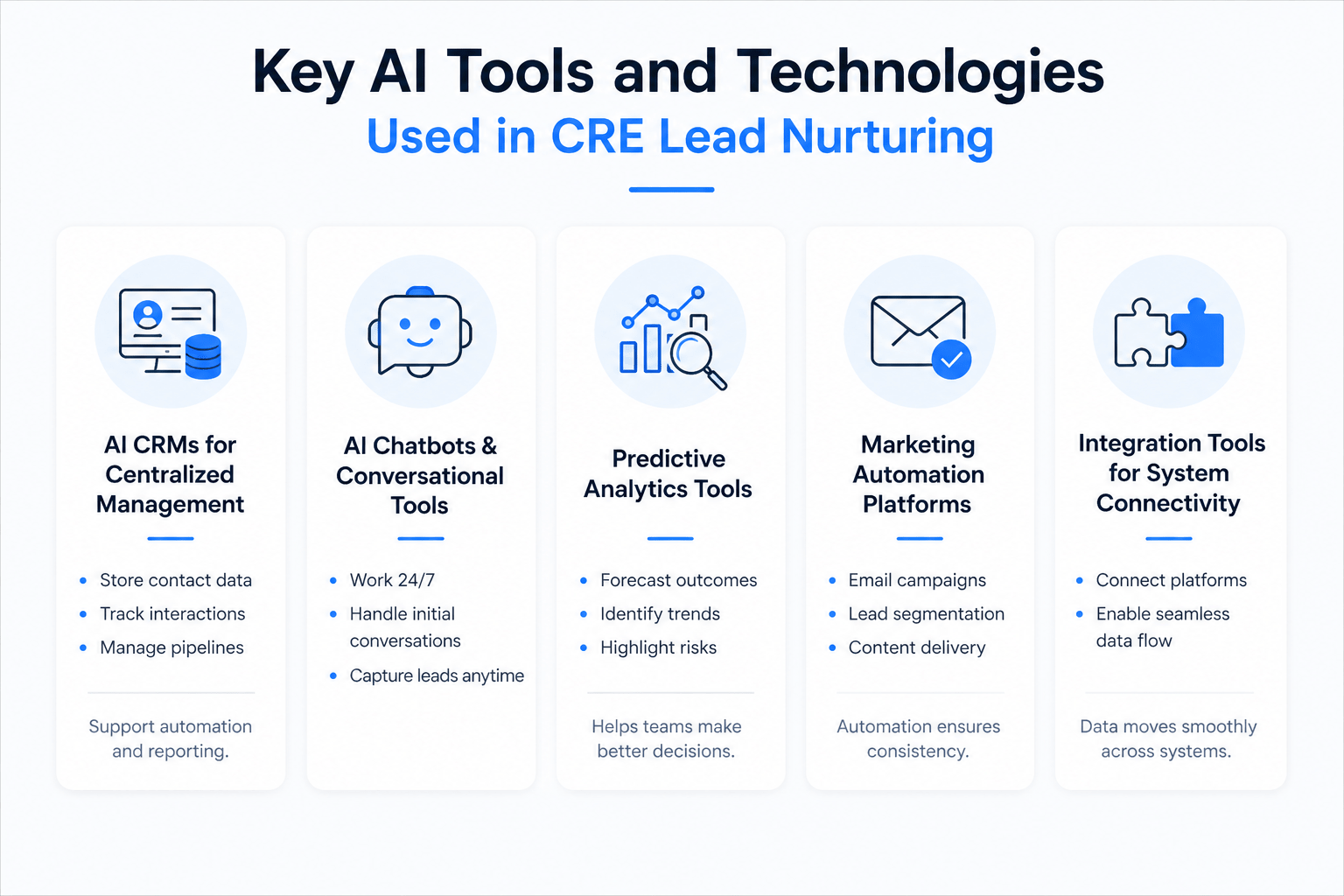
Key AI Tools and Technologies Used in CRE Lead Nurturing
To build a strong system, you need the right tools. Each tool plays a specific role.
AI CRMs for centralized management
AI CRMs act as the core of your system.
They:
-
Store contact data
-
Track interactions
-
Manage pipelines
They also support automation and reporting.
This makes them essential for AI CRE lead nurturing automation. If you’re exploring tools beyond CRMs, this breakdown of the best AI lead generation tools for commercial property can help you choose the right stack.
AI chatbots and conversational tools
Chatbots improve response speed.
They work 24/7 and handle initial conversations.
This helps capture leads even outside business hours.
Predictive analytics tools
These tools analyze patterns in data.
They can:
-
Forecast deal outcomes
-
Identify trends
-
Highlight risks
This helps teams make better decisions.
Marketing automation platforms
These platforms manage communication.
They support:
-
Email campaigns
-
Lead segmentation
-
Content delivery
Automation ensures consistency.
Integration tools for system connectivity
Integration tools connect different platforms.
They allow data to move smoothly between systems.
This reduces manual work and errors.
Real-World Use Cases of AI in CRE Lead Nurturing
Understanding the tools is one thing. Seeing how they work in real scenarios makes the difference. Across the industry, different CRE professionals are already applying AI in practical ways.
These use cases show how AI CRE lead nurturing automation fits into daily operations.
Brokers and agents are improving follow-ups
Brokers often deal with multiple leads at the same time. Keeping track of every conversation can be difficult.
AI helps by:
-
Sending automatic follow-ups after inquiries
-
Tracking which properties a lead views
-
Notifying agents when a lead shows strong interest
For example, if a prospect visits the same listing several times, the system can alert the agent. This allows faster and more relevant outreach.
As a result, agents spend less time chasing leads and more time closing deals.
Developers managing investor communication
Developers usually work with investors over longer timelines. This requires consistent communication.
AI systems can support this by:
-
Sending project updates automatically
-
Sharing relevant documents based on interest
-
Tracking investor engagement
If an investor opens emails frequently or clicks on updates, the system flags them as active. This helps developers prioritize communication.
It also keeps investors informed without manual effort.
Property managers are improving tenant engagement
Property managers handle ongoing relationships. Their focus is not just on new leads but also on existing tenants.
AI can assist in:
-
Sending lease renewal reminders
-
Sharing maintenance updates
-
Handling basic tenant queries through chatbots
This reduces workload and improves response time.
Tenants receive quick answers, which improves satisfaction.
CRE firms scaling across multiple markets
Firms operating in different locations often face communication challenges.
AI systems help maintain consistency by:
-
Standardizing follow-up processes
-
Automating outreach across regions
-
Tracking performance in each market
This allows firms to scale without increasing team size at the same rate.
It also ensures that every lead receives the same level of attention.
Common Mistakes to Avoid When Using AI in CRE
While AI offers clear benefits, poor implementation can reduce its impact. Many teams face issues because they skip basic steps.
Here are the most common mistakes to watch for.
Over-automation without personalization
Automation should not remove the human element.
Some teams rely too much on generic messages. This can make communication feel robotic.
To avoid this:
-
Customize email templates
-
Use lead behavior to adjust messaging
-
Add personal touches where needed
Automation should support relationships, not replace them.
Poor data quality and CRM setup
AI depends on data. If the data is incomplete or incorrect, results will suffer.
Common issues include:
-
Missing contact details
-
Duplicate records
-
Outdated information
Before using AI, clean your data and organize your CRM.
This improves accuracy and performance.
Ignoring training and team adoption
Tools alone do not create results. Teams need to understand how to use them.
Without proper training:
-
Features go unused
-
Workflows remain incomplete
-
Teams return to manual methods
Training ensures that systems are used correctly and consistently.
Using too many disconnected tools
Some firms use multiple platforms that do not integrate well.
This leads to:
-
Data silos
-
Manual data transfer
-
Increased errors
A connected system works better.
It keeps everything aligned and reduces confusion.
Challenges of AI Adoption in Commercial Real Estate
Even with clear benefits, adopting AI comes with challenges. These challenges are common across the industry.
Understanding them early helps you prepare better.
Data privacy and compliance concerns
Handling client and investor data requires care.
AI systems often collect and process large amounts of information.
This raises concerns about:
-
Data security
-
Privacy regulations
-
Access control
Firms need to ensure that their systems follow legal requirements.
Initial setup time and cost
Setting up AI systems requires time and investment.
This includes:
-
CRM configuration
-
Workflow creation
-
Data migration
While the long-term benefits are strong, the initial effort can feel high.
However, once the system is in place, efficiency improves significantly.
Learning curve for teams
AI tools introduce new ways of working.
Teams may need time to adjust.
Common challenges include:
-
Understanding automation workflows
-
Interpreting data insights
-
Managing new tools
A structured approach to training can reduce this learning curve.
Integration with existing systems
Many CRE firms already use legacy systems.
Connecting these systems with new AI tools can be complex.
Issues may include:
-
Compatibility problems
-
Data transfer delays
-
System limitations
Planning integrations carefully helps avoid disruptions.
Future Trends: Where AI Lead Nurturing in CRE Is Heading
AI in commercial real estate is still evolving. What you see today is only the beginning. Over the next few years, systems will become more advanced and more integrated into daily workflows.
For CRE professionals, this means faster processes and better decision-making.
AI agents handling full workflows
Right now, AI supports specific tasks like follow-ups or scoring. In the future, AI agents will handle entire workflows.
This includes:
-
Capturing and qualifying leads
-
Sending personalized messages
-
Booking meetings automatically
-
Updating CRM records
Instead of switching between tools, teams will rely on systems that manage the full process.
This will make AI lead nurturing automation more seamless and efficient.
Hyper-personalization using behavioral data
Personalization will go beyond basic details like name or location.
AI will use deeper insights such as:
-
Browsing patterns
-
Investment preferences
-
Timing of engagement
-
Previous interactions
This allows communication to feel more relevant.
For example, a system can suggest properties based on past behavior, not just general criteria.
This improves engagement and increases the chances of conversion.
Voice AI and conversational interfaces
Communication methods are also changing.
Voice-based systems are becoming more common. These tools can:
-
Answer inquiries through voice assistants
-
Schedule meetings through calls
-
Provide instant updates
This adds another layer to how leads interact with your business.
It also makes communication more natural for users.
Predictive deal-making and investment insights
AI is moving toward prediction, not just automation.
Future systems will:
-
Forecast deal outcomes
-
Identify high-value opportunities
-
Suggest next best actions
This helps professionals make better decisions with less guesswork.
Instead of reacting to data, teams can act in advance.
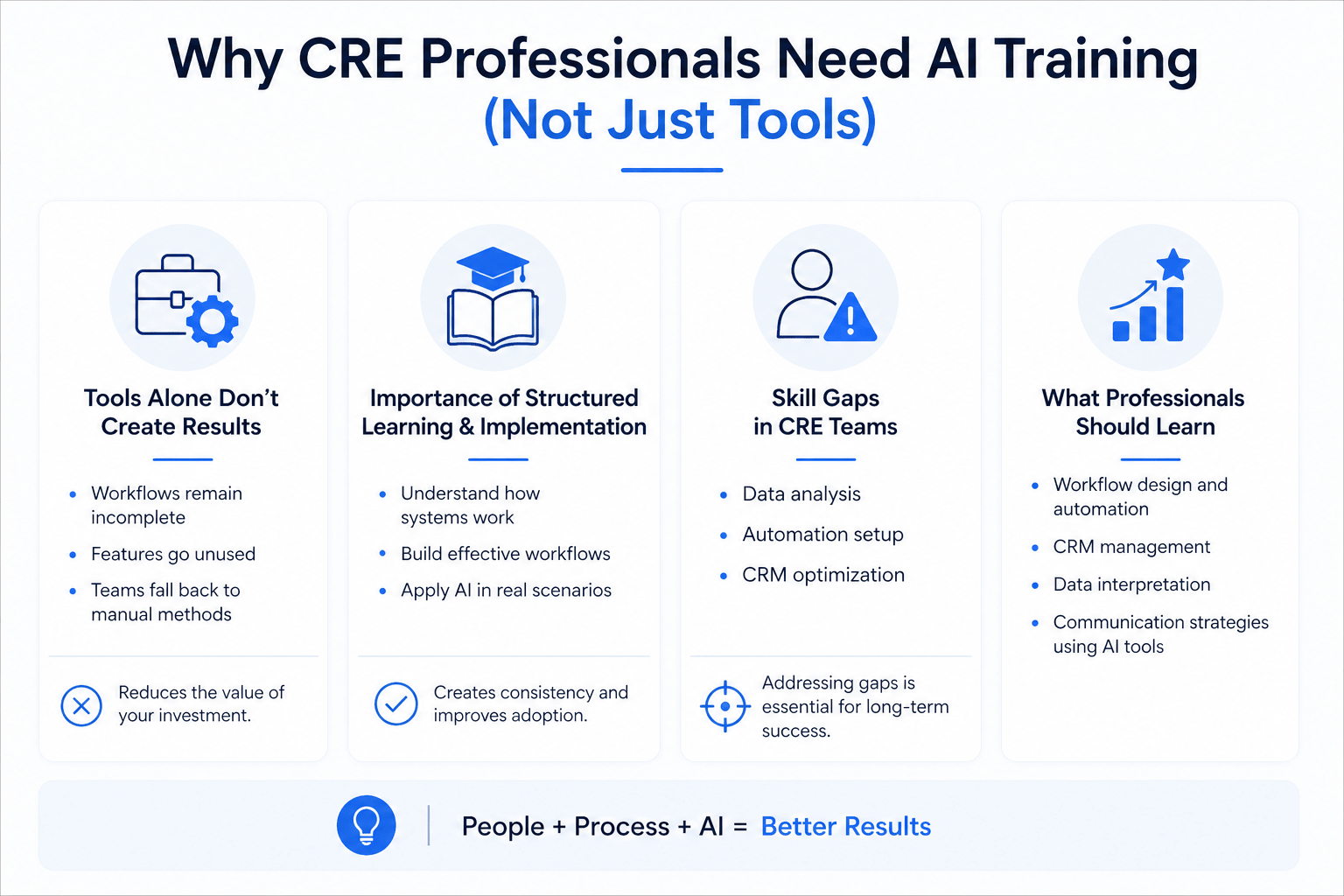
Why CRE Professionals Need AI Training (Not Just Tools)
Many firms invest in tools but do not see strong results. The main reason is a lack of training.
Technology alone does not solve problems. People need to understand how to use it effectively.
Tools alone don’t create results
Buying software is easy. Using it properly is harder.
Without clear processes:
-
Workflows remain incomplete
-
Features go unused
-
Teams fall back to manual methods
This reduces the value of your investment.
Importance of structured learning and implementation
Training provides a clear path.
It helps teams:
-
Understand how systems work
-
Build effective workflows
-
Apply AI in real scenarios
This creates consistency across the organization.
It also improves adoption rates.
Skill gaps in CRE teams
Many CRE professionals come from traditional backgrounds. They may not have experience with AI systems.
Common gaps include:
-
Data analysis
-
Automation setup
-
CRM optimization
Addressing these gaps is essential for long-term success.
What professionals should learn
To use AI effectively, teams should focus on key skills:
-
Workflow design and automation
-
CRM management
-
Data interpretation
-
Communication strategies using AI tools
These skills support better use of AI CRE lead nurturing automation.
How AI for CRE Collective Helps You Implement AI Successfully
This is where structured learning becomes valuable. Instead of trying to figure everything out alone, professionals can follow a guided approach.
AI for CRE Collective focuses on practical training tailored to the industry.
AI training designed for CRE professionals
The training is built around real use cases.
It covers:
-
Lead nurturing workflows
-
CRM setup and optimization
-
Automation strategies
This makes it relevant to daily work.
Hands-on, workflow-based learning approach
Instead of theory, the focus is on application.
Participants learn by:
-
Building workflows
-
Setting up automation
-
Testing real scenarios
This improves understanding and retention.
Focus on measurable results
The goal is not just learning. It is improving performance.
With the right approach, professionals can:
-
Reduce response time
-
Improve lead conversion
-
Lower operational costs
These outcomes directly impact business growth.
Who this is for
The training is suitable for:
-
CRE owners
-
Brokers and agents
-
Developers
-
Architects
Each group can apply AI in different ways, but the core principles remain the same.
Final Thoughts: The Competitive Advantage of AI in CRE
Commercial real estate is becoming more competitive. Speed, consistency, and data now play a major role in success.
AI is helping teams meet these demands.
With ai cre lead nurturing automation, professionals can:
-
Respond faster to leads
-
Focus on high-value opportunities
-
Maintain consistent communication
-
Improve overall efficiency
Those who adopt these systems early will have an advantage.
At the same time, success depends on proper implementation and training.
The combination of the right tools and the right skills creates long-term growth.
Ready to Apply This in Your CRE Business?
If this gave you a clear picture, the next step is simple. You need a structured way to actually apply these ideas in your daily work.
At AI for CRE Collective, we don’t just talk about AI. We show you how to use it in real workflows.
Here’s what you get:
-
Step-by-step training built specifically for CRE professionals
-
Practical workflows you can apply immediately
-
Guidance on tools like CRM automation, lead nurturing, and AI systems
-
A community of professionals learning and applying the same strategies
If you want to move beyond theory and start seeing real improvements in your pipeline, this is the right place.
Also, if you prefer quick insights and regular updates, subscribe to our newsletter. It’s a simple way to stay updated without overcomplicating things.
FAQs: AI CRE Lead Nurturing Automation
What is AI CRE lead nurturing automation?
AI CRE lead nurturing automation refers to using AI tools and systems to manage how leads are captured, followed up, and converted in commercial real estate.
Instead of manual tracking, AI helps automate the entire process:
-
Capturing leads from websites and forms
-
Tracking user behavior and engagement
-
Sending follow-ups based on actions
-
Scoring leads based on intent
This approach improves consistency and reduces missed opportunities. It also helps teams respond faster and focus on high-quality leads. Over time, it creates a structured pipeline where every lead receives attention without increasing manual workload.
How does AI improve lead nurturing in commercial real estate?
AI improves lead nurturing by making communication faster, more relevant, and more consistent.
It works by:
-
Tracking how leads interact with your website and emails
-
Sending follow-ups automatically based on behavior
-
Prioritizing leads that show strong interest
For example, if a prospect views the same listing multiple times, AI can trigger a follow-up message. This ensures timely engagement.
It also removes delays caused by manual processes. As a result, teams can maintain better communication, improve engagement, and increase conversion rates without adding more effort.
What are the main benefits of AI in CRE lead management?
AI offers several practical benefits for CRE teams.
These include:
-
Faster response times to inquiries
-
Better lead prioritization using real data
-
Reduced manual tasks like follow-ups
-
Improved personalization in communication
In addition, AI provides insights into pipeline performance. Teams can see which leads are active and where deals slow down.
This helps improve decision-making and overall efficiency. Over time, these benefits lead to higher conversions and lower operational costs.
Is AI replacing real estate agents or brokers?
AI is not replacing agents. It is supporting them.
AI handles repetitive tasks such as:
-
Data entry
-
Follow-up reminders
-
Basic communication
This allows agents to focus on:
-
Building relationships
-
Negotiating deals
-
Closing transactions
In practice, AI acts as an assistant. It improves efficiency but still relies on human expertise for complex decisions.
Most successful CRE professionals use AI to enhance their work, not replace it.
How does AI lead scoring work in CRE?
AI lead scoring evaluates how likely a lead is to convert.
It uses data points such as:
-
Website visits
-
Email opens and clicks
-
Property views
-
Inquiry frequency
Each action adds to a lead’s score. Higher scores indicate stronger interest.
This helps teams prioritize leads effectively. Instead of treating all leads the same, they can focus on those most likely to convert.
Over time, AI adjusts scoring based on patterns, making the system more accurate.
What tools are commonly used for AI lead nurturing in CRE?
Several tools support AI-driven workflows in CRE.
Common categories include:
-
AI-powered CRM systems
-
Marketing automation platforms
-
Chatbots and conversational tools
-
Data analytics tools
These tools work together to create a connected system.
For example, a CRM stores data, while automation tools handle communication. Chatbots capture leads, and analytics tools provide insights.
When combined, they form a complete AI CRE lead nurturing automation system.
How does HubSpot help with AI lead nurturing?
HubSpot combines CRM, automation, and AI in one platform.
It helps by:
-
Storing and organizing lead data
-
Automating follow-up emails
-
Scoring leads based on behavior
-
Providing pipeline insights
It also integrates marketing and sales tools. This creates a smooth workflow from lead capture to conversion.
For CRE professionals, this reduces the need for multiple tools and improves efficiency.
Can small CRE teams benefit from AI automation?
Yes, small teams often benefit the most.
AI helps them:
-
Handle more leads without hiring more staff
-
Maintain consistent communication
-
Reduce manual workload
For example, a small brokerage can use automation to follow up with every lead. This would be difficult to manage manually.
AI levels the playing field by allowing smaller teams to operate more efficiently.
How long does it take to implement AI in CRE workflows?
The timeline depends on the complexity of your setup.
Basic implementation may take:
-
A few weeks for CRM setup
-
Additional time for workflow design
More advanced systems may take longer.
Key factors include:
-
Data organization
-
Tool selection
-
Team training
With a structured approach, most teams can see results within a few months.
What are the biggest challenges in adopting AI for CRE?
Common challenges include:
-
Poor data quality
-
Lack of training
-
Integration issues with existing tools
-
Initial setup time
Many teams also struggle with adoption.
Without proper training, tools may not be used effectively.
Addressing these challenges early helps ensure a smoother transition.
How does AI personalization work in real estate marketing?
AI personalization uses data to tailor communication.
It considers:
-
User behavior
-
Property preferences
-
Engagement history
For example, if a lead searches for office spaces in a specific area, AI can send relevant listings.
This makes communication more relevant.
As a result, leads are more likely to engage and respond.
Is AI lead nurturing expensive to implement?
Costs vary based on tools and scale.
However, AI often reduces long-term expenses by:
-
Lowering manual workload
-
Improving efficiency
-
Increasing conversion rates
Many tools offer flexible pricing.
This makes it possible for both small and large firms to adopt AI.
Over time, the return on investment usually outweighs the initial cost.
How does AI improve response time in CRE?
AI enables instant communication.
It uses:
-
Chatbots for real-time replies
-
Automated emails
-
SMS follow-ups
This ensures that leads receive a response within minutes.
Faster responses increase engagement and improve the chances of conversion.
What role do chatbots play in CRE lead nurturing?
Chatbots handle initial interactions with leads.
They can:
-
Answer common questions
-
Collect contact details
-
Qualify leads
-
Schedule meetings
This improves efficiency and ensures no lead is missed.
It also allows teams to focus on higher-value tasks.
Can AI help with investor relations in CRE?
Yes, AI supports long-term communication with investors.
It helps by:
-
Sending regular updates
-
Tracking engagement
-
Personalizing communication
This keeps investors informed and engaged.
It also reduces the need for manual follow-ups.
How does AI reduce manual work in CRE operations?
AI automates repetitive tasks.
These include:
-
Data entry
-
Follow-ups
-
Lead tracking
This reduces workload and improves efficiency.
Teams can focus on strategic activities instead.
What is the future of AI in commercial real estate?
AI is expected to become more advanced.
Future trends include:
-
Fully automated workflows
-
Better predictive analytics
-
More personalized communication
These changes will improve efficiency and decision-making.
How does AI help improve conversion rates?
AI improves conversions by:
-
Responding quickly
-
Personalizing communication
-
Prioritizing high-intent leads
These factors increase engagement.
As a result, more leads move through the pipeline successfully.
Do CRE professionals need training to use AI effectively?
Yes, training is essential.
Without training:
-
Tools may be underused
-
Workflows may be incomplete
Training helps teams:
-
Understand systems
-
Build effective processes
-
Apply AI in real scenarios
What is the first step to start using AI in CRE?
Start with a simple approach.
-
Audit your current process
-
Choose a CRM
-
Set up basic automation
Then expand gradually.
This makes implementation manageable and effective.