When to Use AI on CRE Contracts (and When You Absolutely Shouldn’t)
AI has become extremely capable at handling legal-adjacent work in commercial real estate. Tools like Claude inside Microsoft Word can redline a 15-page LOI in minutes. Platforms like Pulse can summarize massive lease documents almost instantly. Manus can draft counter-offers faster than most junior associates. The real edge, however, comes from building a reliable AI CRE contract workflow. Some documents are perfect for AI. Others can create serious risk if a single mistake slips through.
That level of speed is changing how deals get done. But there is an important distinction: Just because AI can work on contracts does not mean it should handle everything.
Some documents are ideal for AI. Others can introduce real financial risk if mistakes go unnoticed. This guide breaks down exactly where AI fits and where it does not.
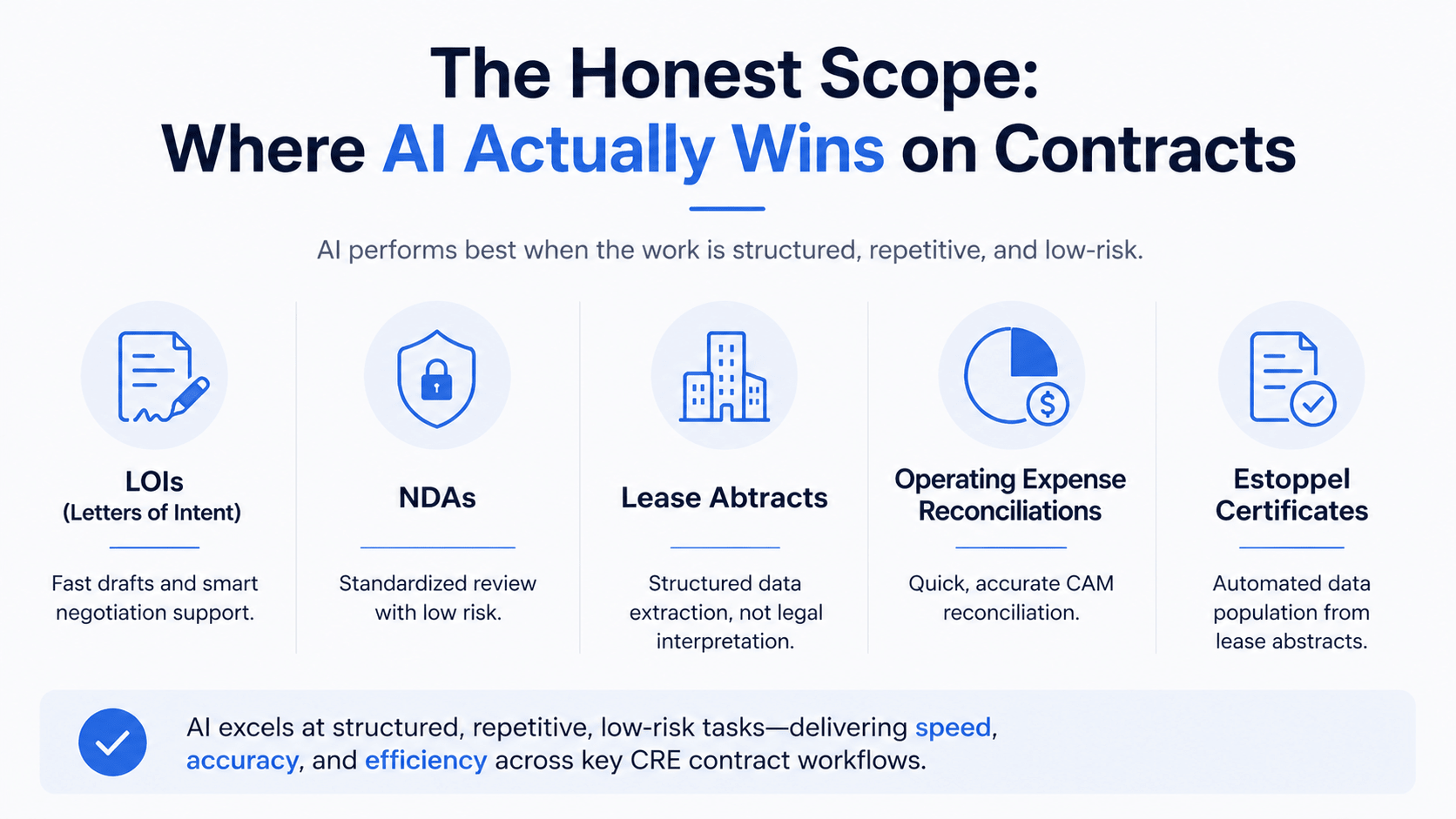
The Honest Scope: Where AI Actually Wins on Contracts
AI performs best when the work is structured, repetitive, and low-risk.
In these cases, it delivers significant time savings without putting your deal at risk.
LOIs (Letters of Intent)
LOIs are non-binding by design. That makes them one of the safest and most effective use cases for AI.
If something is missed or phrased incorrectly, it can be negotiated later in the purchase agreement. That creates a strong upside with limited downside.
In practice, AI can:
-
Redline full LOIs in minutes
-
Suggest negotiation strategies
-
Highlight key risks
-
Add structured comments to each change
Instead of starting from scratch, you begin with a nearly complete draft and refine it.
NDAs
NDAs follow predictable structures, which makes them well-suited for AI review.
AI can quickly identify:
-
Term length
-
Geographic scope
-
Confidentiality exclusions
-
Residual knowledge clauses
Because these agreements are standardized, the risk of major errors is low. Using AI for a first-pass NDA review is highly efficient.
Lease Abstracts
Lease abstraction is one of the highest-value applications of AI in CRE.
This is structured data extraction, not legal interpretation.
AI can reliably pull:
-
Rent schedules
-
Escalations
-
Renewal options
-
CAM structures
-
Exclusivity clauses
The result is clean, organized data that can be used directly in underwriting or asset management workflows.
Operating Expense Reconciliations
AI can review CAM reconciliations against lease terms quickly and accurately.
This helps asset managers:
-
Identify discrepancies
-
Validate pass-through expenses
-
Compare actual costs to lease provisions
It transforms a manual review process into a fast analytical workflow.
Estoppel Certificates
Estoppels are largely a data population task.
AI can take lease abstracts and generate:
-
Tenant confirmations
-
Lease summaries
-
Financial obligations
This removes repetitive work and significantly improves efficiency for asset management teams.
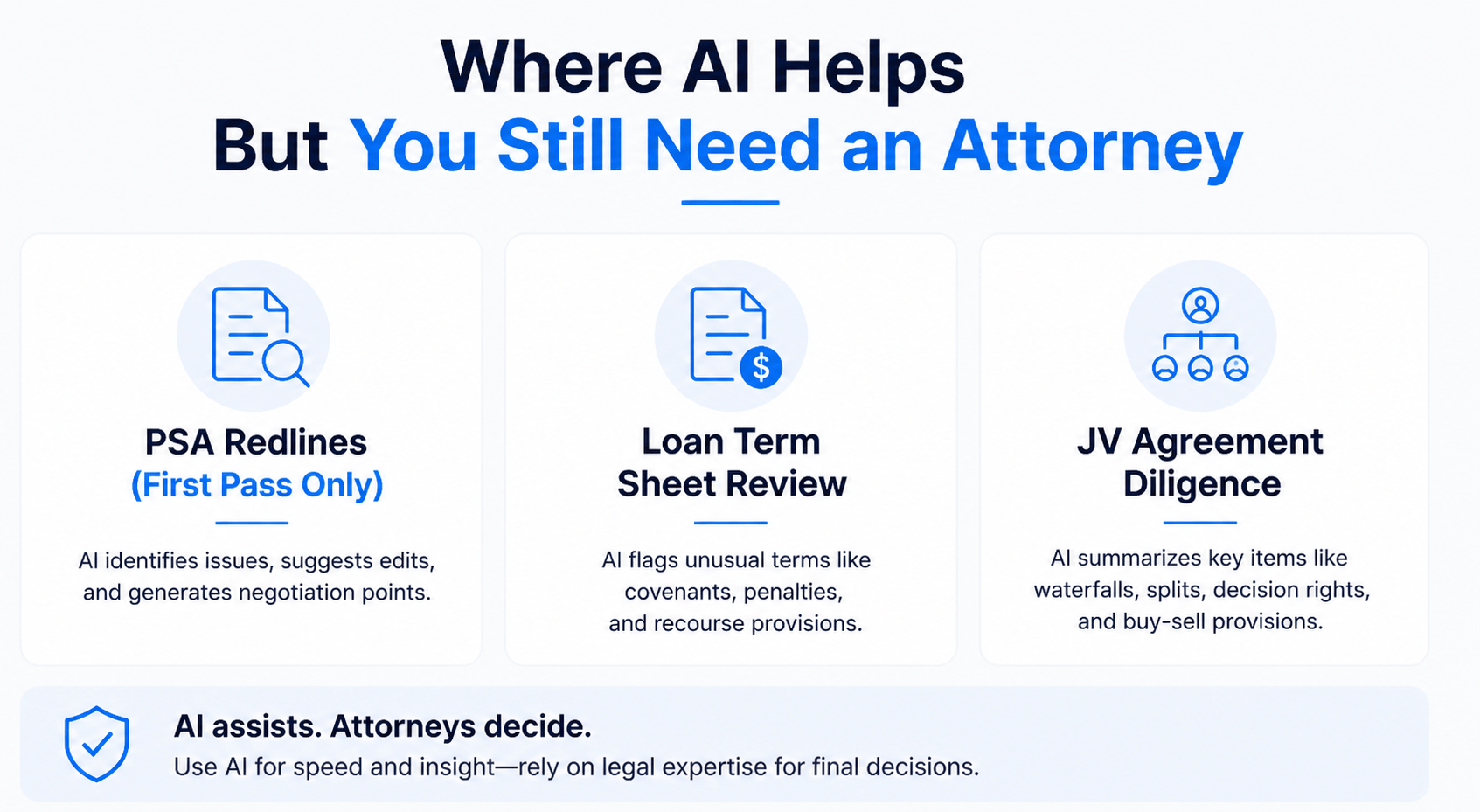
Where AI Helps But You Still Need an Attorney
There is a middle category where AI is useful, but not sufficient on its own. These are best approached as AI-assisted workflows with attorney validation.
PSA Redlines (First Pass Only)
AI is effective at:
-
Identifying problematic clauses
-
Suggesting edits
-
Generating negotiation points
However, it should not be relied on for final decisions.
The optimal workflow:
-
AI produces the first markup
-
You review and refine it
-
Your attorney completes the negotiation
This reduces legal costs while maintaining protection.
Loan Term Sheet Review
AI can quickly flag:
-
Unusual covenants
-
Prepayment penalties
-
Recourse provisions
This helps you ask better questions and understand the structure of the deal.
However, the final evaluation should always involve your attorney.
JV Agreement Diligence
AI can summarize:
-
Waterfall structures
-
Promote splits
-
Major decision rights
-
Buy-sell provisions
This creates clarity and saves time.
But interpretation and negotiation still require legal expertise.
Where You Should NOT Use AI
This is where mistakes become expensive. AI can produce outputs that appear correct but contain subtle errors.
Final Contract Review on Binding Deals
If you are signing a document, AI should not be the final reviewer.
A qualified attorney must validate:
-
Legal language
-
Risk exposure
-
Enforceability
Any Document with Capital at Risk
This includes:
-
Loan agreements
-
JV agreements
-
Partnership documents
-
Guarantees
These documents contain terms that can materially impact your financial outcome. AI should not be the final decision layer.
Litigation-Related Documents
Documents tied to disputes carry high stakes.
Examples include:
-
Settlement agreements
-
Legal notices
-
Demand letters
AI is not reliable enough for this level of risk.
Anything You Are Going to Sign
This is the simplest rule:
If you are signing it, an attorney reviews it. AI should be used before legal review, not instead of it.
Quick Breakdown: Where AI Fits in CRE Contracts
| Category | Use AI? | Why |
|---|---|---|
| LOIs | Yes | Non-binding, high efficiency |
| NDAs | Yes | Standard structure, low risk |
| Lease Abstracts | Yes | Structured data extraction |
| CAM Reconciliations | Yes | Analytical review |
| Estoppels | Yes | Repetitive data population |
| PSA Redlines | Partial | First pass only |
| Loan Terms | Partial | Insight tool |
| JV Agreements | Partial | Summary only |
| Final Contracts | No | High legal risk |
| Loan Docs | No | Financial exposure |
| Litigation Docs | No | High-stakes legal impact |
Why AI Hallucinates on Contracts
AI generates content based on patterns in its training data. Contracts contain both standard boilerplate and highly specific legal language. While AI handles patterns well, it struggles with precision.
Small wording differences can change the meaning significantly:
-
“Shall” vs “may.”
-
“Including” vs “including without limitation.”
-
“Net” vs “gross”
AI can produce text that appears correct but carries a different legal meaning. This is why human review remains essential.
The Right Workflow
The most effective approach combines AI efficiency with legal expertise. For example, if you want to take this further, you can build a full automated deal underwriting workflow that handles document review, extraction, and analysis before legal review even starts.
Here’s a real example of how AI is actually used inside a contract review workflow from start to finish.
Step-by-Step Process
-
Obtain the contract document
-
Run it through AI (Claude, Pulse, or Manus)
-
Use a clear instruction such as: “Review this as my representative and identify risks.”
-
Review all suggested changes
-
Accept or reject edits
-
Send the marked-up document to your attorney
-
Let your attorney handle the final review and negotiation
Why This Works
-
AI handles repetitive work
-
You maintain control over decisions
-
Your attorney focuses on high-impact issues
The result is faster execution, lower legal costs, and stronger deal clarity.
Final Takeaway
AI is not replacing attorneys in commercial real estate. It is removing low-value work and improving efficiency across the deal process. Used correctly, it accelerates workflows and improves outcomes.
Used incorrectly, it introduces risk into the most important documents you handle.
The principle is straightforward:
AI handles the first 70 percent. Your attorney handles the final 30 percent. That is where the real advantage comes from.
Want More Workflows Like This?
Inside the AI for CRE Collective, we test real AI tools on real CRE workflows every week.
You get:
-
Proven prompts
-
Step-by-step workflows
-
Detailed video walkthroughs
-
Access to a growing community of CRE professionals
FAQs Regarding AI CRE Contract Workflow
1. What is an AI CRE contract workflow?
An AI CRE contract workflow is a structured process that uses artificial intelligence to review, analyze, and prepare real estate contracts before legal review.
-
Automates initial document review and redlining
-
Identifies risks and unfavorable clauses
-
Generates summaries and negotiation points
Conclusion: It helps CRE professionals move faster while improving clarity before involving attorneys.
2. When should you use an AI CRE contract workflow?
You should use it during early-stage and non-binding document review.
-
LOIs and NDAs
-
Lease abstraction and data extraction
-
Preliminary contract analysis
Conclusion: It is most effective when speed matters and legal risk is still manageable.
3. When should you avoid using AI on CRE contracts?
AI should not be used as the final decision layer for high-risk documents.
-
Binding agreements like PSAs
-
Loan and partnership documents
-
Litigation-related contracts
Conclusion: If financial or legal risk is high, a qualified attorney must take over.
4. How does an AI CRE contract workflow improve deal efficiency?
It removes repetitive tasks and speeds up document analysis.
-
Reduces manual review time
-
Provides structured insights instantly
-
Shortens turnaround before legal review
Conclusion: It accelerates deal timelines without compromising preparation quality.
5. Can an AI CRE contract workflow replace real estate attorneys?
No, it is designed to support, not replace, legal professionals.
-
Handles first-pass analysis
-
Flags potential issues early
-
Leaves final validation to attorneys
Conclusion: The best results come from combining AI efficiency with legal expertise.
6. What types of documents work best with AI in CRE?
AI performs best on structured and repetitive documents.
-
Letters of intent (LOIs)
-
Non-disclosure agreements (NDAs)
-
Lease abstracts and estoppels
Conclusion: Documents with predictable formats are ideal for AI-driven workflows.
7. Why is there a risk in using AI for contract review?
AI can generate text that appears correct but contains subtle legal errors.
-
Misinterprets precise legal language
-
Substitutes similar but incorrect terms
-
Lacks true legal judgment
Conclusion: Human review is essential to prevent costly mistakes.
8. What is the ideal workflow combining AI and legal review?
The most effective approach follows a structured sequence.
-
Run the contract through AI first
-
Review and refine the output yourself
-
Send the marked-up version to your attorney
-
Finalize with professional legal review
Conclusion: This hybrid workflow delivers faster results while maintaining legal protection.