How to Automate Comps Analysis Using AI and Listing Platforms
AI comps analysis is changing how commercial real estate professionals research comparable properties. What once took hours can now take minutes when AI works alongside listing platforms.
For years, brokers, analysts, investors, and developers relied on manual research. They searched multiple databases, copied information into spreadsheets, removed duplicates, and reviewed dozens of properties before finding useful comparables. The process worked, but it consumed valuable time.
Today, AI comps analysis helps teams organize data faster and identify relevant comparable properties more efficiently. Instead of spending most of the day collecting information, professionals can spend more time reviewing opportunities and making decisions.
This does not mean AI replaces human judgment. Commercial real estate remains a relationship-driven business. Local market knowledge still matters. However, AI can handle many repetitive tasks that slow teams down.
When combined with listing platforms such as CoStar, Crexi, LoopNet, and CommercialEdge, AI becomes a practical research assistant. It can sort listings, compare property characteristics, highlight trends, and generate summaries that help professionals move faster.
The biggest benefit is not automation itself. The real benefit is time. Every hour saved on research can be spent on client relationships, underwriting, negotiations, and deal sourcing.
In this guide, you will learn how AI comps analysis works, where it delivers the most value, and how CRE professionals are already using it to improve productivity.
Table of Contents
ToggleKey AI & CRE Productivity Statistics
The growing adoption of AI across business and commercial real estate is not happening by accident. Companies are investing in these tools because they save time and improve efficiency.
Some important numbers include:
McKinsey estimates generative AI could add trillions in annual productivity value across industries.
Deloitte reports that many commercial real estate firms are actively exploring AI adoption.
AI-assisted workflows can significantly reduce repetitive research tasks.
Real estate firms increasingly use AI for research, reporting, and operational efficiency.
CRE technology investments continue to rise as firms seek productivity improvements.
These trends matter because comps research remains one of the most repetitive activities in commercial real estate. AI comps analysis directly addresses that challenge.
Why These Statistics Matter for CRE Teams
Most CRE professionals do not struggle because they lack information. They struggle because there is too much information.
A single market survey can include hundreds of properties. An investment analyst may review dozens of comparable sales before completing a recommendation. A broker preparing a broker’s opinion of value may spend hours gathering lease and sales data.
AI helps reduce that workload. Instead of manually sorting large datasets, professionals can focus on reviewing the strongest comparable properties. This creates a faster workflow without sacrificing quality.
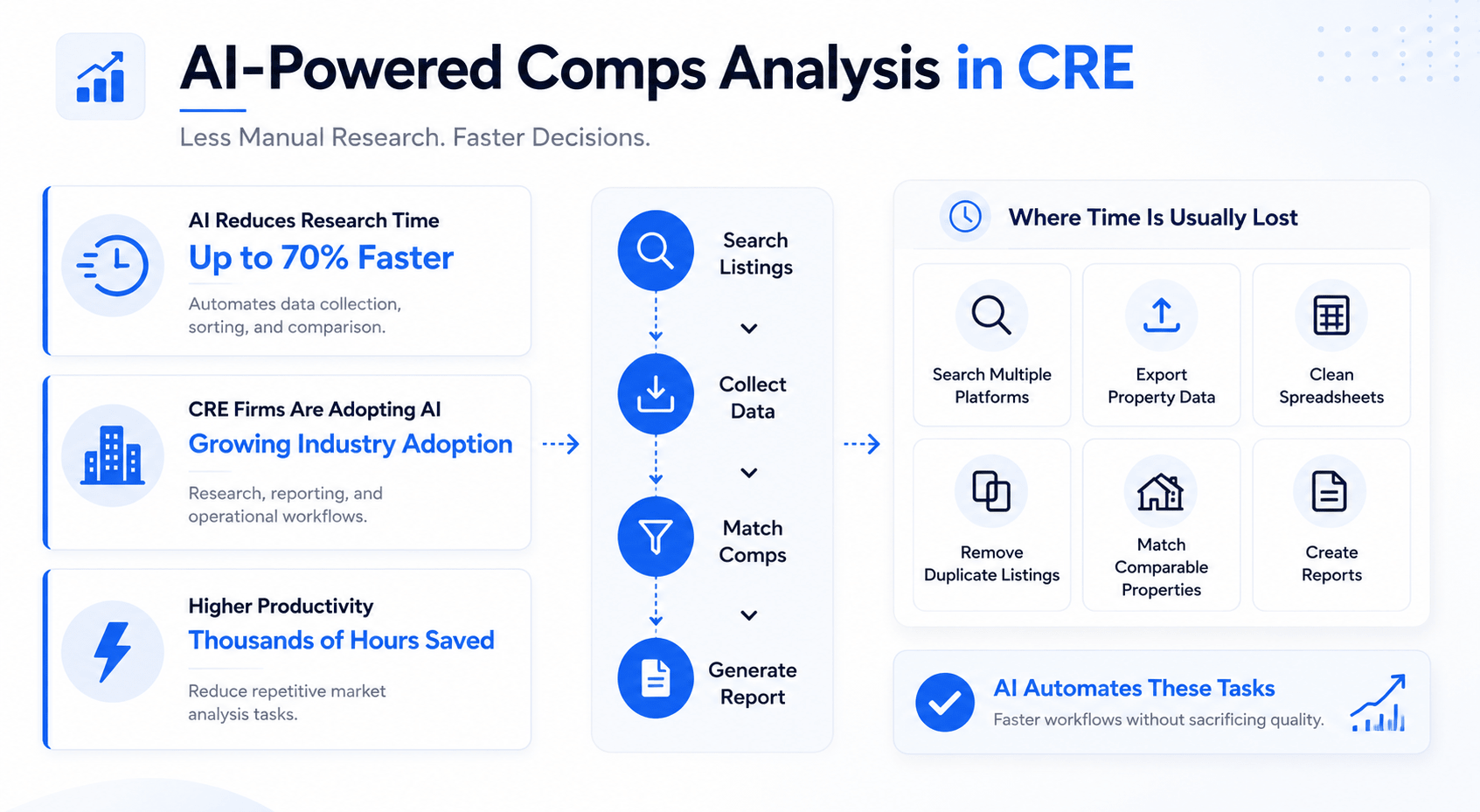
Where Time Is Usually Lost
The biggest productivity issues usually come from:
Searching multiple listing platforms
Exporting property data
Cleaning spreadsheets
Removing duplicate listings
Matching comparable properties
Creating reports
AI comps analysis helps reduce the time spent on each of these tasks.
What Is Comps Analysis in Commercial Real Estate?
Comps analysis is the process of comparing a property against similar properties in the market. These comparable properties help estimate value, rental rates, pricing strategy, and investment potential.
Without accurate comparables, valuations become less reliable. That is why comps analysis remains one of the most important activities in commercial real estate.
Types of Comparable Properties
Different situations require different types of comparables.
Common examples include:
Sales comparables
Lease comparables
Market comparables
Competitive property comparisons
For example, an investor buying a multifamily property may focus on recent sales transactions. A leasing broker may focus more on lease comparables and current asking rents.
Why Comps Analysis Matters
Comparable property analysis supports many CRE activities.
These include:
Property valuation
Investment underwriting
Acquisition analysis
Broker opinions of value
Rent forecasting
Development feasibility studies
Good comparables improve decision-making. Poor comparables can lead to pricing mistakes and missed opportunities.
Common Data Sources Used for Comparables
Most CRE professionals collect data from several sources.
Popular options include:
CoStar
Crexi
LoopNet
CommercialEdge
Internal company databases
Public records
Each platform contains useful information. However, data often appears in different formats. This is one reason AI comps analysis has become so valuable.
Common Sources for Comparable Property Data
Most CRE professionals combine multiple data sources to build stronger comparable property datasets.
What Makes a Good Comparable Property?
Not every nearby property is a true comparable.
Strong comparables usually share similar:
Property type
Building size
Construction quality
Occupancy profile
Location
Transaction timing
For example, comparing a newly built Class A office building with an older Class C property may create misleading conclusions.
This is another area where AI comps analysis helps. AI can quickly review large datasets and identify properties with similar characteristics.
Instead of reviewing hundreds of listings manually, professionals can narrow the list faster and focus on the most relevant opportunities.
Why Traditional Comps Analysis Is Slow
Most commercial real estate professionals understand the value of good comparable data. The challenge is not finding information. The challenge is finding the right information quickly.
Even with modern listing platforms, many teams still spend hours gathering, cleaning, and reviewing data. As deal volume grows, the process becomes harder to manage.
This is one reason AI comps analysis is becoming more common across CRE firms. Before understanding how AI helps, it is important to understand where traditional workflows slow down.
Manual Data Collection Creates Bottlenecks
Most comps research starts with gathering information from multiple sources.
A broker may review CoStar for transactions, Crexi for active listings, LoopNet for market inventory, and internal databases for historical deals. Each platform stores information differently.
As a result, professionals often spend significant time:
Searching for comparable properties
Exporting reports
Comparing datasets
Organizing spreadsheets
Verifying property details
These tasks are necessary, but they add little strategic value.
Different Platforms Use Different Data Formats
Data consistency is a common challenge. One platform may report rent as annual rates. Another may use monthly figures. Building sizes may be measured differently. Property classifications may also vary between sources.
Before meaningful analysis begins, someone must standardize the information.
Common issues include:
Different address formats
Missing property details
Inconsistent rent calculations
Duplicate listings
Outdated transaction records
Without cleanup, the final comps report may contain errors.
Spreadsheet Work Consumes Valuable Time
Many CRE teams still rely heavily on spreadsheets. Spreadsheets remain useful, but they create extra work when handling large datasets. Analysts often spend hours sorting rows, creating filters, and checking formulas.
The larger the market area, the more difficult this becomes. For example, an industrial market survey may contain hundreds of properties. Reviewing every record manually requires significant effort.
Where Traditional Comps Analysis Time Is Spent
| Task | Typical Manual Effort | Common Challenge |
|---|---|---|
| Collecting listings | High | Multiple platforms |
| Exporting data | Medium | Different file formats |
| Cleaning records | High | Duplicate information |
| Selecting comparables | High | Large datasets |
| Creating reports | Medium | Manual formatting |
| Reviewing results | Medium | Human error risk |
Finding True Comparable Properties Is Difficult
Not every nearby property is a valid comparable. Many properties may look similar at first glance but differ in important ways.
Factors that affect comparability include:
Building age
Property class
Tenant mix
Occupancy levels
Renovation history
Access to transportation
Market conditions
A manual review process often requires professionals to examine dozens of properties before identifying a handful of useful comparables. This slows down underwriting, valuation, and investment decisions.
Human Errors Can Affect Results
Even experienced professionals make mistakes when reviewing large amounts of data.
Common errors include:
Missing important transactions
Selecting weak comparables
Using outdated information
Applying incorrect adjustments
Overlooking market changes
These issues can affect valuations and investment recommendations. The problem becomes larger when teams handle multiple assignments simultaneously.
Reporting Often Takes Longer Than Expected
After the research is complete, the information must still be presented.
Many professionals spend additional hours:
Creating charts
Formatting reports
Writing summaries
Preparing presentations
Explaining market trends
In some cases, reporting takes almost as much time as the research itself.
Why Traditional Workflows Struggle to Scale
Traditional comps analysis works reasonably well for small assignments. However, as deal activity increases, the process becomes difficult to scale.
A brokerage team covering multiple markets may need to evaluate hundreds of properties every month. An acquisitions team may review dozens of opportunities each week.
The workload grows faster than the available time. This is where AI comps analysis starts creating measurable value. AI can process large datasets, identify patterns, and organize information much faster than manual workflows.
Instead of spending hours gathering and cleaning data, professionals can focus on interpreting results and making better decisions.
How AI Changes Comps Analysis
AI is not replacing commercial real estate professionals. It is helping them complete repetitive work faster.
The biggest advantage of AI comps analysis is speed. AI can review large datasets in minutes and highlight the information that matters most.
Rather than manually sorting hundreds of records, professionals can focus on evaluating opportunities.
As a result, many CRE teams are using AI to reduce deal analysis time by automating repetitive research and reporting tasks.
AI Automates Repetitive Tasks
Many tasks in comps analysis follow predictable patterns.
These include:
Organizing property records
Categorizing listings
Standardizing data
Detecting duplicates
Matching comparable properties
Generating summaries
These activities consume hours when done manually. AI can complete much of this work automatically.
AI Improves Property Matching
One of the most useful applications of AI comps analysis is identifying comparable properties.
Traditional filtering often relies on simple criteria such as:
Building size
Location
Property type
AI can evaluate additional factors simultaneously, including:
Building quality
Market position
Recent transaction history
Tenant characteristics
Property features
This creates stronger comparable selections.
AI Helps Identify Market Trends Faster
Market trends are often hidden within large datasets.
AI can quickly identify patterns such as:
Rising rental rates
Declining vacancy
Increased sales activity
Shifting demand by asset class
Finding these patterns manually requires substantial research. AI reduces that effort significantly.
AI Produces Faster Reports
Many CRE professionals spend hours preparing reports after completing their analysis.
AI can help generate:
Property summaries
Market overviews
Comparable explanations
Executive summaries
Investment highlights
Human review is still important, but the first draft can be produced much faster.
What AI Does Well and What Still Requires Humans
| Activity | AI Performance | Human Expertise Needed |
|---|---|---|
| Data organization | Excellent | Low |
| Duplicate detection | Excellent | Low |
| Comparable screening | Very Good | Medium |
| Market interpretation | Moderate | High |
| Investment decisions | Limited | Very High |
| Client recommendations | Limited | Very High |
The Real Benefit of AI Comps Analysis
The goal is not to remove people from the process. The goal is to remove unnecessary work.
When AI handles data-heavy tasks, brokers, analysts, investors, and developers can spend more time on:
Client relationships
Negotiations
Investment strategy
Market insights
Deal execution
That combination of human expertise and automation is what makes AI comps analysis valuable for modern CRE teams.
Stop Spending Hours on Comps Research
Join CRE professionals using tested AI workflows, deal analysis systems, prompt libraries, and automation playbooks built specifically for commercial real estate.
Join Community Free NewsletterThe Complete AI-Powered Comps Workflow
Understanding AI is one thing. Applying it to real-world comps analysis is another. Many CRE professionals assume they need advanced technical skills to automate their workflow. In reality, most teams can start with tools they already use.
The most effective AI comps analysis workflows follow a simple process. Data is collected, cleaned, analyzed, reviewed, and turned into a report. The goal is not full automation. The goal is faster and more consistent analysis.
Want to see a real example of AI-powered property screening? This walkthrough shows how an AI agent can review opportunities and surface the strongest deals faster.
Step 1: Collect Property Data From Listing Platforms
Every comps analysis starts with data collection. Most professionals pull information from several sources because no single platform contains everything.
Common sources include:
CoStar
Crexi
LoopNet
CommercialEdge
Public records
Internal transaction databases
Focus on gathering:
Property addresses
Building size
Sale price
Price per square foot
Rental rates
Occupancy data
Year built
Property class
The quality of your output depends heavily on the quality of your input. Poor data leads to poor analysis.
Data Collection Checklist
Before moving to the next step, verify that you have:
Recent transactions
Active listings
Similar property types
Consistent geographic boundaries
Complete property details
Current market information
Skipping this review often creates problems later.
Step 2: Import Data Into Your AI Workflow
After collecting data, move it into a system that AI can process.
Most teams use:
Excel
Google Sheets
ChatGPT
Claude
Airtable
Notion
CRM databases
The process is usually straightforward. Export listing data as a spreadsheet and upload it into your preferred workflow. At this stage, AI comps analysis begins to reduce manual work.
Step 3: Clean and Standardize Property Records
Data cleanup is often the most time-consuming part of traditional comps analysis.
AI can dramatically reduce this workload.
Common cleanup tasks include:
Removing duplicate listings
Standardizing addresses
Fixing formatting issues
Identifying missing fields
Converting measurements
Aligning rent formats
For example, one platform may display annual rent while another displays monthly rent. AI can help standardize these figures quickly.
Manual vs AI Data Preparation
| Task | Manual Process | AI-Assisted Process |
|---|---|---|
| Duplicate Detection | Review line by line | Automated identification |
| Address Cleanup | Manual editing | Automatic standardization |
| Data Categorization | Manual sorting | Instant grouping |
| Rent Normalization | Formula creation | Automated conversion |
Step 4: Identify the Best Comparable Properties
This is where AI comps analysis starts producing the biggest productivity gains. Instead of manually reviewing hundreds of records, AI can narrow the list to the most relevant candidates.
The system can evaluate:
Property size
Asset type
Building class
Sale timing
Rent levels
Geographic proximity
Occupancy trends
Rather than reviewing every property individually, professionals receive a smaller list of likely comparables. This reduces research time significantly.
Step 5: Rank Comparables by Relevance
Not all comparable properties carry equal value. Some properties closely match the subject asset. Others only share a few characteristics. AI can score comparables based on similarity.
A ranking system may prioritize:
Same property type
Similar size range
Similar age
Similar location
Recent transaction date
This approach creates a more structured selection process. Instead of guessing which properties deserve attention, analysts can start with the strongest candidates.
Example of AI-Based Comparable Ranking
Imagine a 120,000-square-foot industrial property in Dallas.
AI might rank comparables based on:
Building size similarity
Distance from subject property
Construction year
Occupancy history
Recent sales activity
The result is a focused shortlist rather than a large spreadsheet.
Step 6: Generate Initial Analysis
After selecting comparables, AI can create an initial summary.
Common outputs include:
Property comparison summaries
Rent comparisons
Sales comparisons
Market observations
Pricing recommendations
This step saves considerable reporting time. Instead of writing from scratch, professionals review and refine the generated content.
Step 7: Apply Human Review
This step is critical. AI should support decisions, not make them.
Local market expertise remains essential.
Professionals should review:
Comparable selections
Market assumptions
Outlier properties
Pricing conclusions
Investment recommendations
Human judgment remains the final quality-control layer.
Common Review Questions
Before finalizing your analysis, ask:
Are the comparables truly similar?
Are there major market changes affecting results?
Is any important transaction missing?
Are there unusual properties skewing the data?
Does the conclusion make sense in today’s market?
These questions help prevent weak recommendations.
Step 8: Produce the Final Report
Once the analysis is complete, AI can help organize findings into a presentation-ready format.
Common deliverables include:
Broker’s opinion of value reports
Acquisition memos
Market reports
Client presentations
Investment summaries
The final report should remain simple and focused. Decision-makers care about insights, not spreadsheets.
A Typical AI Comps Analysis Workflow
Most successful CRE teams follow a process similar to this:
Export property data
Clean records with AI
Identify comparable properties
Rank comparables
Review recommendations
Create summaries
Finalize report
Present findings
The workflow is simple, repeatable, and scalable.
Why This Process Works
Traditional comps analysis often requires several hours for a single assignment. An AI-assisted workflow reduces repetitive tasks and allows professionals to focus on interpretation.
The biggest improvements typically come from:
Faster data cleanup
Better comparable identification
Faster report generation
More consistent analysis
As deal volume increases, these time savings become even more valuable.
Best Listing Platforms for Automated Comps Analysis
AI performs best when it has strong data to work with. That is why choosing the right listing platform matters.
No platform is perfect for every market, asset type, or investment strategy. Most CRE professionals use a combination of tools depending on the assignment.
The good news is that most major listing platforms can support AI comps analysis when data is exported into spreadsheets or connected through integrations.
The key is understanding what each platform does well.
CoStar
CoStar remains one of the most widely used commercial real estate databases.
Many brokers, investors, lenders, and analysts rely on it for transaction data, market research, and comparable properties.
Strengths
Extensive property database
Strong sales and lease comp coverage
Detailed market reports
Historical transaction records
Broad geographic coverage
Limitations
Expensive subscription costs
Learning curve for new users
Some smaller markets may have limited data depth
Best Use Cases
Investment sales
Institutional acquisitions
Market research
Valuation support
Lease comparable analysis
For many large CRE firms, CoStar serves as the primary source for AI comps analysis.
Crexi
Crexi has grown rapidly among brokers and investors.
Its marketplace structure makes it useful for finding active listings and tracking market activity.
Strengths
Easy-to-use interface
Strong listing inventory
Growing transaction database
Useful property marketing tools
Limitations
Historical data can be less comprehensive than CoStar
Market coverage varies by location
Best Use Cases
Active listing research
Broker prospecting
Market activity monitoring
Investment sourcing
Crexi works particularly well when paired with AI for identifying active market comparables.
LoopNet
LoopNet remains one of the most recognized commercial property listing platforms.
Many property owners and brokers use it to market assets.
Strengths
Large listing inventory
Broad national exposure
Frequent listing updates
Easy property searches
Limitations
Limited transaction depth
Less detailed comparable data
Some listings contain incomplete information
Best Use Cases
Active listing analysis
Market surveys
Competitive property reviews
For AI comps analysis, LoopNet often serves as a supplemental source rather than a primary data provider.
CommercialEdge
CommercialEdge focuses heavily on property intelligence and market research.
Many analysts use it to gather detailed property information.
Strengths
Detailed building information
Ownership data
Tenant intelligence
Market-level insights
Limitations
Coverage varies by region
Less commonly used than CoStar
Best Use Cases
Market research
Competitive analysis
Tenant studies
Property intelligence
CommercialEdge can add valuable context to an AI-assisted workflow.
Internal Deal Databases
Many firms overlook one of their most valuable resources. Their own historical transactions. Past acquisitions, lease negotiations, and broker assignments often contain highly relevant comparable data.
Strengths
Highly relevant information
Trusted internal records
Real transaction outcomes
Consistent formatting
Limitations
Limited size
May not reflect current market conditions
Requires ongoing maintenance
Internal databases often produce the most useful comparables because they reflect actual business activity.
Listing Platform Comparison for AI Comps Analysis
Choosing the right data source is just as important as choosing the right AI tool.
CoStar ↗
Best For: Sales & Lease Comps
Data Depth: Very High
Ease of Use: Medium
AI Compatibility: High
Premium OptionCrexi ↗
Best For: Active Listings
Data Depth: High
Ease of Use: High
AI Compatibility: High
Best ValueLoopNet ↗
Best For: Market Surveys
Data Depth: Medium
Ease of Use: High
AI Compatibility: Medium
Supplemental SourceCommercialEdge ↗
Best For: Property Intelligence
Data Depth: High
Ease of Use: Medium
AI Compatibility: High
Research FocusedWhich Platform Is Best for AI Comps Analysis?
The answer depends on your goals. If you need the deepest transaction data, CoStar often leads you; if you focus on active opportunities, Crexi may provide more value, and if you want additional market visibility, LoopNet can help.
If you need ownership and tenant insights, CommercialEdge can be useful. Many of the strongest workflows combine multiple sources.
For example:
CoStar for historical sales
Crexi for active listings
Internal database for company transactions
AI for ranking and analysis
This approach produces more reliable comparable property selections.
Building a Practical Platform Stack
Most successful CRE professionals do not rely on a single platform.
A practical setup often looks like:
Core Data Source
CoStar or Crexi
Market Verification
LoopNet
Property Intelligence
CommercialEdge
Analysis Layer
ChatGPT or Claude
Reporting Layer
Excel or Google Sheets
This structure keeps the workflow simple while improving research quality.
Common Platform Mistakes
Many professionals reduce the effectiveness of AI comps analysis by making a few avoidable mistakes.
These include:
Using only one data source
Ignoring outdated transactions
Failing to clean the exported data
Mixing different property classes
Trusting platform filters without verification
Even the best platforms require human review. The goal is not perfect automation. The goal is better decision-making with less manual work.
Tools That Actually Work vs Hype
The AI market is full of tools claiming to automate commercial real estate analysis. Some deliver meaningful results. Others create more work than they save.
For CRE professionals, practical value matters more than flashy features. The best tools help with research, organization, analysis, and reporting.
Tools That Actually Work vs Hype
Not every AI tool delivers practical value for commercial real estate. Some tools save hours every week. Others create extra work because the outputs need extensive corrections.
For most CRE professionals, the goal is simple. Use tools that improve research, reporting, and comps analysis without adding complexity.
Tools That Deliver Practical Results
ChatGPT
Best for:
Comparable property summaries
Market research
Report drafting
Data interpretation
Property comparisons
Strengths:
Easy to use
Fast outputs
Flexible prompts
Strong reporting support
Claude
Best for:
Large datasets
Long reports
Market analysis
Document review
Strengths:
Handles large documents well
Strong analytical summaries
Detailed explanations
Excel + AI
Best for:
Spreadsheet analysis
Data cleanup
Formula support
Comparable calculations
Strengths:
Familiar workflow
Easy adoption
Strong reporting capabilities
Zapier
Best for:
Workflow automation
Data movement between systems
Repetitive administrative tasks
Strengths:
Reduces manual work
Connects multiple platforms
Requires minimal coding
Tools That Often Create More Work
Some AI products promise instant valuations and fully automated underwriting.
Common problems include:
Limited transparency
Weak data sources
Poor comparable selection
Lack of market context
These tools may produce impressive dashboards, but they often require significant human review.
Practical AI Tools for CRE Professionals
The most useful tools are usually the simplest ones. Focus on workflows, not hype.
ChatGPT ↗
Claude ↗
Excel + AI ↗
Zapier ↗
Before vs After Productivity Comparison
One of the biggest benefits of AI comps analysis is time savings. Most CRE professionals do not struggle with understanding comparables. They struggle with the amount of work required to gather and organize data.
When repetitive tasks are automated, analysts can spend more time evaluating opportunities and less time managing spreadsheets.
For example, if you’re evaluating several opportunities at once, this guide shows how we used AI to compare multiple CRE deals side-by-side and speed up decision-making.
Before vs After AI Comps Analysis
Traditional Workflow
- Collect Property Data: 1–2 Hours
- Clean Records: 1 Hour
- Find Comparables: 1–2 Hours
- Create Summaries: 30–60 Minutes
- Build Report: 1 Hour
AI-Assisted Workflow
- Collect Property Data: 20–30 Minutes
- Clean Records: 10–15 Minutes
- Find Comparables: 20–30 Minutes
- Create Summaries: 5–10 Minutes
- Build Report: 20–30 Minutes
Example: Broker Pricing Assignment
A broker preparing a broker’s opinion of value may need to review dozens of sales and lease transactions.
Traditionally, the process involves exporting data, filtering properties, checking comparables, and building a report manually.
With AI comps analysis, much of the sorting and summarization happens automatically. The broker can focus on reviewing the strongest comparables and explaining market conditions to the client.
Example: Acquisition Analysis
An acquisitions team may review several properties every week. Instead of rebuilding spreadsheets for every opportunity, AI can help standardize the process.
Comparable properties can be identified faster, and investment memos can be generated more efficiently. The result is a more consistent workflow across the entire team.
Example: Development Feasibility Review
Developers often need comparable rents, sales prices, and market trends before moving forward with a project.
AI can help organize this information quickly, making it easier to evaluate project assumptions and identify potential risks.
The biggest advantage is not replacing expertise. It is giving professionals more time to use that expertise where it matters most.
Real-World Use Cases of Automated Comps Analysis
AI comps analysis is most valuable when applied to real business situations. The technology is not just for research. It supports faster decisions across brokerage, investing, development, and asset management.
Broker Pricing Assignments
Brokers frequently need to determine a realistic asking price for a property.
Instead of manually reviewing dozens of comparable properties, AI can help organize lease and sales data, identify the strongest comparables, and generate an initial summary.
This allows brokers to spend more time discussing strategy with clients and less time preparing spreadsheets.
Multifamily Acquisitions
Investors often evaluate multiple opportunities within a short period. AI can help compare recent sales, rental rates, occupancy trends, and property characteristics across a market.
This creates a faster screening process and helps acquisition teams focus on the most promising opportunities.
Retail Site Selection
Retail investors and developers rely heavily on local market data. AI can organize comparable rents, competing properties, and nearby transactions to support location decisions.
While human judgment remains critical, AI reduces the time required to gather supporting information.
Industrial Market Research
Industrial markets generate large amounts of data. AI can quickly sort properties by building size, age, location, and transaction history.
This helps brokers and investors identify relevant comparables without reviewing hundreds of records manually.
Development Feasibility Studies
Developers often need market evidence before moving forward with a project. Comparable rents, sales prices, and competing developments help determine whether a project is financially viable.
AI can organize this information into a clear framework that supports faster decision-making.
What Most CRE Professionals Get Wrong About AI
Many professionals either expect too much from AI or avoid it completely. Both approaches can limit the value of AI comps analysis.
Assuming AI Replaces Market Knowledge
AI can process data quickly, but it does not understand local markets like an experienced professional. Neighborhood trends, tenant demand, political factors, and development activity still require human interpretation.
Trusting Every Suggested Comparable
Not every property selected by AI is a true comparable.
Professionals should always review:
Property condition
Building quality
Location differences
Timing of transactions
Unique market factors
Verification remains an important step.
Ignoring Data Quality
Even the best AI tools cannot fix poor data automatically. Outdated transactions, missing fields, and duplicate records can reduce accuracy. Good inputs produce better outputs.
Using Generic Prompts
Many users ask vague questions and receive vague answers. More detailed prompts generally produce better analysis, stronger summaries, and more useful comparable selections.
Automating Without a Review Process
The strongest workflows combine automation with professional oversight. AI should support analysis, not replace responsibility for final recommendations.
Common AI Mistakes in CRE
- Trusting every AI-generated comparable
- Using outdated transaction data
- Ignoring local market context
- Skipping human review
- Using vague prompts
Conclusion
AI comps analysis helps commercial real estate professionals reduce repetitive work and improve efficiency.
The biggest benefits come from faster data collection, better comparable selection, streamlined reporting, and more consistent workflows.
However, AI works best when paired with quality data and human expertise. Market knowledge, professional judgment, and local experience remain essential.
For most CRE teams, the goal is not full automation. The goal is to spend less time on manual research and more time on decisions that drive results.
See How Leading CRE Teams Use AI
Access real workflows, prompt libraries, deal analysis systems, tool reviews, and practical AI training designed specifically for commercial real estate.
Join the CommunityFrequently Asked Questions
What is AI comps analysis in commercial real estate?
AI comps analysis uses artificial intelligence to identify, organize, and compare similar commercial properties. It helps brokers, investors, and analysts review sales comps, lease comps, and market data faster. Instead of manually sorting large datasets, AI can highlight the most relevant comparable properties and generate summaries for review.
Can AI fully automate comps analysis?
No. AI can automate data collection, cleaning, organization, and reporting, but human expertise remains essential. Market knowledge, property condition, tenant quality, and local factors still require professional judgment. The best results come from combining AI automation with analyst review.
Which listing platforms work best with AI comps analysis?
CoStar, Crexi, LoopNet, and CommercialEdge are commonly used for AI comps analysis. These platforms provide property and transaction data that AI tools can process. Many CRE professionals use multiple platforms together to improve comparable selection and market coverage.
How accurate is AI comps analysis?
AI comps analysis can be highly accurate when it uses reliable data sources and proper review processes. Accuracy depends on the quality of the comparable properties, market data, and user prompts. AI should support decision-making rather than replace final analysis.
How much time can AI save during comps research?
Many CRE professionals reduce research time by several hours per assignment. AI can quickly clean datasets, identify comparable properties, generate summaries, and organize reports. The largest savings usually come from eliminating repetitive spreadsheet work.
What data is needed for AI comps analysis?
Most workflows require property addresses, building size, sale prices, rental rates, property type, year built, and transaction dates. Additional information such as occupancy levels and tenant details can improve comparable property selection and analysis quality.
Is ChatGPT useful for AI comps analysis?
Yes. ChatGPT can help organize property data, compare assets, summarize market trends, generate reports, and explain findings. However, it performs best when paired with trusted listing platforms and verified commercial real estate data.
What are the biggest risks of using AI for comps analysis?
The biggest risks include poor data quality, outdated transactions, weak comparable selection, and overreliance on automation. AI may miss local market nuances that experienced professionals understand. Human review remains a critical step before making decisions.
Can AI analyze both lease comps and sales comps?
Yes. AI can process both lease and sales comparable data. It can compare rental rates, sale prices, occupancy trends, building characteristics, and transaction history. This makes it useful for valuation, underwriting, and market research workflows.
What types of CRE properties benefit most from AI comps analysis?
Office, industrial, retail, multifamily, and mixed-use properties can all benefit from AI comps analysis. Markets with large amounts of transaction data often see the greatest efficiency improvements because AI can process large datasets much faster than manual workflows.
How often should comparable property databases be updated?
Comparable databases should be updated regularly, especially in active markets. Many firms review data monthly or quarterly. Current transaction data helps improve AI comps analysis accuracy and ensures that pricing recommendations reflect recent market conditions.
What is the best AI comps analysis workflow?
A strong workflow includes collecting data from listing platforms, cleaning records, identifying comparable properties, ranking matches, reviewing results, and generating reports. The final step should always include a professional review before sharing recommendations with clients or stakeholders.