How to Build an AI Competitor Tracker for CRE: Complete Guide
Commercial real estate has always been a data-driven business. Whether you’re leasing apartments, managing office portfolios, acquiring industrial assets, or developing mixed-use projects, success often comes down to how quickly you identify market shifts compared to your competitors. The problem is that most competitive intelligence processes are reactive. Leasing teams discover concessions after prospects mention them. Asset managers notice occupancy declines after they show up in quarterly reports. Acquisition teams learn about distressed opportunities after other investors have already made offers. An AI Competitor Tracker for CRE changes this process completely.
Instead of manually checking listing sites, property websites, permit portals, ownership records, news sources, and social channels, AI can continuously monitor competitor activity and deliver organized reports automatically. The result is faster market awareness, better decision-making, and a significant competitive advantage.
As artificial intelligence becomes increasingly integrated into commercial real estate operations, competitor tracking is emerging as one of the highest-value use cases. It requires relatively little setup while producing insights that directly affect leasing performance, asset value, acquisition strategy, and portfolio growth.
Why Competitive Intelligence Matters in Commercial Real Estate
Every commercial real estate market operates as a competitive ecosystem.
-
Property owners compete for tenants.
-
Developers compete for absorption.
-
Investors compete for acquisitions.
-
Brokers compete for listings.
-
The challenge is that meaningful market changes rarely happen overnight. Instead, they develop gradually.
-
A competing apartment community introduces a six-week concession.
-
An office landlord quietly lowers asking rents.
-
A nearby industrial property begins renovations.
-
A retail center changes ownership.
Individually, these events may appear insignificant. Together, they often signal larger market trends.
Organizations that identify these signals early gain a measurable advantage.
Traditional Competitor Research Problems
Most firms still rely on manual research methods:
-
Periodic market surveys
-
Spreadsheet tracking
-
Broker conversations
-
Listing platform reviews
-
Quarterly market reports
While useful, these methods create several limitations:
| Traditional Approach | Common Limitation |
|---|---|
| Manual research | Time intensive |
| Quarterly reports | Information arrives too late |
| Broker intelligence | Often incomplete |
| Internal spreadsheets | Quickly become outdated |
By the time information reaches decision-makers, competitors may have already adjusted their strategies. This is where AI creates substantial value.
What Is an AI Competitor Tracker for CRE?
An AI Competitor Tracker for CRE is a structured system that automatically gathers, analyzes, and summarizes information about competing properties.
Rather than conducting research manually, artificial intelligence performs recurring market scans and identifies changes worth attention.
The system continuously watches selected competitors and compares new information against historical data.
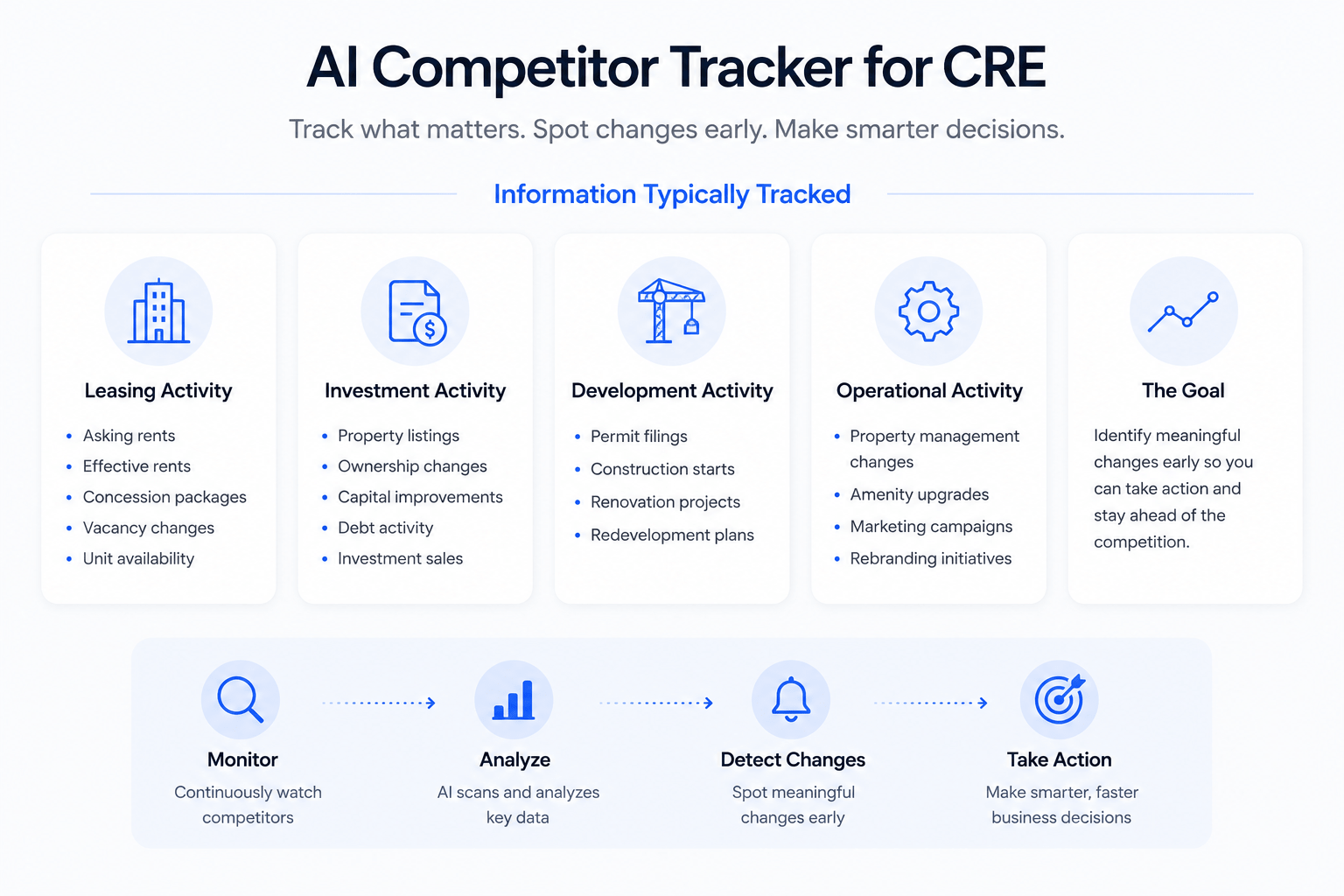
Information Typically Tracked
Most CRE operators focus on several key categories:
Leasing Activity
-
Asking rents
-
Effective rents
-
Concession packages
-
Vacancy changes
-
Unit availability
Investment Activity
-
Property listings
-
Ownership changes
-
Capital improvements
-
Debt activity
-
Investment sales
Development Activity
-
Permit filings
-
Construction starts
-
Renovation projects
-
Redevelopment plans
Operational Activity
-
Property management changes
-
Amenity upgrades
-
Marketing campaigns
-
Rebranding initiatives
The goal is not to collect more data.
The goal is to identify meaningful changes before they affect your business.
Benefits of Building an AI Competitor Tracker for CRE
Organizations implementing AI-driven competitor monitoring often see benefits across multiple departments.
Better Leasing Decisions
Leasing teams gain immediate visibility into competitor incentives. If a nearby property introduces aggressive concessions, your team can respond before occupancy begins to suffer. Instead of relying on anecdotal feedback from prospects, leasing managers work with current market data.
Stronger Asset Management
Asset managers can monitor market conditions continuously.
This helps answer questions such as:
-
Are competitors lowering rents?
-
Is vacancy increasing?
-
Are new developments entering the market?
-
Is concession activity rising?
The answers help shape revenue strategies and forecasting models.
Earlier Acquisition Opportunities
Some of the most valuable investment opportunities emerge from subtle market signals.
For example:
-
A property listed multiple times
-
Rising vacancy levels
-
Deferred maintenance indicators
-
Ownership restructuring
An AI competitor tracker helps uncover these signals earlier.
One of the biggest advantages of AI is its ability to investigate large amounts of market data simultaneously. This example shows what that process looks like when researching property owners and uncovering potential opportunities.
Improved Market Forecasting
Historical competitor data allows operators to identify trends before they become obvious.
This can improve:
-
Budget planning
-
Revenue forecasting
-
Lease-up assumptions
-
Capital allocation decisions
Step 1: Build a High-Quality Competitor Database
The effectiveness of an AI Competitor Tracker for CRE depends heavily on competitor selection. Many teams make the mistake of tracking too many properties. A focused competitor set usually produces better insights than a massive database.
What to Include
For each competitor, record:
-
Property name
-
Address
-
Asset type
-
Unit count
-
Ownership
-
Property manager
-
Website
-
Notes
Example Competitor Database
| Field | Purpose |
|---|---|
| Property Name | Identification |
| Asset Type | Categorization |
| Address | Geographic analysis |
| Unit Count | Scale comparison |
| Ownership Group | Investment insights |
| Management Company | Operational monitoring |
| Website URL | Source tracking |
For multifamily assets, prioritize properties that renters would realistically compare against yours. For office, industrial, and retail assets, focus on buildings serving similar tenant profiles. Quality matters far more than quantity.
Step 2: Identify the Right Data Sources
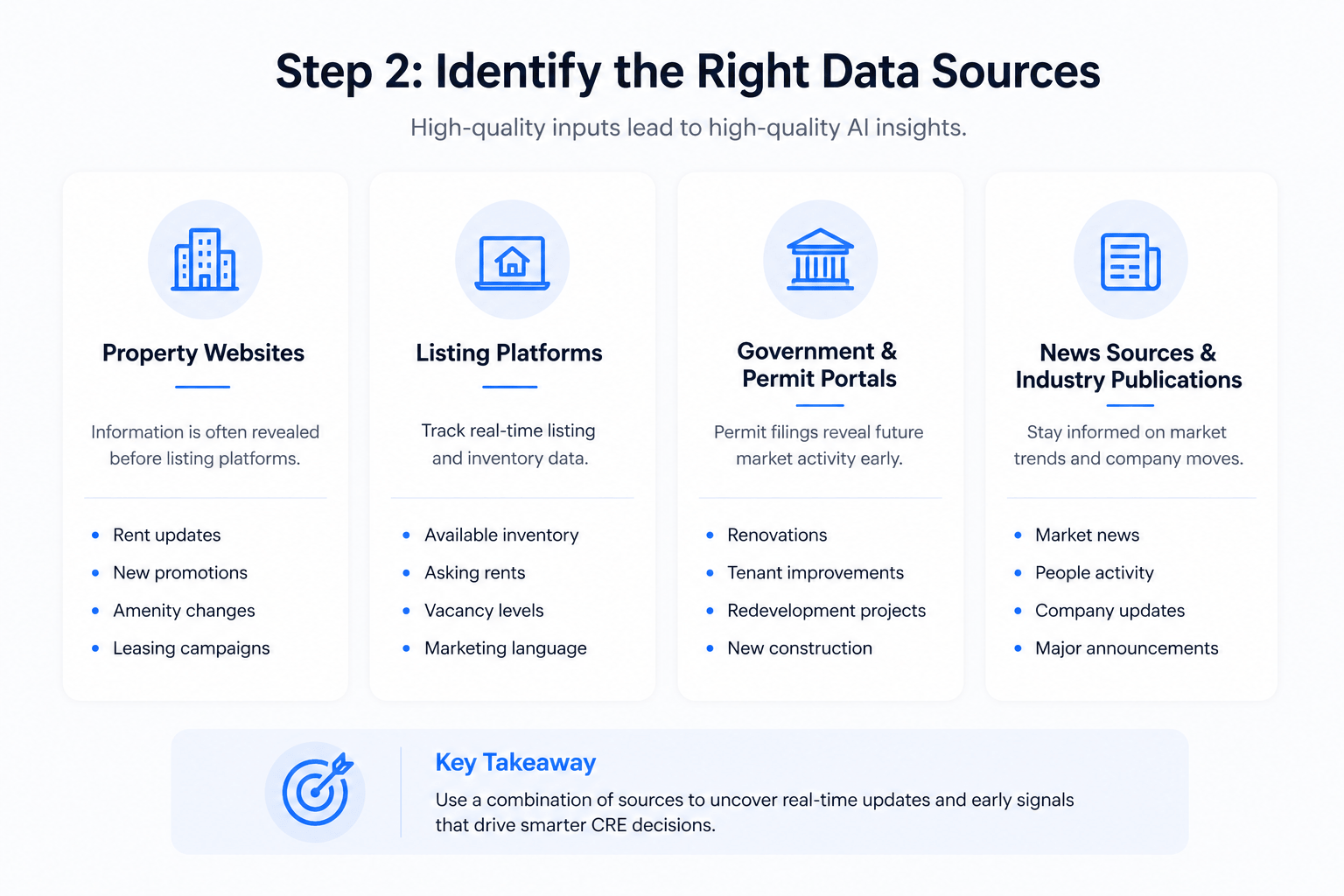
The quality of your AI outputs depends directly on the quality of your inputs. Not all information sources carry equal value.
Property Websites
Property websites often reveal information before listing platforms.
These sites frequently contain:
-
Rent updates
-
New promotions
-
Amenity changes
-
Leasing campaigns
Listing Platforms
Listing portals help track:
-
Available inventory
-
Asking rents
-
Vacancy levels
-
Marketing language
Government and Permit Portals
Permit data is one of the most underutilized sources in commercial real estate. Permit filings often reveal future market activity months before it becomes visible.
Potential insights include:
-
Renovations
-
Tenant improvements
-
Redevelopment projects
-
New construction
News Sources and Industry Publications
News monitoring helps identify:
-
Property sales
-
Financing activity
-
Ownership transitions
-
Major lease transactions
Many market-moving events first appear in local business publications before reaching broader industry reports.
Step 3: Define What Your AI Should Monitor
One of the biggest mistakes organizations make is asking AI to track everything. The most effective systems focus on specific business objectives.
For Leasing Teams
Monitor:
-
Rent changes
-
Occupancy shifts
-
Concessions
-
Availability
For Acquisition Teams
Monitor:
-
Sale listings
-
Distress signals
-
Ownership changes
-
Capital events
For Asset Managers
Monitor:
-
Competitive positioning
-
Market trends
-
Operational improvements
-
Renovation activity
For Developers
Monitor:
-
Future supply
-
Permit activity
-
Construction starts
-
Competitive developments
The more focused the monitoring objectives, the more actionable the reports become.
Step 4: Build Automated Reporting Workflows
Once data sources and competitors are established, reporting becomes the priority. As a result, many CRE teams go one step further and automate deal and market alerts so important updates are delivered automatically instead of requiring someone to review reports manually every week.
The best reports answer three questions:
-
What changed?
-
Why does it matter?
-
What should we do about it?
Recommended Weekly Report Structure
| Section | Purpose |
|---|---|
| Executive Summary | High-level findings |
| Rent Changes | Pricing intelligence |
| Concession Updates | Leasing trends |
| Ownership Activity | Investment signals |
| Permit Activity | Future market changes |
| Action Recommendations | Strategic next steps |
A concise report is typically more valuable than a lengthy one. Decision-makers need insights, not raw data dumps.
Turn Market Intelligence Into a Competitive Advantage
Commercial real estate professionals who consistently monitor competitors are often the first to identify shifts in pricing, occupancy, concessions, and investment activity. An AI-powered tracking system transforms scattered market information into actionable intelligence that supports leasing, acquisitions, asset management, and development decisions.
The AI for CRE Collective brings together 600+ CRE professionals exploring practical AI workflows for real-world commercial real estate operations. If you’re serious about implementing competitive intelligence systems, improving decision-making, and staying ahead of market changes, join the community and subscribe to the newsletter for proven strategies, case studies, and AI workflows built specifically for CRE.
Conclusion
Building an AI Competitor Tracker for CRE is one of the most practical and immediately valuable applications of artificial intelligence in commercial real estate.
By combining a focused competitor database, reliable data sources, automated research workflows, and structured reporting, CRE professionals can create a system that continuously monitors market conditions without requiring hours of manual work every week.
The firms that win in commercial real estate are rarely the ones with the most information. They are the ones who identify meaningful changes first and act on them faster than everyone else.
Frequently Asked Questions About AI Competitor Tracking for Commercial Real Estate
What is an AI competitor tracker for commercial real estate?
An AI competitor tracker for commercial real estate is a tool that automatically monitors competing properties and reports important market changes. Instead of spending hours checking listing websites, property pages, permit portals, and industry news, the system gathers information for you and organizes it into a single report.
Most AI competitor trackers monitor rents, concessions, vacancies, ownership changes, development activity, permit filings, and leasing trends. The AI compares new information with previous data and highlights what has changed over time.
For commercial real estate professionals, this creates a faster and more efficient way to understand the market. Rather than reacting after competitors make a move, owners, investors, and leasing teams can respond quickly based on current market intelligence.
How does an AI competitor tracker work?
An AI competitor tracker begins with a list of properties you want to monitor. These properties may include apartment communities, office buildings, industrial facilities, retail centers, or mixed-use developments that compete directly with your asset.
The system reviews selected data sources on a regular schedule. It checks listing platforms, property websites, public records, permit databases, and industry news sources to identify updates related to those properties. Once the information is collected, the AI compares it with earlier reports and highlights meaningful changes.
For example, the tracker may detect a rent reduction, a new leasing incentive, a renovation permit, or a property sale. These updates are then summarized in an easy-to-read report that helps CRE professionals understand what is happening in their market.
Why should commercial real estate firms use AI competitor tracking?
Commercial real estate markets change constantly. Competitors adjust pricing, introduce concessions, renovate buildings, and change leasing strategies throughout the year. Keeping track of these changes manually can be difficult, especially for teams managing multiple properties.
AI competitor tracking helps firms stay informed without spending hours on research every week. Instead of searching for updates across multiple websites, teams receive a report that highlights the most important changes.
This allows leasing teams to react faster, asset managers to monitor market conditions more effectively, and investors to identify opportunities sooner. In many cases, having access to timely information can create a significant competitive advantage.
What information should an AI competitor tracker monitor?
A strong competitor tracking system focuses on information that directly affects property performance and investment decisions. This typically includes asking rents, effective rents, concessions, occupancy trends, vacancies, and available inventory.
Many firms also monitor ownership changes, permit filings, renovation projects, development activity, financing events, and investment sales. These indicators often provide early signs of market changes before they appear in traditional reports.
By tracking these metrics consistently, CRE professionals gain a better understanding of both current market conditions and future opportunities. The goal is not to collect more data but to identify the information that helps drive better decisions.
How many competitor properties should a CRE company track?
Most commercial real estate firms achieve the best results by tracking between 10 and 20 direct competitors. This provides enough market coverage to identify trends while keeping reports focused and easy to review.
The most valuable competitors are properties that share similar characteristics with your asset. These may include location, asset class, tenant profile, building quality, pricing strategy, and property size.
Tracking too many properties can create unnecessary noise and make it harder to identify meaningful insights. A smaller list of highly relevant competitors often produces better results than a large list of loosely related properties.
Can AI competitor tracking improve leasing performance?
Yes. AI competitor tracking can have a direct impact on leasing performance because it gives teams visibility into competitor pricing, concessions, and marketing strategies. When leasing professionals understand what nearby properties are offering, they can respond more effectively.
For example, if a competing property launches a six-week concession or lowers rents, your team can evaluate whether a response is necessary. This information helps leasing teams stay competitive and avoid being surprised during tenant conversations.
Over time, better market awareness can lead to stronger occupancy levels, improved pricing decisions, and more effective leasing strategies.
What are the best data sources for an AI competitor tracker?
The best AI competitor trackers use information from several reliable sources rather than depending on a single platform. Property websites are often one of the most valuable sources because they provide current pricing, promotions, and availability information.
Listing platforms help track inventory, rents, and leasing activity. Government permit portals can reveal construction projects, renovations, and redevelopment plans. Industry publications, local business journals, and public records also provide useful information about ownership changes, financing activity, and property transactions.
Using multiple sources improves accuracy and creates a more complete picture of competitor activity within a market.
Can AI competitor tracking help identify acquisition opportunities?
Yes. Many acquisition opportunities begin as small signals rather than publicly marketed deals. AI competitor tracking helps investors identify these signals earlier by monitoring property activity over time.
For example, rising vacancies, aggressive concessions, ownership changes, refinancing activity, or repeated sale listings may indicate that a property owner is facing challenges. These situations can sometimes create acquisition opportunities before they become widely known.
While AI does not replace due diligence, it can help investors focus on the properties that deserve closer attention. This makes the acquisition process more efficient and improves deal sourcing efforts.
How often should an AI competitor tracker generate reports?
For most commercial real estate portfolios, weekly reporting provides the best balance between timely information and manageable workloads. Weekly reports capture important market changes without overwhelming teams with daily updates.
A weekly schedule also makes it easier to identify trends over time. Teams can compare reports from previous weeks and understand how competitors are adjusting their pricing, occupancy, and leasing strategies.
Some firms choose more frequent monitoring for high-priority assets or active development projects. However, weekly reporting is usually sufficient for most competitor tracking programs.
What mistakes should be avoided when building an AI competitor tracker?
One of the biggest mistakes is tracking too many properties. Large competitor lists often generate excessive information and make reports harder to use. It is usually better to focus on a smaller group of direct competitors.
Another common mistake is relying on poor-quality data sources. Even the best AI system will produce weak insights if the information it receives is incomplete or inaccurate. Selecting reliable sources is critical to success.
Many firms also collect data without a clear objective. Competitor tracking should support specific goals such as leasing, acquisitions, asset management, or market analysis. Without a clear purpose, reports can become cluttered with information that provides little value.
Will AI competitor tracking replace commercial real estate analysts?
No. AI competitor tracking is designed to support analysts, not replace them. The technology is excellent at collecting information, identifying patterns, and summarizing large amounts of data, but it cannot replace professional judgment.
Commercial real estate analysts provide the context needed to interpret findings and make informed decisions. They evaluate risks, verify information, and determine how market changes should influence business strategy.
The strongest results come from combining AI-powered research with human expertise. AI handles the repetitive work, while analysts focus on understanding the market and turning insights into action.
What is the future of AI competitor tracking in commercial real estate?
The future of AI competitor tracking goes beyond monitoring competitor activity. New tools are becoming more predictive and can help firms anticipate market changes before they happen.
Instead of only reporting current conditions, future systems may forecast rent trends, occupancy shifts, leasing activity, and new supply entering the market. This will help owners and investors make decisions with greater confidence.
As artificial intelligence continues to improve, competitor tracking is likely to become a standard part of commercial real estate operations. Firms that adopt these tools early will be better positioned to identify opportunities, respond to market changes, and maintain a competitive advantage.