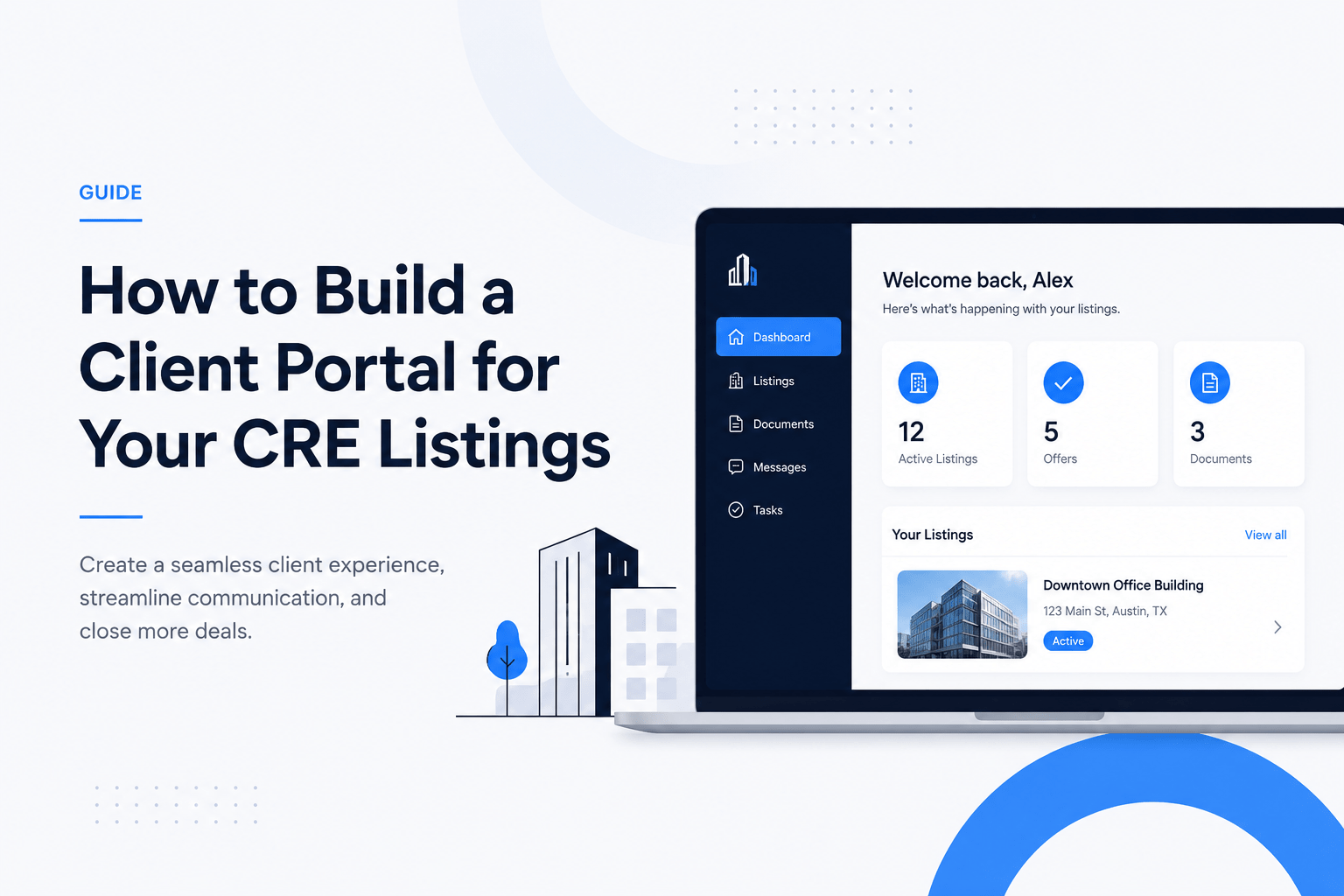
How to Build a Client Portal for Your CRE Listings
Commercial real estate professionals often juggle dozens of property deals and client updates. Yet many still rely on email threads and spreadsheets, which are slow and error-prone. A CRE client portal software solves this by giving each client a secure login to see their property listings, contracts, and messages in one place. Instead of sending weekly email blasts, you update the portal, and clients see changes instantly. This streamlines communication and builds trust. For example, one agency built a portal and saw an 80% drop in client emails and freed up 20+ hours monthly. In short, a portal is not just a luxury but a powerful system upgrade for any CRE firm.
Portal solutions let clients log in anytime and view real-time updates on their listings. They can approve documents, sign contracts, or leave feedback without playing “email tag.” The benefits include better communication, transparency, and saved time for both agents and clients. Rather than scattered emails, everything happens in one branded portal. In this guide, we’ll cover how to build a client portal for your CRE listings from the ground up, with comparisons of tools and step-by-step advice.
What Is a CRE Client Portal Software?
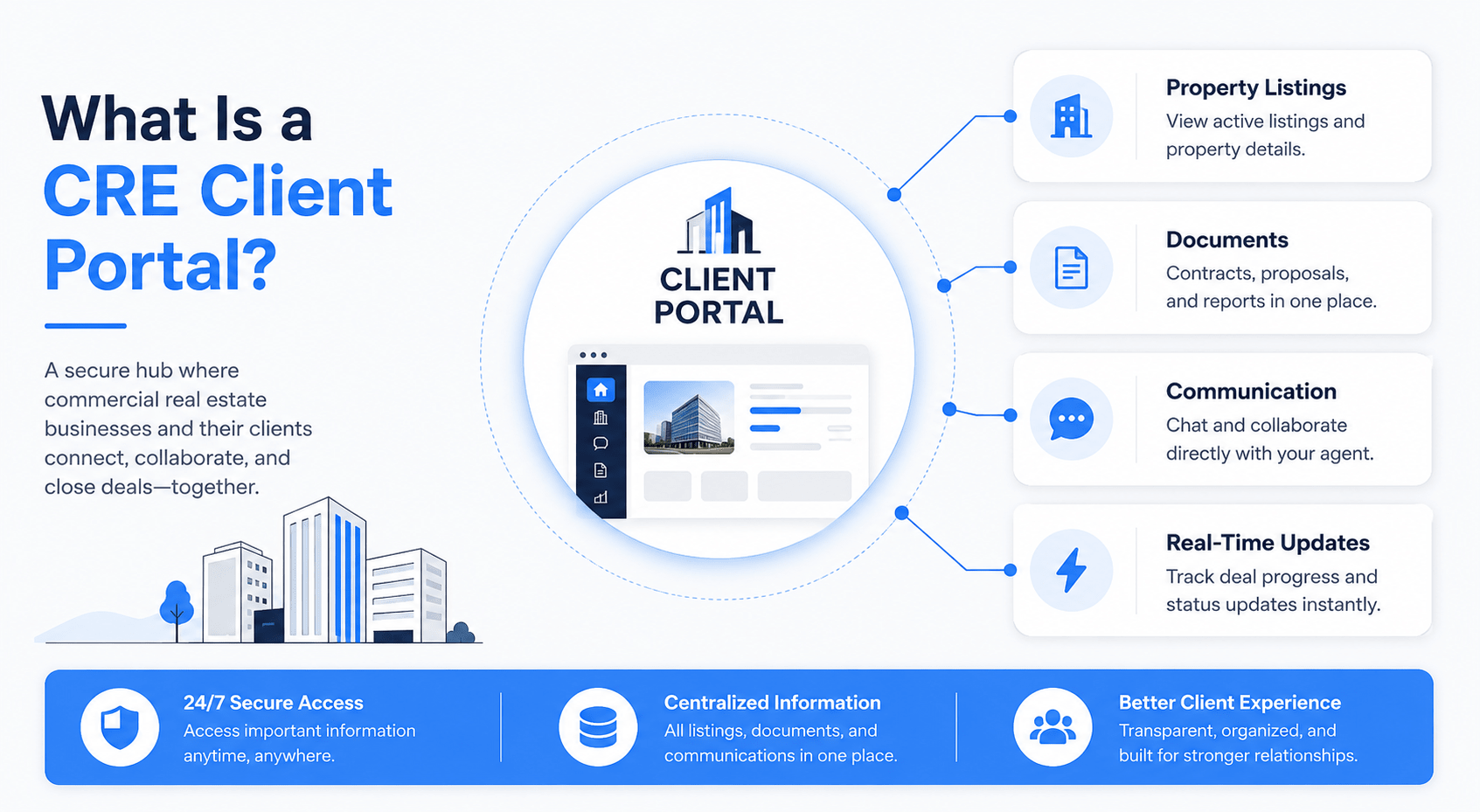
A CRE client portal software is a secure web platform designed for commercial real estate businesses. It serves as a central hub for sharing listings, documents, and communications with clients. Instead of scattered emails and phone calls, clients log into the portal to see everything relevant to their deals. This includes property photos, floor plans, contracts, proposals, and status updates. By organizing information in one place, the portal acts like a personalized dashboard for each client.
- Definition: A secure, branded platform where CRE clients can log in to access their property listings, contracts, and updates anytime.
- Purpose: To streamline client communication, document sharing, and listing management in a transparent way.
- How it works: Agents update listings and documents in the portal. Clients see these updates in real time, can chat with their agent, and download files without email attachments or delays.
- Example: Clinked, a portal provider, advertises that its real estate portal lets clients “access important documents anytime, anywhere” through encrypted sharing. That’s the goal of any portal: 24/7 client access to up-to-date information.
Answer: A CRE client portal is an online application where clients can securely log in to view and manage their commercial property listings and related documents. It centralizes all client data and communications in one secure place.
If you are building a complete digital experience, your portal should work alongside your CRE brokerage website so clients can move seamlessly from public listings to secure deal collaboration.
Key Benefits of a Client Portal for CRE Listings
Having a client portal brings many advantages for brokers, developers, investors, and property managers:
- Improved Communication: Real-time messaging and notifications in the portal mean clients get instant updates on offers, new listings, or document requests. You no longer spend hours repeating the same info over email.
- Time Savings: Automate routine tasks. One expert noted that building a portal cut down client emails by 80%, freeing account managers 20+ hours per month. Agents can focus on high-value work instead of status emails.
- Transparency & Trust: Clients can always see the current status of their deals and documents. When buyers or tenants can track progress (for example, tracking lease approvals or investment proposals), trust increases.
- Professional Experience: A branded portal feels polished. It consolidates property photos, data sheets, and contract signatures, giving clients a VIP experience rather than lost email threads.
- Centralized Data & Docs: All property listings, contracts, floor plans, and financials are in one place. This reduces mistakes like outdated spreadsheets or missed attachments. It also means less phone-tag—clients can self-serve for info.
- Scalability: As your client base grows, the portal scales easily. New clients get accounts, and the system handles dozens of properties and documents automatically, without much extra effort.
For example,
Knack notes that portals “enhance communication, provide greater transparency, and help build lasting trust with clients” by keeping documents and updates in a single hub. Softr’s client portal product similarly highlights time savings and security: clients log in anytime for invoices or updates, reducing repeated requests and protecting data.
| Benefit | Impact |
|---|---|
| Better communication | Fewer phone calls & emails; clients get instant updates |
| Time efficiency | Agents save hours on manual updates; focus on sales and strategy |
| Transparency & trust | Clients see progress 24/7; reduces confusion and builds confidence |
| Professional branding | Branded login and interface improve client experience |
| Organized documents | Contracts, photos, and plans stored centrally; secure and accessible |
| Scalability | Easily add new clients, listings, and features as business grows |
Direct Answer: A CRE client portal boosts efficiency by automating updates and communications. Clients log in to see real-time listing updates, reducing back-and-forth emails by an estimated 80%. It saves brokers time, builds trust through transparency, and centralizes documents for easy access.
Core Features of a CRE Client Portal
When building a portal for CRE, include these essential features to meet client needs:
- Secure Login & Access Control: Each client should have a unique login. Role-based permissions ensure clients only see their own listings and documents. Advanced portals support single sign-on (SSO) and two-factor authentication for extra security.
- Property Listing Dashboard: A clear overview page where clients can browse “their” properties. This might include photos, descriptions, status (available, under contract, etc.), and key metrics (rent, cap rate, etc.). Clinked, for example, emphasizes that portals allow clients to “keep all your property listings organized in one place” with real-time updates.
- Document Management & File Sharing: A document vault for contracts, floor plans, appraisal reports, etc. Files should be organized by listing or project. Clients can view or download documents securely. As FileCloud highlights, a portal “ensures secure, fast and easy access to documents such as contracts, property listings, and client files”.
- Messaging & Notifications: Built-in chat or comment threads let agents and clients communicate without leaving the portal. Automatic alerts (email or in-app) notify clients about new messages, approvals needed, or upcoming deadlines.
- Task & Calendar Integration: Show important dates (e.g., lease expirations, tour schedules) and tasks (e.g., client to approve lease). Syncing with Google Calendar or Outlook is a plus.
- Branding & White-labeling: The portal should match your company’s brand. Custom logos, colors, and domain make it feel like part of your service. Some platforms even offer branded mobile apps.
- Search and Filters: Clients can filter listings by type (office, retail, industrial), location, size, or custom tags. This improves their experience in large portfolios.
- Integration Capabilities: Easy to connect to other systems (CMS, CRM, MLS data, analytics). We’ll cover integrations below.
- Security & Compliance: Encryption of data at rest and in transit, detailed audit logs, and compliance with regulations like GDPR/CCPA.
Answer:
A good CRE portal includes secure logins, a dashboard for property listings, document storage, messaging, and notifications. It’s branded to your firm, letting clients access their files and updates 24/7. It often integrates with calendars and other tools so clients see tasks and deadlines seamlessly.
Table: Portal Feature Comparison (Example Solutions)
| Feature | Clinked Portal | FileCloud (Real Estate) | Softr No-Code Portal | Custom Build |
|---|---|---|---|---|
| Secure Client Login | ✓ (built-in, SSO) | ✓ (with 2FA, SSO) | ✓ (user auth, fine-grained perms) | ✓ (custom auth) |
| Document Sharing | ✓ Encrypted file sharing | ✓ Unlimited secure shares | ✓ File storage & management | ✓ (as implemented) |
| Messaging/Chat | ✓ Group and 1-to-1 chat | (Email notifications via custom flow) | ✗ (relies on integrations) | ✓ (optional chat feature) |
| White-labeling | ✓ Custom branding | ✓ Fully white-labelable | ✓ Custom domain & branding | ✓ (fully branded by design) |
| Mobile App | ✓ Branded mobile app | ✗ (web only) | ✗ (PWA possible, no native app) | ✓ (if built or using PWA) |
| Integration | Zapier, Office, Salesforce | Outlook, Google, Salesforce | Connects Airtable, HubSpot, and SQL | Any (via APIs) |
| Security Features | Audit logs, 2FA option | AES-256 & SSL/TLS, DLP, SSO, 2FA | Standard SSL, SSO via Connect | Fully customizable security model |
| Setup Time | Fast (SaaS signup) | Fast (download or cloud setup) | Very fast (hours via no-code AI) | Long (weeks to months) |
| Typical Cost | $$$/yr | $$$ one-time or subscription | $$ (monthly tier) | $$$$ (development & hosting) |
| Best For | Agencies want a ready solution | Firms needing self-host/security | Teams needing a quick MVP | Unique needs not met by SaaS |
This table shows trade-offs. For example, Clinked and FileCloud are ready-made portals with strong security. Softr is a no-code builder ideal for quick launches. A custom build takes more time but can match any specific requirement.
Build vs. Buy: Choosing the Right Approach
Should you build your own portal or use an existing platform? Each approach has pros and cons:
- Build (Custom Development): You get full control. Build it exactly the way you want, integrate deeply with your systems, and own the code. This is ideal if you have unique workflows or already have a development team. However, it takes longer and costs more upfront. The development process can range from a few months to a year, depending on complexity (one expert notes custom portals can take many months). You’ll also handle ongoing maintenance and updates.
- Buy (SaaS or No-Code): There are turnkey portal solutions and no-code tools that let you launch fast. For example, Softr’s AI co-builder can spin up a portal in minutes with no coding. Platforms like Clinked or FileCloud are available immediately with configurable features. These save time and often include support. The trade-off is less customization and ongoing subscription fees. You may need to adapt your workflow to fit the platform.
- Hybrid / Low-Code: Tools like OutSystems or Mendix let you configure a custom portal with minimal code, offering a middle ground. You get faster delivery than full-code and more flexibility than pure SaaS, but still require some technical skill.
When to Choose Each:
- Choose Custom if your agency has unique requirements (e.g., proprietary calculations, integrations with legacy CRE databases, or a large IT budget). It’s best when off-the-shelf solutions just can’t meet your needs.
- Choose SaaS/No-Code if you want to launch quickly or if you lack in-house development resources. Many small to mid-size brokers benefit from the fast deployment of a standard portal.
- Consider CRM Platforms: Many CRE firms use Salesforce or HubSpot for client management. Both offer “Experience Cloud” (Salesforce) or “client portal” modules. If you already use one, it might be easiest to activate its portal feature.
| Approach | Development Time | Customization | Maintenance | Cost | Best For |
|---|---|---|---|---|---|
| Custom (Code) | 3–6+ months | Very high (full control) | High (in-house team) | High ($$$$) | Unique needs, large firms, full integration |
| Low-Code / Hybrid | 4–8 weeks | Moderate | Medium | Medium ($$) | Moderate complexity, some IT support |
| No-Code (e.g., Softr) | Days to weeks (instant via AI) | Limited by platform | Low (platform updates) | Medium ($$) | Quick MVPs, small teams, limited IT resources |
| SaaS Portal (Clinked, FileCloud) | Immediate setup | Low (configurable) | Low (vendor-managed) | Medium ($$$) | Firms needing quick rollout, proven features |
This comparison shows that no-code or SaaS options get you started immediately, whereas custom builds take longer but yield a tailored product. For instance, Softr advertises that its AI builder can create a complete portal in minutes, whereas custom development may take months.
Direct Answer:
If you need a fully unique portal deeply integrated with your data, opt for a custom solution. If you want speed and lower upfront cost, use a SaaS or no-code builder. Many CRE teams start with a SaaS portal to test the idea, then consider custom development as they scale.
Want to see a portal built from start to finish? This walkthrough shows how AI can rapidly create a commercial real estate portal and dramatically shorten development time.
Technology Stack and Architecture
Building a CRE portal involves designing an architecture that handles clients, listings, documents, and security. A typical tech stack might include:
- Frontend: A web framework (e.g., React, Vue, or a no-code UI builder). This creates the client interface. It handles user login, menus, and displaying listings.
- Backend/API: A server (Node.js, Python, Ruby, etc.) to process data requests. It manages user authentication, serves listing data, and handles uploads.
- Database: A database (e.g., PostgreSQL, MySQL, or MongoDB) to store listings, client accounts, messages, and file metadata.
- File Storage: A secure storage for documents and images (AWS S3, Google Cloud Storage, or on-prem storage). Files are linked to listings or clients in the DB.
- Authentication: Use frameworks like OAuth 2.0 or OpenID Connect for secure login. For example, Auth0 or Firebase Auth can simplify SSO.
- Hosting: Cloud platforms (AWS, Azure, or Google Cloud) can host your app. They offer scalability and high availability.
- APIs/Integrations: Connect to external data sources or services (MLS, CRM, e-signature). Use REST or GraphQL APIs for flexibility.
- CDN & Performance: Use a content delivery network to serve images/ PDFs fast. Optimize queries and add caching to speed up response times.
Integrations: CRM, MLS, and Data Feeds
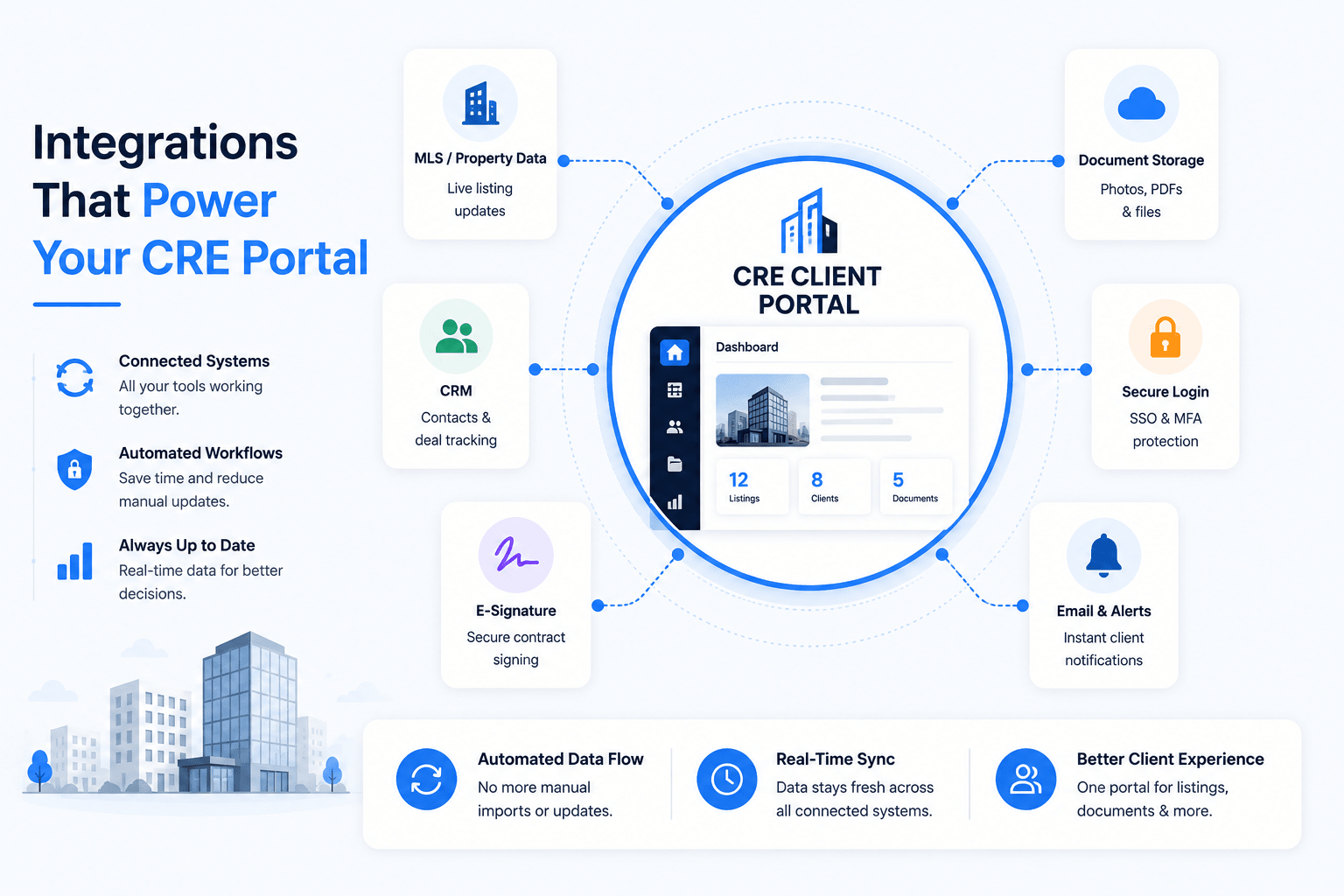
A client portal does best when it connects to your existing systems and data sources. Key integrations include:
- MLS/IDX Data: If you have access to an MLS (Multiple Listing Service) feed, use an MLS API or IDX feed to import commercial listings. This ensures your portal has up-to-date market data. For example, an MLS API provides raw property data for developers to integrate. Datafiniti’s property data API is another example; it lets you “feed active listings directly into” your own portal.
- CRM Integration: Link the portal to your CRM (like Salesforce or HubSpot). This syncs client contacts, company details, and the deal pipeline. Some CRMs have built-in portal tools (e.g., Salesforce Experience Cloud). Integrating means that when you add a listing or client in your CRM, it automatically appears in the portal.
- Document Signing: Connect to an e-signature API (e.g., DocuSign or Adobe Sign). Clients can review and sign contracts in the portal. For instance, Clinked’s integration with Adobe Acrobat Sign lets documents be signed securely.
- Email/Calendar: Integrate email or calendar APIs so portal notifications and meeting schedules flow between the portal and the client’s email/phone.
- Analytics: You might feed portal usage data into analytics (Google Analytics, Mixpanel) to see how clients interact.
| Integration | Example Tools/APIs | Purpose |
|---|---|---|
| MLS/Property Data | MLS API, Datafiniti, Moody’s CRE API | Import and update property listings data |
| CRM | Salesforce, HubSpot API | Sync client contacts, deal info, and track leads |
| E-signature | DocuSign, Adobe Sign | Allow secure digital signing of leases/contracts |
| File Storage | AWS S3, Google Cloud Storage | Store and serve documents and images (photos, PDFs) |
| Authentication | OAuth 2.0, Auth0, OpenID Connect | Secure client login, SSO, and MFA |
| Email/Notification | SendGrid, Mailchimp, Twilio | Send automated alerts (new listing, comment, etc.) |
| Data Enrichment | LightBox API, CoStar | Fetch additional property insights (ownership, comps) |
Example:
LightBox provides CRE data APIs covering parcels, ownership, zoning, etc. Their Developer Portal gives standardized endpoints so you can enrich listings with deep commercial data. Such APIs make it easy to “focus on your area of expertise and not worry about the rest” of data wrangling.
Direct Answer: The portal should pull listing and client data via APIs. Common integrations include MLS or property data APIs to populate listings, CRM APIs to sync client info, and document-signing APIs for contracts. This automation means portal data stays fresh and clients see the latest details without manual updates.
Security, Permissions, and Compliance
Protecting client data is paramount in a portal. Best practices include:
- Encryption: Use HTTPS (SSL/TLS) for all web traffic, and encrypt files at rest with AES-256. For example, FileCloud’s portal uses “AES 256-bit encryption for data at rest and SSL/TLS protocols for data in transit”.
- Authentication & Access Control: Implement strong authentication (SSO, 2FA). Ensure clients can only access their own resources (multi-tenant isolation). Role-based access control (RBAC) is common: admins, brokers, and each client can have different permissions.
- Audit Logging: Record all actions for compliance. Portals should log file access, downloads, and communications. FileCloud notes they keep “complete audit logs and share analytics” for accountability.
- Data Leak Prevention (DLP): Detect unusual data flows. For instance, FileCloud has built-in DLP to prevent unauthorized sharing.
- Compliance Standards: Depending on location, follow GDPR (EU) or CCPA (California). If handling financial data, PCI DSS might apply. Even if not mandated, following standards like ISO 27001 shows clients their data is secure.
- Regular Updates: Keep software and libraries up to date to prevent vulnerabilities. Use web application firewalls (WAF) and intrusion detection as needed.
A portal’s design should focus on security from the start. By using industry-standard encryption and authentication, you make clients and compliance officers comfortable that “sensitive information [is] safe and protected”.
Answer:
Secure a portal with industry-standard measures: SSL/TLS encryption, AES-256 file encryption, strong authentication (SSO and MFA), and detailed audit logs. These features protect contracts and listings while giving only authorized users access.