Your Best CRE Deals Are Sitting in Folders Nobody Reads
A CRE knowledge management system can become one of the most valuable assets inside a commercial real estate firm. Every acquisition, broker conversation, market analysis, and due diligence review generates information that can improve future investment decisions. Yet most firms allow that knowledge to disappear into email threads, spreadsheets, shared drives, and individual employee memories.
The problem is that this information rarely lives in one place. Instead, it ends up scattered across email chains, spreadsheets, underwriting models, shared drives, CRM notes, and individual employee memories. Over time, valuable insights become difficult to find, impossible to compare, and eventually forgotten.
A CRE knowledge management system changes that reality. Rather than treating every deal as an isolated event, it transforms each transaction, market study, broker interaction, and investment decision into part of a growing intelligence database.
The result is not simply better organization. It is a long-term competitive advantage that compounds with every deal your team evaluates.
Why Most Commercial Real Estate Firms Keep Starting From Scratch
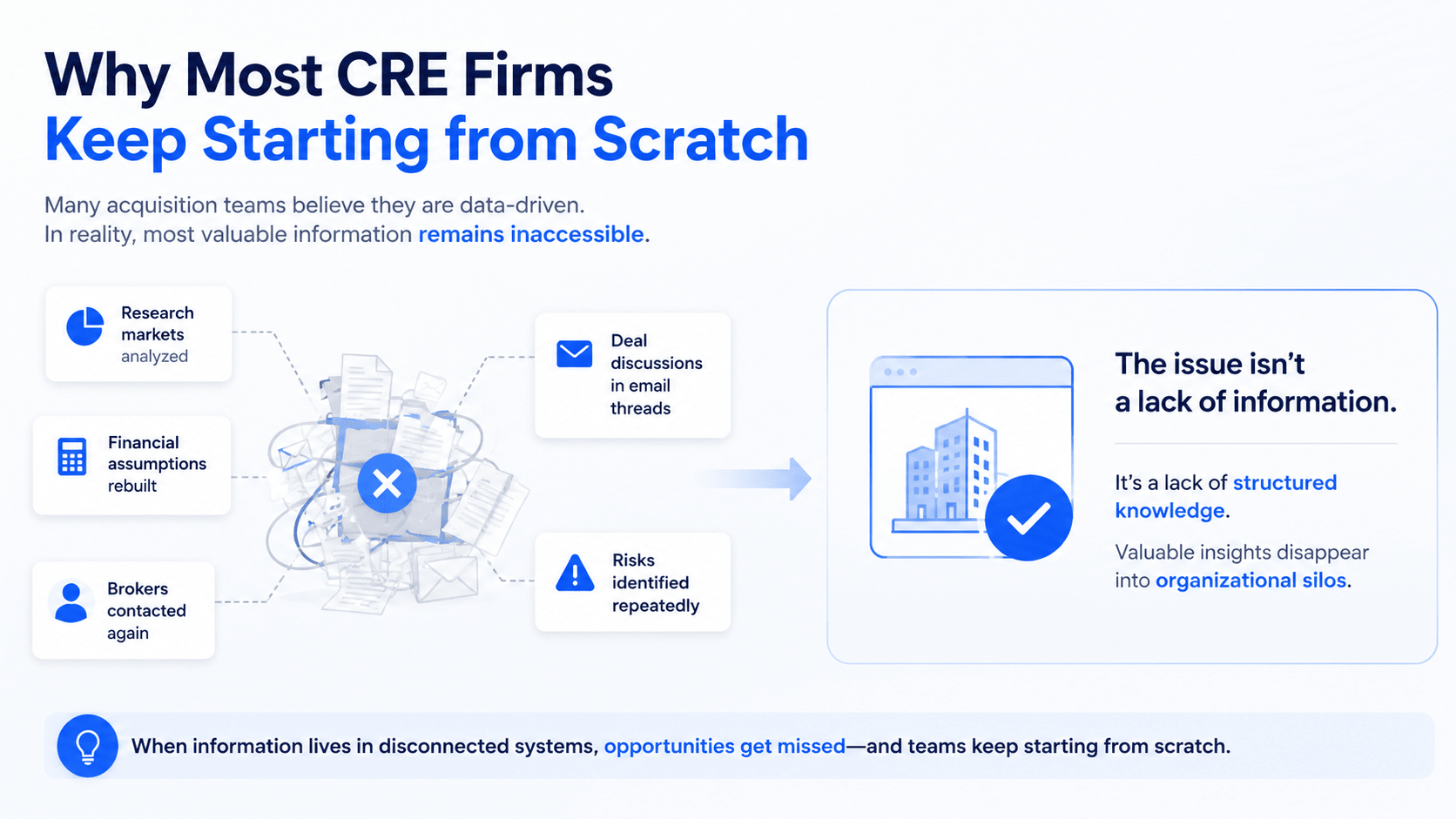
Many acquisition teams believe they are data-driven.
In reality, much of their most valuable information remains inaccessible. A typical CRE organization often stores information in multiple disconnected systems. Market reports sit on shared drives.
Broker contacts live in outdated spreadsheets. Underwriting models are saved on individual computers. Deal discussions remain trapped inside email threads. When a new opportunity arrives, analysts often repeat work that has already been done.
-
They research markets they previously analyzed.
-
They rebuild financial assumptions.
-
They contact brokers without reviewing prior conversations.
-
They investigate risks that were already identified in similar transactions.
The issue is not a lack of information. The issue is a lack of structured knowledge. Without a system that captures and connects information, valuable insights disappear into organizational silos.
What Is a CRE Knowledge Management System?
A CRE knowledge management system is a centralized framework designed to capture, organize, and retrieve information generated throughout the investment lifecycle. Instead of treating documents as isolated files, the system connects them through context. Every deal becomes part of a larger knowledge network.
This includes:
-
Property information
-
Broker communications
-
Investment committee decisions
-
Underwriting assumptions
-
Market research
-
Due diligence findings
-
Rejected opportunities
-
Closed transactions
-
Internal investment criteria
The objective is simple.
Transform historical information into a resource that actively improves future decisions.
Key Components of a Knowledge Management System
| Component | Purpose | Business Value |
|---|---|---|
| Deal Database | Stores transaction history | Historical comparisons |
| Broker Intelligence | Tracks relationships | Better deal sourcing |
| Market Research Library | Preserves analysis | Faster market evaluation |
| Underwriting Repository | Stores models and assumptions | Improved consistency |
| Decision Tracking | Records approvals and rejections | Organizational learning |
A properly structured system ensures every deal contributes knowledge that can be reused later.
The Compounding Value of Knowledge
Unlike most operational tools, a knowledge management system becomes more valuable over time. The first month may not feel revolutionary. The third year can completely change how a firm operates.
Month One
Initially, the system functions primarily as an organized repository.
Benefits include:
-
Faster document retrieval
-
Better record keeping
-
Improved collaboration
These improvements are useful but relatively modest.
Six Months Later
After dozens of deals enter the system, patterns start emerging.
Teams begin noticing:
-
Brokers who consistently source qualified opportunities
-
Markets producing attractive risk-adjusted returns
-
Asset classes matching investment criteria
-
Recurring due diligence concerns
These insights are difficult to identify when information remains scattered.
Two Years Later
At this stage, the firm possesses something highly valuable. It has built proprietary market intelligence.
The system can answer questions such as:
-
Which submarkets generated the highest returns?
-
Which deal characteristics frequently led to rejection?
-
What underwriting assumptions proved most reliable?
-
Which brokers consistently delivered successful transactions?
Competitors cannot replicate this information overnight. It was built through years of actual deal activity. That accumulated intelligence becomes a strategic asset.
The real power of a knowledge management system appears when years of deal history become searchable and actionable. This example shows how firms are beginning to turn historical transactions into a competitive advantage.
How Knowledge Systems Improve Deal Screening
The speed of initial evaluation often determines whether an acquisition team gains access to the best opportunities. A knowledge management system dramatically improves screening efficiency.
Instead of evaluating a property in isolation, teams compare it against years of historical data. For example, an industrial opportunity arrives in the Inland Empire.
Rather than beginning research from scratch, the system immediately surfaces:
-
Similar assets previously reviewed
-
Historical underwriting assumptions
-
Broker history
-
Market research
-
Past investment decisions
Analysts can identify similarities within minutes. As a result, deal screening becomes faster and more informed.
Questions Teams Can Answer Instantly
A mature system allows acquisition professionals to answer questions such as:
-
Have we reviewed similar properties before?
-
Why did we reject comparable deals?
-
Which risks appeared repeatedly?
-
What assumptions proved inaccurate?
-
Which brokers sourced successful investments?
These answers help teams avoid repeating mistakes while improving confidence in new opportunities.
Turning Broker Relationships Into Institutional Assets
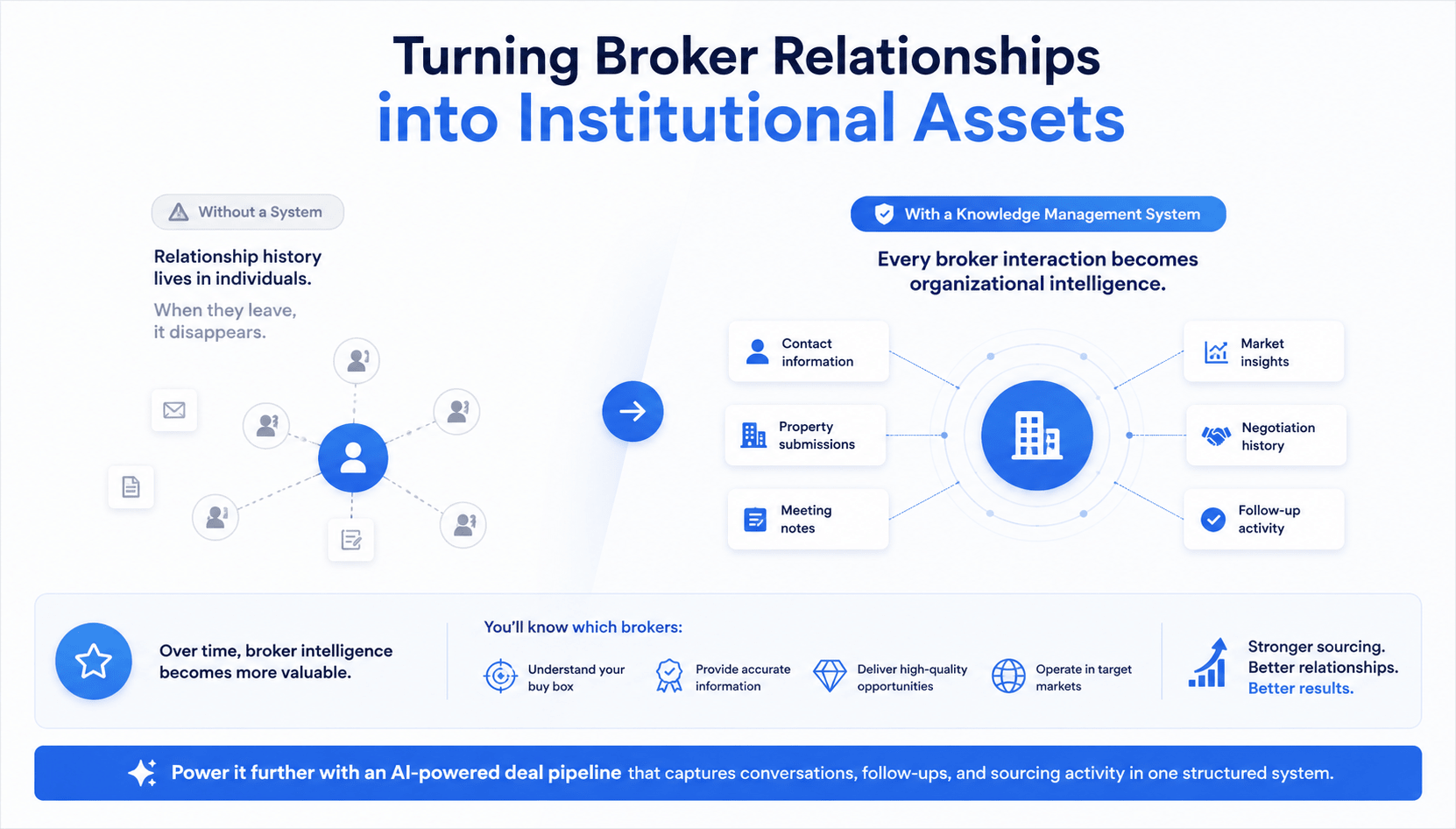
Many firms unintentionally create a dangerous dependency. Critical broker relationships exist only within individual employees’ networks. When team members leave, valuable relationship history often disappears.
A knowledge management system solves this problem. Every broker interaction becomes part of the organization’s collective intelligence.
This may include:
-
Contact information
-
Property submissions
-
Meeting notes
-
Market insights
-
Negotiation history
-
Follow-up activity
Over time, broker intelligence becomes significantly more valuable.
Patterns emerge regarding which brokers:
-
Understand your buy box
-
Provide accurate information
-
Deliver high-quality opportunities
-
Operate in target markets
The result is stronger sourcing and better relationship management.
In addition, firms can strengthen broker relationship tracking by building an AI-powered deal pipeline that captures conversations, follow-ups, and sourcing activity in a structured system.
Preserving Market Research That Cost Thousands to Create
Market research requires significant time and expense.
Analysts spend hours collecting information about:
-
Rent growth
-
Employment trends
-
Population shifts
-
Supply pipelines
-
Absorption rates
-
Capital markets activity
Yet many firms fail to preserve this knowledge effectively. Research completed today often becomes difficult to locate six months later. A centralized knowledge system changes this. Instead of recreating analysis, teams build upon previous work.
This creates substantial efficiency gains. It also improves consistency across investment decisions. Many firms struggle to organize years of market reports and underwriting notes. For teams looking to improve their research process, these AI research workflows for CRE can help centralize information and reduce repetitive analysis.
Building Institutional Memory
One of the greatest risks facing commercial real estate organizations is knowledge loss. Experienced professionals accumulate years of insights. Unfortunately, much of that knowledge exists only in their heads.
When they retire or move elsewhere, institutional memory leaves with them. A CRE knowledge management system preserves that expertise.
Benefits for New Team Members
New hires can immediately access:
-
Historical transactions
-
Investment rationale
-
Market perspectives
-
Due diligence findings
-
Portfolio strategies
This significantly shortens onboarding time. Instead of relying entirely on conversations, employees learn from documented experience.
Benefits for Leadership
Leadership teams gain visibility into how decisions are being made.
They can evaluate:
-
Consistency across underwriting
-
Changes in investment criteria
-
Market exposure
-
Historical performance patterns
This creates stronger governance and better strategic alignment.
The Role of Artificial Intelligence
Artificial intelligence has transformed knowledge management. Traditional systems required users to search manually. Modern AI-powered platforms allow professionals to ask questions naturally.
For example:
“What industrial deals did we reject last year because of environmental concerns?”
“What markets generated the highest projected IRRs over the past 24 months?”
“Which brokers brought us multifamily opportunities that reached final underwriting?”
Instead of searching through folders, users receive immediate answers.
AI Changes Information Retrieval
| Traditional Search | AI-Powered Search |
|---|---|
| Keyword dependent | Context aware |
| Manual review required | Instant summaries |
| Limited connections | Pattern recognition |
| Time intensive | Fast retrieval |
| Fragmented information | Unified insights |
This shift transforms static data into actionable intelligence.
Creating a Reliable Intake Process
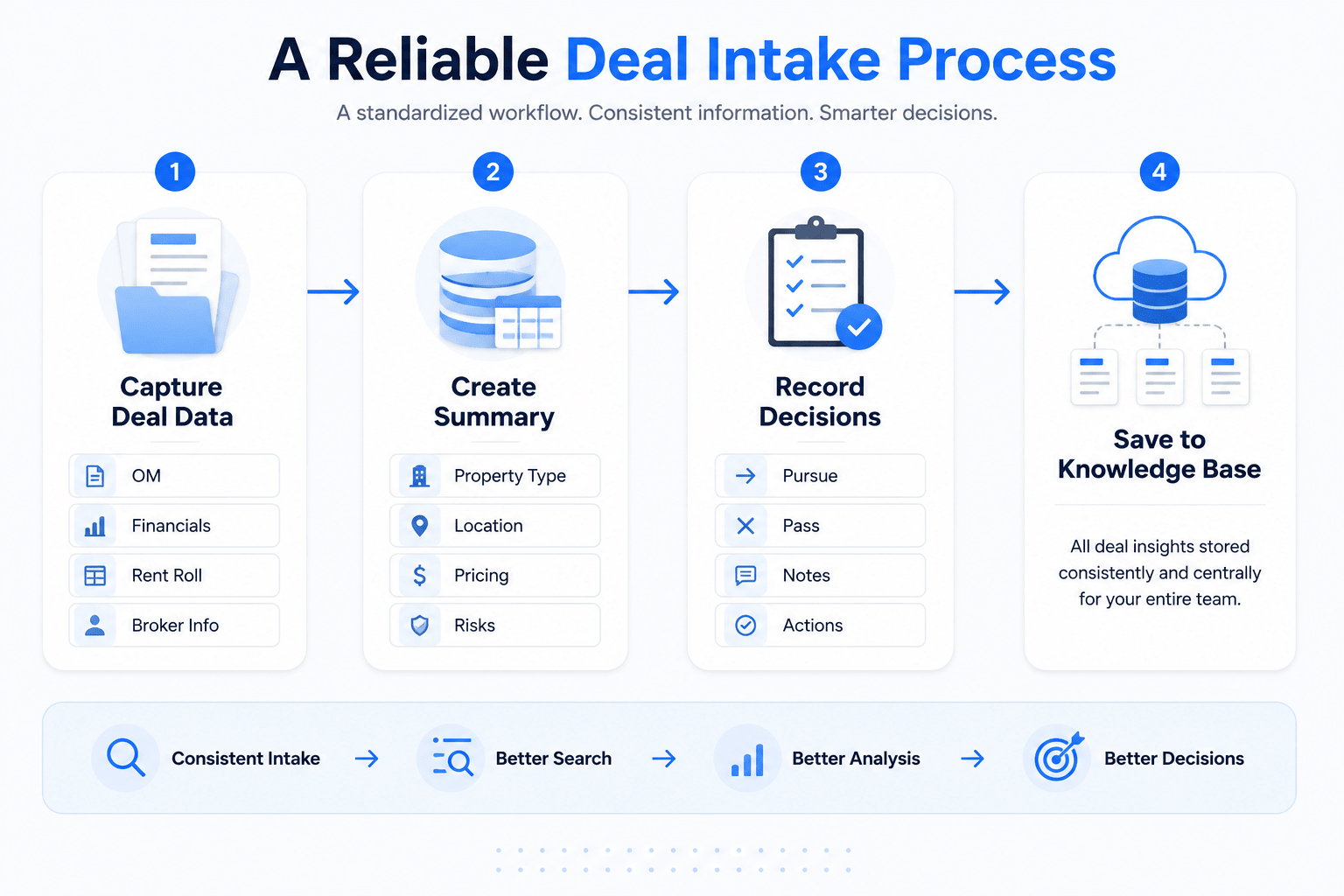
Technology alone will not solve knowledge management challenges. Success depends on process. Every incoming deal should follow a standardized workflow.
Step 1: Capture Information
Gather:
-
Offering memorandum
-
Financial statements
-
Rent roll
-
Broker information
-
Supporting documents
Step 2: Create a Structured Summary
Record:
-
Property type
-
Location
-
Pricing
-
Investment thesis
-
Key risks
Step 3: Document Decisions
Capture:
-
Pass or pursue outcome
-
Investment committee comments
-
Underwriting conclusions
-
Follow-up actions
Step 4: Store Information Consistently
Standardization is essential. The more consistent the structure, the better future search and analysis become. Without consistency, even advanced AI tools struggle to generate reliable insights.
Common Mistakes Firms Make
Many organizations recognize the value of knowledge management but fail during implementation. The most common mistakes are surprisingly simple.
Treating It Like File Storage
A knowledge system is not a digital filing cabinet. Information must be organized around context, not merely stored.
Inconsistent Documentation
If every analyst documents deals differently, the system loses effectiveness. Consistency creates usability.
Ignoring Rejected Deals
Past opportunities often contain valuable lessons. Documenting rejection reasons is just as important as documenting successful acquisitions.
Lack of Ownership
Someone must maintain standards and oversee adoption. Without accountability, systems quickly become outdated.
Measuring Business Impact
Knowledge management generates value across multiple areas of the organization.
| Benefit Area | Impact |
|---|---|
| Deal Screening | Faster evaluations |
| Research | Reduced duplication |
| Broker Management | Better sourcing |
| Underwriting | Improved consistency |
| Training | Faster onboarding |
| Decision Making | Better investment outcomes |
The return is often cumulative rather than immediate. Each deal increases the quality of future decisions, and each research project strengthens market intelligence. And each broker interaction improves sourcing effectiveness.
Over time, these improvements compound into meaningful operational and strategic advantages.
Build a Knowledge Advantage Before Competitors Do
The firms gaining an edge today are not necessarily evaluating more opportunities. They are learning more from every opportunity they evaluate. A structured knowledge management strategy allows acquisition teams to capture broker intelligence, market insights, underwriting lessons, and investment decisions in a way that compounds over time rather than disappearing into disconnected systems.
The AI for CRE Collective is helping 600+ CRE professionals implement practical AI workflows and knowledge systems that improve decision-making and operational efficiency. If you want proven frameworks, implementation guides, and real-world CRE use cases, subscribe to the newsletter and start building a long-term intelligence advantage.
Conclusion
Commercial real estate has always rewarded firms that possess better information. Today, the advantage no longer comes solely from access to data. Data is everywhere. The real advantage comes from organizing, preserving, and learning from that data more effectively than competitors.
A CRE knowledge management system allows firms to transform years of deal activity into a searchable, reusable intelligence asset. It prevents valuable knowledge from disappearing into email chains, spreadsheets, and forgotten folders. More importantly, it enables teams to make faster, smarter, and more consistent investment decisions.
The firms building these systems today are creating an advantage that becomes stronger with every transaction, every broker interaction, and every market study. Knowledge compounds. The organizations that capture it will be the ones that benefit from it.
Frequently Asked Questions About CRE Knowledge Management Systems
What is a CRE knowledge management system?
A CRE knowledge management system is a centralized platform that stores and organizes commercial real estate information. It brings together deal history, underwriting models, broker contacts, market research, due diligence findings, and investment decisions in one searchable location.
Instead of relying on spreadsheets, emails, and individual employee knowledge, firms can access information instantly. This helps teams make better decisions and preserve valuable insights over time.
Why is a CRE knowledge management system important?
Commercial real estate firms evaluate hundreds of opportunities over time. Without a structured system, valuable information often gets lost across multiple platforms and departments.
A knowledge management system ensures that past research, broker conversations, and investment decisions remain accessible. As a result, teams can avoid repeating work, improve efficiency, and make more informed acquisition decisions.
How does a knowledge management system improve deal screening?
A knowledge management system allows acquisition teams to compare new opportunities against previously reviewed deals. This creates valuable context during the early stages of evaluation.
For example, teams can quickly identify similar properties, review prior underwriting assumptions, and understand why comparable opportunities were approved or rejected. This speeds up screening while improving decision quality.
What information should be stored in a CRE knowledge base?
The most valuable knowledge bases include information that supports future investment decisions. This typically includes property details, broker contacts, financial models, market studies, due diligence findings, and investment committee notes.
The goal is not to save every document. Instead, firms should focus on capturing information that provides long-term strategic value.
Can artificial intelligence improve a CRE knowledge management system?
Yes. Artificial intelligence significantly increases the value of a knowledge management system by making information easier to access and analyze.
Instead of manually searching through folders, users can ask questions in plain language. AI can identify patterns, summarize documents, surface relevant deals, and help teams uncover insights hidden within years of historical data.
What is the difference between a CRM and a CRE knowledge management system?
A CRM is designed primarily to manage contacts and track relationship activity. While it is useful for broker and client management, it does not typically store the full context of investment decisions.
A CRE knowledge management system captures a much broader range of information, including underwriting assumptions, market intelligence, due diligence findings, and historical transaction data.
How does a knowledge management system help preserve institutional memory?
Institutional memory refers to the knowledge an organization gains through years of experience. Unfortunately, that knowledge often leaves when employees move on.
A knowledge management system documents lessons learned, investment decisions, and market insights so they remain available to future team members. This helps organizations retain expertise and maintain consistency over time.
How long does it take to see results from a knowledge management system?
Most firms notice operational improvements within the first few months. Information becomes easier to find, collaboration improves, and teams spend less time searching for documents.
However, the greatest benefits appear over the long term. As more deals and market insights are added, the system becomes increasingly valuable and difficult for competitors to replicate.
Can smaller CRE firms benefit from a knowledge management system?
Absolutely. Smaller firms often gain the greatest advantage because they can build strong knowledge management practices before information becomes difficult to manage.
By organizing deal data early, firms create a scalable foundation that supports future growth while reducing inefficiencies and knowledge loss.
What are the most common mistakes when building a knowledge management system?
Many firms focus heavily on technology while overlooking process and consistency. A sophisticated platform cannot compensate for poor documentation habits.
Common mistakes include inconsistent data entry, missing deal summaries, unstructured file storage, and a lack of ownership. Successful systems rely on clear workflows and disciplined execution.
How can a knowledge management system improve broker relationships?
A knowledge management system creates a complete history of broker interactions, property submissions, and transaction activity. This helps firms better understand which brokers consistently provide opportunities that match their investment criteria.
Over time, teams can identify top-performing relationships and strengthen their sourcing strategy based on real historical data.
Does a knowledge management system reduce underwriting time?
Yes. Analysts can access historical assumptions, previous deal evaluations, and market research without starting from scratch. This reduces repetitive work and improves efficiency.
As the database grows, underwriting teams can leverage prior analyses to evaluate new opportunities more quickly and consistently.
Can a knowledge management system create a competitive advantage?
Yes. Every deal reviewed adds new information to the firm’s internal knowledge base. Over time, this creates a proprietary dataset built from real-world investment activity.
Competitors can access market data, but they cannot easily replicate years of deal evaluations, broker intelligence, and investment decisions. That accumulated knowledge becomes a meaningful competitive advantage.
What is the long-term value of a CRE knowledge management system?
The long-term value comes from compounding intelligence. Each deal, broker conversation, market study, and underwriting review strengthens the quality of future decisions.
As the knowledge base expands, firms gain faster access to information, better pattern recognition, and stronger investment insights. This creates a lasting advantage that grows year after year.