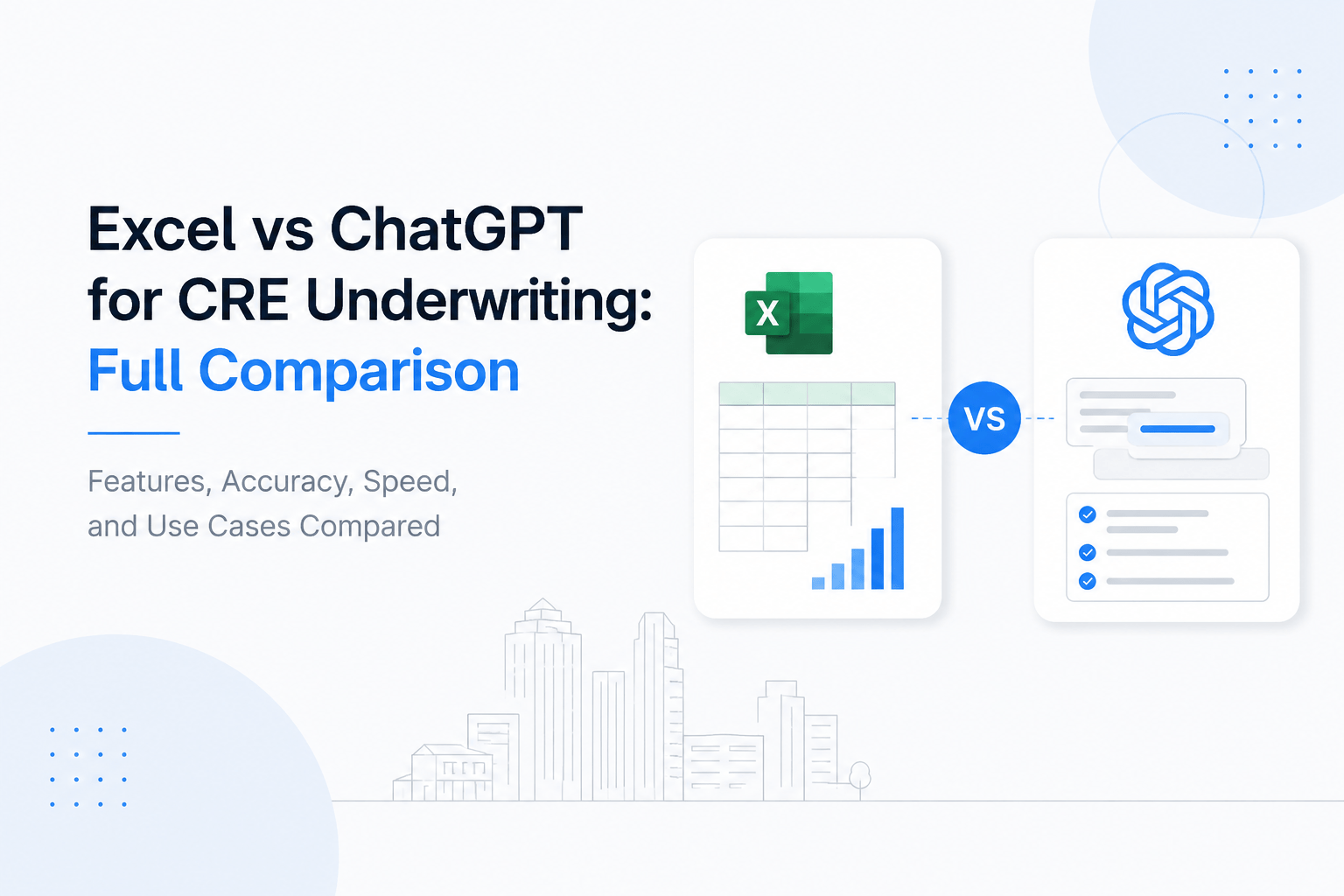
Excel vs ChatGPT for CRE Underwriting: Full Comparison
For years, Excel has been the foundation of commercial real estate underwriting. Analysts, brokers, lenders, and investors rely on spreadsheets to evaluate deals, model cash flows, and make investment decisions. Today, things are changing. Artificial intelligence tools are becoming part of daily CRE workflows. As a result, many professionals are asking the same question: which is better, Excel or ChatGPT? The discussion around Excel vs ChatGPT for CRE underwriting is not really about replacing one tool with another. Instead, it is about understanding where each tool performs best and how they can work together.
Excel remains the standard for financial modeling. It provides complete control over assumptions, formulas, and calculations. Most investment firms, lenders, and institutional investors still depend on spreadsheet-based underwriting models. ChatGPT, however, helps with different parts of the process. It can summarize offering memorandums, review rent rolls, identify risks, create investment summaries, and assist with research. Tasks that once took hours can often be completed much faster.
This is why the debate around Excel vs ChatGPT for CRE underwriting has become increasingly important. The best-performing teams are no longer choosing one or the other. They are combining both to improve efficiency while maintaining accuracy. Before comparing strengths and weaknesses, it helps to understand the broader impact AI is already having on business productivity.
Key AI & CRE Productivity Statistics
Artificial intelligence is no longer an experimental technology. Organizations across industries are using it to improve efficiency, reduce repetitive work, and increase productivity.
Here are several important statistics that help explain why AI is attracting so much attention in commercial real estate.
-
McKinsey estimates generative AI could add up to $4.4 trillion annually to the global economy.
-
PwC projects AI could contribute $15.7 trillion to worldwide economic output by 2030.
-
Deloitte research shows many organizations now prioritize AI for operational efficiency and workforce productivity.
-
Real estate firms continue to increase technology investments to improve decision-making and streamline operations.
-
CRE professionals increasingly use AI-assisted workflows for research, document analysis, and reporting tasks.
These numbers do not mean AI replaces skilled professionals. Instead, they highlight a growing trend. Technology is handling more repetitive work while people focus on analysis, judgment, and decision-making.
That trend directly affects underwriting.
Commercial real estate underwriting involves large amounts of data. Teams review property documents, market reports, financial statements, lease information, and operating expenses before making recommendations.
Many of these activities consume significant time.
This is where the comparison between Excel vs ChatGPT for CRE underwriting becomes relevant. Each tool addresses different challenges within the underwriting process.
What CRE Underwriting Actually Requires
Many discussions about AI in real estate focus on technology. However, understanding the actual underwriting process is more important than understanding the tools themselves.
A tool is only valuable if it improves a specific task. Before comparing Excel vs ChatGPT for CRE underwriting, let’s examine what underwriters actually do every day.
Core Tasks Every Underwriter Performs
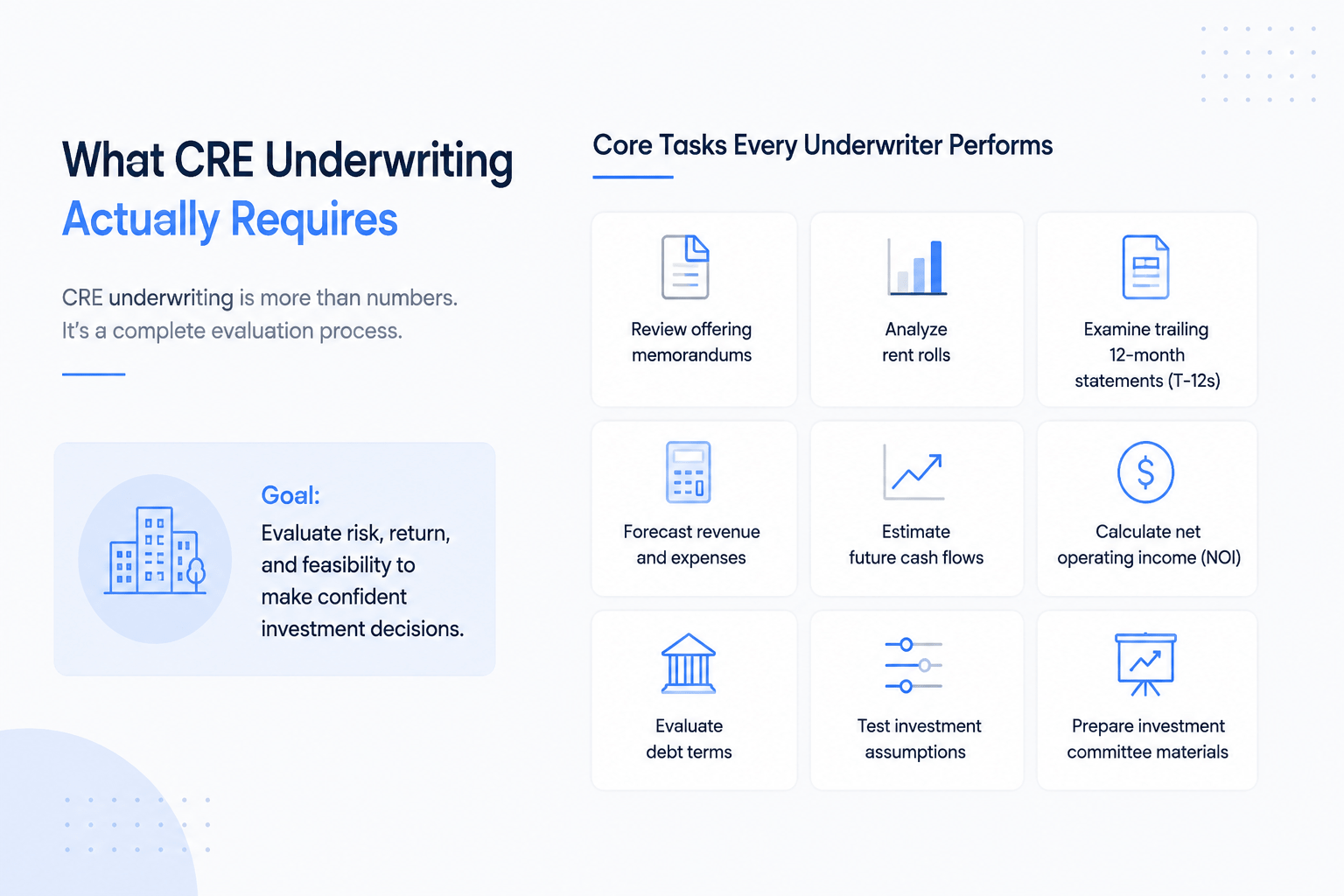
Commercial real estate underwriting involves much more than entering numbers into a spreadsheet. Most professionals perform several key tasks during the evaluation process.
These often include:
-
Reviewing offering memorandums
-
Analyzing rent rolls
-
Examining trailing twelve-month statements (T-12s)
-
Forecasting revenue and expenses
-
Estimating future cash flows
-
Calculating net operating income (NOI)
-
Evaluating debt terms
-
Testing investment assumptions
-
Preparing investment committee materials
Every property type follows a slightly different process. However, these core activities remain largely consistent across multifamily, office, retail, and industrial assets.
Why Underwriting Is Still Time-Intensive
Technology has improved dramatically over the past decade. Yet underwriting remains one of the most labor-intensive functions in commercial real estate. One major reason is data quality.
Property information often arrives in multiple formats. Some documents contain structured data. Others require manual review. Analysts frequently spend hours gathering information before they even begin modeling.
Common time-consuming activities include:
-
Copying data from PDFs
-
Reviewing lease abstracts
-
Verifying expense information
-
Organizing market research
-
Building assumption sets
-
Creating reports for decision-makers
Even experienced underwriters can spend significant time preparing information before financial analysis begins.
Where Most Analyst Hours Are Spent
Many CRE professionals assume modeling consumes most underwriting hours. In reality, preparation often takes longer.
The table below illustrates how analyst time is commonly distributed during a typical underwriting assignment.
Typical Time Allocation During CRE Underwriting
| Underwriting Task | Estimated Time Share |
|---|---|
| Document Review | 25% |
| Data Collection | 20% |
| Data Cleaning & Validation | 15% |
| Financial Modeling | 20% |
| Market Research | 10% |
| Investment Memo Preparation | 10% |
As the table shows, only a portion of the process involves actual modeling. Large amounts of time go toward reviewing documents, gathering information, and preparing reports. This is an important distinction when evaluating Excel vs ChatGPT for CRE underwriting.
Excel excels at calculations, forecasting, and financial modeling. It remains one of the most powerful tools available for structured analysis. ChatGPT serves a different purpose. It can help accelerate research, summarize documents, identify trends, and organize information before data enters the underwriting model.
In other words, both tools support underwriting, but they support different stages of the workflow. Understanding this difference helps avoid one of the biggest misconceptions in the industry: expecting AI to replace financial models entirely.
The reality is much more practical. Excel and ChatGPT solve different problems. The firms seeing the best results are using each tool where it delivers the most value.
What Excel Does Best in CRE Underwriting
Even with the rapid growth of AI, Excel remains the backbone of commercial real estate underwriting. Most acquisition teams, lenders, private equity firms, and institutional investors still rely on spreadsheets to evaluate opportunities.
While new technologies can improve efficiency, they have not replaced the need for detailed financial models.
When discussing Excel vs ChatGPT for CRE underwriting, it is important to understand that Excel was specifically built for calculations, data organization, and financial analysis. Those strengths continue to make it an essential tool in CRE.
Many CRE professionals are exploring ways to combine AI with existing Excel models instead of replacing them. This walkthrough shows a practical example of how AI can support spreadsheet-based underwriting.
Why Excel Remains the Industry Standard
Commercial real estate underwriting requires precision. Investors need to understand how a property performs under different scenarios. Lenders need confidence in debt coverage ratios. Investment committees need transparent assumptions.
Excel supports all of these requirements. For decades, firms have built underwriting templates that reflect their investment strategies. These models contain formulas, sensitivity tables, debt calculations, and reporting structures that have been tested over thousands of transactions.
Because of this history, Excel remains deeply integrated into CRE operations.
Most firms already have:
-
Standardized underwriting templates
-
Investment committee models
-
Acquisition models
-
Development models
-
Asset management reporting systems
Replacing these systems would require significant effort and risk. As a result, Excel continues to serve as the primary platform for financial analysis.
Complete Control Over Financial Models
One of Excel’s greatest strengths is flexibility. Underwriters can customize every assumption, formula, and calculation according to the specific property being analyzed.
For example, an analyst evaluating a multifamily acquisition may adjust:
-
Rent growth assumptions
-
Vacancy rates
-
Operating expense inflation
-
Capital expenditure schedules
-
Financing terms
-
Exit cap rates
Every change immediately affects projected returns. This level of control is critical because no two CRE deals are identical.
Unlike standardized software, Excel allows professionals to build models that reflect the unique characteristics of each investment opportunity.
This flexibility is one reason Excel continues to outperform AI tools for detailed financial modeling.
Institutional Acceptance and Auditability
Commercial real estate transactions often involve multiple stakeholders.
A deal may be reviewed by:
-
Analysts
-
Acquisition managers
-
Investment committees
-
Equity partners
-
Lenders
-
Auditors
Every party wants to understand how conclusions were reached. Excel provides a transparent audit trail because users can trace formulas, review assumptions, and verify calculations.
For example, if an investment committee questions projected NOI growth, the analyst can quickly show:
-
Revenue assumptions
-
Expense assumptions
-
Supporting calculations
-
Scenario analysis
This transparency helps build trust.
When comparing Excel vs ChatGPT for CRE underwriting, auditability remains one of Excel’s strongest advantages.
Advanced Financial Modeling Capabilities
Financial modeling is where Excel truly shines. CRE professionals use spreadsheets to perform calculations that require precision and consistency.
Common modeling functions include:
-
Discounted cash flow analysis
-
Internal rate of return (IRR)
-
Net present value (NPV)
-
Equity multiple calculations
-
Debt service coverage ratio calculations
-
Loan amortization schedules
-
Waterfall structures
-
Partnership distributions
These calculations often depend on dozens or even hundreds of interconnected assumptions. Excel manages these relationships efficiently. AI tools can assist with analysis, but they are not designed to replace institutional-quality financial models.
Scenario Analysis and Sensitivity Testing
Real estate investing involves uncertainty. Interest rates change. Occupancy changes. Market rents change. Exit values change. Successful investors evaluate multiple scenarios before making decisions.
Excel makes this process straightforward.
Analysts can test:
-
Best-case scenarios
-
Base-case scenarios
-
Worst-case scenarios
They can also analyze how changes affect returns. For example, a small increase in exit cap rate may significantly reduce projected IRR.
Sensitivity testing helps investors understand risk before committing capital. This remains one of Excel’s most valuable functions in the Excel vs ChatGPT for CRE underwriting discussion.
Integration With Existing CRE Workflows
Another reason Excel remains dominant is its compatibility with existing systems. Most organizations already use spreadsheets throughout the investment lifecycle.
Excel supports:
-
Acquisition underwriting
-
Debt analysis
-
Development modeling
-
Portfolio management
-
Budget forecasting
-
Asset management reporting
Because these workflows already exist, Excel fits naturally into day-to-day operations. Teams do not need extensive retraining. They simply continue using tools they already understand.
Common Excel Models Used by CRE Teams
Different property types require different underwriting approaches. However, several model categories are widely used across the industry.
Most Common Excel Underwriting Models Used in CRE
| Model Type | Primary Use | Complexity | Typical Users |
|---|---|---|---|
| Acquisition Model | Evaluate property purchases | High | Investors, Analysts |
| Multifamily Model | Apartment underwriting | High | Acquisition Teams |
| Development Model | Ground-up projects | Very High | Developers |
| Debt Model | Loan analysis | Medium | Lenders |
| Asset Management Model | Portfolio monitoring | Medium | Asset Managers |
| Sensitivity Model | Risk analysis | Medium | Investment Committees |
These models often become core intellectual property for investment firms. Many organizations spend years refining them.
Biggest Advantages of Excel
Excel continues to dominate underwriting because it provides several practical benefits.
Key advantages include:
-
Complete transparency
-
Full control over formulas
-
Strong auditability
-
Industry-wide acceptance
-
Powerful financial calculations
-
Flexible scenario analysis
-
Easy customization
-
Reliable reporting
These capabilities make Excel extremely difficult to replace. Even firms adopting AI continue to use spreadsheets as their primary financial modeling platform.
Biggest Limitations of Excel
Although Excel remains powerful, it is not perfect. Many underwriting teams face challenges when relying exclusively on spreadsheets.
Common limitations include:
-
Manual data entry
-
Human calculation errors
-
Version control problems
-
Time-consuming document review
-
Duplicate work across teams
-
Slow information gathering
-
Limited automation
For example, an analyst may spend hours reviewing a 100-page offering memorandum before entering data into a model. The calculations themselves may only require a fraction of that time. This is where newer technologies begin to add value.
While Excel remains unmatched for modeling, it struggles with tasks such as document analysis, information extraction, and content creation. These are areas where AI tools can help reduce workload and improve efficiency.
What ChatGPT Does Best in CRE Underwriting
While Excel remains the leader for financial modeling, ChatGPT is changing how CRE professionals handle many of the tasks that happen before and after the model itself. This distinction is important.
The debate around Excel vs ChatGPT for CRE underwriting often assumes both tools are trying to do the same job. In reality, they excel at different parts of the underwriting process.
Excel focuses on calculations and financial projections. ChatGPT focuses on information processing, research, document review, and communication. When used correctly, ChatGPT can significantly reduce the time spent on repetitive tasks that slow down underwriting teams.
How ChatGPT Fits Into Underwriting Workflows
Most CRE professionals spend far more time gathering and reviewing information than actually building models.
Before an analyst enters a single number into Excel, they often need to review:
-
Offering memorandums
-
Rent rolls
-
T-12 statements
-
Property condition reports
-
Market reports
-
Loan documents
-
Lease abstracts
This preparation stage can consume several hours per deal. ChatGPT helps streamline much of this work. Instead of manually reviewing hundreds of pages, users can ask targeted questions and receive structured summaries.
This does not eliminate the need for human review. However, it can make the review process much faster.
Document Summarization and Extraction
One of ChatGPT’s most valuable underwriting uses is document analysis. Commercial real estate deals often come with large document packages.
These may include:
-
Offering memorandums
-
Market studies
-
Environmental reports
-
Due diligence materials
-
Property operating statements
Finding important information manually can be time-consuming.
ChatGPT can quickly identify:
-
Occupancy rates
-
Revenue trends
-
Major risks
-
Deferred maintenance issues
-
Tenant concentration concerns
-
Capital expenditure requirements
This allows analysts to focus on interpretation rather than document hunting. For many firms, this is one of the biggest productivity improvements in the Excel vs ChatGPT for CRE underwriting comparison.
Rent Roll and T-12 Review Assistance
Reviewing rent rolls and T-12 statements is a critical part of underwriting. However, these documents often contain hundreds of data points.
ChatGPT can help identify:
-
Vacancy patterns
-
Expiring leases
-
Unusual expenses
-
Revenue inconsistencies
-
Tenant concentration risks
-
Occupancy trends
For example, an analyst can upload a rent roll and ask:
-
Which leases expire within the next 12 months?
-
Which tenants occupy the most space?
-
Are there unusual rent variations?
-
What risks should I investigate further?
Instead of manually searching through spreadsheets, analysts can quickly focus on areas that require deeper review.
Market Research and Competitive Analysis
Market research is another area where ChatGPT can save significant time.
Underwriters often need information about:
-
Local market conditions
-
Rent growth trends
-
New developments
-
Vacancy rates
-
Comparable properties
-
Economic drivers
Gathering this information from multiple sources can take hours. ChatGPT can help organize findings, summarize reports, and identify key themes.
For example, an analyst evaluating an industrial property may ask ChatGPT to summarize:
-
Industrial demand trends
-
Local employment growth
-
New supply pipelines
-
Major market risks
This creates a faster starting point for investment analysis.
Investment Memo Drafting
Many acquisition teams spend substantial time preparing investment committee materials.
After completing the financial analysis, someone must still summarize:
-
Property details
-
Market conditions
-
Investment strengths
-
Risks
-
Return projections
-
Acquisition recommendations
ChatGPT can significantly reduce drafting time. Instead of starting from a blank page, analysts can generate first drafts that are later reviewed and refined. This helps teams move deals through the approval process faster.
Deal Screening Before Full Underwriting
Not every opportunity deserves a complete underwriting model. Many CRE professionals review dozens of opportunities before selecting a few for deeper analysis.
ChatGPT can help screen opportunities by identifying:
-
Obvious risks
-
Missing information
-
Market concerns
-
Operational issues
-
Questions requiring clarification
This helps acquisition teams prioritize their time more effectively. Rather than fully underwriting every deal, they can focus on the opportunities most likely to move forward.
Creating Investor and IC Summaries
Investment committees often need concise summaries rather than detailed spreadsheets.
ChatGPT can convert large amounts of information into clear reports that highlight:
-
Key assumptions
-
Financial performance
-
Major risks
-
Market conditions
-
Investment rationale
This improves communication between analysts, executives, and investors. As deal volume increases, this capability becomes increasingly valuable.
Biggest Advantages of ChatGPT
ChatGPT provides several benefits that complement traditional underwriting workflows.
Key advantages include:
-
Faster document review
-
Faster research
-
Improved report drafting
-
Better information organization
-
Reduced repetitive work
-
Quick summaries of large files
-
Enhanced productivity
-
Easier knowledge access
These strengths make ChatGPT particularly useful during the early stages of underwriting. Many firms are finding that combining ChatGPT with Excel creates a more efficient process than relying on spreadsheets alone.
Biggest Limitations of ChatGPT
Despite its strengths, ChatGPT has important limitations. Understanding these limitations is essential when comparing Excel vs ChatGPT for CRE underwriting.
Common challenges include:
-
Hallucinated information
-
Limited financial modeling capabilities
-
Lack of built-in audit trails
-
Difficulty handling highly customized models
-
Dependence on prompt quality
-
Need for human verification
Most importantly, ChatGPT should never be treated as a final source of truth. All outputs must be reviewed and verified before being used in investment decisions.
For example, if ChatGPT summarizes a rent roll or identifies projected risks, analysts should confirm those findings against the original documents.
The technology is best viewed as an assistant rather than a replacement for professional judgment.
ChatGPT Tasks That Save the Most Time for CRE Teams
The greatest value often comes from reducing repetitive administrative work.
ChatGPT Tasks That Save the Most Time for CRE Teams
| Task | Manual Time | AI-Assisted Time | Typical Savings |
|---|---|---|---|
| OM Review | 60–90 min | 10–20 min | 70–80% |
| Rent Roll Summary | 45–60 min | 10–15 min | 65–75% |
| T-12 Review | 45–60 min | 10–15 min | 65–75% |
| Market Research Summary | 2–3 hrs | 30–45 min | 70–80% |
| Investment Memo Draft | 1–2 hrs | 15–30 min | 70–85% |
| Deal Screening | 30–45 min | 5–10 min | 70–80% |
These estimates vary by property type and workflow. However, they illustrate why AI adoption is growing across commercial real estate firms. The key takeaway is simple. Excel remains the better tool for modeling and calculations.
ChatGPT excels at research, document review, summarization, and communication. The most productive underwriting teams use both.
Excel vs ChatGPT for CRE Underwriting: Side-by-Side Comparison
By now, it should be clear that Excel and ChatGPT serve different purposes. Excel is designed for structured financial analysis. ChatGPT is designed for processing information, generating insights, and assisting with repetitive tasks.
However, many CRE professionals still want a direct comparison. If you had to choose between the two, which one would perform better for underwriting?
The answer depends entirely on the task. Let’s compare them across the areas that matter most to commercial real estate professionals.
Speed
Speed is one of the main reasons AI adoption is growing. Traditional underwriting often involves reviewing large documents before any modeling begins.
An analyst may spend hours reading offering memorandums, organizing data, and creating reports. ChatGPT can reduce much of this workload.
For example:
-
Summarizing a 100-page OM
-
Reviewing rent rolls
-
Extracting property information
-
Drafting investment memos
These tasks can often be completed in minutes instead of hours. Excel, on the other hand, is only as fast as the person using it. Data must still be entered, organized, and analyzed manually.
Winner: ChatGPT
Accuracy
Accuracy is critical in underwriting. A small error can change projected returns and affect investment decisions. Excel performs calculations consistently when formulas are built correctly. Results can also be audited and verified.
ChatGPT does not calculate investment returns with the same reliability. It may occasionally generate incorrect assumptions or inaccurate information. For this reason, AI outputs always require human review. When precision matters most, Excel remains the safer choice.
Winner: Excel
Financial Modeling
Financial modeling is where Excel dominates.
Commercial real estate models often include:
-
Monthly cash flows
-
Debt schedules
-
Waterfalls
-
Sensitivity tables
-
Partnership structures
-
Exit analyses
Excel was built specifically for this type of work. ChatGPT can explain calculations and help build formulas, but it is not designed to serve as a full underwriting model. Most institutional investors still require spreadsheet-based analysis.
Winner: Excel
Document Analysis
Commercial real estate transactions generate large volumes of documentation. Reviewing these materials manually takes time.
ChatGPT can quickly summarize:
-
Offering memorandums
-
Market reports
-
Lease abstracts
-
T-12 statements
-
Due diligence reports
Excel is not designed for document analysis. As a result, ChatGPT has a major advantage in this category.
Winner: ChatGPT
Reporting
Investment committees, lenders, and equity partners often need written summaries.
These reports explain:
-
Property performance
-
Risks
-
Opportunities
-
Investment recommendations
Creating these materials manually can take significant time. ChatGPT can generate first drafts within minutes. Excel can produce charts and reports, but writing remains largely manual.
Winner: ChatGPT
Collaboration
Collaboration requirements vary by organization. Many firms already use Excel-based workflows that multiple team members understand. Spreadsheet models can be reviewed, audited, and shared across departments.
ChatGPT improves collaboration by helping teams communicate information more efficiently. However, it does not replace established underwriting processes. In most firms, Excel remains the primary collaboration platform for deal analysis.
Winner: Excel
Scalability
As deal volume grows, efficiency becomes increasingly important. A team reviewing 10 deals per month faces different challenges than a team reviewing 100 deals.
ChatGPT can help scale:
-
Document review
-
Initial screening
-
Research
-
Reporting
Excel scales well for modeling, but does not reduce preparation work.
As transaction volume increases, AI often provides greater operational leverage.
Winner: ChatGPT
Learning Curve
Most CRE professionals already know Excel. Universities, certification programs, and employers have relied on spreadsheets for decades. ChatGPT is relatively easy to learn, but effective prompting still requires practice.
For experienced analysts, Excel usually feels more familiar. For newer professionals, ChatGPT may be easier to adopt. Overall, both tools are accessible, but Excel benefits from widespread industry familiarity.
Winner: Tie
Cost
Cost is another important consideration. Excel is typically included within Microsoft 365 subscriptions already used by most firms. ChatGPT requires an additional subscription cost.
However, when measured against labor savings, many teams find the cost relatively small. The real question is not software pricing. The real question is whether time savings justify the investment. For most active acquisition teams, the answer is often yes.
Winner: Depends on workflow
Compliance and Audit Requirements
Institutional investors require transparency.
Investment decisions must often be supported by documented assumptions and verifiable calculations.
Excel provides:
-
Formula visibility
-
Version tracking
-
Auditability
-
Structured review processes
ChatGPT does not provide the same level of financial transparency. For regulated environments and institutional reporting, Excel remains the preferred option.
Winner: Excel
Excel vs ChatGPT Feature Comparison for CRE Underwriting
Excel vs ChatGPT Feature Comparison for CRE Underwriting
| Feature | Excel | ChatGPT | Winner |
|---|---|---|---|
| Financial Modeling | Excellent | Limited | Excel |
| IRR & NPV Analysis | Excellent | Limited | Excel |
| Sensitivity Analysis | Excellent | Limited | Excel |
| Document Review | Poor | Excellent | ChatGPT |
| Rent Roll Analysis | Good | Excellent | ChatGPT |
| T-12 Review | Good | Excellent | ChatGPT |
| Market Research | Fair | Excellent | ChatGPT |
| Investment Memo Writing | Limited | Excellent | ChatGPT |
| Auditability | Excellent | Limited | Excel |
| Institutional Acceptance | Excellent | Limited | Excel |
| Speed for Research | Fair | Excellent | ChatGPT |
| Speed for Calculations | Excellent | Fair | Excel |
Which Tool Wins Overall?
The comparison reveals something important. There is no single winner in the Excel vs ChatGPT for CRE underwriting debate. Each tool solves a different problem.
Excel remains the clear leader for:
-
Financial modeling
-
Cash flow projections
-
Debt analysis
-
Sensitivity testing
-
Investment committee reviews
ChatGPT leads in:
-
Research
-
Document analysis
-
Information extraction
-
Report writing
-
Deal screening
The most effective underwriting teams do not replace Excel with ChatGPT. Instead, they use ChatGPT to reduce manual work and Excel to perform the financial analysis that drives investment decisions.
Before vs After Productivity Comparison
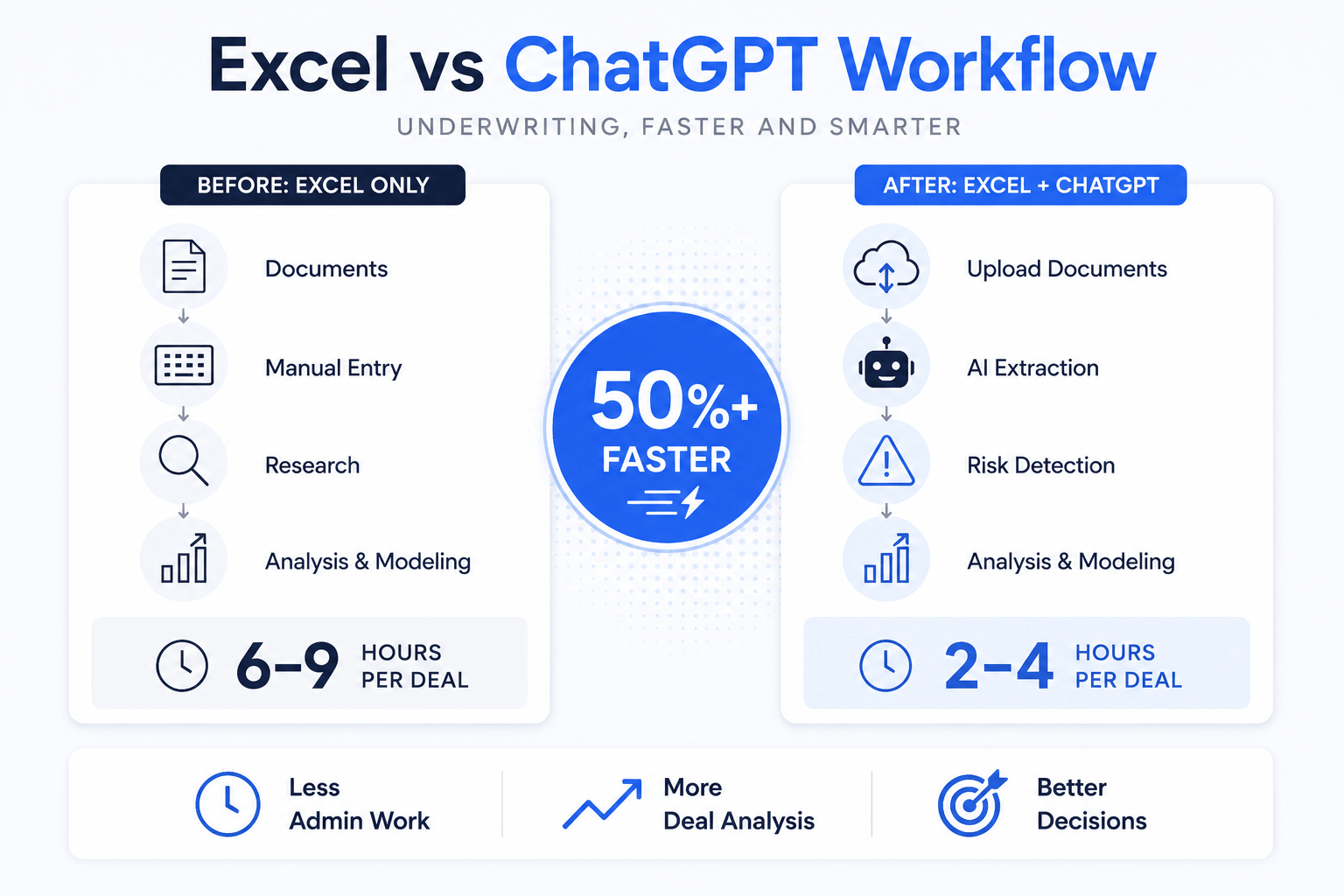
The biggest benefit of combining AI with underwriting is not replacing analysts. It is helping analysts spend more time on decisions and less time on repetitive tasks. To understand the impact, let’s compare a traditional underwriting process with a workflow that combines Excel and ChatGPT.
As more teams look to reduce manual work, many are building an automated underwriting system that combines AI-driven document analysis with traditional Excel modeling.
Traditional Excel-Only Workflow
A conventional underwriting process typically follows these steps:
-
Receive the offering memorandum.
-
Review all property documents manually.
-
Extract rent roll information.
-
Review T-12 statements.
-
Gather market research.
-
Build assumptions.
-
Populate the underwriting model.
-
Create an investment memo.
-
Present findings to decision-makers.
This process works well.
However, much of the time is spent preparing information rather than analyzing it.
Excel Plus ChatGPT Workflow
A modern underwriting workflow looks different.
-
Upload property documents.
-
Generate document summaries.
-
Extract key property data.
-
Identify risks and missing information.
-
Build assumptions faster.
-
Populate Excel model.
-
Generate draft investment memo.
-
Review and verify outputs.
-
Finalize recommendations.
The financial model still lives in Excel.
The difference is that the preparation work becomes significantly faster.
Time Savings Breakdown
The value of combining Excel and ChatGPT becomes clearer when we look at actual workflow improvements. Most underwriting teams do not struggle with building models. They struggle with everything that happens before and after the model.
Document review, data gathering, research, and reporting often consume more time than the financial analysis itself. When ChatGPT handles portions of those tasks, analysts can spend more time evaluating deals and less time processing information.
The result is faster underwriting without sacrificing model quality.
Underwriting Workflow Time Comparison
| Task | Excel Only | Excel + ChatGPT |
|---|---|---|
| OM Review | 60–90 min | 10–20 min |
| Rent Roll Analysis | 45–60 min | 10–15 min |
| T-12 Review | 45–60 min | 10–15 min |
| Market Research | 2–3 hrs | 30–45 min |
| Data Organization | 30–45 min | 10–15 min |
| Investment Memo Draft | 1–2 hrs | 15–30 min |
| Initial Deal Screening | 30–45 min | 5–10 min |
| Total Time Per Deal | 6–9 hrs | 2–4 hrs |
These estimates vary based on deal complexity. However, the pattern remains consistent. The greatest savings come from reducing manual review and administrative work. Financial modeling still requires human oversight, but the preparation process becomes much more efficient.
For active acquisition teams evaluating dozens of deals each month, these savings can add up quickly. A team reviewing 40 deals per month could potentially save dozens of hours every week.
That time can then be spent on:
-
Better due diligence
-
More market analysis
-
Additional deal sourcing
-
Investor communication
-
Portfolio strategy
This is why many firms are moving beyond the question of Excel vs ChatGPT for CRE underwriting and focusing instead on how to combine both effectively.
Real-World CRE Use Cases
The benefits of combining Excel and ChatGPT become easier to understand when viewed through actual commercial real estate scenarios. Different property types create different underwriting challenges.
Some require extensive lease analysis. Others involve operational complexity or large amounts of market data. The following examples show where AI-assisted workflows can provide practical value.
Multifamily Acquisition Analysis
Multifamily underwriting often involves large rent rolls and detailed operating statements.
An acquisition analyst may need to review:
-
Unit mix
-
Occupancy trends
-
Historical collections
-
Operating expenses
-
Renovation opportunities
ChatGPT can quickly summarize rent roll data and highlight potential issues. The analyst can then transfer verified information into an Excel model for detailed projections. This approach reduces preparation time while maintaining model accuracy.
Retail Property Underwriting
Retail properties often involve complex lease structures.
Underwriters may need to evaluate:
-
Anchor tenants
-
Percentage rent clauses
-
Lease expiration schedules
-
Tenant credit quality
-
Co-tenancy provisions
Reviewing these documents manually can be time-intensive. ChatGPT can help summarize lease information and identify clauses that deserve closer attention. Excel remains responsible for forecasting future cash flows and investment returns.
Office Investment Evaluation
Office underwriting often requires a deep understanding of tenant risk.
Analysts must assess:
-
Lease rollover schedules
-
Occupancy trends
-
Tenant concentration
-
Market demand
-
Future leasing assumptions
ChatGPT can organize lease information and summarize market reports. Excel then converts those assumptions into financial projections. Together, the tools create a faster workflow without compromising analytical rigor.
Industrial Property Screening
Industrial properties frequently attract large volumes of investor interest. Acquisition teams may need to evaluate numerous opportunities in a short period.
ChatGPT can assist with:
-
Initial document review
-
Market summaries
-
Tenant analysis
-
Risk identification
This allows teams to eliminate weaker opportunities before investing significant underwriting resources. Excel remains the final evaluation tool once a deal passes initial screening.
Debt and Lending Analysis
Lenders also benefit from AI-assisted workflows.
Loan underwriting requires reviewing:
-
Borrower information
-
Property performance
-
Debt coverage metrics
-
Market conditions
ChatGPT can summarize borrower packages and supporting documentation. Loan officers can then focus on financial analysis, risk assessment, and approval decisions. This improves efficiency while preserving underwriting standards.
Investment Committee Preparation
Many analysts spend substantial time preparing materials for investment committees.
A typical IC package may include:
-
Property overview
-
Market analysis
-
Risk assessment
-
Financial projections
-
Investment recommendation
Creating these reports manually can take several hours. ChatGPT can generate initial drafts that analysts review and refine. This helps teams move opportunities through the approval process more efficiently.
How to Implement Excel and ChatGPT Together in 24 Hours
Many CRE professionals understand the benefits of AI but are unsure where to begin. The good news is that implementation does not require a complete overhaul of existing systems. In most cases, firms can begin improving productivity within a single day.
The goal is simple:
Keep Excel for modeling and use ChatGPT for repetitive information-processing tasks. For a deeper look at how leading firms structure their process, check out our guide on an AI underwriting workflow that breaks down each step from document review to final deal analysis.
Step 1: Identify Bottlenecks
Start by examining your current underwriting process.
Ask yourself:
-
Which tasks consume the most time?
-
Which activities are repetitive?
-
Where do delays typically occur?
For many teams, common bottlenecks include:
-
OM review
-
Rent roll analysis
-
Market research
-
Memo preparation
These are often ideal candidates for AI assistance.
Step 2: Select Repeatable Tasks
Not every task should be delegated to AI.
Focus on activities that follow a predictable process.
Examples include:
-
Summarizing documents
-
Extracting key property information
-
Organizing research
-
Drafting reports
Keep financial calculations inside Excel. This ensures accuracy and auditability.
Step 3: Build Prompt Templates
Consistency matters.
Instead of creating new prompts for every deal, develop reusable templates.
Examples include:
-
OM summary prompts
-
Rent roll review prompts
-
Market analysis prompts
-
Risk assessment prompts
-
Investment memo prompts
Standardized prompts improve output quality and save time.
Step 4: Create Review Procedures
Every AI-generated output should be verified.
Establish review processes that require analysts to:
-
Validate key figures
-
Confirm assumptions
-
Cross-check summaries
-
Review recommendations
AI should support decision-making, not replace professional judgment.
Step 5: Standardize Outputs
Consistency improves efficiency.
Create standard formats for:
-
Deal summaries
-
Risk reports
-
Market analyses
-
Investment recommendations
Standardized outputs make information easier to review and compare.
Step 6: Train Team Members
Even simple AI workflows require basic training.
Team members should understand:
-
Effective prompting
-
Verification procedures
-
Data privacy guidelines
-
Workflow expectations
Training helps ensure adoption across the organization.
Step 7: Measure Results
Track performance after implementation.
Monitor:
-
Time saved per deal
-
Deals reviewed per month
-
Analyst productivity
-
Reporting efficiency
Measuring results helps justify future investments in AI-assisted workflows.
Implementation Checklist
Before launching an AI-assisted underwriting process, make sure you have:
-
Standard prompt library
-
Data review procedures
-
Verification requirements
-
Team training materials
-
Security policies
-
Approved workflows
-
Performance metrics
Firms that follow a structured implementation process typically see better results than those adopting AI without clear guidelines.
Copy-Paste ChatGPT Prompts for CRE Underwriting
One of the biggest reasons CRE professionals get inconsistent results from AI is poor prompting. Many users ask vague questions and receive vague answers. A better approach is to create structured prompts that follow the same process every time.
This improves consistency, accuracy, and efficiency. The following prompts are designed to complement Excel-based underwriting workflows. They help analysts gather information faster while keeping financial modeling inside the spreadsheet.
Rent Roll Review Prompt
Use this prompt when reviewing a rent roll before entering information into your underwriting model.
Prompt:
Act as a senior commercial real estate acquisitions analyst. Review the rent roll below and identify the following:
-
Largest tenants by leased area
-
Lease expirations within the next 12 months
-
Occupancy percentage
-
Tenant concentration risks
-
Unusual rent variations
-
Potential underwriting concerns
Present findings in a clear table and include recommendations for additional due diligence.”
T-12 Analysis Prompt
This prompt helps identify operating trends and potential risks.
Prompt:
“Review the following trailing 12-month operating statement and provide:
-
Revenue trends
-
Expense trends
-
Largest expense categories
-
Unusual operating costs
-
Potential red flags
-
Questions requiring clarification
Summarize findings in bullet-point format suitable for an acquisition team.”
OM Summary Prompt
Offering memorandums often contains dozens of pages of information. This prompt helps create a quick first-pass review.
Prompt:
“Review the attached offering memorandum and create a summary covering:
-
Property overview
-
Location highlights
-
Occupancy statistics
-
Tenant information
-
Financial performance
-
Value-add opportunities
-
Major investment risks
Keep the summary under 500 words and use acquisition analyst language.”
Investment Memo Prompt
Many teams spend significant time preparing investment committee materials. This prompt creates a strong first draft.
Prompt:
“Using the information provided, draft an investment committee summary including:
-
Executive summary
-
Property description
-
Market overview
-
Financial highlights
-
Investment strengths
-
Key risks
-
Recommendation
Write in a professional tone suitable for institutional real estate investors.”
Market Analysis Prompt
Market research can become overwhelming without structure.
Prompt:
“Act as a commercial real estate market analyst. Summarize the following market information and provide:
-
Key demand drivers
-
Employment trends
-
Population trends
-
New supply pipeline
-
Vacancy trends
-
Rent growth outlook
-
Major risks
Provide a concise investment-focused summary.”
Risk Identification Prompt
Every deal has risks.
The goal is to identify them early.
Prompt:
“Review the attached property information and identify:
-
Financial risks
-
Leasing risks
-
Market risks
-
Tenant risks
-
Capital expenditure concerns
-
Due diligence items requiring further investigation
Rank risks by severity and explain why each matters.”
Debt Sizing Prompt
Debt assumptions can significantly impact returns. This prompt helps organize financing discussions.
Prompt:
“Based on the property information below, identify factors that could affect debt sizing and financing terms. Include:
-
Cash flow stability
-
Occupancy considerations
-
Tenant quality
-
Property condition
-
Market conditions
-
Potential lender concerns
Present findings in a lender-focused format.”
Acquisition Recommendation Prompt
Use this prompt before preparing a final investment recommendation.
Prompt:
“Act as an acquisitions director reviewing this opportunity. Based on the information provided:
-
Summarize strengths
-
Summarize weaknesses
-
Highlight major risks
-
Identify missing information
-
Recommend next steps
-
Provide a preliminary investment opinion
Keep the analysis objective and evidence-based.”
What Most CRE Professionals Get Wrong About AI
Artificial intelligence is becoming more common in commercial real estate. However, many professionals still misunderstand how it should be used. As a result, they either expect too much from AI or fail to use it where it can provide the most value.
Understanding these mistakes is important when evaluating Excel vs ChatGPT for CRE underwriting.
Expecting AI to Replace Excel
This is probably the most common misconception. Some people assume ChatGPT can replace underwriting models entirely.
In reality, financial modeling still requires:
-
Structured calculations
-
Sensitivity analysis
-
Auditability
-
Formula transparency
-
Institutional reporting
These remain Excel’s strengths. AI helps support underwriting, but it does not replace the model itself. The most successful teams use both tools together.
Blindly Trusting Outputs
AI can produce impressive answers. However, impressive does not always mean accurate. ChatGPT occasionally generates incorrect information, incomplete conclusions, or unsupported assumptions.
This is why verification remains essential. Every output should be reviewed before it influences an investment decision. Experienced analysts treat AI as an assistant, not a final authority.
Ignoring Verification Processes
Some firms adopt AI without establishing review procedures. This creates unnecessary risk.
A better approach includes:
-
Human review requirements
-
Data validation steps
-
Approval processes
-
Documentation standards
These safeguards help maintain underwriting quality while still benefiting from automation.
Using Generic Prompts
Prompt quality directly affects output quality. A vague request often produces vague results.
For example:
Poor prompt:
“Analyze this property.”
Better prompt:
“Review this rent roll and identify tenant concentration risks, lease rollover exposure, and occupancy concerns.”
Specific prompts create more useful outputs.
Focusing on Tools Instead of Workflows
Many professionals spend too much time comparing software. The more important question is how work gets done. Technology alone does not improve productivity. Well-designed workflows improve productivity.
Instead of asking:
“Which tool is better?”
Ask:
“Which process becomes faster and more accurate with this tool?”
That mindset usually produces better results.
Underestimating Training Requirements
AI is not completely self-explanatory.
Teams still need guidance on:
-
Prompt creation
-
Verification methods
-
Security standards
-
Workflow integration
Organizations that invest in training typically see stronger adoption and better outcomes. The technology may be easy to access, but effective implementation requires planning.
Tools That Actually Work vs Hype
The commercial real estate technology market is crowded. Every year, new AI platforms promise faster underwriting, better forecasting, and automated decision-making. Some deliver real value.
Others generate more marketing excitement than practical results. Understanding the difference helps firms invest their time and money more effectively.
Excel
Excel remains one of the most valuable tools in commercial real estate.
Its strengths include:
-
Financial modeling
-
Cash flow forecasting
-
Debt analysis
-
Sensitivity testing
-
Institutional reporting
Despite all the AI innovation in the market, Excel continues to be the foundation of most underwriting processes.
ChatGPT
ChatGPT provides value in areas where spreadsheets are less effective.
Its strengths include:
-
Document review
-
Research assistance
-
Report drafting
-
Information organization
-
Deal screening
For many teams, it delivers the greatest productivity gains outside the financial model.
Claude
Claude has gained popularity for analyzing long documents.
Many users prefer it when reviewing:
-
Lease agreements
-
Due diligence reports
-
Offering memorandums
-
Market studies
Its ability to process large amounts of information makes it useful during underwriting preparation.
Excel AI Add-Ins
Microsoft continues adding AI functionality to Excel.
These tools can help with:
-
Formula generation
-
Data analysis
-
Spreadsheet assistance
-
Productivity improvements
While promising, most firms still rely on traditional Excel workflows for core underwriting functions.
Purpose-Built CRE AI Platforms
A growing number of companies now offer AI tools specifically for commercial real estate.
Potential benefits include:
-
Property data integration
-
Automated extraction
-
Specialized workflows
-
Industry-specific reporting
However, firms should evaluate these platforms carefully before replacing existing processes.
Practical Value vs Marketing Hype
Practical Value vs Marketing Hype
| Tool Type | Real Value | Hype Level | Best Use Case |
|---|---|---|---|
| Excel | Very High | Low | Financial Modeling |
| ChatGPT | High | Medium | Research & Document Review |
| Claude | High | Medium | Long Document Analysis |
| Excel AI Features | Moderate | Medium | Spreadsheet Assistance |
| CRE AI Platforms | Varies | High | Specialized Workflows |
| Fully Automated Underwriting Claims | Low to Moderate | Very High | Limited Real-World Use |
The strongest takeaway remains consistent throughout the Excel vs ChatGPT for CRE underwriting discussion. The best technology stack is rarely a single tool.
Instead, high-performing CRE teams combine proven financial models with AI-assisted workflows to increase efficiency while maintaining accuracy and control.
Cost Comparison and ROI Analysis
Technology investments should produce measurable business value. That is especially true in commercial real estate, where margins matter, and teams are expected to operate efficiently.
When evaluating Excel vs ChatGPT for CRE underwriting, cost is often one of the first questions decision-makers ask. However, software pricing alone does not tell the whole story. The more important question is whether a tool saves enough time to justify its cost.
Excel Licensing Costs
Most CRE firms already use Microsoft 365. As a result, Excel is typically viewed as an existing business expense rather than a new investment. For many organizations, underwriting models have been built and refined over the years.
This means the direct software cost is relatively low compared to the value generated.
Additional costs may include:
-
Model development
-
Staff training
-
Template maintenance
-
Quality control reviews
However, these costs are usually spread across multiple teams and projects.
ChatGPT Subscription Costs
ChatGPT requires an additional subscription. Compared with salaries, acquisition costs, and software budgets, the expense is relatively small. The real value comes from time savings.
If an analyst saves several hours each week through document review, research assistance, and memo drafting, the return can quickly exceed the subscription cost.
For active acquisition teams, productivity improvements often matter far more than subscription fees.
Analyst Time Savings
Labor is one of the largest expenses in underwriting. Highly skilled analysts spend significant time on tasks that do not directly contribute to investment decisions.
Examples include:
-
Reviewing documents
-
Organizing information
-
Preparing summaries
-
Drafting reports
These activities are necessary, but they can be time-consuming.
When ChatGPT reduces those tasks, analysts can spend more time on:
-
Deal evaluation
-
Market analysis
-
Due diligence
-
Investor communication
This shift often creates the largest return on investment.
Small Team ROI Example
Consider a small acquisitions team consisting of:
-
One acquisitions manager
-
Two analysts
Assume each analyst saves four hours per week through AI-assisted workflows.
That equals:
-
8 hours saved per week
-
32 hours saved per month
-
Nearly 400 hours saved annually
Those hours can be redirected toward sourcing and evaluating additional opportunities. For many firms, even one extra successful acquisition can justify the investment many times over.
Mid-Sized CRE Firm ROI Example
Now consider a larger organization with:
-
Five acquisition analysts
-
Multiple markets
-
High transaction volume
If each analyst saves five hours per week:
-
25 hours saved weekly
-
Over 100 hours saved monthly
-
More than 1,200 hours saved annually
The cumulative productivity impact becomes substantial. More deals can be screened. Reports can be produced faster. Teams can scale without immediately increasing headcount.
Enterprise Adoption Considerations
Large organizations face additional considerations.
These may include:
-
Security requirements
-
Data governance policies
-
Compliance standards
-
Internal approval processes
Enterprise adoption often requires more planning than small-team implementation. However, the potential productivity gains are also larger because improvements can affect dozens of employees simultaneously.
Annual Cost and ROI Comparison
Annual Cost and ROI Comparison
| Item | Excel | ChatGPT | Combined Stack |
|---|---|---|---|
| Software Cost | Low | Low to Moderate | Moderate |
| Financial Modeling Capability | Excellent | Limited | Excellent |
| Research Efficiency | Fair | Excellent | Excellent |
| Document Review Speed | Fair | Excellent | Excellent |
| Reporting Efficiency | Moderate | Excellent | Excellent |
| Time Savings Potential | Moderate | High | Very High |
| Overall ROI Potential | High | High | Very High |
The numbers make one thing clear. The real opportunity is not choosing between Excel and ChatGPT. The greatest value comes from combining them.
When Excel Is Better Than ChatGPT
Although AI continues to improve, there are many situations where Excel remains the superior tool. These situations usually involve precision, transparency, and financial calculations.
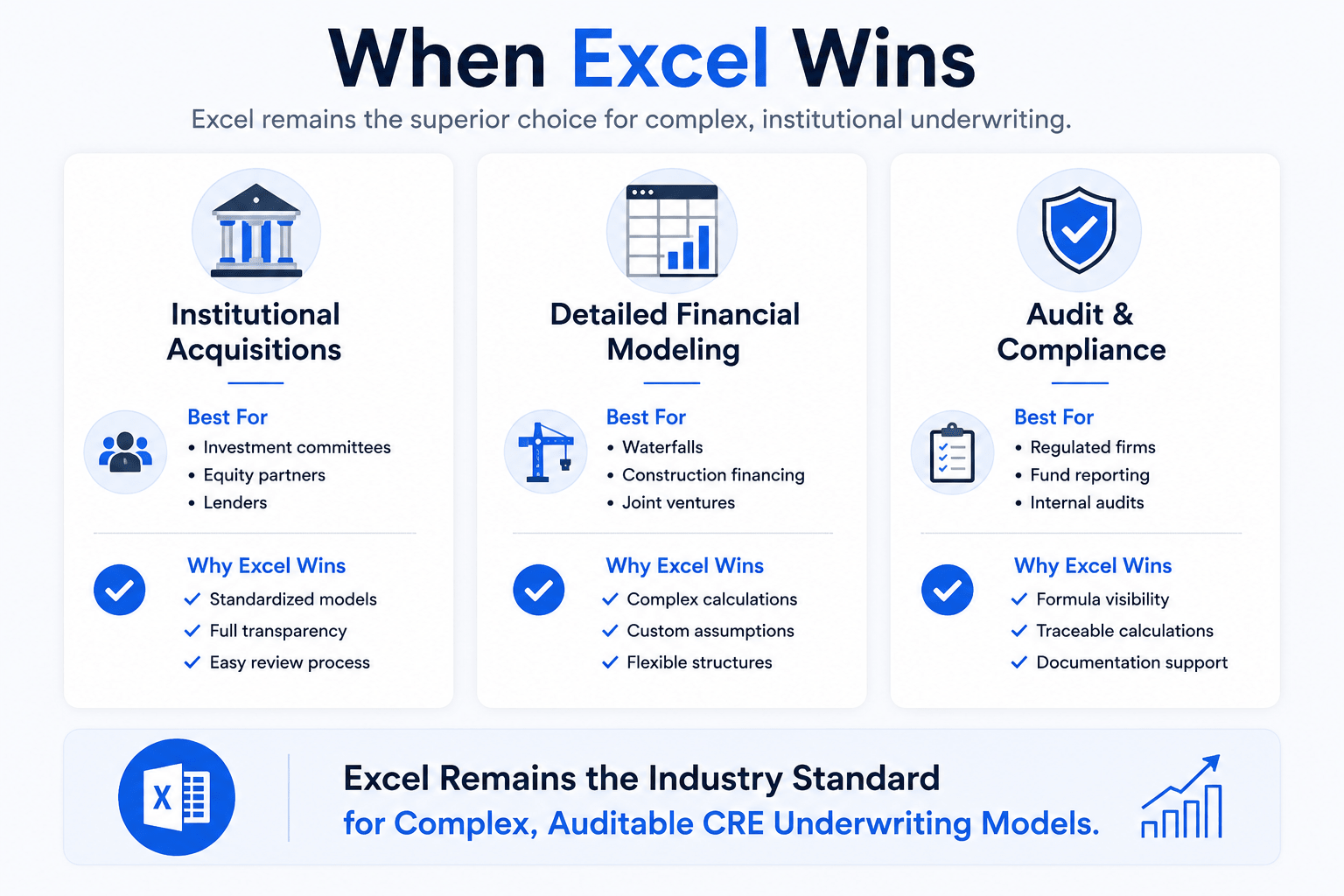
Institutional Acquisitions
Large investment firms often have strict underwriting standards.
Models must be reviewed by:
-
Acquisition teams
-
Investment committees
-
Equity partners
-
Lenders
Excel provides the structure and transparency these organizations require. This is one reason institutional underwriting remains heavily spreadsheet-driven.
Detailed Financial Modeling
Complex real estate transactions involve numerous variables.
Examples include:
-
Preferred equity structures
-
Waterfalls
-
Construction financing
-
Partnership distributions
-
Multi-phase developments
Excel handles these relationships effectively. ChatGPT can assist with explanations and analysis, but it cannot replace a fully customized institutional model.
Audit-Heavy Organizations
Many organizations require complete visibility into calculations.
Reviewers need to understand:
-
How numbers were calculated
-
Which assumptions were used
-
How projections were developed
Excel provides this transparency. Every formula can be reviewed and tested. This level of auditability remains one of Excel’s biggest advantages.
Investment Committee Review Requirements
Investment committees often expect:
-
Detailed models
-
Supporting assumptions
-
Sensitivity analyses
-
Scenario testing
These materials are typically built within Excel. While ChatGPT can help summarize findings, the underlying financial analysis usually remains spreadsheet-based.
When ChatGPT Is Better Than Excel
There are also situations where ChatGPT clearly outperforms spreadsheets. These tasks generally involve processing information rather than calculating returns.
Early Deal Screening
Acquisition teams often review far more opportunities than they ultimately pursue.
ChatGPT can help identify:
-
Missing information
-
Potential risks
-
Key property details
-
Follow-up questions
This allows analysts to focus their time on the most promising opportunities.
Research and Market Intelligence
Research can consume hours each week.
ChatGPT helps organize:
-
Market trends
-
Economic drivers
-
Property information
-
Industry insights
This creates a faster starting point for underwriting and investment analysis.
Document Summaries
Large commercial real estate transactions generate extensive documentation.
ChatGPT can quickly summarize:
-
Offering memorandums
-
Lease abstracts
-
Market reports
-
Due diligence materials
Instead of searching through hundreds of pages, analysts can focus on reviewing the most relevant information.
Investor Communication
Communicating investment opportunities often requires written content.
Examples include:
-
Executive summaries
-
Investment memos
-
Market updates
-
Portfolio reports
ChatGPT can significantly reduce drafting time while improving consistency.
Repetitive Writing Tasks
Many underwriting activities involve repeating similar explanations.
Examples include:
-
Risk summaries
-
Property descriptions
-
Market commentary
-
Investment recommendations
AI performs these tasks efficiently, allowing analysts to spend more time on higher-value work.
The Future of CRE Underwriting
The future of underwriting is unlikely to be Excel-only or AI-only. Instead, it will combine both. Technology will continue improving, but professional judgment will remain essential. The firms that adapt successfully will focus on enhancing analysts rather than replacing them.
AI-Augmented Analysts
The modern analyst is becoming more productive.
Instead of spending hours organizing information, analysts can focus on:
-
Critical thinking
-
Investment strategy
-
Risk assessment
-
Decision-making
AI handles more of the administrative workload, while people handle the analysis.
Automated Document Extraction
Document review is already becoming faster.
Future systems will likely extract:
-
Lease information
-
Operating data
-
Property characteristics
-
Market insights
With minimal manual effort.
This will shorten underwriting timelines even further.
AI-Powered Model Population
One of the most promising developments is automated model preparation.
Future workflows may allow AI to:
-
Extract property data
-
Organize assumptions
-
Prepare inputs
-
Populate underwriting templates
Analysts will still review the results, but preparation time may decline significantly.
Workflow Automation Across Teams
The biggest gains may come from workflow integration.
Instead of isolated tools, organizations will connect:
-
Research
-
Underwriting
-
Asset management
-
Reporting
-
Investor communications
This could reduce duplicate work and improve efficiency across the investment lifecycle.
Why Excel Is Unlikely to Disappear
Despite advances in AI, Excel continues to offer advantages that are difficult to replace.
These include:
-
Formula transparency
-
Flexibility
-
Industry acceptance
-
Auditability
-
Financial modeling power
For these reasons, Excel is likely to remain a core underwriting tool for years to come.
What Underwriting May Look Like by 2030
By 2030, many underwriting teams may operate differently than they do today.
Analysts could spend less time gathering information and more time evaluating opportunities.
AI may handle:
-
Data extraction
-
Initial screening
-
Report drafting
-
Information organization
Meanwhile, Excel and similar modeling platforms will continue supporting financial analysis and investment decisions.
The future of Excel vs ChatGPT for CRE underwriting is not a competition.
It is a partnership where each tool contributes its unique strengths to create a faster, smarter, and more scalable underwriting process.
Conclusion
The discussion around Excel vs ChatGPT for CRE underwriting often starts with the wrong question. Many professionals ask which tool is better. The more useful question is which tool is better for a specific task. Throughout this comparison, one pattern remains clear.
Excel continues to be the foundation of commercial real estate underwriting. It provides the financial modeling capabilities, transparency, auditability, and flexibility that acquisition teams, lenders, and institutional investors require.
For cash flow forecasting, debt analysis, sensitivity testing, and investment committee reviews, Excel remains the industry standard. At the same time, ChatGPT is helping underwriting teams become more efficient.
It can summarize offering memorandums, review rent rolls, analyze T-12 statements, organize research, identify risks, and draft reports in a fraction of the time required through manual processes. These capabilities do not replace underwriting models.
Instead, they reduce the administrative workload surrounding those models. The most successful firms are not choosing between Excel and ChatGPT. They are combining both.
A practical workflow often looks like this:
-
ChatGPT reviews and summarizes documents.
-
ChatGPT helps organize research and assumptions.
-
Excel performs financial analysis.
-
ChatGPT assists with reporting and communication.
-
Analysts review and verify all outputs.
This approach allows professionals to spend less time gathering information and more time making investment decisions. As AI adoption continues to grow across commercial real estate, firms that learn how to integrate these tools effectively will likely gain a competitive advantage.
The future of Excel vs ChatGPT for CRE underwriting is not about replacement. It is about building a workflow where each tool handles the work it does best.
Join CRE Professionals Using AI the Right Way
Want access to CRE-specific AI workflows, prompt libraries, video tutorials, training programs, and a database of 600+ AI tools?
Join the AI for CRE Collective and learn from professionals already using proven systems instead of guessing what works.
Common Questions About Excel vs ChatGPT for CRE Underwriting
Is ChatGPT replacing Excel in commercial real estate underwriting?
No. ChatGPT is not replacing Excel in commercial real estate underwriting. Excel remains the preferred platform for financial modeling, cash flow projections, sensitivity analysis, and investment committee reporting.
ChatGPT serves a different purpose. It helps analysts process information faster by assisting with:
-
Document review
-
Market research
-
Rent roll summaries
-
T-12 analysis
-
Investment memo drafting
Most CRE firms use Excel as the financial engine and ChatGPT as a productivity tool. Rather than replacing spreadsheets, AI helps reduce the time spent on repetitive tasks surrounding the underwriting process. For the foreseeable future, Excel and AI will likely work together rather than compete directly.
Can ChatGPT build a complete CRE underwriting model?
ChatGPT can assist with building underwriting models, but it should not be relied upon to create a complete institutional-quality model without review.
It can help:
-
Explain formulas
-
Suggest model structures
-
Generate calculation logic
-
Identify underwriting assumptions
However, professional underwriting models require:
-
Accurate formulas
-
Auditability
-
Sensitivity testing
-
Debt calculations
-
Return projections
These functions are still best handled in Excel. Analysts should always verify any AI-generated calculations before using them in investment decisions.
Which is more accurate for CRE underwriting, Excel or ChatGPT?
For financial calculations, Excel is generally more accurate. Excel performs calculations based on formulas that can be reviewed and tested. If the formulas are correct, the results are consistent and transparent.
ChatGPT, on the other hand, generates responses based on patterns in data. While often helpful, it can occasionally produce incorrect information or unsupported conclusions.
A practical approach is:
-
Use Excel for calculations.
-
Use ChatGPT for research and summaries.
-
Verify all AI-generated outputs.
This combination provides both accuracy and efficiency.
How much time can ChatGPT save during underwriting?
The amount of time saved depends on the workflow and property type.
Many CRE professionals report significant reductions in time spent on:
-
Offering memorandum reviews
-
Rent roll analysis
-
Market research
-
Investment memo drafting
-
Initial deal screening
In many cases, tasks that previously required one to three hours can be reduced to 15 to 45 minutes. Teams reviewing a high volume of deals often experience the largest benefits because repetitive tasks occur more frequently. The greatest productivity gains usually come from information processing rather than financial modeling.
Is ChatGPT safe for confidential CRE deal information?
Data security should always be considered before uploading confidential information to any AI platform.
Organizations should review:
-
Company policies
-
Client agreements
-
Privacy requirements
-
Regulatory obligations
Many firms establish guidelines regarding what information can be shared with AI tools.
Best practices include:
-
Removing sensitive information
-
Avoiding confidential identifiers
-
Following internal compliance standards
-
Using approved platforms
Security policies vary by organization, so users should consult their firm’s requirements before using AI with confidential deal data.
What CRE tasks should remain in Excel?
Excel remains the preferred tool for tasks requiring structured financial analysis.
Examples include:
-
Cash flow modeling
-
IRR calculations
-
NPV analysis
-
Debt modeling
-
Waterfall calculations
-
Sensitivity analysis
-
Budget forecasting
These activities depend on transparent formulas and precise calculations. Institutional investors, lenders, and acquisition teams continue to rely on Excel because it provides auditability and flexibility. For detailed underwriting, spreadsheets remain difficult to replace.
What CRE tasks should move to ChatGPT?
ChatGPT is most useful for information-heavy tasks that consume analyst time.
Examples include:
-
Document summaries
-
Market research
-
Risk identification
-
Rent roll reviews
-
T-12 reviews
-
Report drafting
-
Deal screening
These activities involve organizing and interpreting information rather than performing financial calculations. Using AI for these tasks allows analysts to focus more attention on investment decisions and less on administrative work.
Can small CRE firms benefit from ChatGPT?
Yes. Small firms often benefit significantly because they typically operate with limited staff and resources.
AI can help small teams:
-
Review more opportunities
-
Produce reports faster
-
Conduct research efficiently
-
Improve consistency
Instead of hiring additional staff immediately, firms may be able to increase productivity using AI-assisted workflows. For many small organizations, the return on investment can be substantial because even modest time savings have a meaningful impact on operations.
How do institutional investors use AI in underwriting?
Most institutional investors use AI as a supplement rather than a replacement for existing underwriting processes.
Common applications include:
-
Document analysis
-
Market research
-
Data extraction
-
Reporting assistance
-
Workflow automation
Financial modeling generally remains in Excel or specialized underwriting software. Institutional firms often prioritize auditability and transparency, making spreadsheet-based analysis essential even when AI is incorporated into the workflow.
What are the biggest risks of AI-assisted underwriting?
The primary risks include:
-
Inaccurate outputs
-
Hallucinated information
-
Overreliance on automation
-
Inadequate verification
-
Data security concerns
These risks can be managed through strong review processes.
Best practices include:
-
Human oversight
-
Output verification
-
Standardized workflows
-
Clear approval procedures
AI should support underwriting decisions, not replace professional judgment.
Should analysts learn AI if they already know Excel?
Yes. Excel remains one of the most valuable skills in commercial real estate. However, AI literacy is becoming increasingly important.
Analysts who understand both tools can:
-
Work more efficiently
-
Process information faster
-
Improve reporting
-
Review more opportunities
The strongest professionals are often those who combine traditional financial modeling expertise with modern productivity tools. Learning AI does not replace Excel skills. It complements them.
What is the best workflow using Excel and ChatGPT together?
For most acquisition teams, the most effective workflow combines the strengths of both tools.
A common process looks like this:
-
Use ChatGPT to summarize documents.
-
Use ChatGPT to organize research.
-
Extract key assumptions.
-
Build financial models in Excel.
-
Verify calculations.
-
Use ChatGPT to draft reports.
-
Review all outputs before final decisions.
This approach improves efficiency while maintaining the accuracy and transparency required for commercial real estate underwriting.