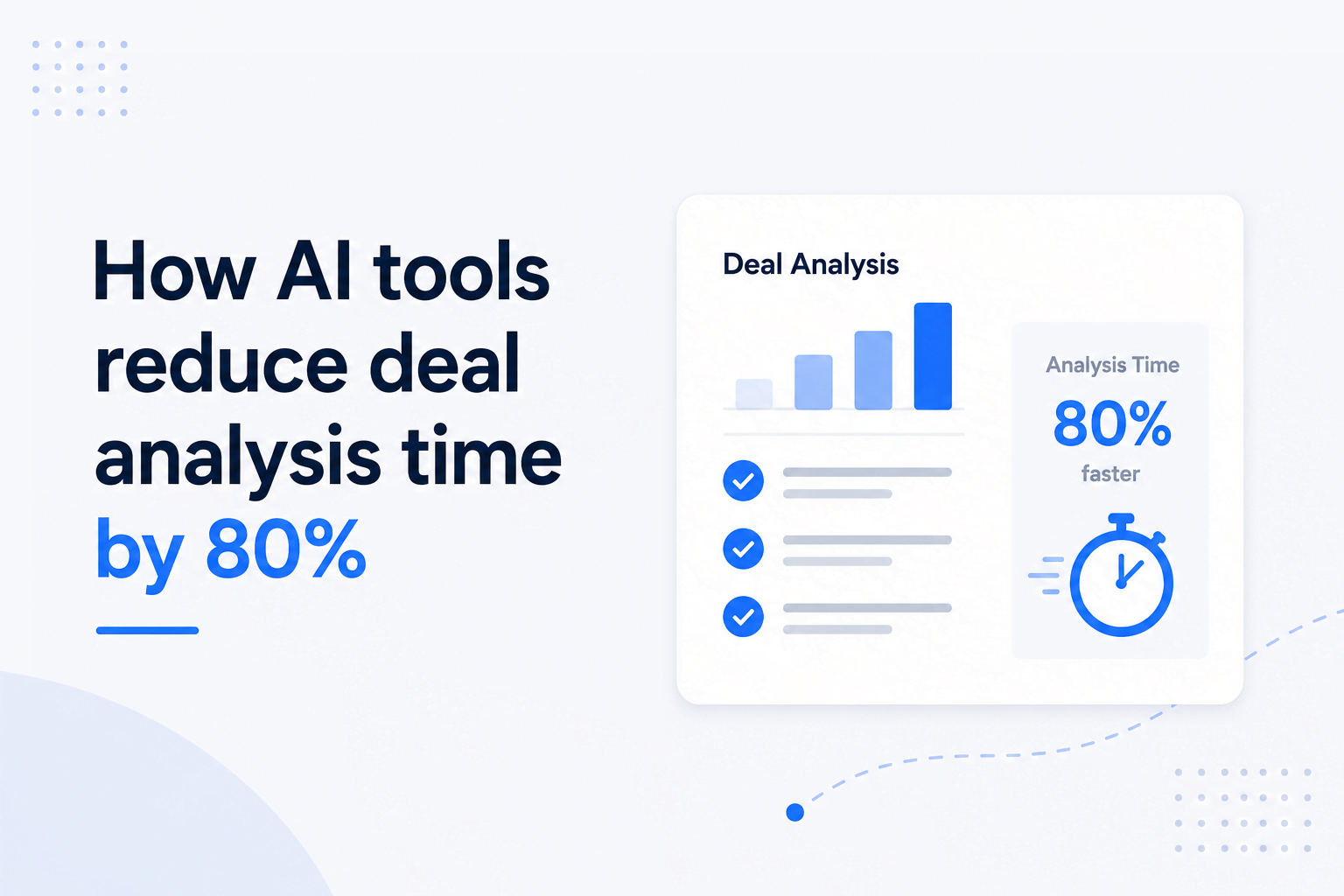
HOW AI TOOLS REDUCE DEAL ANALYSIS TIME BY 80%
Commercial real estate teams manage large amounts of data every day. Analysts review rent rolls, leases, offering memoranda, financial reports, and market data before making decisions. Most of this work takes too much time. That is why many firms now study how AI tools reduce deal analysis time by 80%.
The biggest benefit is speed. AI removes many manual tasks from underwriting workflows. It can summarize documents, organize spreadsheets, compare properties, and pull key lease details in minutes. Analysts no longer need to spend hours cleaning files or copying data between systems.
This matters because CRE markets move quickly. Firms that review deals faster often win better opportunities. Slow underwriting can delay offers and reduce deal flow. AI helps teams move faster while keeping work consistent.
Many professionals still think AI only writes emails or marketing copy. That is not true anymore. Today, AI supports underwriting, due diligence, market research, and reporting. These are the areas where firms save the most time.
This guide explains the practical side of AI in commercial real estate. You will learn which tools work well, how firms build faster workflows, and what mistakes reduce results. The focus stays on real implementation, not theory.
Why Traditional Deal Analysis Takes So Long
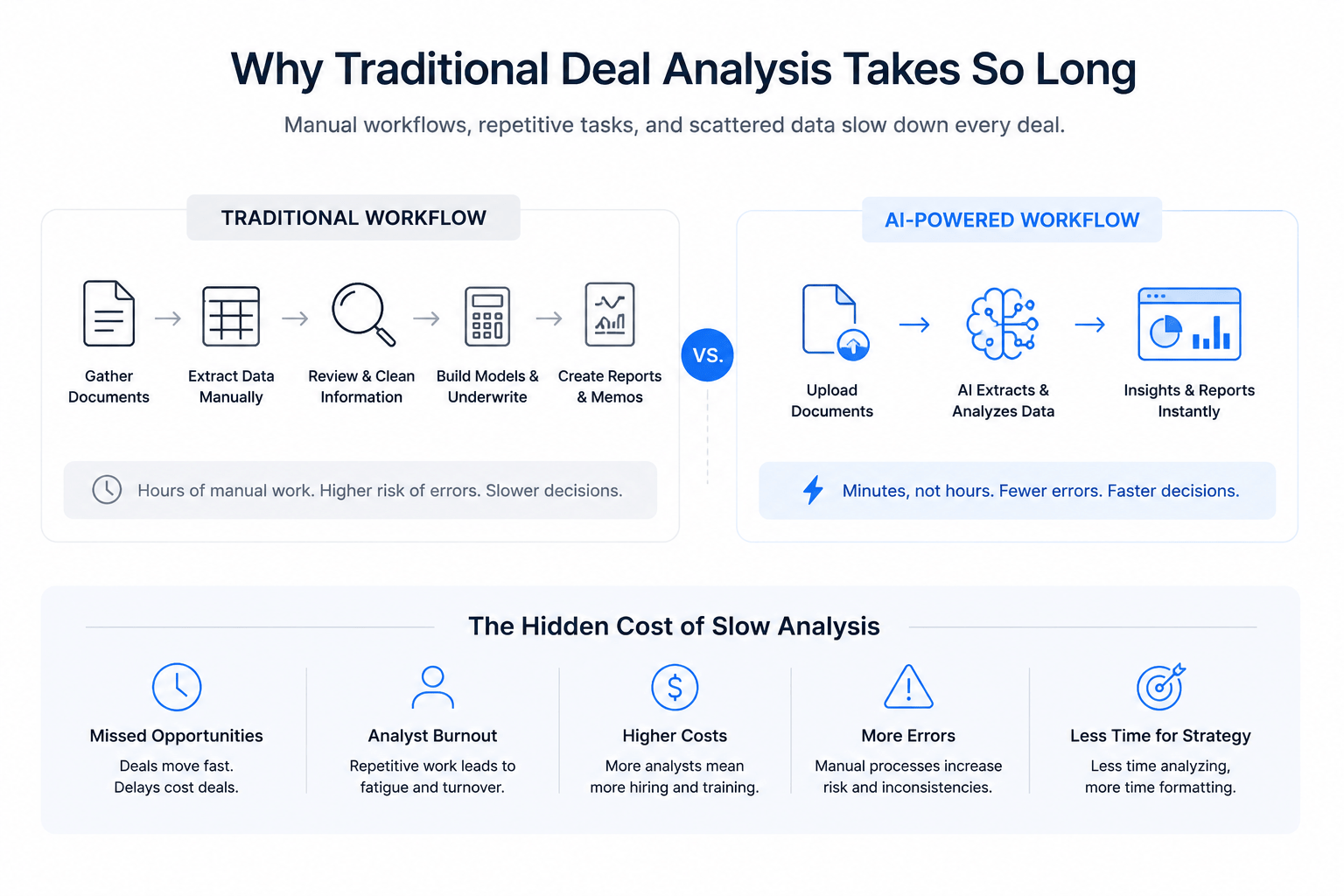
Commercial real estate analysis includes many separate tasks. Most firms still rely on manual systems. Analysts move data between spreadsheets, PDFs, emails, and underwriting models. This process takes hours before real analysis even begins.
A normal deal review starts with the offering memorandum. Analysts then review rent rolls, operating expenses, tenant details, and market comps. After that, they build underwriting assumptions and prepare reports. Every step requires manual work.
The workload becomes larger when firms review several deals at once. Analysts may handle hundreds of pages every week. This slows down decisions and increases mistakes.
Manual CRE workflows create bottlenecks
Traditional underwriting usually includes:
-
Copying lease data into spreadsheets
-
Reviewing PDFs manually
-
Searching for market comps
-
Cleaning broker financials
-
Creating repetitive IC memos
-
Comparing rent rolls manually
-
Organizing scattered files
These tasks are important, but they waste time. Analysts often spend more time formatting information than analyzing the deal itself.
Most analysts waste time on repetitive work
Many CRE teams lose hours every week on repetitive tasks. Large amounts of time go toward document review and formatting instead of strategic analysis.
For example, reviewing a long offering memorandum manually may take several hours. Extracting lease details takes even longer. If files arrive in different formats, analysts must clean and organize everything first.
This slows down deal flow and limits the number of opportunities a team can review.
The hidden cost of slow analysis
Slow workflows create serious business problems. Delayed underwriting reduces competitiveness in active markets. Firms may lose deals because another buyer moved faster.
There are also internal costs:
-
Analyst burnout increases
-
Hiring costs grow
-
Reporting becomes inconsistent
-
Errors become harder to catch
-
Teams spend less time on strategy
The problem is not only speed. Manual systems also reduce operational efficiency across the business.
Why do more analysts alone not solve the problem?
Some firms hire more analysts to speed up underwriting. This may help temporarily, but it does not fix workflow problems. More analysts also increase training costs and operational complexity.
AI improves the process itself. Firms can automate repetitive tasks while analysts focus on higher-value decisions. This creates scalability without sharply increasing costs.
How AI Changes CRE Deal Analysis Workflows
Artificial intelligence improves commercial real estate workflows by speeding up repetitive tasks. Instead of replacing analysts, AI removes low-value work from underwriting and due diligence.
The biggest improvements happen in document review and data organization. AI tools can read PDFs, summarize leases, identify risks, organize rent rolls, and create investment summaries in minutes. Analysts can then focus on decisions instead of manual formatting.
For many firms, the results appear quickly. Tasks that once required several hours may now take less than one hour.
AI compresses repetitive work into minutes
AI works best in workflows with structured information. Commercial real estate contains large amounts of repeatable data, making it a strong fit for automation.
Common AI-assisted tasks include:
-
Offering memorandum summaries
-
Lease abstraction
-
Tenant analysis
-
Expense categorization
-
Market research summaries
-
Financial cleanup
-
Comparable property reviews
-
Investment memo drafting
Instead of reviewing every page manually, analysts can generate summaries quickly. They then verify the results rather than starting from zero.
AI acts as a workflow accelerator, not a replacement
Many people think AI replaces analysts completely. That is incorrect. Successful firms use AI to speed up workflows while keeping human oversight.
AI can organize information quickly, but investment decisions still require experience. Local market knowledge, negotiation strategy, and risk analysis cannot be fully automated.
The best workflows combine automation with expert review.
The biggest productivity gains happen in repetitive processes
Some workflows benefit from AI more than others. The largest time savings usually appear in repetitive document-heavy tasks.
These include:
-
Reviewing offering memorandums
-
Extracting lease terms
-
Creating IC memos
-
Organizing underwriting assumptions
-
Summarizing market reports
-
Preparing comparison tables
When firms automate these tasks first, they often see immediate productivity gains.
Traditional vs AI-assisted underwriting workflow
| Task | Manual Time | AI-Assisted Time |
|---|---|---|
| OM Review | 2 Hours | 15 Minutes |
| Rent Roll Analysis | 3 Hours | 20 Minutes |
| Market Research | 4 Hours | 45 Minutes |
| IC Memo Drafting | 5 Hours | 30 Minutes |
| Comparable Review | 2 Hours | 20 Minutes |
These savings increase across larger pipelines. A team reviewing 20 deals monthly can recover dozens of hours every week through AI-assisted workflows.
AI Tools That Actually Work for Deal Analysis
The CRE AI market grows quickly every year. New tools launch constantly, but only a small number create real productivity gains. Many platforms promise full automation but fail in real underwriting workflows.
The best systems combine general AI platforms with specialized workflow tools. Successful firms usually build flexible AI stacks around their operational needs.
In commercial real estate, practical implementation matters more than flashy features.
AI Tools That Actually Work for Deal Analysis
The CRE AI market grows quickly. New tools appear almost every week. Many promise full automation, but only a few save real time during underwriting and deal review.
The best tools remove repetitive work from daily workflows. They help analysts process information faster, organize documents, and prepare reports with less manual effort. Most successful CRE firms do not rely on one platform alone. Instead, they combine several tools into one workflow.
The goal is simple. Reduce manual work while keeping analysts in control.
Large language models for CRE workflows
Large language models now support many CRE tasks. These tools can summarize documents, answer questions, organize data, and draft reports.
The most common platforms include:
-
ChatGPT
-
Claude
-
Gemini
-
Perplexity
Each platform has different strengths. ChatGPT works well for flexible workflows and prompt customization. Claude performs strongly with long documents and lease reviews. Perplexity helps with research because it includes web sources and citations.
Most firms use these tools for:
-
Offering memorandum summaries
-
Lease abstraction
-
Market research
-
Investment memo drafting
-
Property comparison reports
-
Risk identification
These tools work best when firms create repeatable prompts and workflows.
Spreadsheet AI tools for underwriting
Underwriting teams spend large amounts of time inside Excel. AI spreadsheet tools now reduce many manual steps during analysis.
These systems help with:
-
Formula explanations
-
Financial cleanup
-
Scenario analysis
-
Data normalization
-
Assumption organization
-
Report formatting
Analysts can upload spreadsheets and ask AI tools to explain trends, identify errors, or summarize key financial risks. This reduces review time significantly.
Some firms also connect AI directly into underwriting templates. This creates faster workflows during acquisitions and asset management reporting.
Automation tools for repetitive CRE tasks
Automation tools connect different systems together. Instead of moving files manually, firms can automate repetitive processes between applications.
Popular automation tools include:
-
Zapier
-
Make
-
Airtable automations
-
CRM integrations
These tools support workflows such as:
-
Saving property documents automatically
-
Sending reports to team members
-
Organizing acquisition pipelines
-
Updating CRM records
-
Tracking underwriting stages
Automation becomes especially valuable for teams handling large deal volume.
Market research and due diligence tools
Research takes a large amount of underwriting time. Analysts often search through reports, articles, demographic data, and comparable properties manually.
AI research tools speed up this process.
They help teams:
-
Summarize market reports
-
Identify local trends
-
Compare properties faster
-
Gather demographic insights
-
Organize due diligence findings
Perplexity has become popular because it combines AI summaries with cited sources. Analysts can review information faster while still checking original references.
Document analysis tools
Commercial real estate depends heavily on documents. Lease agreements, offering memorandums, and operating statements often contain hundreds of pages.
AI document analysis tools help extract information quickly.
Common use cases include:
-
Lease abstraction
-
Tenant summaries
-
Rent schedule extraction
-
Expense categorization
-
PDF analysis
-
OCR data extraction
Instead of reviewing every page manually, analysts can identify key details within minutes.
Tools that are hype vs tools that save real time
Some AI products focus more on marketing than operational value. CRE firms should prioritize tools that improve daily workflows immediately.
CRE AI Tools Comparison
| Tool | Best Use Case | Strength | Weakness | Approximate Cost |
|---|---|---|---|---|
| ChatGPT | General workflows | Flexible prompts | Requires verification | $$ |
| Claude | Document review | Long context windows | Slower responses | $$ |
| Perplexity | Market research | Source citations | Limited automation | $$ |
| Zapier | Workflow automation | Easy integrations | Setup required | $$ |
| Make | Process automation | Visual workflows | Learning curve | $$ |
The most effective strategy is starting small. Firms should first automate repetitive tasks that already consume large amounts of time.
Commercial real estate teams already use AI workflows to underwrite faster and review more deals every week. Explore practical workflows and real examples here: AI for CRE Newsletter
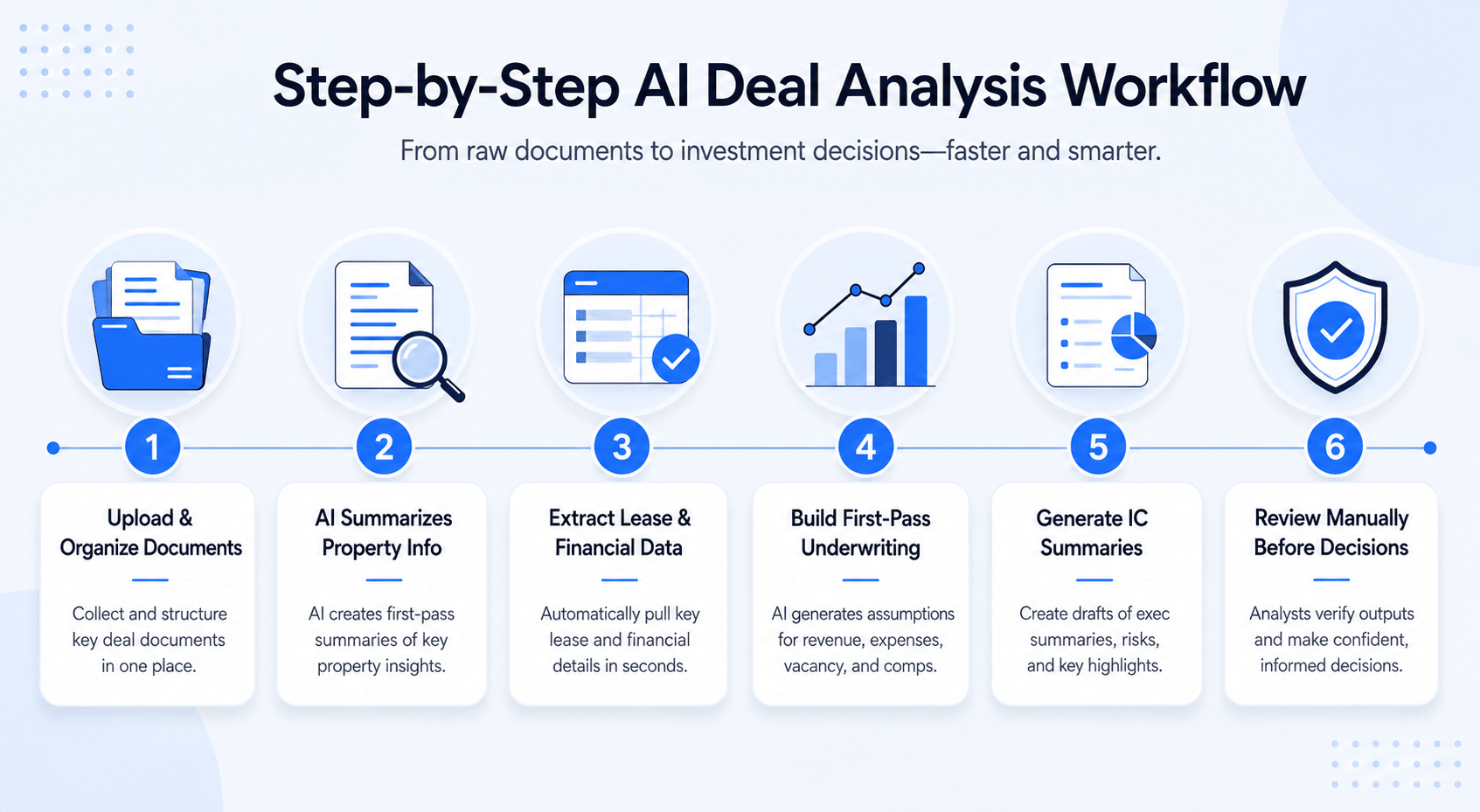
Step-by-Step AI Deal Analysis Workflow
Many CRE firms fail with AI because they adopt tools without building workflows first. Technology alone does not improve productivity. The real gains come from creating repeatable systems.
A structured AI workflow helps analysts move from raw documents to investment decisions much faster. Instead of starting every analysis manually, teams can standardize large parts of the process.
The workflow below reflects how many modern CRE teams now analyze deals.
Step 1 — Upload and organize deal documents
Every workflow starts with document organization. Analysts collect:
-
Offering memorandums
-
Rent rolls
-
T12 statements
-
Lease agreements
-
Market reports
-
Property photos
-
Capital expenditure reports
Good organization matters because AI tools work better with structured files. Teams should create standardized naming systems and folders before automation begins.
Cloud storage systems also improve collaboration across acquisitions teams.
Step 2 — Use AI to summarize property information
Once documents are uploaded, AI tools can create first-pass summaries.
These summaries often include:
-
Occupancy rates
-
NOI trends
-
Tenant mix
-
Lease rollover risk
-
Property strengths
-
Market positioning
This saves analysts from reviewing hundreds of pages manually during early-stage screening.
The goal is not replacing review entirely. The goal is accelerating first-pass analysis.
Step 3 — Extract lease and financial data automatically
Lease abstraction normally takes hours. AI tools now pull key details automatically from lease files and rent rolls.
Common extracted data includes:
-
Rental rates
-
Lease expiration dates
-
Escalation schedules
-
Tenant names
-
Vacancy assumptions
-
Expense categories
This creates faster underwriting preparation and improves reporting consistency.
Step 4 — Build first-pass underwriting assumptions
AI tools also help analysts prepare underwriting assumptions faster.
These systems can assist with:
-
Revenue projections
-
Expense normalization
-
Vacancy assumptions
-
Market rent comparisons
-
Scenario analysis
Analysts still review assumptions manually, but AI removes much of the repetitive setup work.
Step 5 — Generate investment committee summaries
Investment committee reporting often consumes several hours per deal. AI can create first drafts rapidly.
These summaries may include:
-
Executive summaries
-
Key risks
-
Market insights
-
Tenant highlights
-
Investment thesis drafts
-
Comparable property analysis
Analysts then refine and verify the information before distribution.
Step 6 — Review outputs manually before decisions
Human oversight remains critical. AI can accelerate workflows, but final decisions still require experienced review.
Teams should always verify:
-
Lease details
-
Financial assumptions
-
Market data
-
Risk factors
-
Tenant information
Strong CRE firms use AI as an assistant, not a replacement for expertise.
How to Implement This in 24 Hours
Many firms delay AI adoption because they think implementation requires large budgets or technical teams. In reality, most CRE firms can begin improving workflows within one day.
The key is starting small. Teams should focus on removing repetitive work first instead of automating everything immediately.
Simple workflows often create the biggest productivity gains.
Minimum viable AI stack for CRE teams
A basic AI workflow usually includes:
-
One large language model
-
One spreadsheet AI tool
-
One automation platform
-
Cloud document storage
Most firms begin with ChatGPT or Claude because these tools support flexible workflows quickly.
The goal is not building a perfect system immediately. The goal is creating measurable time savings fast.
The fastest workflows to automate first
Some tasks create faster ROI than others. Firms should prioritize repetitive workflows with high manual workload.
The best starting points include:
-
Deal summaries
-
Market research
-
Comparable property reviews
-
IC memo drafting
-
Lease abstraction
-
Financial cleanup
These workflows usually create visible productivity gains within days.
24-hour AI rollout checklist
Teams can begin implementation with a simple process.
Checklist
-
Choose one AI platform
-
Upload one real deal package
-
Test lease abstraction workflows
-
Create one IC memo template
-
Build reusable prompts
-
Train one analyst first
-
Measure time saved weekly
Starting small reduces complexity and improves adoption across the team.
Copy-Paste AI Prompts for Deal Analysis
Most CRE teams fail with AI because they use weak prompts. Generic instructions produce generic results. Strong prompts create structured outputs, faster workflows, and more accurate analysis.
A good prompt should provide context, define the task clearly, and explain the desired output format. Analysts should also guide the AI toward investment-focused insights instead of broad summaries.
The best prompts are reusable. Once teams create strong templates, they can apply them across multiple deals consistently.
Below are practical prompts that work well for commercial real estate workflows.
OM summary prompt
This prompt helps analysts review offering memorandums faster.
Prompt Example
“You are a senior CRE acquisitions analyst. Review this offering memorandum and create a structured investment summary. Include property overview, tenant mix, occupancy, lease rollover risks, NOI trends, cap rate assumptions, market strengths, major risks, and key investment considerations. Use concise sections with bullet points. Highlight any missing or unclear information requiring further due diligence.”
This type of prompt helps teams create fast first-pass deal reviews.
Rent roll analysis prompt
Rent roll reviews often consume several hours manually. AI can organize the information much faster.
Prompt Example
“Analyze this rent roll as a CRE underwriting analyst. Identify occupancy trends, tenant concentration risks, lease expiration clusters, below-market rents, rollover exposure, vacancy risks, and unusual lease structures. Summarize findings in a clean underwriting format. Flag tenants representing more than 10% of gross income.”
This prompt improves consistency during underwriting reviews.
Market research prompt
Market research often becomes scattered and time-consuming. AI can organize findings into clear investment insights.
Prompt Example
“Act as a commercial real estate market analyst. Summarize this market data for an acquisitions team. Include population growth, employment trends, rent growth, vacancy trends, supply pipeline, absorption trends, major employers, and economic risks. Focus on information relevant for multifamily investment decisions.”
This creates more focused research summaries.
Investment committee memo prompt
IC memo drafting is one of the most repetitive CRE workflows. AI helps create first drafts quickly.
Prompt Example
“You are preparing an investment committee memo for a commercial real estate acquisition. Create a professional summary using the provided underwriting data and market information. Include acquisition overview, financial highlights, projected returns, market strengths, key risks, tenant analysis, business plan, and final investment considerations.”
This reduces reporting time significantly.
Risk identification prompt
Risk analysis is critical during acquisitions. AI helps identify issues that may require deeper review.
Prompt Example
“Review this deal package as a CRE risk analyst. Identify operational, financial, market, tenant, and lease-related risks. Highlight any assumptions that appear aggressive or unsupported. Organize findings by risk category and explain potential investment impact.”
This helps teams standardize risk reviews across deals.
Comparable property analysis prompt
Comparable property reviews often involve repetitive data comparison. AI can summarize trends quickly.
Prompt Example
“Analyze these comparable properties for a commercial real estate acquisition. Compare rental rates, occupancy, cap rates, property condition, tenant quality, location advantages, and recent transaction activity. Explain how these comps support or challenge the subject property valuation.”
This creates faster valuation support during underwriting.
Strong prompts improve consistency across acquisition teams. Instead of reinventing workflows every time, firms can build repeatable systems that scale efficiently.
Real CRE Use Cases Where AI Saves the Most Time
Artificial intelligence creates the biggest gains in workflows that involve repetitive data review. Commercial real estate contains many document-heavy processes, making the industry well-suited for automation.
The strongest results usually appear in acquisitions, brokerage, development, and asset management workflows. These areas involve large amounts of manual reporting and repetitive analysis.
Firms that implement AI correctly often review more deals without increasing headcount. In addition, many firms now use AI to turn raw property financials into clean underwriting models within minutes instead of hours.
Multifamily acquisitions
Multifamily acquisitions involve large amounts of underwriting work. Analysts review rent rolls, operating statements, market reports, and renovation assumptions across multiple properties.
AI helps acquisition teams:
-
Summarize offering memorandums
-
Analyze lease expiration schedules
-
Identify below-market rents
-
Organize expense categories
-
Draft investment summaries
-
Compare market comps
This allows firms to move faster during competitive bidding processes.
Brokerage workflows
Brokerage teams also save time with AI-assisted systems. Many brokers spend hours creating reports, prospecting, and organizing marketing materials manually.
AI can assist with:
-
Property summaries
-
Prospecting research
-
Market updates
-
Client reporting
-
Offering memorandum drafts
-
Email personalization
This reduces administrative work and gives brokers more time for relationship building.
Development analysis
Development teams often handle complex feasibility reviews and research workflows. AI helps organize information faster during early-stage analysis.
Common use cases include:
-
Zoning summaries
-
Site feasibility analysis
-
Construction bid comparisons
-
Market demand research
-
Entitlement tracking
-
Vendor communication summaries
AI cannot replace development expertise, but it speeds up research and reporting significantly.
Asset management operations
Asset management involves constant reporting and operational tracking. Many firms still create these reports manually.
AI helps automate:
-
Monthly reporting summaries
-
Tenant communication drafts
-
Budget variance explanations
-
Property performance summaries
-
Maintenance trend analysis
-
Operational dashboards
This improves reporting consistency across larger portfolios.
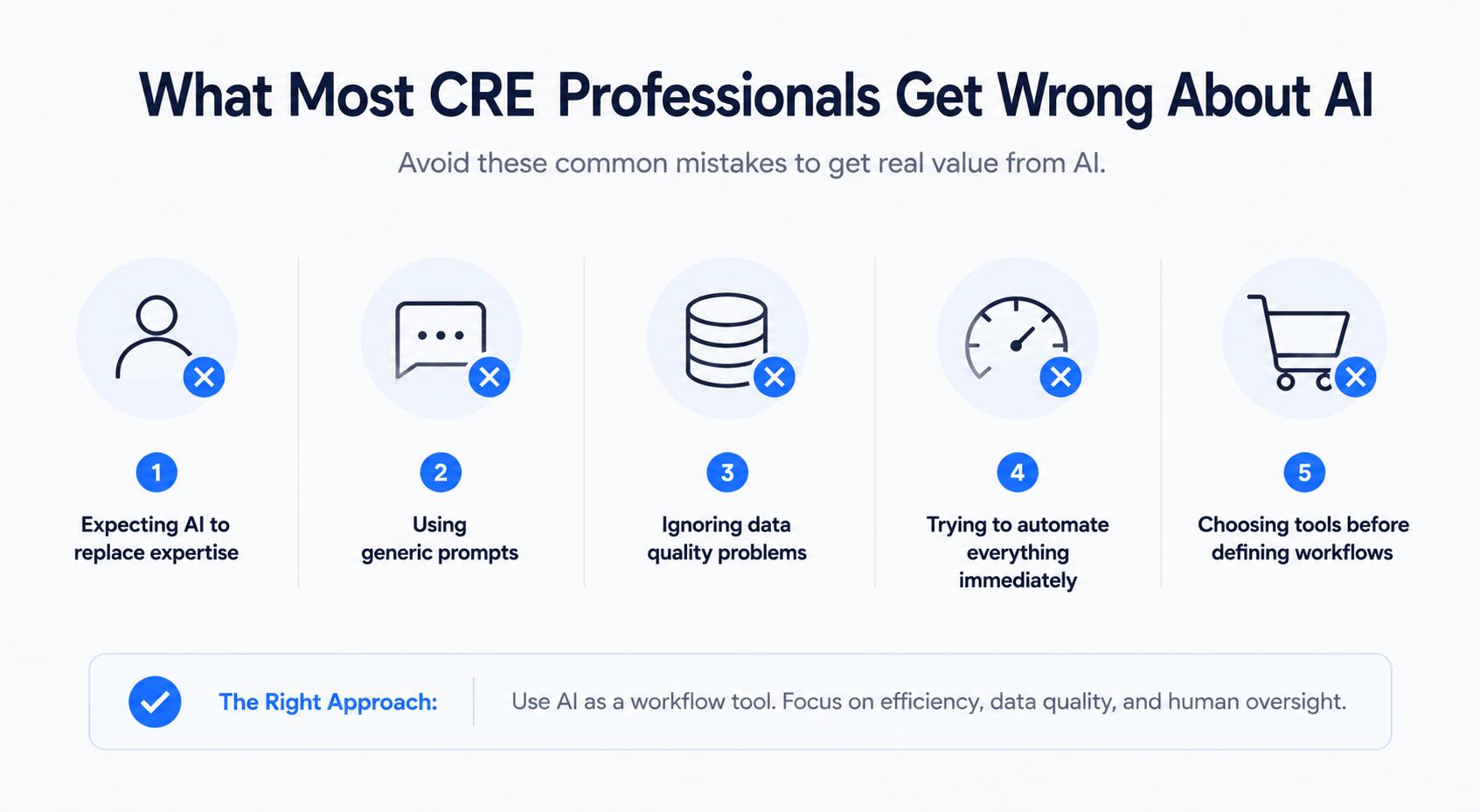
What Most CRE Professionals Get Wrong About AI
Many CRE firms adopt AI with unrealistic expectations. Some expect instant automation across the business. Others assume AI can replace experienced analysts completely.
Both approaches create poor results.
The firms seeing the biggest gains treat AI as a workflow tool instead of a magic solution. They focus on operational efficiency first.
Understanding what AI cannot do is just as important as understanding what it does well.
Expecting AI to replace expertise
AI can organize information quickly, but it cannot replace investment judgment.
Commercial real estate decisions depend on:
-
Local market experience
-
Negotiation strategy
-
Relationship networks
-
Risk tolerance
-
Capital market knowledge
Strong firms combine AI speed with human expertise.
Using generic prompts
Weak prompts create weak outputs. Many teams simply ask AI to “summarize this deal” without giving context or instructions.
CRE workflows require specific prompts built around underwriting goals.
Good prompts should define:
-
Role
-
Task
-
Output structure
-
Risk focus
-
Investment context
This creates more reliable results.
Ignoring data quality problems
AI cannot fix poor data automatically. If rent rolls contain errors or missing information, the output quality drops immediately.
This is why document organization matters before automation begins.
Teams should standardize:
-
File naming
-
Spreadsheet formats
-
Lease documentation
-
Data structures
Better data improves AI performance significantly.
Trying to automate everything immediately
Some firms attempt full automation too quickly. This usually creates confusion and low adoption.
The best approach is starting with simple repetitive workflows first.
Strong starting points include:
-
OM summaries
-
Lease abstraction
-
IC memo drafts
-
Market research summaries
Once these systems work consistently, firms can expand automation gradually.
Choosing tools before defining workflows
Many teams buy software before understanding their operational problems.
This creates expensive systems with poor adoption.
Firms should first identify:
-
Time-consuming tasks
-
Repetitive workflows
-
Reporting bottlenecks
-
Data organization problems
Then they should choose tools that solve those specific issues.
Common Mistakes That Reduce AI Productivity, Gains
AI can improve underwriting speed dramatically, but poor implementation reduces results quickly. Many firms struggle because they focus on tools instead of workflows.
Simple systems usually outperform overly complex setups.
No standardized process
Without standardized workflows, every analyst uses AI differently. This creates inconsistent reporting and unreliable outputs.
Firms should create:
-
Shared prompts
-
Workflow templates
-
Reporting structures
-
Review processes
Consistency improves both speed and accuracy.
Lack of prompt libraries
Many teams rewrite prompts repeatedly instead of building reusable systems.
A strong prompt library reduces:
-
Training time
-
Workflow inconsistency
-
Reporting errors
-
Manual revisions
This also helps new analysts onboard faster.
Poor file organization
Disorganized files reduce AI efficiency immediately.
Messy folders create:
-
Missing information
-
Duplicate analysis
-
Incorrect summaries
-
Slower workflows
Clean data structure improves productivity across the team.
No validation checkpoints
AI outputs always require review. Firms that skip validation increase risk.
Strong review systems should include:
-
Financial verification
-
Lease review
-
Assumption testing
-
Risk confirmation
Human oversight remains essential.
Overcomplicated automation systems
Some firms build workflows that become difficult to maintain. Overengineering often creates more operational problems than benefits.
Simple workflows usually scale better.
The best systems focus on:
-
Speed
-
Clarity
-
Ease of use
-
Repeatability
Case Study — Reducing Deal Analysis From 6 Hours to 45 Minutes
Many CRE firms still rely on manual underwriting systems. Analysts often spend most of the day reviewing documents, cleaning spreadsheets, and preparing reports. One acquisitions team recently rebuilt this workflow using AI-assisted systems. The result was a major reduction in underwriting time.
Before automation, the team needed nearly six hours to complete a first-pass deal review. After implementing AI workflows, the same process took about 45 minutes.
The biggest improvement did not come from replacing analysts. It came from removing repetitive work from the underwriting process.
Original manual process
The team originally followed a traditional underwriting workflow. Analysts manually reviewed offering memorandums, copied lease information into spreadsheets, organized rent rolls, and prepared investment summaries.
The workflow included:
-
Manual OM review
-
Lease abstraction
-
Market research collection
-
Financial normalization
-
IC memo drafting
-
Comparable property analysis
Most tasks required repetitive formatting and document review. Analysts spent more time organizing data than evaluating opportunities.
The firm also struggled with inconsistent reporting. Different analysts used different structures, assumptions, and reporting formats.
AI-assisted workflow implementation
The firm implemented a simple AI workflow instead of building a large automation system.
The stack included:
-
Claude for document review
-
ChatGPT for report drafting
-
Spreadsheet AI tools for underwriting support
-
Cloud storage for file organization
-
Automation workflows for reporting
The team first standardized file naming and document structure. Then they created reusable prompts for:
-
OM summaries
-
Lease analysis
-
Risk reviews
-
IC memos
-
Market summaries
Instead of reviewing every page manually, analysts generated structured first-pass summaries within minutes.
Measured productivity improvements
The results became visible quickly.
The team reduced:
-
OM review time
-
Lease abstraction time
-
Reporting delays
-
Manual spreadsheet work
-
Repetitive formatting
Analysts also reviewed more deals weekly without increasing headcount.
Before vs After AI Workflow
| Workflow Stage | Manual Process | AI-Assisted Process |
|---|---|---|
| Document Review | 2 Hours | 15 Minutes |
| Lease Analysis | 90 Minutes | 15 Minutes |
| Market Research | 1 Hour | 10 Minutes |
| IC Memo Drafting | 90 Minutes | 5 Minutes |
| Total Time | 6 Hours | 45 Minutes |
The firm also improved reporting consistency across acquisition teams.
Lessons learned from implementation
The team discovered several important lessons during implementation.
First, simple workflows worked better than complex systems. Second, reusable prompts created faster adoption. Third, human review remained essential for underwriting accuracy.
Most importantly, the firm realized AI delivers the highest value when it removes repetitive operational work first.
Future Trends in AI Deal Analysis
AI adoption in commercial real estate is still early. Most firms currently use AI for summaries, research, and document review. However, the technology continues to improve rapidly.
Over the next several years, AI will likely become part of daily CRE operations across acquisitions, development, brokerage, and asset management.
The firms that learn these workflows early may gain long-term operational advantages.
AI agents for underwriting
AI agents will likely become more common in underwriting workflows. These systems can complete multi-step tasks automatically instead of responding to single prompts only.
Future underwriting agents may:
-
Organize property documents
-
Extract lease data
-
Build underwriting assumptions
-
Generate investment memos
-
Compare market comps
-
Flag potential risks
Analysts will still review outputs, but workflows may become much faster.
Automated market intelligence systems
Market research may also change significantly.
Future AI systems could track:
-
Rent growth
-
Vacancy shifts
-
Transaction trends
-
Development pipelines
-
Capital market activity
-
Employer movement
Instead of searching for updates manually, analysts may receive real-time market intelligence automatically.
Integrated CRE AI operating systems
Today, many firms use disconnected tools. Future systems will likely combine underwriting, reporting, document management, and research into unified AI platforms.
These operating systems may connect:
-
CRMs
-
Underwriting models
-
Property databases
-
Document storage
-
Asset management systems
This could reduce operational friction across entire organizations.
Predictive deal scoring
Some firms already experiment with predictive analytics for acquisitions.
Future AI systems may score deals based on:
-
Market conditions
-
Tenant quality
-
Lease rollover risk
-
Historical performance
-
Economic trends
-
Capital market conditions
These scores will not replace investment committees, but they may improve screening speed.
AI-powered portfolio monitoring
Asset management may become more automated as AI systems improve.
Future portfolio monitoring tools could identify:
-
Revenue risks
-
Expense anomalies
-
Occupancy shifts
-
Maintenance trends
-
Tenant issues
-
Budget variances
This would help operators respond faster to operational problems.
Conclusion
Commercial real estate firms face growing pressure to review deals faster while maintaining underwriting quality. Traditional workflows slow teams down because analysts spend too much time on repetitive tasks instead of strategic analysis.
That is why more firms now explore how AI tools reduce deal analysis time by 80% across acquisitions and operations workflows. The largest gains usually come from document review, lease abstraction, market research, and investment reporting.
AI does not replace experienced analysts. Instead, it removes operational bottlenecks that limit productivity. Firms that combine automation with strong human oversight often review more deals, improve consistency, and move faster in competitive markets.
The most successful teams start small. They automate repetitive tasks first, create reusable workflows, and improve systems gradually over time.
Commercial real estate is moving toward AI-assisted operations quickly. Firms that delay adoption may struggle to compete with teams using faster and more efficient workflows.
Stop Guessing With AI Workflows
Commercial real estate teams are already using tested AI systems to review deals faster, improve underwriting speed, and reduce repetitive analysis work. If you want real CRE workflows instead of generic AI advice, explore the resources below and see how professionals apply these systems daily.
Frequently Asked Questions
Can AI really reduce commercial real estate deal analysis time by 80%?
Yes, AI can reduce deal analysis time significantly when firms automate repetitive workflows properly. Most time savings come from tasks like offering memorandum review, lease abstraction, rent roll analysis, market research, and investment memo drafting. These tasks usually consume hours of manual work during underwriting.
AI tools speed up these workflows by summarizing documents, extracting data, organizing spreadsheets, and generating structured reports within minutes. Instead of manually reviewing hundreds of pages, analysts can focus on verifying outputs and making investment decisions.
However, the full 80% reduction usually applies to operational tasks rather than strategic decision-making. Human oversight still matters for underwriting assumptions, market interpretation, negotiation strategy, and final approvals.
The firms seeing the best results usually:
-
Standardize workflows first
-
Create reusable AI prompts
-
Train analysts gradually
-
Keep validation systems in place
AI improves productivity most when combined with experienced CRE professionals.
What are the best AI tools for commercial real estate deal analysis?
The best AI tools depend on the workflow being automated. Most CRE firms combine multiple tools instead of relying on one platform.
Popular AI tools include:
-
ChatGPT for flexible underwriting workflows
-
Claude for lease review and long documents
-
Perplexity for market research
-
Zapier for workflow automation
-
Spreadsheet AI tools for underwriting support
Claude performs especially well with long PDFs and offering memorandums because it handles large document context effectively. ChatGPT works well for customizable prompts, reporting, and financial analysis support.
Automation tools help firms connect systems together and reduce manual administrative work.
The best approach is choosing tools based on:
-
Document volume
-
Team size
-
Workflow complexity
-
Reporting needs
-
Budget
Practical implementation matters more than buying expensive software.
How do CRE firms use AI during underwriting?
Commercial real estate firms use AI to speed up repetitive underwriting tasks. Instead of replacing analysts, AI removes operational bottlenecks from the process.
AI commonly supports:
-
Offering memorandum summaries
-
Lease abstraction
-
Rent roll analysis
-
Market research
-
Comparable property analysis
-
Investment committee memo drafting
-
Financial data organization
For example, analysts can upload rent rolls and ask AI to identify lease rollover risks, tenant concentration issues, or below-market rents. AI can also summarize large offering memorandums in structured formats within minutes.
Most firms still keep human review systems in place. Analysts verify assumptions, confirm lease details, and evaluate investment risks manually.
The strongest underwriting workflows combine automation speed with experienced oversight.
Is AI accurate enough for commercial real estate investment decisions?
AI can improve analysis speed, but it should not make final investment decisions independently. AI systems sometimes generate inaccurate information, incomplete assumptions, or incorrect summaries.
This is why human review remains essential.
AI performs best when used for:
-
Data organization
-
First-pass analysis
-
Report drafting
-
Market summaries
-
Document extraction
Experienced CRE professionals should still verify:
-
Financial assumptions
-
Lease structures
-
Tenant details
-
Market data
-
Comparable property analysis
The best firms use AI as an assistant rather than a replacement for underwriting expertise.
AI improves operational efficiency, but successful investment decisions still depend on human judgment and local market knowledge.
What tasks should CRE firms automate first with AI?
CRE firms should start with repetitive workflows that consume large amounts of analyst time. These tasks usually create the fastest ROI and easiest adoption.
The best starting points include:
-
OM summaries
-
Lease abstraction
-
IC memo drafting
-
Market research summaries
-
Comparable property analysis
-
Rent roll organization
These workflows are document-heavy and highly repetitive, making them ideal for AI-assisted systems.
Firms should avoid trying to automate everything immediately. Large automation projects often create confusion and poor adoption across teams.
The strongest strategy is:
-
Automate one workflow first
-
Measure time savings
-
Standardize prompts
-
Expand gradually
Simple systems usually outperform overly complex setups.
How does AI help with lease abstraction?
Lease abstraction is one of the most time-consuming workflows in commercial real estate. Analysts often spend hours reviewing lease agreements manually.
AI speeds up this process by extracting key information automatically.
Common extracted data includes:
-
Lease expiration dates
-
Rental rates
-
Escalation schedules
-
Tenant responsibilities
-
Renewal options
-
Vacancy risks
Instead of reviewing every page manually, analysts can use AI to generate structured summaries quickly.
This improves:
-
Underwriting speed
-
Reporting consistency
-
Operational efficiency
-
Portfolio visibility
However, human review still matters because lease structures can vary significantly across properties and tenant agreements.
Can small CRE firms use AI effectively?
Yes, small CRE firms can benefit significantly from AI workflows. In many cases, smaller teams see faster ROI because they handle multiple responsibilities with limited staff.
AI helps smaller firms:
-
Review more deals
-
Reduce repetitive work
-
Improve reporting speed
-
Scale operations efficiently
-
Compete with larger firms
Most small firms do not need enterprise software immediately. A simple setup often works well.
This may include:
-
ChatGPT or Claude
-
Cloud document storage
-
Basic automation tools
-
Spreadsheet AI support
The goal is to improve workflow efficiency without increasing headcount dramatically.
Small firms that adopt AI early may gain a strong competitive advantage in acquisitions and operations.
How do AI prompts improve underwriting workflows?
AI prompts determine output quality. Weak prompts create generic results, while detailed prompts generate structured underwriting analysis.
Strong prompts usually define:
-
The analyst role
-
The task
-
Desired output format
-
Risk focus
-
Investment context
For example, instead of asking AI to “summarize this deal,” analysts should request detailed underwriting summaries with lease rollover risks, occupancy analysis, tenant concentration concerns, and investment considerations.
Good prompts improve:
-
Reporting consistency
-
Workflow speed
-
Output quality
-
Team collaboration
Most successful CRE firms build reusable prompt libraries for acquisitions, underwriting, and reporting workflows.
What are the biggest risks of using AI in commercial real estate?
AI creates strong productivity gains, but firms should still understand the risks.
The most common concerns include:
-
Inaccurate outputs
-
Hallucinated information
-
Data privacy issues
-
Poor document organization
-
Overreliance on automation
AI systems sometimes generate incorrect assumptions confidently. This becomes dangerous when firms skip validation processes.
Strong CRE teams reduce risk by:
-
Keeping human review systems
-
Verifying financial assumptions
-
Confirming lease details
-
Restricting sensitive data exposure
-
Standardizing workflows
AI works best as a workflow assistant rather than a fully autonomous system.
How long does it take to implement AI workflows in CRE?
Most firms can begin using simple AI workflows within one day. Basic implementation does not require large technical teams or expensive infrastructure.
Many acquisition teams start with:
-
OM summaries
-
Lease abstraction
-
IC memo drafting
-
Market research automation
A simple rollout often includes:
-
Choosing one AI platform
-
Uploading one real deal package
-
Creating reusable prompts
-
Testing outputs
-
Measuring time savings
More advanced workflow automation may take longer, especially when integrating CRMs, underwriting systems, and reporting platforms.
The fastest results usually come from starting small and improving workflows gradually.
Will AI replace commercial real estate analysts?
AI will likely change analyst workflows, but it will not fully replace experienced CRE professionals.
Commercial real estate decisions still depend heavily on:
-
Local market expertise
-
Negotiation strategy
-
Relationship networks
-
Capital markets knowledge
-
Investment judgment
AI handles repetitive operational work effectively, but it cannot fully evaluate complex investment risks or strategic decisions independently.
Most firms now use AI to improve analyst productivity rather than reduce headcount.
This allows teams to:
-
Review more opportunities
-
Improve reporting consistency
-
Reduce repetitive work
-
Focus on strategic analysis
The future of CRE will likely combine AI-assisted workflows with human expertise.
How does AI improve market research for CRE firms?
Market research often requires reviewing reports, demographic data, economic trends, and comparable properties manually. AI speeds up this process by organizing information into structured summaries quickly.
AI tools can help analysts:
-
Summarize market reports
-
Compare submarkets
-
Identify rent trends
-
Review supply pipelines
-
Track vacancy changes
-
Analyze demographic growth
Instead of searching through dozens of sources manually, analysts can receive concise summaries focused on underwriting relevance.
This improves:
-
Research speed
-
Reporting consistency
-
Decision-making efficiency
However, analysts should still confirm important market assumptions using trusted local data and direct industry sources.
What makes CRE-specific AI workflows different from general AI use?
Commercial real estate workflows involve specialized financial structures, lease terms, underwriting assumptions, and investment analysis processes. Generic AI usage often misses these details.
CRE-specific workflows focus on:
-
NOI analysis
-
Cap rate evaluation
-
Lease rollover risk
-
Tenant concentration
-
Rent comps
-
Debt assumptions
-
Market positioning
Specialized prompts and workflows improve output quality significantly.
For example, a general AI summary may overlook critical underwriting risks. A CRE-focused workflow can specifically identify:
-
Lease expiration clusters
-
Below-market rents
-
Vacancy exposure
-
Expense anomalies
That is why many firms now build industry-specific AI systems instead of relying only on general-purpose automation.