Top AI Tools for Commercial Real Estate in 2026
Commercial real estate teams are changing how they work. In the past, most firms used AI for small experiments. Now, many teams use it every day to save time, improve research, and handle repetitive tasks faster. That shift matters because CRE work is heavily manual. Brokers spend hours writing emails and researching owners. Investors review long reports and rent rolls. Asset managers build updates, reports, and tenant communication daily. Much of this work is repetitive. That is why interest in AI tools for commercial real estate keeps growing in 2026.
The biggest benefit is speed. AI helps teams complete routine work faster. It also helps smaller firms compete with larger companies. A lean brokerage can now automate workflows that once required multiple employees.
Still, many CRE professionals feel confused about where to start. Hundreds of AI tools claim to “transform real estate.” Most do not fit real CRE workflows. Some tools create extra work instead of reducing it.
This guide focuses on practical tools that professionals actually use. You will learn:
-
Which AI tools work best for CRE
-
Where each tool fits in daily workflows
-
How brokers and investors use AI today
-
What tools are overhyped
-
How to implement AI quickly without overwhelm
The goal is simple. Help CRE professionals use AI in a practical way that improves daily operations.
Why AI Tools for Commercial Real Estate Matter in 2026
Commercial real estate involves constant information management. Every day, professionals handle emails, market reports, property data, investor updates, and financial analysis.
Most of this work takes time because it repeats daily.
For example, brokers often spend hours researching owners and writing outreach emails. Investors review long financial packages before making decisions. Asset managers prepare reports for tenants and ownership groups. Marketing teams create listing descriptions and campaign content.
AI helps reduce the time required for these tasks.
That is why AI adoption is accelerating across CRE firms in 2026. Teams are no longer testing tools only for innovation. They now want practical systems that improve operations.
One major improvement is research speed.
In the past, collecting market information could take several hours. Teams had to search multiple websites, organize notes, and summarize findings manually. Today, AI research tools can organize large amounts of information within minutes.
Another major benefit is communication support.
Commercial real estate professionals write constantly. Emails, proposals, investment summaries, reports, and listing descriptions all require time. AI writing tools help create structured drafts quickly. Teams can then edit and personalize them instead of starting from zero.
Here are some common ways CRE teams use AI today:
-
Property research
-
Prospecting workflows
-
Market summaries
-
Lease abstraction
-
CRM updates
-
Investor reporting
-
Listing creation
-
Meeting summaries
-
Internal operations
Smaller firms benefit the most from this shift.
Large companies already have analysts and operational support teams. Smaller brokerages usually operate with limited staff. AI helps lean teams handle more work without adding more employees.
For example, a two-person investment team can now automate research, reporting, and communication workflows using affordable AI tools.
Still, implementation matters.
Many firms fail because they try too many tools at once. Others expect AI to replace human decision-making completely. That usually creates frustration.
The best approach is simple:
-
Pick one repetitive workflow
-
Add one AI tool
-
Build one repeatable process
-
Improve slowly over time
That method creates much better long-term results. If you want a quick look at how AI is already changing commercial real estate workflows, this breakdown covers several trends firms are actively adopting right now.
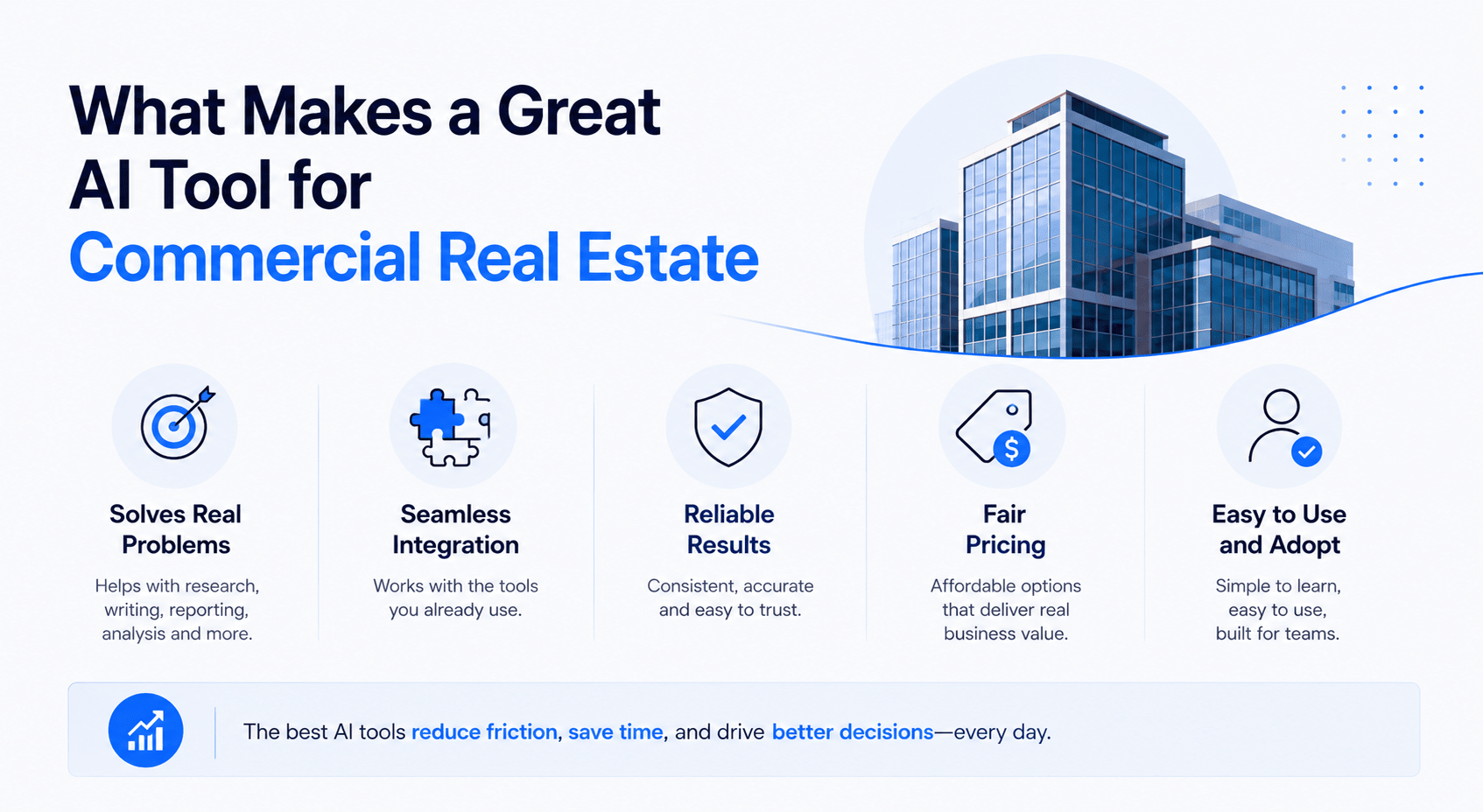
What Makes a Great AI Tool for Commercial Real Estate
Not every AI platform works well for CRE teams. Some tools look impressive during demos but fail in real daily workflows.
The best AI tools solve clear business problems.
Strong CRE tools usually help with one or more important tasks:
-
Research
-
Writing
-
Reporting
-
Analysis
-
Automation
-
Organization
-
Communication
Workflow fit matters more than flashy features.
For example, many AI platforms generate beautiful presentations. However, if they do not improve underwriting, prospecting, or reporting, most CRE teams will stop using them quickly.
The best tools reduce friction inside existing operations.
That means they work smoothly with platforms professionals already use, including:
-
Excel
-
Outlook
-
Salesforce
-
HubSpot
-
Airtable
-
Google Workspace
-
CRM systems
Integration is extremely important. AI should simplify work, not create additional steps.
Reliability matters just as much.
Many AI tools produce inconsistent results. One output looks excellent, while the next requires heavy editing. That inconsistency creates trust issues inside teams.
Good CRE AI tools usually provide:
-
Clear formatting
-
Predictable outputs
-
Fast responses
-
Easy workflows
-
Strong integrations
-
Simple onboarding
Pricing also matters.
Some firms buy expensive enterprise software without using most features. Others avoid AI completely because they assume implementation is too expensive.
In reality, many affordable tools now provide strong operational value.
A simple automation that saves five hours weekly can create major productivity gains over time. That often matters more than buying the “most advanced” AI platform.
Ease of use is another major factor.
Most CRE professionals are not engineers. Complicated systems with difficult setup processes usually fail during adoption. Simpler platforms often work better because teams actually use them consistently.
The most successful firms focus on practical improvements instead of chasing every new AI trend.
Best AI Tools for Commercial Real Estate in 2026
The AI market is crowded in 2026. New tools launch constantly. However, only a small group consistently delivers value for commercial real estate professionals.
The platforms below stand out because they improve real CRE workflows.
ChatGPT
ChatGPT remains one of the most useful AI tools for commercial real estate teams. Its flexibility makes it valuable across brokerage, investing, operations, and marketing.
Brokers often use ChatGPT for:
-
Prospecting emails
-
Owner outreach
-
Market summaries
-
Listing descriptions
-
Client communication
Investors use it for:
-
Investment memo drafts
-
Deal summaries
-
Market research
-
Financial explanations
-
Underwriting support
Marketing teams also rely heavily on ChatGPT for SEO content, newsletters, and social media writing.
One major advantage is speed. Instead of starting every task manually, professionals can create structured drafts within minutes.
Another advantage is workflow consistency. Teams can save repeatable prompts and reuse them across daily operations.
For example, a brokerage team might build prompts for:
-
Property summaries
-
Cold outreach
-
Investor updates
-
Market reports
-
Meeting summaries
That standardization improves both efficiency and quality.
Still, ChatGPT works best as an assistant, not a replacement for expertise. Financial assumptions, market data, and underwriting decisions still require human review.
The platform is strongest when used to accelerate workflows instead of fully automating decisions.
Claude
Claude has become one of the most useful AI platforms for document-heavy CRE work. Many commercial real estate professionals prefer it for reviewing long files because it handles large amounts of text very well.
That matters in CRE. Teams regularly work with:
-
Lease agreements
-
Offering memorandums
-
Property reports
-
Market studies
-
Investment packages
-
Legal documents
Instead of reading hundreds of pages manually, professionals can upload files and ask focused questions. Claude then summarizes the information in a clean and organized format.
For example, investors often use Claude to review rent rolls and identify risks quickly. Brokers use it to summarize long market reports before client meetings. Asset managers use it to organize operational notes and tenant communication.
One major advantage is context handling. Claude performs well when analyzing long documents together instead of separately. That helps teams connect information across multiple files.
Common CRE use cases include:
-
Lease abstraction
-
Investment memo review
-
Market report summaries
-
Due diligence support
-
Tenant communication analysis
-
Contract comparison
Claude also writes in a more natural tone than many AI tools. That makes it useful for client-facing communication and internal reporting.
However, professionals should still verify important financial or legal details manually. AI tools can miss context or interpret information incorrectly.
For firms that handle large amounts of documentation daily, Claude can reduce hours of reading and organization work each week.
Perplexity AI
Perplexity AI has become popular because it combines AI responses with live web research. Instead of giving generic answers, it pulls information from current online sources.
That makes it especially useful for commercial real estate research.
CRE professionals constantly need updated information, including:
-
Market trends
-
Vacancy data
-
Economic news
-
Tenant movement
-
Development activity
-
Company research
Perplexity helps organize that information quickly.
For example, a broker researching industrial growth in Dallas can ask Perplexity for recent market activity, major developments, and tenant demand trends. The tool then provides summarized answers with source links.
Investors also use it heavily for competitive research. Instead of manually searching dozens of articles, they can generate quick overviews of markets, sectors, and economic changes.
Strong CRE use cases include:
-
Market research
-
Economic trend analysis
-
Tenant research
-
Competitive intelligence
-
Submarket summaries
-
Industry news tracking
One of the biggest advantages is speed. Teams can gather high-level market insights within minutes instead of spending hours across multiple websites.
Still, users should verify data from primary sources before making investment decisions. Perplexity is excellent for research support, but not for final validation.
For many CRE professionals, it has become one of the fastest ways to stay informed without drowning in information overload.
Microsoft Copilot
Microsoft Copilot works especially well for enterprise CRE teams already using Microsoft products daily.
Many commercial real estate firms rely heavily on:
-
Excel
-
Outlook
-
Teams
-
Word
-
PowerPoint
Copilot integrates directly into those workflows.
That integration is its biggest strength.
For example, analysts can ask Copilot to summarize spreadsheets, organize data, or explain trends directly inside Excel. Teams can generate meeting summaries automatically inside Microsoft Teams. Brokers can draft emails quickly in Outlook.
These small improvements save significant time across large organizations.
Copilot also performs well for reporting workflows. Asset managers often spend hours preparing updates for ownership groups and investors. Copilot helps organize financial commentary and operational summaries faster.
Strong use cases include:
-
Spreadsheet analysis
-
Reporting support
-
Email drafting
-
Meeting summaries
-
Presentation preparation
-
Internal workflow organization
Another advantage is security. Large firms often prefer Microsoft because of enterprise compliance and data management capabilities.
However, Copilot works best inside the Microsoft ecosystem. Teams using different operational systems may not experience the same level of efficiency.
For enterprise CRE environments, though, Copilot is becoming a major operational productivity tool.
Notion AI
Notion AI focuses more on organization and internal knowledge management. It is especially useful for CRE teams handling large amounts of operational information.
Commercial real estate firms often struggle with scattered data. SOPs sit in one folder. Meeting notes stay inside another platform. Market research gets lost across emails and spreadsheets.
Notion helps centralize that information.
Teams can create organized workspaces for:
-
Deal tracking
-
Research notes
-
Operating procedures
-
Market data
-
Team collaboration
-
Project management
The AI layer then improves productivity by summarizing notes, organizing content, and helping teams retrieve information faster.
For example, acquisition teams can create shared research hubs for target markets. Brokers can organize prospecting systems and outreach workflows. Operations teams can build internal knowledge libraries.
Notion AI is especially useful for firms trying to create repeatable systems.
Common CRE workflows include:
-
Meeting note organization
-
Research databases
-
Team collaboration
-
SOP creation
-
Project tracking
-
Internal reporting
One major advantage is simplicity. The platform feels less technical than many enterprise systems. Smaller firms can implement it quickly without large onboarding processes.
However, Notion is not a specialized underwriting or financial analysis tool. It works best as an operational organization platform.
For teams drowning in scattered information, it creates much-needed structure.
Zapier AI
Zapier has become one of the most valuable automation tools in commercial real estate because it connects different systems together.
Most CRE workflows involve multiple platforms. A broker may use:
-
A CRM
-
Email software
-
Spreadsheet tools
-
Marketing platforms
-
Research systems
-
Communication apps
Without automation, teams manually move information between those systems every day.
Zapier reduces that manual work.
For example, a brokerage can automatically send leads from a website form into a CRM. Investor inquiries can trigger automated email sequences. Market reports can move directly into shared databases.
AI features inside Zapier now improve these workflows even more.
Common CRE automations include:
-
Lead routing
-
CRM updates
-
Meeting summaries
-
Email workflows
-
Task creation
-
Reporting notifications
One strong use case involves prospecting workflows. A broker can connect research tools, email systems, and CRMs into one automated pipeline. Instead of manually copying information, the workflow updates automatically.
That saves hours every week.
Zapier also helps smaller firms scale operations without hiring additional support staff. Many repetitive administrative tasks can now run automatically in the background.
Still, successful automation requires planning. Firms should avoid creating overly complicated workflows too early. Simple automations usually provide the best results initially.
For many CRE teams, Zapier becomes the operational glue connecting their entire workflow ecosystem.
AI Tools by CRE Job Function
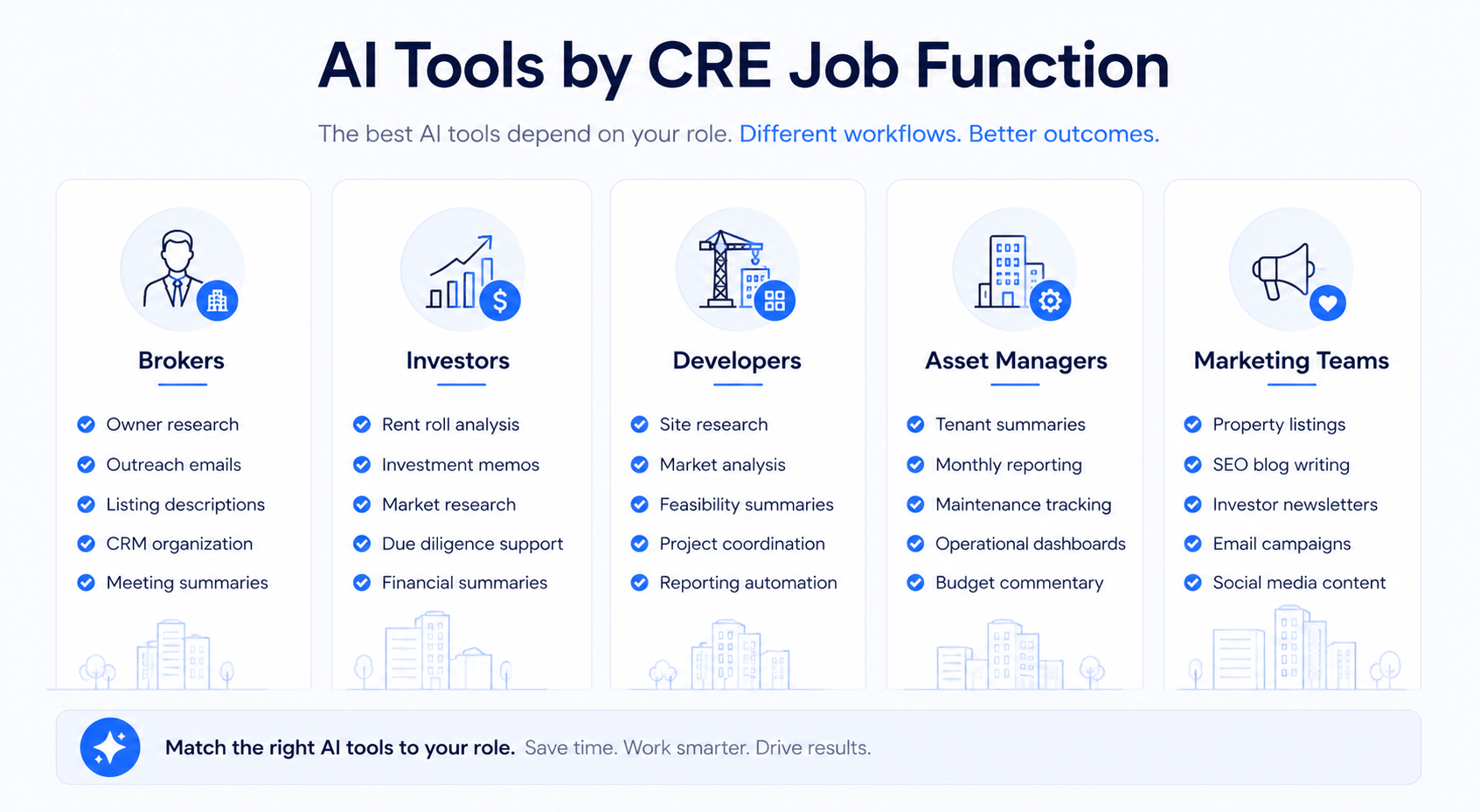
Different CRE roles need different AI workflows. A broker’s daily tasks look very different from an asset manager’s responsibilities. Because of that, the best AI tool depends heavily on the user’s role.
The strongest implementations match tools to specific operational problems instead of using one platform for everything.
Best AI Tools for Brokers
Brokers spend large amounts of time on communication and prospecting. AI helps reduce the administrative side of those workflows.
Useful broker workflows include:
-
Owner research
-
Outreach emails
-
Listing descriptions
-
CRM organization
-
Meeting summaries
-
Market updates
ChatGPT and Perplexity work especially well for brokerage teams. ChatGPT helps with communication and marketing content. Perplexity speeds up research and market analysis.
Zapier also becomes valuable because it automates repetitive CRM workflows.
The biggest advantage for brokers is speed. Faster research and communication create more time for relationship-building and deal activity.
Best AI Tools for Investors
Investors usually focus more on analysis and due diligence. They handle large datasets, financial reports, and property documents daily.
Claude performs especially well for document-heavy workflows. Investors use it to summarize investment memorandums, leases, and market reports.
Useful investor workflows include:
-
Rent roll analysis
-
Investment memo creation
-
Market research
-
Due diligence support
-
Financial summaries
-
Risk identification
Perplexity also helps investors monitor market trends and economic changes quickly.
The goal is not to replace underwriting expertise. Instead, AI reduces the time spent organizing and reviewing information.
Best AI Tools for Developers
Developers handle planning, reporting, research, and project coordination. AI helps organize those workflows more efficiently.
Useful development workflows include:
-
Site research
-
Market analysis
-
Feasibility summaries
-
Project coordination
-
Consultant communication
-
Reporting automation
Notion AI works well for organizing large development projects. ChatGPT helps create summaries, reports, and stakeholder communication.
Developers also benefit from AI-assisted research when evaluating zoning trends, construction activity, and market conditions.
Best AI Tools for Asset Managers
Asset managers deal with constant reporting and communication. They track tenant issues, financial performance, maintenance updates, and operational data across multiple properties.
AI helps reduce the administrative pressure behind those workflows.
Instead of manually organizing every report, asset managers can now use AI to summarize updates, structure communication, and prepare reports faster.
Useful AI workflows include:
-
Tenant communication summaries
-
Monthly reporting
-
Maintenance tracking
-
Operational dashboards
-
Budget commentary
-
Meeting summaries
Microsoft Copilot works especially well for reporting inside Excel and Outlook. Claude helps review long operational documents and organize notes clearly.
Many asset managers also use Notion AI to centralize property information and operational procedures.
The biggest benefit is time savings. Reporting tasks that once required several hours can often be completed much faster with structured AI workflows.
Still, human oversight remains important. Asset managers must verify financial figures, operational data, and tenant details before sharing reports externally.
AI works best as a support system, not a replacement for operational expertise.
Best AI Tools for CRE Marketing Teams
Marketing teams inside commercial real estate create large amounts of content every week. They write listing descriptions, newsletters, market updates, blogs, email campaigns, and social media posts.
AI significantly speeds up that process.
ChatGPT and Jasper AI are especially useful for marketing workflows because they help teams create structured drafts quickly.
Common marketing workflows include:
-
Property listing creation
-
SEO blog writing
-
Investor newsletters
-
Email campaigns
-
Social media captions
-
Video scripting
One major advantage is scalability. Smaller teams can now produce much more content without hiring additional writers.
For example, a brokerage marketing team can use AI to generate first drafts for multiple property listings in a single afternoon. Editors then refine and personalize the content before publishing.
AI also helps maintain consistency across branding and messaging.
However, quality control matters. Generic AI writing often sounds repetitive or robotic. Strong marketing teams still edit outputs carefully to maintain a natural and professional tone.
The best results come when AI supports experienced marketers instead of replacing them.
AI Tools That Actually Work vs Hype
AI conversations in commercial real estate often become exaggerated. Some companies claim AI can fully automate investing, underwriting, or brokerage operations. In reality, most successful CRE teams use AI in much simpler ways.
The best tools improve productivity. They do not replace professional judgment.
Here is a realistic breakdown of where AI performs well today.
| Tool Category | Actually Useful | Mostly Hype |
|---|---|---|
| Research AI | Fast market summaries | Fully automated investment decisions |
| CRM Automation | Workflow efficiency | “Hands-free” brokerage operations |
| Underwriting Support | Faster document review | AI is replacing analysts entirely |
| Marketing AI | Content scaling | Generic spam content |
| Meeting AI | Organized summaries | Perfect memory and accuracy |
Table Caption: Realistic AI capabilities compared to overhyped expectations in CRE
Many CRE professionals waste time chasing “all-in-one” AI systems. Usually, those platforms promise too much and deliver inconsistent results.
The strongest AI implementations focus on practical operational improvements instead.
Good AI tools usually have these traits:
-
Clear workflow purpose
-
Simple onboarding
-
Reliable outputs
-
Strong integrations
-
Measurable time savings
On the other hand, some warning signs appear repeatedly across weak AI products.
Common red flags include:
-
Complicated setup processes
-
Poor formatting
-
Unreliable summaries
-
Weak customer support
-
No real CRE workflow fit
Another mistake is assuming AI can remove expertise from commercial real estate. That rarely works.
AI can organize information quickly. However, it still struggles with nuance, negotiation context, local market dynamics, and relationship management.
Experienced professionals still make the real decisions.
The firms getting the best results use AI to remove repetitive work while keeping human expertise at the center of operations.
Real-World CRE AI Workflows
The most successful CRE teams do not use AI randomly. They build repeatable workflows around specific operational problems.
That structure creates consistency and measurable productivity gains.
Below are some practical examples of how CRE professionals use AI in daily operations. In addition, if you want to see how professionals connect these tools into real operational systems, this guide on AI workflow systems for CRE breaks down practical automation setups step by step.
Broker Prospecting Workflow
Prospecting remains one of the most time-consuming activities in brokerage. AI helps speed up research and communication significantly.
A common workflow looks like this:
-
Use Perplexity for market and owner research
-
Organize prospect data inside Airtable or CRM
-
Generate personalized outreach drafts with ChatGPT
-
Automate follow-ups using Zapier
-
Track responses inside CRM systems
This process reduces hours of manual research and email drafting each week.
Instead of spending an afternoon building outreach lists, brokers can focus more time on calls, meetings, and relationships.
Investment Analysis Workflow
Investment teams often review massive amounts of information during acquisitions.
AI helps organize that process faster.
A practical workflow may include:
-
Upload rent rolls and offering memorandums into Claude
-
Generate summary notes and risk highlights
-
Use Perplexity for market trend research
-
Draft investment memos with ChatGPT
-
Organize deal tracking in Notion or Airtable
This approach speeds up early-stage analysis without replacing underwriting expertise.
Analysts still verify assumptions and financial conclusions manually. However, AI dramatically reduces the time spent reviewing and organizing documents.
Property Marketing Workflow
Marketing workflows benefit heavily from AI because CRE teams create repetitive content constantly.
A common workflow includes:
-
Generate listing drafts using ChatGPT
-
Create SEO blog content for market visibility
-
Write newsletter summaries
-
Produce social media captions
-
Organize campaigns inside marketing platforms
This process helps smaller marketing teams scale output efficiently.
Instead of writing every piece manually, marketers can focus on editing, branding, and campaign strategy.
Asset Management Workflow
Asset managers often spend large amounts of time preparing updates and organizing operational information.
AI helps streamline those tasks.
A practical workflow may include:
-
Upload operational notes into Claude
-
Generate meeting summaries automatically
-
Organize tenant communication
-
Draft monthly operational updates
-
Track tasks inside Notion
This system improves reporting speed while keeping operational information centralized and easier to manage.
The key across all workflows is simplicity.
The best CRE teams start with one operational problem and build one repeatable system around it.
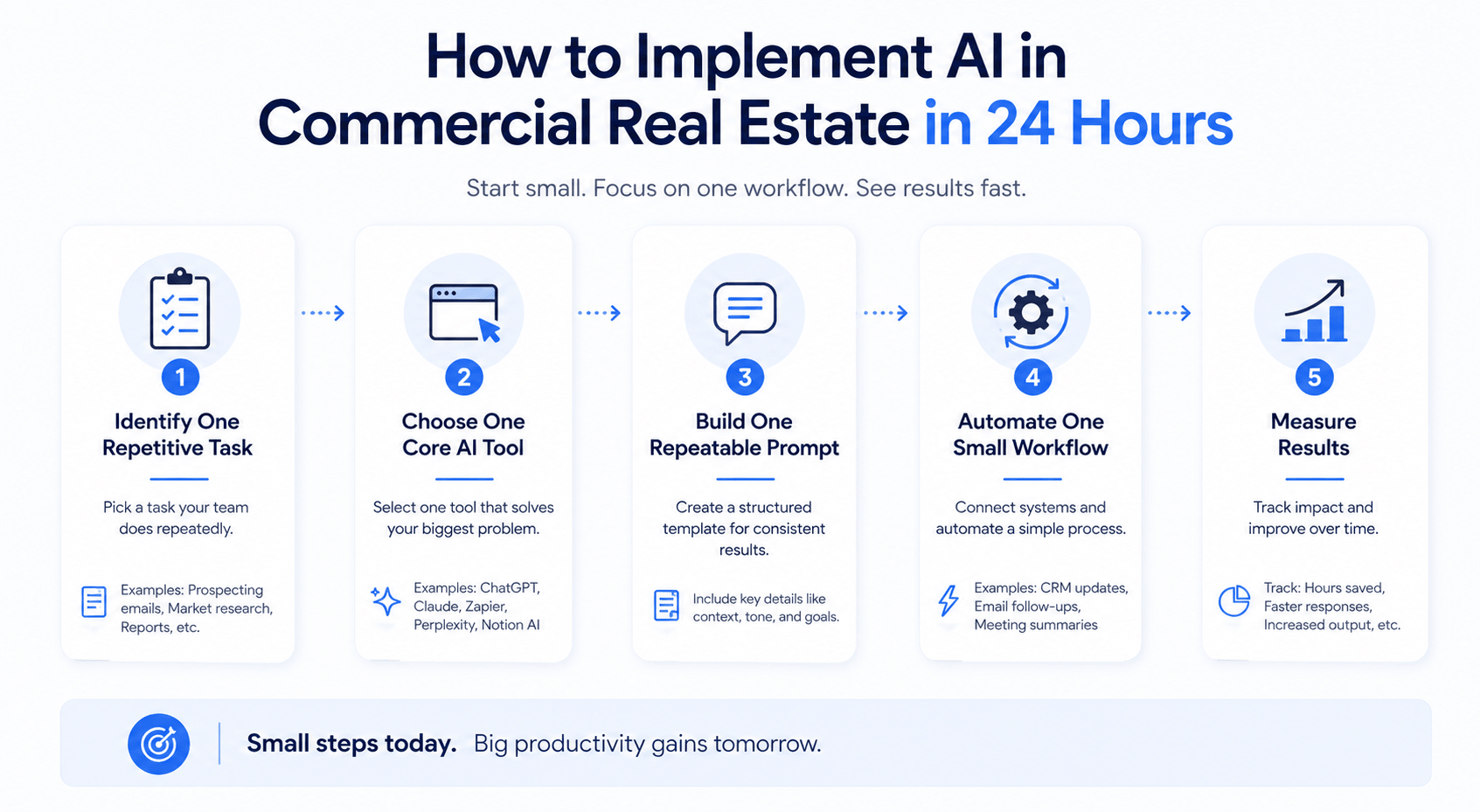
How to Implement AI in Commercial Real Estate in 24 Hours
Many CRE professionals delay AI adoption because they think implementation will be complicated. In reality, most firms can begin using AI productively within a single day.
The key is starting small.
Trying to automate everything immediately usually creates confusion. Instead, focus on one repetitive workflow first.
Step 1: Identify One Repetitive Task
Choose a task your team repeats constantly.
Good starting points include:
-
Prospecting emails
-
Market research
-
Investor reporting
-
Meeting summaries
-
Listing descriptions
-
CRM updates
The best workflows usually involve repetitive writing or information organization.
Step 2: Choose One Core AI Tool
Do not start with five different platforms.
Choose one tool that matches your biggest operational problem.
Examples include:
-
ChatGPT for writing workflows
-
Claude for document analysis
-
Zapier for automation
-
Perplexity for research
-
Notion AI for organization
Simple systems usually create better adoption rates.
Step 3: Build One Repeatable Prompt
Most AI results improve dramatically with strong prompts.
Instead of typing random instructions every time, create structured templates.
For example, a broker outreach prompt should include:
-
Property type
-
Market location
-
Owner goals
-
Desired tone
-
Call-to-action
-
Relationship context
That consistency improves output quality significantly.
Stop guessing which AI tools actually work in CRE. Join professionals already using proven workflows, automation systems, and real-world prompts inside the AI for CRE Collective community.
Step 4: Automate One Small Workflow
After prompts are working well, begin connecting systems together.
Start with simple automations like:
-
CRM lead updates
-
Meeting summaries
-
Email follow-ups
-
Task notifications
-
Report organization
Avoid building overly complex automations early.
Simple workflows are easier to manage and improve over time.
Step 5: Measure Results
AI adoption should improve measurable business outcomes.
Track:
-
Hours saved
-
Faster response times
-
Increased output
-
Workflow consistency
-
Reduced repetitive work
This helps teams understand which tools provide real operational value.
Successful AI implementation is usually gradual. Small improvements compound over time into major productivity gains.
Copy-Paste AI Prompts for Commercial Real Estate
Good prompts make a huge difference in AI output quality. Weak prompts usually create generic responses that require heavy editing.
Strong prompts provide context, structure, goals, and formatting instructions clearly.
Below are practical CRE prompts professionals can adapt for daily workflows.
Broker Outreach Prompt
Instead of writing:
“Write an email to a property owner.”
Use something more detailed, like:
You are a commercial real estate broker specializing in industrial properties in Dallas. Write a professional but conversational outreach email to an owner of a 50,000-square-foot warehouse. Mention recent leasing activity in the submarket, discuss rising tenant demand, and ask if they would consider discussing market positioning opportunities. Keep the tone relationship-focused and avoid sounding overly sales-driven.
This type of prompt creates more personalized and useful outreach.
Investment Memo Prompt
Strong investment prompts improve structure and readability.
Example:
Analyze the following property information and create an executive-level investment summary. Include strengths, risks, tenant overview, market positioning, vacancy concerns, and long-term upside potential. Keep the tone professional and investor-focused. Use concise paragraphs and bullet points where appropriate.
This helps analysts organize investment communication much faster.
Market Research Prompt
Market research prompts work best when they include geography, property type, and business goals clearly.
Example:
Provide a commercial real estate market overview for multifamily properties in Phoenix, Arizona. Include vacancy trends, rent growth, construction activity, migration patterns, and investor sentiment. Explain how these trends may affect acquisition opportunities over the next 12 months. Use simple business language and organize the response with short sections and bullet points.
This type of prompt helps brokers and investors gather structured market insights quickly.
It also reduces the time spent organizing research manually.
Property Listing Prompt
Generic listing descriptions usually sound repetitive and forgettable. Better prompts create more useful and professional marketing content.
Example:
Write a commercial real estate listing description for a Class A office property in Austin, Texas. Highlight walkability, nearby amenities, flexible floor plans, parking availability, and access to major highways. Keep the tone professional, modern, and investor-friendly. Avoid exaggerated marketing language. Use short paragraphs for readability.
This creates cleaner listing drafts that need far less editing.
Investor Update Prompt
Investor communication needs clarity and structure. AI helps organize updates quickly while keeping messaging professional.
Example:
Create a quarterly investor update for a multifamily property portfolio. Include occupancy performance, leasing activity, operational improvements, maintenance updates, and market conditions. Explain challenges clearly while maintaining a confident and transparent tone. Use concise paragraphs and short bullet points for key metrics.
This type of prompt helps asset managers and operators prepare updates faster without sacrificing readability.
Before vs After AI Productivity in CRE
Many CRE professionals understand the AI conceptually but struggle to measure practical value. The biggest impact usually appears in time savings.
AI reduces the hours spent on repetitive administrative work. That allows teams to focus more on relationships, negotiations, and strategic decisions.
Here is a realistic comparison of how workflows often improve after AI implementation.
WorkflowTraditional ProcessAI-Assisted ProcessMarket Research3–4 hours30–45 minutesListing Creation1–2 hours10–20 minutesInvestor Reporting4–5 hours45–60 minutesLease ReviewManual readingAI-assisted summariesProspecting EmailsWritten individuallyPrompt-assisted draftingMeeting NotesManual organizationAutomated summaries
Table Caption: Estimated productivity improvements using AI in commercial real estate workflows
The biggest improvements usually happen in writing and organization tasks.
For example, many brokers spend large portions of their day drafting emails and preparing marketing content. AI reduces that workload significantly.
Analysts also benefit because AI tools organize large amounts of information faster. Instead of manually reviewing every page first, teams can focus directly on important findings and risks.
Still, productivity gains depend heavily on implementation quality.
Firms that build repeatable workflows usually see stronger results than teams using AI randomly. Consistency matters more than tool quantity.
Another important point is employee adoption.
The best systems are usually simple. Overly complicated AI workflows often create frustration and low usage rates. Smaller operational improvements usually produce better long-term results.
AI works best when it removes friction from existing processes instead of replacing them completely.
What Most CRE Professionals Get Wrong About AI
Many commercial real estate professionals either overestimate AI or underestimate it completely. Both approaches create problems.
Some firms believe AI will replace analysts, brokers, and asset managers entirely. Others ignore AI because they assume it has no practical value. The truth sits somewhere in the middle.
AI is extremely useful for repetitive operational tasks. However, it still depends heavily on human expertise, judgment, and verification.
One common mistake is expecting AI to make investment decisions automatically.
AI can summarize data quickly. It can identify patterns and organize reports. However, it does not fully understand negotiation dynamics, relationship history, local political factors, or real-world market sentiment.
Experienced professionals still provide that context. Another major mistake is using too many tools at once. Many teams adopt several AI platforms immediately without building clear workflows. That creates confusion and inconsistent adoption across departments.
The better approach is gradual implementation.
Start with:
-
One workflow
-
One tool
-
One repeatable process
Then expand carefully over time.
Poor prompt quality also creates major problems.
Weak prompts often produce vague and generic outputs. Strong prompts include context, goals, formatting instructions, and audience details clearly.
For example, “Write a property email” usually creates weak content.
Meanwhile, a detailed prompt explaining the market, owner type, property class, and communication goal produces much stronger results.
Training matters too.
Some firms purchase AI tools without teaching teams how to use them effectively. That usually leads to low adoption and inconsistent results.
The most successful CRE firms treat AI like an operational skill. They build systems, templates, workflows, and internal standards around usage.
That structure improves both efficiency and trust across teams. Similarly, many firms struggle with implementation because of internal resistance and workflow confusion. This article on enterprise AI adoption challenges explains why many CRE companies still fail to scale AI successfully.
Future of AI Tools for Commercial Real Estate
AI adoption inside commercial real estate will continue growing rapidly over the next several years. However, the future is not just about faster writing or automation.
The next phase involves operational intelligence.
Many CRE workflows will become more connected through AI systems. Instead of using separate tools for research, communication, and reporting, firms will build integrated workflows that operate together.
One major trend is AI agents.
These systems go beyond simple prompts. AI agents can complete sequences of tasks automatically. For example, an AI workflow may:
-
Research a property owner
-
Organize contact data
-
Draft outreach emails
-
Update the CRM
-
Schedule follow-up reminders
That type of automation is already beginning to appear across sales and operations software.
Predictive analytics will also become more important.
CRE firms increasingly want AI systems that help identify:
-
Market shifts
-
Leasing trends
-
Investment risks
-
Tenant movement
-
Development opportunities
However, data quality will remain critical. Poor information still creates poor analysis, even with advanced AI systems.
Another major trend is vertical AI platforms built specifically for commercial real estate.
Generic AI tools remain useful. Still, many firms now want systems trained around CRE workflows directly. That includes:
-
Lease abstraction
-
Underwriting support
-
Property operations
-
Asset management
-
Investor reporting
These specialized tools will likely grow significantly over the next few years.
Voice AI and meeting automation will also expand.
Teams already use AI meeting assistants to summarize calls and organize action items automatically. Over time, these systems will connect more deeply with CRMs, reporting platforms, and operational dashboards.
Still, human relationships will remain central to commercial real estate.
AI may improve efficiency, but trust, negotiation, market knowledge, and relationship-building will continue driving the industry.
The firms that succeed will not necessarily use the most AI. They will use AI in the most practical and disciplined way.
Conclusion
Artificial intelligence is changing how commercial real estate teams operate in 2026. What started as experimentation is now becoming part of daily workflows across brokerage, investing, development, and operations. The biggest value comes from productivity improvements.
AI helps professionals organize research faster, draft communication more quickly, automate repetitive tasks, and manage information more efficiently. It does not replace expertise. Instead, it gives experienced teams more time to focus on relationships, strategy, and execution.
The most successful firms usually take a simple approach. They start with one workflow, build one repeatable system, and improve gradually over time. That mindset creates better adoption and stronger long-term results.
As competition increases across the industry, firms using AI tools for commercial real estate effectively will likely operate faster and more efficiently than teams relying only on manual systems.
The goal is not to chase every new AI trend. The goal is to use practical tools that solve real operational problems.
Ready to Use AI in CRE the Right Way?
Want practical CRE AI workflows instead of generic advice? Join professionals already using real prompts, automations, and implementation systems inside the AI for CRE Collective community.
What are the best AI tools for commercial real estate?
The best AI tools for commercial real estate depend on the type of work you handle daily. Brokers, investors, developers, and asset managers all use AI differently.
Some of the most useful platforms in 2026 include:
-
ChatGPT for writing and communication
-
Claude for document analysis
-
Perplexity for market research
-
Zapier for automation
-
Notion AI for organization
-
Microsoft Copilot for reporting workflows
Most CRE professionals do not rely on one tool alone. Instead, they combine multiple platforms to improve different parts of their workflow.
For example, a brokerage team may use ChatGPT for outreach emails, Perplexity for research, and Zapier for CRM automation.
The best approach is to start with one repetitive workflow first. That creates faster adoption and better long-term results.
How are CRE brokers using AI in 2026?
CRE brokers mainly use AI to improve prospecting, research, and communication.
Many brokers spend hours every week researching owners, writing emails, updating CRMs, and creating marketing content. AI reduces the time required for those tasks.
Common broker workflows include:
-
Personalized outreach emails
-
Listing descriptions
-
Market summaries
-
Owner research
-
Meeting summaries
-
CRM updates
For example, a broker can use Perplexity to research industrial leasing activity in a market, then use ChatGPT to draft personalized outreach emails for property owners.
AI also helps brokers respond faster to clients. Faster communication often improves relationship management and deal flow.
Still, AI does not replace relationship-building or negotiation skills. It mainly removes repetitive administrative work so brokers can focus on higher-value activities.
Can AI help with commercial real estate underwriting?
Yes, AI can significantly support underwriting workflows. However, it should not replace financial expertise or investment judgment.
Many investment teams use AI to organize and summarize information faster. That includes:
-
Rent roll analysis
-
Offering memorandum summaries
-
Market research
-
Risk identification
-
Lease abstraction
-
Investment memo drafting
Claude is especially useful because it handles large documents well. Analysts can upload lengthy reports and ask focused questions about risks, tenant exposure, or vacancy concerns.
AI helps reduce the time spent reviewing information manually. Instead of reading hundreds of pages first, teams can quickly identify key areas requiring deeper analysis.
Still, financial assumptions and investment decisions must always be reviewed by experienced professionals.
AI improves efficiency. It does not replace underwriting expertise.
Is ChatGPT useful for commercial real estate professionals?
Yes, ChatGPT has become one of the most useful AI tools for CRE workflows because it supports many different tasks.
Commercial real estate professionals use ChatGPT for:
-
Prospecting emails
-
Market summaries
-
Investment memo drafts
-
Listing descriptions
-
Investor communication
-
Blog content
-
Meeting notes
One major advantage is flexibility. Teams can create repeatable prompts for recurring workflows and save hours each week.
For example, brokers can build templates for owner outreach while asset managers can create standardized reporting prompts.
Still, ChatGPT works best as a support tool. Market data, financial figures, and underwriting assumptions should always be verified manually.
The strongest results happen when professionals use ChatGPT to speed up workflows instead of fully automating decisions.
What AI tools help with CRE marketing?
AI tools are becoming extremely important for commercial real estate marketing teams because they help scale content production.
Popular marketing-focused AI tools include:
-
ChatGPT
-
Jasper AI
-
Canva AI
-
Notion AI
-
Grammarly
Marketing teams use these tools for:
-
Listing descriptions
-
SEO blogs
-
Email campaigns
-
Social media posts
-
Investor newsletters
-
Video scripts
For example, a brokerage team can generate multiple listing drafts quickly using ChatGPT, then edit them for tone and branding consistency.
AI also helps smaller firms compete with larger companies by increasing marketing output without adding additional staff.
However, human editing still matters. Generic AI content often feels repetitive. Strong marketing teams refine AI outputs carefully to maintain professionalism and readability.
Are AI tools replacing jobs in commercial real estate?
AI is changing workflows in commercial real estate, but it is not fully replacing professionals.
Most AI tools handle repetitive operational tasks rather than strategic decision-making.
For example, AI can:
-
Summarize documents
-
Draft emails
-
Organize research
-
Prepare reports
-
Automate workflows
However, AI still struggles with:
-
Negotiation
-
Relationship-building
-
Local market expertise
-
Investment judgment
-
Complex deal strategy
Commercial real estate remains highly relationship-driven. Trust, experience, and market knowledge still matter heavily.
Instead of replacing jobs entirely, AI is changing how professionals spend their time. Teams now spend less time on repetitive administrative work and more time on strategic activities.
The professionals who adapt to AI workflows will likely become more productive and competitive over time.
How much do commercial real estate AI tools cost?
AI tool pricing varies widely depending on the platform and feature set.
Many individual tools cost between $20 and $100 per month. Enterprise platforms can cost much more depending on team size and integrations.
Typical pricing ranges include:
-
ChatGPT Plus: affordable monthly subscription
-
Claude Pro: moderate monthly pricing
-
Perplexity Pro: research-focused subscription
-
Zapier: pricing based on automation volume
-
Microsoft Copilot: enterprise licensing
The good news is that many CRE professionals can begin with low-cost tools before scaling into larger systems.
The important factor is return on investment.
A tool saving five to ten hours weekly may create significant operational value even at higher pricing levels.
Teams should evaluate tools based on productivity gains rather than feature count alone.
What is the easiest AI tool for beginners in CRE?
ChatGPT is usually the easiest starting point for most commercial real estate professionals.
The interface is simple, and users can begin immediately without technical setup. It also supports many different workflows, making it useful across multiple CRE roles.
Beginners often start with:
-
Email drafting
-
Market summaries
-
Listing descriptions
-
Meeting notes
-
Research organization
Perplexity is another strong beginner-friendly tool because it combines AI responses with web research.
The best way to start is by focusing on one repetitive workflow instead of trying to automate everything immediately.
Simple workflows create faster learning and stronger long-term adoption.
How can small CRE firms implement AI successfully?
Small CRE firms often benefit the most from AI because they usually operate with limited staff.
AI helps lean teams scale operations without hiring additional employees immediately.
A simple implementation process looks like this:
-
Identify one repetitive workflow
-
Choose one AI tool
-
Build one repeatable process
-
Measure time savings
-
Expand gradually
Good starting workflows include:
-
Prospecting emails
-
Market research
-
Investor reporting
-
Listing creation
-
CRM updates
The key is avoiding overcomplicated systems early.
Small firms usually succeed faster when they implement practical workflows slowly and consistently.
What mistakes should CRE teams avoid with AI?
Many commercial real estate teams struggle with AI because they approach implementation incorrectly.
One major mistake is adopting too many tools at once. That usually creates confusion and inconsistent workflows.
Other common mistakes include:
-
Poor prompt quality
-
No workflow structure
-
Lack of employee training
-
Expecting AI to replace expertise
-
Ignoring output verification
The best AI implementations are usually simple.
Strong teams start with one operational problem and improve it gradually. They also create repeatable prompts and internal standards for consistency.
AI works best when it supports existing workflows instead of replacing them entirely.
Which AI tools integrate with CRE CRMs?
Several AI and automation tools now integrate with CRM systems used in commercial real estate.
Popular integrations include:
-
Zapier
-
HubSpot AI
-
Salesforce Einstein
-
Microsoft Copilot
-
Airtable AI
These integrations help automate repetitive administrative tasks like:
-
Lead tracking
-
Contact organization
-
Follow-up reminders
-
Email sequences
-
Meeting summaries
For example, Zapier can automatically move website leads into a CRM and trigger follow-up workflows immediately.
CRM automation helps brokers reduce manual data entry while improving response speed and workflow consistency.
Can AI analyze leases and contracts?
Yes, AI can help analyze leases and contracts, especially during early-stage document review.
Many firms use AI tools to:
-
Extract lease terms
-
Summarize clauses
-
Identify renewal dates
-
Highlight risks
-
Organize tenant information
Claude is especially popular for lease abstraction because it handles large documents effectively.
Still, legal review remains essential.
AI can miss nuanced language or misunderstand context inside complex agreements. Attorneys and experienced professionals should always review important lease details manually.
AI works best as a support tool that speeds up document organization and review.
What AI workflows save the most time in CRE?
The largest productivity gains usually come from repetitive operational workflows.
Some of the most effective AI workflows include:
-
Market research automation
-
Prospecting email generation
-
Investor reporting
-
Meeting summaries
-
Listing creation
-
CRM automation
For example, many brokers reduce several hours of weekly administrative work by automating outreach drafts and CRM updates.
Asset managers often save significant time using AI-assisted reporting workflows.
The strongest gains happen when firms create repeatable systems instead of using AI randomly throughout the day.
What is the future of AI in commercial real estate?
The future of AI in commercial real estate will focus more on operational intelligence and connected workflows.
Several major trends are already emerging, including:
-
AI agents
-
Predictive analytics
-
Automated reporting
-
Voice AI
-
CRE-specific platforms
AI agents are especially important because they complete sequences of tasks automatically. Instead of generating one response, these systems can manage entire workflows.
At the same time, vertical AI tools built specifically for commercial real estate will continue growing. Firms increasingly want software trained around underwriting, leasing, asset management, and property operations directly.
Still, human relationships and expertise will remain central to the industry.
Are AI tools secure for commercial real estate firms?
Security depends heavily on the platform being used and how firms manage internal data policies.
Enterprise AI systems usually provide stronger security and compliance features than free public tools.
Commercial real estate firms should review:
-
Data privacy policies
-
File storage practices
-
Access controls
-
Compliance standards
-
Integration security
Many firms avoid uploading sensitive financial or legal documents into unsecured systems.
Microsoft Copilot and enterprise AI platforms often appeal to larger CRE companies because they offer stronger internal security controls.
Regardless of the platform, firms should create internal AI usage policies to protect confidential client and property information properly.