Using Midjourney for real estate marketing visuals
Using Midjourney for real estate marketing visuals is helping commercial real estate teams create faster and better campaigns. Brokers, investors, and developers now use AI-generated visuals to improve branding, social media marketing, and investor presentations. Strong visuals also help properties stand out in crowded CRE markets.
Many CRE teams still struggle with slow design processes. Traditional rendering work often takes days or weeks. Revisions can also become expensive. Stock images create another problem because many campaigns start to look identical online.
That is one reason more firms now explore using Midjourney for real estate marketing visuals in their marketing workflow. Midjourney helps brokers, developers, investors, and operators create visual concepts much faster. Teams use it for social media graphics, investor presentations, offering memorandums, and property branding.
The biggest advantage is speed. A task that once required several days can now take minutes. Marketing teams can test different visual styles without waiting for long production cycles. They can also create multiple campaign directions before selecting the best option.
Midjourney does not replace architects or professional designers. Instead, it helps CRE teams move faster during the early planning and marketing stage. Firms can explore ideas quickly before investing in full production work.
This guide explains how Midjourney works in commercial real estate marketing. You will learn where it creates the most value and where its limits still exist. You will also see practical workflows, prompt examples, tool comparisons, and common mistakes that CRE professionals should avoid.
What Is Midjourney?
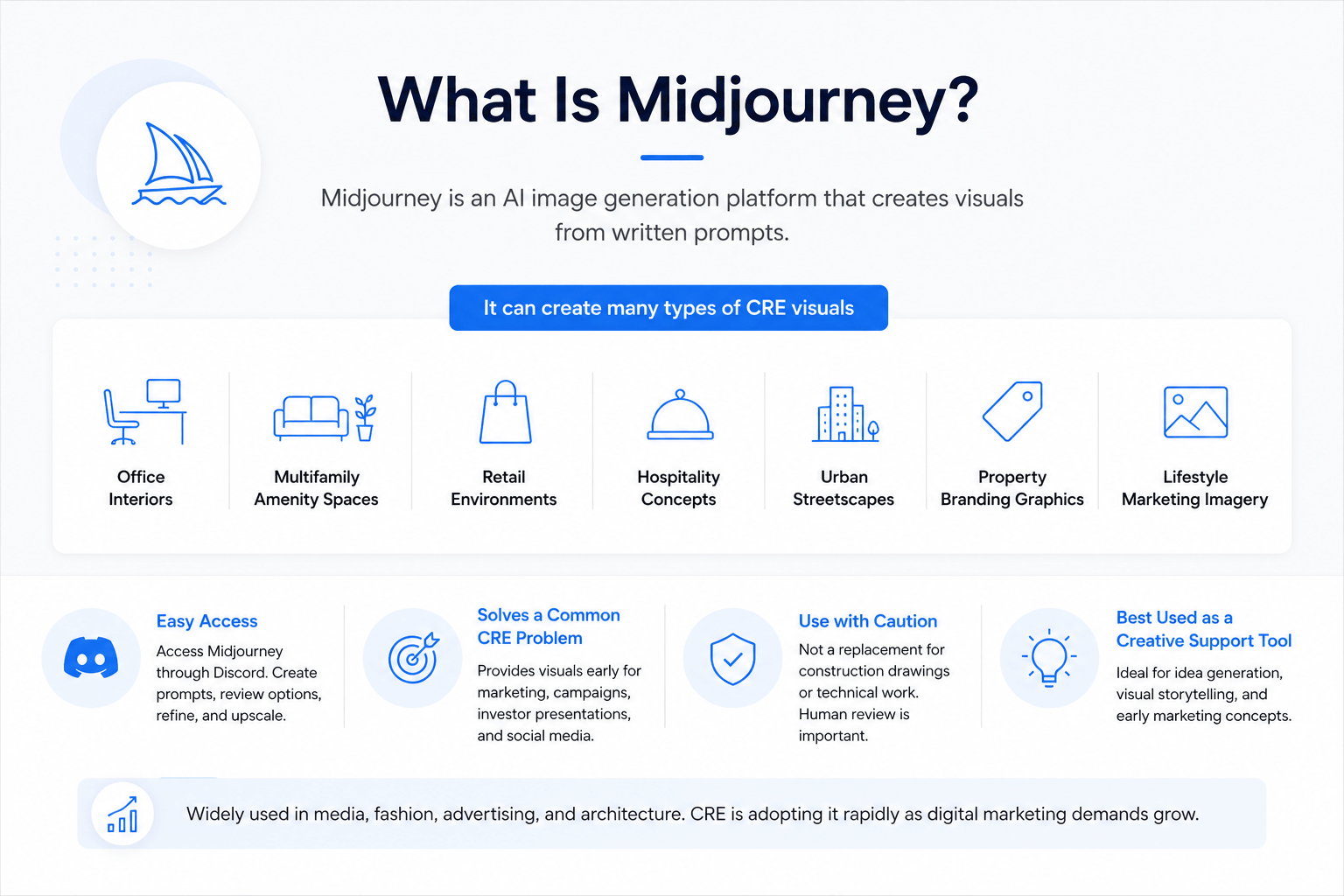
Midjourney is an AI image generation platform. It creates visuals from written prompts. Users type instructions into the platform, and the AI generates images based on those instructions.
The platform can create many types of CRE visuals, including:
-
Office interiors
-
Multifamily amenity spaces
-
Retail environments
-
Hospitality concepts
-
Urban streetscapes
-
Property branding graphics
-
Lifestyle marketing imagery
Unlike traditional design software, Midjourney does not require advanced design skills. Users guide the AI with detailed prompts instead of building graphics manually. This makes the platform attractive for commercial real estate teams that need fast visual content.
Most users access Midjourney through Discord. The setup feels unusual at first, but the workflow becomes easier after several sessions. Users create prompts, review image options, refine outputs, and upscale final versions for marketing use.
Midjourney became popular because it solves a common CRE problem. Many teams need visuals before official renderings exist. Brokers need campaign graphics early. Developers need concept imagery for investor discussions. Marketing teams need social media content quickly.
Midjourney helps fill that gap.
However, the platform also has limits. It should not replace construction drawings or technical architectural work. AI-generated images may contain unrealistic geometry or inaccurate dimensions. Human review remains important.
The best approach is to use Midjourney as a creative support tool. It works well for idea generation, visual storytelling, and early marketing concepts. It does not replace architects, designers, or professional rendering studios.
Several industries already use Midjourney heavily. These include media, fashion, advertising, and architecture. Commercial real estate is now adopting technology faster because digital marketing demands continue to grow.
Why CRE Professionals Are Using Midjourney
Commercial real estate depends heavily on visual presentation. Investors, lenders, buyers, and tenants often react to visuals before reviewing detailed numbers. Strong marketing images help shape that first impression.
That is why many CRE professionals now use AI-generated visuals in their workflow.
Brokers use Midjourney to improve listing campaigns. Instead of relying only on stock photography, they can create visuals tailored to the property and audience. A multifamily broker, for example, can generate rooftop amenity scenes, lobby concepts, or leasing graphics within minutes.
Developers also benefit from faster concept creation. Many teams use Midjourney before paying for expensive rendering packages. This allows them to test branding ideas and visual directions early in the planning process.
Investors use Midjourney for storytelling and presentations. Many value-add projects require a strong vision. AI-generated visuals help investors explain renovation opportunities before construction begins.
Common CRE use cases include:
-
Offering memorandum graphics
-
Investor deck visuals
-
Property branding concepts
-
Social media campaigns
-
Renovation concepts
-
Website hero images
-
Leasing campaign graphics
-
Market report visuals
Another major benefit is faster iteration. Traditional design revisions often slow marketing timelines. Midjourney allows teams to test multiple concepts quickly.
For example, a developer repositioning an office property could generate:
-
Modern lobby concepts
-
Flexible workspace visuals
-
Outdoor collaboration areas
-
Executive suite branding
-
Lifestyle-focused marketing graphics
All within a single afternoon.
This speed allows marketing teams to experiment more often. Instead of choosing one concept immediately, they can compare several creative directions before launching campaigns.
Successful firms still combine AI with human strategy. Strong marketing requires positioning, branding, and market knowledge. AI simply helps teams execute faster.
Midjourney vs Traditional CRE Design Workflows
Traditional design workflows still play an important role in commercial real estate. Professional renderings remain valuable for large developments and institutional projects. Many firms still rely on architects, visualization studios, and creative agencies for final presentations.
However, AI tools now give CRE teams another option during the early marketing stage.
Midjourney works best when speed matters. Teams can generate concepts quickly and test several creative directions before spending money on formal production. This helps firms reduce delays during campaign planning.
The biggest difference usually comes down to speed, flexibility, and cost.
| Workflow Factor | Midjourney | Traditional Rendering |
|---|---|---|
| Turnaround Speed | Minutes | Days or weeks |
| Revision Speed | Very fast | Slower |
| Upfront Cost | Lower | Higher |
| Technical Accuracy | Limited | High |
| Creative Testing | Excellent | Moderate |
| Best Use Case | Marketing concepts | Final presentations |
| Team Size Needed | Small | Larger creative teams |
Table Caption: Comparing AI-generated workflows with traditional CRE rendering processes
Traditional rendering teams still provide several important advantages. They understand zoning requirements, technical accuracy, branding systems, and architectural details. Their work is often necessary for investor presentations, entitlement approvals, and construction planning.
Midjourney serves a different purpose. It helps teams brainstorm faster and explore creative directions early.
For example, a developer planning a mixed-use project may use Midjourney to test:
-
Retail atmosphere concepts
-
Outdoor dining visuals
-
Amenity branding ideas
-
Streetscape aesthetics
-
Lifestyle marketing scenes
After selecting a direction, the developer can move into formal rendering production with more clarity. This often reduces revision cycles later in the process.
Another advantage is scalability. Traditional rendering workflows become expensive when teams need large amounts of content. Midjourney allows marketing teams to create many visual variations quickly.
This helps with:
-
Social media campaigns
-
Investor updates
-
Website graphics
-
Leasing campaigns
-
Email marketing
-
Market reports
That flexibility matters because digital marketing now requires constant content production. CRE firms that create content faster often gain more visibility online.
Still, firms should avoid treating Midjourney as a replacement for professional design teams. The strongest workflows combine AI speed with human review and creative oversight.
How to Set Up Midjourney for CRE Marketing
Getting started with Midjourney is easier than many CRE professionals expect. Most users can learn the basics in a single day. The key is building a simple workflow instead of overcomplicating the setup process.
The first step is creating a Midjourney account. Users join through Discord and select a subscription plan. Most brokers and marketing teams can start with a basic paid plan before scaling usage later.
When choosing a plan, focus on:
-
Image generation limits
-
Commercial usage rights
-
Team collaboration needs
-
Rendering speed
-
Private generation options
After setup, the next step is learning the prompt structure. Prompt quality has a major impact on output quality. Weak prompts create generic visuals. Strong prompts create polished marketing imagery.
A strong CRE prompt usually includes:
-
Property type
-
Architectural style
-
Lighting conditions
-
Camera angle
-
Design mood
-
Target audience
-
Visual quality details
For example, instead of writing:
“Office building”
A stronger prompt would be:
“Modern Class A office lobby, natural lighting, luxury finishes, collaborative workspace design, cinematic architectural photography, ultra realistic, wide-angle perspective”
The second version gives Midjourney much more context. That usually produces better results.
CRE teams should also build organized prompt libraries. This saves time later and improves consistency across campaigns.
A good prompt library may include categories such as:
-
Multifamily interiors
-
Office branding
-
Retail streetscapes
-
Industrial facilities
-
Hospitality concepts
-
Mixed-use environments
Organization matters as usage grows. Many teams quickly generate hundreds of images. Without structure, finding assets becomes difficult.
A simple workflow often works best:
-
Generate concepts
-
Save the strongest outputs
-
Organize by project type
-
Refine prompts
-
Export final visuals
-
Move assets into marketing tools
Most firms pair Midjourney with Canva, Photoshop, or presentation software for final campaign production.
Another important step is defining internal approval standards. AI-generated visuals should always go through human review before publication. Teams should verify branding consistency, realism, and compliance before using images in public campaigns.
Best Midjourney Prompts for Commercial Real Estate
Prompt quality determines output quality. This is one of the biggest lessons CRE teams learn when using Midjourney. Generic prompts usually create weak results. Detailed prompts create stronger and more realistic marketing visuals.
Many beginners make the mistake of using short prompts with little direction. The platform performs better when users provide a clear visual context.
Strong prompts often include:
-
Property type
-
Design style
-
Lighting
-
Materials
-
Camera perspective
-
Environment details
-
Rendering style
-
Mood and atmosphere
The goal is to guide the AI like a creative director.
Multifamily Marketing Prompt Examples
Multifamily campaigns often focus on lifestyle and amenities. Good prompts should highlight atmosphere, comfort, and modern design.
Examples:
-
Luxury multifamily rooftop lounge, sunset lighting, modern urban skyline, cinematic architectural photography, ultra-realistic
-
Modern apartment lobby, warm lighting, upscale finishes, hospitality-inspired design, wide-angle lens
-
Luxury amenity deck, outdoor firepit, contemporary multifamily branding, evening atmosphere
Office Property Prompt Examples
Office marketing visuals should communicate productivity, flexibility, and professional branding.
Examples:
-
Modern Class A office workspace, collaborative design, glass conference rooms, natural lighting, premium finishes
-
Flexible coworking environment, modern furniture, urban office branding, realistic architectural photography
-
Executive office suite, luxury workspace design, skyline views, cinematic lighting
Retail and Mixed-Use Prompt Examples
Retail campaigns often rely on energy, walkability, and consumer experience.
Examples:
-
Mixed-use retail district, outdoor dining, pedestrian-friendly streetscape, modern urban design
-
Luxury retail center at night, active storefronts, cinematic lighting, realistic lifestyle environment
-
Walkable lifestyle center, outdoor seating, modern architecture, premium shopping atmosphere
Industrial Property Prompt Examples
Industrial visuals should feel clean, efficient, and modern.
Examples:
-
Modern logistics warehouse, aerial drone perspective, clean industrial branding, realistic lighting
-
Large industrial distribution center, contemporary facade design, cinematic commercial photography
-
Advanced logistics facility, modern loading bays, sunrise industrial environment
The best prompts are highly descriptive without becoming confusing. Most advanced users refine prompts through several iterations before selecting final outputs.
CRE firms should also save high-performing prompts into reusable libraries. This creates consistency across future campaigns and reduces repetitive work.
Stop testing random AI tools without a clear system. Join CRE professionals inside the AI for CRE Collective Membership to access proven workflows, real prompt libraries, and practical implementation strategies. Also subscribe to the AI for CRE Newsletter
How to Create Real Estate Marketing Campaigns with Midjourney
Many CRE teams struggle with content production. Marketing campaigns often move slowly because design work takes time. Revisions create delays. Stock images also make campaigns feel repetitive. Midjourney helps solve those problems.
The platform allows teams to create custom visuals much faster. Brokers can test campaign ideas in minutes instead of waiting several days. Developers can explore branding directions before hiring rendering teams. Marketing departments can also create more content without increasing design costs. The key is using Midjourney inside a clear workflow.
For example, many CRE teams now combine Midjourney visuals with advanced AI virtual staging workflows to improve empty property marketing and leasing campaigns.
Visual campaigns work even better when combined with AI-generated video content. This walkthrough shows how CRE teams can create professional property videos much faster using AI tools.
Social Media Campaign Workflow
Social media now plays a major role in commercial real estate marketing. Investors, brokers, tenants, and developers all consume content daily on LinkedIn, Instagram, and X.
Strong visuals help campaigns stand out.
A simple Midjourney workflow for social media looks like this:
-
Define the campaign goal
-
Choose the target audience
-
Create image prompts
-
Generate multiple versions
-
Select the strongest visuals
-
Add branding in Canva or Photoshop
-
Schedule posts
For example, a multifamily broker could create:
-
Rooftop lifestyle scenes
-
Luxury amenity graphics
-
Leasing campaign visuals
-
Neighborhood branding images
-
Resident experience content
A retail broker could generate:
-
Outdoor dining visuals
-
Lifestyle center concepts
-
Foot traffic scenes
-
Storefront branding graphics
The biggest benefit is speed. Teams can create several campaign directions in one afternoon.
That flexibility improves testing. Marketers can compare different visual styles before launching ads.
Offering Memorandum Workflow
Offering memorandums needs a strong presentation design. Investors often form early impressions from the visuals alone.
Midjourney helps improve that process.
Most CRE teams use the platform for:
-
Cover images
-
Lifestyle concepts
-
Area branding visuals
-
Renovation concepts
-
Section divider graphics
However, teams should avoid using AI visuals to misrepresent properties. The images should support the story, not replace factual property details.
A smart workflow looks like this:
-
Generate concept imagery
-
Select realistic outputs
-
Add clear branding
-
Review compliance concerns
-
Finalize layouts in InDesign or Canva
Many firms also combine Midjourney visuals with real photography. This creates a more balanced presentation.
Investor Presentation Workflow
Investor decks often become text-heavy. Long slides with limited visuals reduce engagement quickly.
Midjourney helps make presentations easier to follow.
For example, a value-add multifamily project may include:
-
Future amenity concepts
-
Modern lobby visuals
-
Renovation inspiration imagery
-
Lifestyle branding scenes
These visuals help investors understand the business plan faster.
A simple investor deck workflow includes:
-
Outline the story first
-
Identify visual gaps
-
Generate supporting images
-
Keep branding consistent
-
Add charts and financials separately
Good visuals support the investment narrative. They should not distract from the numbers. In addition, firms building capital raise presentations should review these strategies for creating AI-generated investor decks with better visuals and faster production workflows.
Website Hero Image Workflow
Many CRE websites still use generic stock images. That creates a weak first impression.
Midjourney gives firms more control over branding.
Teams can create:
-
Homepage banners
-
Property landing page graphics
-
The market report covers
-
Team branding visuals
-
Campaign-specific hero images
For best results, firms should keep visual styles consistent across the website.
That includes:
-
Similar lighting
-
Matching color tones
-
Consistent architecture styles
-
Unified branding direction
Consistency makes the brand feel more professional.
Why Workflow Matters More Than the Tool
Many beginners focus too much on prompts alone. The real advantage comes from workflow design.
Strong CRE teams usually follow the same process every time:
-
Define the campaign goal
-
Build targeted prompts
-
Generate several options
-
Select the best visuals
-
Add human review
-
Publish consistently
This creates better results over time.
The firms seeing the biggest gains from AI are not using random prompts every day. They build repeatable systems that save time across the entire marketing process.
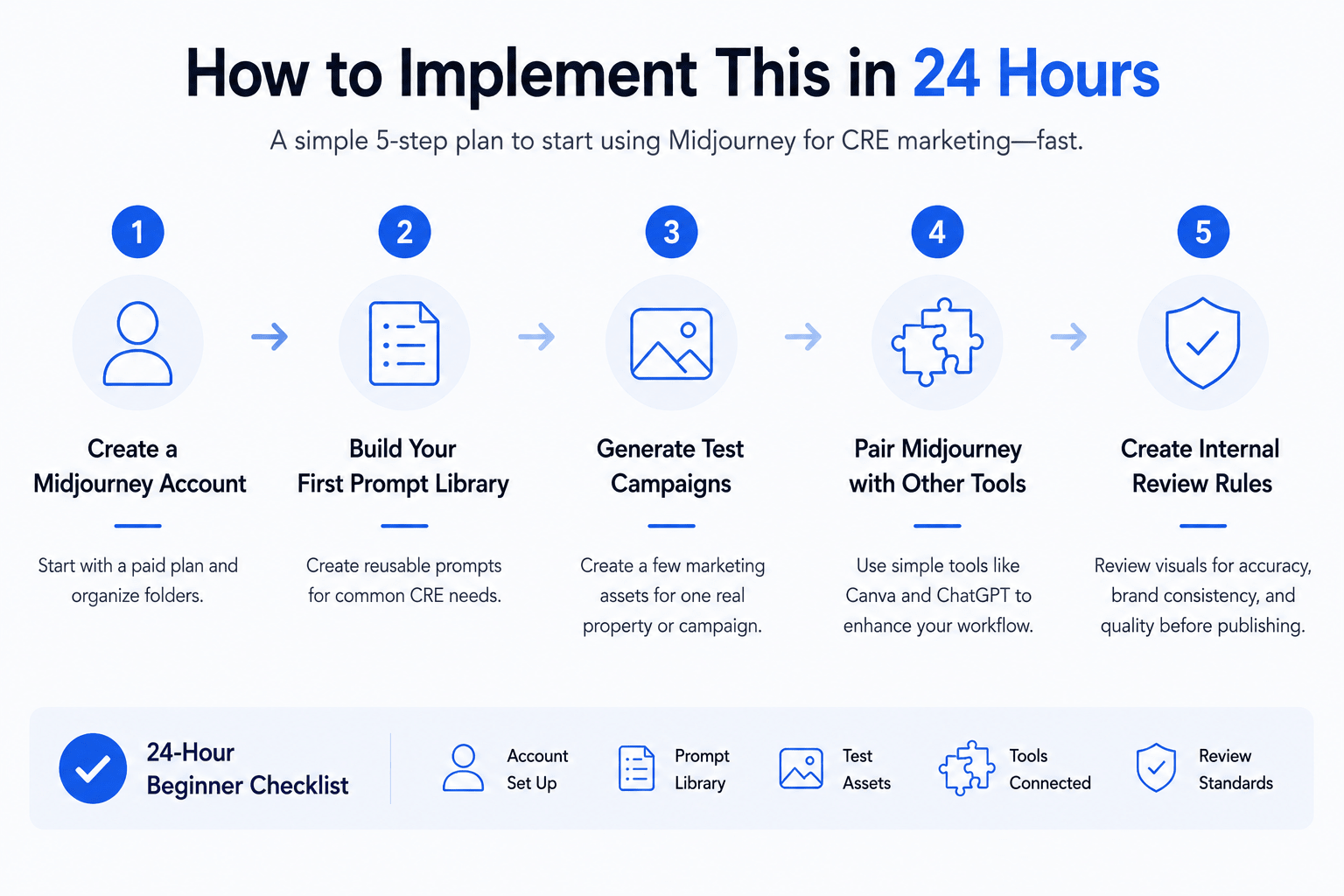
How to Implement This in 24 Hours
Many CRE professionals delay AI adoption because they think the setup will be difficult. In reality, most teams can build a basic workflow in one day.
The goal is not perfection. The goal is to create a simple system that works.
Step 1: Create a Midjourney Account
Start with a paid Midjourney plan. Most CRE professionals do not need advanced plans immediately.
Focus on learning the workflow first.
Create folders for:
-
Multifamily
-
Office
-
Retail
-
Industrial
-
Marketing campaigns
-
Investor presentations
Good organization saves time later.
Step 2: Build Your First Prompt Library
Do not start from scratch every time.
Create reusable prompts for common CRE needs.
For example:
-
Office lobby visuals
-
Retail streetscapes
-
Apartment amenities
-
Industrial drone views
-
Mixed-use environments
Save strong prompts inside Google Docs, Notion, or Airtable.
This quickly becomes a valuable internal resource.
Step 3: Generate Test Campaigns
Choose one real property or marketing campaign.
Then create:
-
5 social media visuals
-
2 website banners
-
1 investor presentation image
-
1 OM cover concept
This helps teams learn faster through real work.
Step 4: Pair Midjourney with Other Tools
Most CRE teams combine Midjourney with simple design platforms.
Popular combinations include:
| Tool | Main Purpose |
|---|---|
| Midjourney | Image generation |
| Canva | Branding and layouts |
| ChatGPT | Copywriting and prompts |
| Gamma | Presentation design |
| Google Drive | Asset storage |
Table Caption: Common AI workflow stack for CRE marketing teams
These tools work well together because they simplify production.
Step 5: Create Internal Review Rules
AI-generated visuals still need human review.
Before publishing content, check:
-
Branding consistency
-
Realism
-
Property accuracy
-
Fair housing concerns
-
Design quality
-
Image clarity
This step is important. AI speeds up production, but human oversight protects quality.
24-Hour Beginner Checklist
By the end of the first day, most teams should have:
-
A working Midjourney account
-
Saved prompt templates
-
Organized campaign folders
-
Sample marketing visuals
-
A repeatable workflow
-
Internal review standards
That is enough to start building real momentum.
The biggest mistake is overthinking the process. Many successful CRE teams started with simple experiments and improved over time.
Tools That Actually Work vs AI Hype
The AI market changes every month. New tools appear constantly. Many promise to “transform” commercial real estate overnight. Most do not deliver meaningful results.
That is why CRE teams should focus on practical workflows instead of chasing trends.
Midjourney remains one of the strongest tools for visual generation. However, it works best when paired with other platforms. Most successful teams build a small stack of tools that solve specific problems.
The goal is simple:
-
Create content faster
-
Improve visual quality
-
Reduce repetitive work
-
Keep branding consistent
The best workflow usually combines image generation, design editing, copywriting, and presentation tools.
| Tool | Best Use Case | Ease of Use | Pricing Level | Best For |
|---|---|---|---|---|
| Midjourney | Marketing visuals | Moderate | Medium | CRE campaigns |
| Canva AI | Quick branding edits | Easy | Low | Social media |
| ChatGPT | Copywriting and prompts | Easy | Low | Content creation |
| Gamma | Presentation design | Easy | Medium | Investor decks |
| Adobe Firefly | Brand-safe image edits | Moderate | Medium | Design teams |
| Runway | AI video creation | Moderate | Medium | Video marketing |
| Stable Diffusion | Custom image workflows | Advanced | Low | Technical users |
Table Caption: Popular AI tools used in commercial real estate marketing workflows
Midjourney performs especially well for:
-
Lifestyle visuals
-
Architectural concepts
-
Campaign imagery
-
Branding directions
-
Social media graphics
Canva works better for quick editing and layout design. Many brokers use it to turn Midjourney visuals into finished marketing assets.
ChatGPT supports the process by helping teams:
-
Write prompts
-
Create captions
-
Build campaign copy
-
Generate email content
-
Organize workflows
Gamma helps with investor presentations and pitch decks. It reduces formatting time and improves slide consistency.
Tools That Often Get Overhyped
Many AI tools look impressive in demos but fail during real implementation.
Common problems include:
-
Poor image quality
-
Slow workflows
-
Weak commercial usage rights
-
Limited customization
-
Generic outputs
-
Confusing interfaces
CRE professionals should avoid adding too many tools too quickly. Complexity usually hurts productivity instead of improving it.
A smaller workflow often performs better.
For many firms, this setup is enough:
-
Midjourney for visuals
-
Canva for editing
-
ChatGPT for writing
-
Google Drive for organization
That combination already saves significant time.
Which Tools Work Best for Different CRE Teams
Different CRE businesses need different workflows.
Solo Brokers
Solo brokers usually need:
-
Fast content creation
-
Simple workflows
-
Affordable tools
Best stack:
-
Midjourney
-
Canva
-
ChatGPT
Small Investment Firms
Investment firms often focus on:
-
Investor presentations
-
Market updates
-
Branding consistency
Best stack:
-
Midjourney
-
Gamma
-
Canva
-
ChatGPT
Large Marketing Teams
Larger firms usually need:
-
Asset management
-
Team collaboration
-
Brand control
-
Scalable production
Best stack:
-
Midjourney
-
Adobe tools
-
Runway
-
Canva
-
Internal DAM systems
The best workflow depends on team size, goals, and content volume. However, simplicity almost always improves adoption.
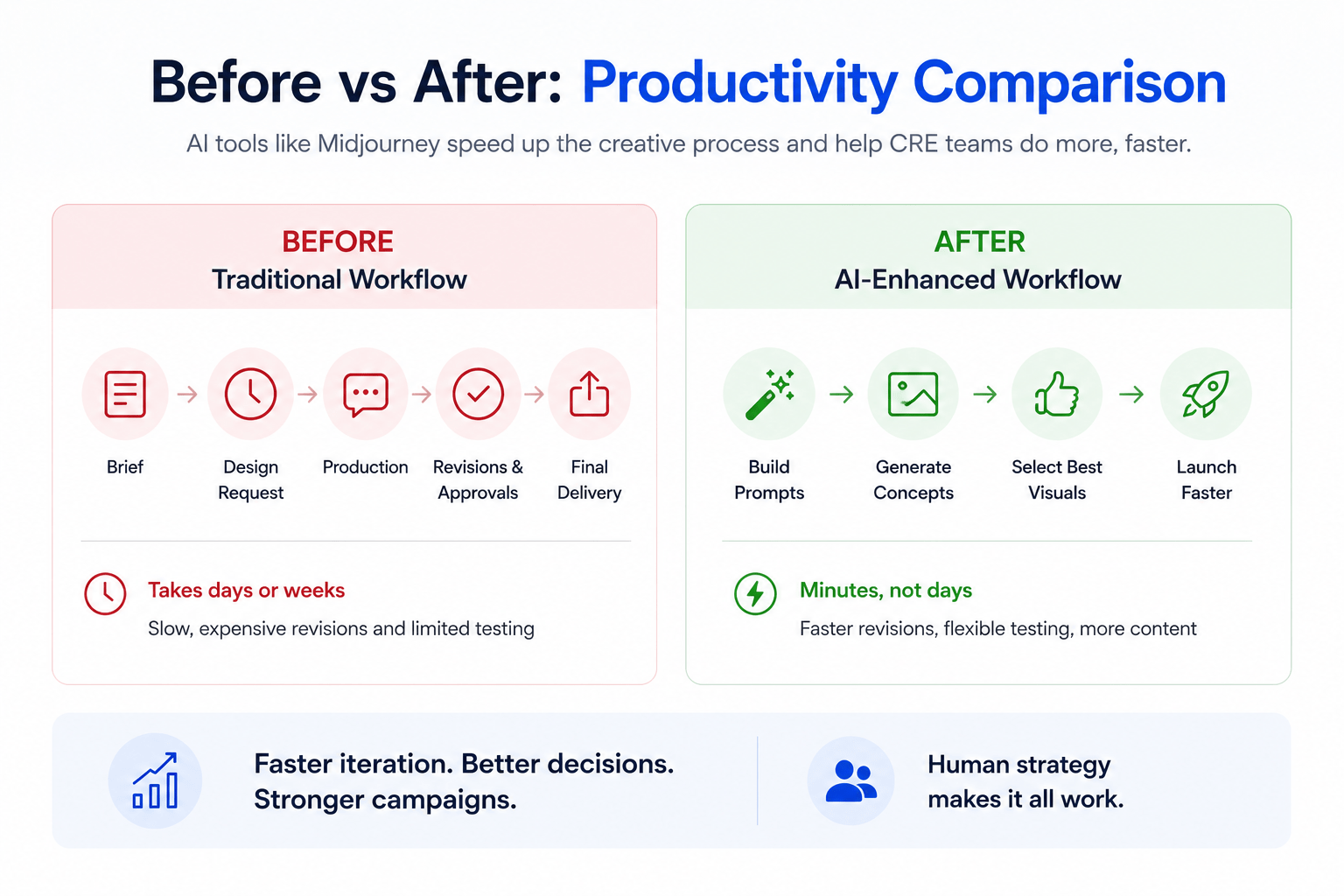
Before vs After Productivity Comparison
One of the biggest benefits of AI visual tools is speed. Many CRE teams spend too much time waiting on design revisions, campaign updates, and marketing production.
AI changes that workflow.
Traditional marketing production often involves several stages:
-
Creative briefing
-
Design requests
-
Rendering production
-
Revisions
-
Internal approvals
-
Final delivery
That process can take days or weeks.
Midjourney shortens the early creative stage significantly. Teams can test visual ideas immediately instead of waiting for formal production.
Traditional CRE Marketing Workflow
Traditional workflows still work well for polished final deliverables. However, they often move slowly.
Common challenges include:
-
Long turnaround times
-
Expensive revisions
-
Limited testing
-
Creative bottlenecks
-
Delayed campaigns
This becomes a major issue when teams need large amounts of content quickly.
For example, a broker launching a leasing campaign may need:
-
Social media graphics
-
Website banners
-
Presentation visuals
-
Email marketing assets
-
Property branding concepts
Producing all of that traditionally can become expensive fast.
AI-Enhanced CRE Marketing Workflow
AI tools speed up the creative phase.
Instead of waiting several days for first drafts, teams can review concepts within minutes. That improves decision-making and reduces delays.
A faster workflow often looks like this:
-
Build prompts
-
Generate concepts
-
Select strong visuals
-
Edit in Canva or Photoshop
-
Launch campaigns faster
This allows marketing teams to create more content without expanding headcount.
| Task | Traditional Workflow | AI-Enhanced Workflow |
|---|---|---|
| First concept draft | Several days | Minutes |
| Design revisions | Slow | Fast |
| Campaign testing | Limited | Flexible |
| Content volume | Lower | Higher |
| Creative experimentation | Expensive | Easier |
Table Caption: Estimated workflow improvements using AI marketing tools in CRE
Why Faster Iteration Matters
Speed alone is not the main advantage. Better testing is often more valuable.
Many CRE teams launch campaigns with limited experimentation because production takes too long. AI tools allow marketers to compare several creative directions before making decisions.
For example, a broker can test:
-
Different branding styles
-
Various lighting moods
-
Multiple headline concepts
-
Several campaign visuals
This improves campaign quality over time.
Human Strategy Still Matters
AI improves execution speed. It does not replace marketing strategy.
Strong CRE marketing still depends on:
-
Positioning
-
Market knowledge
-
Branding clarity
-
Audience targeting
-
Property storytelling
The best firms combine AI efficiency with human expertise.
That combination creates the strongest long-term advantage.
Real-World CRE Use Cases
Many CRE professionals understand AI in theory. The bigger question is how firms actually use it in daily operations.
The strongest use cases usually involve marketing speed, investor communication, and branding.
Multifamily Repositioning Campaigns
Value-add multifamily projects often need strong storytelling. Investors and tenants need help visualizing the future version of the property.
Midjourney helps teams create:
-
Renovated lobby concepts
-
Amenity upgrades
-
Outdoor lifestyle visuals
-
Modern leasing imagery
These visuals improve communication before renovations begin.
A broker can also use the images during leasing campaigns to support the repositioning story.
Retail Redevelopment Marketing
Retail properties often struggle with perception problems. Older centers may look outdated online even when the location remains strong.
AI visuals help teams reframe the property story.
For example, firms can create:
-
Modern storefront concepts
-
Outdoor dining scenes
-
Walkable lifestyle visuals
-
Updated branding graphics
This helps leasing campaigns feel more modern and active.
Industrial Branding Campaigns
Industrial properties rarely receive strong marketing design. Many campaigns rely on basic drone photography and generic layouts.
Midjourney helps industrial teams create:
-
Modern logistics visuals
-
Advanced warehouse branding
-
Distribution center concepts
-
Professional investor graphics
This improves presentation quality without large production costs.
Broker Personal Branding
Many brokers now use AI visuals for content marketing.
This includes:
-
LinkedIn graphics
-
Market update visuals
-
Newsletter banners
-
Podcast artwork
-
Event promotions
Consistent visual branding helps brokers stand out online.
Internal Team Collaboration
Some firms also use Midjourney internally.
Common internal uses include:
-
Brainstorming sessions
-
Branding discussions
-
Concept testing
-
Campaign planning
-
Client presentations
The technology helps teams communicate ideas faster.
That speed becomes valuable when multiple stakeholders are involved in a project.
What Most CRE Professionals Get Wrong About AI Visuals
Many CRE professionals focus too much on the tool itself. They assume AI automatically creates great marketing. That rarely happens.
The strongest results come from good workflows, strong prompts, and a clear marketing strategy.
One common mistake is treating AI visuals like final architectural renderings. Midjourney creates conceptual imagery, not technical drawings. The visuals may look realistic, but they can still contain errors.
For example, AI images may include:
-
Impossible building layouts
-
Unrealistic window placements
-
Incorrect structural details
-
Inconsistent floor plans
-
Distorted geometry
That is why human review remains important.
Another major mistake is using weak prompts. Generic prompts create generic images. Many beginners type short descriptions and expect polished outputs.
For example:
“Luxury apartment building”
That prompt lacks detail.
A better version would include:
-
Architecture style
-
Lighting conditions
-
Camera angle
-
Mood
-
Materials
-
Environment details
Specific prompts usually create stronger results.
Ignoring Brand Consistency
Some firms generate random visuals without maintaining a clear brand style. This creates inconsistent marketing.
A professional CRE brand should maintain:
-
Similar lighting styles
-
Consistent color tones
-
Matching architecture aesthetics
-
Similar editing styles
-
Clear campaign identity
Consistency helps marketing feel more polished.
Overusing AI Without Human Oversight
AI should support creative teams, not replace judgment.
Some firms publish visuals too quickly without reviewing accuracy. That creates risk.
Human review helps prevent:
-
Unrealistic imagery
-
Misleading visuals
-
Branding mistakes
-
Compliance issues
-
Poor design quality
The best approach combines AI speed with human decision-making.
Focusing on Quantity Instead of Quality
AI allows teams to generate hundreds of images quickly. That does not mean every image should be used.
Many successful firms follow a simple rule:
Generate many. Publish few.
Strong curation matters more than volume.
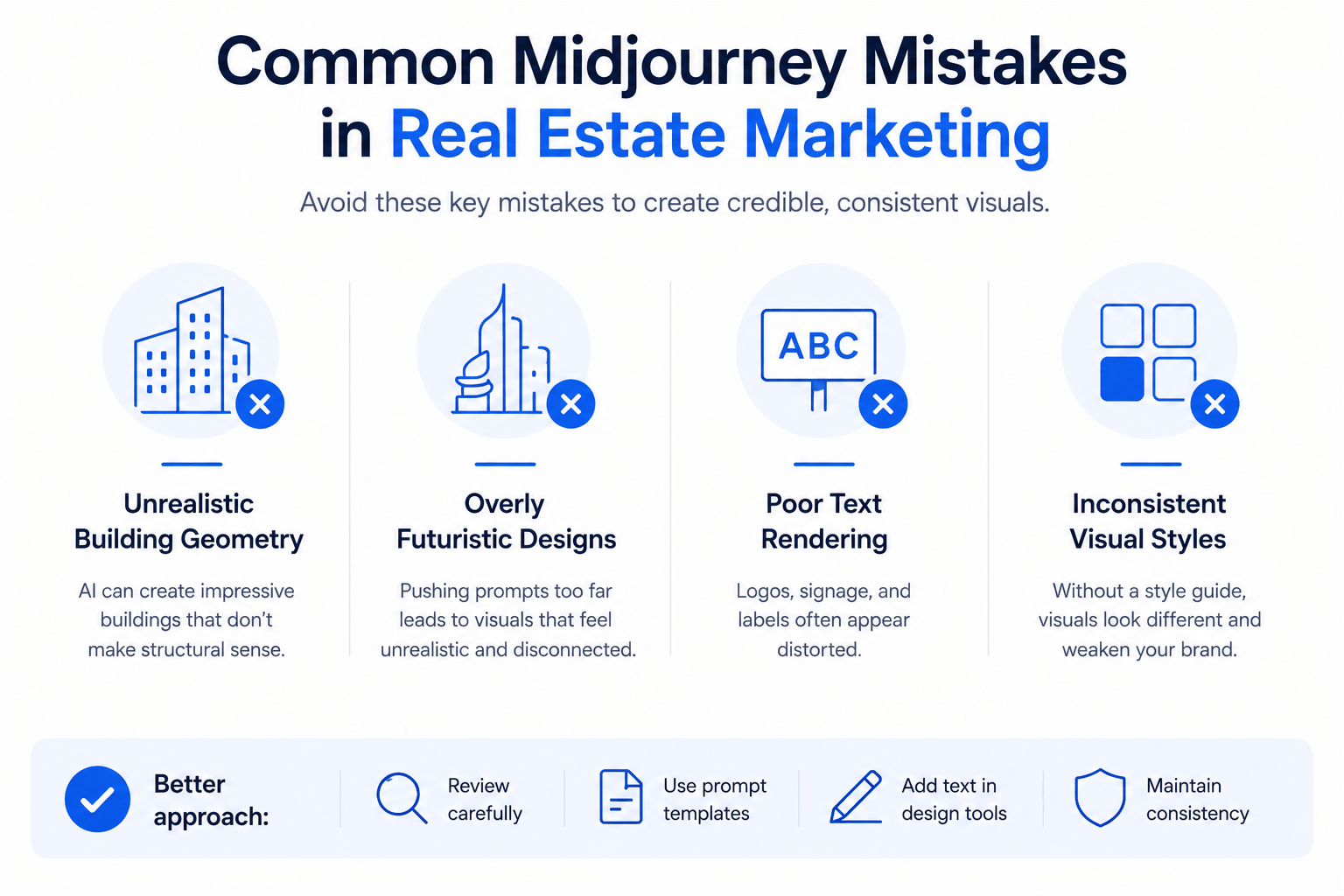
Common Midjourney Mistakes in Real Estate Marketing
Most beginners make the same mistakes during the first few weeks. The good news is that these issues are easy to fix once teams understand the workflow better.
Unrealistic Building Geometry
Midjourney sometimes creates buildings that look visually impressive but make no structural sense.
Common problems include:
-
Floating design elements
-
Uneven window spacing
-
Impossible rooflines
-
Distorted interiors
These errors reduce credibility fast.
The solution is simple. Always review visuals carefully before publishing.
Overly Futuristic Designs
Many AI-generated images feel unrealistic because the prompts push the visuals too far.
Some marketers accidentally create:
-
Sci-fi architecture
-
Unrealistic lighting
-
Impossible interiors
-
Overdesigned spaces
This may look artistic, but it often feels disconnected from real commercial properties.
Most CRE campaigns perform better with realistic imagery.
Poor Text Rendering
Midjourney still struggles with text inside images. Logos, signage, and labels often appear distorted.
Avoid relying on AI for:
-
Property signage
-
Branding text
-
Callouts
-
Marketing copy
Instead, add text later using Canva, Photoshop, or Adobe tools.
Inconsistent Visual Styles
Many firms generate visuals without a consistent style guide.
That creates campaigns where:
-
Lighting changes constantly
-
Architecture styles clash
-
Branding feels disconnected
-
Image quality varies
A better approach is to create prompt templates that maintain consistency across projects.
Weak Prompt Structure
Prompt quality directly affects image quality.
Weak prompts usually:
-
Lack detail
-
Miss context
-
Ignore camera perspective
-
Skip environmental details
Strong prompts guide the AI clearly.
For example, instead of:
“Retail center”
Use:
“Modern outdoor retail center, evening lighting, active pedestrian environment, luxury storefronts, realistic architectural photography”
That extra detail improves the output significantly.
Legal, Ethical, and Compliance Considerations
AI-generated visuals create exciting opportunities, but they also create responsibility. CRE firms should understand the legal and ethical risks before using AI imagery publicly.
The biggest issue is misrepresentation.
Marketing visuals should support the property story without misleading investors, buyers, or tenants.
Avoid Misleading Property Marketing
Some AI visuals look highly realistic. That can create confusion if the images do not reflect the actual property condition.
For example, problems may occur when firms:
-
Show amenities that do not exist
-
Overstate renovation progress
-
Present unrealistic improvements
-
Use conceptual imagery without clarification
Transparency matters.
Many firms now label AI-generated visuals as:
-
Conceptual renderings
-
Vision imagery
-
Proposed renovations
-
Marketing concepts
Simple disclosures reduce confusion.
Fair Housing Considerations
AI-generated lifestyle imagery also creates fair housing concerns.
Marketing visuals should remain inclusive and professional. Firms should avoid imagery that unintentionally excludes protected groups.
Review all visuals carefully before publishing.
Copyright and Commercial Usage
Midjourney allows commercial usage under paid plans. However, firms should still review licensing terms regularly because AI policies continue evolving.
Marketing teams should also avoid:
-
Copying recognizable brands
-
Replicating copyrighted artwork
-
Using trademarked imagery improperly
Original prompts usually create safer outputs.
Internal Approval Processes
Many CRE firms now create internal AI usage guidelines.
These often include:
-
Review standards
-
Disclosure requirements
-
Branding policies
-
Compliance checks
-
Approval workflows
This helps maintain quality control as AI usage grows.
The firms succeeding with AI usually treat it like any other professional marketing tool. They build systems around it instead of using it randomly.
Future Trends of AI Visuals in CRE
AI visuals are improving quickly. What feels advanced today may become standard within a few years.
Commercial real estate marketing will likely change significantly as these tools mature.
AI Video Generation
Static images are only the beginning.
New AI platforms already create short property videos from prompts. These tools will likely improve leasing campaigns, investor presentations, and social media marketing.
Future workflows may include:
-
AI property walkthroughs
-
Automated promotional videos
-
Dynamic investor presentations
-
Personalized marketing clips
This could reduce video production costs significantly.
Interactive AI Marketing
Marketing may also become more personalized.
Future systems could generate visuals based on user preferences, location, or behavior.
For example:
-
Investors may see different branding than tenants
-
Office users may see tailored workspace concepts
-
Retail tenants may receive customized leasing visuals
This level of personalization could improve engagement rates.
Faster Creative Workflows
AI tools will likely become more integrated.
Instead of moving between several platforms, CRE teams may soon manage:
-
Image generation
-
Video creation
-
Presentation design
-
Branding
-
Campaign deployment
Inside one connected workflow.
This would simplify marketing production even further.
Better Realism and Accuracy
Image quality continues to improve rapidly.
Future AI systems will likely reduce common issues such as:
-
Distorted geometry
-
Unrealistic interiors
-
Weak lighting consistency
-
Poor text rendering
As realism improves, firms will need stronger review standards and disclosure policies.
AI Will Not Replace CRE Expertise
Despite rapid progress, AI still depends on human direction.
Strong marketing requires:
-
Market understanding
-
Positioning strategy
-
Investment knowledge
-
Branding decisions
-
Creative judgment
The firms gaining the most value from AI are not replacing people. They are improving team efficiency.
Expert Insights from CRE AI Adoption
The biggest lesson from early AI adoption is simple: implementation matters more than tools.
Many firms waste time testing dozens of platforms without building repeatable systems. That usually creates confusion instead of productivity.
Successful teams focus on workflows first.
They create simple processes that improve:
-
Marketing speed
-
Campaign consistency
-
Content production
-
Internal collaboration
They also avoid chasing every new trend.
Why Repeatable Systems Matter
Consistency creates long-term efficiency.
The best CRE teams usually build:
-
Prompt libraries
-
Branding templates
-
Content workflows
-
Review systems
-
Asset organization standards
This reduces repetitive work over time.
Faster Marketing Creates Competitive Advantage
Speed matters in commercial real estate.
Firms that launch campaigns faster often gain:
-
More visibility
-
Better engagement
-
Faster leasing momentum
-
Improved investor communication
AI helps reduce delays during the creative process.
Human Creativity Still Wins
AI improves production speed, but a strong strategy still comes from people.
The best campaigns still depend on:
-
Clear positioning
-
Good storytelling
-
Strong branding
-
Market expertise
AI simply helps teams execute those ideas faster.
The Real Opportunity
The biggest opportunity is not replacing creative teams.
The real opportunity is helping smaller CRE teams produce high-quality marketing without massive overhead costs.
That shift may level the playing field across the industry.
Conclusion
AI-generated visuals are becoming a practical tool in commercial real estate marketing. The technology helps teams move faster, test ideas quickly, and create stronger campaigns without long production timelines.
That does not mean AI replaces architects, designers, or marketing professionals. Human strategy still matters. Strong branding, clear positioning, and market knowledge remain essential.
The firms seeing the best results use AI as a support tool. They combine automation with human review and structured workflows. That balance improves efficiency without sacrificing quality.
For many CRE teams, the biggest advantage is speed. Brokers can launch campaigns faster. Developers can communicate project vision more clearly. Investors can create better presentations with less manual work.
The most important step is starting with a simple system.
Focus on:
-
Clear prompt libraries
-
Consistent branding
-
Human oversight
-
Repeatable workflows
-
Practical use cases
Over time, those systems create significant efficiency gains.
Most CRE professionals are still experimenting with AI tools. However, the industry is moving quickly. Firms that learn these workflows early will likely gain a long-term advantage.
If used correctly, using Midjourney for real estate marketing visuals can improve both marketing quality and operational speed across commercial real estate teams.
Explore real CRE AI workflows, tested prompts, and practical implementation systems inside the AI for CRE Collective. You can also get weekly AI updates and workflow ideas through the AI for CRE Newsletter.
Can Midjourney create real commercial real estate renderings?
Midjourney works best for conceptual marketing visuals, not technical architectural renderings. The platform creates realistic-looking images, but the outputs may still contain design inaccuracies or unrealistic layouts.
Most CRE professionals use Midjourney for:
-
Marketing campaigns
-
Investor presentations
-
Branding concepts
-
Lifestyle imagery
-
Renovation inspiration
Architects and rendering studios still handle construction-ready visuals and technical presentations.
A good workflow combines both systems. Midjourney helps teams explore ideas quickly during early planning stages. Professional rendering teams then finalize technical visuals later in the process.
This approach saves time because teams can test visual directions before paying for expensive rendering revisions.
Is Midjourney good for CRE brokers?
Yes. Many CRE brokers already use Midjourney for marketing and branding tasks. The platform helps brokers create custom visuals much faster than traditional workflows.
Common broker use cases include:
-
Leasing campaign graphics
-
Offering memorandum covers
-
Social media visuals
-
Market report banners
-
Property branding concepts
The biggest advantage is flexibility. Brokers can test multiple campaign styles quickly instead of relying only on stock photography.
However, strong prompts and human review still matter. Generic prompts usually create weak results. Brokers who build organized prompt libraries often produce much better visuals over time.
What is the best Midjourney prompt structure for real estate?
Strong prompts usually include several visual details instead of short descriptions. The goal is to guide the AI clearly.
A strong CRE prompt often includes:
-
Property type
-
Architecture style
-
Lighting conditions
-
Camera angle
-
Mood or atmosphere
-
Rendering quality
-
Environmental details
For example, this prompt works better:
“Modern Class A office lobby, natural lighting, luxury finishes, cinematic architectural photography, ultra realistic”
This works better than:
“Office lobby”
More detail usually improves image quality. Most experienced users also refine prompts through multiple iterations before selecting final visuals.
How much does Midjourney cost for commercial use?
Midjourney offers several subscription plans. Pricing changes over time, but most CRE professionals start with a lower-tier paid plan before scaling usage later.
The best plan depends on:
-
Image volume
-
Team size
-
Commercial usage needs
-
Rendering speed
-
Privacy settings
Many solo brokers and small firms can start with basic plans. Larger marketing teams may need higher usage limits.
Compared with traditional rendering workflows, Midjourney is usually much more affordable for early-stage marketing visuals and concept generation.
Can AI-generated visuals be used in offering memorandums?
Yes, but firms should use them carefully.
AI-generated visuals work well for:
-
Concept imagery
-
Lifestyle branding
-
Future renovation inspiration
-
Campaign storytelling
However, teams should avoid misleading investors or tenants. The visuals should support the property narrative without misrepresenting the actual asset.
Many firms now label AI-generated images as:
-
Conceptual renderings
-
Proposed renovations
-
Vision imagery
-
Marketing concepts
Simple disclosures improve transparency and reduce compliance risks.
Midjourney vs DALL·E for real estate marketing
Both platforms create AI-generated images, but they perform differently.
Midjourney usually creates stronger architectural and cinematic visuals. Many CRE professionals prefer it for:
-
Lifestyle imagery
-
Branding visuals
-
Property marketing
-
Architectural atmosphere
DALL·E often feels simpler for beginners. It also integrates well with ChatGPT workflows.
However, many users believe Midjourney produces more polished and visually dramatic real estate imagery.
The best choice depends on workflow preferences and visual style goals.
Can developers use Midjourney for entitlement presentations?
Developers often use Midjourney during early project planning and concept exploration. The platform helps teams communicate vision before formal rendering work begins.
Common use cases include:
-
Amenity concepts
-
Streetscape ideas
-
Branding direction
-
Lifestyle imagery
-
Public presentation visuals
However, Midjourney should not replace official architectural deliverables.
Developers still need professional teams for:
-
Technical renderings
-
Site plans
-
Construction documentation
-
Zoning presentations
The platform works best during the early brainstorming stage.
What are the biggest mistakes in using AI visuals in CRE?
Most mistakes come from poor workflows instead of the technology itself.
Common problems include:
-
Unrealistic visuals
-
Weak prompts
-
Inconsistent branding
-
Lack of human review
-
Overly futuristic imagery
Some firms also publish AI visuals too quickly without reviewing accuracy.
The best approach combines AI speed with clear quality control processes. Strong prompts, organized workflows, and careful review usually improve results significantly.
How do brokers create branded AI visuals?
Consistency is the key to strong branding.
Most brokers create reusable prompt templates that maintain:
-
Similar lighting
-
Consistent architecture style
-
Matching color tones
-
Unified editing style
Many teams also use Canva or Adobe tools after image generation. This helps add:
-
Logos
-
Brand colors
-
Marketing text
-
Layout consistency
Over time, these systems create a stronger visual identity across campaigns.
Is Midjourney replacing graphic designers?
No. Most successful CRE teams still rely on designers and marketing professionals.
Midjourney improves speed during early content creation. Designers still provide:
-
Brand strategy
-
Layout expertise
-
Creative direction
-
Quality control
-
Final production work
The strongest workflows combine AI efficiency with human creativity.
Many firms now use Midjourney to reduce repetitive design tasks while allowing creative teams to focus on higher-level work.
Join CRE professionals already using AI to improve marketing speed, content production, and workflow efficiency inside the AI for CRE Collective Membership. You can also follow the AI for CRE Newsletter for weekly updates and practical AI workflows.