How to Build an Automated Distressed Property Finder in Manus
Commercial real estate prospecting still takes too much manual work. Many brokers and acquisitions teams spend hours reviewing tax records, court filings, and ownership databases. The process is slow. It is also hard to scale. By the time a lead list is ready, some data is already outdated. In competitive markets, delayed information can lead to missed deals. This is where automated property prospecting changes the process. Instead of building lists manually every week, CRE teams can use AI workflows to find and organize opportunities automatically.
In Los Angeles and other active CRE markets, firms are already using AI tools to identify distressed retail, office, industrial, and multifamily properties faster. This guide explains how automated prospecting works, which distress signals matter most, and how CRE teams can build scalable sourcing systems.
What Is Automated Property Prospecting?
Automated property prospecting is the process of using AI workflows, scheduled research systems, and public data sources to identify commercial real estate opportunities without relying on manual sourcing.
If you want to see how AI prospecting workflows work in practice, this live demo walks through how CRE brokers are automating lead sourcing and market research.
Instead of researching one property at a time, automated systems can scan thousands of records simultaneously.
These workflows typically search for:
-
Tax delinquency
-
Probate filings
-
Vacancies
-
Loan maturities
-
Code violations
-
Ownership changes
-
Bankruptcy filings
-
Distressed retail signals
The information is then organized into a structured lead list.
Most systems also rank properties based on the number of distress indicators identified.
That ranking helps acquisition teams focus on the strongest opportunities first.
Why CRE Teams Are Moving Toward AI Prospecting
Commercial real estate teams are under pressure to source opportunities faster while reducing operational inefficiencies.
Traditional prospecting methods are difficult to scale because they depend heavily on manual labor.
AI-driven prospecting systems improve speed, consistency, and market coverage.
Main Benefits of Automated Prospecting
Faster Lead Generation
AI systems can scan multiple sources in parallel and generate updated lead lists automatically.
Better Market Coverage
Instead of researching one neighborhood or county manually, AI workflows can cover entire metropolitan areas.
Consistent Prospecting
Scheduled systems continue running every week without requiring manual input.
Lower Research Costs
Automation reduces the hours acquisition teams spend on repetitive sourcing tasks.
Improved Lead Prioritization
Properties can be scored based on overlapping distress signals.
The more signals identified, the stronger the acquisition opportunity may become.
Traditional Prospecting vs Automated Prospecting
| Category | Traditional Prospecting | Automated Prospecting |
|---|---|---|
| Research speed | Slow | Fast |
| Data collection | Manual | AI-driven |
| Workflow consistency | Inconsistent | Scheduled |
| Market coverage | Limited | Scalable |
| Lead scoring | Manual review | Automated ranking |
| Time investment | High | Lower |
| Scalability | Difficult | Easier |
Automated workflows do not replace acquisition professionals.
They reduce repetitive research so teams can spend more time on outreach, underwriting, and negotiations.
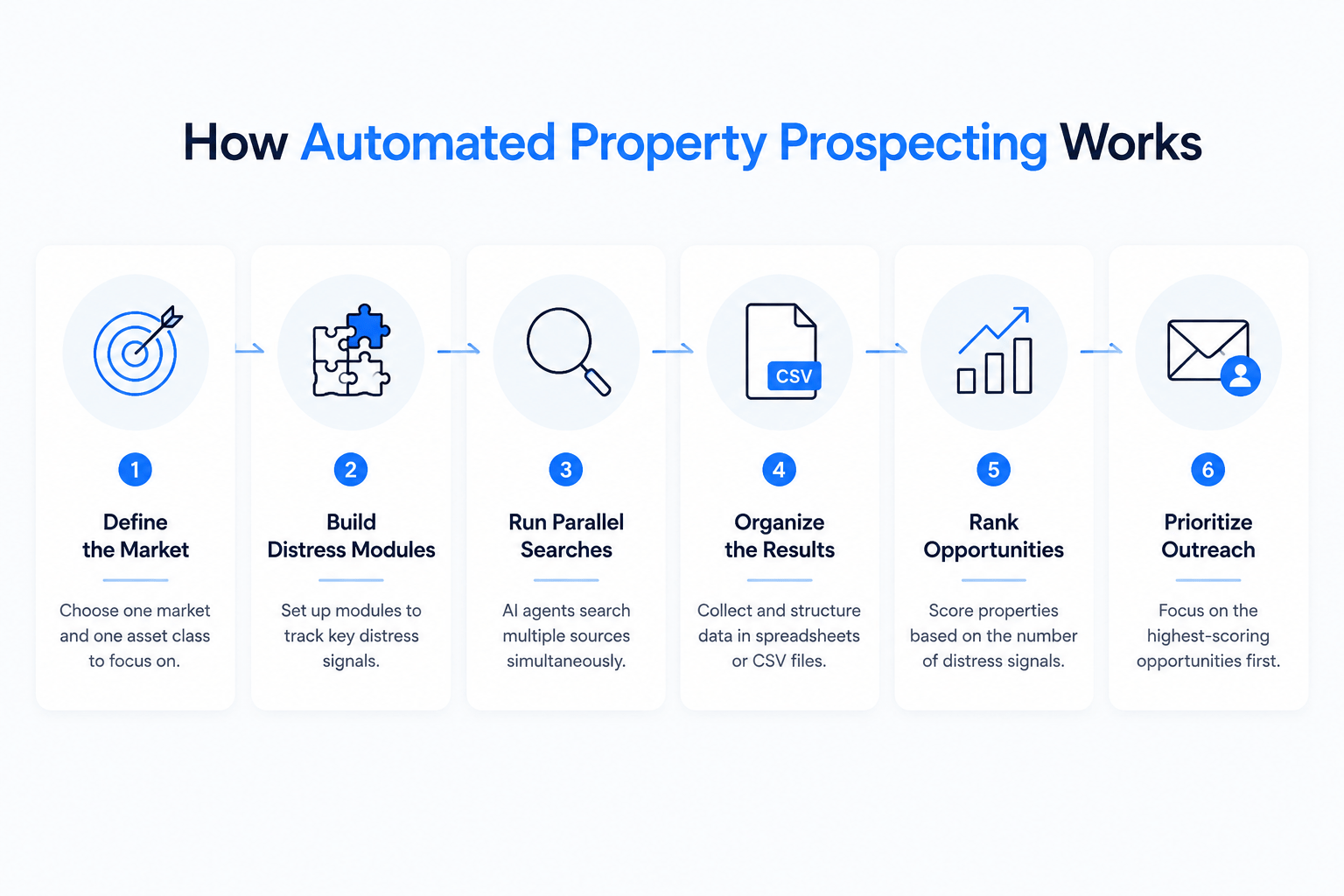
How Automated Property Prospecting Works
Most AI-driven prospecting systems follow a structured workflow.
Step 1: Define the Market
Start with one market and one asset class.
Examples include:
-
Retail centers in Los Angeles
-
Multifamily in Atlanta
-
Industrial in Dallas
-
Office properties in Chicago
Narrow targeting usually produces cleaner results.
Step 2: Build Distress Modules
Each module searches for a specific distress signal.
Common modules include:
-
Tax delinquency
-
Vacancy analysis
-
Probate filings
-
Loan maturities
-
Ownership research
-
Code enforcement issues
Step 3: Run Parallel Searches
AI agents search multiple sources simultaneously.
This significantly reduces research time.
Step 4: Organize the Results
Properties are collected into spreadsheets or CSV files.
Step 5: Rank Opportunities
Properties are scored based on the number of distress signals identified.
Step 6: Prioritize Outreach
Acquisition teams review the highest-scoring opportunities first.
The Most Valuable Distress Signals
Distress signals are the foundation of automated property prospecting. The goal is not simply to identify properties. The goal is to identify owners who may be motivated to sell.
For a deeper breakdown of sourcing distressed assets with automation workflows, check out our guide on AI distressed property sourcing and how CRE teams are identifying off-market opportunities faster.
Tax Delinquencies
Tax delinquency is one of the strongest indicators of financial stress.
Properties with multiple years of unpaid taxes often signal operational or ownership challenges.
Probate Filings
Inherited commercial properties frequently become acquisition opportunities.
Estate transitions can create situations where heirs prefer liquidation over long-term property management.
Vacancies and Dark Retail
Vacant spaces and anchor closures often indicate declining property performance.
Retail centers with dark anchors are particularly important for distress prospecting.
Loan Maturities
Upcoming loan maturities can create refinancing pressure.
This is especially relevant in the office and retail sectors.
Absentee Ownership
Out-of-state owners are often less operationally engaged.
These properties may present stronger acquisition opportunities.
Code Violations
Open code violations can indicate deferred maintenance or ownership neglect.
Building a Weekly AI Prospecting Workflow
One of the most effective setups uses scheduled AI tasks that run every week.
Weekly prospecting keeps lead lists current without creating excessive duplicate results.
Recommended Workflow Structure
| Workflow Component | Recommended Setup |
|---|---|
| Schedule frequency | Weekly |
| Ideal day | Monday |
| Output format | CSV and summary |
| Research method | Parallel AI searches |
| Asset focus | One class initially |
| Geographic scope | Single market first |
| Lead ranking | Distress-score system |
Weekly workflows provide enough fresh information for consistent acquisition outreach.
Daily workflows often produce unnecessary duplication.
Monthly workflows usually miss too many market changes.
How AI Improves CRE Acquisition Pipelines
AI prospecting systems create operational leverage. Instead of spending hours building lists manually, acquisitions teams receive organized opportunities automatically.
Similarly, firms using AI agents for deal sourcing are reducing manual research time while improving acquisition pipeline coverage across multiple markets.
Tasks AI Handles Well
AI performs repetitive research tasks efficiently.
This includes:
-
Public record searches
-
Ownership analysis
-
Data organization
-
CSV generation
-
Pattern recognition
-
Distress signal matching
Tasks Humans Still Handle Best
Human expertise remains critical in commercial real estate.
Acquisition teams still manage:
-
Relationship building
-
Negotiations
-
Market judgment
-
Underwriting decisions
-
Seller communication
The strongest workflows combine automation with human expertise.
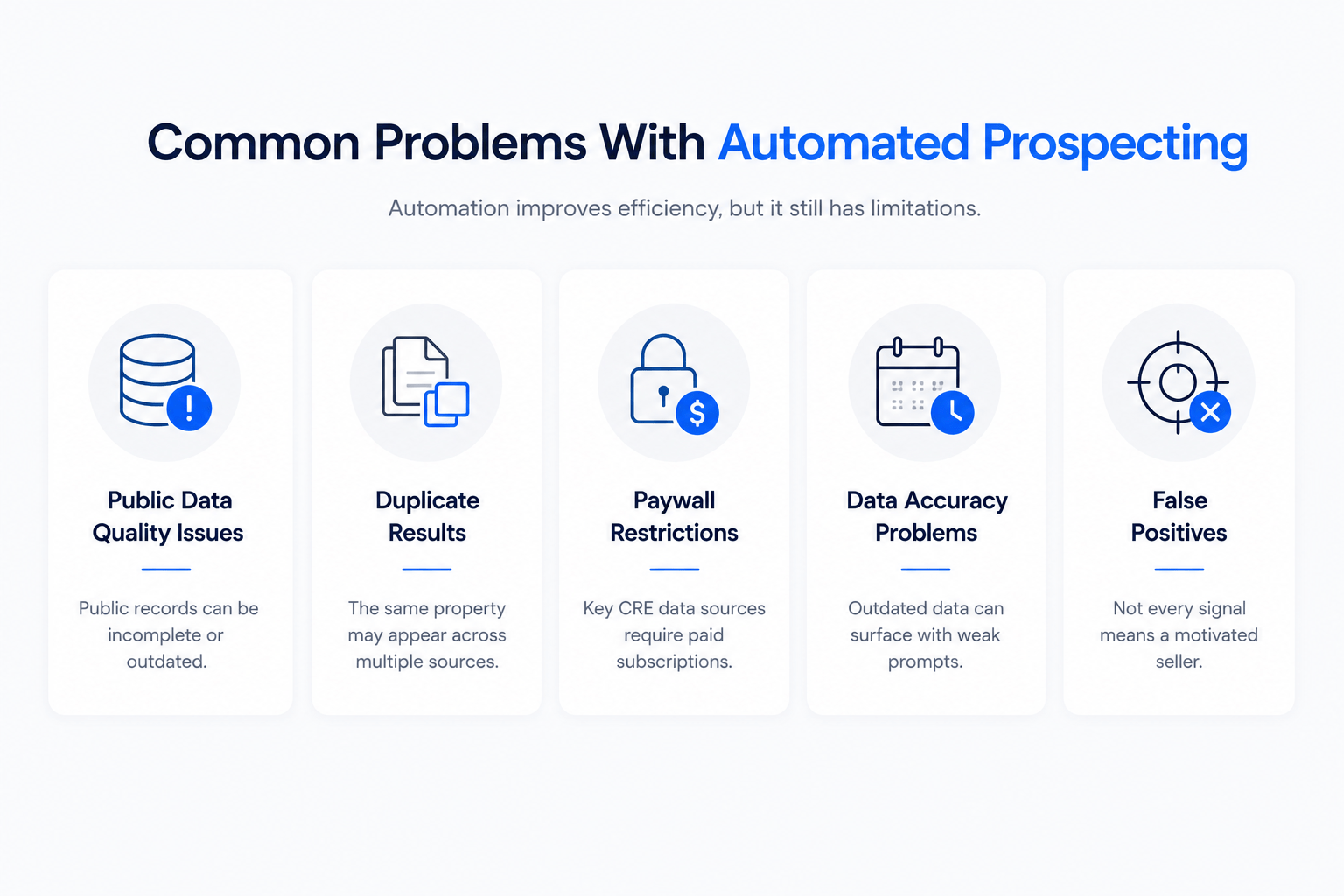
Common Problems With Automated Prospecting
Automation improves efficiency, but it still has limitations.
Understanding those limitations is important before building large-scale workflows.
Public Data Quality Issues
Some counties provide excellent public access.
Others provide incomplete or outdated records.
Duplicate Results
AI systems may pull the same property from multiple databases.
Paywall Restrictions
Some important CRE data sources require subscriptions.
Examples include:
-
CoStar
-
Trepp
-
PropertyRadar
-
DataTree
Date Accuracy Problems
Weak prompts can surface outdated information.
Strong date filtering improves accuracy.
False Positives
Not every distressed signal represents a motivated seller.
Human review remains necessary.
How to Improve Prospecting Accuracy
The best AI workflows improve over time through iteration.
Start Small
Focus on:
-
One market
-
One asset class
-
One weekly workflow
Expansion becomes easier after validation.
Tighten Date Filters
Specify time ranges clearly.
Examples include:
-
Last 90 days
-
Current year
-
Last 6 months
Validate Outputs
Manually review a sample of properties before starting outreach campaigns.
Save Prompt Versions
Small prompt improvements can dramatically improve results.
Version control helps maintain consistency.
Add Ownership Enrichment
After identifying leads, enrich them with:
-
Ownership structures
-
LinkedIn profiles
-
Secretary of State records
-
Google research
That second layer improves acquisition targeting.
Different Asset Classes Need Different Distress Signals
Each commercial real estate asset class behaves differently.
The signals should match the asset type.
Multifamily Distress Signals
-
Habitability complaints
-
Tenant lawsuits
-
Deferred maintenance
-
Section 8 issues
-
Rent control violations
Industrial Distress Signals
-
Environmental violations
-
Tenant bankruptcies
-
SBA loan defaults
-
Expiring owner-user occupancy
Office Distress Signals
Office assets currently face major refinancing pressure.
Important indicators include:
-
Rising vacancies
-
Loan maturities
-
Tenant downsizing
-
Large sublease availability
-
Weak occupancy trends
Retail Distress Signals
Retail prospecting often focuses on:
-
Dark anchors
-
Store closures
-
Vacancy spikes
-
Tax delinquency
-
Anchor tenant bankruptcies
Manual Prospecting vs AI-Driven Prospecting
| Area | Manual Workflow | AI-Driven Workflow |
|---|---|---|
| Research time | Several hours weekly | Mostly automated |
| Lead organization | Manual spreadsheets | Structured outputs |
| Market monitoring | Limited | Continuous |
| Opportunity ranking | Subjective | Data-driven |
| Multi-market scalability | Difficult | Easier |
| Operational efficiency | Lower | Higher |
The biggest advantage is consistency.
AI systems continue running whether acquisition teams are busy or not.
The Future of Automated Property Prospecting
Commercial real estate workflows are becoming increasingly data-driven.
Over the next several years, AI prospecting systems will likely become more advanced.
Future capabilities may include:
-
Real-time distress alerts
-
Predictive ownership scoring
-
Automated underwriting summaries
-
CRM integrations
-
AI-driven outreach preparation
Firms that adopt automation early may gain significant sourcing advantages.
The gap between manual prospecting and AI-driven acquisition systems will likely continue growing.
Build Better CRE Acquisition Systems
Automated property prospecting is quickly becoming an operational advantage for acquisition teams that want faster sourcing, better lead quality, and more scalable workflows. Firms using AI-driven research systems can spend less time building spreadsheets and more time evaluating deals, contacting owners, and moving opportunities through the pipeline.
The AI for CRE Collective includes 600+ CRE professionals actively sharing AI workflows, sourcing systems, underwriting automations, and acquisition strategies built specifically for commercial real estate. If you want practical CRE AI workflows and real implementation examples, subscribe to the newsletter and stay current with how the industry is evolving.
Conclusion
Commercial real estate prospecting is changing rapidly. Manual sourcing workflows are difficult to scale, time-consuming, and often inconsistent. Automated property prospecting offers a more efficient alternative by combining AI research, recurring workflows, and structured distress analysis.
The strongest acquisition teams will likely combine automation with human expertise. AI handles repetitive sourcing tasks. CRE professionals focus on relationships, underwriting, and execution.
For firms willing to invest in these systems now, automated prospecting can become a major competitive advantage over the next several years.
FAQs Regarding Automated Property Prospecting
What is automated property prospecting in commercial real estate?
Automated property prospecting is the use of AI tools, scheduled workflows, and public data systems to identify commercial real estate opportunities without relying fully on manual research. Instead of spending hours reviewing tax records, ownership databases, and court filings, CRE teams can automate much of the sourcing process.
These systems usually help firms:
-
Scan multiple distress signals at once
-
Organize leads into spreadsheets or CRMs
-
Rank properties based on distress indicators
-
Monitor markets on a recurring schedule
Most automated workflows focus on identifying motivated sellers or distressed assets before competitors find them. The biggest advantage is consistency. Instead of prospecting only when teams have extra time, AI systems can run every week and generate updated lead lists automatically.
How does AI help commercial real estate prospecting?
AI helps commercial real estate prospecting by reducing the amount of repetitive research that acquisition teams perform every week. Traditional sourcing methods often require manually checking several databases and websites. AI systems simplify that process by handling searches in parallel.
AI workflows can:
-
Search public property records
-
Detect distress signals
-
Identify vacancies and ownership changes
-
Organize large datasets quickly
-
Rank opportunities based on multiple signals
This allows CRE professionals to spend more time on underwriting, outreach, and negotiations instead of repetitive research tasks. AI also improves market coverage because systems can scan thousands of records much faster than a manual acquisitions process.
What are the best distress signals for finding off-market CRE deals?
The best distress signals are usually indicators that suggest financial pressure, ownership transition, or operational problems. Strong prospecting systems combine multiple signals instead of relying on only one data point.
Common distress indicators include:
-
Tax delinquency
-
Probate filings
-
Vacant retail space
-
Loan maturities
-
Code violations
-
Bankruptcy filings
-
Absentee ownership
Properties showing several distress signals at the same time are often stronger acquisition opportunities. For example, a retail center with tax delinquency, dark anchor space, and an upcoming loan maturity may indicate a highly motivated ownership situation. Multi-signal scoring systems usually create better lead quality than simple single-source prospecting.
Can automated property prospecting replace acquisition analysts?
Automated prospecting can reduce manual sourcing work, but it does not replace acquisition analysts completely. AI tools are strongest when handling repetitive research tasks and organizing data. Human expertise is still essential during the decision-making process.
Acquisition teams still handle:
-
Relationship building
-
Negotiations
-
Market analysis
-
Underwriting reviews
-
Seller conversations
AI systems simply help teams move faster. Instead of spending hours building spreadsheets manually, analysts can focus on evaluating opportunities and prioritizing outreach. Most successful CRE firms use automation to improve operational efficiency rather than eliminate human involvement entirely.
How often should automated CRE prospecting systems run?
Most commercial real estate prospecting systems work best on a weekly schedule. Weekly workflows provide updated information without creating excessive duplicate results.
A weekly cadence helps teams:
-
Monitor changing market conditions
-
Keep lead lists fresh
-
Support regular outreach cycles
-
Reduce manual research workloads
Daily prospecting runs are usually unnecessary unless firms operate in highly active markets. Monthly workflows can miss important ownership or distress changes. Many CRE professionals prefer Monday morning schedules because they provide fresh opportunities at the start of the workweek.
What asset classes work best for AI-driven prospecting?
AI-driven prospecting works across nearly every commercial real estate asset class. However, the distress signals and sourcing strategies vary depending on the property type.
Common asset classes include:
-
Retail centers
-
Multifamily properties
-
Industrial buildings
-
Office assets
-
Mixed-use developments
Retail prospecting often focuses on vacancies and anchor closures. Multifamily sourcing may prioritize tenant complaints or deferred maintenance. Office prospecting frequently centers on loan maturities and rising vacancies. The most effective workflows customize distress modules based on the specific asset class and target market.
Why are tax delinquency records important for CRE prospecting?
Tax delinquency records are one of the most valuable data sources for distressed property prospecting. Owners with unpaid property taxes may be experiencing financial stress, operational problems, or declining property performance.
Tax delinquency research helps investors:
-
Identify motivated sellers
-
Spot long-term ownership issues
-
Prioritize distressed opportunities
-
Find overlooked off-market deals
Properties with multiple years of unpaid taxes are often stronger acquisition targets than properties with temporary payment delays. When tax delinquency appears alongside vacancies or loan issues, the probability of seller motivation usually increases significantly.
What are the biggest limitations of automated property prospecting?
Automated prospecting systems improve efficiency, but they still have limitations. Public data quality varies by county and market, which can impact output accuracy.
Common limitations include:
-
Outdated public records
-
Duplicate property entries
-
Paywalled CRE databases
-
Weak ownership data
-
False-positive distress signals
Some important information is locked behind subscription platforms like CoStar or Trepp. AI systems also require prompt refinement and periodic validation. Most acquisition teams still review high-priority properties manually before launching outreach campaigns. Automation works best when combined with human oversight.
How can CRE firms improve AI prospecting accuracy?
The best way to improve AI prospecting accuracy is through prompt refinement and workflow optimization. Most systems improve over time as teams adjust filters, distress modules, and market targeting.
CRE firms can improve results by:
-
Tightening date filters
-
Starting with one market first
-
Using multiple distress signals
-
Validating lead samples manually
-
Saving prompt versions for iteration
Adding ownership enrichment also improves accuracy. After identifying properties, firms can research ownership entities, LinkedIn profiles, and Secretary of State records. This second layer of research helps acquisition teams prioritize outreach more effectively.
What is the future of AI in commercial real estate prospecting?
AI will likely become a standard part of commercial real estate acquisitions over the next several years. Prospecting systems are already helping firms automate sourcing, monitor distress signals, and organize lead pipelines more efficiently.
Future CRE AI workflows may include:
-
Real-time distress alerts
-
Automated underwriting summaries
-
CRM integrations
-
Predictive ownership scoring
-
AI-generated outreach preparation
The biggest change will probably be speed. Firms using AI workflows can review opportunities much faster than teams relying only on manual research. As automation tools improve, CRE acquisition teams may shift more of their operational workflows toward AI-assisted systems.