

How to Run AI Plan Mode for Better CRE Analysis
If you’ve ever watched AI produce something wildly off-base because it made wrong assumptions about your deal, you already know why Plan Mode in Claude for CRE matters. I test AI tools on commercial real estate workflows every week with 540+ members in the AI for CRE Collective, and the single biggest factor separating good AI output from bad? Whether you planned the task or just let AI run.
Table of Contents
TogglePlan Mode in Claude for CRE: What Most People Skip
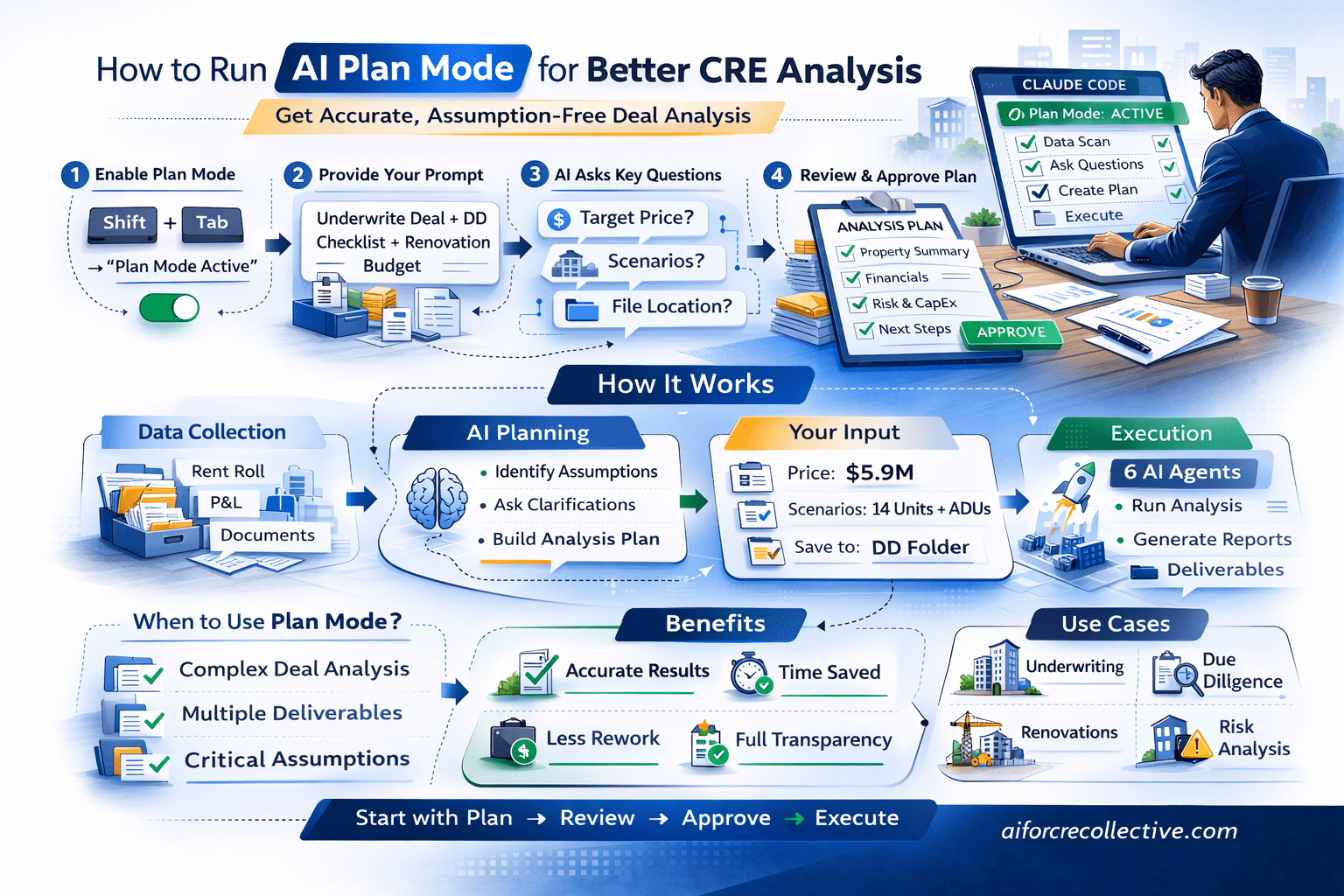
Plan mode is a setting in Claude Code that prevents the AI from executing tasks immediately. Instead, it forces the system to scan your data, ask you questions, and write out a full plan for your review before it touches anything.
Most people skip it because it feels slower. You paste your prompt, and you want results now. I get it. But here’s what happens when you skip: the AI assumes your purchase price. Assumes your return targets. Assumes which scenarios you care about. Assumes where to save the files.
And those assumptions cascade through every deliverable it produces.
Plan Mode in Claude for CRE: Real Deal Setup
I had a 14-unit multifamily deal in Venice, CA. $5.9M asking price. Full DD folder with rent rolls, P&L statements, ADU drawings, and other documents.
I opened the terminal, launched Claude Code, and hit shift+tab until I saw “plan mode” activated. That’s all it takes.
Then I pasted my prompt asking Claude to underwrite the deal, produce a DD checklist, red flag report, seller questions, and renovation budget.
The Questions Claude Asked Me
Before doing any work, Claude stopped and asked:
-
Do you have an existing contract price, or should I solve for the max purchase price to hit your return targets?
-
Should I model this as 14 units only at stabilized occupancy, 14 units plus 3 ADUs, or both?
-
Where do you want the output files saved?
These aren’t random questions. Each one represents an assumption that would’ve changed the entire output. If Claude had assumed I wanted only the 14-unit scenario, I would’ve missed the ADU analysis entirely. If it had guessed a different purchase price, every return metric would be wrong.
I answered: $5.9M price, both scenarios, save to the DD folder.
What the Plan Looked Like
Claude then produced a written plan covering:
• Property summary with all extracted deal details
• Document inventory: what’s present vs. missing
• Acquisition pro forma with my specific return assumptions
• DD checklist methodology and categories
• Red flag identification approach
• Seller follow-up question priority structure
• Renovation and CapEx budget methodology, including ADU construction
I reviewed the plan. Made no changes. Hit approve.
Then Claude executed everything. Six AI agents ran simultaneously, producing all deliverables in parallel. The results were dramatically more accurate than if I’d just let it go.
When to Use Plan Mode vs. Just Letting It Run
How Plan Mode in Claude for CRE Improves Underwriting Accuracy
Plan mode adds a few minutes to the front end. For simple, single-task requests like “extract the rent roll from this PDF,” you don’t need it. Just let Claude execute.
But for complex, multi-deliverable workflows? Always plan first. If your prompt asks for more than two things, or if the quality of the output depends on assumptions about your deal criteria, use plan mode.
The math is simple: spend 3–4 minutes planning upfront, or spend 30 minutes fixing outputs that were built on wrong assumptions.
Plan Mode in Claude for CRE FAQs
1. What is Plan Mode in Claude for CRE workflows?
Plan Mode in Claude for CRE is a setting that allows the AI to review data, ask clarifying questions, and create a structured execution plan before performing due diligence or underwriting tasks.
2. How does Plan Mode in Claude for CRE improve deal analysis?
It improves deal analysis by preventing incorrect assumptions about purchase price, return targets, or development scenarios before generating underwriting reports.
3. Should CRE professionals always use Plan Mode in Claude?
Plan Mode in Claude for CRE is most useful for complex workflows such as due diligence checklists, acquisition modeling, and CapEx budgeting.
4. Can Plan Mode in Claude for CRE reduce underwriting errors?
Yes, it reduces underwriting errors by allowing users to confirm modeling assumptions before financial outputs are generated.
5. When should Plan Mode in Claude for CRE be skipped?
It can be skipped for simple tasks like extracting rent rolls or reviewing individual property documents.
6. Does Plan Mode in Claude for CRE slow down analysis?
Plan Mode adds a few minutes upfront but prevents time spent correcting inaccurate outputs later.
7. Can Plan Mode in Claude for CRE be used with multifamily deals?
Yes, it works effectively for multifamily acquisitions by planning DD tasks and financial modeling scenarios before execution.
8. What is the biggest benefit of Plan Mode in Claude for CRE?
The biggest benefit is improved output accuracy by aligning AI execution with verified deal assumptions.
Try It Today
Open Claude Code. Hit shift+tab to activate plan mode. Paste your next complex CRE prompt. Let Claude ask you questions before it starts working.
I share workflows like this every week in the AI for CRE Collective—540+ CRE professionals testing and sharing what actually works. Join here.
For weekly breakdowns of AI tools and workflows for commercial real estate, subscribe to the newsletter. 3,000+ CRE professionals get it every Thursday.