How to Build an AI Workflow for CRE Due Diligence
This AI workflow shows how commercial real estate teams can automate due diligence, underwriting, and acquisition analysis using multiple AI agents simultaneously. Instead of reviewing files manually one by one, CRE teams can process financials, checklists, red flags, and pro formas in minutes.
Most CRE acquisition teams still handle underwriting and due diligence manually, which slows down deal screening and creates analyst bottlenecks. AI workflows allow teams to automate repetitive review tasks and process multiple acquisition deliverables simultaneously.
Table of Contents
ToggleHow the CRE AI Workflow Was Set Up
Taylor Vakan from The Group CRE sent me a full due diligence set for a 14-unit multifamily in Venice, CA. $5.9M asking price. $421K per door. The DD folder had rent rolls, P&L statements, ADU drawings, and various property documents.
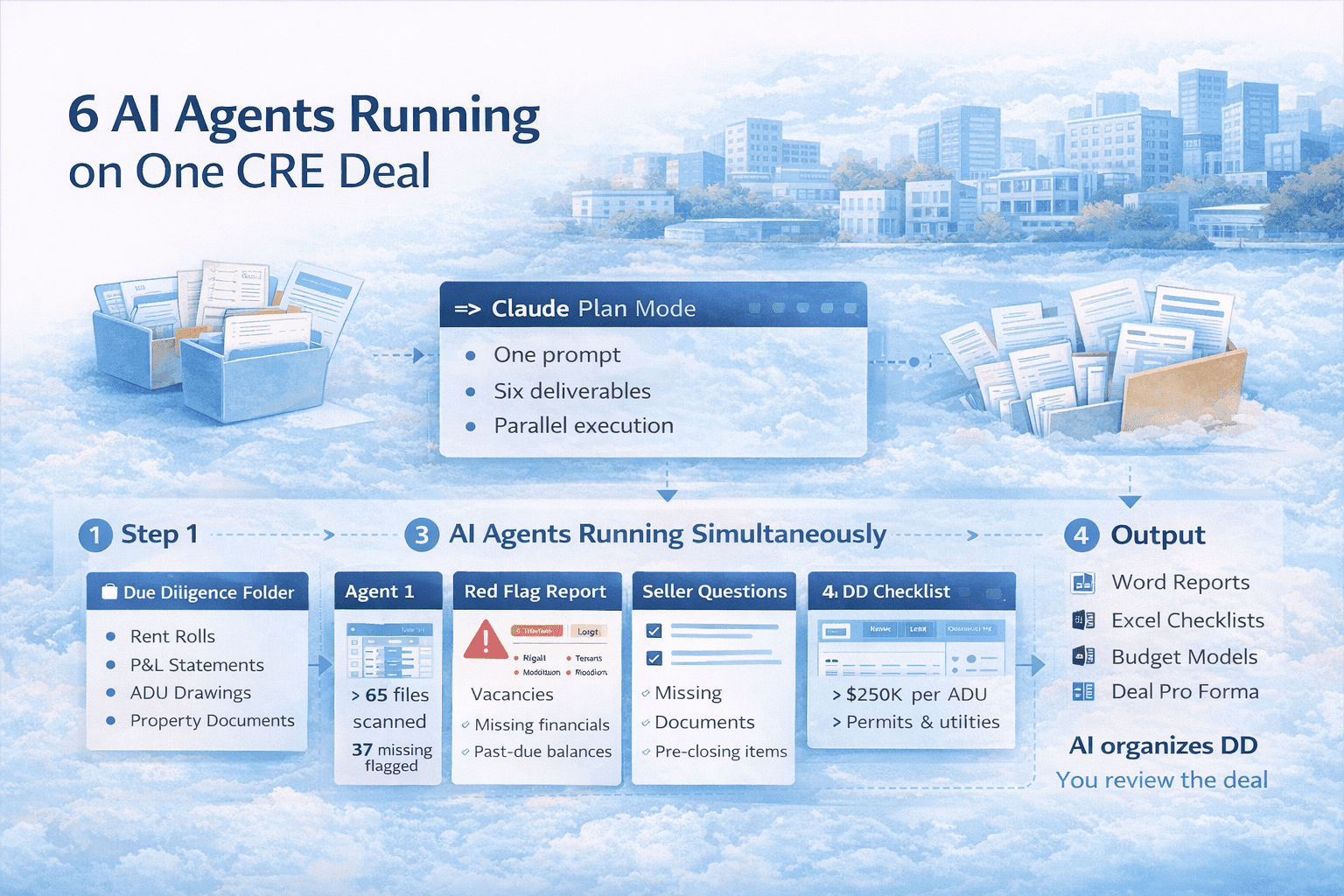
I opened Claude Code in my terminal, activated plan mode, and pasted one prompt asking for six different deliverables from those DD files.
Step-by-Step AI Workflow for CRE Due Diligence
Here’s how six parallel AI agents handled different due diligence tasks at the same time:
Step 1 — AI Workflow for Document Inventory
Scanned every file in the DD folder and produced a status tracker. 65 total items identified. 37 flagged as missing or not provided.
Step 2 — Generate AI Red Flag Reports
Red flag report in Word. Categorized issues by priority level.
High priority: 5 vacancies, key financial documents missing.
Medium: past-due balances.
Low: minor maintenance items.
Step 3 — Create Seller Follow-Up Requests
Seller follow-up questions in Word. Three priority tiers.
>Priority 1 was missing documents needed immediately.
>Priority 2 was items needed before closing.
>Priority 3 was questions that would help refine the underwriting.
Step 4 — Build an AI Due Diligence Checklist
DD checklist. Eventually converted to Excel with 65 tracked items across financial DD, legal DD, environmental (phase 1 and 2), title and survey, regulatory, and tenant categories.
Step 5 — Generate AI CapEx and ADU Budgets
CapEx and ADU construction budget in Excel. Pulled historical capital expenses from the trailing 12-month P&L, broken down by month. Built individual budgets for three ADU conversions from garage ports. Estimated $250K per unit, including plans, engineering, permits, utility connections, and contingency. Solid estimate for LA garage port conversions.
Agent 6: Acquisition Pro Forma
Acquisition pro forma in Excel. Two scenarios.
Scenario A: 14 units at stabilized occupancy showed a negative 1.8% IRR at $5.9M.
Scenario B: 14 units plus 3 ADUs, still negative.
The price would need to come down significantly for either scenario to pencil.
Why AI Workflows Improve CRE Due Diligence
How Parallel AI Agents Work in CRE Due Diligence
Humans can only do one thing at a time. I could open the rent roll, review it, then open the P&L, review that, then start building a checklist. Sequentially. Each deliverable is waiting for the last one to finish.
Claude Code doesn’t work that way. It assigned all six tasks at once. While Agent 1 was scanning documents, Agent 5 was already pulling capital expense data, and Agent 6 was building the pro forma. The DD checklist was being written at the same time as the red flag report.
I could also open a second terminal window and run Claude Code on a completely different deal. That’s not theoretical. You can literally process multiple deals in parallel on the same computer.
How AI Workflows Automate CRE Acquisitions
AI workflows help commercial real estate teams automate repetitive due diligence and underwriting tasks without replacing human review. Instead of completing acquisition analysis sequentially, AI agents can process multiple workflows simultaneously.
Common AI workflow use cases include:
-
Due diligence review
-
Acquisition underwriting
-
Financial modeling
-
Red flag reporting
-
CapEx analysis
-
Seller communication tracking
-
Document organization
-
Deal screening automation
This improves acquisition speed while reducing repetitive manual work for analysts and brokers.
The Catch: Specify Your Output Format
One thing I’d do differently: tell Claude upfront what file formats you want. I didn’t specify, so it defaulted to markdown files. They work, but they look ugly. I had to ask it to convert to Word and Excel after the fact.
Next time, the prompt will include “produce all reports as Word documents and all spreadsheets as Excel files.” A small detail that saves a conversion step.
Why CRE Teams Are Adopting AI Workflows
CRE firms are increasingly adopting AI workflows to improve operational efficiency and scale acquisition analysis. Instead of relying entirely on manual review systems, acquisitions teams can automate document analysis, underwriting support, and checklist generation using AI-driven processes.
Benefits include:
-
Faster deal screening
-
Reduced manual workload
-
Better workflow automation
-
Improved underwriting efficiency
-
Scalable acquisition systems
-
Faster report generation
For high-volume acquisitions teams, AI workflows reduce bottlenecks and improve productivity significantly.
Parallel AI Agents in CRE FAQs
What is an AI workflow in commercial real estate?
An AI workflow in commercial real estate is a structured process where AI tools automate repetitive tasks involved in acquisitions, underwriting, due diligence, and document analysis. Instead of reviewing every file manually, CRE teams can use AI workflows to process multiple tasks simultaneously.
AI workflows commonly automate:
-
Document organization
-
Financial analysis
-
Due diligence checklists
-
Red flag reporting
-
Acquisition modeling
-
Seller follow-up tracking
These systems help analysts and brokers reduce repetitive manual work while improving deal screening speed. Many CRE firms now use AI workflows to handle first-pass analysis so teams can focus more on decision-making, negotiations, and investment strategy rather than administrative tasks.
How do AI workflows improve CRE due diligence?
AI workflows improve CRE due diligence by processing financial, legal, and operational documents much faster than traditional manual review systems. Instead of analyzing files sequentially, AI agents can review multiple deliverables simultaneously.
AI workflows help automate:
-
Rent roll analysis
-
P&L review
-
Document inventory
-
Missing file tracking
-
CapEx estimation
-
Risk identification
This allows acquisitions teams to generate reports, checklists, and underwriting outputs within minutes instead of hours. While human review is still required for final decisions, AI workflows significantly reduce the time spent organizing and reviewing large due diligence folders.
Can AI workflows automate acquisition underwriting?
Yes. AI workflows can assist with acquisition underwriting by analyzing property financials, occupancy assumptions, expenses, and investment scenarios automatically.
Typical underwriting tasks include:
-
NOI calculations
-
IRR projections
-
Cash flow analysis
-
Rent roll interpretation
-
Expense categorization
-
Scenario modeling
Many CRE teams use AI workflows to create first-pass underwriting models before analysts refine assumptions manually. This speeds up deal screening and allows acquisitions teams to review more opportunities without increasing analyst workload.
What types of CRE tasks can AI workflows automate?
AI workflows can automate many repetitive operational and analytical tasks in commercial real estate.
Common AI workflow use cases include:
-
Due diligence analysis
-
Financial modeling
-
Lease abstraction
-
Market research
-
Seller question tracking
-
CapEx budgeting
-
Acquisition checklists
-
Investment memo creation
Instead of handling each task manually, CRE professionals can automate large portions of the acquisition process. This improves operational efficiency while reducing repetitive administrative work for analysts and brokers.
Do AI workflows replace acquisitions analysts?
No. AI workflows support analysts by automating repetitive tasks, but they do not replace human judgment, investment strategy, or relationship management.
AI workflows are best for:
-
Organizing data
-
Running first-pass analysis
-
Generating reports
-
Tracking missing documents
-
Building preliminary models
Analysts still handle:
-
Investment decisions
-
Assumption validation
-
Negotiations
-
Market judgment
-
Deal structuring
The goal of AI workflows is to improve efficiency and reduce bottlenecks, not eliminate acquisitions teams.
How fast can AI workflows process due diligence files?
AI workflows can process CRE due diligence materials within minutes, depending on file complexity and system setup. Tasks that normally take several hours manually can often be completed simultaneously through AI-driven workflows.
These tasks may include:
-
Document inventory
-
Financial review
-
Checklist creation
-
Red flag reporting
-
Underwriting support
By processing multiple deliverables in parallel, AI workflows dramatically improve acquisition speed and operational efficiency for CRE teams.
What are parallel AI agents in AI workflows?
Parallel AI agents are multiple AI-driven processes running simultaneously within a single workflow. Instead of completing tasks one after another, each AI agent handles a different responsibility at the same time.
Examples include:
-
One agent reviewing financials
-
Another building checklist
-
Another creates red flag reports
-
Another generating acquisition model
This parallel structure allows CRE teams to analyze deals much faster while reducing repetitive manual coordination. Parallel AI workflows are becoming increasingly valuable for high-volume acquisition teams.
Can AI workflows analyze multifamily investment deals?
Yes. AI workflows are highly effective for multifamily acquisitions because they can analyze multiple property documents simultaneously.
AI workflows can review:
-
Rent rolls
-
T12 statements
-
Occupancy trends
-
CapEx history
-
ADU feasibility
-
Tenant balances
The system can also generate underwriting models and identify operational risks. Many multifamily investors use AI workflows to improve screening speed and reduce underwriting bottlenecks during acquisitions.
What Parallel AI Agents Mean for Acquisitions Teams
With parallel AI agents, the bottleneck in deal screening has traditionally been analyst bandwidth. One analyst, one deal at a time, hours per deal for basic DD organization and analysis.
With Claude Code, anyone can run a comprehensive DD analysis on a deal in minutes while processing other deals in parallel on terminals. The quality still needs human review (always will). But the first-pass analysis, document organization, and checklist generation? AI handles that faster than any team I’ve seen.I share the full demo, prompt, and all outputs inside the AI for CRE Collective every week. 540+ CRE professionals are testing workflows like this.
For weekly breakdowns of AI tools and workflows for commercial real estate, subscribe to the newsletter. 3,000+ CRE professionals get it every Thursday.