California AI Advisory for Real Estate
The California AI real estate rules are reshaping how commercial real estate professionals use artificial intelligence in their day-to-day work. If you’re relying on tools like ChatGPT, Claude, or any AI-driven platform to generate listings, analyze deals, or communicate with clients, this guidance is no longer optional; it directly impacts your legal responsibility.
In major markets like Los Angeles and San Francisco, where innovation and regulation often collide first, agents are already adjusting workflows. However, the reality is simple: AI is no longer just a productivity tool; it’s now a compliance risk if used incorrectly.
What makes this shift important is not just the technology, but the accountability attached to it. The California Department of Real Estate has made it clear that AI does not reduce your responsibility; it increases the need for oversight.
What Are California AI Real Estate Rules?
The California AI real estate rules are official guidance issued by the Department of Real Estate (DRE) that outlines how licensed professionals must use artificial intelligence in their business.
Direct Answer
These rules establish that AI is allowed but only under strict professional responsibility, meaning:
-
You are fully accountable for all AI-generated outputs
-
All content must comply with fair housing laws
-
AI cannot provide legal advice or replace attorneys
-
The rules apply across all real estate activities
This guidance doesn’t ban AI. Instead, it defines how it must be used responsibly.
Why California AI Real Estate Rules Matter Now
The timing of this advisory is not random. It reflects a major shift in how the real estate industry operates.
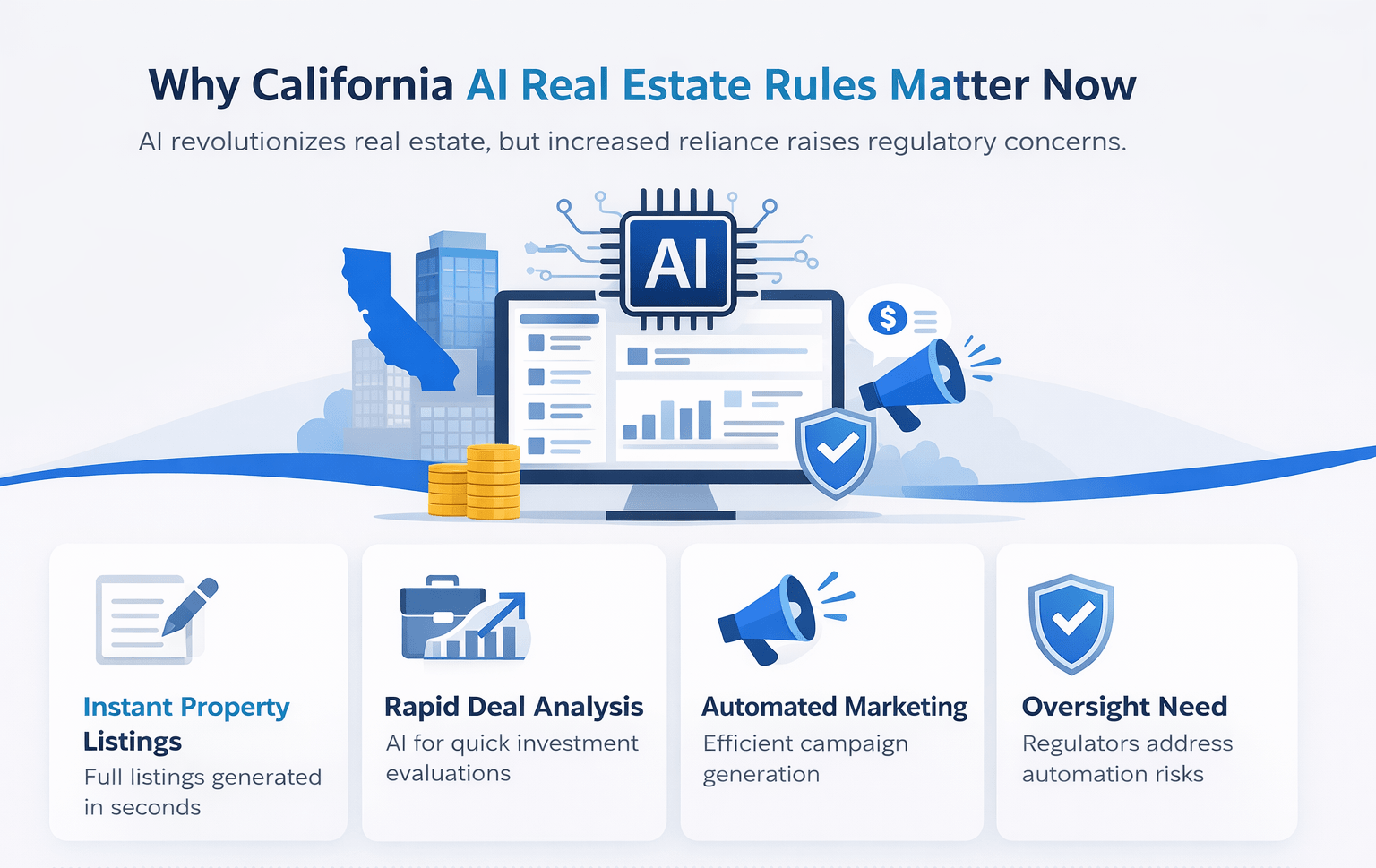
Over the past two years, AI adoption has accelerated rapidly. What started as simple text generation has evolved into tools that can:
-
Write full property listings in seconds
-
Analyze investment deals
-
Generate marketing campaigns
-
Respond to client inquiries automatically
This increase in capability has also increased risk. Regulators recognized that agents were beginning to rely too heavily on AI without proper oversight.
Industry Shift Overview
AreaBefore AIAfter AI AdoptionListing CreationManual writingAI-generated draftsMarketingAgent-drivenAutomated campaignsDeal AnalysisSpreadsheet-basedAI-assisted insightsCommunicationPersonal responsesAI-generated replies
Because of this transformation, California stepped in early, and historically, other states tend to follow its lead.
Core Principle: You Own AI Output
The most important concept in the California AI real estate rules is ownership.
Direct Answer
If AI generates it, you are legally responsible for it, no exceptions.
This principle changes how you must approach AI entirely. Instead of treating AI output as “ready to use,” you must treat it as a first draft that requires professional review.
What This Looks Like in Practice
Imagine you use AI to generate a listing description. The AI includes:
-
Incorrect square footage
-
Misleading property features
-
Language that could violate fair housing laws
Even though the AI created the content, you are still accountable for publishing it.
This is similar to delegating work to a junior team member. You wouldn’t publish their work without reviewing it, and the same standard now applies to AI.
Fair Housing Compliance Under AI
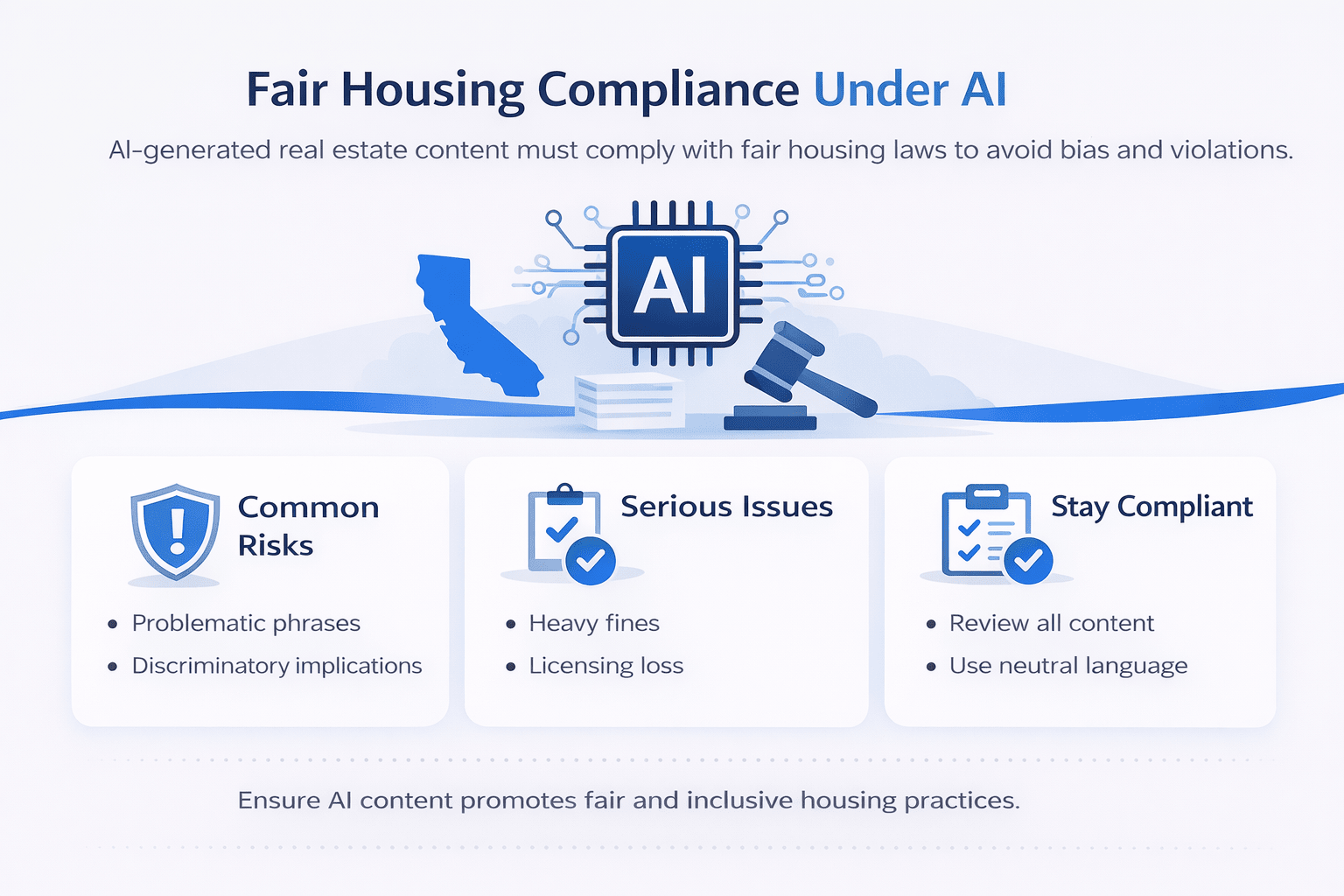
Fair housing compliance is one of the highest-risk areas when using AI.
Direct Answer
All AI-generated content must strictly comply with fair housing laws, regardless of how it was created.
AI tools are trained on large datasets that include human language patterns, some of which contain bias. Because of this, AI can unintentionally produce language that suggests discrimination or exclusion.
Common Risk Examples
AI might generate phrases like:
-
“Perfect for young professionals”
-
“Ideal family neighborhood”
-
“Safe and quiet community”
While these may seem harmless, they can imply preferences or exclusions tied to protected classes.
Why This Is a Serious Issue
Fair housing violations are not minor mistakes—they can lead to:
-
Legal penalties
-
Licensing issues
-
Reputation damage
How to Stay Compliant
To avoid these risks:
-
Focus on property features, not people
-
Remove subjective or demographic-based language
-
Review every AI-generated sentence carefully
The key is to ensure that all marketing remains neutral, factual, and inclusive.
AI cannot Practice Law
Another critical part of the California AI real estate rules is the restriction on legal usage.
Direct Answer
AI cannot be used to provide legal advice, interpret contracts, or replace legal professionals.
Where Agents Often Go Wrong
Many professionals are starting to use AI for:
-
Lease reviews
-
Contract summaries
-
Risk assessments
While some of this is acceptable, there’s a clear boundary.
Safe vs Risky AI Usage
| Use Case | Safe to Use AI? |
|---|---|
| Summarizing lease terms | Yes |
| Extracting key clauses | Yes |
| Interpreting legal meaning | No |
| Drafting binding agreements | No |
Key Insight
AI is useful for organizing information, but not for making legal judgments. Any legally binding or interpretive work must involve a qualified attorney.
Where These Rules Apply in Real Estate
The California AI real estate rules apply broadly across the industry.
Covered Areas Include:
-
Listing and marketing content
-
Lead generation and outreach
-
Property valuation and underwriting
-
Transaction management
-
Property management communication
This means even small uses like drafting an email fall under these guidelines.
How to Stay Compliant with California AI Real Estate Rules
Understanding the rules is one thing. Implementing them is what actually protects you.
Practical Compliance Framework
| Step | What You Should Do |
|---|---|
| Review | Check every AI output |
| Verify | Confirm the accuracy of details |
| Edit | Adjust tone and compliance |
| Document | Keep records of usage |
| Train | Educate your team |
1. Review Everything Before Publishing
Never copy and paste AI content directly.
Instead:
-
Read every line carefully
-
Adjust for accuracy and tone
-
Remove risky phrasing
2. Verify All Information
AI is known to “hallucinate,” meaning it can generate incorrect data confidently.
Always double-check:
-
Property details
-
Pricing information
-
Market data
3. Apply Compliance Filters
Before publishing, ask:
-
Is this neutral and unbiased?
-
Does it avoid targeting specific groups?
-
Would this pass a compliance review?
4. Document Your AI Usage
Documentation is your protection.
Keep records of:
-
Prompts used
-
Tools used
-
Edits made
If a complaint arises, this shows you followed a responsible process.
5. Train Your Team
If you’re a managing agent or a brokerage:
-
Create AI usage policies
-
Standardize review processes
-
Conduct regular training
Without training, risk multiplies quickly.
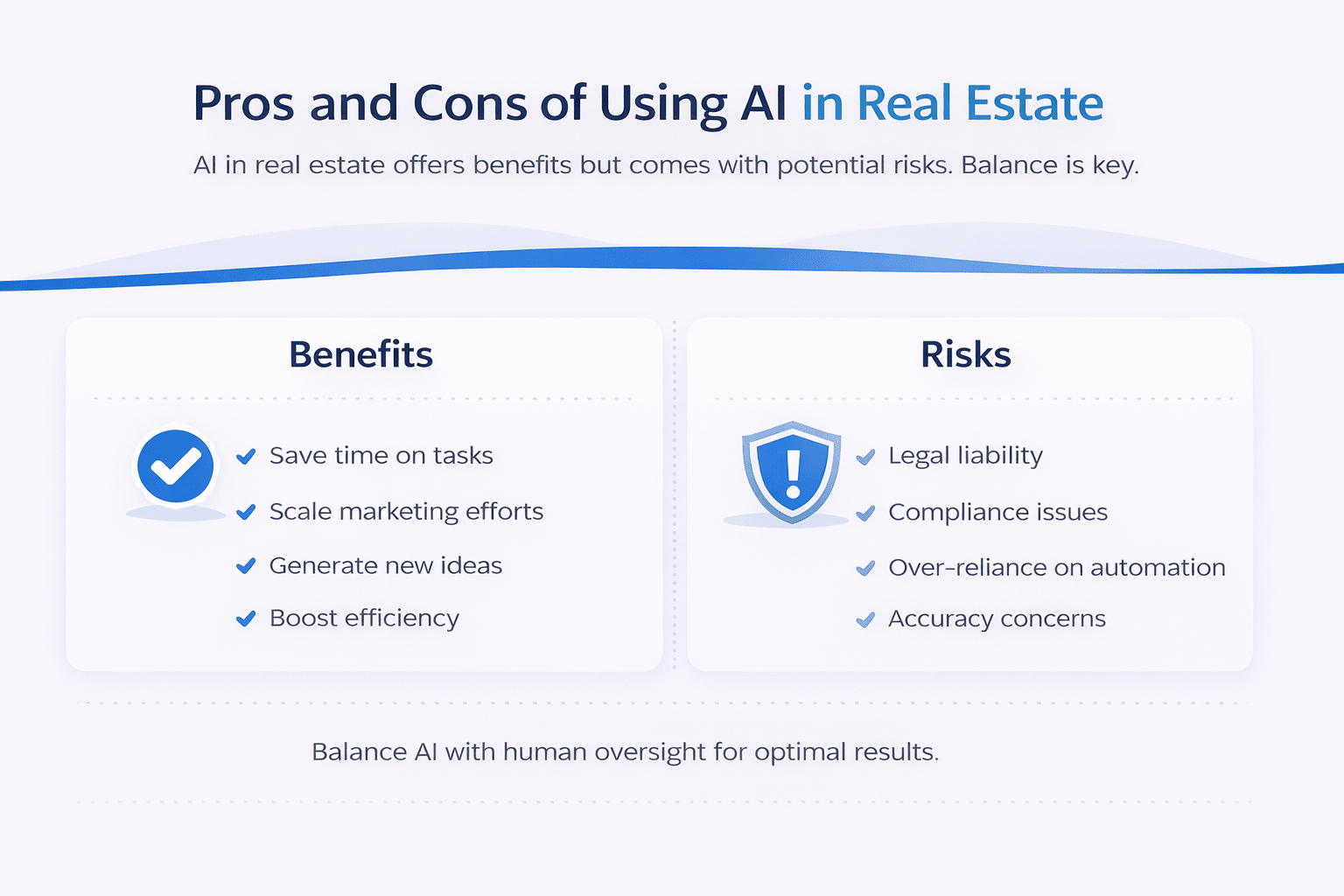
Pros and Cons of Using AI in Real Estate
AI is powerful, but it comes with trade-offs.
Benefits
AI allows you to:
-
Save time on repetitive tasks
-
Scale marketing efforts
-
Generate ideas quickly
-
Improve operational efficiency
Risks
However, it also introduces:
-
Legal liability
-
Compliance issues
-
Over-reliance on automation
-
Accuracy concerns
The key is balance. AI should enhance your workflow, not replace your judgment.
When to Use AI vs When to Avoid It
Knowing when to use AI is just as important as knowing how.
Best Use Cases
-
Drafting listing descriptions
-
Creating email templates
-
Summarizing market data
-
Organizing information
Avoid Using AI For
-
Legal decision-making
-
Final contract drafting
-
Compliance approvals
-
Sensitive negotiations
A simple rule: if the decision carries legal or ethical weight, AI should not be the final authority.
Future of AI Regulation in Real Estate
California is likely setting the tone for what’s coming next.
What to Expect
-
More states are issuing similar guidance
-
Increased scrutiny on AI-generated content
-
Possible disclosure requirements
-
Brokerage-level compliance policies
This means the systems you build today will determine how prepared you are for future regulations.
Common Mistakes Agents Make with AI
Even experienced professionals are making avoidable errors.
Most Common Issues
-
Publishing AI content without review
-
Ignoring fair housing risks
-
Using AI for legal interpretations
-
Over-automating client communication
Key Insight
AI amplifies your process. If your workflow lacks structure, AI will scale that weakness.
Best Practices for Using AI Safely
To stay compliant and effective:
-
Treat AI as a draft tool
-
Always review before publishing
-
Use structured prompts
-
Maintain documentation
-
Stay updated on regulations
These habits will keep you ahead of both risk and competition.
Stay Ahead of AI in CRE Compliance
The California AI real estate rules are just the beginning, and professionals who adapt early will gain a significant advantage. Inside the AI4CRE Collective, 600+ CRE professionals are actively implementing compliant AI workflows that scale without increasing legal risk. If you’re serious about using AI strategically, this is where real-world insights are being shared.
Instead of navigating this shift alone, you can learn from operators already using AI across marketing, underwriting, and transactions. If you want ongoing updates, practical strategies, and regulatory insights, make sure you subscribe to the newsletter and stay ahead of where the CRE industry is heading.
Conclusion
The California AI real estate rules don’t limit innovation; they define responsibility.
AI is a powerful tool, but it doesn’t replace professional judgment, compliance knowledge, or accountability. The agents and brokers who succeed will be the ones who use AI thoughtfully, review everything carefully, and stay aligned with evolving regulations.
In the end, AI won’t replace real estate professionals, but professionals who use AI responsibly will outperform those who don’t.
FAQs Regarding California AI Real Estate Rules
What are California AI real estate rules?
California AI real estate rules are official guidelines that define how licensed agents and brokers can use artificial intelligence tools in their professional activities while remaining compliant with existing laws.
-
They require full accountability for all AI-generated content, regardless of the tool used
-
They apply to marketing, listings, client communication, and transaction workflows
-
They reinforce compliance with laws like fair housing and consumer protection
These rules do not ban AI usage. Instead, they ensure that professionals use it responsibly, with proper oversight and review processes in place.
Conclusion: The rules establish that AI is a tool, but the responsibility always stays with the licensed professional.
Can real estate agents legally use AI tools in California?
Yes, real estate agents in California can legally use AI tools, but only if they follow strict compliance standards outlined by the Department of Real Estate.
-
Agents must review and verify all AI-generated outputs before using them publicly
-
They must ensure content does not violate fair housing laws or mislead consumers
-
They cannot rely on AI for legal interpretations or compliance decisions
AI is treated similarly to an assistant; it can help with efficiency, but it cannot replace professional judgment or accountability.
Conclusion: AI is allowed, but it must always be used under human supervision and within regulatory boundaries.
Who is responsible if AI-generated content contains errors or violations?
The licensed agent or broker is fully responsible for any errors, omissions, or violations in AI-generated content.
-
AI platforms do not carry legal liability for their outputs
-
Any incorrect listing information, misleading marketing, or compliance violations fall on the licensee
-
Even accidental mistakes can result in penalties or disciplinary action
This is one of the most important aspects of the California AI real estate rules because it reinforces that AI does not shift responsibility away from the professional.
Conclusion: If you use or publish AI-generated content, you are legally accountable for everything in it.
How do California AI real estate rules impact fair housing compliance?
These rules significantly increase the importance of reviewing AI-generated content for fair housing compliance, as AI can unintentionally produce biased or discriminatory language.
-
AI models may generate phrases that suggest preferences for certain demographics
-
Even subtle wording can imply exclusion of protected classes
-
All marketing and communication must remain neutral and inclusive
For example, phrases like “perfect for families” or “ideal for young professionals” may create compliance risks if not corrected.
Conclusion: Fair housing laws fully apply to AI-generated content, and careful review is essential to avoid violations.
Can AI be used to create real estate listings and marketing content?
Yes, AI can be used to generate listing descriptions, marketing emails, and promotional content, but it must be treated as a draft, not a final product.
-
It can speed up content creation and improve efficiency
-
It can help structure and enhance messaging
-
However, it may include inaccurate or non-compliant language
Agents should always review, edit, and verify all AI-generated content before publishing it to ensure accuracy and compliance.
Conclusion: AI is an effective drafting tool, but final approval must always come from the agent.
Is it allowed to use AI for contract review or legal tasks?
AI can assist with basic contract review tasks, but it cannot be used to provide legal advice or make legal decisions.
-
It can summarize documents and highlight key clauses
-
It can help organize and simplify complex agreements
-
It cannot interpret legal meaning or assess legal risks
Using AI for legal conclusions crosses into unauthorized practice of law, which is strictly prohibited.
Conclusion: AI can support document review, but legal interpretation must always be handled by a qualified attorney.
What are the biggest risks of using AI in real estate?
The main risks involve compliance issues, inaccurate information, and over-reliance on automation without proper oversight.
-
AI may generate incorrect data or “hallucinate” details
-
It can produce language that violates fair housing laws
-
Agents may rely on it too heavily without verifying outputs
Because AI operates at scale, even a small mistake can be repeated across multiple listings or communications.
Conclusion: The biggest risk is not AI itself, but using it without proper review and control.
Should real estate brokerages create AI usage policies?
Yes, brokerages should implement clear AI usage policies to ensure consistency, compliance, and risk management across their teams.
-
Policies define how AI tools can be used within the organization
-
They standardize review and approval processes
-
They help reduce legal exposure and improve accountability
Without structured guidelines, agents may use AI inconsistently, increasing the risk of errors and violations.
Conclusion: AI policies are essential for brokerages to safely scale AI adoption.
Will other states introduce similar AI real estate regulations?
It is highly likely that other states will introduce similar regulations as AI adoption continues to grow in the real estate industry.
-
California often leads regulatory trends in the U.S.
-
Other major markets are already monitoring AI usage closely
-
Industry-wide standards are beginning to emerge
Professionals who adapt early to these rules will be better positioned as regulations expand nationwide.
Conclusion: California is just the beginning—similar AI rules are expected across multiple states.
What is the safest way to use AI in real estate today?
The safest way to use AI is to treat it as a support tool while maintaining full human control over all outputs and decisions.
-
Use AI for drafting, brainstorming, and organizing information
-
Always verify facts, data, and compliance before publishing
-
Maintain documentation and consistent review processes
This approach allows agents to benefit from AI’s efficiency while minimizing legal and compliance risks.
Conclusion: Safe AI use comes down to human oversight, verification, and responsible implementation.
Build Compliant AI Workflows in Real Estate
The California AI real estate rules are changing how agents and brokers use AI—and most professionals are still figuring it out as they go. Instead of guessing, you can follow proven workflows that are already working in real-world CRE environments.
Inside AI for CRE Collective, you’ll learn how 600+ CRE professionals are using AI for underwriting, marketing, and operations while staying compliant and in control. Get practical systems, not theory.