Build a Broker Opinion of Value with AI in Under 20 Minutes
Yet most commercial real estate firms are still stuck in evaluation mode. They understand the potential. They’ve seen demos. They’ve tested tools. But when it comes to actually implementing AI across workflows, progress slows down.
The reason is not the technology. The tools already work. The real challenge lies in legal approvals, security concerns, and internal decision-making friction.
In competitive markets, this delay is becoming costly. Firms that move early are already compressing workflows that used to take hours into minutes.
Understanding Enterprise AI Adoption in CRE
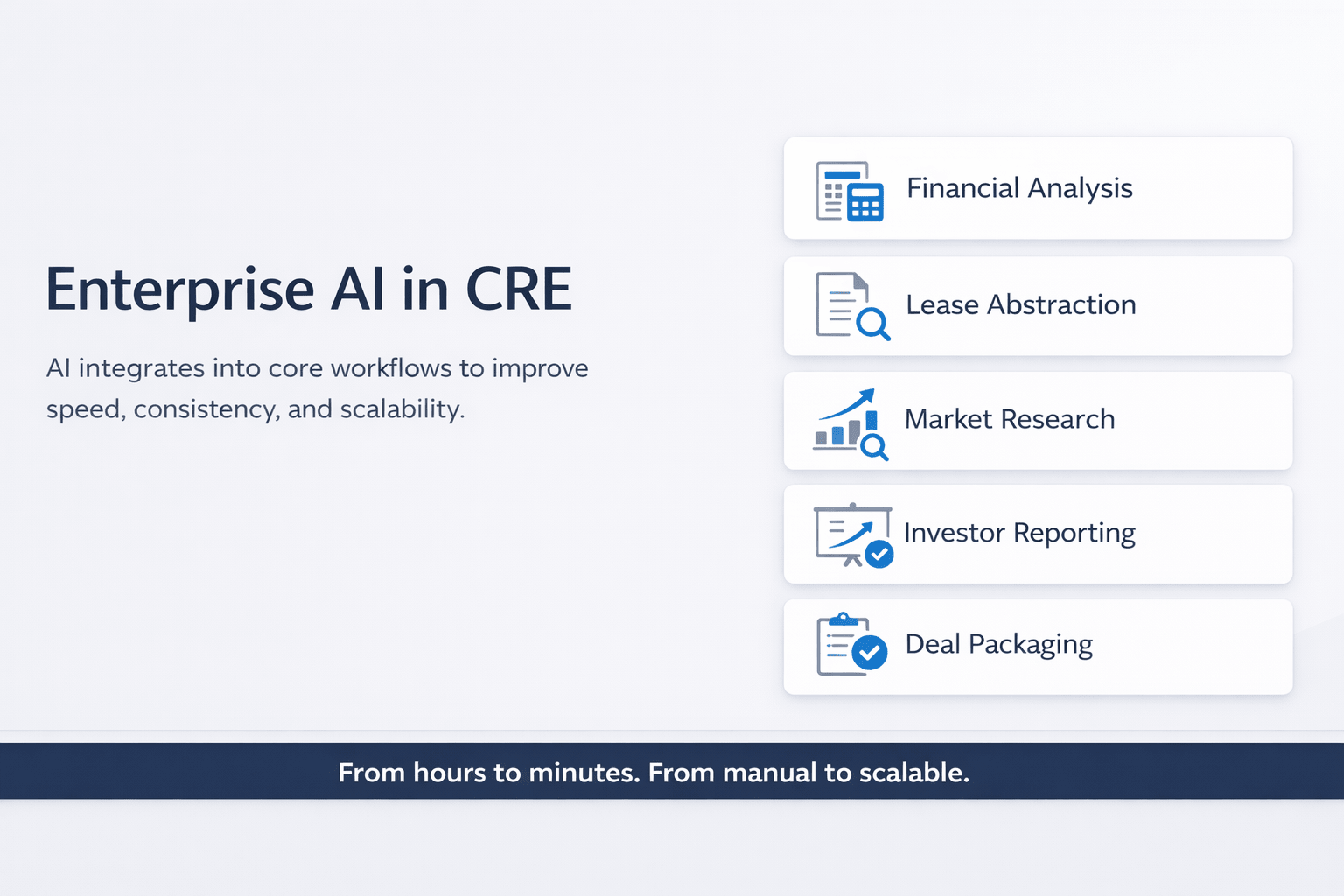
Enterprise AI adoption in CRE refers to integrating AI into core real estate workflows, underwriting, reporting, research, and deal execution, to improve speed, consistency, and scalability.
Where AI Is Creating Immediate Impact
-
Financial analysis and underwriting
-
Lease abstraction and document review
-
Market research and comp analysis
-
Investor reporting and presentations
-
Deal packaging (BOVs, offering memorandums)
These workflows are highly repetitive, data-heavy, and time-consuming, making them ideal for AI.
Why This Shift Matters Now
Commercial real estate has always relied on manual analysis. Brokers and analysts spend hours pulling rent rolls, reviewing T12s, and building decks.
AI changes that dynamic completely:
-
Tasks that took hours now take minutes
-
Multiple deals can be processed simultaneously
-
Output consistency improves across teams
The Real Barriers to Enterprise AI Adoption in CRE
Despite the clear upside, most firms struggle to move forward. The blockers are rarely technical; they are operational and structural.
Legal and Data Privacy Constraints
Legal teams need clarity on:
-
Where data is stored
-
Whether proprietary data is used for model training
-
Vendor liability and compliance
These reviews can take months in large organizations.
Security and IT Reviews
AI tools must pass internal security checks:
-
System integration risks
-
Data access permissions
-
API-level security
These processes are necessary but slow.
Organizational Inertia
Even when tools are approved, adoption stalls due to:
-
Lack of ownership
-
Too many decision-makers
-
Risk-averse culture
Table 1: Why AI Adoption Slows Down in CRE
| Barrier Type | Real Impact on Firms | Result |
|---|---|---|
| Legal & Compliance | Delayed approvals | Slow implementation timelines |
| Security Reviews | Integration bottlenecks | Limited tool deployment |
| Internal Alignment | Lack of ownership | Projects stall or die |
| Executive Hesitation | Risk avoidance | Missed opportunities |
What Actually Works: Moving from Pilots to Execution
Firms that are successfully implementing enterprise AI adoption in CRE follow a different approach. They do not try to roll out AI across the entire organization at once.
They start small and move fast.
Controlled Pilot Programs
The most effective strategy is a contained pilot:
-
4–6 users
-
One specific workflow
-
30-day testing window
-
Clear performance metrics
This removes complexity and creates measurable outcomes.
Clear Data Boundaries
Successful firms define what data can and cannot be used:
-
Allowed: public data, general market information
-
Restricted: investor data, confidential deal terms
This simplifies legal and security discussions.
Internal Champion
Every successful implementation has one thing in common: ownership.
An internal champion:
-
Drives the initiative forward
-
Connects business and technical teams
-
Prevents delays
Real Example: Automating BOV Workflows with AI
One of the most practical examples of enterprise AI adoption in CRE is automating Broker Opinion of Value (BOV) creation.
Traditionally, building a BOV involves:
-
Extracting rent roll data
-
Analyzing financials
-
Researching comps
-
Writing narrative
-
Formatting slides
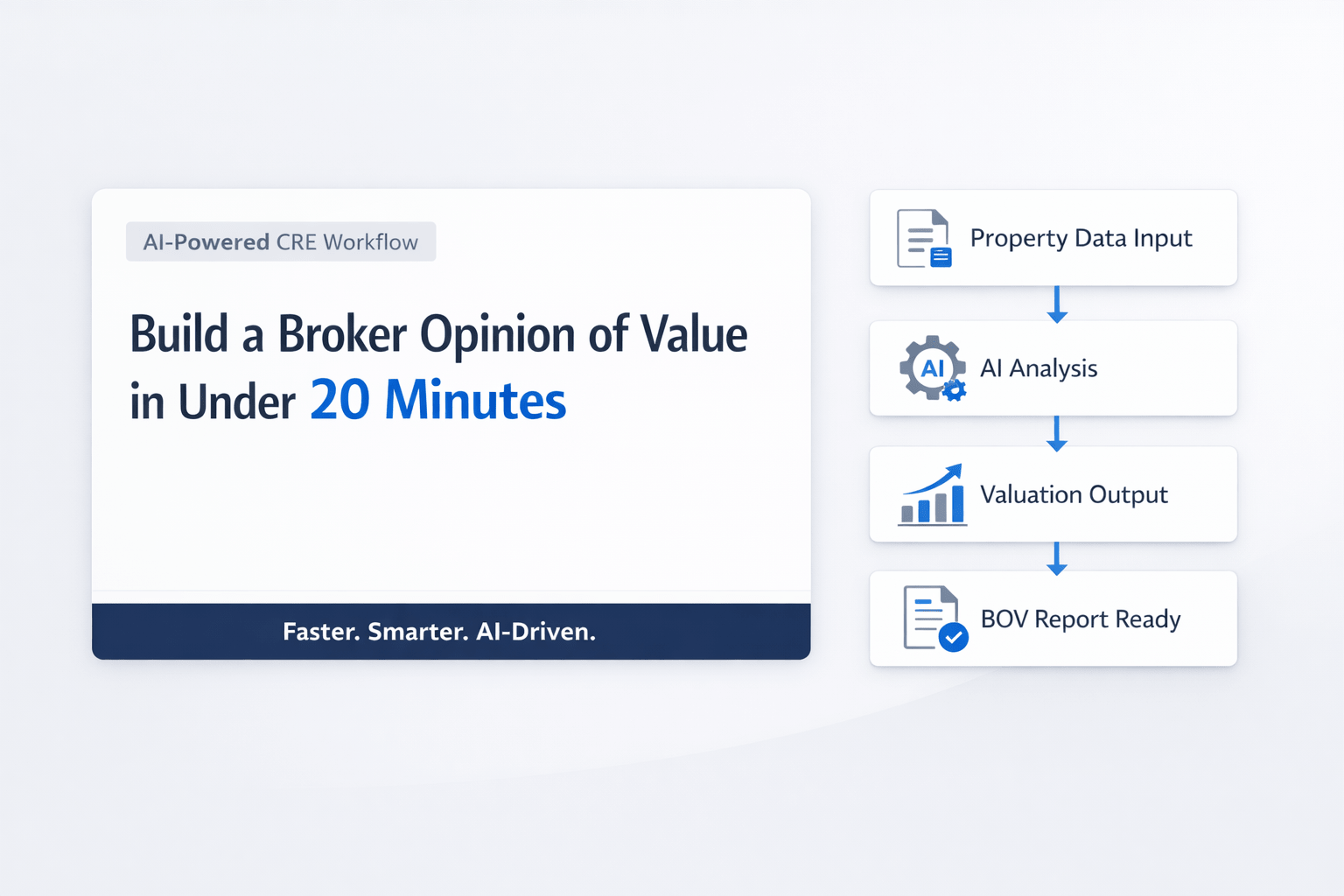
This process can take hours per property. Here’s a real-world example showing how AI can compress an entire deal workflow into minutes:
However, using AI workflows, it’s now possible to run multiple BOVs simultaneously. In one real-world case, three full BOV decks were generated in just 18 minutes using parallel AI agents.
How the Workflow Operates
-
Each property has its own folder with due diligence documents
-
AI reads all documents automatically
-
Separate agents process each property in parallel
-
Output is generated as structured presentation decks
What AI Handles Effectively
-
Rent roll and financial extraction
-
Expense and income summaries
-
Risk identification
-
Initial valuation logic
Where Human Input Is Still Needed
-
Final narrative refinement
-
Branding and presentation design
-
Strategic pricing decisions
Table 2: Traditional vs AI-Driven BOV Workflow
| Step | Traditional Process | AI Workflow Process |
|---|---|---|
| Data Extraction | Manual | Automated |
| Analysis | Sequential | Parallel |
| Time per Property | Hours | Minutes |
| Output Consistency | Variable | Standardized |
| Final Review | Required | Required |
High-Impact Use Cases to Start With
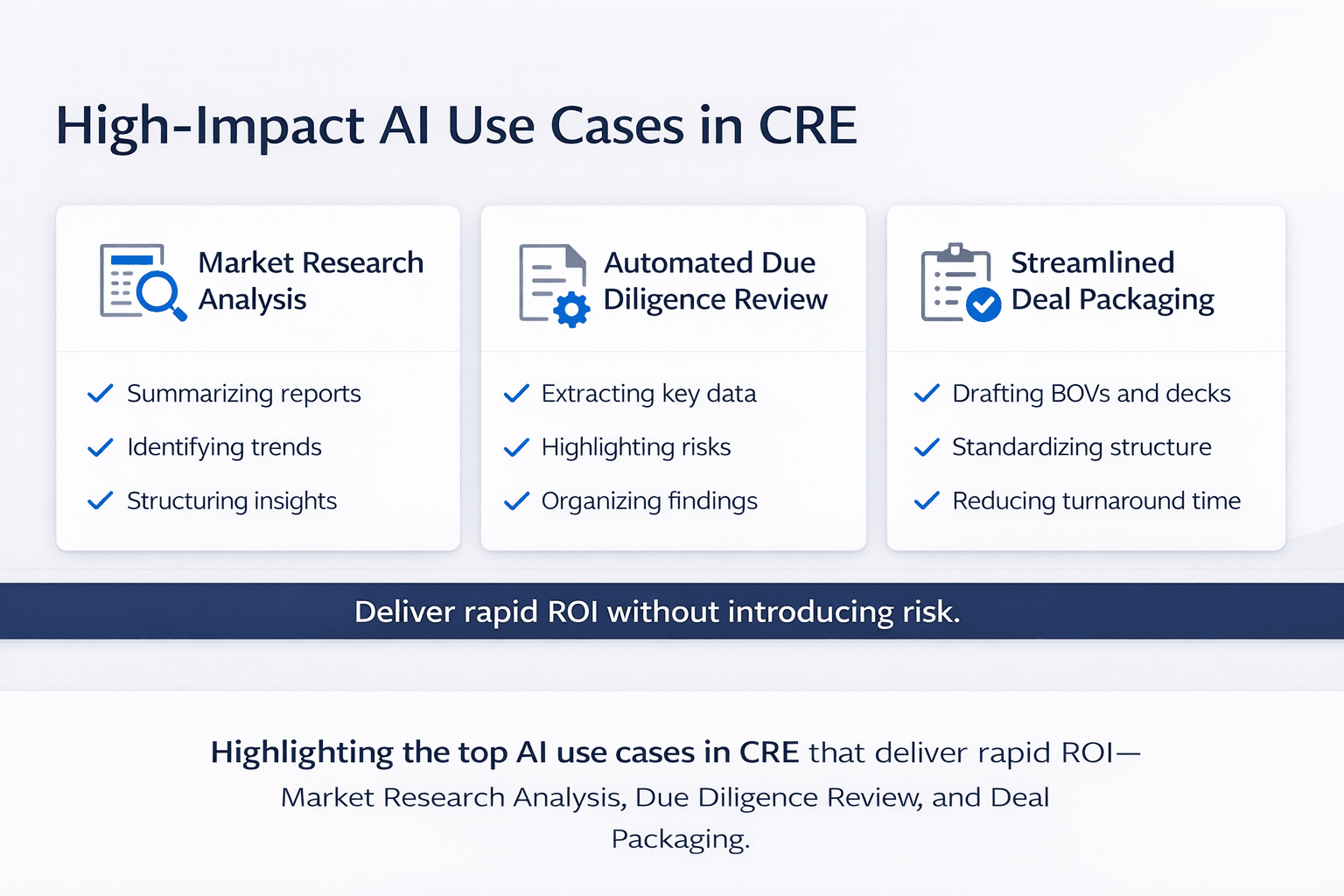
The key to successful enterprise AI adoption in CRE is starting with workflows that deliver immediate ROI without introducing risk.
1. Market Research and Analysis
-
Summarizing reports
-
Identifying trends
-
Structuring insights
2. Due Diligence Review
-
Extracting key data from documents
-
Highlighting risks
-
Organizing findings
Many teams are already using AI due diligence commercial real estate workflows to extract key data and identify risks faster.
3. Deal Packaging (BOVs, Decks)
-
Automating first drafts
-
Standardizing structure
-
Reducing turnaround time
These use cases are practical, repeatable, and scalable.
Step-by-Step Framework for Implementation
A structured approach is essential for scaling AI across an organization.
Step 1: Choose a Single Workflow
Focus on:
-
Repetitive processes
-
High time investment
-
Clear output
Step 2: Run a Pilot
-
Small team
-
Defined timeline
-
Measurable results
Step 3: Evaluate Results
Track:
-
Time savings
-
Output quality
-
User adoption
Step 4: Standardize the Workflow
Turn successful processes into repeatable systems. For example, BOV workflows can be converted into reusable AI “skills” that run automatically with minimal input.
Step 5: Scale Gradually
Expand only after proven success.
Table 3: AI Implementation Workflow in CRE
| Phase | Action Taken | Outcome |
|---|---|---|
| Pilot | Test workflow | Proof of concept |
| Evaluation | Measure performance | ROI validation |
| Standardization | Create a repeatable system | Consistent output |
| Scaling | Expand usage | Organization-wide impact |
Risk Mitigation in Enterprise AI Adoption in CRE
Risk management is not optional; it is part of the process.
Key Strategies
-
Avoid sensitive data in early stages
-
Maintain human review of outputs
-
Use controlled environments for testing
-
Clearly define usage policies
Risk in enterprise AI adoption in CRE is minimized by starting with low-risk workflows, limiting data exposure, and maintaining human oversight throughout the process.
The Competitive Advantage Window
There is a clear gap forming in the market.
Smaller and mid-sized firms are moving faster because they can:
-
Make decisions quickly
-
Test workflows without bureaucracy
-
Implement changes immediately
Larger firms, while more resource-rich, are slowed down by process.
This creates a temporary advantage for firms willing to act now.
Conclusion
Enterprise AI adoption in CRE is no longer about access to tools; it is about execution. The firms that succeed are not the ones experimenting the most, but the ones building repeatable workflows and scaling them across their operations.
Start small. Prove value. Standardize what works. Then scale.
That is how real adoption happens.
Move from AI Experimentation to Real CRE Workflows
Most CRE professionals are still testing AI. Very few are actually using it in live deal workflows. That gap is where the opportunity is. The firms that operationalize AI today will outperform those still stuck in evaluation cycles.
The AI for CRE Collective brings together 600+ CRE professionals who are actively building and using AI workflows across underwriting, research, and deal execution. If you want proven systems instead of theory, this is where to start: subscribe to the newsletter and begin implementing immediately.
FAQs Regarding Enterprise AI Adoption in CRE
1. What is enterprise AI adoption in CRE?
Enterprise AI adoption in CRE is the process of integrating artificial intelligence into commercial real estate workflows to automate tasks, enhance analysis, and improve operational efficiency.
-
Applies to underwriting, due diligence, market research, and reporting
-
Uses AI to process large volumes of data faster than manual methods
-
Enables teams to focus on higher-value decision-making
Conclusion: It allows CRE firms to scale operations while improving speed, consistency, and insight quality.
2. Why is enterprise AI adoption in CRE challenging?
The main challenges are not technical; they are legal, organizational, and operational.
-
Legal concerns around data privacy and vendor agreements
-
IT security reviews for system integration
-
Internal resistance due to risk aversion and unclear ownership
Conclusion: Adoption slows down because of internal processes, not because AI tools are ineffective.
3. What is the best way to start enterprise AI adoption in CRE?
The most effective approach is to begin with a focused pilot program.
-
Select one workflow with clear value
-
Use a small team for testing
-
Define measurable success metrics
Conclusion: Starting small reduces risk and creates proof before scaling across the organization.
4. What are the most effective AI use cases in CRE?
The highest-impact use cases are those that are repetitive and data-heavy.
-
Market research and report summarization
-
Due diligence document analysis
-
Deal packaging, such as BOVs and presentations
Conclusion: These workflows deliver immediate ROI while being relatively low risk to implement.
5. How does AI improve underwriting in commercial real estate?
AI accelerates underwriting by automating data extraction and analysis.
-
Pulls data from rent rolls, T12s, and leases
-
Identifies trends and potential risks
-
Generates structured financial summaries
Conclusion: AI reduces underwriting time significantly while improving consistency and efficiency.
6. Can AI fully replace real estate analysts or brokers?
No, AI is designed to augment, not replace, human expertise.
-
Handles repetitive and data-heavy tasks
-
Supports faster analysis and reporting
-
Still requires human judgment for strategy and decisions
Conclusion: AI enhances productivity but relies on human oversight for final decision-making.
7. How secure is AI for handling commercial real estate data?
AI can be secure when implemented with proper governance and controls.
-
Use enterprise-grade tools with strong data protection policies
-
Restrict sensitive data inputs during early adoption
-
Implement access controls and monitoring
Conclusion: Security depends on how AI is implemented, not the technology itself.
8. How long does it take to implement AI in a CRE firm?
Implementation timelines vary depending on scope, but pilots are quick.
-
Pilot programs typically take 2–4 weeks
-
Evaluation and iteration may take 1–2 months
-
Full-scale rollout depends on organizational complexity
Conclusion: Firms can see measurable results quickly when starting with focused pilots.
9. What is a pilot program in enterprise AI adoption in CRE?
A pilot program is a small-scale test used to validate AI workflows before scaling.
-
Limited users and a controlled environment
-
Focus on a single use case
-
Tracks performance and ROI
Conclusion: Pilots are essential for reducing risk and building internal confidence in AI adoption.
10. What is the future of enterprise AI adoption in CRE?
AI adoption is expected to become standard across CRE workflows.
-
Increased integration into daily operations
-
More advanced automation of complex processes
-
Competitive pressure is accelerating adoption
Conclusion: Firms that adopt early will gain long-term advantages in efficiency, speed, and decision-making.