How to Use AI to Audit a GP’s Underwriting Model
If you’re an LP evaluating a GP’s deal model, you probably know the drill. You get a clean spreadsheet, a polished pitch deck, and a limited time to respond. However, this AI deal model review workflow gives you a faster and more reliable way to analyze everything before the call.
Instead of relying on trust or spending hours reviewing formulas, you can now audit the entire model in minutes.
The Problem with Traditional Model Review
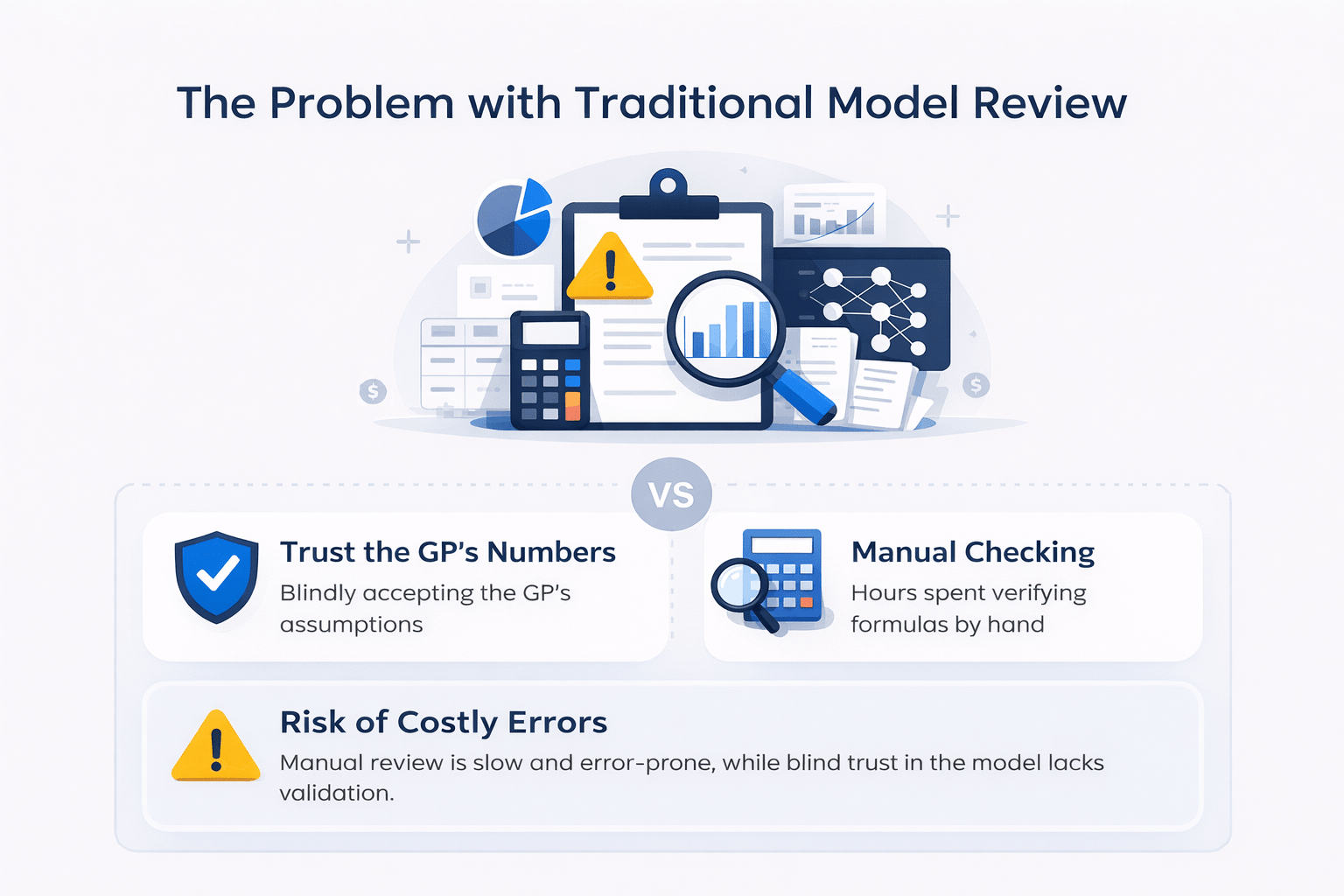
Most LPs follow one of two approaches:
-
Trust the GP’s numbers
-
Spend hours manually checking formulas
Both options come with risk. Manual review is slow, and errors are easy to miss. At the same time, trusting the model without validation can lead to costly mistakes.
Testing an AI Deal Model Review Workflow
I tested this workflow using a $57 million industrial deal model.
Setup
-
Tool used: Shortcut AI
-
File: GP underwriting model
-
Role prompt: LP reviewing the deal
The goal was simple:
-
Find formula errors
-
Flag aggressive assumptions
-
Compare returns
-
Generate questions for the GP
The entire process took about 10 minutes.
What the AI Found: Formula Errors
The first result was clear—broken formulas across the model.
Key Errors Identified
-
Incorrect going-in cap rate calculation
-
Wrong stabilized cap rate
-
Sign error in loan payoff
-
IRR references pointing to incorrect cells
-
Tenant improvement costs using the wrong square footage
-
Broken sensitivity table references
These were not judgment calls. There were actual calculation errors in a model already shared with investors.
Formula Audit Summary
| Issue Type | Impact on Model |
|---|---|
| Cap Rate Errors | Misstated valuation |
| Loan Payoff Sign Error | Incorrect equity waterfall |
| IRR Reference Issues | Wrong return calculations |
| Cost Input Errors | Misstated expenses |
| Sensitivity Table Errors | Invalid scenario analysis |
The Return Discrepancy
After fixing the formulas, the AI compared returns.
GP Stated Returns
-
18.9% IRR
-
2.1x equity multiple
-
8.2% cash-on-cash
AI Findings
None of these numbers matched:
-
Not the original model
-
Not the corrected model
This suggests the returns likely came from an earlier version of the model.
Why This Matters
This doesn’t always mean bad intent. However, it creates a serious risk for LPs if not identified early.
Aggressive Assumptions vs Market Reality
The AI also reviewed assumptions against market data.
Key Flags
-
Exit cap rate at 5% vs 8.9% entry
-
Implied 389 basis points compression
-
Rent growth at 4.5% annually
-
Market rents declining ~10% year-over-year
These assumptions were rated as aggressive compared to current conditions.
Assumption Risk Breakdown
| Assumption Type | Modeled Value | Market Reality | Risk Level |
|---|---|---|---|
| Exit Cap Rate | 5% | Much higher | High |
| Rent Growth | 4.5% | Negative trend | High |
| Hold Strategy | Aggressive | Uncertain | Medium |
| Market Timing | Optimistic | Volatile | High |
The Question List Advantage
One of the most useful outputs was a structured question list.
What It Included
-
20+ deal-specific questions
-
Organized by category
-
Based on actual model data
Example Areas Covered
-
Model inconsistencies
-
Return mismatches
-
Tenant rollover risks
-
Exit assumptions
-
Fee structure
This replaces generic due diligence questions with targeted, deal-specific ones.
How to Run This Workflow
You can replicate this process quickly.
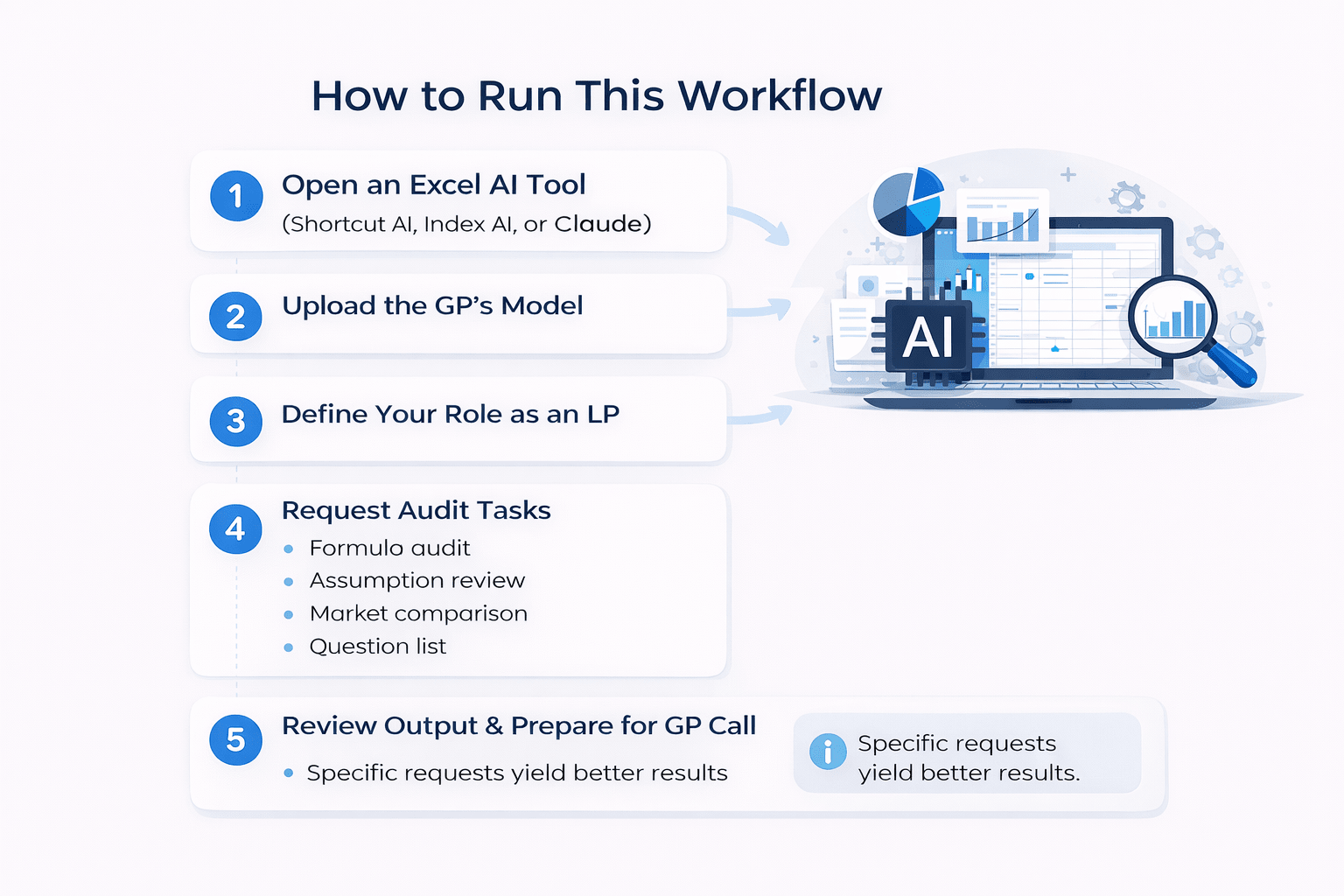
Steps
-
Open an Excel AI tool (Shortcut AI, Index AI, or Claude)
-
Upload the GP’s model
-
Define your role as an LP
-
Request:
-
Formula audit
-
Assumption review
-
Market comparison
-
Question list
-
-
Review output and prepare for the GP call
The more specific your prompt, the better your results.
What It Does Well
-
Finds formula errors quickly
-
Flags unrealistic assumptions
-
Generates structured questions
-
Saves time in due diligence
Where It Falls Short
-
Market data may need verification
-
Fee analysis can be shallow
-
Does not automatically run alternative scenarios
However, these gaps can be addressed with follow-up prompts.
Why This Matters for LPs
This AI deal model review workflow changes how LPs approach due diligence.
Key Benefits
-
Faster model review
-
Reduced risk of errors
-
Better preparation for GP calls
-
More informed investment decisions
Instead of reacting to a model, you can now analyze it proactively.
Time & Efficiency Impact
| Factor | Traditional Review | AI Workflow |
|---|---|---|
| Time Required | Hours | Minutes |
| Error Detection | Inconsistent | High |
| Depth of Analysis | Limited | Structured |
| Preparation Quality | Variable | Improved |
FAQs Regarding AI Deal Model Review Workflow
Can AI audit real estate deal models accurately?
Yes, AI can identify many calculation and logic errors quickly.
-
Detects broken formulas
-
Finds incorrect references
-
Flags inconsistencies
-
Improves review speed
For insights on financial modeling automation, see MIT Sloan (https://mitsloan.mit.edu/).
How reliable is AI for investment analysis?
It is useful for initial review but requires human validation.
-
Strong for error detection
-
Helpful for assumptions
-
Needs oversight
-
Not a final decision tool
Stanford Insights (https://hai.stanford.edu/) explores AI in decision-making.
Can AI replace manual model review?
No, but it significantly improves efficiency.
-
Speeds up analysis
-
Reduces manual effort
-
Improves accuracy
-
Supports better decisions
Deloitte (https://www2.deloitte.com/) covers AI in finance workflows.
What errors can AI detect in Excel models?
AI can catch both formula and logic issues.
-
Broken formulas
-
Incorrect references
-
Data inconsistencies
-
Calculation mistakes
Microsoft Excel resources explain model structures.
Does AI understand market assumptions?
Partially, depending on available data.
-
Compares trends
-
Flags outliers
-
Needs verification
-
Improves with context
CBRE research (https://www.cbre.com/) provides market benchmarks.
Can AI generate due diligence questions?
Yes, and they are often highly specific.
-
Based on model inputs
-
Organized by category
-
Focused on risks
-
Saves preparation time
PwC insights (https://www.pwc.com/) discuss due diligence practices.
How fast is this workflow?
It typically takes around 10 minutes.
-
Upload model
-
Run analysis
-
Review output
-
Prepare questions
McKinsey (https://www.mckinsey.com/) highlights productivity gains from AI.
Is this useful for all LPs?
Yes, from small investors to institutional LPs.
-
Works across deal sizes
-
Scales easily
-
Improves consistency
-
Enhances decision-making
BlackRock insights (https://www.blackrock.com/) explore investment analysis trends.
Start Using This Today
Inside the AI for CRE Collective, 600+ CRE professionals are already using workflows like this to audit GP models, uncover hidden errors, and pressure-test assumptions before committing capital.
Get access to real prompts, full demos, and the 12-month Perplexity Pro access—and start reviewing deal models with more confidence and less time.