How to Use AI for Entitlement Analysis: Complete Guide for CRE Developers
If you’re a developer or investor evaluating a potential project, the entitlement path is one of the biggest unknowns, and this AI CRE entitlement analysis guide shows how to get fast, actionable answers. What does the zoning allow? Which density bonus programs apply? How many applications do you need, and what studies are required before submission? How long will it take, and what are the risks?
Traditionally, you hire an entitlement consultant. That costs $5,000–$15,000 and takes several weeks. That works when you already control a site. But during the deal screening phase, when you’re deciding whether to put a property under contract, you need faster and more affordable answers.
AI tools now make that possible.
After testing Perplexity, Manus, and Claude on real properties in Los Angeles, the results are highly practical. These tools can produce zoning analysis, application checklists, required studies, timelines, and even approval probability estimates in under an hour for less than $10 total.
This guide walks through the exact process, what the outputs look like, where AI performs well, and where you still need professional validation.
Why Entitlement Analysis Is Still One of the Biggest Time Sinks
Every developer knows the pattern. You find a promising site, the numbers look good, and the location works. But before anything moves forward, you need to understand what you can actually build.
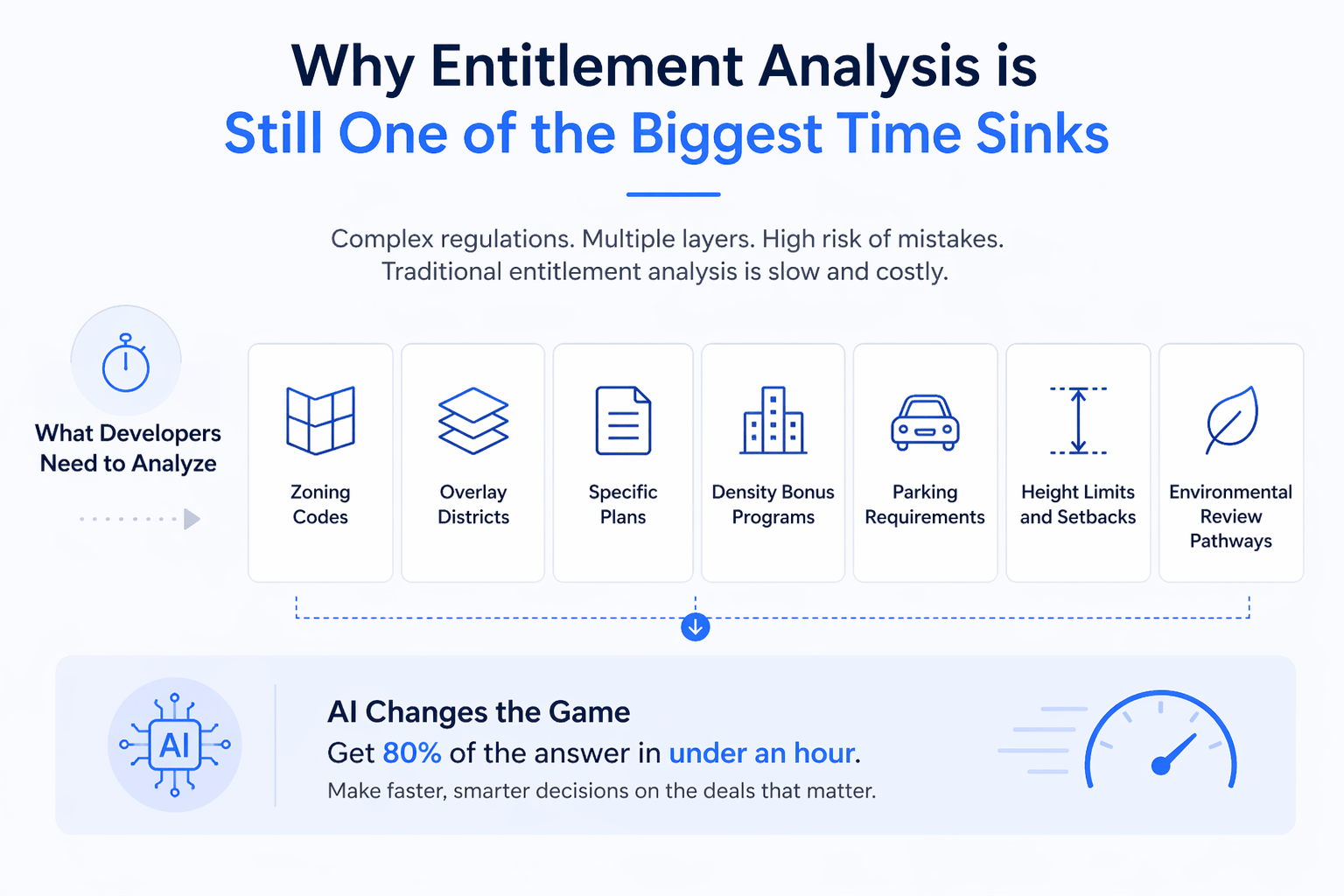
That means analyzing:
-
Zoning codes
-
Overlay districts
-
Specific plans
-
Density bonus programs
-
Parking requirements
-
Height limits and setbacks
-
Environmental review pathways
In cities like Los Angeles, this becomes highly complex. Multiple layers of regulation interact with each other, and even small mistakes in density calculations can break a deal. The traditional solution, hiring a consultant, is still necessary at later stages. But during early screening, it’s too slow and expensive.
AI solves this by giving you 80% of the answer in under an hour, allowing you to quickly decide which deals are worth pursuing. This AI CRE entitlement analysis guide highlights how automation can remove the biggest bottlenecks in early-stage development decisions.
What You’ll Need Before You Start
Before running an AI entitlement analysis, gather the following:
-
Property address
-
Current site use
-
Proposed development (units, stories, parking strategy)
-
Target outputs (zoning, applications, risks, timeline)
-
Preferred format (report or presentation)
The more specific your inputs, the more accurate the results.
Step 1: Write a Prompt That Gets Real Results
This is the most critical step. A generic prompt produces generic answers. A detailed prompt produces usable analysis.
Frame the AI as a senior entitlement consultant with deep experience in municipal planning. Then request jurisdiction-specific analysis based on the actual zoning code and local regulations.
Ask for these deliverables:
-
Zoning and general plan analysis
-
Full entitlement application list
-
Required supporting documents
-
Timeline estimates
-
Risk assessment and approval probability
-
Developer recommendations
Avoid vague requests like “feasibility analysis.” Be precise.
Step 2: Choose the Right AI Tool
Each tool has a different strength.
Claude
Best for detailed written reports and structured output. Produces clean, professional PDFs suitable for lenders or attorneys.
Manus
Best for investor-ready presentations. Creates polished slide decks and visual breakdowns of zoning layers.
Perplexity
Best for research depth. Finds existing entitlements, prior approvals, and hidden deal-critical insights.
Recommendation
If using one tool, start with Perplexity. For higher confidence, run all three and compare outputs. If you want to see how this connects directly to underwriting workflows and real deal evaluation:
How to Set Up Automated Deal Underwriting with AI
Step 3: Run the Analysis and Review Outputs
Each tool typically takes 10–20 minutes.
During execution:
-
Manus browses planning websites in real time
-
Perplexity gathers sources and verifies data
-
Claude structures findings into a report
Once complete, review:
-
Base zoning accuracy
-
Overlay districts
-
Density bonus programs
-
Unit count calculations
-
Required studies
If these are correct, you have a reliable screening output.
Watch how AI tools are used for real CRE research and analysis workflows:
Step 4: Verify What Actually Matters
AI is a screening tool, not a final authority.
Always verify:
-
Density calculations
-
Overlay district constraints
-
Existing entitlements or cases
-
Timeline estimates
-
Fee assumptions
Generally reliable:
-
Application lists
-
Study requirements
-
Overall entitlement pathway
What You Get Back From AI
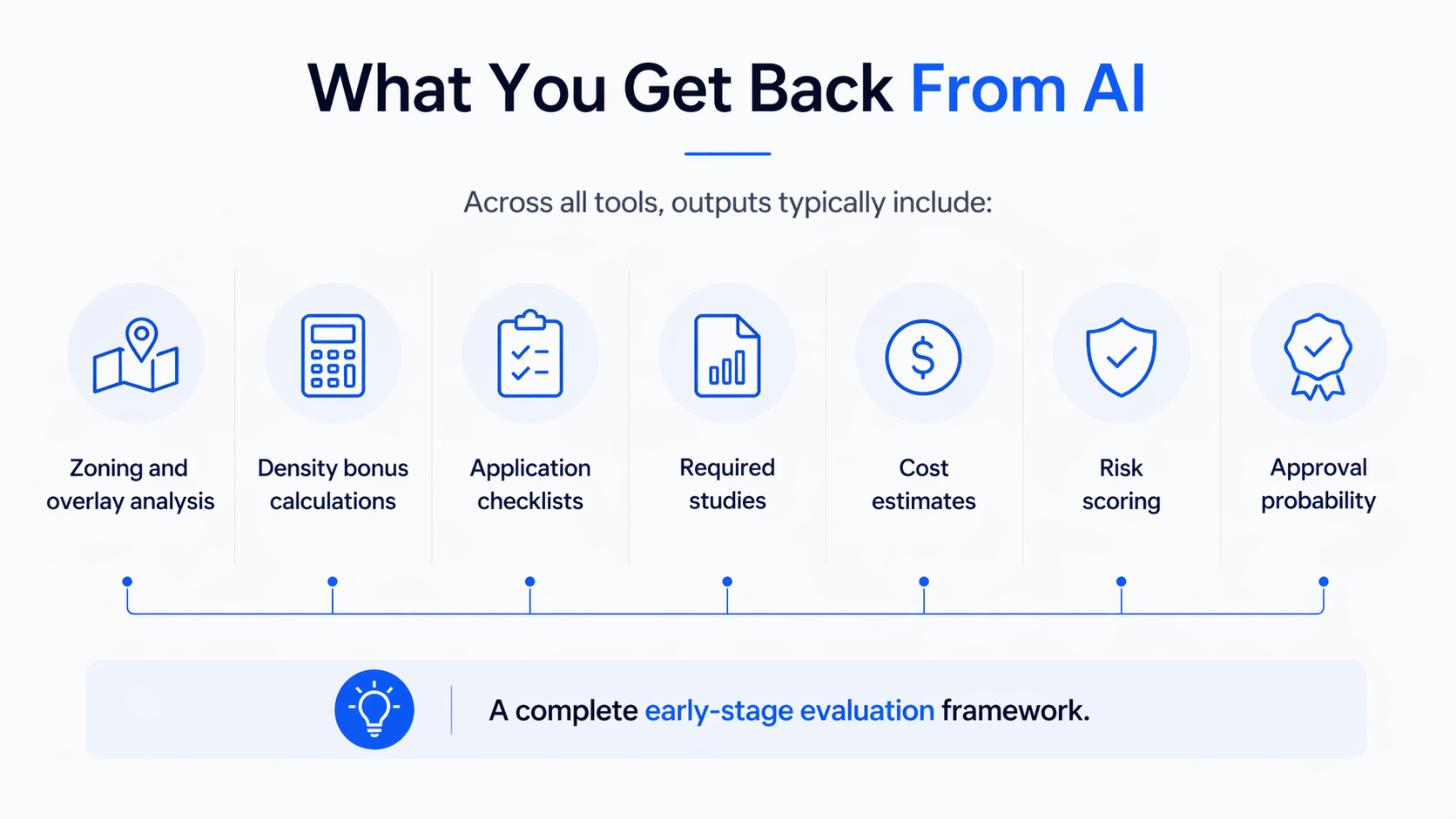
Across all tools, outputs typically include:
-
Zoning and overlay analysis
-
Density bonus calculations
-
Application checklists
-
Required studies
-
Cost estimates
-
Risk scoring
-
Approval probability
This provides a complete early-stage evaluation framework.
Where AI Gets It Right
AI performs well in:
-
Identifying zoning and overlays
-
Mapping entitlement applications
-
Running density calculations
-
Structuring risk analysis
-
Delivering professional outputs
These are the core elements needed for deal screening.
Where AI Falls Short
There are still important limitations:
-
Timeline estimates are often too optimistic
-
ADU opportunities are frequently missed
-
Cost estimates can vary widely
-
Overlay interactions lack deep nuance
These gaps are why a professional review is still necessary.
Time Comparison: AI vs Traditional Consultant
| Step | AI Approach | Traditional Approach |
|---|---|---|
| Initial research | 10–20 minutes | 1–2 weeks |
| Full analysis | < 1 hour | 2–4 weeks |
| Cost | ~$2–$15 | $5,000–$15,000 |
AI dramatically improves speed and cost efficiency for early-stage decisions.
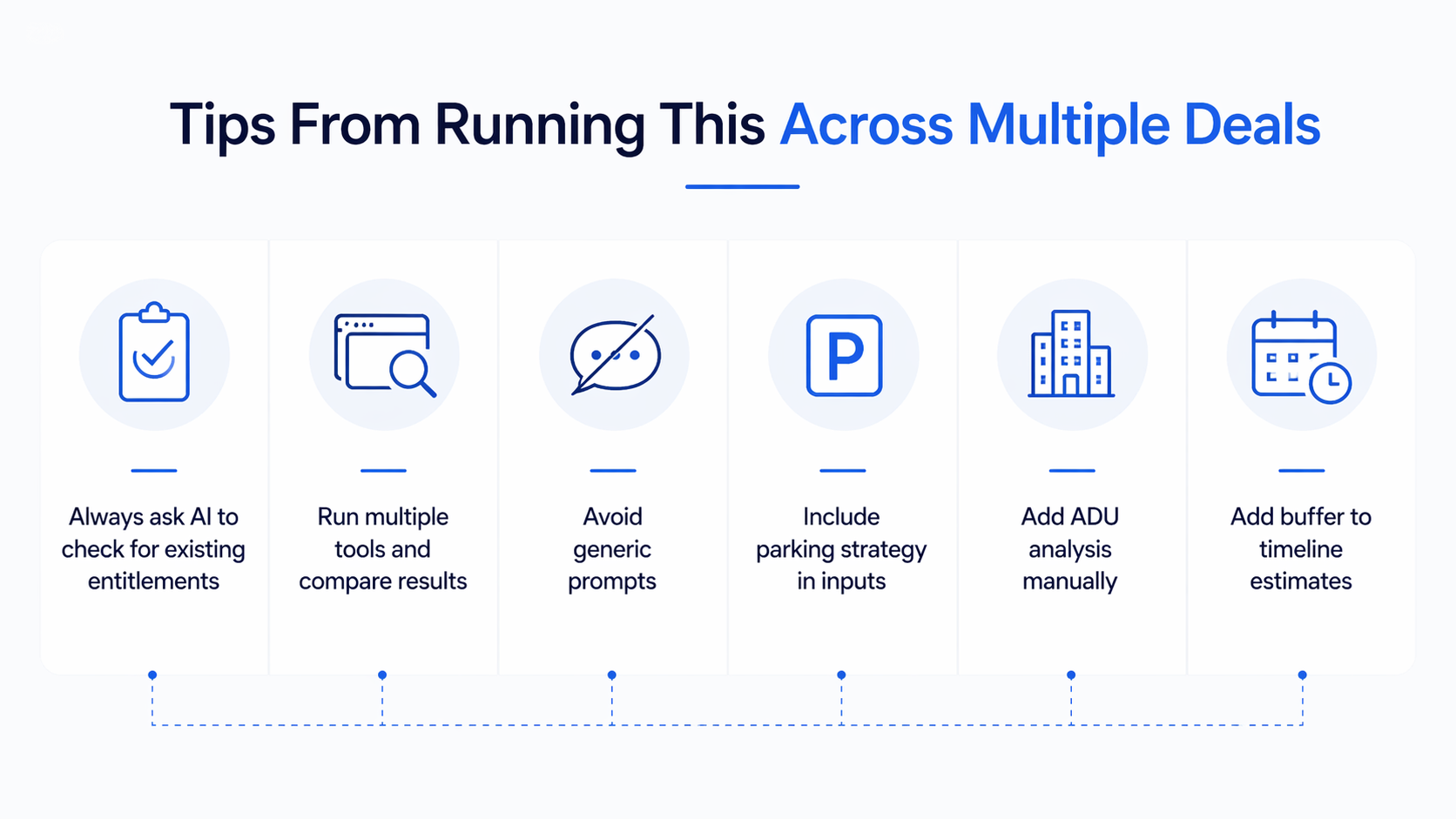
Tips From Running This Across Multiple Deals
-
Always ask AI to check for existing entitlements
-
Run multiple tools and compare results
-
Avoid generic prompts
-
Include parking strategy in inputs
-
Add ADU analysis manually
-
Add buffer to timeline estimates
How to Use This by Role
Developers
Use AI to screen sites before hiring consultants.
Acquisitions Teams
Integrate entitlement analysis into deal underwriting.
Investors
Validate sponsor assumptions independently.
Brokers
Include AI analysis in offering materials to increase value.
Conclusion
AI has fundamentally changed how entitlement analysis can be done at the screening stage. Instead of spending weeks and thousands of dollars, you can now generate meaningful insights in under an hour. By following this AI CRE entitlement analysis guide, CRE professionals can evaluate opportunities faster and make more confident investment decisions.
While AI will not replace entitlement consultants, it gives you a powerful tool to evaluate deals faster and more confidently. The real advantage is not just cost savings, it’s speed, clarity, and better decision-making across more opportunities.
Start Using This on Your Next Deal
If you’re still relying entirely on manual processes during deal screening, you’re moving more slowly than necessary. AI gives you the ability to evaluate more opportunities in less time, with better initial clarity.
Inside AI for CRE Collective, 600+ CRE professionals are actively testing workflows like this on real deals every week. If you want access to prompts, demos, and real use cases, subscribe to the newsletter and start applying these strategies immediately.
FAQs Regarding AI CRE Entitlement Analysis Guide
1. Can AI replace entitlement consultants in commercial real estate?
No, AI cannot fully replace entitlement consultants, but it can significantly reduce reliance on them during early-stage analysis.
-
AI can quickly analyze zoning codes, overlays, and development potential using publicly available data
-
It provides fast screening insights that help investors decide whether to pursue a deal
-
However, it lacks deep local knowledge, relationships with planning departments, and real-world negotiation experience
Conclusion: AI is best used as a first-pass decision tool, while consultants remain essential for final approvals and complex cases.
2. How accurate is AI for CRE entitlement and zoning analysis?
AI is highly effective for structured zoning analysis but has limitations in nuanced scenarios.
-
It accurately identifies base zoning, overlays, and permitted uses in most cases
-
It performs well when analyzing clearly documented municipal codes
-
However, it may misinterpret exceptions, discretionary approvals, or recent policy changes
Conclusion: AI provides strong directional accuracy (around 70–85%), but final verification is always required.
3. What is the biggest advantage of using AI for entitlement analysis?
The biggest advantage is speed combined with cost efficiency.
-
AI can deliver a full entitlement analysis in under an hour
-
Traditional consultants may take weeks for similar outputs
-
Costs drop from thousands of dollars to under $20
Conclusion: AI enables faster deal screening, allowing CRE professionals to evaluate more opportunities with less risk.
4. Which AI tool is best for CRE entitlement analysis: Claude, Manus, or Perplexity?
Each tool has a specialized role, and the best results often come from combining them.
-
Claude excels at structured reporting, clean formatting, and investor-ready documentation
-
Manus is strong in creating visual outputs and presentation-style summaries
-
Perplexity provides deeper research by sourcing real-time data and references
Conclusion: For the most reliable results, use Perplexity for research, Claude for output, and Manus for presentation.
5. What kind of projects benefit the most from AI entitlement analysis?
AI is most valuable during early-stage feasibility and acquisition screening.
-
Multifamily development projects benefit from fast density and zoning checks
-
Land acquisition deals gain from quick entitlement feasibility validation
-
Redevelopment projects benefit from understanding overlay and bonus programs
Conclusion: AI is most impactful when deciding whether a deal is worth pursuing before committing capital.
6. What are the main limitations of AI in entitlement workflows?
AI still struggles with highly localized and judgment-based factors.
-
Timeline estimates are often overly optimistic because they lack real-world delays
-
Cost projections can vary due to missing fee structures or outdated data
-
Complex overlay interactions and political factors are not fully captured
Conclusion: AI is strong for structure and speed but weak in real-world nuance and execution risk.
7. How can you improve the accuracy of AI entitlement analysis?
Accuracy depends heavily on how you structure your inputs and prompts.
-
Provide a detailed development scenario, including units, height, and parking strategy
-
Ask for a jurisdiction-specific analysis instead of a general feasibility analysis
-
Run the same query across multiple tools and compare outputs
Conclusion: Better inputs and multi-tool validation significantly improve reliability and confidence.
8. Can AI estimate entitlement timelines and approval probability?
AI can estimate timelines and probabilities, but these should be treated as rough guidance.
-
It analyzes standard approval processes and historical patterns
-
It can identify whether a project is “by-right” or discretionary
-
However, it cannot account for political resistance, community feedback, or staffing delays
Conclusion: AI provides directional estimates, not precise timelines or guaranteed outcomes.
9. How should developers and investors integrate AI into their workflow?
AI should be integrated as the first step in the deal evaluation process.
-
Use AI to screen multiple sites quickly before engaging consultants
-
Incorporate outputs into underwriting models and investment memos
-
Validate high-potential deals with professional advisors
Conclusion: AI enhances efficiency and scale, allowing teams to focus resources on the best opportunities.
10. Does AI work equally well across all cities and markets?
AI performance varies depending on data availability and regulatory transparency.
-
It works best in cities like Los Angeles, where zoning data is well-documented online
-
Mid-sized cities may produce moderately reliable results
-
Smaller or less digitized jurisdictions may lead to incomplete or inaccurate outputs
Conclusion: AI is most effective in data-rich markets and less reliable where information is fragmented or outdated.