AI Cold Calling for Real Estate Explained
AI cold calling for real estate is changing how agents and brokers approach prospecting. Cold calling still works, but the process is becoming faster, smarter, and more efficient. Agents today deal with low pickup rates, long call hours, and inconsistent results. Some days feel productive. Others feel like a waste of time. This is where AI cold calling starts to make sense.
Instead of dialing numbers all day, agents can now use AI to handle the heavy lifting. It helps with calling, script handling, and even filtering leads. As a result, agents spend more time talking to serious prospects instead of chasing cold ones. For commercial real estate professionals, this shift is even more important. Deals are bigger. Cycles are longer. And every conversation matters.
In this guide, you will learn how AI cold calling works, why it is growing fast, and how you can use it in your own process.
Key Stats on AI Cold Calling and Real Estate Prospecting
-
According to McKinsey & Company, AI can increase sales productivity by up to 40%, especially in lead generation and outreach processes.
-
Harvard Business Review reports that companies using AI in sales see 50% more leads and appointments compared to traditional methods.
-
Data from the National Association of Realtors shows that over 70% of agents rely on cold calling and outreach as a primary lead source.
-
Gartner estimates that by 2026, 75% of B2B sales interactions will involve AI tools, including calling and prospecting.
-
A report by Salesforce found that high-performing sales teams are 2.8x more likely to use AI in their workflows.
What Is AI Cold Calling in Real Estate?
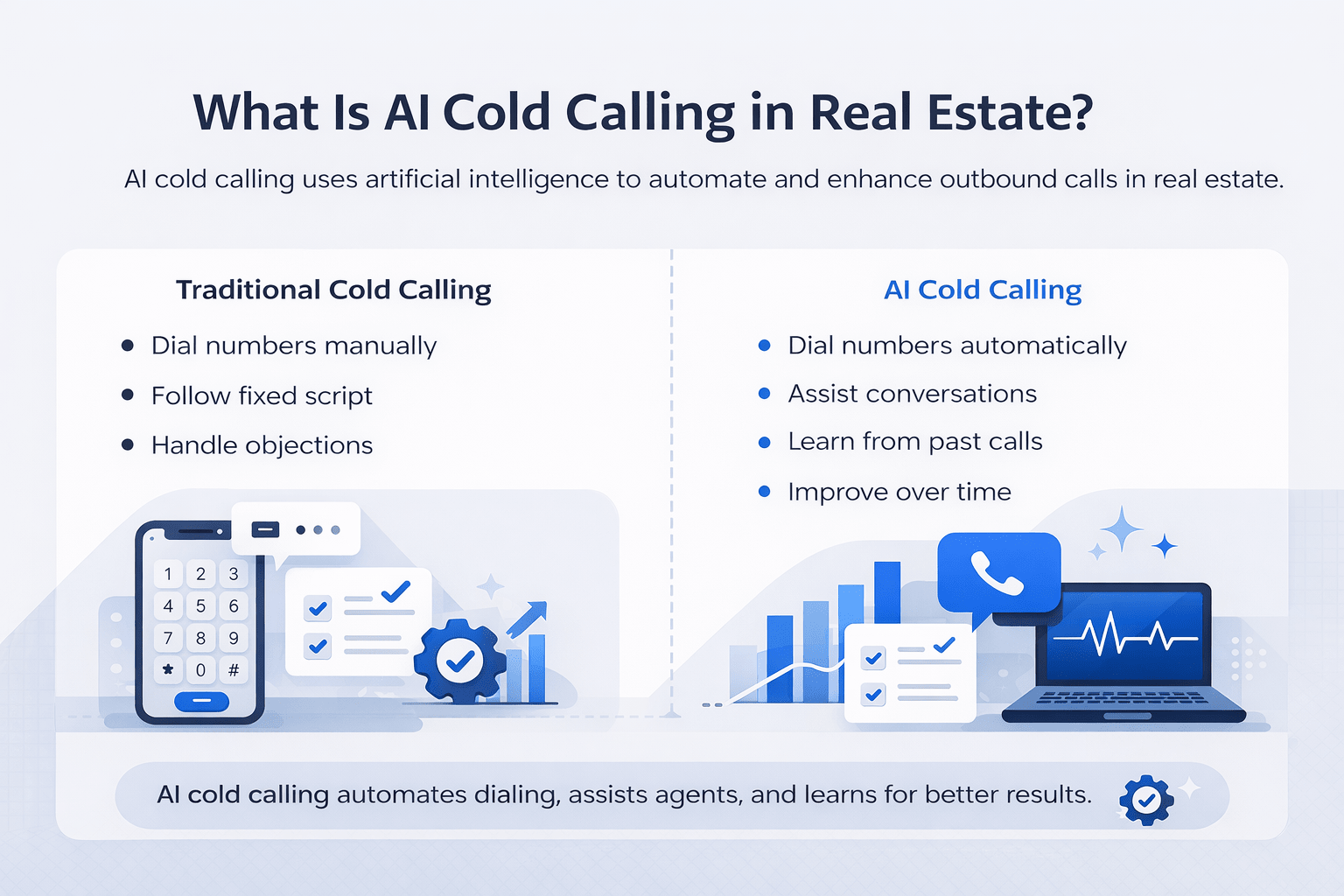
AI cold calling is the use of artificial intelligence to automate and improve outbound calls. It goes beyond simple auto-dialers. It adds intelligence to the process.
In traditional cold calling, agents:
-
Dial numbers manually
-
Follow a fixed script
-
Handle objections on the spot
With AI cold calling, the system can:
-
Dial numbers automatically
-
Assist or fully handle conversations
-
Learn from past calls
-
Improve over time
This does not mean agents are removed. Instead, their role shifts. They focus on qualified leads and closing deals. In simple terms, AI helps reduce repetitive work while improving consistency.
How AI Cold Calling Works (Simple Breakdown)
The process is easier than most people think. Here is a basic flow:
-
You upload your lead list into a system
-
The AI dials numbers automatically
-
It follows a script or assists you during the call
-
It records and analyzes each interaction
-
Over time, it improves responses and targeting
Some systems use AI as an assistant. Others use it as a voice agent that can talk to prospects directly. For real estate teams, this means fewer missed opportunities and better use of time.
Key Technologies Behind AI Cold Calling
AI cold calling relies on a few core technologies. You do not need to master them, but understanding them helps.
-
Natural Language Processing (NLP): Helps the system understand and respond to human speech
-
Voice AI: Enables real-time conversations that sound natural
-
Predictive Dialers: Call multiple numbers and connect only to answered calls
-
CRM Integration: Syncs call data, lead status, and follow-ups automatically
These technologies work together to create a smoother calling experience.
Why AI Cold Calling Is Transforming Real Estate Prospecting
Real estate prospecting has always been about volume and timing. The more people you reach, the better your chances. But doing this manually is slow and tiring. AI changes that completely. Instead of increasing effort, you increase efficiency. That is the key difference.
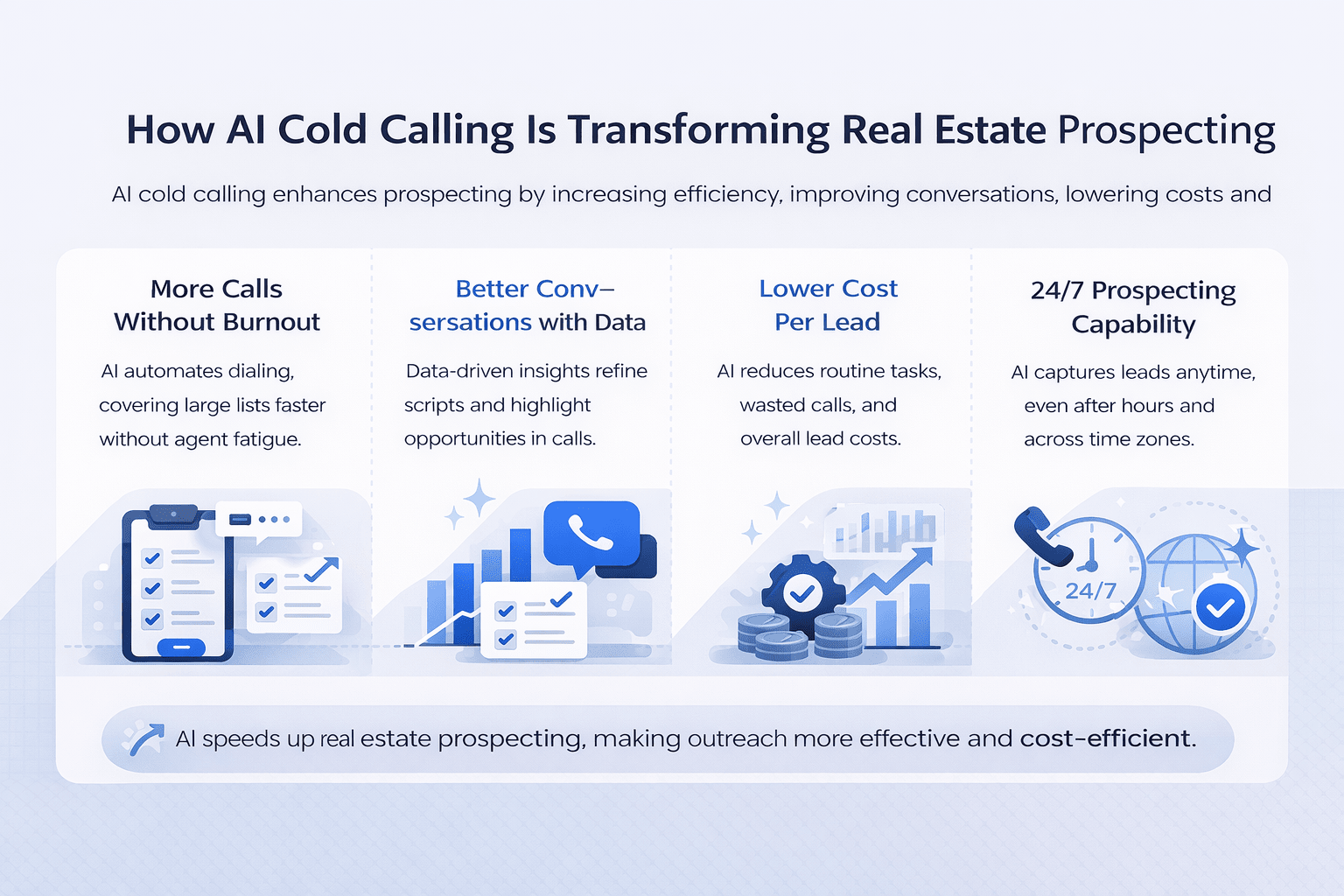
More Calls Without Burnout
Manual calling limits how many people you can reach in a day. Fatigue sets in quickly.
With AI:
-
Calls can run continuously
-
Large lists can be covered faster
-
Agents avoid repetitive dialing
This leads to more conversations without extra effort.
Better Conversations with Data
Most agents rely on experience to adjust their pitch. That works, but it takes time.
AI speeds this up by:
-
Tracking what works and what does not
-
Adjusting scripts based on responses
-
Highlighting patterns in objections
Over time, conversations become more effective.
Lower Cost Per Lead
Hiring and training callers takes time and money. Results can vary.
AI reduces this by:
-
Automating routine tasks
-
Improving consistency
-
Reducing wasted calls
This leads to a lower cost per lead, especially in high-volume outreach.
24/7 Prospecting Capability
Real estate does not always run on a 9–5 schedule. Opportunities can come at any time.
AI systems can:
-
Follow up after hours
-
Reach leads in different time zones
-
Respond instantly to inquiries
This helps capture leads that might otherwise be missed.
Traditional Cold Calling vs AI Cold Calling
To understand the shift, it helps to compare both approaches side by side.
Key Differences
The core difference is simple:
-
Traditional calling depends on human effort
-
AI calling depends on systems and data
This changes how outreach is done and scaled.
Pros and Cons Breakdown
Here is a clear comparison to help you see where each method stands:
| Factor | Traditional Cold Calling | AI Cold Calling |
|---|---|---|
| Call Volume | Limited by human capacity | High volume, automated |
| Consistency | Varies by agent | Consistent across calls |
| Script Handling | Manual and fixed | Adaptive and improving |
| Lead Qualification | Done during call | Automated and data-driven |
| Cost Over Time | Higher (staff + training) | Lower after setup |
| Setup Effort | Low | Moderate (tools + configuration) |
| Personal Touch | Strong | Moderate (can improve with hybrid use) |
Both approaches still have value. In fact, many successful teams combine them.
For example:
-
AI handles initial outreach
-
Humans step in for serious conversations
This hybrid approach often delivers the best results.
How AI Cold Calling Works Step-by-Step in Real Estate
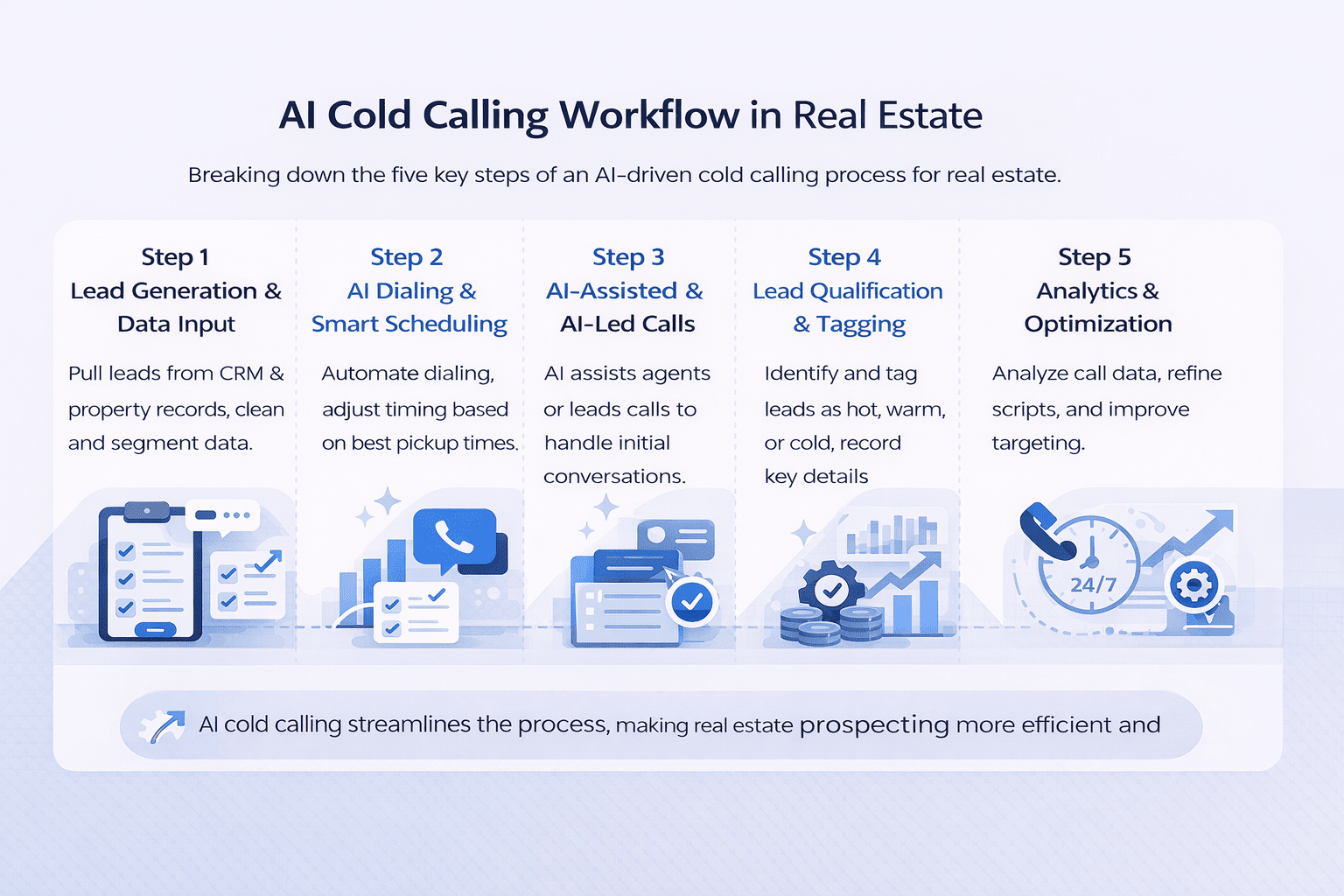
Now that you understand the basics, let’s break this down into a real workflow. Think of AI cold calling as a system. Each step connects to the next. When set up properly, it runs smoothly in the background while you focus on closing deals.
Step 1: Lead Generation and Data Input
Everything starts with data. If your list is weak, results will be weak too.
Most real estate professionals pull leads from:
-
CRM databases
-
Property ownership records
-
Website inquiries
-
LinkedIn or business directories
Before uploading, clean your data:
-
Remove duplicates
-
Verify phone numbers
-
Segment your audience
For example:
-
Property owners
-
Investors
-
Tenants
-
Developers
Clean data improves connection rates and overall performance.
Step 2: AI Dialing and Smart Scheduling
Once your list is ready, the AI system starts dialing.
Instead of calling one number at a time, it:
-
Dials multiple numbers automatically
-
Skips unanswered calls
-
Connects only to live responses
Timing also matters. Good systems adjust call times based on:
-
Past pickup behavior
-
Time zones
-
Industry patterns
This increases the chances of reaching real people.
Step 3: AI-Assisted or AI-Led Conversations
At this stage, the system handles the conversation in one of two ways:
AI-assisted calling
-
The agent speaks
-
AI provides prompts and suggestions
AI-led calling
-
AI speaks directly with the prospect
-
Follows a trained script
-
Responds based on input
For commercial real estate, many teams prefer a hybrid model:
-
AI qualifies
-
Human closes
This keeps conversations efficient but still personal.
Step 4: Lead Qualification and Tagging
Not every lead is worth your time. This is where AI helps most.
During or after the call, the system:
-
Identifies interest level
-
Tags lead as hot, warm, or cold
-
Records key details
For example:
-
Interested in selling
-
Looking for investment opportunities
-
Not interested
This saves hours of manual sorting.
Step 5: Analytics and Continuous Optimization
This is where AI stands out.
Instead of guessing what works, you get real data:
-
Call duration
-
Response rates
-
Objection patterns
-
Conversion rates
Over time, the system:
-
Improves scripts
-
Adjusts timing
-
Refines targeting
The result is a process that gets better with use.
Best Use Cases of AI Cold Calling in Real Estate
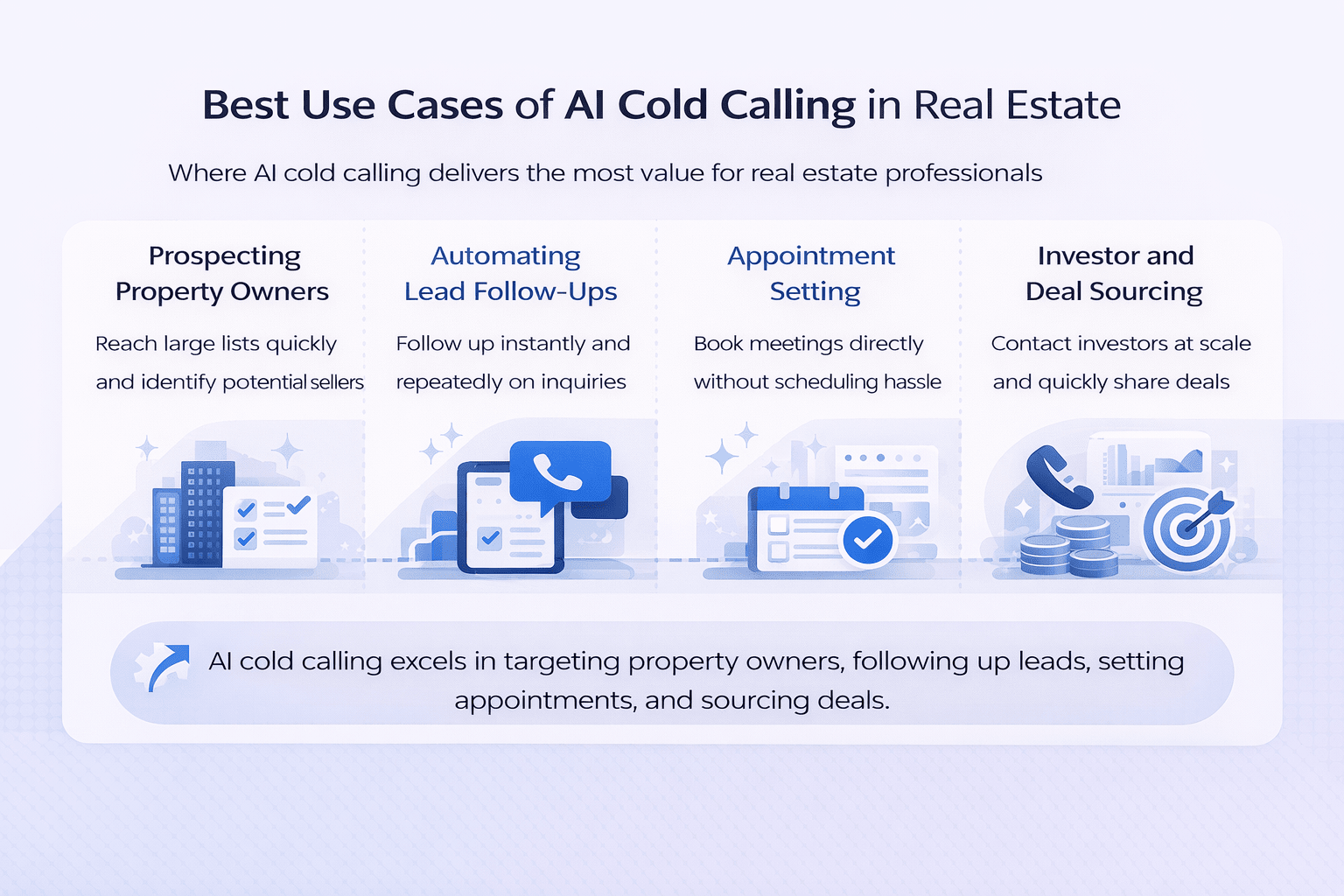
AI cold calling is not just about making more calls. It works best in specific situations. Let’s look at where it delivers the most value.
Prospecting Property Owners
Finding property owners is time-consuming. Calling them manually takes even longer.
AI helps by:
-
Reaching large lists quickly
-
Filtering interested owners
-
Identifying potential sellers
This is especially useful in commercial real estate, where deals take time to surface.
Automating Lead Follow-Ups
Many deals are lost due to slow follow-up.
AI solves this by:
-
Calling leads instantly after inquiry
-
Following up multiple times
-
Keeping communication consistent
This increases your chances of conversion without extra effort.
Appointment Setting
Setting meetings is often repetitive work.
AI can:
-
Ask qualifying questions
-
Suggest time slots
-
Book appointments directly
This frees up agents to focus on meetings, not scheduling.
Investor and Deal Sourcing
Investors are always looking for opportunities. Reaching them at scale is difficult.
With AI:
-
You can contact large investor lists
-
Share deal summaries quickly
-
Identify serious buyers
This speeds up deal matching and improves pipeline flow.
AI Cold Calling Scripts for Real Estate (Examples + Framework)
Scripts are still important. AI does not replace them. It improves them. A good script keeps the conversation clear and focused.
What Makes a High-Converting Script
Strong scripts share a few key traits:
-
Short and direct
-
Clear purpose
-
Easy to understand
-
Focused on value
Avoid long introductions. Get to the point quickly.
Simple AI Cold Calling Script Example
Here is a basic structure you can use:
-
Opening: “Hi, is this [Name]? I’ll keep it quick.”
-
Reason for call: “I’m reaching out regarding your property on [Location].”
-
Value statement: “We’re working with buyers looking for similar assets.”
-
Qualification question: “Would you consider selling if the right offer comes in?”
-
Call to action: “If yes, I can share more details or set a quick call.”
This structure works because it respects time and stays relevant.
How AI Improves Scripts Over Time
This is where AI adds real value.
Instead of using the same script forever, it:
-
Tracks which lines get responses
-
Identifies common objections
-
Suggests better phrasing
For example:
-
If people respond better to shorter openings, AI adjusts
-
If certain questions lead to more meetings, it prioritizes them
Over time, your script becomes sharper without constant manual edits.
How to Build an AI Cold Calling Tool for Real Estate (Step-by-Step)
At this point, you understand how AI cold calling works. The next question is simple: how do you actually set it up? You do not need to be technical. But you do need a clear process. Think of this as building a system, not just using a tool.
Step 1: Define Your Use Case and Goals
Start with clarity. Do not jump into tools yet.
Ask yourself:
-
Do you want more leads?
-
Do you want to book meetings?
-
Do you want to follow up faster?
Each goal needs a different setup.
For example:
-
Lead generation → large lists + simple scripts
-
Appointment setting → qualification + scheduling
-
Follow-ups → timing + consistency
Clear goals help you avoid confusion later.
Step 2: Choose the Right AI Components
An AI cold calling system is not one tool. It is a combination of parts working together.
You will typically need:
-
A voice AI platform (for conversations)
-
A dialer system (for calling at scale)
-
A CRM (to manage leads and outcomes)
Some platforms combine all three. Others require integration. Keep it simple at the start. Avoid complex setups unless needed.
Step 3: Set Up Your Data and Lead Sources
Your system is only as good as your data.
Start by preparing your lead lists:
-
Remove invalid numbers
-
Organize contacts clearly
-
Segment based on type
Common segments in commercial real estate:
-
Property owners
-
Investors
-
Tenants
-
Developers
Segmentation improves targeting. It also helps you create better scripts.
Step 4: Create and Train AI Scripts
This is where most people make mistakes. They either overcomplicate scripts or make them too generic.
Keep scripts:
-
Short
-
Clear
-
Relevant
Then add variations based on:
-
Property type
-
Location
-
Lead intent
For example:
-
Owner script → focused on selling interest
-
Investor script → focused on opportunities
Train your AI using real scenarios. The more context you provide, the better it performs.
Step 5: Integrate With CRM and Workflows
Now connect everything.
Your system should:
-
Log every call
-
Update lead status
-
Trigger follow-ups automatically
For example:
-
Interested lead → assign to agent
-
No answer → schedule retry
-
Not interested → mark and remove
This step turns your setup into a working pipeline.
Step 6: Test With Small Campaigns
Do not launch at full scale right away.
Start with a small batch:
-
50–100 leads
-
Limited script variations
-
Short campaign duration
Watch closely:
-
Call pickup rates
-
Conversation quality
-
Lead responses
This helps you fix issues early.
Step 7: Optimize Using Data
Once your system is running, improvement becomes continuous.
Focus on:
-
Which scripts perform best
-
Which times get more pickups
-
Which segments convert
Make small adjustments:
-
Change opening lines
-
Adjust call timing
-
Refine targeting
Over time, results improve without increasing effort.
Build vs Buy: What’s Better?
One common question is whether to build your own system or use an existing platform.
Here is a simple comparison:
| Option | Best For | Pros | Cons |
|---|---|---|---|
| Build | Large teams, custom workflows | Full control, flexible setup | High cost, technical complexity |
| Buy | Most agents and brokers | Faster setup, easier to manage | Less customization |
| Hybrid | Growing teams | Balance of control and simplicity | Requires some integration effort |
For most real estate professionals, starting with a ready-made solution makes more sense. You can always customize later as your needs grow.
Common Challenges of AI Cold Calling (And How to Solve Them)
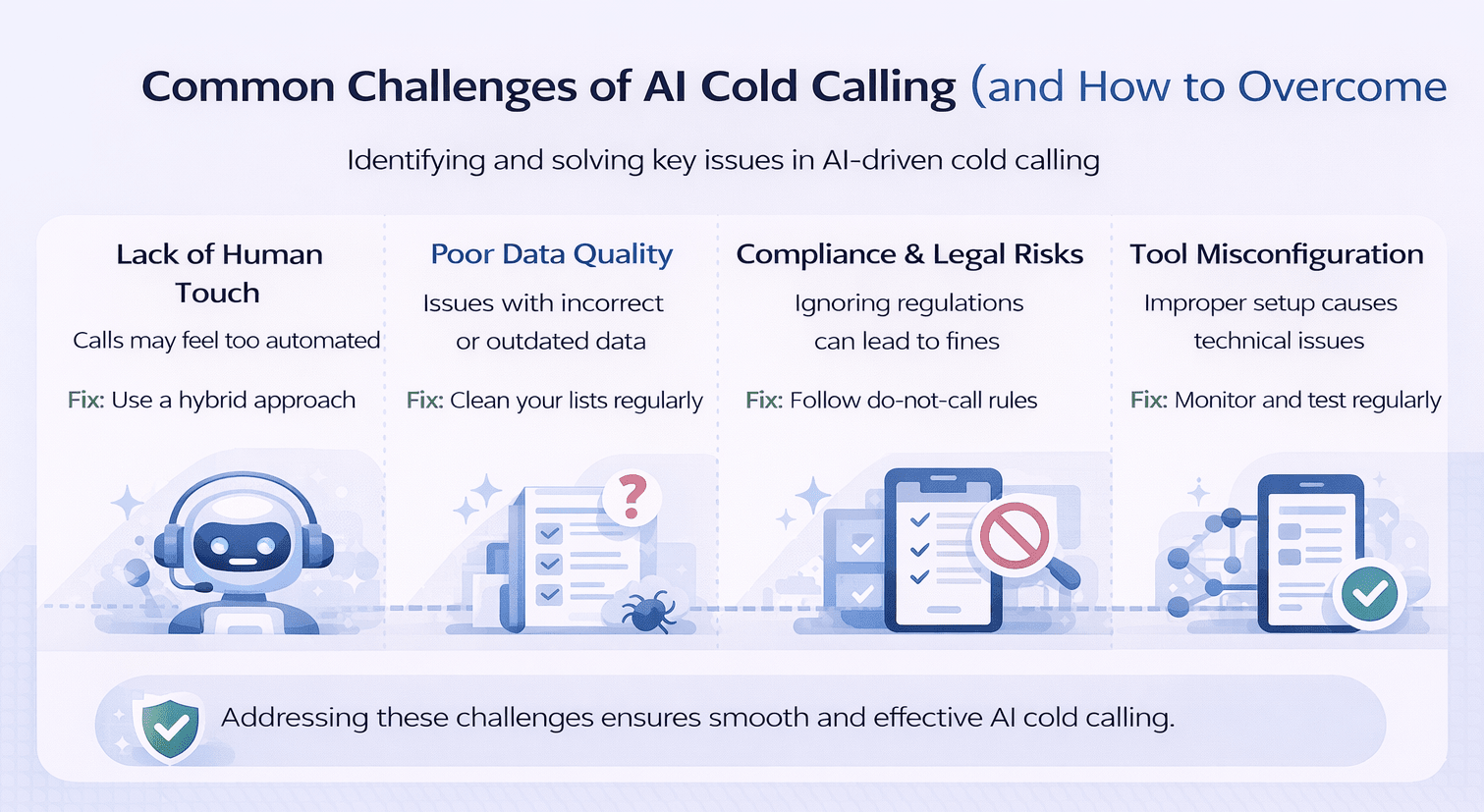
AI cold calling is powerful, but it is not perfect. Most issues come from poor setup, not the technology itself. Let’s go through the common challenges and how to handle them.
Lack of Human Touch
Some prospects can tell when a call feels automated. This can reduce engagement.
To fix this:
-
Use a hybrid approach
-
Let AI handle first contact
-
Transfer serious leads to a human
This keeps efficiency high while maintaining trust.
Poor Data Quality
Bad data leads to bad results. It is that simple.
Common issues:
-
Wrong numbers
-
Outdated contacts
-
Unclear segmentation
Solutions:
-
Clean your lists regularly
-
Use verified data sources
-
Segment properly before calling
Good data improves everything else.
Compliance and Legal Risks
Cold calling is regulated in many regions. Ignoring this can create problems.
Key points to consider:
-
Do-not-call lists
-
Consent requirements
-
Calling hours
Make sure your system follows local rules. This protects your business and your reputation.
Tool Misconfiguration
Many users expect results without proper setup.
Common mistakes:
-
Weak scripts
-
No segmentation
-
No testing
To avoid this:
-
Start simple
-
Test before scaling
-
Monitor performance
Proper setup makes a big difference.
AI Cold Calling Tools and Platforms for Real Estate
There are many tools available. Choosing the right one depends on your needs. Instead of focusing on brand names, focus on features.
Types of Tools
You will usually find three main types:
-
AI voice agents: Handle conversations directly
-
Predictive dialers: Focus on call efficiency
-
CRM-integrated systems: Combine calling with lead management
Each serves a different purpose. Some platforms combine all three.
Features to Look For
When evaluating tools, focus on what actually matters:
-
Real-time conversation handling
-
Easy script customization
-
Call analytics and reporting
-
CRM integration
-
Automated follow-ups
Avoid tools that look complex but lack practical features.
AI Cold Calling Cost Breakdown (Real Estate)
| Cost Component | Typical Range (Monthly) | What It Includes | Best For |
|---|---|---|---|
| Basic AI Dialer Tools | $50 – $150 | Auto-dialing, basic call tracking | Solo agents |
| AI Voice Calling Systems | $200 – $800 | AI conversations, scripts, automation | Growing teams |
| Advanced Platforms | $800 – $2,500+ | Full automation, CRM integration, analytics | Brokerages / large teams |
| CRM Integration Costs | $0 – $200 | Lead management and syncing | All users |
| Call Usage Costs | $0.01 – $0.10 per minute | Outbound call charges | Depends on call volume |
How to Get Started with AI Cold Calling (Beginner Guide)
Getting started does not have to be complicated. Most people delay because they think it requires a full system from day one. It does not.
You can begin with a simple setup and improve over time.
Quick Start Framework
Follow this basic flow:
-
Define your goal
-
Choose a simple tool
-
Upload a small lead list
-
Use a basic script
-
Launch a test campaign
That is enough to get real data.
Do not wait for perfection. Early feedback is more valuable than a perfect setup.
Step-by-Step Beginner Approach
If you want a clearer path, follow this:
Step 1: Start with one use case: Focus on one goal only. For example, appointment setting.
Step 2: Use a small, clean list: Start with 50–100 contacts. Quality matters more than size.
Step 3: Keep your script simple: Avoid long explanations. Short and clear works better.
Step 4: Run calls for a few days: Let the system gather enough data.
Step 5: Review results: Look at:
-
Pickup rates
-
Responses
-
Conversions
Then adjust and repeat.
Best Practices for Better Results
Once you start, small improvements can make a big difference.
-
Call at the right time (late morning or early evening often works well)
-
Keep your tone natural and direct
-
Do not overload scripts with information
-
Follow up consistently
-
Always track results
Consistency matters more than complexity.
AI Cold Calling Strategies for Commercial Real Estate Professionals
Commercial real estate is different from residential. Deals are larger. Timelines are longer. Relationships matter more. Because of this, your AI strategy should be slightly different.
Targeting High-Value CRE Leads
Not all leads are equal. In CRE, a few strong leads can be more valuable than hundreds of weak ones.
Focus on:
-
Office property owners
-
Retail space owners
-
Industrial property investors
Use AI to:
-
Reach them faster
-
Identify interest early
-
Prioritize serious prospects
This helps you spend time where it matters.
Long-Term Follow-Up Systems
Most CRE deals do not close quickly. Some take months or even years. AI helps you stay consistent without extra effort.
You can:
-
Schedule follow-ups automatically
-
Check in at regular intervals
-
Keep communication active
This keeps you top of mind when the timing is right.
Scaling Outreach Without Increasing Costs
Hiring more callers increases costs. But AI lets you scale without doing that.
With the right setup:
-
You can contact hundreds of leads daily
-
Maintain consistent messaging
-
Keep quality under control
This is especially useful for brokerages and growing teams.
Combining AI with Human Expertise
AI works best when paired with human experience. A simple structure works well:
-
AI handles initial outreach
-
AI filters and qualifies leads
-
Agents step in for serious discussions
This balance improves both efficiency and conversion rates.
The Future of AI Cold Calling in Real Estate
AI cold calling is still evolving. What you see today is only the early stage. Over the next few years, the process will become more refined and more natural.
Emerging Trends
Here are a few changes already taking shape:
-
AI conversations are becoming more human-like
-
Systems are improving voice tone and clarity
-
Integration with property data is getting deeper
-
Real-time insights are becoming more accurate
These changes will make outreach smoother and more effective.
AI’s Role in Real Estate Teams
AI is not replacing agents. It is changing how they work.
In most cases:
-
AI handles repetitive tasks
-
Agents focus on relationships and closing
This shift allows professionals to work more efficiently without increasing workload.
How AI for CRE Collective Helps You Master AI Cold Calling
Learning AI on your own can take time. Many tools look simple but require a strategy to use properly. This is where structured training becomes valuable.
What Makes This Approach Different
A focused approach for commercial real estate matters.
Key differences include:
-
Training built specifically for CRE professionals
-
Practical systems, not just theory
-
Real-world examples and workflows
This makes it easier to apply what you learn.
What You Can Expect to Learn
A structured program should help you:
-
Understand AI tools clearly
-
Build and launch campaigns
-
Create effective scripts
-
Improve performance over time
The goal is simple: help you use AI in a way that actually improves your results.
Why Training Matters for AI Cold Calling Success
Many people assume AI tools will work instantly. That is rarely the case. Without proper setup and understanding, results can be poor.
Common Mistakes Without Training
Here are some issues people run into:
-
Using weak or unclear scripts
-
Targeting the wrong audience
-
Not testing before scaling
-
Ignoring data and feedback
These mistakes reduce performance quickly.
Benefits of Proper AI Training
When you understand how to use the system, results improve.
Training helps you:
-
Set up campaigns correctly
-
Write better scripts
-
Interpret data effectively
-
Avoid common mistakes
It also reduces trial and error, which saves time and money.
Final Thoughts: Is AI Cold Calling Worth It?
AI cold calling is not about replacing people. It is about improving how work gets done.
It helps you:
-
Reach more prospects
-
Save time on repetitive tasks
-
Focus on serious opportunities
For commercial real estate professionals, this can be a strong advantage. Those who adopt early often see better efficiency and stronger pipelines. If you approach it with the right setup and strategy, AI cold calling can become a reliable part of your prospecting system.
Want to Start Using AI in Your Real Estate Workflow?
If you are serious about improving your prospecting, learning AI the right way matters. At AI for CRE Collective, the focus is not just on tools. It is on helping you actually use them in real-world scenarios.
Here is what you can do next:
-
Join the community and training platform: Access step-by-step systems, practical workflows, and real use cases designed for commercial real estate professionals
-
Subscribe to the newsletter: Get simple insights, strategies, and updates on how AI is being used in CRE
-
Explore the main platform: Learn how AI can fit into your daily work without overcomplicating things
If you want to stay ahead, this is the direction the industry is moving in. Starting early gives you an advantage.
Frequently Asked Questions About AI Cold Calling in Real Estate
How does AI cold calling actually work in real estate?
AI cold calling works by combining automation with data-driven decision-making. Instead of manually dialing numbers, the system handles outreach using preset workflows.
It typically includes:
-
Uploading a lead list into a CRM or calling system
-
AI dialing numbers automatically
-
Using scripts to guide or handle conversations
-
Tracking responses and updating lead status
Over time, the system improves by analyzing call outcomes. It identifies which messages work best and adjusts accordingly. For real estate professionals, this means less time on repetitive tasks and more time speaking with serious prospects.
Is AI cold calling better than traditional cold calling?
AI cold calling is not always better, but it is more efficient in many cases. It depends on how it is used.
Traditional cold calling:
-
Offers a strong personal touch
-
Allows flexible conversations
AI cold calling:
-
Increases call volume
-
Improves consistency
-
Uses data to refine messaging
Most successful real estate teams use a hybrid approach. AI handles initial outreach and filtering, while agents focus on closing deals. This balance provides both efficiency and relationship-building.
Can AI really replace human agents in cold calling?
AI cannot fully replace human agents, especially in real estate. Deals often depend on trust and relationship-building.
What AI can do:
-
Handle initial outreach
-
Qualify leads
-
Schedule follow-ups
What humans still do best:
-
Build relationships
-
Handle complex negotiations
-
Close deals
AI works as a support system. It removes repetitive work so agents can focus on higher-value tasks.
What type of real estate professionals benefit most from AI cold calling?
AI cold calling is useful for many professionals, but it is especially valuable in commercial real estate.
It benefits:
-
Brokers handling large property portfolios
-
Agents working with investors
-
Developers sourcing deals
-
Teams managing high lead volumes
Because CRE deals take longer, consistent follow-up is key. AI helps maintain that consistency without increasing workload.
How much does an AI cold calling system cost?
Costs vary depending on the platform and setup.
Typical cost factors include:
-
Subscription fees for tools
-
Usage-based calling charges
-
CRM integration costs
Basic systems can start at lower monthly costs, while advanced setups can be more expensive.
However, many users see:
-
Lower cost per lead
-
Reduced staffing costs
-
Higher efficiency
The value often outweighs the cost when used properly.
What are the main challenges of using AI cold calling?
The biggest challenges usually come from setup, not the technology itself.
Common issues include:
-
Poor data quality
-
Weak scripts
-
Lack of proper testing
-
Compliance risks
These can be solved by:
-
Cleaning and segmenting data
-
Keeping scripts simple
-
Running pilot campaigns
-
Following local regulations
With the right setup, most challenges can be managed effectively.
Is AI cold calling legal in real estate?
AI cold calling is legal in many regions, but it must follow local regulations.
Key considerations:
-
Do-not-call lists
-
Consent requirements
-
Allowed calling hours
Rules vary by country and region. It is important to:
-
Check local laws
-
Use compliant tools
-
Maintain proper records
Following guidelines helps avoid legal issues and protects your reputation.
How accurate are AI-generated conversations?
AI conversations have improved significantly, but they are not perfect.
Accuracy depends on:
-
Script quality
-
Training data
-
System setup
Well-trained systems can:
-
Respond clearly
-
Handle basic objections
-
Maintain natural flow
However, complex conversations still require human input. That is why many teams use AI for early-stage interactions and switch to humans later.
What kind of leads work best with AI cold calling?
AI cold calling works best with structured and segmented lead lists.
Strong lead types include:
-
Property owners
-
Investors
-
Business owners
-
Previous inquiries
Leads should be:
-
Relevant to your niche
-
Clearly categorized
-
Up-to-date
Better targeting leads to higher response rates and better outcomes.
How long does it take to see results with AI cold calling?
Results can appear quickly, but optimization takes time.
In the early stage:
-
You may see initial engagement within days
-
Data starts building after a few campaigns
Long-term results depend on:
-
Continuous testing
-
Script improvements
-
Better targeting
Most users see stronger performance after consistent use over a few weeks.
Can AI handle objections during cold calls?
AI can handle basic objections, especially common ones.
For example:
-
“Not interested”
-
“Call me later.”
-
“Send details”
It responds using pre-trained patterns and scripts.
However:
-
Complex objections
-
Negotiation scenarios
are better handled by humans. This is why hybrid systems work best.
Do I need technical skills to use AI cold calling tools?
No, most modern tools are designed for non-technical users.
You typically need to:
-
Upload data
-
Set scripts
-
Launch campaigns
Some setup is required, but it is manageable with basic training.
For more advanced systems, guidance or training can help speed up the process.
How does AI improve cold calling scripts?
AI improves scripts by learning from real interactions.
It tracks:
-
Which lines get responses
-
Where conversations drop
-
Which questions lead to conversions
Then it adjusts:
-
Wording
-
Timing
-
Flow
This makes scripts more effective over time without constant manual editing.
What is the difference between AI-assisted and AI-led calling?
There are two main approaches:
AI-assisted calling
-
The agent speaks
-
AI provides prompts and insights
AI-led calling
-
AI speaks directly with the prospect
-
Follows trained scripts
AI-assisted is better for personal interaction. AI-led is better for scale. Many teams use both.
Can AI cold calling be used for follow-ups?
Yes, follow-ups are one of the best use cases.
AI can:
-
Call leads after initial contact
-
Send reminders
-
Reconnect after weeks or months
This ensures:
-
Consistent communication
-
No missed opportunities
It is especially useful in long sales cycles like commercial real estate.
What CRM systems work with AI cold calling tools?
Most AI tools integrate with common CRM systems.
Typical integrations include:
-
Lead tracking
-
Call logging
-
Status updates
A good integration ensures:
-
Smooth workflow
-
Better data organization
-
Easier follow-ups
Choosing compatible tools is important for efficiency.
How many calls can AI handle in a day?
AI systems can handle a much higher volume than humans.
Depending on the setup:
-
Hundreds of calls per day
-
Simultaneous dialing
-
Continuous operation
This scale is one of the biggest advantages of AI cold calling.
Is AI cold calling suitable for small real estate teams?
Yes, small teams can benefit a lot.
AI helps them:
-
Compete with larger teams
-
Increase outreach
-
Save time
It allows smaller teams to scale without hiring more staff.
What is the biggest mistake people make with AI cold calling?
The most common mistake is a poor setup.
This includes:
-
Using unclean data
-
Writing long or unclear scripts
-
Skipping testing
These reduce effectiveness quickly.
Starting simple and improving gradually works much better.
How can I get the best results from AI cold calling?
To get strong results, focus on the basics first.
Key steps:
-
Use clean and targeted data
-
Keep scripts short and clear
-
Test before scaling
-
Track performance
Also:
-
Combine AI with human follow-up
-
Adjust based on real data
Consistency and improvement matter more than complexity.