How to Build an AI Memory Layer for Your CRE Business
Every commercial real estate professional eventually encounters the same challenge when using artificial intelligence. You open a new chat, ask a question about a property, and quickly realize the AI has no idea who you are, what assets you own, or what deals you’ve been evaluating. As a result, you spend valuable time re-explaining information before getting any useful output. An AI memory layer CRE system solves this problem.
Instead of relying on a chatbot to remember information between sessions, you create a structured knowledge base that stores your portfolio, investment criteria, lender relationships, operating procedures, and deal history. The AI then uses that knowledge whenever you need assistance.
For CRE professionals managing acquisitions, asset management, capital raising, underwriting, and operations, this approach can dramatically improve productivity and decision-making.
What Is an AI Memory Layer?
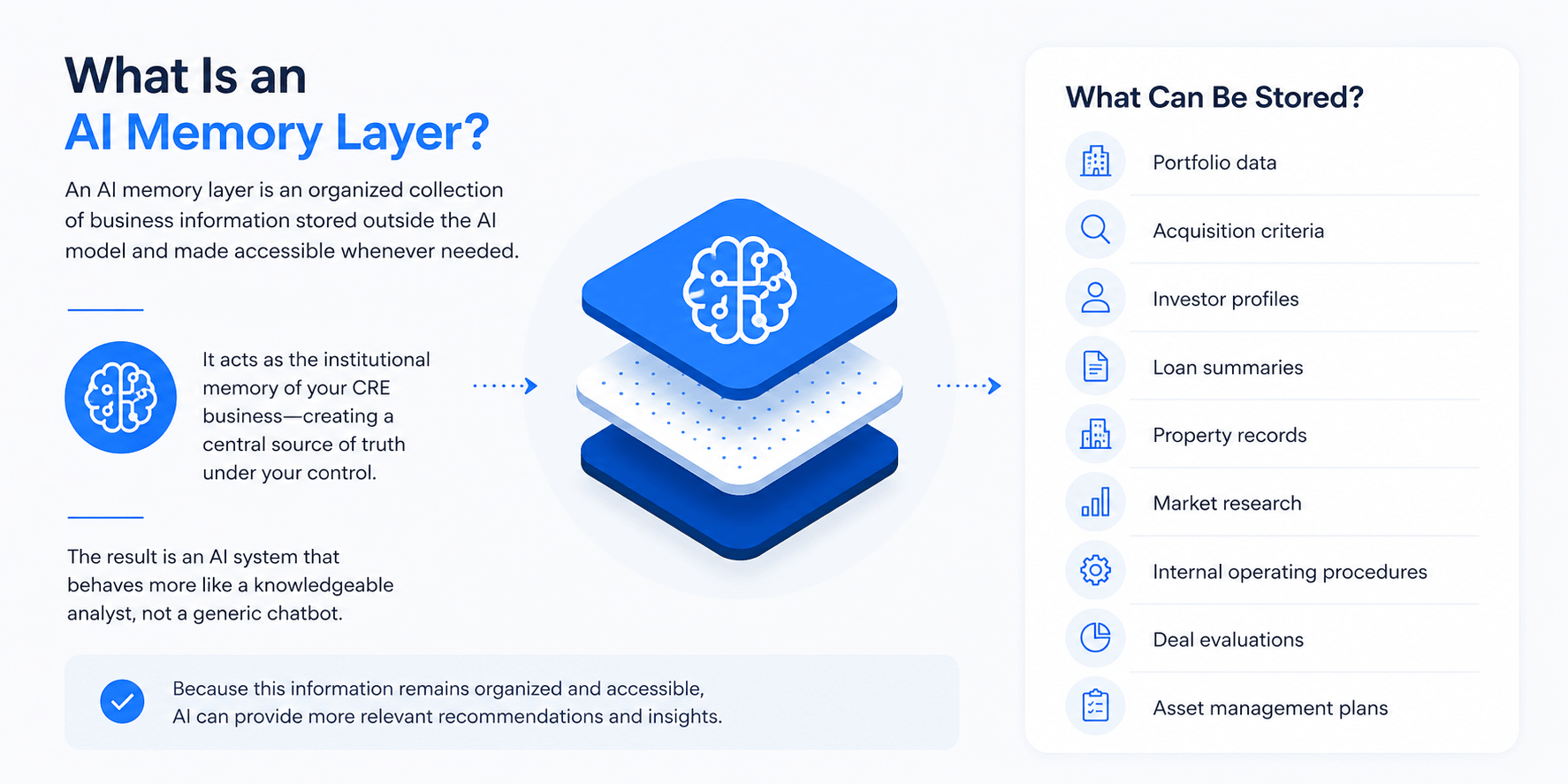
An AI memory layer is an organized collection of business information stored outside the AI model and made accessible whenever needed. Most AI tools are excellent at reasoning but poor at retaining long-term context. Even when memory features exist, they are often limited, inconsistent, or tied to a single platform.
An AI memory layer solves this by creating a central source of truth that remains under your control. Think of it as the institutional memory of your real estate business.
Instead of asking AI to remember your portfolio details, acquisition criteria, or lender relationships, you store that information in files that can be accessed whenever needed. The result is a system that behaves more like a knowledgeable analyst than a generic chatbot.
What Can Be Stored in an AI Memory Layer?
Typical information includes:
-
Portfolio data
-
Acquisition criteria
-
Investor profiles
-
Loan summaries
-
Property records
-
Market research
-
Internal operating procedures
-
Deal evaluations
-
Asset management plans
Because this information remains organized and accessible, AI can provide more relevant recommendations and insights.
Why CRE Professionals Need a Memory Layer
Commercial real estate firms generate an enormous amount of information over time. Every property acquisition, investor update, financing package, market report, and operational decision creates knowledge that can help future decisions.
Unfortunately, much of this information becomes scattered across spreadsheets, emails, cloud drives, CRM systems, and old chat conversations. Without a structured system, AI tools only see a tiny fraction of your business context.
As a result:
-
Teams repeat information constantly
-
Valuable insights become difficult to locate
-
Research gets duplicated
-
Institutional knowledge remains fragmented
-
AI outputs become inconsistent
A memory layer helps consolidate this knowledge into a usable format.
Common Challenges Without a Memory Layer
| Problem | Business Impact |
|---|---|
| Repeating context in every AI session | Lower productivity |
| Information spread across multiple systems | Slower decisions |
| Inconsistent AI outputs | Reduced confidence |
| Lost deal knowledge | Missed opportunities |
The larger the portfolio becomes, the more expensive these inefficiencies become.
How AI Memory Layers Actually Work
An AI memory layer stores structured business knowledge in files that AI systems can access and understand. The process is simpler than most people expect.
Step 1: Store Business Information
Business knowledge is collected and stored in organized files.
Examples include:
-
Property profiles
-
Investment criteria
-
Investor records
-
Market analyses
-
Operating procedures
Step 2: Create Consistent Structures
Each type of information follows a predictable format.
For example, every property profile may contain:
-
Address
-
Asset type
-
Unit count
-
Purchase price
-
Debt details
-
Occupancy
-
Business plan
This consistency allows AI to locate information quickly.
Step 3: Provide Relevant Context
When evaluating a task, the AI reviews the relevant files before generating output. Instead of starting from a blank slate, it starts with business knowledge.
Step 4: Generate Better Results
The AI combines reasoning capabilities with your proprietary data.
This can improve:
-
Acquisition analysis
-
Underwriting support
-
Asset management recommendations
-
Investor communications
-
Market research
The memory layer provides knowledge while the AI provides intelligence.
Why Obsidian Is Ideal for an AI Memory Layer CRE System
One of the most practical tools for building an AI memory layer CRE framework is Obsidian. The primary benefit is not note-taking. The real advantage is ownership and portability. Every note is stored as a plain Markdown file on your computer.
This creates several advantages:
-
You own your data
-
Files remain portable
-
Multiple AI tools can access them
-
No vendor lock-in exists
-
The structure remains future-proof
Today, you may use ChatGPT. Tomorrow, you may use another AI platform. Your knowledge base remains the same.
Why Markdown Works So Well for AI
Markdown is lightweight, structured, and easy for AI systems to process.
| Benefit | Why It Matters |
|---|---|
| Human-readable | Easy to maintain |
| AI-friendly | Simple to analyze |
| Portable | Works across platforms |
| Lightweight | Fast processing |
Because markdown files are open and standardized, they create an ideal foundation for long-term AI knowledge systems.
For teams looking to go beyond simple note-taking, our guide on building an AI stack for CRE shows how tools like NotebookLM and Claude can work alongside a centralized knowledge base.
The Two-Layer Framework Every CRE Firm Should Use
One of the most common mistakes is mixing permanent information with temporary information. A better approach is to separate information into two layers.
Reference Layer
The reference layer contains information that changes slowly.
Examples include:
-
Company strategy
-
Investment criteria
-
Portfolio records
-
Investor information
-
Debt summaries
-
Standard operating procedures
This information may remain useful for years.
Working Layer
The working layer contains active information.
Examples include:
-
Current acquisitions
-
Active negotiations
-
Asset management initiatives
-
Weekly priorities
-
Market opportunities
-
Open tasks
This information changes frequently. Keeping these layers separate helps AI distinguish between long-term facts and short-term activities.
Example Layer Structure
| Reference Layer | Working Layer |
|---|---|
| Portfolio records | Active deals |
| Investor profiles | Current negotiations |
| Debt summaries | Open tasks |
| Company procedures | Weekly priorities |
Designing a Folder Structure That AI Can Navigate
Many professionals overcomplicate their systems. They create dozens of folders and hundreds of subfolders. Eventually, both humans and AI struggle to find information. A simpler approach works better.
Recommended Top-Level Folders
Company Properties Acquisitions Investors Finance and Debt Contacts Market Research Operations Templates. This structure aligns with how most CRE firms already organize information.
Each folder serves a clear purpose. Each file has an obvious destination. As a result, AI can navigate the system more effectively.
The Importance of a Vault README
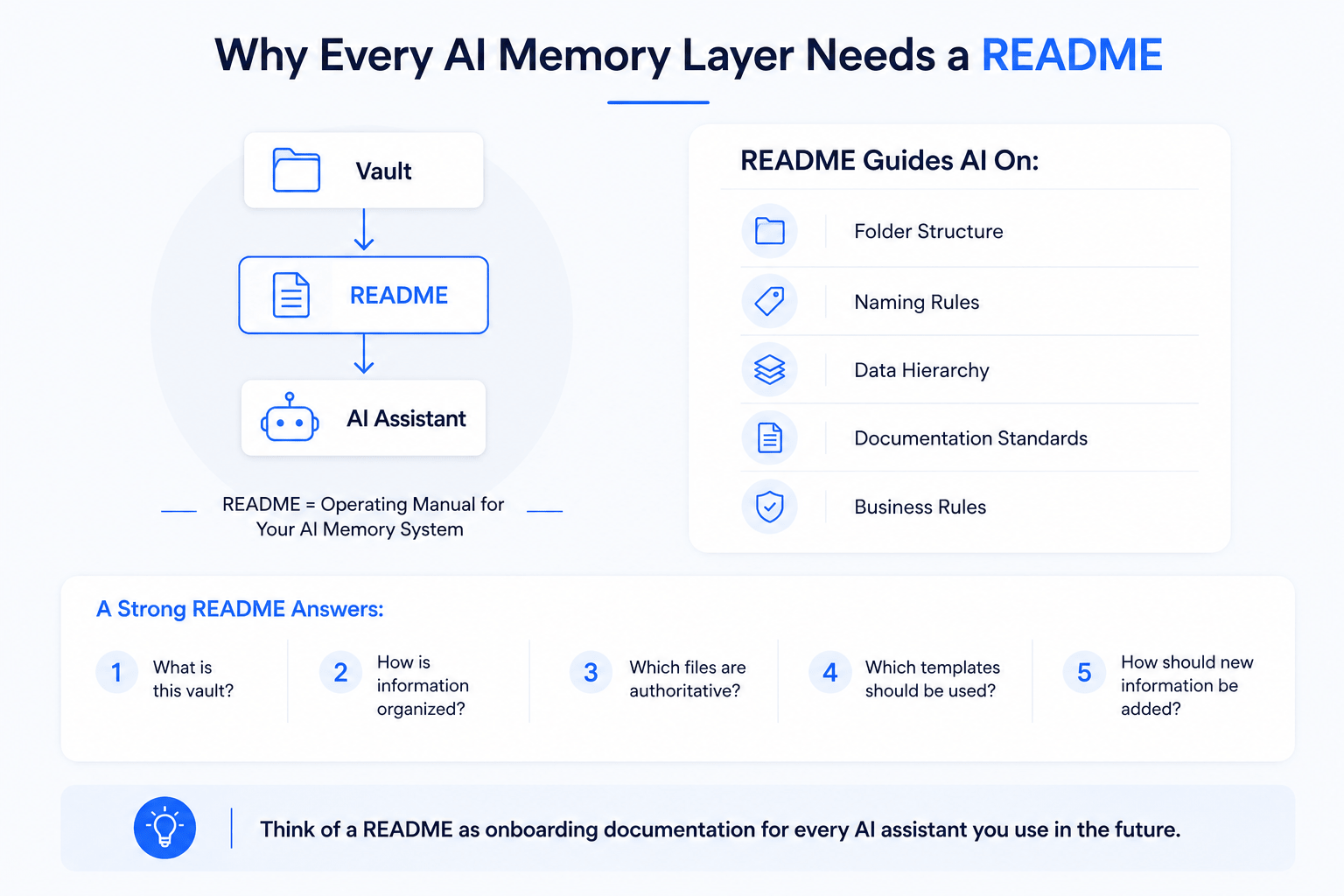
A README serves as the operating manual for your entire AI memory layer. Many people skip this step. That is a mistake. Without instructions, AI must guess how information is organized.
With a README, AI immediately understands:
-
Folder structure
-
Naming conventions
-
Data hierarchy
-
Documentation standards
-
Business rules
What a README Should Include
A strong README should answer:
-
What is this vault?
-
How is information organized?
-
Which files are authoritative?
-
Which templates should be used?
-
How should new information be added?
Think of it as onboarding documentation for every AI assistant you use in the future.
Creating Property Fact Sheets for Instant Context
One of the highest-value components of an AI memory layer CRE system is the property fact sheet. Rather than forcing AI to search through multiple documents, you provide a structured summary of each asset.
Information to Include
Every property file should contain:
-
Property name
-
Address
-
Asset class
-
Acquisition date
-
Purchase price
-
Current valuation
-
NOI
-
Debt balance
-
Occupancy rate
-
Business plan
-
Key risks
-
Growth opportunities
Why Fact Sheets Matter
When AI can access a property fact sheet, it can answer questions quickly and accurately. Instead of reviewing dozens of files, it can immediately understand the asset and provide recommendations based on current information.
This simple practice creates one of the biggest productivity gains in an AI-powered CRE workflow.
Creating Templates for Deals, Investors, and Loans
Once the foundation of your AI memory layer is in place, the next step is creating standardized templates.
Templates ensure information is captured consistently. More importantly, they make it easier for AI to retrieve and analyze information across multiple records.
Without templates, every file looks different. AI must spend time interpreting the structure before it can provide useful insights.
Deal Template
Every acquisition opportunity should have a dedicated deal file.
A deal template might include:
-
Property name
-
Market
-
Asset type
-
Seller
-
Broker
-
Asking price
-
Target purchase price
-
Estimated cap rate
-
NOI
-
Debt assumptions
-
Investment thesis
-
Key risks
-
Next actions
When every opportunity follows the same structure, AI can compare deals much more effectively.
Investor Template
Investor relationships are often stored across emails, CRM notes, and spreadsheets.
Instead, create a single investor profile for each relationship.
Include:
-
Investor name
-
Contact information
-
Investment preferences
-
Typical check size
-
Geographic interests
-
Asset preferences
-
Previous investments
-
Follow-up notes
-
Recent conversations
This allows AI to quickly identify which investors may be suitable for a specific opportunity.
Loan Template
Debt is a major component of CRE operations.
Each loan profile should include:
-
Lender
-
Loan type
-
Original balance
-
Current balance
-
Interest rate
-
Maturity date
-
Extension options
-
Covenants
-
Key contacts
As your portfolio grows, these records become increasingly valuable for refinancing analysis and portfolio management.
Let AI Build the Initial System for You
One of the biggest misconceptions is that building an AI memory layer requires weeks of manual work. In reality, modern AI tools can generate much of the initial structure.
Start With a Clear Prompt
Describe your business.
For example:
“I operate a multifamily investment firm focused on value-add acquisitions in secondary markets. Create a complete knowledge management system for acquisitions, asset management, investors, debt, and operations.”
A capable AI can generate:
-
Folder structures
-
Naming conventions
-
Templates
-
README files
-
Documentation standards
Review Before Implementing
AI can accelerate setup, but you should not blindly accept everything it produces.
Review:
-
Folder organization
-
Naming conventions
-
Data categories
-
Workflow assumptions
The goal is to create a system that reflects how your business actually operates.
Build Incrementally
Many professionals attempt to document everything at once.
That usually fails.
Instead, start with:
-
Portfolio records
-
Active deals
-
Investor profiles
-
Debt records
Once those core areas are functioning, expand gradually.
How an AI Memory Layer Improves Acquisitions
Acquisitions are one of the most valuable use cases for an AI memory layer CRE system. Evaluating opportunities requires context. A generic AI tool lacks that context. Your memory layer provides it.
Faster Deal Screening
Imagine receiving an offering memorandum. Instead of manually comparing the opportunity to your investment criteria, AI can immediately determine whether the deal aligns with your strategy.
It already knows:
-
Target markets
-
Preferred asset classes
-
Unit ranges
-
Return thresholds
-
Risk tolerances
This significantly reduces initial screening time.
Better Market Analysis
If your memory layer includes market research files, AI can compare new opportunities against historical data and previous evaluations.
Rather than treating every deal as an isolated event, it can analyze opportunities within a broader strategic framework.
Improved Investment Committee Preparation
Investment committee presentations often require gathering information from multiple sources.
With a well-structured memory layer, AI can:
-
Summarize property information
-
Identify risks
-
Highlight opportunities
-
Compare similar acquisitions
-
Draft executive summaries
This can save hours of preparation work.
Using AI Memory Layers for Asset Management
Many CRE professionals focus on acquisitions while overlooking operational value. However, asset management may produce even greater long-term benefits.
Portfolio-Level Visibility
When property information is organized consistently, AI can evaluate multiple assets simultaneously.
Examples include:
-
Occupancy trends
-
Rent growth performance
-
Capital expenditure plans
-
Debt maturities
-
Leasing activity
This creates a portfolio-wide perspective that is often difficult to achieve manually.
Operational Insights
As historical information accumulates, AI can identify patterns.
For example:
-
Which renovation projects produced the highest returns
-
Which leasing strategies performed best
-
Which vendors consistently delivered results
Over time, your memory layer becomes a source of operational intelligence.
Faster Reporting
Investor reporting often consumes significant resources.
Because portfolio information already exists inside the system, AI can assist with:
-
Quarterly updates
-
Property summaries
-
Performance commentary
-
Executive reports
The time savings can be substantial.
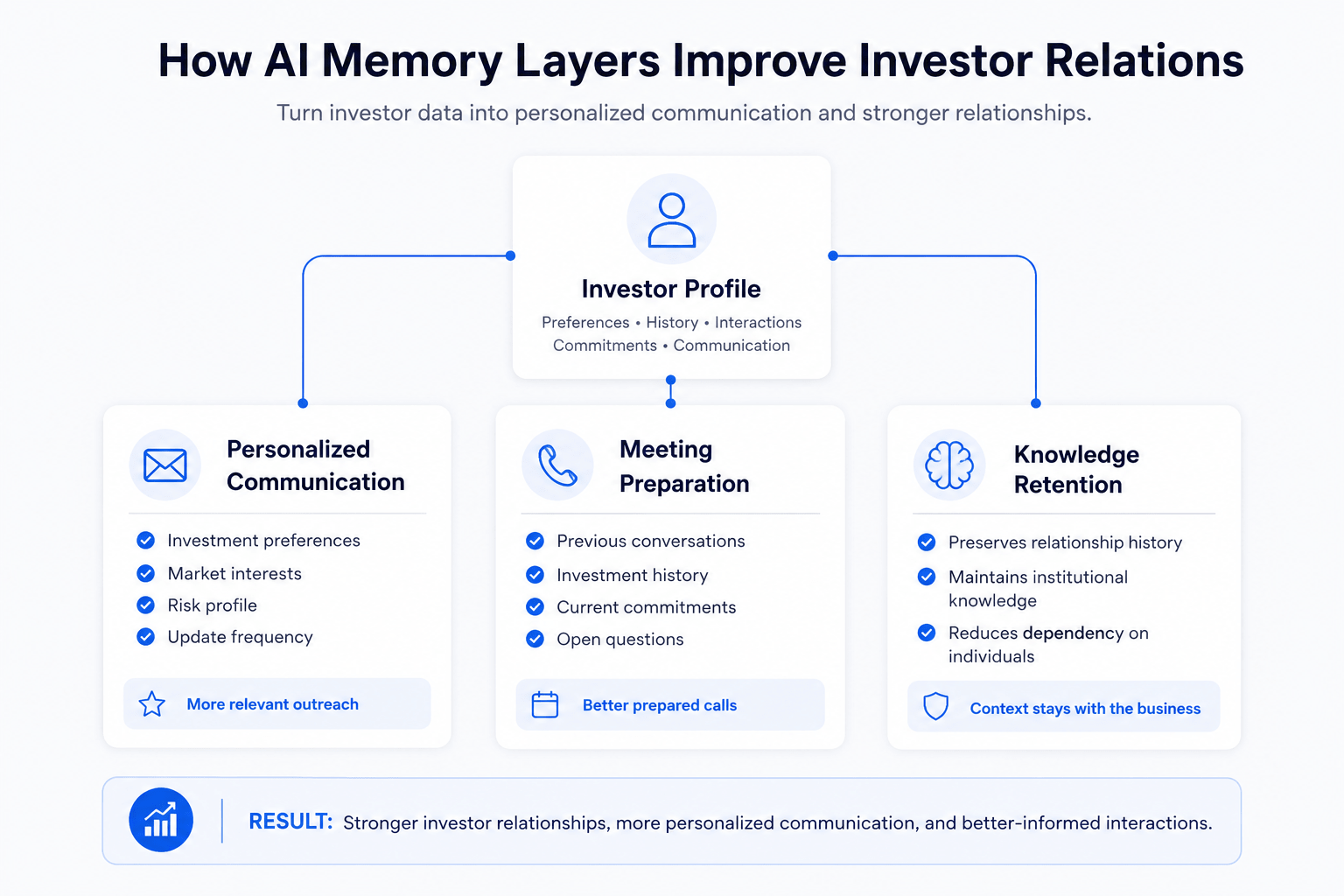
How an AI Memory Layer Helps Investor Relations
Investor communication depends heavily on context. The more investors you manage, the harder it becomes to maintain personalized relationships. An AI memory layer helps solve that challenge.
Personalized Communication
When investor profiles include preferences and historical interactions, AI can help tailor communication.
For example, it may identify:
-
Investors interested in multifamily assets
-
Investors focused on specific markets
-
Investors seeking conservative opportunities
-
Investors who prefer frequent updates
This creates more relevant outreach.
Better Meeting Preparation
Before a call, AI can summarize:
-
Previous conversations
-
Investment history
-
Current commitments
-
Outstanding questions
Instead of searching through emails and notes, you start every conversation fully informed.
Knowledge Retention
Relationships often span years. A memory layer ensures valuable context is preserved even as team members change. Institutional knowledge stays with the organization rather than individual employees.
Common Mistakes When Building an AI Memory Layer
Many projects fail because they become too complex. Avoiding a few common mistakes can dramatically improve success rates.
Creating Too Many Folders
Complex structures seem logical initially. In practice, they create confusion. If people cannot quickly decide where information belongs, the system will eventually become disorganized. Keep structures simple.
Documenting Everything Immediately
Trying to capture years of information at once is overwhelming. Start small. Focus on high-value records first. Build momentum before expanding.
Ignoring Maintenance
An outdated memory layer becomes less valuable over time.
Establish simple processes for updating:
-
Property records
-
Deal files
-
Investor profiles
-
Debt information
Consistency matters more than perfection.
Mixing Reference and Working Data
Permanent information should remain separate from active projects. When everything is mixed together, AI may treat outdated information as current. The two-layer structure prevents this problem.
Security and Privacy Considerations
An AI memory layer contains sensitive business information. That makes security important.
Control Access
Not everyone should access every file.
Establish clear permissions for:
-
Investors
-
Employees
-
Contractors
-
Advisors
Access should match responsibilities.
Store Sensitive Information Carefully
Avoid placing highly sensitive information into systems without proper safeguards.
Examples include:
-
Banking details
-
Personal identification information
-
Confidential legal documents
Maintain appropriate security standards.
Review AI Permissions
Before connecting any AI tool to your knowledge base, understand:
-
What information can it access
-
How information is processed
-
Whether data is retained
-
What privacy controls exist
Your memory layer should increase efficiency without creating unnecessary risk.
Building a Competitive Advantage With Institutional Memory
One of the biggest advantages of an AI memory layer is the ability to learn from historical transactions. This example shows how firms can use accumulated deal knowledge to make better acquisition decisions.
Most firms have access to similar market data. Many have access to the same AI tools. The difference increasingly comes from proprietary knowledge. An AI memory layer transforms scattered information into an organized strategic asset.
Every acquisition reviewed, every investor conversation documented, and every operational lesson captured adds value to the system. Over time, the memory layer becomes more useful because it reflects the unique experiences of your business.
Competitors can subscribe to the same market reports. They cannot replicate years of accumulated institutional knowledge organized specifically for your organization.
As your knowledge base grows, it also becomes a valuable resource for training CRE teams on AI and creating consistent workflows across the organization.
Turn Your CRE Knowledge Into a Strategic Asset
If you’re serious about implementing an AI memory layer CRE system, the biggest mistake is waiting until your information becomes unmanageable. The sooner you start organizing portfolio knowledge, investor records, acquisition data, and operating procedures, the sooner AI can begin creating value from information you already own. Many members of the AI for CRE Collective are building these systems today to streamline decision-making and improve operational efficiency.
Join 600+ CRE professionals who are actively exploring practical AI workflows for acquisitions, asset management, capital raising, and research. If you want implementation guides, real-world examples, and proven frameworks, subscribe to the newsletter and start building a knowledge advantage that compounds over time.
Conclusion
AI is rapidly becoming a standard tool in commercial real estate. However, most professionals still use it as a standalone chatbot rather than as an extension of their business knowledge.
An AI memory layer CRE system changes that dynamic. By organizing portfolio information, investor records, debt details, operating procedures, and deal history into a structured knowledge base, you give AI the context it needs to deliver more accurate and valuable outputs.
The process does not require expensive software or a large technology budget. A simple framework built around markdown files, consistent templates, and clear organization can create a durable foundation for long-term AI adoption.
The firms that gain the most value from AI over the next decade will not necessarily be those using the most advanced models. They will be the ones who successfully combine powerful AI tools with their own proprietary knowledge. An AI memory layer is one of the most practical ways to start building that advantage today.
FAQs Regarding How to Build an AI Memory Layer for Your CRE Business
What is an AI memory layer in commercial real estate?
An AI memory layer is a structured knowledge system that stores business information outside the AI model itself. It gives AI tools access to portfolio data, acquisition criteria, investor records, operating procedures, and historical deal information so they can provide more accurate and context-aware outputs.
-
Stores institutional knowledge in a reusable format
-
Provides consistent context across AI tools
-
Improves the quality of AI-generated analysis
Conclusion: An AI memory layer transforms scattered business information into a long-term strategic asset.
Why do CRE firms need an AI memory layer?
Commercial real estate firms generate large amounts of information across acquisitions, asset management, investor relations, financing, and operations. Without a centralized system, this knowledge becomes fragmented, making it difficult for AI tools to deliver relevant recommendations and insights.
-
Reduces repetitive prompting
-
Improves operational efficiency
-
Helps preserve organizational knowledge
Conclusion: An AI memory layer allows firms to capture and leverage years of accumulated business experience.
How is an AI memory layer different from AI memory features?
Built-in AI memory features are typically controlled by the software provider and may be limited to a specific platform. An AI memory layer is owned and managed by the business, making it portable and usable across multiple AI tools.
-
Provides full control over business data
-
Works across different AI platforms
-
Reduces dependency on a single vendor
Conclusion: An AI memory layer offers greater flexibility and long-term value than platform-specific memory features.
What information should be included in a CRE AI memory layer?
The most valuable information is the data that supports recurring business decisions. This includes property profiles, investment criteria, investor records, debt summaries, operating procedures, market research, and active deal information.
-
Property and portfolio data
-
Investor and lender information
-
Acquisition and asset management records
Conclusion: The best memory layers focus on information that directly supports daily CRE workflows.
Is Obsidian a good tool for building an AI memory layer?
Obsidian is popular because it stores notes as markdown files, which are easy for both humans and AI systems to read. Since the files remain on your computer, you retain ownership and portability while creating a structure that works well with modern AI tools.
-
Uses open and portable file formats
-
Supports flexible folder structures
-
Avoids vendor lock-in
Conclusion: Obsidian provides one of the most practical foundations for building an AI-ready knowledge base.
How long does it take to build an AI memory layer?
Most CRE professionals can create the initial framework in a single afternoon. The greater effort is gradually adding high-value business information and maintaining the system as operations evolve.
-
Start with core business records
-
Expand over time instead of all at once
-
Focus on consistency rather than perfection
Conclusion: Building the structure is quick, while long-term value comes from ongoing use and maintenance.
How can an AI memory layer improve acquisitions?
Acquisition teams frequently evaluate opportunities against predefined criteria. An AI memory layer allows AI tools to understand those criteria and compare new opportunities against previous deals, portfolio goals, and market preferences.
-
Speeds up initial deal screening
-
Improves investment analysis
-
Supports faster decision-making
Conclusion: AI becomes more useful when it understands how your firm evaluates opportunities.
Can an AI memory layer help with asset management?
Yes. Asset managers can use memory layers to organize operational data, property performance metrics, capital improvement plans, and leasing strategies. This enables AI tools to provide more informed recommendations and reporting support.
-
Tracks portfolio performance over time
-
Supports operational analysis
-
Simplifies reporting workflows
Conclusion: Asset management becomes more data-driven when AI has access to structured historical information.
How does an AI memory layer improve investor relations?
Investor relationships depend on context, history, and personalization. A memory layer helps AI understand investor preferences, past conversations, and investment history so communication can be more relevant and efficient.
-
Maintains detailed investor profiles
-
Improves meeting preparation
-
Supports personalized communication
Conclusion: Better context leads to stronger investor relationships and more effective engagement.
What are the biggest mistakes when building an AI memory layer?
Most failures occur when firms create systems that are overly complex or difficult to maintain. Successful implementations prioritize simplicity, consistency, and gradual expansion.
-
Creating too many folders and categories
-
Failing to update information regularly
-
Mixing active and historical information
Conclusion: A simple system that gets used consistently is more valuable than a complex system that is ignored.
Is an AI memory layer secure for sensitive business information?
Security depends on where data is stored and how access is managed. Firms should implement appropriate permissions, review AI platform policies, and avoid exposing highly sensitive information unnecessarily.
-
Control access based on roles
-
Protect confidential business records
-
Understand AI platform privacy settings
Conclusion: With proper governance, an AI memory layer can remain secure while supporting AI-powered workflows.
Will AI memory layers become standard in commercial real estate?
As AI adoption increases, firms are realizing that proprietary knowledge is often more valuable than the AI model itself. Organizations that organize and maintain their data effectively will have a significant advantage over those relying solely on generic AI tools.
-
AI adoption continues to accelerate
-
Institutional knowledge creates competitive advantages
-
Structured data improves AI performance
Conclusion: AI memory layers are likely to become a core component of future CRE operations and decision-making.