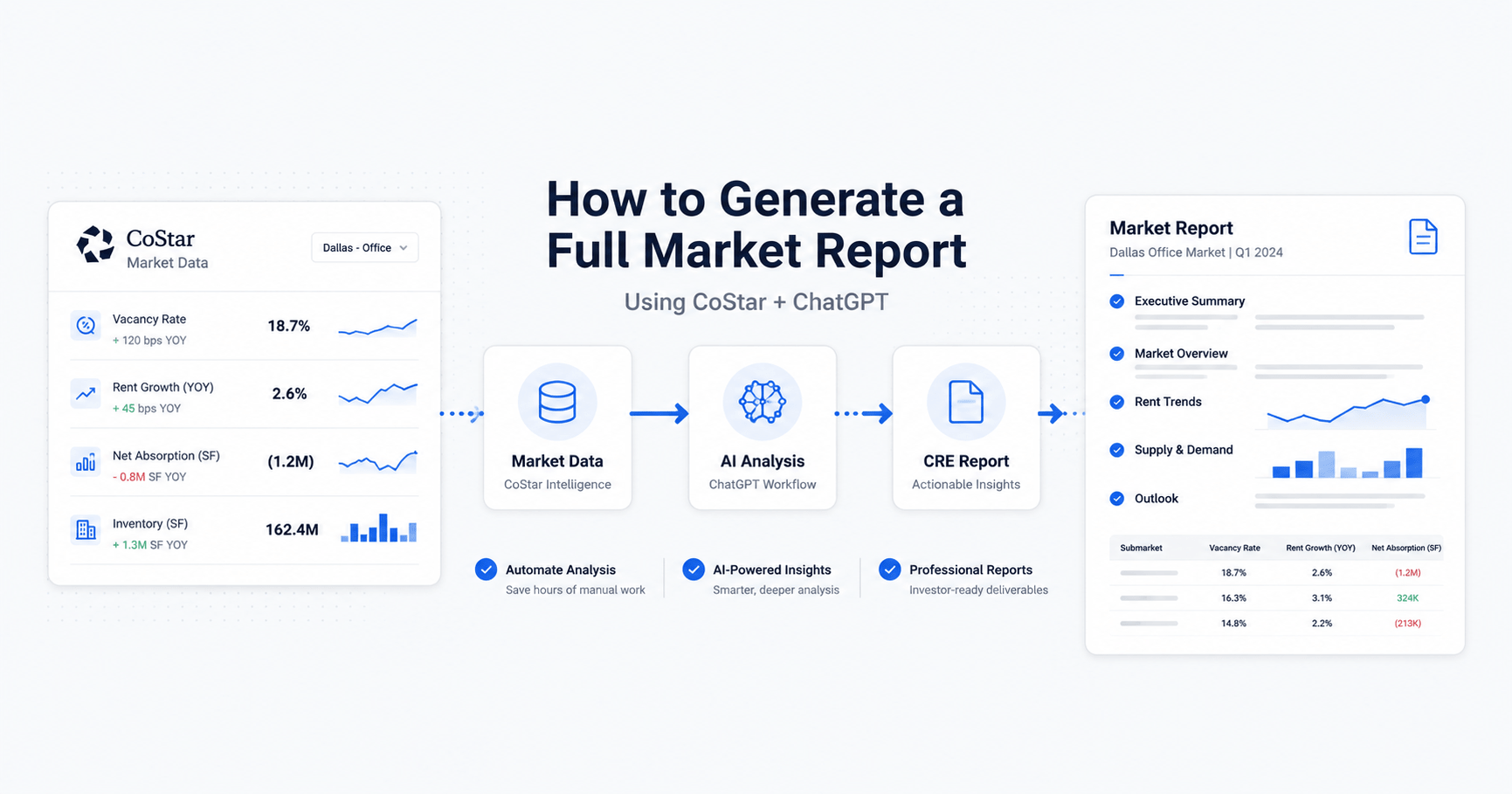
How to Generate a Full Market Report Using CoStar + ChatGPT
Creating commercial real estate reports can be time-consuming. Most professionals spend hours gathering data, analyzing trends, writing summaries, and formatting documents. Today, many brokers, investors, developers, and analysts are using AI Market Reports workflows to speed up this process. By combining CoStar’s market data with ChatGPT’s writing and analytical capabilities, teams can create reports much faster while maintaining quality.
CoStar gives you access to property, market, leasing, sales, and construction data. ChatGPT helps transform that information into readable analysis, executive summaries, and market commentary. The goal is not to replace expertise. Instead, it helps reduce repetitive work so professionals can spend more time reviewing insights and making decisions.
This approach works well for:
-
Broker’s opinion of value reports
-
Investor acquisition reports
-
Market overviews
-
Development research
-
Quarterly asset management reports
-
Client presentations
As AI adoption continues to grow across commercial real estate, firms that build efficient reporting processes can gain a meaningful advantage.
In this guide, you’ll learn exactly how to generate a full market report using CoStar and ChatGPT, from data collection to final presentation.
Key AI & CRE Productivity Statistics
Artificial intelligence is becoming a practical business tool rather than an experimental technology. Commercial real estate professionals are increasingly using AI to support research, reporting, and analysis.
Here are several notable statistics:
-
McKinsey estimates generative AI could add up to $4.4 trillion annually to global productivity.
-
PwC projects AI could contribute $15.7 trillion to the global economy by 2030.
-
Many organizations report significant time savings for writing and research tasks.
-
Real estate firms continue to increase technology spending to improve efficiency.
-
AI-assisted workflows help reduce repetitive administrative work.
Traditional Reporting vs AI-Assisted Reporting
| Task | Traditional Process | CoStar + ChatGPT Process |
|---|---|---|
| Data Collection | Manual research | CoStar export |
| Data Analysis | Manual review | AI-assisted review |
| Executive Summary | Written manually | Generated from prompts |
| Market Commentary | Time intensive | Faster drafting |
| Formatting | Manual organization | Structured workflow |
| Completion Time | Several hours | Significantly faster |
Comparing traditional market reporting with AI-assisted market reporting.
While technology improves efficiency, experienced professionals should always review findings before sharing reports with clients or stakeholders.
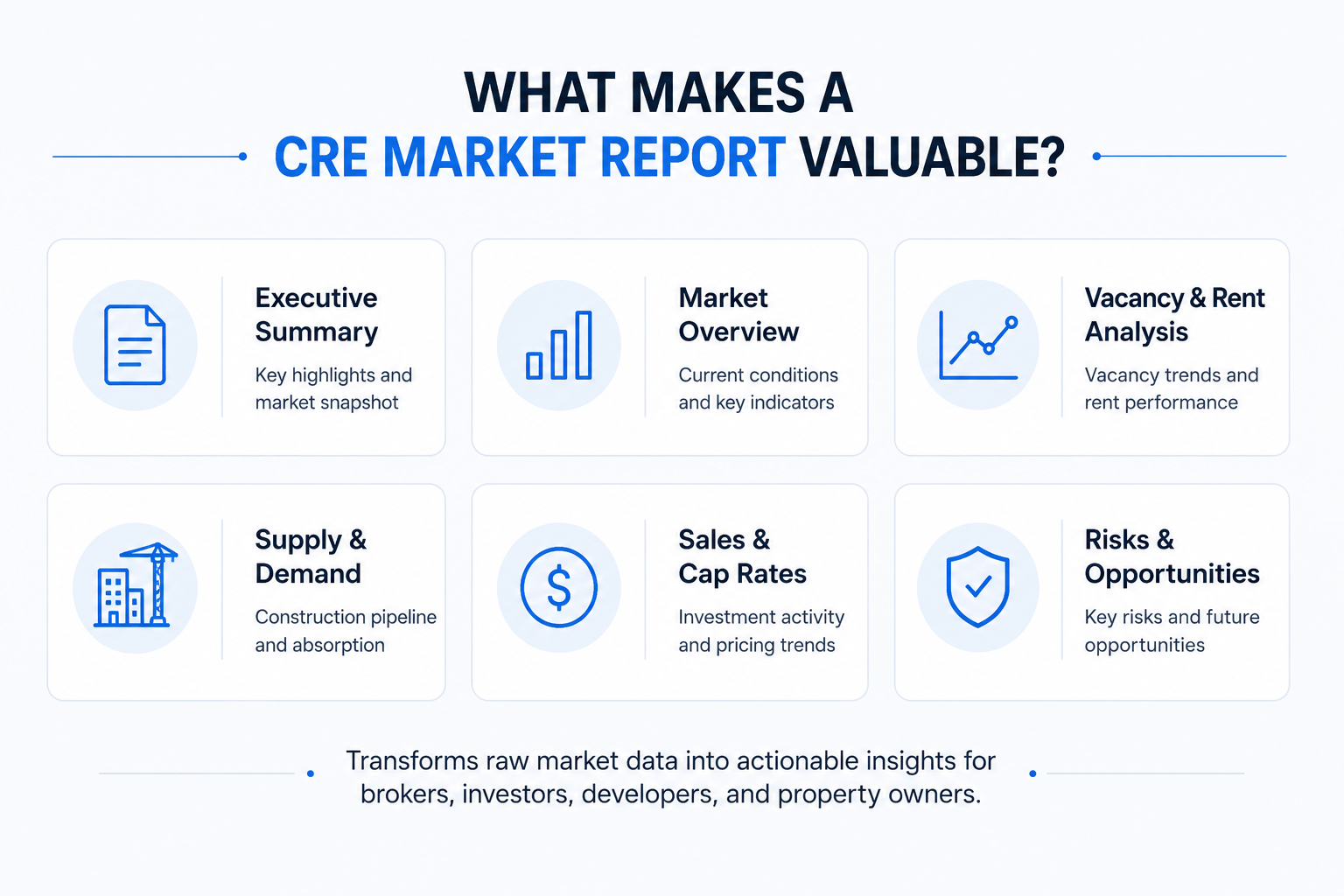
What Is a CRE Market Report?
A commercial real estate market report is a document that explains the current condition of a market, identifies trends, highlights opportunities, and discusses potential risks.
The purpose of the report is to help decision-makers understand what is happening in a market and what those changes may mean for future performance.
Strong AI Market Reports do more than present numbers. They explain the story behind the data.
For example, a vacancy rate by itself provides limited value. Readers also need to understand:
-
Why is the vacancy changing
-
Whether demand is increasing
-
How the new supply affects competition
-
What trends could influence future rents
Core Purpose of a Market Report
A market report helps answer important questions:
-
Is the market growing?
-
Are rents increasing?
-
Is new construction accelerating?
-
Are investors actively acquiring assets?
-
What risks should stakeholders monitor?
The report converts raw data into actionable insights.
Who Uses Market Reports?
Several groups rely on market reports during the investment and development process.
These include:
-
Commercial real estate brokers
-
Investors
-
Developers
-
Asset managers
-
Property owners
-
Lenders
-
Acquisition teams
-
Institutional investors
Each audience focuses on different metrics, but all need reliable market intelligence.
Typical Components of a Market Report
Most professional reports contain:
-
Executive summary
-
Market overview
-
Economic indicators
-
Vacancy analysis
-
Rent analysis
-
Supply and demand trends
-
Construction pipeline
-
Sales activity
-
Cap rate analysis
-
Investment outlook
-
Risks and opportunities
Understanding these sections is important because each can be created more efficiently using CoStar and ChatGPT together.
CoStar provides the market intelligence. ChatGPT helps organize that information into clear and professional AI Market Reports that are easier for clients, investors, and stakeholders to understand.
Why CoStar + ChatGPT Is a Powerful Combination
Commercial real estate professionals have access to more data than ever before. The challenge is not finding information. The challenge is turning that information into useful insights and presenting it in a format clients can understand.
This is where CoStar and ChatGPT work well together.
CoStar is designed to collect and organize market data. ChatGPT helps analyze that information and transform it into professional content. When combined, they create a practical workflow for building AI Market Reports faster and more consistently.
What CoStar Does Best
CoStar remains one of the most widely used data platforms in commercial real estate because of its extensive market coverage.
It helps users access:
-
Vacancy rates
-
Rent trends
-
Absorption data
-
Construction pipeline activity
-
Sales transactions
-
Cap rate trends
-
Market forecasts
-
Property comparables
Instead of searching multiple sources, professionals can gather most of their market data from a single platform.
For market reporting, CoStar serves as the foundation. The quality of your report depends heavily on the quality of the data you collect.
What ChatGPT Does Best
While CoStar provides data, ChatGPT helps explain what the data means.
For example, a market may show:
-
Vacancy increasing from 7% to 9%
-
Rent growth is slowing from 5% to 2%
-
Construction deliveries reaching a five-year high
Most clients do not want to study spreadsheets. They want a clear explanation.
ChatGPT can help create:
-
Executive summaries
-
Market commentary
-
Trend explanations
-
Investment outlooks
-
Risk assessments
-
Report conclusions
This is one reason many professionals are incorporating AI Market Reports into their reporting process.
Why Neither Tool Is Enough Alone
Some professionals expect AI to replace market analysis completely. Others believe data platforms alone provide everything needed.
In reality, both tools have limitations.
| Function | CoStar | ChatGPT |
|---|---|---|
| Market Data | Excellent | Limited |
| Property Data | Excellent | Limited |
| Trend Analysis | Good | Excellent |
| Writing Quality | Limited | Excellent |
| Executive Summaries | Limited | Excellent |
| Local Expertise | User Dependent | User Dependent |
| Final Report Creation | Moderate | Strong |
Comparing the strengths of CoStar and ChatGPT for CRE reporting. CoStar gives you facts. ChatGPT helps communicate those facts. Human expertise connects everything together. The strongest AI Market Reports combine all three elements.
A Simple Example
Imagine you are creating an industrial market report for Dallas.
You export the following information from CoStar:
-
Vacancy rate: 6.1%
-
Rent growth: 4.3%
-
Net absorption: Positive
-
New construction: Increasing
-
Sales activity: Strong
Instead of writing several pages manually, you can provide the data to ChatGPT and request:
-
A market overview
-
A demand analysis
-
A supply analysis
-
An investment outlook
Within minutes, you have a draft that can be reviewed and refined.
This does not eliminate the need for market knowledge. It simply reduces the time spent writing repetitive content.
Common Benefits Reported by CRE Professionals
Teams using AI Market Reports often see improvements in:
-
Reporting speed
-
Consistency across reports
-
Content quality
-
Executive summary creation
-
Client presentation preparation
The biggest advantage is not automation. The biggest advantage is having more time to focus on strategy, client relationships, and decision-making.
What You Need Before Starting
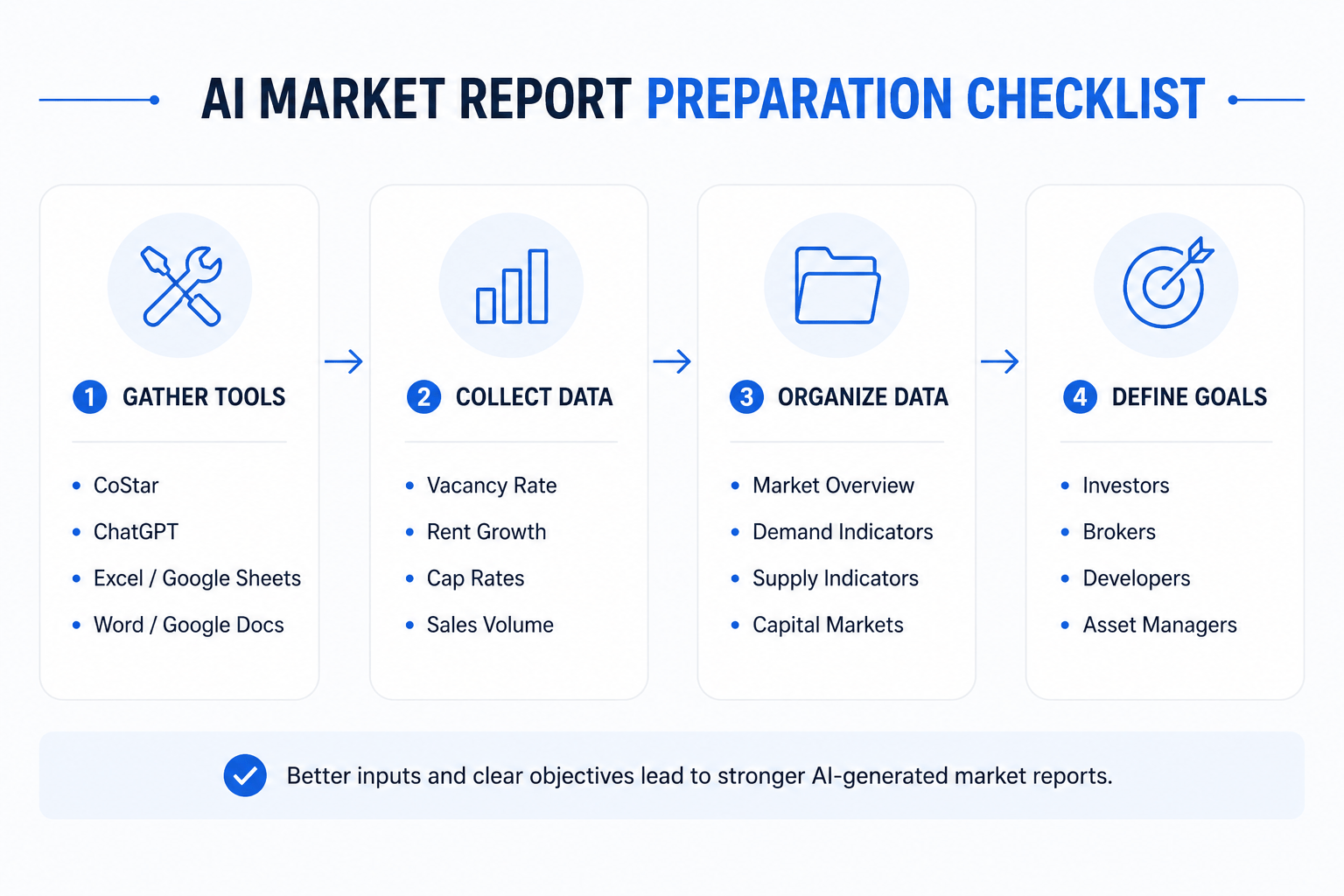
Before creating AI Market Reports, it is important to gather the right tools and data. A structured process will produce better results and reduce editing later.
Required Tools
Most professionals only need four tools:
| Tool | Purpose |
|---|---|
| CoStar | Market data collection |
| ChatGPT Plus | Analysis and report writing |
| Excel or Google Sheets | Data organization |
| Word or Google Docs | Final report formatting |
Basic tools required for AI-assisted market reporting. You do not need complex software or expensive automation platforms to get started.
Data Collection Checklist
Before opening ChatGPT, gather the key market metrics you plan to analyze.
Recommended data includes:
-
Vacancy rate
-
Rent growth
-
Net absorption
-
Inventory levels
-
Construction pipeline
-
Sales volume
-
Cap rates
-
Employment growth
-
Population trends
-
Major market developments
The better your inputs, the better your final report.
Organize Data Before Analysis
One common mistake is copying large amounts of raw data directly into ChatGPT.
Instead, organize information into categories such as:
-
Market overview
-
Demand indicators
-
Supply indicators
-
Capital markets
-
Economic conditions
This makes the analysis more accurate and easier to review.
Establish Reporting Goals
Before generating content, decide who will read the report.
For example:
-
Investors want market opportunities and risks.
-
Brokers want leasing and sales insights.
-
Developers focus on future supply and demand.
-
Asset managers monitor performance trends.
Understanding the audience helps create stronger AI Market Reports and more useful recommendations.
Step 1 – Export Market Data from CoStar
The foundation of strong AI Market Reports is accurate market data. Before using ChatGPT, collect the key metrics that explain market performance.
Select the Right Market
Start by choosing a specific market, submarket, or asset type.
Examples include:
-
Dallas Industrial
-
Phoenix Multifamily
-
Atlanta Office
-
Miami Retail
Keep your market selection consistent throughout the report.
Export Vacancy Data
Vacancy rates help explain market demand and available supply.
Export:
-
Current vacancy rate
-
Historical vacancy trends
-
Year-over-year changes
-
Submarket comparisons
Export Rent Data
Rent performance is one of the most important indicators for investors and owners.
Collect:
-
Asking rents
-
Annual rent growth
-
Historical rent trends
-
Submarket rent comparisons
Export Absorption Data
Net absorption shows how much space tenants are occupying.
Gather:
-
Quarterly absorption
-
Annual absorption
-
Historical absorption trends
Export Construction Pipeline Data
Future supply can influence rents and vacancy.
Include:
-
Properties under construction
-
Planned developments
-
Recent deliveries
-
Pipeline square footage
Export Sales and Capital Markets Data
Investment activity provides insight into market confidence.
Collect:
-
Sales volume
-
Transaction count
-
Price per square foot
-
Cap rate trends
Essential Data Checklist
| Category | Key Metrics |
|---|---|
| Vacancy | Current and historical vacancy |
| Rents | Asking rents and rent growth |
| Absorption | Quarterly and annual absorption |
| Construction | Pipeline and deliveries |
| Sales | Volume, pricing, and cap rates |
| Economy | Employment and population growth |
Core data needed for AI Market Reports. Focus on collecting the data that directly explains market performance rather than exporting every available metric.
Step 2 – Organize CoStar Data Before Using ChatGPT
Once your data is exported, organize it before sharing it with ChatGPT. Clean and structured information produces better results.
Create Clear Data Categories
Group your information into logical sections.
Examples include:
-
Market Overview
-
Demand Indicators
-
Supply Indicators
-
Capital Markets
-
Economic Conditions
This structure helps ChatGPT understand relationships between different metrics.
Remove Unnecessary Information
Before analysis, eliminate:
-
Duplicate fields
-
Empty columns
-
Formatting issues
-
Irrelevant metrics
Cleaner data improves output quality.
Summarize Important Trends
Instead of uploading large spreadsheets, provide key findings.
For example:
-
Vacancy increased from 5.8% to 6.6%.
-
Rent growth reached 4.1%.
-
Net absorption remained positive.
-
Construction activity increased 15%.
This approach helps ChatGPT identify market trends more effectively.
Build a Standard Reporting Framework
Most AI Market Reports follow a similar structure:
-
Executive Summary
-
Market Overview
-
Vacancy Analysis
-
Rent Analysis
-
Supply and Demand
-
Investment Activity
-
Market Outlook
Using the same framework for every report improves consistency and efficiency.
Step 3 – Use ChatGPT to Generate Market Analysis
Once your data is organized, use ChatGPT to transform raw numbers into market commentary. The quality of the prompts often determines the quality of the report.
If you’re interested in how AI can interpret complex real estate data beyond reporting, this demo shows how underwriting and analysis workflows are becoming significantly faster.
Generate a Market Overview
Provide key market metrics and request a summary.
Prompt Example
“Analyze the following market data and write a 150-word overview explaining current conditions, major trends, and market direction.”
Generate Vacancy Analysis
Use vacancy data to explain demand and occupancy conditions.
Prompt Example
“Review the vacancy trends below and explain what they indicate about market supply and tenant demand.”
Generate Rent Growth Commentary
Rent performance is a key factor in most market reports.
Prompt Example
“Analyze the rent growth data and explain its impact on property owners, investors, and future market performance.”
Generate Construction Pipeline Analysis
Construction activity helps readers understand future supply risks.
Prompt Example
“Review the construction pipeline and discuss how upcoming deliveries may affect vacancy and rental growth.”
Generate an Executive Summary
After completing the analysis, create a summary of the most important findings. For example, if you’re working with large market datasets and multiple research sources, this guide on using NotebookLM for CRE reports shows how to organize information before generating executive summaries and market commentary.
Prompt Example
“Using the information below, write an executive summary highlighting opportunities, risks, and overall market outlook.”
Step 4 – Build the Final Market Report
The final step is turning the analysis into a professional document that clients, investors, and stakeholders can easily review. In addition, many professionals enhance reports with location insights using a CRE amenity mapping workflow, helping investors understand nearby demand drivers and market advantages.
Write the Executive Summary
Start with a concise overview covering:
-
Current market conditions
-
Key trends
-
Major opportunities
-
Potential risks
This section should quickly communicate the report’s main findings.
Build the Market Fundamentals Section
Summarize:
-
Inventory
-
Vacancy rates
-
Rent growth
-
Absorption trends
Focus on the metrics that have changed the most.
Explain Supply and Demand Trends
Discuss:
-
Tenant demand
-
New construction
-
Market balance
-
Future supply pressure
Help readers understand how these factors affect performance.
Review Investment Activity
Analyze:
-
Sales volume
-
Pricing trends
-
Cap rates
-
Investor demand
This section provides insight into capital market conditions.
Create the Market Outlook
End the report with a forward-looking perspective.
Cover:
-
Expected rent growth
-
Future vacancy trends
-
Construction impact
-
Investment opportunities
-
Potential risks
Complete a Final Review
Before sharing the report:
-
Verify all data
-
Check calculations
-
Remove repetitive language
-
Add local market context
-
Review charts and tables
-
Confirm conclusions match the data
The best AI Market Reports combine accurate CoStar data, thoughtful analysis, and human expertise. ChatGPT can speed up report creation, but professional review remains essential before delivering the final product.
Conclusion
Creating professional AI Market Reports no longer requires hours of manual writing. By combining CoStar’s market data with ChatGPT’s analytical and writing capabilities, commercial real estate professionals can streamline the reporting process without sacrificing quality.
The workflow is straightforward. First, export reliable market data from CoStar. Next, organize the information into clear categories. Then, use targeted prompts to generate analysis and commentary. Finally, review, refine, and format the report for your audience.
The biggest advantage is not simply saving time. It is creating a repeatable process that produces consistent reports across markets, clients, and property types.
While ChatGPT can help draft content quickly, human expertise remains critical. Market knowledge, local insights, and professional judgment are what turn data into valuable recommendations.
Professionals who learn to combine strong data with effective AI workflows will be better positioned to deliver faster insights and more informed market analysis.
Ready to Improve Your CRE AI Workflow?
Want access to real-world CRE AI workflows, prompt libraries, training sessions, and practical implementation guides? Join the AI for CRE Collective community and see how commercial real estate professionals are using AI in their daily work.
Frequently Asked Questions About AI Market Reports
How do you create a market report using CoStar and ChatGPT?
To create a market report using CoStar and ChatGPT, first export market data from CoStar, including vacancy rates, rent growth, absorption, construction activity, and sales trends. Next, organize the data into categories such as market overview, demand, supply, and capital markets. Then, use ChatGPT prompts to generate analysis, executive summaries, and market commentary. Finally, review the output, verify all figures, and format the report for clients, investors, or internal stakeholders.
What data should be included in a commercial real estate market report?
A commercial real estate market report should include key market fundamentals, demand indicators, supply trends, and investment activity. The most common sections include:
-
Vacancy rates
-
Rent growth
-
Net absorption
-
Construction pipeline
-
Sales volume
-
Cap rates
-
Employment growth
-
Population trends
-
Market outlook
These metrics help explain current conditions and future opportunities within a market.
Can ChatGPT analyze CoStar market data?
Yes, ChatGPT can analyze CoStar market data when the information is provided as text, tables, or summaries. ChatGPT can identify trends, explain market shifts, summarize performance, and generate executive summaries. However, it cannot access CoStar directly. Users must export the data manually and verify all conclusions before publishing reports.
Is ChatGPT accurate for commercial real estate market analysis?
ChatGPT can provide accurate market commentary when supplied with reliable data and clear prompts. However, it should be used as an analysis and writing assistant rather than a replacement for professional judgment. Market reports should always be reviewed by brokers, analysts, investors, or asset managers before being shared with clients or decision-makers.
What is the best AI tool for commercial real estate market reports?
ChatGPT is one of the most effective AI tools for creating commercial real estate market reports because it can quickly summarize data, generate commentary, and draft executive summaries. When combined with data platforms such as CoStar, it helps professionals create reports faster while maintaining consistency and readability.
How long does it take to create an AI-assisted market report?
An AI-assisted market report can often be completed in one to three hours, depending on the amount of data and level of customization required. Traditional reporting methods may take several hours or even multiple days. Using CoStar for data collection and ChatGPT for drafting significantly reduces the time required to produce professional reports.
Can brokers use AI Market Reports for listing presentations?
Yes, brokers can use AI Market Reports to support listing presentations, buyer packages, market updates, and client meetings. These reports help explain local market conditions, leasing trends, investment activity, and future opportunities in a format that is easy for clients to understand.
What are the benefits of using AI for market reporting?
The primary benefits of AI-assisted market reporting include:
-
Faster report creation
-
Consistent report structure
-
Improved productivity
-
Better executive summaries
-
Reduced manual writing
-
More time for client-facing activities
Many commercial real estate professionals use AI to streamline reporting while maintaining data accuracy through human review.
Can AI replace commercial real estate analysts?
No, AI cannot replace commercial real estate analysts. AI can process information, summarize trends, and generate written content, but it cannot fully replicate market expertise, local knowledge, investment judgment, or client advisory skills. The most effective approach combines AI efficiency with human analysis.
What is the biggest mistake when creating AI Market Reports?
The biggest mistake is relying on AI-generated content without verifying the underlying data. Successful AI Market Reports start with accurate market information and end with a professional review. Users should always validate metrics, confirm conclusions, and add local market context before sharing reports with clients or investors.
How often should commercial real estate market reports be updated?
Commercial real estate market reports should typically be updated quarterly, although some firms produce monthly reports for highly active markets. The ideal reporting frequency depends on the property type, market volatility, and intended audience.
For example, investors and acquisition teams often prefer quarterly updates because they provide enough data to identify meaningful trends. Brokers, on the other hand, may create monthly market snapshots to support business development and client outreach.
Regular updates help stakeholders track changes in:
-
Vacancy rates
-
Rent growth
-
Leasing activity
-
Construction pipeline
-
Investment sales
Consistent reporting also makes it easier to compare performance over time and identify emerging market opportunities or risks.
What is the difference between a market report and a market analysis?
A market report presents data, trends, and market conditions, while a market analysis focuses on interpreting that information to support a specific decision.
A market report typically includes metrics such as vacancy, rents, absorption, construction activity, and sales volume. Its goal is to provide a broad overview of market performance.
A market analysis goes a step further by answering questions such as:
-
Is this market attractive for investment?
-
Are rents likely to increase?
-
Is the new supply creating risk?
-
Should a developer move forward with a project?
Most professional commercial real estate reports combine both reporting and analysis to provide readers with data and actionable insights.
What are the most important metrics in a commercial real estate market report?
The most important metrics depend on the property type and audience, but several indicators appear in nearly every commercial real estate market report.
These include:
-
Vacancy rate
-
Rent growth
-
Net absorption
-
Inventory levels
-
Construction pipeline
-
Sales volume
-
Cap rates
-
Employment growth
-
Population growth
Together, these metrics help explain market demand, supply conditions, investment activity, and future performance.
Rather than focusing on a single statistic, professionals should evaluate how these indicators interact. For example, rising vacancy combined with increasing construction activity may signal future pressure on rents, while positive absorption and limited new supply may indicate a stronger outlook.
Can investors use AI Market Reports for acquisition decisions?
Yes, investors can use AI Market Reports as part of their acquisition process, but they should not rely on them as the sole basis for investment decisions.
AI-assisted reports can quickly summarize market conditions, identify trends, and highlight potential opportunities or risks. This helps investors screen markets and properties more efficiently.
However, acquisition decisions should also include:
-
Financial underwriting
-
Property-level due diligence
-
Lease review
-
Tenant analysis
-
Local market research
-
Risk assessment
AI is most valuable when it helps investors process information faster and identify areas that require deeper investigation.
How do you write an executive summary for a market report?
An executive summary should provide a concise overview of the most important findings from the report. It is often the first section readers review and, in many cases, the only section busy executives read in detail.
A strong executive summary should answer four questions:
-
What is happening in the market?
-
Why is it happening?
-
What opportunities exist?
-
What risks should be monitored?
Most executive summaries include:
-
Current market conditions
-
Key performance trends
-
Supply and demand observations
-
Investment activity
-
Future outlook
The goal is to communicate the report’s main conclusions in a clear and easy-to-understand format without overwhelming readers with data.
What makes a commercial real estate market report valuable?
A valuable market report does more than present statistics. It explains what those statistics mean and how they may affect future decisions.
The best reports combine:
-
Reliable market data
-
Clear analysis
-
Local market knowledge
-
Actionable insights
-
Forward-looking commentary
Readers should be able to understand current market conditions, identify opportunities, evaluate risks, and make informed decisions after reviewing the report.
Whether the audience consists of investors, brokers, developers, or asset managers, the most effective reports focus on answering practical questions rather than simply displaying data. That is why many firms are using AI-assisted workflows to improve reporting efficiency while maintaining high analytical standards.