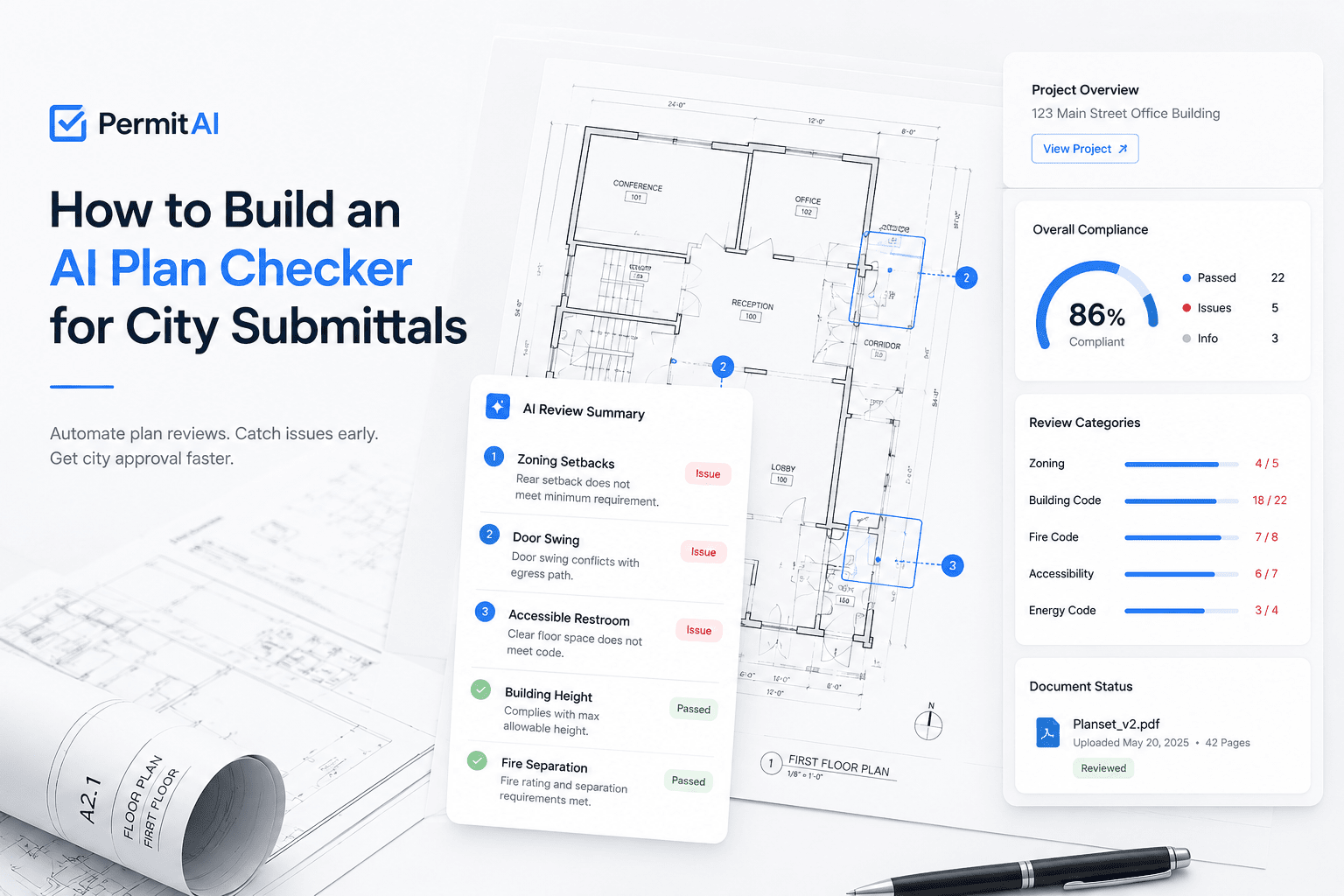
How to Build an AI Plan Checker for City Submittals
Permit delays remain one of the most expensive and frustrating challenges in real estate development and construction. Whether the project is a multifamily community, mixed-use development, office building, or industrial facility, even minor documentation errors can trigger weeks of additional review time. This is where an AI Plan Checker City Submittals workflow can provide a significant advantage. Instead of waiting for municipal reviewers to identify missing sheets, conflicting dimensions, incomplete references, or coordination issues, artificial intelligence can review construction documents before submission and flag potential problems in minutes.
As projects become increasingly complex, maintaining consistency across architectural, structural, civil, mechanical, electrical, and plumbing drawings becomes more difficult. A single discrepancy between sheets can create correction notices, consultant revisions, and costly resubmittals. These delays affect schedules, increase carrying costs, and create uncertainty throughout the development process.
Fortunately, advances in document intelligence, computer vision, and large language models have made automated plan review more practical than ever. Rather than replacing architects, engineers, or city reviewers, AI functions as an additional quality-control layer that helps teams submit more complete and coordinated permit packages. Organizations that adopt AI-assisted review processes can often reduce preventable errors, improve permit readiness, and create a more efficient path from design to approval.
This guide explains how to build an AI-powered plan review system, the technology required to support it, and the practical steps needed to implement it successfully.
Quick Answer: What Is an AI Plan Checker?
An AI Plan Checker City Submittals system is software that automatically reviews permit drawings and supporting documents before submission to a municipality. The system uses document intelligence, computer vision, large language models, and rules-based validation to identify potential errors and inconsistencies.
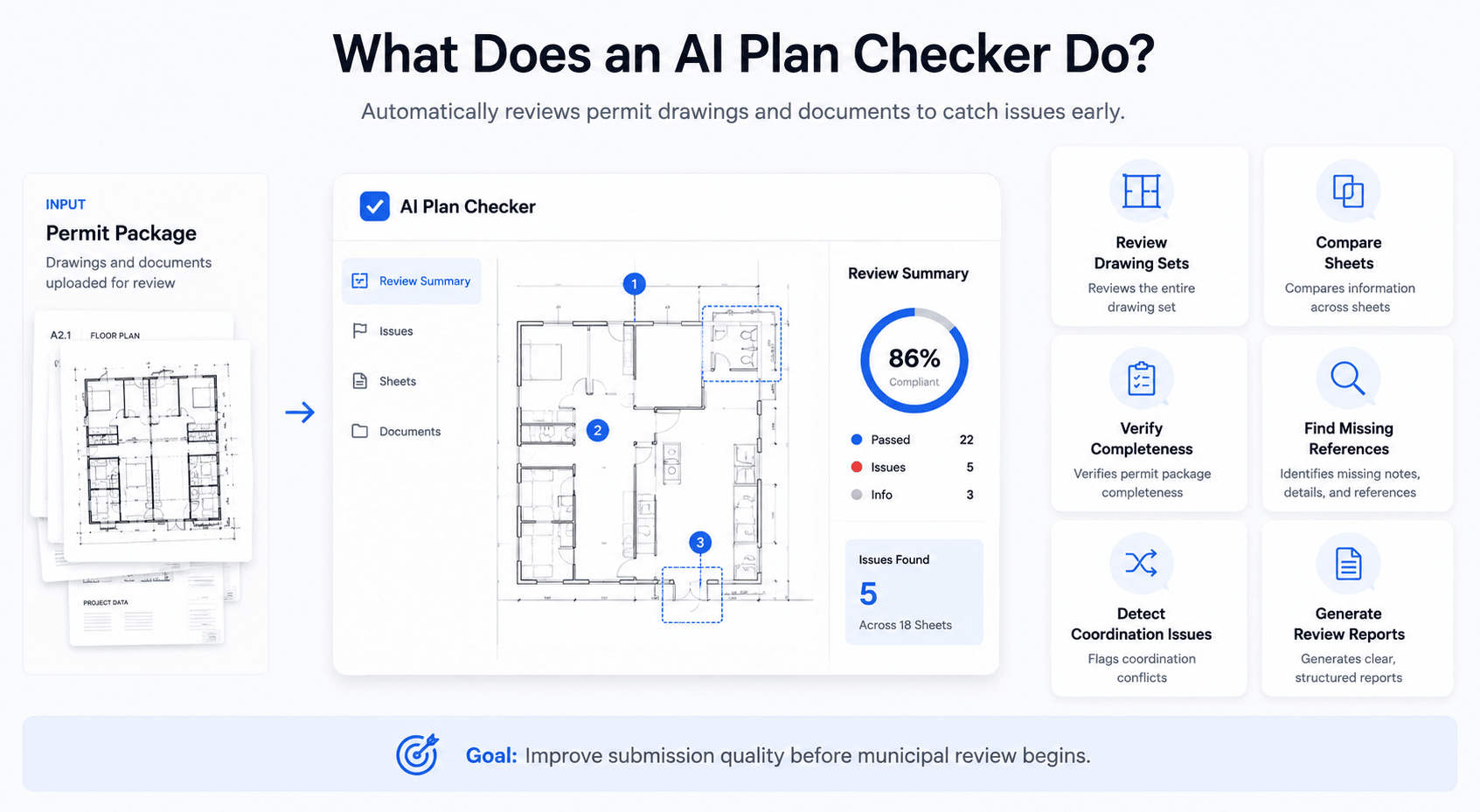
Instead of manually checking hundreds of pages, the AI can:
-
Review the entire drawing set
-
Compare information across sheets
-
Verify permit package completeness
-
Identify missing references
-
Flag coordination conflicts
-
Highlight potential code concerns
-
Generate review reports
The objective is not to approve plans. The objective is to improve submission quality before municipal review begins.
Why Permit Review Delays Are So Expensive
Permit delays affect far more than project schedules. Every additional review cycle creates financial consequences that compound throughout the development process.
For developers, delayed approvals often mean additional interest payments, extended carrying costs, and postponed revenue generation. Construction starts later, contractor schedules shift, and project milestones become increasingly difficult to predict.
Architectural and engineering teams also absorb costs. Review comments frequently trigger coordination meetings, drawing revisions, and quality-control efforts that consume billable hours without creating additional project value.
Municipal reviewers face challenges as well. Many planning and building departments operate with limited staffing resources while permit volumes continue to increase. As a result, review timelines become longer, and reviewers must process large volumes of documentation under significant time constraints.
The reality is that many correction notices are not caused by major design flaws. They are caused by relatively simple issues such as:
-
Inconsistent setbacks
-
Missing sheet references
-
Incorrect calculations
-
Incomplete schedules
-
Conflicting dimensions
-
Missing accessibility information
-
Documentation gaps
These are precisely the types of issues artificial intelligence can identify effectively. Before building your own AI plan checker, it’s helpful to see how dedicated blueprint-review platforms are already identifying thousands of potential issues before plans reach municipal reviewers.
The Hidden Cost of Resubmittals
A single resubmittal may appear minor, but the cumulative impact can be substantial.
Consider a multifamily project where a city identifies three documentation conflicts requiring clarification. The city may take three weeks to complete its review. The design team then spends one week addressing comments before resubmitting. Another review cycle adds another two or three weeks.
A seemingly small issue can easily create a six-week delay.
For projects carrying acquisition loans, predevelopment expenses, consultant contracts, and internal overhead, those six weeks can represent tens of thousands of dollars in additional costs.
This is why proactive plan review has become increasingly valuable.
Why AI Plan Review Is Becoming a Competitive Advantage
The construction and development industries are entering a period where speed increasingly determines profitability. Markets move quickly, financing conditions change rapidly, and project economics can shift significantly during long approval processes.
Organizations that reduce permit timelines gain several advantages.
First, they can begin construction sooner. Earlier construction starts often lead to earlier occupancy and faster revenue generation.
Second, they can reduce uncertainty. Investors, lenders, and project stakeholders generally prefer predictable timelines over unpredictable approval cycles.
Third, they can improve internal efficiency. Teams spend less time managing corrections and more time advancing projects.
The most forward-thinking organizations are beginning to view AI-powered quality control as a strategic capability rather than simply a technology tool.
Traditional Review vs AI-Assisted Review
| Process Area | Traditional Review | AI-Assisted Review |
|---|---|---|
| Drawing Review | Manual | Automated + Manual |
| Error Detection | Reviewer Dependent | Consistent |
| Cross-Sheet Coordination | Limited | Extensive |
| Review Speed | Days or Weeks | Minutes |
| Submission Readiness | Reactive | Proactive |
| Resubmittal Risk | Higher | Lower |
| Scalability | Limited | High |
Core Components of an AI Plan Checker
Building an effective AI Plan Checker City Submittals platform requires multiple systems working together.
The most successful solutions combine document processing, computer vision, reasoning models, rules-based validation, and reporting capabilities.
Document Intake Layer
The intake layer serves as the system’s entry point.
It should accept:
-
PDF plan sets
-
Site plans
-
Engineering drawings
-
Permit applications
-
Reports
-
Supporting exhibits
Many projects include hundreds of pages of documentation. Therefore, the system must organize and preprocess files efficiently before analysis begins.
The intake layer should also validate uploads, identify file types, and separate drawing sets into manageable components.
Drawing Intelligence Layer
Construction drawings are complex visual documents.
Unlike standard text documents, they contain:
-
Dimensions
-
Symbols
-
Elevations
-
Tables
-
Schedules
-
Notes
-
Legends
-
Section references
A vision-capable AI model analyzes these elements and converts them into structured information. For example, instead of simply recognizing that a setback dimension exists, the system extracts the actual value and stores it as usable data.
This structured approach allows later validation stages to compare information across sheets.
Knowledge and Compliance Layer
A sophisticated plan checker requires access to relevant regulations and standards.
This layer may contain:
-
Building codes
-
Zoning ordinances
-
Accessibility requirements
-
Municipal checklists
-
Planning standards
-
Fire code references
Rather than relying entirely on model memory, modern systems typically use retrieval-based architectures that pull information from approved knowledge sources.
This improves accuracy and reduces hallucination risks.
Cross-Sheet Validation Layer
This is where most of the value is created. A human reviewer can only compare a limited number of documents simultaneously. An AI system can compare hundreds.
For example, if one sheet identifies a rear setback as 15 feet while another identifies it as 10 feet, the system immediately flags the discrepancy. Similarly, if a sheet references Detail A502 but no such sheet exists, the AI can identify the issue instantly.
Reporting Layer
The final layer transforms findings into actionable information.
Effective reports should include:
-
Issue descriptions
-
Severity levels
-
Supporting evidence
-
Sheet references
-
Recommended actions
-
Confidence scores
The objective is to help professionals make decisions quickly.
Designing the AI Plan Checker Architecture
The architecture of the platform determines how effectively it scales. Most successful systems follow a four-stage workflow.
For a deeper look at how artificial intelligence analyzes drawings, specifications, and consultant deliverables, explore our guide on AI construction document review workflows, which breaks down the review process used by leading CRE teams.
Stage 1: Document Segmentation
The first step is dividing the uploaded package into individual sheets. This process improves performance because each page can be analyzed independently.
Segmentation also allows the AI to identify sheet types before detailed review begins.
Examples include:
-
Site plans
-
Floor plans
-
Elevations
-
Sections
-
Structural sheets
-
MEP sheets
Once categorized, the system can apply discipline-specific review logic.
Stage 2: Data Extraction
The extraction phase gathers information from every sheet.
This includes:
-
Dimensions
-
Unit counts
-
Parking counts
-
Occupancy data
-
Elevations
-
Callouts
-
References
The extracted information is stored in a structured database that serves as the foundation for later validation.
Stage 3: Permit Readiness Review
At this stage, the system evaluates whether the submission appears complete.
Questions may include:
-
Are all required disciplines included?
-
Are the referenced sheets present?
-
Are title blocks complete?
-
Are the required schedules available?
-
Is the project information consistent?
This creates a permit-readiness assessment before formal submission.
Stage 4: Cross-Sheet Coordination
The coordination stage compares all extracted data.
Potential findings include:
-
Setback conflicts
-
Area calculation discrepancies
-
Unit count mismatches
-
Missing references
-
Elevation inconsistencies
-
Parking count conflicts
This stage often identifies the highest-value findings because many permit comments result from coordination issues rather than technical design problems.
AI Review Categories
| Review Category | Example Findings |
|---|---|
| Administrative | Missing title block data |
| Zoning | Setback inconsistencies |
| Accessibility | Missing accessible routes |
| Coordination | Cross-sheet conflicts |
| Documentation | Missing schedules |
| Permit Readiness | Incomplete package |
Building the First Version Without Writing Code
One of the most interesting developments in AI software creation is the emergence of AI-assisted coding tools.
Today, many commercial real estate professionals can build functional prototypes without traditional software engineering experience.
If you’re building your first permit-review workflow, the quality of your instructions matters significantly. These construction plan review prompts can help improve accuracy and reduce hallucinations during analysis.
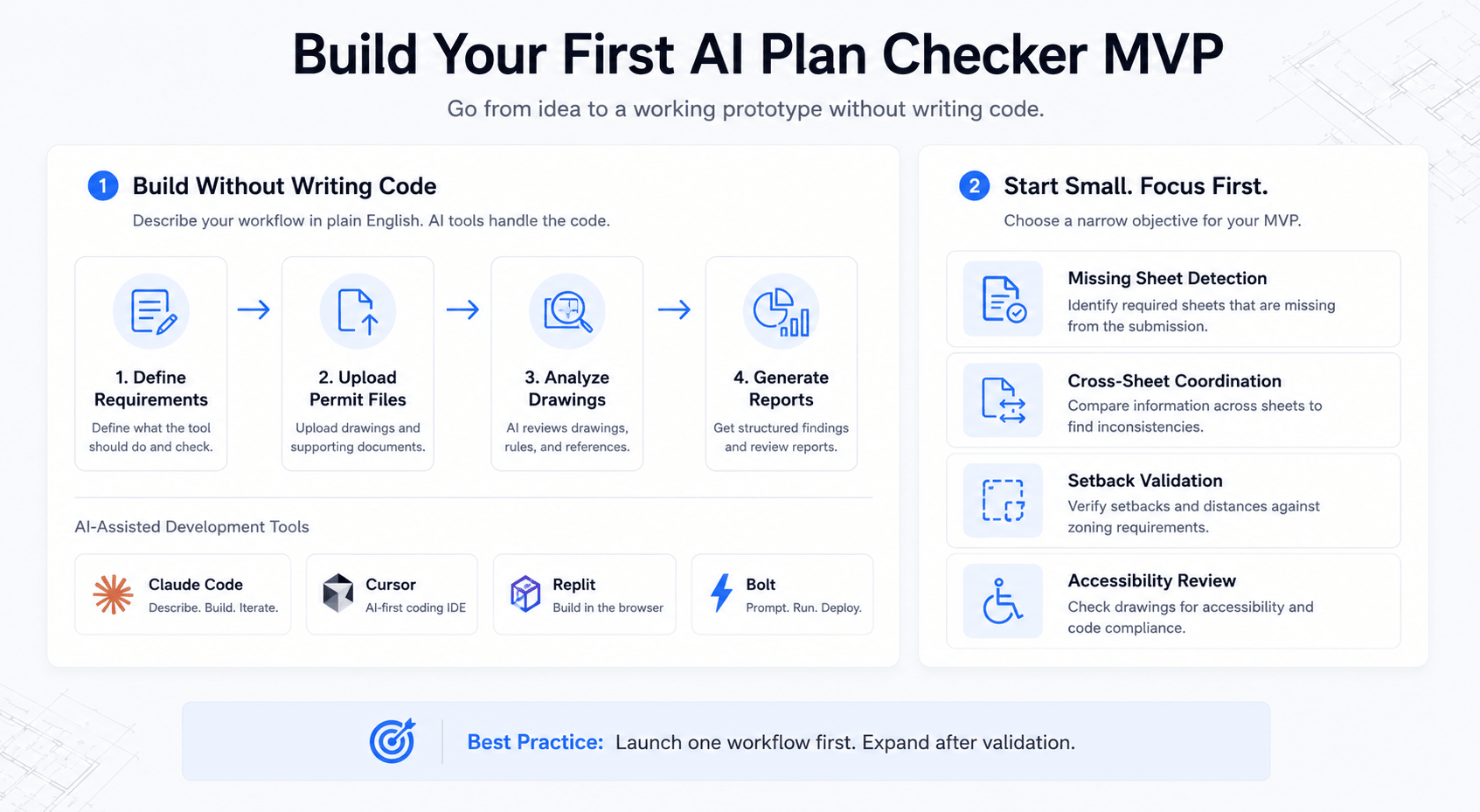
Using Claude Code
Claude Code allows users to describe functionality in plain English.
Instead of manually programming every feature, users can explain:
-
What the tool should do
-
What files should it analyze
-
What reports should it generate
-
How findings should be categorized
The AI then generates the required code. This approach dramatically reduces development barriers.
Using Cursor
Cursor combines traditional software development with AI assistance. Users can build applications while receiving real-time coding support. This is particularly useful for expanding a prototype into a production-ready platform.
Using Replit
Replit provides a browser-based development environment. Teams can quickly test concepts without investing heavily in infrastructure. For early-stage experimentation, this can significantly accelerate development.
Using Bolt
Bolt allows rapid creation of web applications using natural language prompts. For founders validating product concepts, Bolt can reduce development timelines substantially.
Building an MVP
A minimum viable product should focus on a narrow objective.
Examples include:
-
Missing sheet detection
-
Cross-sheet coordination
-
Setback validation
-
Accessibility review
Starting small improves accuracy and reduces implementation complexity. Organizations often fail because they attempt to automate every aspect of plan review immediately. A focused MVP typically delivers stronger results and faster adoption.
Preventing Hallucinations and False Findings
Accuracy is critical. A plan checker that generates unreliable findings quickly loses user trust. Several safeguards should be implemented.
Require Evidence
Every finding should include:
-
Sheet number
-
Supporting text
-
Drawing reference
This enables users to verify findings quickly.
Use Confidence Scores
Issues should be categorized by confidence level.
Examples include:
-
High confidence
-
Medium confidence
-
Low confidence
This helps users prioritize review efforts.
Avoid Invented Code References
The system should only cite regulations retrieved from approved sources. Generated citations should never be accepted without verification.
Keep Humans in the Loop
The AI should recommend actions rather than automatically approve or reject plans. Professional judgment remains essential.
Calculating the ROI of an AI Plan Checker
Technology investments should produce measurable returns. The ROI of an AI Plan Checker City Submittals platform typically comes from reduced delays and improved efficiency.
Example ROI Scenario
| Metric | Traditional Process | AI-Assisted Process |
|---|---|---|
| Review Cycles | 3 | 2 |
| Permit Delay | 8 Weeks | 4 Weeks |
| Consultant Revision Time | High | Reduced |
| Carrying Costs | Higher | Lower |
| Administrative Effort | High | Lower |
The financial impact becomes more significant as project size increases.
For multifamily developments, mixed-use projects, and large commercial developments, even small reductions in review timelines can create substantial value.
The greatest ROI often comes from avoided delays rather than labor savings. When projects move forward faster, organizations realize revenue sooner and reduce uncertainty throughout the development process.
The Future of AI-Powered Permit Automation
The future extends far beyond document review. Emerging systems are beginning to support broader permit automation workflows.
Future capabilities may include:
-
Automatic code citations
-
Jurisdiction-specific review agents
-
BIM model validation
-
Automated permit package assembly
-
Continuous compliance monitoring
-
AI-generated correction responses
Municipalities themselves may eventually adopt AI-assisted review systems. Rather than replacing reviewers, these tools would help staff process larger permit volumes more efficiently.
As adoption grows, organizations that have already developed AI-enabled review workflows will possess a significant operational advantage.
Future Evolution of AI Plan Review
| Current Capability | Future Capability |
|---|---|
| Drawing Review | Full Permit Automation |
| Error Detection | Predictive Compliance |
| Sheet Coordination | BIM Validation |
| Static Reports | Real-Time Monitoring |
| Manual Corrections | Automated Recommendations |
Build a Smarter Permit Review Workflow
The organizations gaining the most value from artificial intelligence are not necessarily the ones using the most advanced technology. They are the ones applying AI to solve real operational problems. Permit review is a perfect example because even small improvements in submission quality can reduce delays, improve project predictability, and accelerate development timelines. Through the AI for CRE Collective, industry professionals are actively exploring practical workflows that create measurable business outcomes.
Whether you are a developer, architect, permit expediter, consultant, or technology founder, learning from peers can dramatically shorten your implementation timeline. Join a network of 600+ CRE professionals who are testing real-world AI use cases across commercial real estate and construction. To stay updated on emerging strategies, case studies, and implementation frameworks, subscribe to the newsletter and discover how AI can improve your development process.
Conclusion
Building an AI Plan Checker City Submittals system is one of the most practical applications of artificial intelligence in commercial real estate and construction today. Unlike many AI initiatives that struggle to demonstrate measurable value, plan review automation directly addresses a costly and persistent industry problem: permit delays caused by preventable documentation errors.
By combining document intelligence, computer vision, code knowledge, and cross-sheet validation, organizations can dramatically improve submission quality before plans reach municipal reviewers. The result is fewer correction cycles, faster approvals, lower soft costs, and a more predictable development process.
As municipalities continue modernizing their workflows and project complexity increases, AI-assisted plan review will likely become a standard component of the permitting process. Organizations that begin building these capabilities today will be better positioned to deliver projects faster, reduce risk, and create lasting competitive advantages.
FAQs Regarding How to Build an AI Plan Checker for City Submittals
What is an AI plan checker for city submittals?
An AI plan checker is software that automatically reviews construction drawings and permit documents before submission to identify errors, inconsistencies, missing information, and coordination issues.
-
Reviews architectural, structural, civil, and MEP drawings
-
Identifies conflicts between sheets
-
Helps reduce permit correction cycles
Conclusion: An AI plan checker improves submission quality and helps teams catch issues before municipal review.
How does an AI plan checker work?
An AI plan checker uses computer vision, OCR, large language models, and validation rules to analyze construction documents and compare information across an entire plan set.
-
Extracts data from drawings
-
Compares information between sheets
-
Generates issue reports and recommendations
Conclusion: The system automates many manual quality-control tasks traditionally performed by project teams.
Can AI review construction drawings accurately?
Yes, AI can review construction drawings accurately when combined with structured validation rules and human oversight.
-
Detects missing references and inconsistencies
-
Reviews large drawing sets quickly
-
Improves consistency across disciplines
Conclusion: AI is most effective as a quality-control tool rather than a replacement for professional reviewers.
What types of errors can AI identify in permit drawings?
AI can identify many common permit submission issues that frequently lead to correction notices.
-
Missing sheets
-
Setback discrepancies
-
Unit count conflicts
-
Broken sheet references
Conclusion: Most AI findings involve coordination and documentation errors rather than design deficiencies.
Does an AI plan checker replace city plan reviewers?
No, an AI plan checker is designed to support the review process, not replace municipal reviewers.
-
Improves permit readiness
-
Reduces preventable mistakes
-
Assists internal quality control
Conclusion: Final approval decisions remain the responsibility of the city reviewing agency.
What documents can an AI plan checker analyze?
Most AI plan review systems can analyze a wide range of project documentation.
-
Construction drawings
-
Site plans
-
Permit applications
-
Supporting reports
Conclusion: The broader the document coverage, the more effective the review process becomes.
Can AI compare information across multiple sheets?
Yes, one of the biggest advantages of AI is its ability to compare information across an entire drawing set simultaneously.
-
Reviews hundreds of sheets
-
Detects conflicting values
-
Identifies missing references
Conclusion: Cross-sheet coordination is one of the highest-value capabilities of AI plan review systems.
What is the biggest benefit of using AI before permit submission?
The biggest benefit is reducing costly correction cycles and permitting delays.
-
Improves submission quality
-
Reduces resubmittals
-
Accelerates project timelines
Conclusion: Earlier issue detection often translates directly into faster project approvals.
Can AI check zoning compliance requirements?
AI can assist with zoning reviews when provided with jurisdiction-specific zoning regulations and project requirements.
-
Reviews setbacks
-
Verifies parking counts
-
Evaluates height restrictions
Conclusion: AI can support zoning analysis but should always be verified by qualified professionals.
How long does AI take to review a plan set?
Most AI systems can review plan sets in minutes rather than days.
-
Processes documents automatically
-
Performs simultaneous analysis
-
Generates rapid reports
Conclusion: AI dramatically reduces the time required for preliminary document review.
What technologies are used to build an AI plan checker?
Modern AI plan checkers combine several technologies to perform comprehensive reviews.
-
Computer vision
-
OCR technology
-
Large language models
-
Validation engines
Conclusion: Multiple technologies work together to create accurate and scalable review workflows.
Can non-technical professionals build an AI plan checker?
Yes, modern AI-assisted development tools make it possible for non-programmers to build functional prototypes.
-
Uses natural language instructions
-
Reduces coding requirements
-
Accelerates development
Conclusion: Many commercial real estate professionals can build MVP solutions without extensive programming experience.
How can AI reduce permit approval delays?
AI helps reduce delays by identifying issues before plans reach municipal reviewers.
-
Improves drawing quality
-
Finds missing information
-
Supports consultant coordination
Conclusion: Fewer corrections generally lead to fewer review cycles and faster approvals.
What are the limitations of AI plan review?
AI has limitations and should not be treated as a substitute for professional judgment.
-
May produce false positives
-
Requires accurate source data
-
Needs human verification
Conclusion: The most effective systems combine AI automation with expert oversight.
Can AI identify accessibility compliance issues?
AI can help identify accessibility concerns when trained on relevant standards and requirements.
-
Reviews accessible routes
-
Checks parking requirements
-
Evaluates drawing consistency
Conclusion: Accessibility reviews should still be validated by qualified professionals.
What is the ROI of an AI plan checker?
The return on investment often comes from reducing delays, lowering soft costs, and improving project efficiency.
-
Fewer correction cycles
-
Reduced consultant time
-
Faster project progression
Conclusion: Even small reductions in permit timelines can generate significant financial value.
Should developers build their own AI plan checker?
The answer depends on project volume, internal resources, and business objectives.
-
Greater customization
-
Full workflow control
-
Potential long-term savings
Conclusion: Organizations with recurring permit activity may benefit from developing internal solutions.
How does AI improve drawing coordination?
AI can compare data across multiple disciplines more consistently than manual review processes.
-
Reviews architectural sheets
-
Checks engineering documents
-
Detects conflicting information
Conclusion: Better coordination reduces errors that commonly trigger permit corrections.
What features should an AI plan checker include?
An effective system should focus on review quality, usability, and verification.
-
Cross-sheet validation
-
Permit readiness scoring
-
Confidence ratings
-
Detailed reporting
Conclusion: The best platforms prioritize actionable findings rather than overwhelming users with alerts.
What is the future of AI in permit review and city submittals?
AI is expected to play an increasingly important role in permit preparation and compliance workflows.
-
Automated code analysis
-
BIM integration
-
Predictive compliance tools
-
Intelligent review assistants
Conclusion: AI will likely become a standard component of permit preparation and construction quality-control processes.