How to Avoid a Plan Check Rejection (Before the City Ever Sees Your Set)
If you’ve ever waited weeks for permit comments only to receive a rejection over a simple coordination issue, you’re not alone. Plan Check Rejection Prevention is one of the most valuable disciplines in development, architecture, engineering, and construction today. Most projects are not rejected because they are fundamentally flawed. They are rejected because of avoidable mistakes buried somewhere inside the drawing set.
A setback dimension doesn’t match across sheets. A referenced detail is missing. The sheet index includes plans that were never submitted. The city catches the inconsistency, returns the package, and the clock starts over.
For developers, architects, permit expediters, and CRE professionals, these delays create real costs. Holding expenses continue, consultants spend additional time on revisions, and project schedules slip. The good news is that most plan check rejections can be prevented long before the city ever reviews your set.
Why Plan Check Rejection Prevention Matters
Permit review timelines continue to stretch across many jurisdictions. Whether you’re working on a multifamily project, commercial tenant improvement, mixed-use development, or industrial facility, every review cycle impacts project economics.
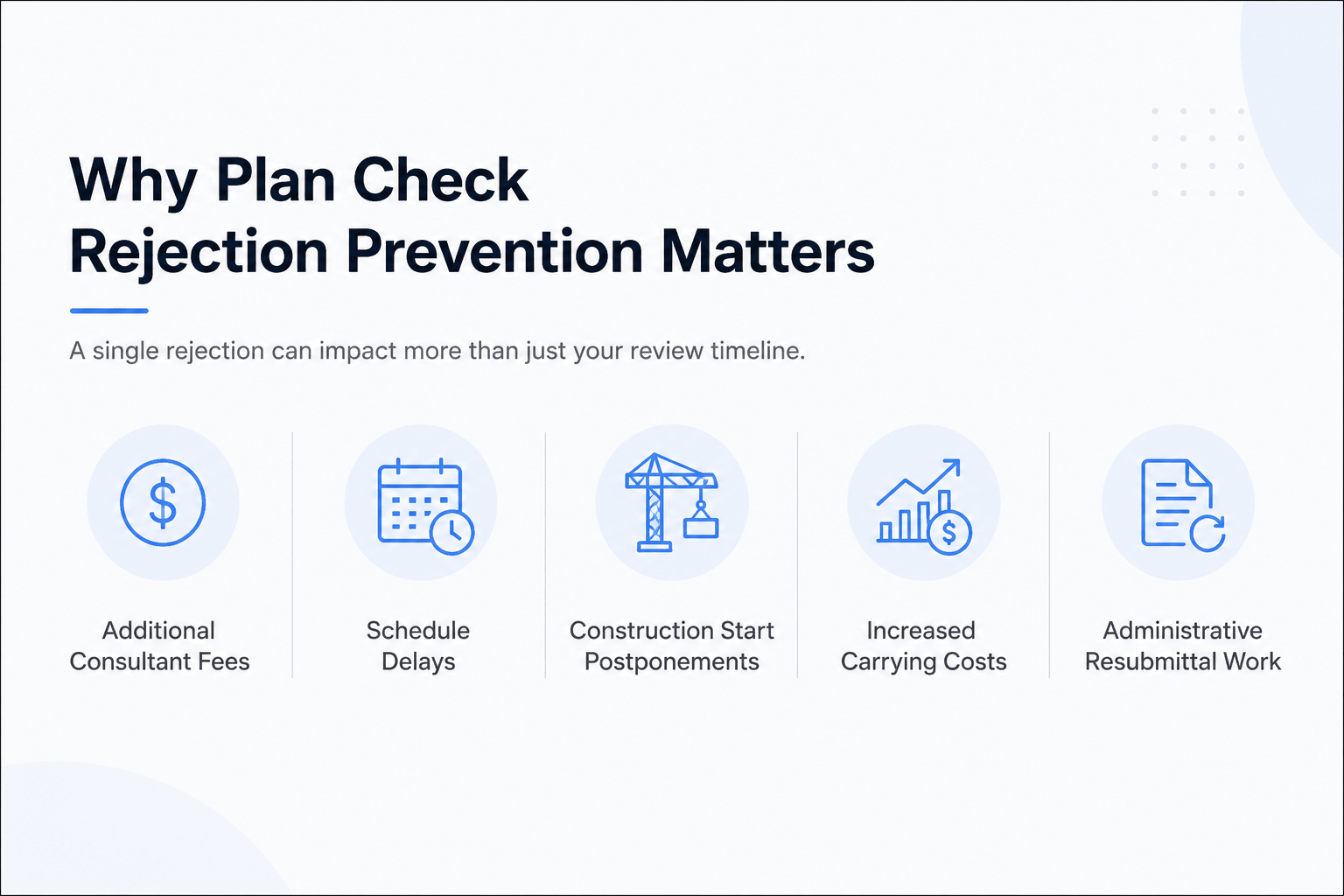
A single rejection often triggers:
-
Additional consultant fees
-
Schedule delays
-
Construction start postponements
-
Increased carrying costs
-
Lost opportunities for leasing or sales
-
Administrative resubmittal work
Many teams focus heavily on design quality but overlook document quality. Cities review what is submitted, not what was intended.
The Hidden Cost of a Rejection
Consider a multifamily project with financing, consultant coordination, and contractor mobilization schedules already underway.
A rejection that adds six weeks can impact:
| Cost Category | Potential Impact |
|---|---|
| Loan Carry Costs | Additional interest expenses |
| Consultant Time | Revision and coordination fees |
| Construction Schedule | Delayed mobilization |
| Leasing Activities | Delayed occupancy |
| Investor Expectations | Extended timelines |
| Staff Resources | Additional management time |
While every project differs, the financial impact often exceeds the effort required to conduct a proper quality control review.
Why the City Kicks Plans Back
Many project teams assume plan reviewers are primarily looking for sophisticated design issues. In reality, reviewers frequently identify basic documentation problems first.
Their job is not to redesign the project. Their responsibility is to verify that the submitted package contains sufficient information to demonstrate compliance.
Common review objectives include:
-
Verifying zoning compliance
-
Confirming building code requirements
-
Checking accessibility provisions
-
Reviewing life safety requirements
-
Ensuring structural completeness
-
Confirming MEP coordination
-
Validating site information
When information conflicts or appears incomplete, reviewers often stop and issue comments rather than continuing through the entire package.
The Reviewer’s Perspective
A plan checker may review dozens of projects every week. They do not know your project history, they do not know what discussions occurred internally, and they only see the submitted drawings.
If Sheet A says one thing and Sheet B says another, they cannot assume which version is correct. The safest response is to reject the inconsistency and request clarification. That is why document coordination plays such a major role in Plan Check Rejection Prevention.
The Errors That Trigger Most Rejections
Although every jurisdiction has unique requirements, most rejections fall into predictable categories.
Understanding these categories allows teams to create effective quality control processes.
Dimension and Setback Conflicts
Dimension discrepancies are among the most common causes of permit comments.
Examples include:
-
Front setbacks that differ between plans
-
Rear yard dimensions that conflict
-
Building heights that vary between elevations and sections
-
Parking counts that do not match the site plans
A reviewer immediately notices when critical numbers disagree.
Missing or Incorrect Sheet References
Cross-referencing problems create confusion throughout a drawing package.
Typical examples include:
-
Details referencing missing sheets
-
Callouts pointing to non-existent pages
-
Incorrect sheet numbering
-
Missing section references
-
Outdated detail references after revisions
These errors may seem minor internally, but often generate review comments.
Missing Disciplines
Cities generally expect complete submission packages.
Depending on project type, required disciplines may include:
-
Architectural
-
Structural
-
Mechanical
-
Electrical
-
Plumbing
-
Civil
-
Landscape
-
Fire protection
If critical disciplines are absent, reviewers may stop the review process entirely.
Count and Quantity Mismatches
Project totals must remain consistent throughout the set.
Common issues include:
-
Unit count discrepancies
-
Parking count inconsistencies
-
Occupant load conflicts
-
Fixture count mismatches
-
Open space calculations that differ
Reviewers often compare summary tables against detailed plans.
When numbers fail to match, questions arise immediately.
Code Compliance Gaps
Sometimes the information exists but is not clearly documented.
Examples include:
-
Accessible routes not identified
-
Guardrail details missing
-
Fire separation requirements unclear
-
Means of egress are inadequately documented
-
ADA requirements not shown
Reviewers need visible proof of compliance.
Assumptions rarely survive plan review.
A Practical Framework for Plan Check Rejection Prevention
The most effective strategy is creating a repeatable quality control workflow.
Rather than reviewing drawings randomly, use a structured process.
Step 1: Administrative Review
Before examining technical content, verify basic submission requirements.
Review:
-
Sheet index
-
Project information
-
Addresses
-
Assessor parcel numbers
-
Drawing dates
-
Revision clouds
-
Consultant information
These simple checks often eliminate easy-to-catch mistakes.
Step 2: Internal Consistency Review
Next, compare information across sheets.
Focus on:
-
Dimensions
-
Setbacks
-
Heights
-
Counts
-
Elevations
-
References
Many teams miss these issues because each consultant reviews only their own discipline.
Step 3: Code Documentation Review
Verify that major code requirements are clearly shown.
Questions include:
-
Is accessibility documented?
-
Are egress paths clear?
-
Are occupancy classifications identified?
-
Are fire ratings shown?
-
Are the required details included?
Step 4: Completeness Review
Confirm every required discipline is present.
Use a checklist before submission.
| Review Area | Questions to Verify |
|---|---|
| Site Plans | Complete and coordinated? |
| Architecture | All sheets included? |
| Structural | Required calculations provided? |
| MEP | Complete design package present? |
| Accessibility | Clearly documented? |
| Life Safety | Fully identified? |
| Details | Are all references functional? |
A disciplined review process dramatically reduces submission risk.
How AI Is Changing Plan Check Rejection Prevention
Historically, quality control depended entirely on human review.
While experienced professionals remain essential, modern AI tools are transforming document verification.
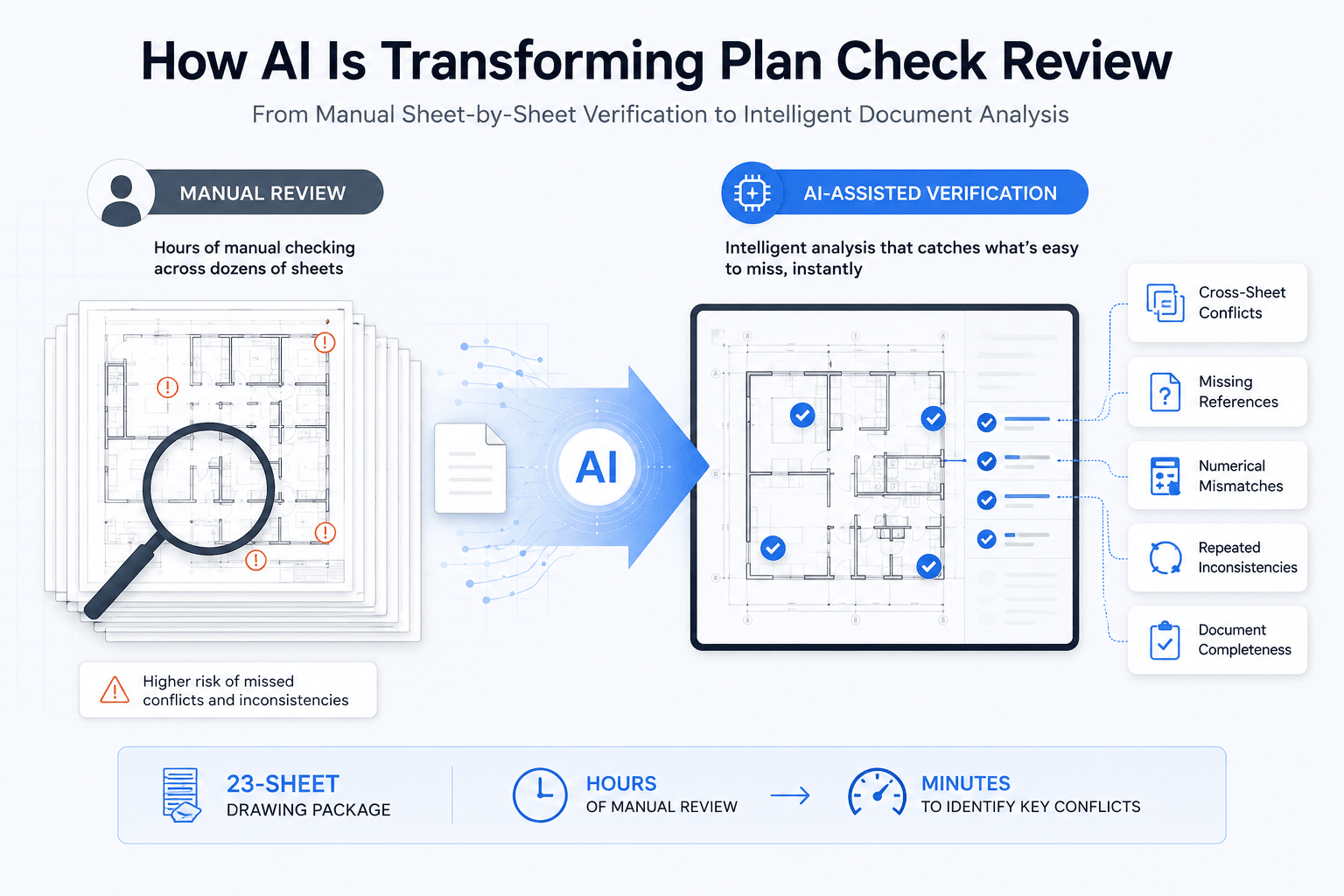
What AI Does Well
AI excels at identifying:
-
Repeated inconsistencies
-
Cross-sheet conflicts
-
Missing references
-
Numerical mismatches
-
Document completeness issues
These tasks involve pattern recognition, which is difficult for humans to perform consistently across dozens of sheets.
Real-World Example
Imagine a 23-sheet multifamily drawing package.
A traditional reviewer might spend hours manually checking:
-
Setbacks
-
Unit counts
-
Building heights
-
Parking totals
-
Detail references
AI can extract these data points rapidly and compare them across the entire set.
Instead of searching for errors, reviewers can focus on evaluating flagged issues.
Where Human Expertise Still Matters
AI is not replacing architects, engineers, or permit professionals.
Human judgment remains necessary for:
-
Code interpretation
-
Design intent
-
Jurisdiction-specific requirements
-
Constructability evaluation
-
Risk assessment
The strongest workflow combines AI review with expert validation.
Building a Pre-Submittal Quality Control Checklist
Every organization should develop a standard checklist.
Consistency creates better outcomes.
Zoning Verification
Review:
-
Setbacks
-
Height restrictions
-
Lot coverage
-
FAR calculations
-
Parking requirements
-
Open space requirements
Architectural Verification
Confirm:
-
Sheet numbering consistency
-
Room labeling
-
Unit counts
-
Elevation coordination
-
Detail references
Structural Verification
Review:
-
Foundation references
-
Framing notes
-
Structural details
-
Load information
MEP Verification
Confirm:
-
Equipment schedules
-
Electrical loads
-
Plumbing fixture counts
-
Mechanical calculations
Administrative Verification
Ensure:
-
Cover sheets are complete
-
Contacts are current
-
Revisions are updated
-
Sheet indexes are accurate
| QC Category | Common Errors Found |
|---|---|
| Zoning | Setback conflicts |
| Architecture | Missing details |
| Structural | Incomplete references |
| Mechanical | Schedule mismatches |
| Electrical | Load discrepancies |
| Plumbing | Fixture count errors |
| Administration | Missing sheets |
Organizations that standardize these checks often experience fewer review cycles.
Common Mistakes Even Experienced Teams Make
Experience helps, but it does not eliminate risk.
Many rejections occur on sophisticated projects managed by highly qualified teams.
Revision Drift
Changes made late in the design process often create inconsistencies.
One sheet gets updated.
Another sheet remains unchanged.
The conflict survives until permit review.
Consultant Silos
Architects, engineers, and consultants frequently work independently.
Without coordination reviews, discrepancies emerge naturally.
Assumptions About Reviewer Interpretation
Many teams assume reviewers will understand intent. Unfortunately, reviewers must rely on documented information. If something is unclear, comments are inevitable.
Rushed Deadlines
Permit deadlines encourage shortcuts. The final review stage often receives the least attention despite being one of the most important phases.
How Developers Can Reduce Permit Risk
Developers play a critical role in Plan Check Rejection Prevention.
Even when consultants prepare the drawings, ownership teams can establish expectations.
Require Formal QC Reviews
Ask consultants:
-
What quality control process was completed?
-
Who performed the review?
-
Was cross-discipline coordination conducted?
Establish Submission Standards
Create project-specific requirements.
These may include:
-
QC signoffs
-
Coordination meetings
-
Checklist completion
-
AI-assisted reviews
Track Review Metrics
Monitor:
-
Rejection frequency
-
Review cycle counts
-
Common comments
-
Resubmittal timelines
Data helps improve future performance.
Using Technology to Create Better Submittals
Technology continues to improve document review capabilities.
Today’s tools can assist with:
-
Drawing extraction
-
Data validation
-
Sheet comparison
-
Reference verification
-
Workflow automation
The goal is not to replace professional judgment.
The goal is to reduce preventable mistakes.
Organizations that embrace technology often spend less time fixing errors and more time advancing projects.
Indicators That Your Review Process Needs Improvement
You may need stronger QC procedures if:
-
Projects frequently receive similar comments
-
Missing sheets occur regularly
-
Consultants disagree on counts
-
Review cycles exceed expectations
-
Resubmittals are common
These symptoms often point to process failures rather than design failures.
Creating a Culture of Plan Check Rejection Prevention
The most successful organizations treat quality control as part of project delivery rather than a final administrative task.
That mindset creates measurable advantages. Teams begin identifying issues earlier. Consultants coordinate more effectively.
Developers receive cleaner permit packages. Cities receive more complete submissions. Everyone benefits.
Key Habits of High-Performing Teams
Successful permit teams typically:
-
Use standardized checklists
-
Conduct cross-discipline reviews
-
Verify code documentation
-
Leverage technology
-
Track recurring errors
-
Review lessons learned
Over time, these habits significantly reduce permit friction.
Build a Smarter Permit Review Process
Avoiding permit delays is not about creating more paperwork. It is about creating better systems. The teams that consistently move projects through entitlement and permitting understand that small coordination issues can create major schedule impacts. Building structured quality control reviews into every submission cycle can dramatically improve outcomes.
Inside the AI for CRE Collective, you’ll find practical workflows built specifically for commercial real estate professionals, including permit review systems, document analysis workflows, and AI-assisted quality control processes tested on real projects. Join 600+ CRE professionals already exploring these strategies, and subscribe to the newsletter to receive additional AI workflows and implementation guides.
Conclusion
Most plan check rejections are preventable.
Cities rarely reject projects because the concept is fundamentally flawed. More often, they identify inconsistencies, omissions, and coordination errors that slipped through internal reviews.
A strong Plan Check Rejection Prevention process focuses on catching those issues before submission. Whether through traditional quality control methods, AI-assisted document review, or a combination of both, the objective remains the same: submit cleaner drawing packages, reduce review cycles, and keep projects moving forward.
The earlier errors are identified, the less expensive they become. For developers, architects, engineers, and permit expediters, that simple principle can save weeks of schedule and thousands of dollars on every project.
FAQs Regarding How to Avoid a Plan Check Rejection
What causes most plan check rejections?
Most plan check rejections occur when city reviewers find missing information, conflicting details, or documentation that does not clearly demonstrate compliance with local codes and regulations. While many teams assume rejections stem from major design flaws, the reality is that simple coordination mistakes are often responsible for permit delays.
-
Conflicting dimensions between sheets
-
Missing drawing references or details
-
Incomplete architectural, structural, or MEP plans
Conclusion: The majority of plan check rejections are caused by preventable documentation and coordination errors rather than fundamental design problems.
How can you avoid a plan check rejection before submitting plans?
Avoiding a plan check rejection starts with implementing a structured quality control process before submission. Every drawing set should be reviewed for consistency, completeness, and compliance to ensure that reviewers can easily verify the project without requesting corrections.
-
Conduct a cross-discipline coordination review
-
Verify all dimensions, setbacks, and calculations
-
Confirm all required sheets and documents are included
Conclusion: A thorough pre-submittal review can eliminate many of the issues that commonly trigger permit review comments.
What is a pre-submittal plan review and why is it important?
A pre-submittal plan review is an internal review process performed before plans are submitted to a city or permitting agency. Its purpose is to identify errors, omissions, and inconsistencies that could lead to permit delays or rejection.
-
Reviews drawing completeness
-
Identifies conflicts between disciplines
-
Confirms code compliance documentation
Conclusion: Pre-submittal reviews help teams catch problems while they are still easy and inexpensive to fix.
Why do cities reject permit drawing sets even when the design is correct?
Cities review permit applications based on the information shown in the submitted documents, not on the design intent behind them. If required information is missing or unclear, reviewers may reject the plans even if the actual design meets code requirements.
-
Missing code references
-
Unclear compliance information
-
Incomplete project documentation
Conclusion: A code-compliant design can still be rejected if the supporting documentation does not clearly demonstrate compliance.
What are the most common drawing coordination errors found during plan review?
Drawing coordination errors happen when information differs between sheets or disciplines. These discrepancies create uncertainty for reviewers and often result in correction notices or requests for clarification.
-
Setback dimensions that do not match
-
Unit counts that vary between sheets
-
Different elevation values shown in plans and sections
Conclusion: Consistent information across all drawings is one of the most important factors in successful permit approvals.
How do missing sheet references affect permit approval?
Sheet references allow reviewers to navigate a drawing package efficiently. When references are missing, incorrect, or point to sheets that do not exist, reviewers may question the completeness and accuracy of the entire set.
-
Callouts linked to missing sheets
-
Incorrect detail references
-
Outdated sheet numbering
Conclusion: Accurate sheet references improve review efficiency and reduce unnecessary permit comments.
Can AI help identify permit review issues before submission?
AI can analyze large drawing sets and compare information across multiple sheets much faster than traditional manual reviews. While it does not replace professional judgment, it can assist teams by identifying issues that may otherwise be overlooked.
-
Detects conflicting dimensions
-
Finds missing references
-
Flags inconsistent project data
Conclusion: AI can serve as an additional layer of quality control that helps reduce permit review risks.
How much can a plan check rejection delay a construction project?
The impact of a rejection depends on the jurisdiction, project complexity, and review backlog. Even a minor correction can result in weeks of delay if a project must re-enter the review queue.
-
Additional consultant revisions
-
Resubmittal processing time
-
Extended permit review cycles
Conclusion: Small documentation errors can create significant schedule and financial impacts when they trigger a rejection.
What documents should be included in a complete permit submission package?
A complete permit submission package should include every drawing, report, and supporting document required by the local jurisdiction. Missing disciplines or incomplete documentation are common reasons for immediate permit comments.
-
Architectural plans
-
Structural calculations and drawings
-
Mechanical, electrical, and plumbing documents
Conclusion: Complete permit packages reduce reviewer questions and improve approval timelines.
Why is code compliance documentation critical during plan review?
Plan reviewers must verify that a project complies with applicable building codes, accessibility standards, fire regulations, and zoning requirements. If compliance is not clearly documented, reviewers may request additional information before continuing.
-
Accessibility requirements
-
Life safety provisions
-
Fire-resistance and egress information
Conclusion: Clearly documented code compliance helps reviewers approve projects more efficiently.
What should developers review before submitting plans to the city?
Developers should not assume consultants have caught every issue. A final review focused on completeness and coordination can help identify problems before they become permit delays.
-
Confirm all disciplines are included
-
Verify drawing package completeness
-
Review consultant coordination efforts
Conclusion: Developer oversight can help reduce costly review comments and resubmittals.
How can architects improve permit approval success rates?
Architects can improve approval rates by establishing repeatable quality control procedures and ensuring that all project information remains coordinated throughout the design process.
-
Standardize review checklists
-
Conduct internal QA/QC reviews
-
Coordinate closely with consultants
Conclusion: Strong quality control practices lead to cleaner submissions and faster approvals.
Why are setback discrepancies frequently flagged during plan review?
Setbacks are a critical zoning requirement that reviewers check early in the review process. Even a small inconsistency can raise concerns about zoning compliance and trigger comments.
-
Different setback values on separate sheets
-
Incorrect zoning calculations
-
Unclear property line information
Conclusion: Accurate setback information is essential for demonstrating zoning compliance.
What role does consultant coordination play in permit approval?
Most projects involve multiple consultants working on different disciplines. Without proper coordination, conflicting information can easily appear throughout the drawing set.
-
Architectural and structural conflicts
-
MEP coordination issues
-
Inconsistent project data
Conclusion: Effective consultant coordination reduces inconsistencies and improves permit review outcomes.
How can project teams create a better quality control process?
A successful quality control process follows a structured workflow that reviews completeness, consistency, and compliance before submission.
-
Use standardized review checklists
-
Assign responsibility for final reviews
-
Document and track recurring errors
Conclusion: A repeatable QC process significantly reduces the likelihood of permit review comments.
What are the most common accessibility issues that lead to permit comments?
Accessibility requirements are closely reviewed during plan checks. Missing or unclear accessibility information often generates correction notices.
-
Incomplete accessible routes
-
Missing ADA details
-
Incorrect accessibility dimensions
Conclusion: Clearly documenting accessibility requirements can prevent avoidable review delays.
How does incomplete documentation affect permit timelines?
Incomplete documentation prevents reviewers from fully evaluating a project. As a result, the review process often stops until missing information is provided.
-
Missing sheets
-
Incomplete calculations
-
Absent supporting reports
Conclusion: Complete documentation helps keep permit reviews moving forward without interruption.
What is the difference between manual and AI-assisted drawing reviews?
Manual reviews rely entirely on human expertise, while AI-assisted reviews use technology to identify patterns, inconsistencies, and missing information across drawing sets.
-
Manual reviews provide professional judgment
-
AI reviews improve speed and consistency
-
Combining both methods offers the strongest results
Conclusion: AI works best as a supplement to experienced professional review processes.
Why should permit review lessons be documented after each project?
Every permit review generates valuable information about recurring issues and reviewer expectations. Capturing these lessons can improve future submissions.
-
Identifies recurring mistakes
-
Improves internal processes
-
Strengthens future quality control
Conclusion: Learning from past permit comments helps teams continuously improve approval rates.
What is the most effective plan check rejection prevention strategy?
The most effective strategy combines proactive quality control, consultant coordination, standardized checklists, and modern review technology to identify issues before submission.
-
Conduct comprehensive pre-submittal reviews
-
Verify consistency across all sheets
-
Use AI-assisted validation when possible
Conclusion: The best way to prevent plan check rejections is to identify and resolve documentation issues before the city ever sees the drawing set.