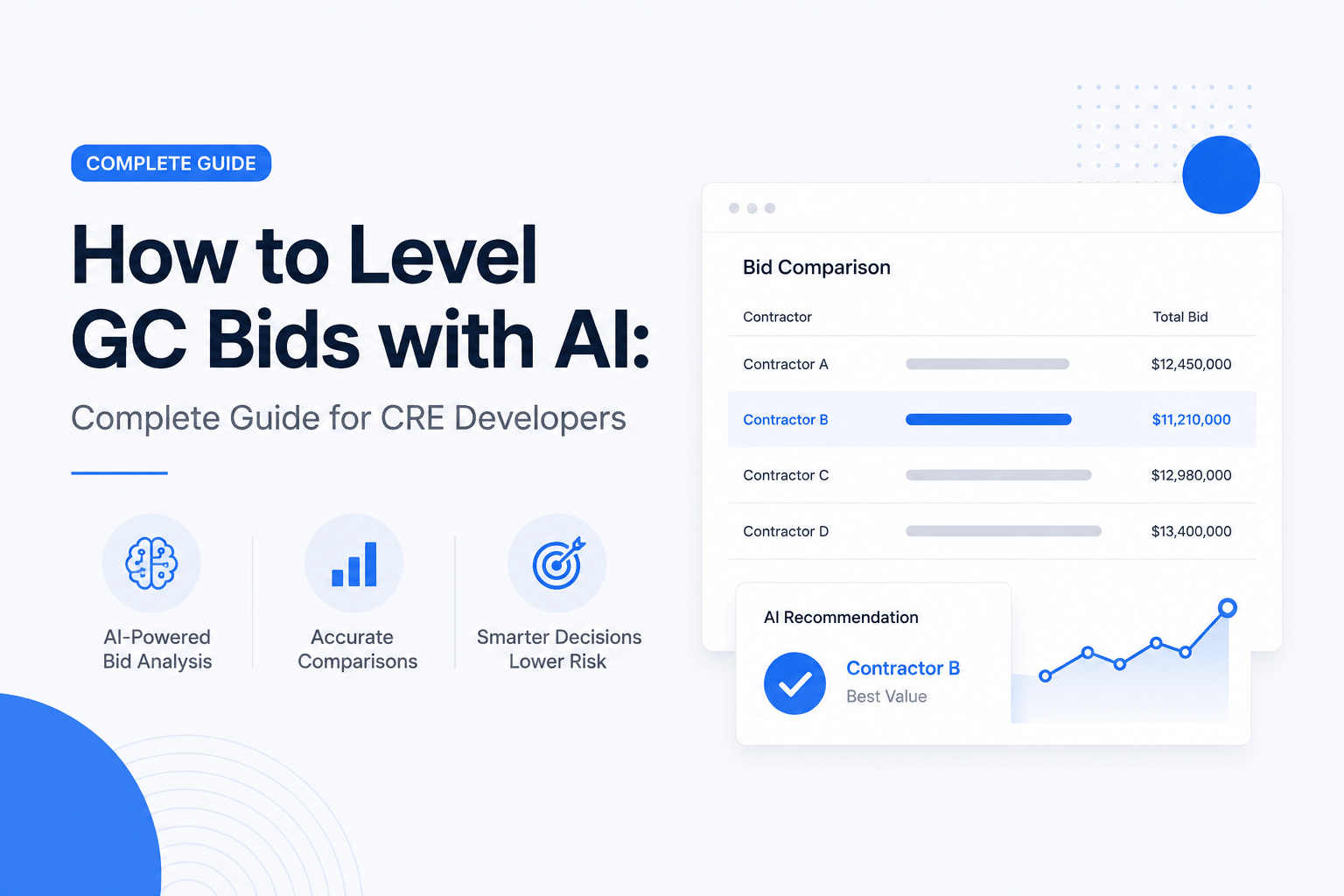
How to Level GC Bids with AI: Complete Guide for CRE Developers
Selecting the right general contractor is one of the most consequential decisions a commercial real estate developer will make during preconstruction. Yet many award decisions still rely heavily on comparing bottom-line numbers rather than understanding what each contractor is actually proposing. This is where AI Construction Bid Leveling is changing the game. Instead of spending days reviewing schedules of values, proposal narratives, exclusions, allowances, and scope assumptions manually, developers can now leverage artificial intelligence to identify differences, normalize bids, and generate actionable recommendations within hours.
The challenge with contractor bids is simple: no two proposals are structured exactly the same way. One contractor may include fire alarm systems while another excludes them. One bidder may assume a 13-month schedule while another carries 18 months of general conditions. A low bid may appear attractive until hidden exclusions and unrealistic assumptions are revealed. Without proper bid leveling, developers often discover these issues later through change orders, delays, and disputes.
AI allows owners, developers, owner’s representatives, and construction managers to review contractor proposals more comprehensively while significantly reducing the manual effort involved. When used correctly, AI can uncover risks that may otherwise remain hidden until construction begins.
Why Traditional GC Bid Reviews Often Fail
Bid leveling exists because contractor proposals rarely align perfectly. Developers commonly receive bids that appear comparable on the surface but differ significantly once examined in detail.
The Problem with Bottom-Line Comparisons
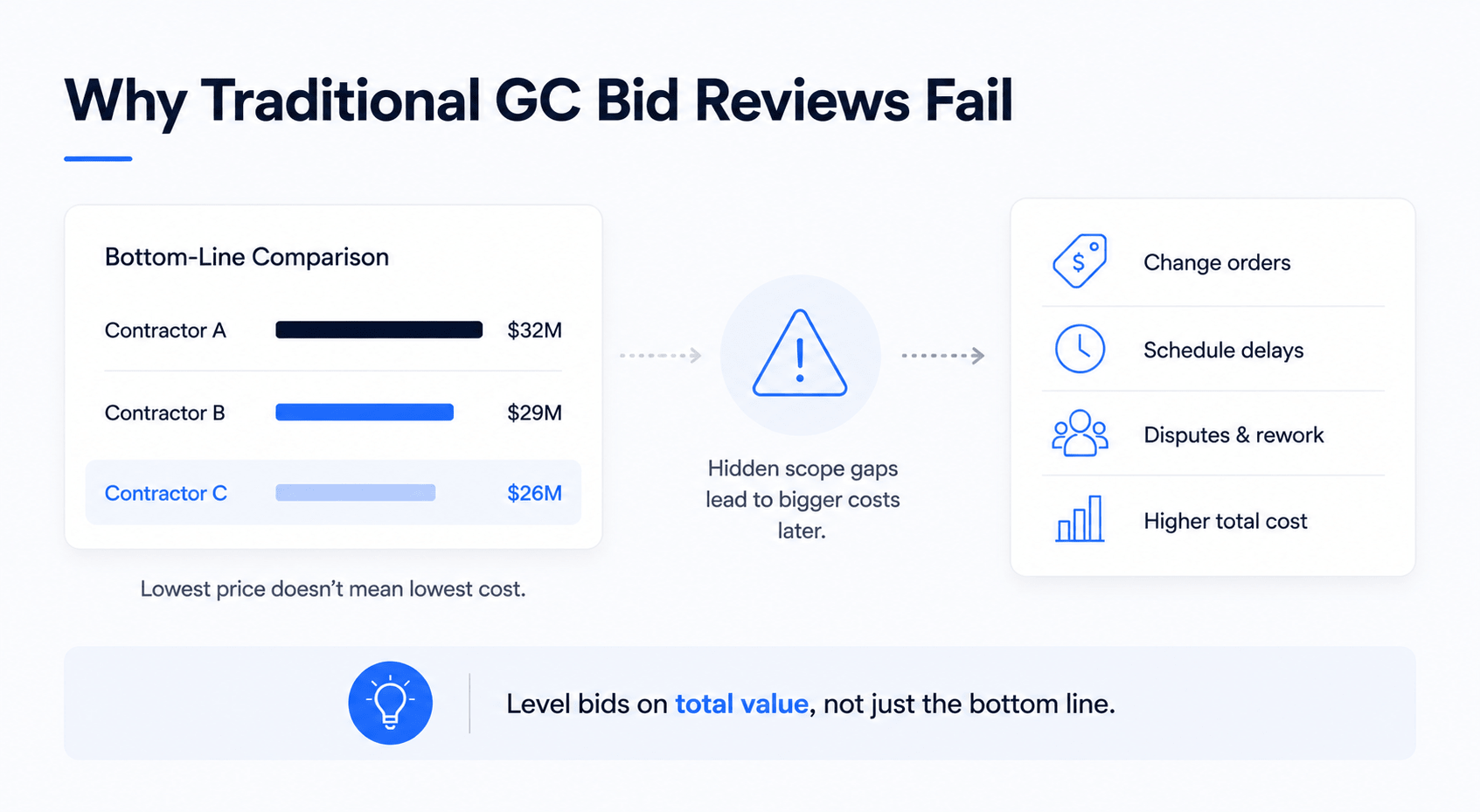
Imagine three contractors submitting bids for a multifamily development:
-
Contractor A: $32 million
-
Contractor B: $29 million
-
Contractor C: $26 million
At first glance, Contractor C appears to be the obvious choice.
However, a deeper review may reveal:
-
Security systems excluded
-
Low-voltage scope omitted
-
General conditions underfunded
-
Fire protection is carried as an allowance
-
Aggressive schedule assumptions
Once those gaps are normalized, the apparent savings may shrink dramatically. This is precisely why sophisticated developers rarely rely solely on total contract values.
The Cost of Missing Scope Gaps
Scope gaps often become future change orders.
When a missing scope is discovered after mobilization:
-
Pricing leverage shifts to the contractor
-
Competitive bidding opportunities disappear
-
Schedule impacts increase costs
-
Project teams spend time resolving disputes
The financial consequences can be substantial.
A seemingly minor omission worth $200,000 during procurement can easily become a much larger expense during construction when additional labor, delays, and contractor markups are factored into the equation.
What AI Brings to the Bid Leveling Process
Artificial intelligence does not replace construction expertise. Instead, it amplifies it. AI excels at reviewing large volumes of information quickly and consistently.
Key Advantages of AI Analysis
AI can:
-
Read every page of every proposal
-
Compare multiple contractors simultaneously
-
Identify exclusions automatically
-
Organize findings into structured reports
-
Highlight pricing anomalies
-
Generate recommendation summaries
Most importantly, AI does not suffer from review fatigue.
Human reviewers naturally begin skimming after dozens of pages. AI continues evaluating each document with the same level of attention.
Why This Matters for CRE Developers
Development teams operate under significant time pressure.
Acquisitions, financing, entitlement work, leasing efforts, and construction planning often happen simultaneously.
Reducing bid review time from several days to a few hours creates meaningful operational advantages.
| Traditional Review | AI-Assisted Review |
|---|---|
| Manual spreadsheet analysis | Automated comparison |
| Multiple days of review | Hours of review |
| Higher risk of missed scope | Systematic gap detection |
| Manual reporting | Automated summaries |
Preparing for AI-Powered Bid Leveling
Successful analysis begins with proper preparation. The quality of outputs depends heavily on the quality of inputs.
Similarly, combining bid analysis with AI construction document review allows developers to verify contractor assumptions against actual plans, specifications, and project requirements before award decisions are made.
Documents You Should Gather
Before beginning, collect:
-
Contractor proposals
-
Schedules of values
-
Bid forms
-
Clarification logs
-
Alternate pricing sheets
-
Addenda
-
Project specifications
The more complete the document package, the more accurate the analysis becomes. Since drawings play a critical role in accurate bid analysis, this video demonstrates how AI can review plans and identify issues before they become expensive construction problems.
Why Drawings Matter
Many developers stop at proposals and schedules of values. While useful, those documents only show what contractors say they are including. Construction drawings provide another layer of validation.
With plans available, AI can compare contractor pricing not only against competing bidders but also against actual project requirements. This significantly improves the quality of scope gap analysis.
Organizing Files for Better Results
Consistency matters. Create a dedicated folder containing all bid documents.
A simple structure might include:
-
Contractor A Proposal
-
Contractor A SOV
-
Contractor B Proposal
-
Contractor B SOV
-
Contractor C Proposal
-
Contractor C SOV
Clear naming conventions help AI associate related documents correctly.
Building an Effective Prompt for Bid Analysis
One of the biggest mistakes users make is providing vague instructions. A prompt such as “compare these bids” produces generic results. A detailed prompt produces a detailed analysis.
Define the AI’s Role
Start by assigning expertise.
For example:
“You are an experienced owner’s representative and construction cost consultant helping evaluate multiple general contractor bids for a multifamily development.”
This provides important context.
Define Deliverables
Specify exactly what outputs should be created.
Examples include:
-
Leveled bid comparison
-
Scope gap matrix
-
Variance analysis
-
Risk assessment
-
Recommendation memo
Specificity consistently improves output quality.
Include Project Context
Provide:
-
Project type
-
Building size
-
Number of units
-
Construction type
-
Expected schedule
-
Geographic market
These details help AI evaluate assumptions more accurately.
Creating an Apples-to-Apples Bid Comparison
The first major deliverable should be a leveled comparison workbook. This becomes the foundation for all subsequent analysis.
Mapping CSI Divisions
Each contractor structures pricing differently. AI can reorganize costs into standardized CSI divisions to simplify comparison.
Examples include:
-
General Conditions
-
Concrete
-
Masonry
-
Metals
-
Wood Framing
-
Roofing
-
Finishes
-
Mechanical
-
Electrical
Once aligned, meaningful comparisons become possible.
Identifying Pricing Variances
Not every difference represents a problem. However, significant deviations deserve attention.
If two contractors price framing at approximately $4 million and a third prices it at $2.8 million, further investigation is warranted.
The goal is not necessarily to eliminate the low bidder but to understand why the variance exists.
Interpreting the Results
Review pricing differences alongside contractor comments, assumptions, and exclusions.
Many apparent savings disappear once additional context is considered.
| CSI Division | GC A | GC B | GC C | Review Focus |
|---|---|---|---|---|
| General Conditions | Higher | Moderate | Lower | Schedule assumptions |
| Concrete | Similar | Similar | Similar | Low concern |
| Low Voltage | Included | Excluded | Excluded | Major scope gap |
| Fire Alarm | Included | Included | Allowance | Risk item |
Performing Scope Gap Analysis
Scope gap analysis is arguably the most valuable component of bid leveling.
What Is a Scope Gap?
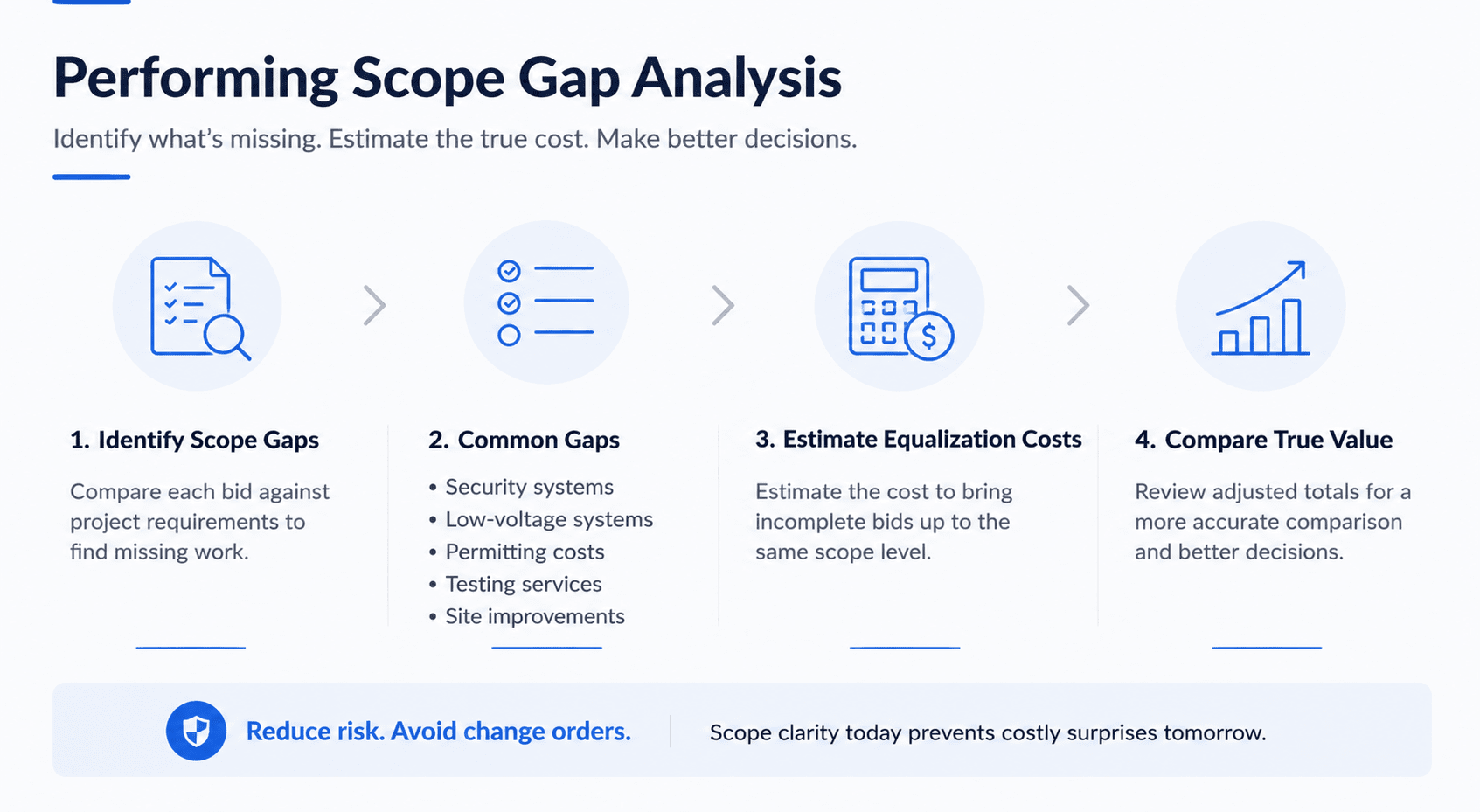
A scope gap occurs when work required for the project is missing from a contractor’s proposal.
The work still needs to be completed. The question is simply who will pay for it and when.
Common Scope Gaps
Frequently overlooked items include:
-
Security systems
-
Low-voltage systems
-
Utility company fees
-
Permitting costs
-
Testing services
-
Temporary facilities
-
Site improvements
-
Specialty equipment
Estimating Equalization Costs
AI can estimate the cost required to bring incomplete bids up to the same scope level as the most comprehensive proposal.
This creates a much more accurate comparison. Instead of reviewing submitted totals, developers review adjusted totals.
That distinction often changes contractor rankings significantly.
Risk Implications
Every exclusion introduces uncertainty. The more exclusions present, the greater the potential exposure to future cost growth.
Developers should consider both direct costs and execution risks when evaluating scope gaps.
Detecting Unbalanced Bids
Another critical function of AI is identifying unbalanced pricing.
What Is an Unbalanced Bid?
An unbalanced bid contains line items that appear significantly higher or lower than expected.
These discrepancies may result from:
-
Misunderstood scope
-
Cash flow strategies
-
Estimating errors
-
Intentional pricing tactics
Why It Matters
Unbalanced bids create risk because they can distort project economics.
For example:
-
Underpriced early packages may lead to future change orders.
-
Overpriced divisions may indicate misunderstanding.
-
Missing contingencies can create budget pressure later.
Variance Thresholds
Many analyses flag items that exceed predefined thresholds from the median bidder value. The goal is not to reject contractors automatically. Rather, it is to identify areas requiring clarification.
Contractor Interviews
Use AI-generated variance reports to guide contractor discussions.
Request written explanations for:
-
Large pricing differences
-
Missing scope
-
Aggressive schedules
-
Unusual assumptions
These conversations frequently uncover valuable information.
Evaluating Schedule Risk
Cost is only one component of contractor selection. Schedule performance often has an equal or greater financial impact.
Why Schedule Assumptions Matter
General conditions pricing is directly linked to project duration. An unrealistically short schedule can create problems later.
Potential outcomes include:
-
Extension requests
-
Additional staffing costs
-
Acceleration claims
-
Delayed occupancy
Assessing Realism
AI can compare schedule assumptions against:
-
Building type
-
Project size
-
Market conditions
-
Competing contractors
This helps identify proposals that may be overly optimistic.
Looking Beyond Duration
Developers should also evaluate:
-
Staffing plans
-
Procurement assumptions
-
Long-lead material risks
-
Labor availability
-
Weather impacts
These factors often influence project outcomes more than headline schedules.
Generating a Risk-Weighted Recommendation
The final objective is not merely identifying the cheapest contractor. The objective is to select the best overall value.
Key Evaluation Factors
Strong recommendations incorporate:
-
Equalized cost
-
Scope completeness
-
Schedule credibility
-
Contractor experience
-
Financial strength
-
Bonding capacity
Creating a Balanced Decision Framework
Contractor selection should be systematic rather than emotional.
| Evaluation Category | Suggested Weight |
|---|---|
| Equalized Cost | 30% |
| Scope Completeness | 25% |
| Schedule Reliability | 20% |
| Relevant Experience | 15% |
| Financial Capacity | 10% |
Using a weighted approach creates greater transparency and consistency.
Presenting Findings to Stakeholders
AI-generated recommendation memos can be valuable tools when communicating with:
-
Investment committees
-
Equity partners
-
Lenders
-
Internal leadership teams
Clear documentation strengthens decision-making and reduces uncertainty.
Common Mistakes When Using AI for Bid Leveling
Even sophisticated users can make avoidable mistakes.
Relying Entirely on AI
AI should support professional judgment, not replace it. Construction expertise remains essential.
Using Incomplete Documents
Missing files inevitably reduce accuracy. Always gather the most comprehensive package available.
Ignoring Clarification Questions
Analysis should generate follow-up discussions. Failing to pursue clarifications reduces value.
Treating Estimates as Final Costs
Equalization estimates are directional. They should guide decisions, not replace professional cost estimating.
Future Applications of AI in Construction Procurement
Bid leveling is only one use case. The broader opportunity extends throughout the development lifecycle.
Emerging applications include:
-
Budget forecasting
-
Value engineering
-
Draw review automation
-
Change order evaluation
-
Schedule analysis
-
Procurement planning
-
Cost benchmarking
As technology continues improving, AI will become an increasingly important component of construction decision-making.
Transform Your Contractor Selection Process
The most successful developers are not using AI simply to save time. They are using it to make better decisions, uncover hidden risks, and create more defensible contractor selection processes. When combined with professional construction expertise, AI-powered bid leveling can improve transparency, reduce change-order exposure, and strengthen project outcomes before contracts are executed.
If you want access to proven CRE AI workflows and real-world implementation strategies, join the AI for CRE Collective alongside 600+ CRE professionals actively testing AI across acquisitions, development, asset management, and construction. You can also subscribe to the newsletter to receive practical examples, prompts, and workflows that can be applied directly to active projects.
Conclusion
AI Construction Bid Leveling is quickly becoming one of the most valuable applications of artificial intelligence in commercial real estate development. By automating document review, identifying scope gaps, highlighting pricing anomalies, and generating structured recommendations, AI allows developers to evaluate contractors more thoroughly and efficiently than traditional methods.
While human judgment remains critical, AI significantly improves the quality and speed of bid analysis. For developers seeking to reduce procurement risk, improve contractor selection, and protect project budgets, AI-powered bid leveling represents a practical and immediately actionable solution.
FAQs About AI Construction Bid Leveling
What is AI construction bid leveling?
AI construction bid leveling is the process of using artificial intelligence to compare, normalize, and analyze multiple general contractor bids so developers can make accurate apples-to-apples comparisons. Instead of manually reviewing hundreds of pages of proposals, schedules of values, exclusions, and assumptions, AI identifies scope gaps, pricing inconsistencies, schedule risks, and contractor differences automatically.
Key benefits include:
-
Faster bid comparison across multiple contractors
-
Automated identification of exclusions and allowances
-
Improved scope gap analysis
-
Better contractor selection decisions
-
Reduced risk of costly change orders
For CRE developers, AI construction bid leveling helps reveal the true cost and risk profile of each contractor before awarding a construction contract.
How does AI compare general contractor bids?
AI compares general contractor bids by reviewing proposal narratives, schedules of values, bid forms, clarifications, and supporting documentation. It extracts pricing data, maps costs into comparable categories, and identifies differences between contractors.
The process typically includes:
-
Parsing contractor documents
-
Standardizing CSI divisions
-
Identifying exclusions and inclusions
-
Evaluating schedule assumptions
-
Comparing allowances and contingencies
-
Calculating equalized bid totals
The result is a structured comparison that helps developers understand which contractor offers the best overall value rather than simply the lowest price.
Why is bid leveling important in commercial real estate development?
Bid leveling is important because contractor proposals rarely contain identical scopes of work. Two contractors may submit significantly different prices because one includes items that the other excludes.
Without proper bid leveling, developers risk:
-
Selecting incomplete bids
-
Underestimating project costs
-
Increasing change-order exposure
-
Encountering construction delays
-
Creating disputes during execution
A thorough bid-leveling process ensures contractors are evaluated on equal terms, allowing owners to make informed procurement decisions and minimize financial risk.
What documents are needed for AI-powered bid leveling?
For accurate analysis, AI requires a complete set of contractor and project documents.
The most important documents include:
-
General contractor proposals
-
Schedules of values (SOVs)
-
Bid forms
-
Clarification responses
-
Addenda
-
Project specifications
-
Construction drawings
Construction drawings and specifications significantly improve results because AI can compare contractor pricing against actual project requirements instead of relying solely on submitted proposals.
Can AI identify scope gaps in contractor bids?
Yes. Identifying scope gaps is one of the most valuable functions of AI bid leveling.
A scope gap occurs when a contractor excludes work that is necessary to complete the project. AI can review multiple proposals and detect inconsistencies that might otherwise be overlooked during manual review.
Common scope gaps include:
-
Low-voltage systems
-
Fire alarm systems
-
Security systems
-
Utility connection fees
-
Landscaping
-
Testing and inspection services
By uncovering these omissions early, developers can avoid unexpected costs and reduce the likelihood of future change orders.
How accurate is AI construction bid analysis?
AI construction bid analysis is highly effective for identifying patterns, inconsistencies, exclusions, and pricing anomalies. However, its accuracy depends on the quality of the documents provided and the context available.
Factors that improve accuracy include:
-
Complete bid packages
-
Detailed project specifications
-
Construction drawings
-
Well-structured prompts
-
Clear project information
While AI can dramatically improve efficiency and consistency, experienced developers, construction managers, and owner’s representatives should still validate recommendations before making final award decisions.
Can AI help reduce construction change orders?
AI can significantly reduce the likelihood of change orders by identifying missing scope and risky assumptions before contracts are executed.
Many change orders originate from:
-
Bid exclusions
-
Incomplete scopes
-
Unrealistic allowances
-
Ambiguous contract language
-
Missing trade coordination
By exposing these issues during procurement, developers can resolve them before construction starts, resulting in fewer surprises, better cost control, and smoother project execution.
What are equalized bid totals, and why do they matter?
Equalized bid totals represent contractor bids after adjustments are made for scope differences, exclusions, allowances, and other inconsistencies.
Rather than comparing submitted bid values, equalized totals compare contractors on the same scope basis.
Benefits include:
-
More accurate contractor rankings
-
Better visibility into true project costs
-
Improved procurement decisions
-
Reduced selection bias toward low bidders
-
Stronger investment committee recommendations
Equalized totals often reveal that the apparent low bidder is not actually the most competitive contractor once all scope requirements are considered.
Can AI evaluate construction schedule risk?
Yes. Modern AI tools can assess construction schedules by reviewing contractor assumptions, project size, building type, and proposed durations.
AI can help identify:
-
Unrealistic completion schedules
-
Underfunded general conditions
-
Resource allocation concerns
-
Procurement risks
-
Potential schedule conflicts
While AI cannot replace construction scheduling expertise, it can flag assumptions that warrant closer review and support more informed schedule-related decisions.
What are the benefits of using AI for CRE contractor selection?
AI provides commercial real estate developers with a faster, more comprehensive, and more data-driven contractor evaluation process.
Major benefits include:
-
Accelerated bid review timelines
-
Improved scope transparency
-
Better risk identification
-
More consistent evaluations
-
Enhanced reporting for investors and lenders
-
Reduced procurement uncertainty
As construction projects become more complex, AI helps development teams make smarter contractor selection decisions while improving project outcomes and protecting investment returns.