Claude Code vs Manus vs Codex for CRE Deliverables
Commercial real estate professionals are rapidly adopting AI agents to build Broker Opinion of Value websites, investor presentations, LP decks, market reports, underwriting tools, and interactive client experiences. Yet choosing the right platform remains difficult because every vendor promises faster execution, better design, and more automation. This AI CRE Agent Comparison evaluates Claude Code, Manus, and Codex using the same real-world apartment deal files and the same deployment-ready BOV challenge.
Instead of relying on marketing claims, this comparison focuses on what matters most to CRE professionals: feature execution, design quality, usability, reliability, and client readiness. Whether you’re building interactive BOVs, investor presentations, or market reports, understanding the strengths and weaknesses of each platform can save hours of work and help you deliver a better final product.
What I Tested
To make this comparison meaningful, all three AI coding agents received exactly the same inputs.
The test involved a 179-unit apartment building and required each platform to create a deployment-ready, interactive Broker Opinion of Value website capable of competing with presentations from major brokerage firms.
Each platform received:
-
The same prompt
-
The same deal files
-
The same underwriting assumptions
-
The same objectives
-
The same deliverable requirements
The requested output included:
-
BOV-at-a-glance dashboard
-
Live valuation sensitivity lab
-
Buyer persona underwriting
-
AI-generated buyer outreach
-
Scenario modeling
-
1031 exchange calculator
-
Comparable sales map
-
Marketing timeline
-
Team page
This created a controlled environment where the only variable was the AI platform itself.
How the Platforms Were Evaluated
| Evaluation Category | Importance for CRE | Why It Matters |
|---|---|---|
| Design Quality | High | Influences client perception and professionalism |
| Feature Coverage | High | Determines deliverable depth and usefulness |
| Reliability | Critical | Broken functionality damages credibility |
| Speed | Medium | Impacts production timelines |
| Data Handling | Critical | Supports underwriting accuracy |
| Client Readiness | Critical | Determines whether the output can be used immediately |
The goal wasn’t simply to see which platform generated the most code.
The goal was to determine which platform could create the strongest commercial real estate deliverable.
Why This Test Matters for CRE Professionals
Commercial real estate marketing has changed dramatically.
A decade ago, brokers primarily competed using printed offering memorandums and static PDF presentations.
Today, sophisticated clients expect more.
Investors increasingly want:
-
Interactive dashboards
-
Real-time underwriting tools
-
Dynamic scenario analysis
-
Market intelligence visualizations
-
Buyer targeting insights
-
Tax planning calculators
As a result, AI coding agents are becoming valuable tools for brokers, analysts, and marketing teams.
The challenge is knowing which platform actually delivers.
Most online comparisons focus on software development projects. Very few evaluate these tools through a CRE lens.
This experiment was designed specifically to answer that question.
Before diving into the platform comparison, this video explains why interactive CRE deliverables are becoming a competitive advantage in modern brokerage.
Manus: The Most Comprehensive Build
If the objective is feature coverage, Manus immediately stands out.
Among the three platforms, it delivered the largest number of requested features and came closest to implementing everything outlined in the original prompt.
That alone deserves recognition because the prompt was extensive.
Where Manus Excelled
The scenario modeling section was one of the strongest features in the entire comparison.
Rather than simply calculating outcomes, Manus generated commentary explaining how changes in assumptions affected investment decisions.
This transformed the tool from a calculator into a decision-support system.
The buyer persona underwriting section was another highlight.
Instead of generic investor categories, Manus created a competitive matrix showing which buyer profile could justify the highest purchase price and why.
The 1031 exchange calculator also worked well and added meaningful value for prospective investors.
Similarly, the comparable sales map functioned properly and helped visualize market positioning.
The Trade-Off: Bugs
However, Manus wasn’t perfect.
Several areas suffered from execution issues.
Examples included:
-
Broken email-copy buttons
-
Navigation inconsistencies
-
Non-functional links
-
User interface glitches
-
Minor workflow interruptions
None of these issues was catastrophic.
Still, they created friction that would likely require cleanup before presenting to a client. For an internal prototype, that may be acceptable. For a listing presentation, it becomes a concern.
When Manus Makes Sense
Manus is best suited for professionals who value functionality above all else.
If your goal is exploring ideas, testing advanced features, or rapidly building a proof of concept, Manus delivers impressive results.
However, you should expect to spend time refining the output before deployment.
Claude Code: The Most Client-Ready Solution
While Manus prioritized breadth, Claude Code prioritized polish. The difference became apparent almost immediately.
Typography was cleaner. Navigation felt smoother. Spacing was more intentional. The overall experience looked and felt more professional.
Instead of appearing like an AI-generated prototype, the final output resembled a finished software product.
For a deeper look at how these two platforms perform on a real CRE workflow, check out our Claude vs Manus comparison, where we tested both tools on a construction document review process.
Stronger Design Matters in CRE
Commercial real estate is highly visual. Investors often form impressions before reviewing a single underwriting assumption.
Because of that, design quality directly impacts credibility. Claude Code demonstrated a better understanding of this reality than the other platforms.
Its layouts have improved:
-
Readability
-
Information hierarchy
-
User flow
-
Mobile usability
-
Visual consistency
Every section felt cohesive.
The Chatbot Worked
One of the biggest surprises was the chatbot. Unlike competing versions, Claude Code’s chatbot functioned properly.
Users could ask deal-specific questions and receive relevant answers based on the property information. That capability has significant implications for CRE marketing.
Instead of forcing investors to search through a presentation, they can simply ask questions and receive answers instantly.
Less Cleanup, Faster Deployment
Perhaps Claude Code’s biggest advantage was reducing post-production work.
Rather than fixing bugs, brokers can focus on:
-
Improving messaging
-
Updating assumptions
-
Refining branding
-
Preparing presentations
That distinction matters because every hour spent debugging is an hour not spent winning business.
Why Claude Code Won the Test
Ultimately, Claude Code delivered the best balance between functionality and professionalism. It wasn’t necessarily the most ambitious build. It was the most usable.
And in client-facing commercial real estate, usability often matters more than feature count.
Codex (ChatGPT 5.5): Strong Visuals, Weak Execution
I expected Codex to perform much better. Given the broader capabilities of ChatGPT, this comparison seemed likely to be extremely competitive.
Instead, Codex produced the weakest overall result.
The Good News
To be fair, Codex generated attractive visuals. In some areas, the renderings were arguably the most polished of all three platforms.
The interface looked modern and visually appealing. If the competition ended with screenshots, Codex might have ranked much higher.
The Problem
Unfortunately, the experience changed once users began interacting with the site.
Several critical components failed.
Issues included:
-
Non-functional chatbot tools
-
Data room errors
-
Broken interactions
-
Reliability concerns
These problems significantly reduced the platform’s usefulness for client-facing work. In CRE, appearance matters. However, functionality matters more.
A beautiful deliverable that doesn’t work properly quickly loses its value.
Where Codex Still Fits
Codex still offers benefits. For users heavily invested in the ChatGPT ecosystem, workflow integration remains attractive.
The platform works well for:
-
Focused coding projects
-
Component development
-
Internal experimentation
-
Smaller technical tasks
For complete interactive CRE deliverables, however, it currently lags behind Claude Code and Manus.
AI CRE Agent Comparison Across Key Categories
The clearest way to evaluate these platforms is side-by-side.
| Category | Claude Code | Manus | Codex |
|---|---|---|---|
| Design | Winner | Good | Very Good |
| Feature Count | Good | Winner | |
| Reliability | Winner | Average | Weak |
| Client Readiness | Winner | Average | Weak |
| Chatbot Quality | Winner | Good | Weak |
| Scenario Analysis | Good | Winner | Average |
| Speed | Very Good | Good | Good |
| Deployment Readiness | Winner | Average | Weak |
Manus remains the best option when feature depth is the primary objective.
Codex is better suited for focused coding assistance than complete CRE deliverable generation.
Overall Platform Scores
| Category | Claude Code | Manus | Codex |
|---|---|---|---|
| Feature Coverage | 8.5/10 | 9.5/10 | 7/10 |
| Design Quality | 9.5/10 | 7.5/10 | 9/10 |
| Reliability | 9/10 | 7/10 | 6/10 |
| User Experience | 9.5/10 | 7.5/10 | 6.5/10 |
| Client Readiness | 9.5/10 | 7.5/10 | 6/10 |
| Overall Score | 9.2/10 | 8.0/10 | 6.9/10 |
These scores reflect the complete testing process and weigh practical deployment considerations more heavily than raw feature count.
Which Platform Should You Use?
Choosing the right platform depends on your goals.
Different tools excel in different situations.
1- Use Claude Code When
-
You need client-ready output
-
Design quality matters
-
Reliability is critical
-
You want minimal cleanup
-
You are building interactive BOV websites
2- Use Manus When
-
You want maximum functionality
-
You enjoy experimenting with new features
-
You are building prototypes
-
You don’t mind fixing bugs
-
Feature coverage matters more than polish
3- Use Codex When
-
You already work heavily within ChatGPT
-
You need coding assistance
-
You are building specific components
-
Full deployment isn’t required
Best Platform by Use Case
| Use Case | Recommended Platform |
|---|---|
| Interactive BOV Website | Claude Code |
| Client Presentation | Claude Code |
| LP Deck Creation | Claude Code |
| Market Report Website | Claude Code |
| Maximum Feature Coverage | Manus |
| Prototype Development | Manus |
| Scenario Modeling | Manus |
| Focused Coding Tasks | Codex |
One Workflow Tip That Beats All Three
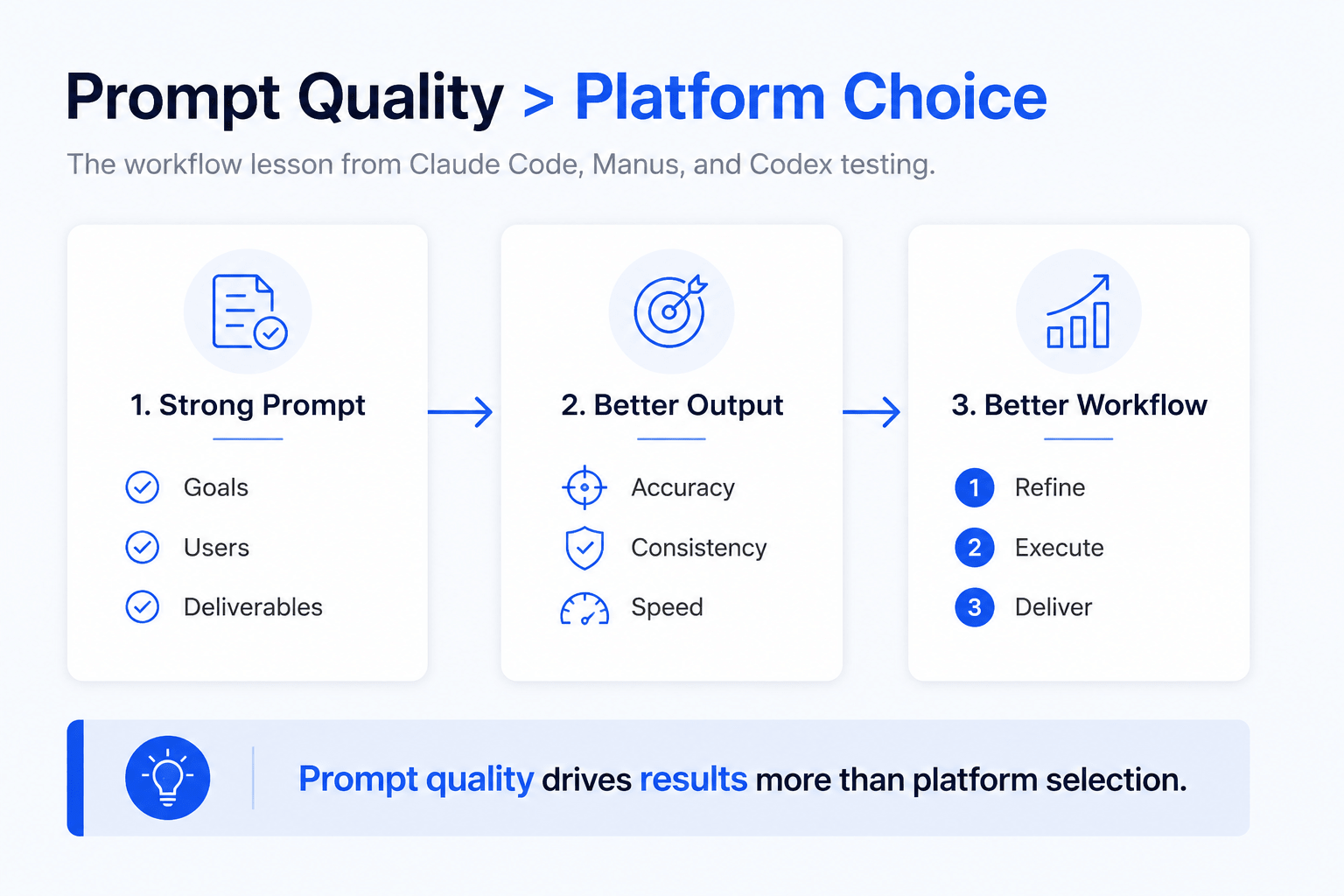
The biggest takeaway from this experiment wasn’t platform selection. It was of prompt quality.
The prompt is often more important than the AI agent. Many CRE professionals spend countless hours evaluating tools while spending very little time improving instructions.
That approach is backwards. A great prompt can dramatically improve outcomes across every platform. A mediocre prompt limits results regardless of which platform you choose.
Why Prompt Quality Matters
The prompt defines:
-
Success criteria
-
User journeys
-
Deliverable requirements
-
Functional specifications
-
Design expectations
When those elements are clearly defined, output quality improves significantly.
The Meta-Prompting Advantage
One unexpected discovery was Claude Code’s ability to improve prompts. Using Claude Code to develop requirements before sending them to another platform frequently produces stronger results.
In many cases, the best workflow may involve using one AI tool to improve prompts and another to execute them.
The Future of AI-Powered CRE Deliverables
AI-generated commercial real estate deliverables are improving rapidly. The platforms tested today will look very different six months from now. Several trends are already emerging.
Better Data Integrations
Future systems will likely connect directly with:
-
CRM software
-
Market intelligence platforms
-
Property databases
-
Investor portals
Multi-Agent Workflows
Rather than relying on a single tool, teams may combine multiple AI agents. One agent may handle research. Another may focus on design. A third may generate code. A fourth may perform quality assurance.
Interactive Deliverables Become Standard
Static PDFs are slowly losing relevance.
Interactive web-based experiences are becoming increasingly important for:
-
BOVs
-
LP decks
-
Market reports
-
Investor updates
-
Disposition packages
Platforms that can reliably create those experiences will gain a significant advantage.
Build Better CRE Deliverables With AI
The difference between a good CRE deliverable and a winning one increasingly comes down to execution. Interactive BOVs, investor presentations, market reports, and underwriting tools are becoming expected rather than optional. The professionals staying ahead are actively testing new workflows, sharing results, and learning from real-world implementations. That’s why the AI for CRE Collective has become a valuable resource for teams looking to move faster and produce stronger client-facing work alongside 600+ CRE professionals.
If you’re evaluating Claude Code, Manus, Codex, or future AI agents, don’t rely solely on vendor claims. Learn from live experiments, side-by-side comparisons, and practical CRE use cases. Join the conversation, review actual deliverables, and subscribe to the newsletterr to stay current as the technology evolves.
Conclusion
This AI CRE Agent Comparison produced a much clearer outcome than expected.
Claude Code delivered the strongest overall experience by combining professional design, reliable functionality, and client-ready execution. It may not have included every possible feature, but it provided the best balance of usability and presentation quality.
Manus generated the most comprehensive build and remains an excellent option for experimentation, feature exploration, and advanced workflows.
Codex showed potential, particularly in visual presentation, but currently trails behind for complete CRE deliverable generation.
The most important lesson is that workflow quality matters more than platform loyalty. Strong prompts, clear objectives, and thoughtful review processes consistently outperform simply choosing the newest tool.
FAQs Regarding Claude Code vs Manus vs Codex for CRE Deliverables
Which AI coding agent is best for commercial real estate deliverables?
Claude Code is currently the strongest option for most commercial real estate professionals because it balances design quality, reliability, and client readiness better than Manus or Codex.
-
Produces polished presentations
-
Requires less cleanup before deployment
-
Performs well for BOVs, LP decks, and market reports
Conclusion: Claude Code is the best overall choice for client-facing CRE deliverables today.
What is the difference between Claude Code, Manus, and Codex?
Claude Code focuses on polished and deployable outputs, Manus prioritizes maximum feature coverage, and Codex is better suited for focused coding assistance within the ChatGPT ecosystem.
-
Claude Code emphasizes usability
-
Manus emphasizes functionality
-
Codex emphasizes workflow integration
Conclusion: The right platform depends on whether you value polish, features, or integration.
Is Manus better than Claude Code for interactive BOV websites?
Manus offers more features, but Claude Code generally delivers a better client experience.
-
Manus includes advanced functionality
-
Claude Code has stronger design quality
-
Claude Code typically requires less troubleshooting
Conclusion: Claude Code is better for client presentations, while Manus is better for feature-heavy experimentation.
Can AI agents create complete Broker Opinion of Value websites?
Yes, modern AI coding agents can build interactive BOV websites that include valuation tools, buyer analysis, scenario modeling, maps, and investor-facing dashboards.
-
Generate web-based presentations
-
Create underwriting calculators
-
Support interactive user experiences
Conclusion: AI agents can significantly accelerate BOV production when combined with human review.
Which AI platform creates the best CRE investor presentations?
Claude Code currently creates the strongest CRE investor presentations due to its visual consistency and presentation quality.
-
Clean layouts
-
Strong information hierarchy
-
Better user experience
Conclusion: For LP decks and investor-facing materials, Claude Code is the safest choice.
Is Codex good for commercial real estate workflows?
Codex can be useful for coding tasks and workflow support but currently struggles with complete end-to-end CRE deliverable creation.
-
Strong visual design
-
Good integration with ChatGPT
-
Less reliable for full deployments
Conclusion: Codex works best as a supporting tool rather than a complete CRE solution.
What features should an interactive BOV website include?
A modern interactive BOV should provide investors with both property information and decision-making tools.
-
Valuation sensitivity analysis
-
Comparable sales mapping
-
Scenario modeling
-
Buyer persona analysis
-
Marketing timelines
Conclusion: The most effective BOV websites combine underwriting insights with interactive functionality.
Why is prompt engineering important when using AI coding agents?
Prompt quality often determines the quality of the final output more than the platform itself.
-
Defines project objectives
-
Improves feature implementation
-
Reduces revision cycles
Conclusion: Better prompts consistently produce better CRE deliverables regardless of the AI agent used.
Are AI-generated CRE deliverables ready for clients?
Some AI-generated deliverables can be client-ready, but the quality varies significantly between platforms.
-
Claude Code often requires minimal revisions
-
Manus may need bug fixes
-
Codex may require additional troubleshooting
Conclusion: Human review remains essential before presenting deliverables to clients.
What is the future of AI in commercial real estate marketing?
AI is expected to play an increasingly important role in creating interactive and data-driven CRE deliverables.
-
Interactive BOVs will become more common
-
Market reports will become more dynamic
-
Investor presentations will become increasingly personalized
Conclusion: AI will continue transforming how brokers create, present, and distribute commercial real estate marketing materials.