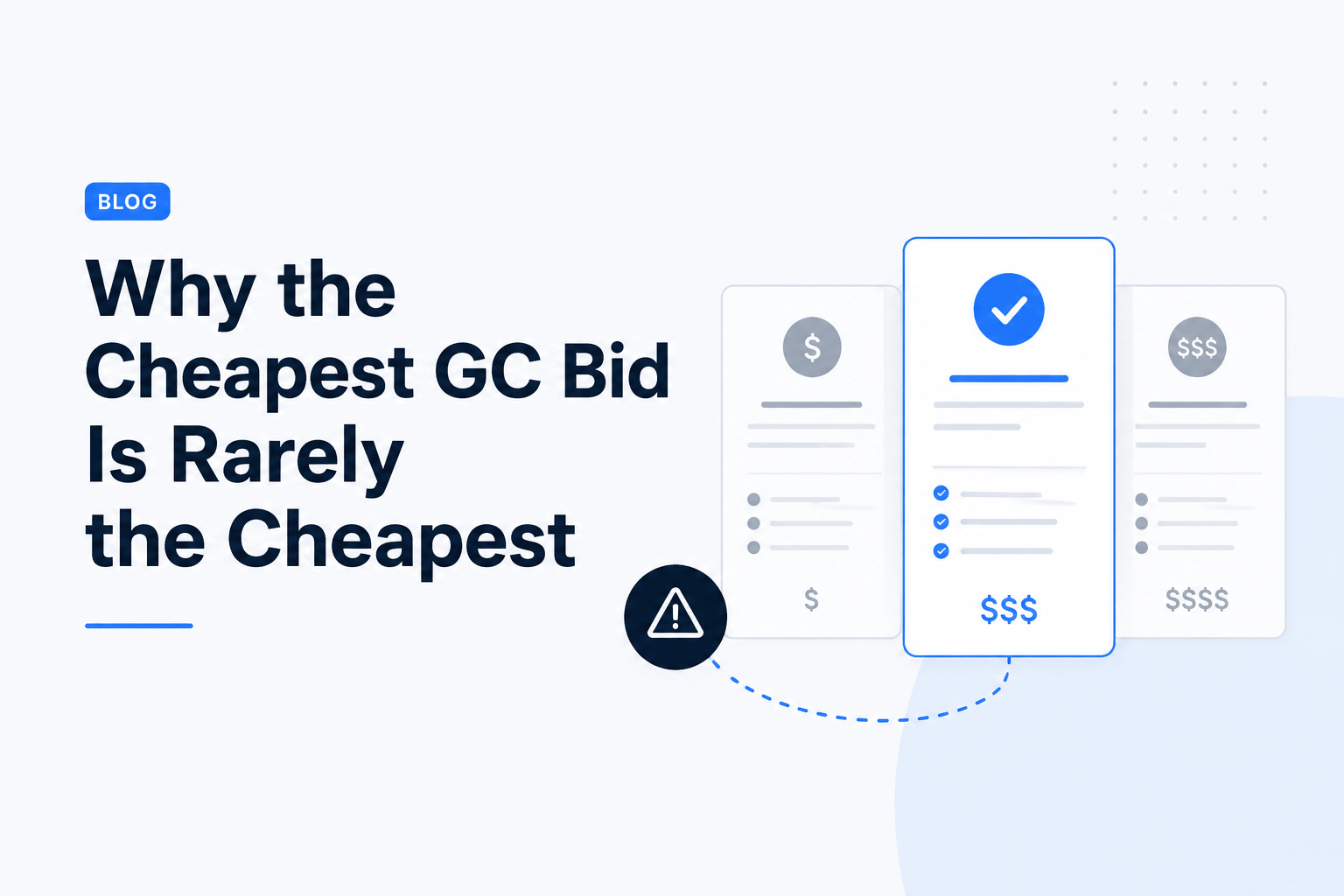
Why the Cheapest GC Bid Is Rarely the Cheapest
Most developers, owners, and project managers naturally gravitate toward the lowest bid. After all, if three general contractors are pricing the same project, choosing the cheapest option seems like the smartest financial decision. However, construction projects rarely work that way. A proper Cheapest GC Bid Analysis often reveals that the lowest bidder is not actually offering the lowest project cost.
In many cases, the apparent savings come from missing scope, underestimated schedules, incomplete assumptions, or allowances that eventually become expensive change orders.
This issue affects projects of every size, from small tenant improvements to large multifamily developments. Owners frequently discover months into construction that the contractor they selected based on price alone omitted work that must still be completed. By that point, the budget advantage has disappeared.
One recent comparison involving a 79-unit apartment project in Los Angeles highlighted this problem perfectly. Three contractors submitted bids ranging from $25.1 million to $32.4 million. While the difference initially appeared to be $7.3 million, a detailed review revealed a much smaller gap after scope equalization. The lowest bidder was no longer the clear winner.
Understanding why this happens is essential for anyone responsible for construction budgets, project planning, or contractor selection.
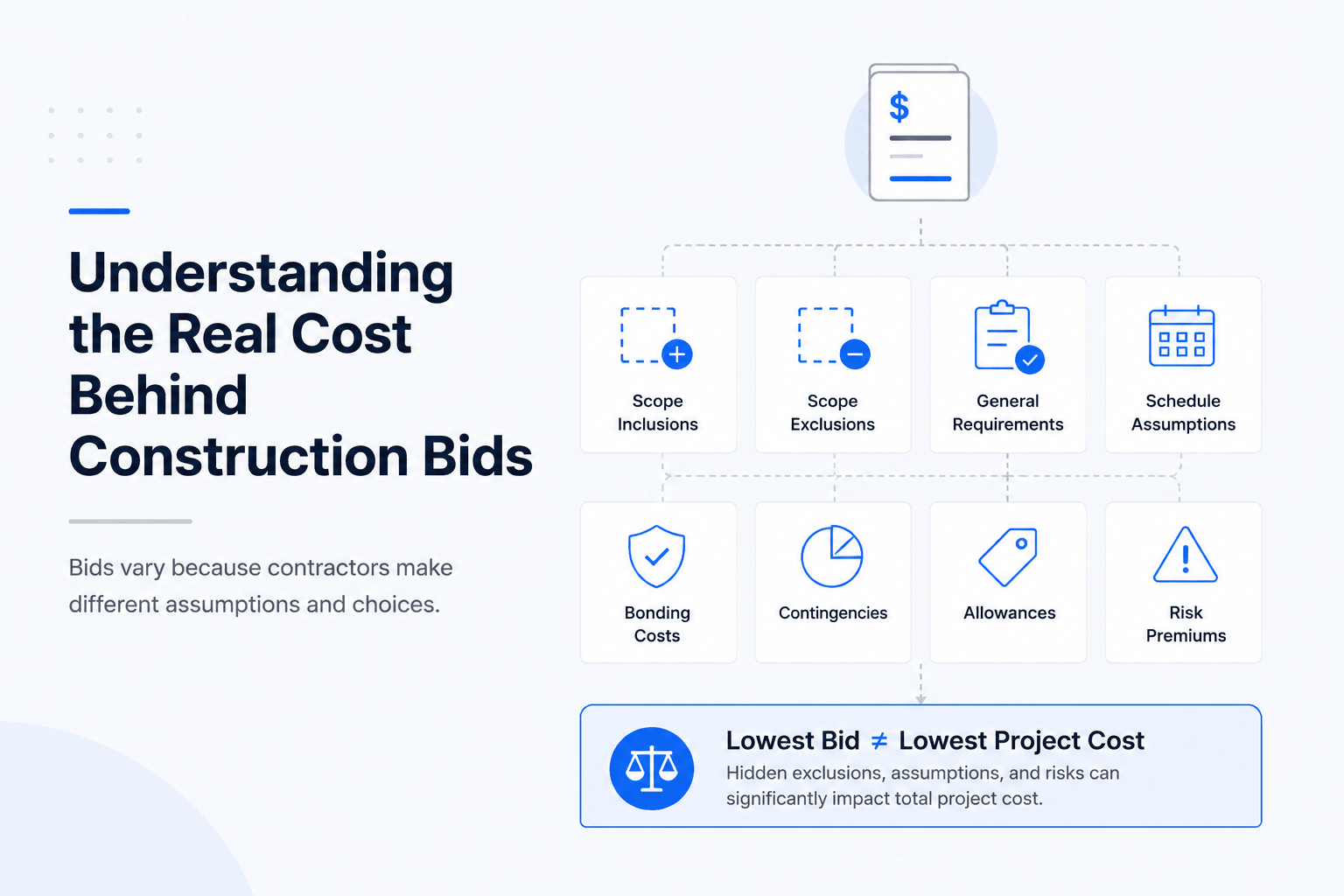
Understanding the Real Cost Behind Construction Bids
Construction proposals are not standardized products. Every contractor interprets drawings, specifications, schedules, and bid instructions differently.
Although two contractors may review the same set of plans, their pricing can vary significantly based on what they choose to include.
This creates one of the biggest challenges in construction procurement. Owners assume they are comparing equivalent proposals when, in reality, they are comparing different versions of the project.
Several factors influence bid pricing:
-
Scope inclusions
-
Scope exclusions
-
General requirements
-
Schedule assumptions
-
Bonding costs
-
Contingencies
-
Allowances
-
Risk premiums
Without understanding these differences, the lowest number on the page can be misleading.
Why Bid Totals Don’t Tell the Whole Story
Many construction teams focus exclusively on the final contract value.
Unfortunately, the total bid amount reveals very little about how complete the proposal actually is.
For example, one contractor may include low-voltage systems, landscaping, and utility coordination. Another contractor may exclude those items entirely.
The second proposal appears cheaper, but the project owner will still pay for the work eventually.
| Evaluation Method | Accounts for Scope Differences | Predicts Final Project Cost |
|---|---|---|
| Lowest Bid Only | No | Poorly |
| Basic Proposal Review | Partially | Moderate |
| Bid Leveling Analysis | Yes | Strong |
| Full Scope Equalization | Yes | Excellent |
The Hidden Risks of Choosing Based on Price Alone
Selecting a contractor solely because they submitted the lowest number often leads to:
-
Unexpected change orders
-
Budget overruns
-
Schedule delays
-
Contract disputes
-
Reduced project transparency
-
Additional management costs
These issues can easily erase any initial savings.
For developers managing tight pro formas, this risk becomes especially significant.
The Scope Gap Problem in Construction Bidding
Scope gaps are the primary reason low bids become expensive projects.
A scope gap occurs when one contractor excludes work that another contractor includes.
The challenge is that these differences are not always obvious.
Sometimes exclusions appear deep within proposal qualifications. Other times, they are hidden inside assumptions or allowances.
What Causes Scope Gaps?
Scope gaps occur for several reasons:
-
Different interpretations of construction documents
-
Incomplete design information
-
Competitive bidding pressure
-
Aggressive estimating strategies
-
Miscommunication during preconstruction
Not all scope gaps are intentional. However, every scope gap creates risk.
Common Areas Where Scope Gaps Appear
Certain construction categories consistently create bidding discrepancies.
These areas deserve special attention during contractor evaluations.
| Scope Category | Common Issue |
|---|---|
| General Requirements | Underestimated schedule duration |
| Low Voltage | Entirely excluded |
| Fire & Life Safety | Allowances instead of actual pricing |
| Landscaping | Excluded scope |
| Site Improvements | Partial coverage |
| Bonding | Not included |
| Temporary Utilities | Limited assumptions |
| Testing & Inspections | Owner responsibility language |
Why Scope Gaps Become Expensive
Missing scope never truly disappears.
Instead, the cost resurfaces later through:
-
Change orders
-
Owner allowances
-
Supplemental contracts
-
Schedule extensions
-
Additional subcontractor agreements
The contractor who appeared cheapest initially may become one of the most expensive options by project completion.
A Real Example of Bid Equalization
A recent apartment development provides an excellent example of why bid leveling matters.
Three contractors submitted proposals for the same project.
Their original bids looked dramatically different.
| Contractor | Original Bid |
|---|---|
| Ironclad Builders | $32.4M |
| Pacific Coast Construction | $27.7M |
| Apex GC Group | $25.1M |
At first glance, Apex GC Group appeared to be the clear value leader.
However, a detailed review told a different story.
Ironclad Builders
Ironclad submitted the highest proposal.
Their bid included:
-
Division 27 low-voltage systems
-
Full bonding
-
Open-book preconstruction services
-
A realistic 16-month schedule
-
Comprehensive scope coverage
As a result, their proposal served as the benchmark during equalization.
Pacific Coast Construction
Pacific Coast Construction initially appeared significantly cheaper.
However, the contractor excluded exterior improvements and certain site-related work.
After those costs were added back, the bid increased substantially.
Apex GC Group
The lowest bidder carried the greatest risk.
Several warning signs emerged during review:
-
General requirements appeared unusually low
-
Fire and life safety work was listed as an allowance
-
Schedule assumptions seemed aggressive
-
Multiple scope gaps existed
After equalization, the bid increased considerably and received a recommendation against award.
| Contractor | Original Bid | Equalized Bid |
|---|---|---|
| Ironclad Builders | $32.4M | $32.4M |
| Pacific Coast Construction | $27.7M | $29.7M |
| Apex GC Group | $25.1M | $27.5M |
The original spread of $7.3 million shrank significantly after equalization.
This demonstrates why owners should never compare bids based solely on submitted totals.
Areas That Require Extra Attention During Bid Reviews
Experienced construction managers know exactly where hidden costs tend to appear.
Reviewing these categories carefully can prevent expensive surprises later.
General Requirements
General requirements include:
-
Site supervision
-
Project management
-
Temporary facilities
-
Safety programs
-
Field offices
-
Site logistics
Contractors occasionally underprice this category to make their overall bid more competitive.
For example, pricing 13 months of general requirements on a project likely to take 18 months creates significant risk.
Low-Voltage Systems
Division 27 frequently causes confusion.
Typical components include:
-
Data cabling
-
Telecommunications infrastructure
-
Security systems
-
Access control systems
Some contractors fully include these systems while others exclude them.
Fire and Life Safety
Fire alarm systems often appear as allowances rather than firm pricing.
While allowances seem harmless, they create uncertainty because the final cost is rarely equal to the placeholder amount.
Site Improvements
Exterior scope commonly includes:
-
Landscaping
-
Sidewalks
-
Site lighting
-
Utility connections
-
Parking improvements
These items can represent substantial costs on larger developments.
Bonding Requirements
Performance and payment bonds are another area where bids vary significantly.
| Project Value | Typical Bond Cost |
|---|---|
| $5 Million | $50K–$100K |
| $10 Million | $100K–$200K |
| $20 Million | $200K–$400K |
| $30 Million | $300K–$600K |
| $50 Million | $500K–$1M+ |
Ignoring bonding differences can distort bid comparisons.
How to Perform a Proper Cheapest GC Bid Analysis
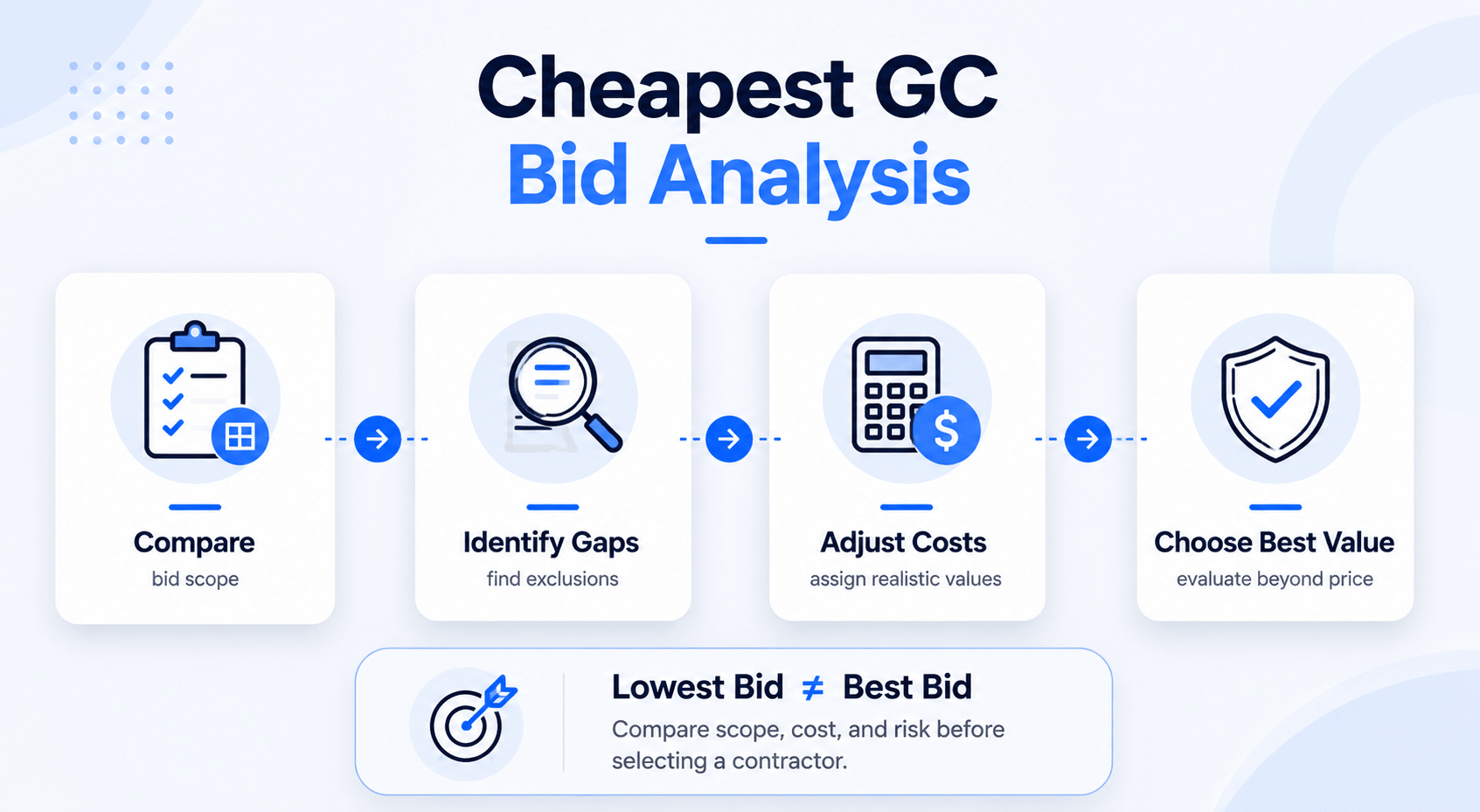
Bid leveling is not complicated, but it requires attention to detail. The goal is simple: create an apples-to-apples comparison.
Build a Scope Matrix
Start by mapping every CSI division across all bidders.
This creates visibility into:
-
Included scope
-
Excluded scope
-
Allowances
-
Assumptions
The matrix becomes the foundation for comparison.
Identify Missing Scope
Next, review each proposal carefully.
Pay attention to:
-
Qualifications
-
Clarifications
-
Notes
-
Assumptions
-
Exclusions
Many scope gaps are hidden in these sections. Similarly, using AI construction document review tools can help uncover exclusions, qualifications, and scope gaps that are often buried deep within contractor proposals.
Assign Realistic Costs
Once missing scope is identified, estimate its value.
Sources may include:
-
Independent estimates
-
Historical project data
-
Design consultants
-
Competing contractor proposals
Equalize Bid Totals
Add missing scope back into each proposal. This produces normalized pricing. Only after equalization should contractor selection discussions begin.
Evaluate More Than Price
Contractor selection should consider:
-
Relevant experience
-
Team quality
-
Financial strength
-
Safety record
-
Schedule credibility
-
Communication ability
Price matters, but it should not be the only factor.
Why Change Orders Destroy the Illusion of Savings
Many project owners discover the true cost of a low bid through change orders. By then, the opportunity to avoid those costs has passed.
Change Orders Cost More Than Bid Pricing
During bidding, contractors compete aggressively. After construction begins, competition disappears.
The contractor controls:
-
Site operations
-
Labor resources
-
Subcontractor coordination
-
Project schedule
This often leads to higher pricing for added work.
The Cost Adds Up Quickly
A project missing $2 million in scope rarely experiences one large adjustment. Instead, costs appear gradually through multiple changes.
Examples include:
-
Scope clarifications
-
Additional work authorizations
-
Allowance overruns
-
Design revisions
-
Schedule-related expenses
These costs accumulate over months.
Administrative Burden Matters Too
Change orders also create indirect costs.
Owners spend additional time on:
-
Negotiation
-
Documentation
-
Review processes
-
Accounting procedures
-
Schedule impact analysis
These expenses rarely appear in project budgets but affect overall performance.
When the Lowest Bid Is Actually the Best Choice
Not every low bidder should be rejected. Sometimes the lowest contractor truly delivers the best value. The key is understanding why they are cheaper.
Valid reasons include:
-
Operational efficiency
-
Strong subcontractor relationships
-
Local market expertise
-
Self-perform capabilities
-
Lower overhead structure
The difference is transparency.
Reliable contractors can clearly explain their pricing advantage without relying on exclusions.
| Healthy Low Bid | Risky Low Bid |
|---|---|
| Complete Scope | Significant Exclusions |
| Realistic Schedule | Aggressive Schedule |
| Clear Assumptions | Vague Qualifications |
| Strong References | Limited Experience |
| Consistent Pricing | Heavy Allowance Usage |
How AI Is Transforming Construction Bid Analysis
Traditional bid leveling can take several days.
Construction managers often review hundreds of pages manually.
Today, AI-powered workflows are dramatically reducing that effort.
Benefits include:
-
Automated document review
-
Scope extraction
-
Bid comparison
-
Risk identification
-
Cost equalization
In the multifamily project example, six construction documents were analyzed and equalized in approximately 20 minutes rather than several days.
AI does not replace construction expertise. Instead, it allows teams to focus on decision-making while technology handles repetitive document analysis.
Beyond bid comparisons, AI is also helping construction teams identify costly plan issues before they become change orders. This walkthrough shows how AI can review construction documents at scale.
Build Better Construction Budgets With Smarter Bid Analysis
Every project eventually pays for missing scope. The question is whether those costs are discovered before or after contract award. By implementing a structured Cheapest GC Bid Analysis process, owners can identify hidden risks, reduce change orders, and make more confident contractor selection decisions. The most successful development teams understand that evaluating bids properly is one of the highest-return activities in preconstruction.
If you want more practical workflows that combine construction expertise with modern technology, join AI for CRE Collective . More than 600+ CRE professionals are already using these strategies to improve underwriting, preconstruction, due diligence, and project management processes. To stay ahead of emerging CRE technology trends, subscribe to the newsletter and receive actionable insights every week.
Conclusion
The cheapest bid is not always the lowest-cost option. Construction proposals often contain different scopes, assumptions, schedules, and exclusions that can dramatically alter the true project budget.
A comprehensive Cheapest GC Bid Analysis helps owners identify these differences before signing a contract. By equalizing scope, evaluating contractor risk, and understanding the long-term impact of change orders, developers can make smarter decisions that protect both budgets and schedules.
The goal is not to select the cheapest contractor. The goal is to select the contractor that delivers the best overall value with the fewest surprises throughout construction.
FAQs Regarding Why the Cheapest GC Bid Is Rarely the Cheapest
Why is the lowest general contractor bid often misleading?
The lowest bid can be misleading because it may exclude important scope items, contain unrealistic assumptions, or rely heavily on allowances rather than actual pricing.
-
Contractors often interpret plans differently.
-
Some bids exclude work that others include.
-
Missing scope usually reappears as change orders.
Conclusion: A low bid should always be evaluated for scope completeness before it is considered a true cost advantage.
What is bid leveling in construction?
Bid leveling is the process of comparing contractor proposals on an equal basis by adjusting for differences in scope, exclusions, allowances, and assumptions.
-
It creates an apples-to-apples comparison.
-
It helps identify hidden costs.
-
It improves contractor selection decisions.
Conclusion: Bid leveling ensures owners compare actual project costs rather than misleading bid totals.
How do scope gaps affect project budgets?
Scope gaps increase project costs because excluded work must eventually be completed and paid for.
-
Missing scope often becomes a change order.
-
Budget forecasts become less accurate.
-
Construction costs can rise significantly.
Conclusion: Identifying scope gaps early helps prevent unexpected expenses during construction.
What are the most commonly excluded items in GC bids?
Several categories frequently appear as exclusions or allowances in contractor proposals.
-
Low-voltage systems.
-
Fire and life safety systems.
-
Landscaping and site improvements.
Conclusion: Reviewing these areas carefully can prevent costly surprises after contract award.
How do change orders impact the true cost of a project?
Change orders often increase the final project cost beyond the original contract value.
-
Pricing is usually less competitive after award.
-
Additional administrative work is required.
-
Schedule impacts may occur.
Conclusion: Preventing change orders through thorough bid analysis is usually more cost-effective than managing them later.
Can a higher bid actually save money?
Yes, a higher bid can save money if it includes a more complete scope and reduces future change order exposure.
-
Complete bids provide better cost certainty.
-
Fewer surprises occur during construction.
-
Budget forecasting becomes more reliable.
Conclusion: The best value is not always the lowest price but the most complete and predictable proposal.
What role do allowances play in construction bids?
Allowances are placeholder amounts used when final pricing is not available at bid time.
-
Actual costs may exceed the allowance.
-
They create budget uncertainty.
-
Excessive allowances increase project risk.
Conclusion: Owners should carefully evaluate allowance amounts before selecting a contractor.
How can developers identify an unbalanced bid?
An unbalanced bid often contains unusually low pricing in key categories or unrealistic project assumptions.
-
General requirements may be underpriced.
-
Schedule durations may appear too short.
-
Critical systems may be excluded.
Conclusion: Reviewing individual cost categories helps identify bids that may create future financial risks.
How does AI improve construction bid analysis?
AI can rapidly review and compare large volumes of construction documents to identify pricing and scope differences.
-
Documents can be analyzed faster.
-
Scope gaps are easier to identify.
-
Bid equalization becomes more efficient.
Conclusion: AI helps teams make faster and more informed contractor selection decisions.
What should owners look at besides price when evaluating contractors?
Price is important, but several other factors influence project success.
-
Relevant project experience.
-
Financial stability.
-
Safety performance and team quality.
Conclusion: The best contractor is typically the one that offers the strongest combination of value, experience, and scope completeness rather than simply the lowest bid.