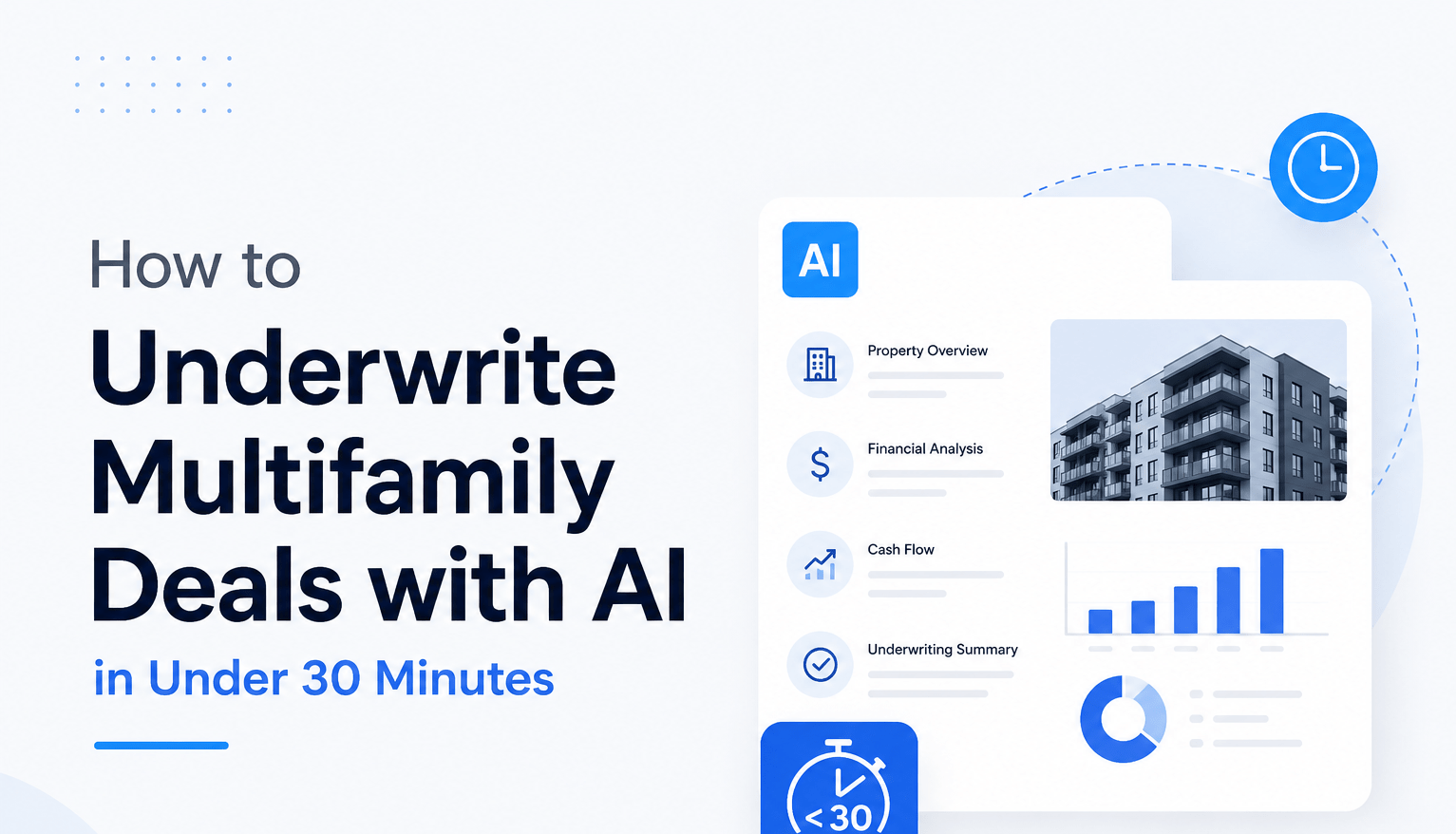
How to Underwrite Multifamily Deals with AI in Under 30 Minutes
Today, AI tools can speed up many of those tasks. They help CRE teams organize data, summarize financials, and review deals faster. That gives investors more time to focus on decision-making instead of manual work.
This is why many firms now use AI multifamily underwriting workflows. The goal is simple: review more deals in less time without lowering underwriting quality.
AI does not replace underwriting skills. You still need to understand:
-
NOI
-
Occupancy
-
Debt
-
Expenses
-
Market risk
-
Cash flow
However, AI can remove much of the repetitive work around those tasks.
For example, AI can:
-
Summarize rent rolls
-
Review T12 statements
-
Spot unusual expenses
-
Draft investment summaries
-
Compare market trends
That matters in competitive markets. The faster your team reviews deals, the faster you can make offers.
In this guide, you will learn:
-
How AI speeds up underwriting
-
Which tools work best
-
A simple 30-minute workflow
-
Copy-paste prompts for analysts
-
Common AI mistakes to avoid
This guide focuses on practical workflows. No hype. No complicated theory. Just simple systems CRE professionals can use immediately.
What Is AI Multifamily Underwriting?
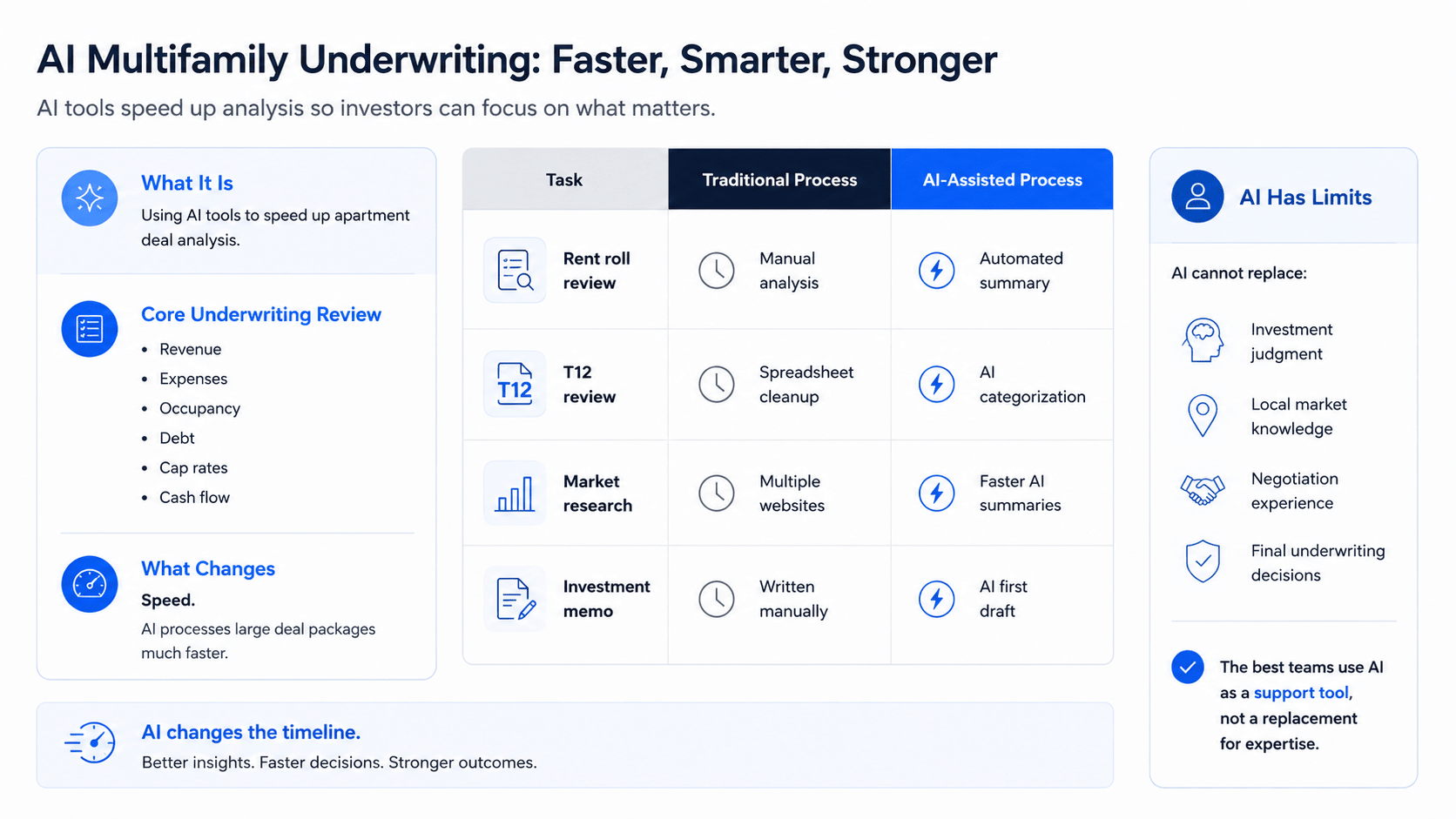
AI multifamily underwriting means using AI tools to speed up apartment deal analysis.
The core underwriting process stays the same. Investors still need to review:
-
Revenue
-
Expenses
-
Occupancy
-
Debt
-
Cap rates
-
Cash flow
What changes is the speed.
Traditionally, analysts review large deal packages manually. That usually includes:
-
Offering memorandums
-
Rent rolls
-
T12 statements
-
Market reports
-
Debt summaries
Reviewing those files takes time. AI tools can process them much faster.
For example, AI can quickly identify:
-
Occupancy trends
-
Lease rollover risk
-
Expense spikes
-
Below-market rents
-
Operational issues
That allows acquisition teams to screen deals faster.
Here is a simple breakdown:
| Task | Traditional Process | AI-Assisted Process |
|---|---|---|
| Rent roll review | Manual analysis | Automated summary |
| T12 review | Spreadsheet cleanup | AI categorization |
| Market research | Multiple websites | Faster AI summaries |
| Investment memo | Written manually | AI first draft |
Table Caption: Examples of how AI supports multifamily underwriting workflows.
Another benefit is consistency. Many firms struggle because every analyst structures underwriting differently. AI prompts help standardize reviews across the team.
Still, AI has limits.
AI cannot replace:
-
Investment judgment
-
Local market knowledge
-
Negotiation experience
-
Final underwriting decisions
That is important to understand.
The best underwriting teams use AI as a support tool, not a replacement for expertise.
Why Traditional Multifamily Underwriting Takes Too Long
Most multifamily underwriting workflows are still manual. Analysts move between spreadsheets, PDFs, emails, and research platforms all day. That slows down the process.
The biggest problem is document cleanup.
Many broker packages are messy. Rent rolls often contain inconsistent labels, missing information, or formatting issues. T12 statements may also require cleanup before analysis starts.
As a result, analysts spend too much time preparing data instead of reviewing the deal itself.
Another issue is repetitive work. Many underwriting tasks follow the same pattern every time.
For example, analysts repeatedly:
-
Update vacancy assumptions
-
Review lease expirations
-
Compare expense ratios
-
Research rent comps
-
Build investment summaries
These steps are important, but they are time-consuming.
Market research also slows down underwriting. Analysts usually search several platforms for:
-
Population growth
-
Employment trends
-
Rent growth
-
Occupancy rates
-
Construction pipelines
That research process can easily take more than an hour per deal.
The problem becomes worse when acquisition teams handle large deal volumes. A team may review dozens of apartment opportunities every week. Manual underwriting creates bottlenecks quickly.
Slow underwriting also creates business risk.
In competitive markets, speed matters. The faster your team reviews a deal, the faster you can make decisions and submit offers.
Here is where many teams lose time:
| Underwriting Task | Typical Manual Time |
|---|---|
| Rent roll review | 45 minutes |
| T12 cleanup | 30 minutes |
| Market research | 60 minutes |
| Investment memo | 45 minutes |
Table Caption: Common multifamily underwriting tasks that consume analyst time.
This is why AI tools are becoming popular in CRE. Many underwriting tasks are repetitive and structured. AI handles those types of tasks very well.
Instead of manually reviewing every line item, analysts can use AI to organize information faster.
That allows teams to focus more on:
-
Investment strategy
-
Risk analysis
-
Deal structure
-
Market positioning
The result is a faster and more scalable underwriting process. One of the biggest underwriting bottlenecks is rent roll cleanup. This demo shows how AI can speed up that process dramatically.
The 30-Minute AI Multifamily Underwriting Workflow
The goal of AI underwriting is not full automation. The goal is faster first-pass analysis.
Acquisition teams need a quick way to screen deals before spending hours on detailed underwriting. AI helps reduce the early review time dramatically.
A simple workflow can cut underwriting time from several hours to around 30 minutes.
Step 1: Collect the Deal Package
Start by organizing all property documents.
Most multifamily deals include:
-
Offering memorandum
-
Rent roll
-
T12 statement
-
Financing assumptions
-
Broker notes
-
Market reports
Keeping files organized improves AI output quality.
Step 2: Upload Files Into AI Tools
Next, upload documents into tools like:
-
ChatGPT
-
Claude
-
Gemini
Claude works especially well for long PDFs and detailed rent rolls. ChatGPT is strong for summaries and workflow automation.
Once uploaded, the AI tool can process large amounts of information quickly.
Step 3: Extract Key Property Insights
Now ask AI to summarize the deal.
Focus on important underwriting areas like:
-
Occupancy trends
-
Unit mix
-
Lease rollover risk
-
Expense issues
-
Below-market rents
-
Value-add opportunities
This step replaces much of the manual first-pass review process.
Multifamily Data Extraction Tasks AI Can Automate
| Task | Manual Time | AI Time |
|---|---|---|
| Rent roll review | 45 min | 5 min |
| Expense categorization | 30 min | 3 min |
| Deal summary | 20 min | 2 min |
Table Caption: Common underwriting tasks accelerated with AI workflows.
Step 4: Run Market Analysis
AI tools can also speed up market research.
Ask the platform to summarize:
-
Rent growth trends
-
Occupancy trends
-
Population growth
-
Local employment drivers
-
New apartment supply
This reduces time spent jumping between websites and reports.
Step 5: Generate Underwriting Assumptions
AI can help analysts create starting assumptions for:
-
Vacancy
-
Rent growth
-
Expense growth
-
Exit cap rates
-
Renovation costs
However, these assumptions still require human review.
Step 6: Create an Investment Memo
Many analysts spend too much time writing summaries manually.
AI can generate first-draft investment memos in minutes.
These summaries usually include:
-
Property overview
-
Key risks
-
Upside opportunities
-
Market strengths
-
Financial highlights
That saves significant time during acquisition meetings.
Step 7: Final Human Review
This is the most important step.
AI speeds up underwriting, but analysts must still validate:
-
Financial assumptions
-
Market data
-
Debt sizing
-
Risk exposure
-
Exit assumptions
AI should support decisions, not replace them.
The best results happen when AI automation and human judgment work together. For example, many CRE teams now use repeatable AI underwriting workflows to standardize deal reviews and reduce manual spreadsheet work across acquisitions.
Stop spending hours cleaning spreadsheets manually. Join CRE professionals using proven AI underwriting workflows inside the community:
Best AI Tools for Multifamily Underwriting
The best AI tool is not always the most expensive one. In most cases, simple workflows work better.
Many CRE teams fail because they use too many tools at once. That creates confusion and slows adoption.
A better approach is to start with one or two tools. Then build repeatable workflows around them.
Most multifamily underwriting teams use AI for:
-
Document review
-
Financial summaries
-
Market research
-
Investment memos
-
Data extraction
Different tools perform better in different areas.
ChatGPT for Multifamily Underwriting
ChatGPT is one of the easiest tools to use. It works well for everyday underwriting tasks.
Many analysts use it for:
-
Rent roll summaries
-
T12 reviews
-
Investment memos
-
Underwriting checklists
-
Market summaries
Another advantage is flexibility. Analysts can create custom prompts based on their underwriting style.
ChatGPT is also useful for team workflows. Firms can create standard prompts that every analyst follows. That improves consistency across underwriting reviews.
However, analysts should still verify outputs carefully. AI occasionally makes incorrect assumptions or misses context.
Claude for Large Deal Packages
Claude performs very well with large files.
That makes it useful for:
-
Long offering memorandums
-
Detailed rent rolls
-
Large PDFs
-
Lease reviews
-
Complex property packages
Many apartment deal packages exceed 100 pages. Reviewing those manually takes time. Claude helps summarize large amounts of information quickly.
Another benefit is readability. Claude often produces cleaner summaries and more organized responses.
This helps acquisition teams review deals faster during internal discussions.
Gemini for Market Research
Gemini works well for web-connected research tasks.
Analysts often use it for:
-
Neighborhood research
-
Rent trend analysis
-
Employment growth
-
Population trends
-
Supply pipeline reviews
Market research usually involves checking multiple websites and reports. Gemini helps organize that information faster.
Still, analysts should always confirm important market data through trusted CRE research platforms.
Excel Still Matters
AI does not replace Excel.
That point is important.
Most underwriting models still live inside spreadsheets. Excel remains essential for:
-
Cash flow modeling
-
Sensitivity analysis
-
Debt sizing
-
Waterfall calculations
-
Return projections
AI simply improves the workflow around those models.
The strongest acquisition teams combine:
-
AI automation
-
Strong underwriting skills
-
Solid Excel models
That combination creates the biggest advantage.
AI Underwriting Tools Comparison
| Tool | Best Use | Main Strength |
|---|---|---|
| ChatGPT | Workflow automation | Flexible prompts |
| Claude | Large PDFs | Long document handling |
| Gemini | Market research | Web-connected insights |
| Excel | Financial modeling | Detailed underwriting |
Table Caption: Popular tools used in AI multifamily underwriting workflows.
Most firms do not need complicated proptech systems immediately. Simple workflows often produce better results in the beginning.
Start small. Build repeatable systems. Improve the process over time.
Copy-Paste AI Multifamily Underwriting Prompts
Good prompts improve underwriting quality significantly.
Many CRE professionals struggle with AI because their prompts are too vague. Asking AI to “analyze this deal” usually creates weak results.
Better prompts create better outputs.
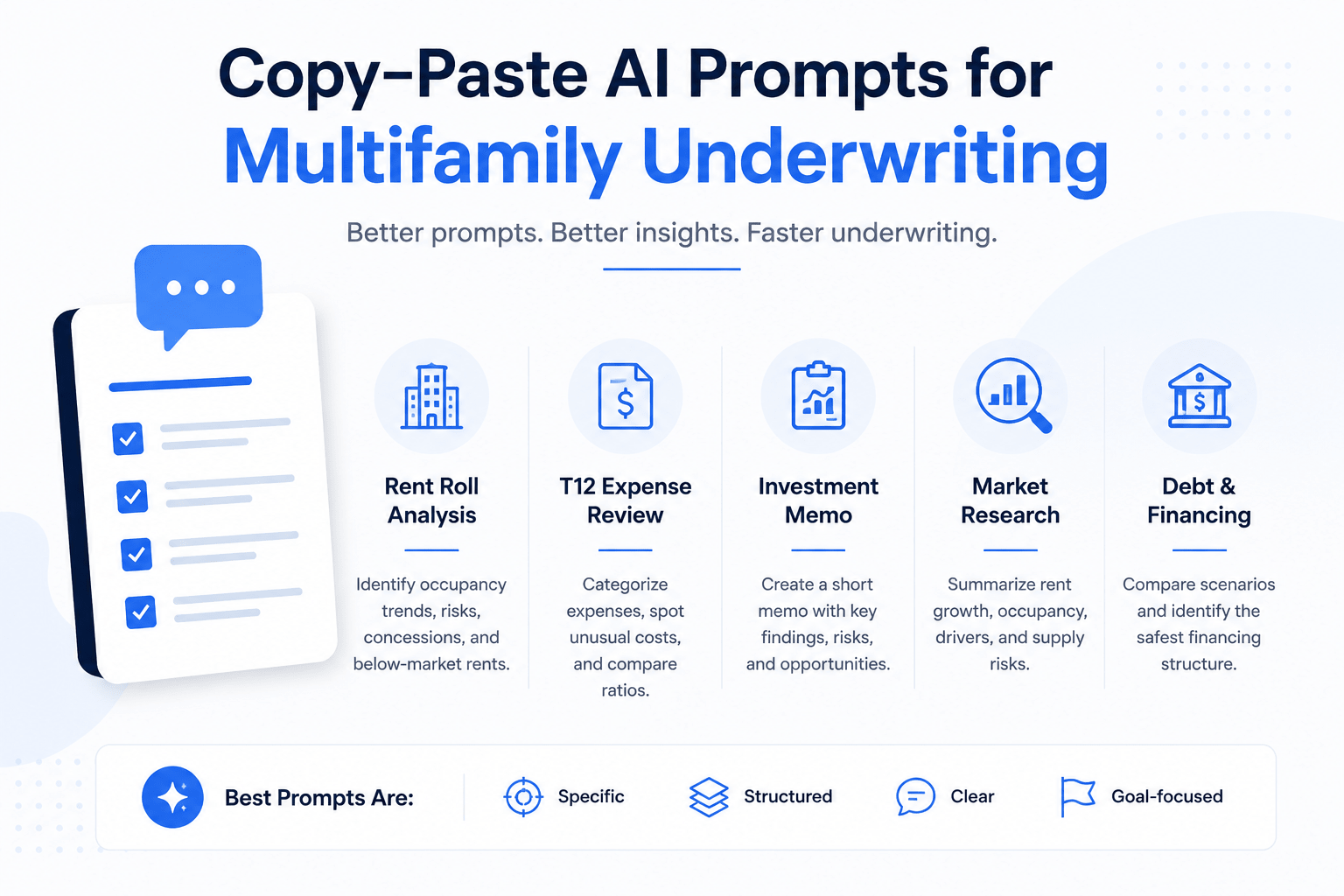
The best prompts are:
-
Specific
-
Structured
-
Clear
-
Goal-focused
Below are practical prompts analysts can use immediately.
Rent Roll Analysis Prompt
Use this after uploading a rent roll:
Review this multifamily rent roll. Identify occupancy trends, lease expiration risks, delinquency concerns, concessions, and below-market rents. Summarize the biggest operational risks and opportunities in bullet points.
This prompt helps analysts spot operational issues faster.
T12 Expense Review Prompt
Use this with a trailing 12-month statement:
Analyze this multifamily T12 statement. Categorize expenses, identify unusual operating costs, compare expense ratios, and flag any items that appear inconsistent.
Expense review usually takes analysts a long time. AI can complete the first-pass review quickly.
Investment Memo Prompt
Use this after reviewing the deal package:
Create a short investment memo for this multifamily acquisition opportunity. Include property overview, financial strengths, operational risks, value-add opportunities, and key underwriting assumptions.
This saves time during acquisition meetings.
Market Research Prompt
Use this for submarket analysis:
Research this multifamily submarket. Summarize rent growth, occupancy trends, employment drivers, population growth, and new apartment supply risks.
This helps teams review markets faster without checking multiple websites manually.
Debt and Financing Prompt
Use this during financing analysis:
Compare these multifamily financing scenarios. Review DSCR, refinance risk, loan proceeds, and interest rate exposure. Summarize the safest financing structure.
These prompts improve consistency across underwriting teams.
Instead of every analyst creating different workflows, firms can standardize reviews using shared prompt templates.
AI Multifamily Underwriting Case Study
A mid-sized acquisition team recently tested AI-assisted underwriting on multifamily deals across two growing Sun Belt markets.
Before using AI, the team needed around four hours for an initial underwriting review.
Most of that time went toward repetitive work:
-
Cleaning spreadsheets
-
Reviewing rent rolls
-
Organizing financials
-
Writing summaries
-
Researching markets
The team then introduced a simple AI workflow using:
-
ChatGPT
-
Claude
-
Excel
They also created standardized prompts for every analyst.
The results were immediate.
Initial underwriting time dropped from four hours to roughly 30 minutes per deal.
Analysts spent less time formatting data and more time evaluating investment quality.
The workflow looked like this:
-
Upload documents to Claude
-
Extract operational insights
-
Generate summaries with ChatGPT
-
Verify assumptions in Excel
-
Complete final human review
The team also improved consistency.
Before AI, every analyst structured underwriting summaries differently. After implementing shared prompts, investment reviews became easier to compare internally.
Before AI Workflow
-
Long review times
-
Repetitive spreadsheet work
-
Manual summaries
-
Slower deal screening
-
Higher analyst fatigue
After AI Workflow
-
Faster underwriting
-
Cleaner summaries
-
Better organization
-
More scalable workflows
-
Faster acquisition decisions
Before vs After AI Underwriting
| Task | Traditional Workflow | AI Workflow |
|---|---|---|
| Initial deal review | 2 hours | 15 minutes |
| Market research | 1 hour | 10 minutes |
| Investment memo | 45 minutes | 5 minutes |
Table Caption: Example time savings from AI-assisted multifamily underwriting.
These productivity improvements are becoming common across CRE. Firms using AI workflows can often review more opportunities without increasing analyst headcount.
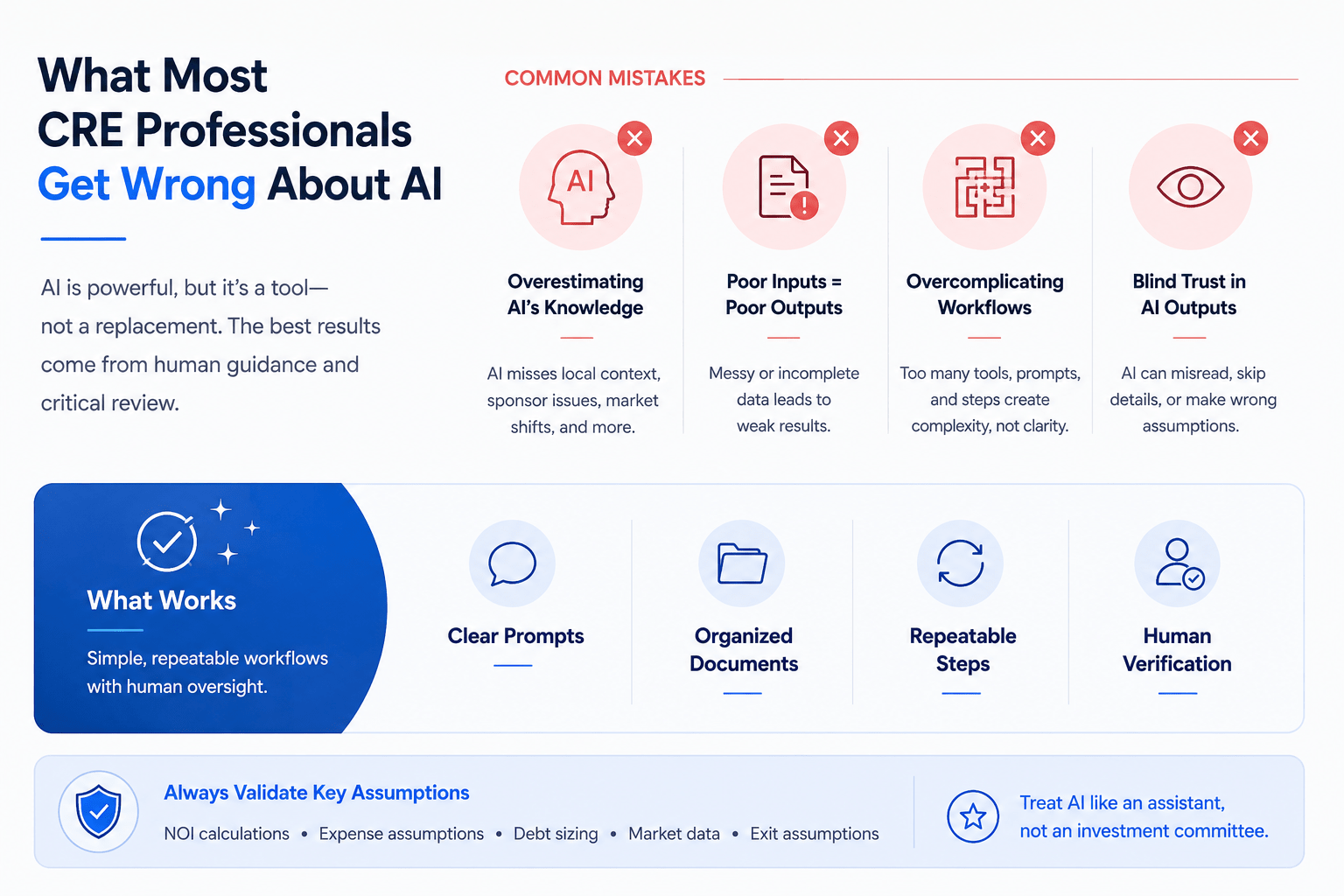
What Most CRE Professionals Get Wrong About AI
Many CRE professionals expect AI to do too much too quickly. That usually leads to poor results.
AI is powerful, but it is still a tool. It works best when experienced analysts guide the process.
One common mistake is treating AI like a replacement for underwriting knowledge. Some users expect perfect answers without reviewing the data carefully. That creates risk.
AI can summarize information fast, but it does not truly understand the deal like an experienced investor does.
For example, AI may miss:
-
Local market risks
-
Sponsor reputation issues
-
Political concerns
-
Neighborhood changes
-
Property management problems
That is why human review still matters.
Another mistake is using poor-quality inputs. AI depends heavily on the information provided. Messy rent rolls or incomplete financials usually create weak outputs.
Good underwriting still starts with clean data.
Many firms also overcomplicate their AI workflows. They add too many tools, too many prompts, and too many automation steps. Eventually, the process becomes harder to manage than traditional underwriting.
Simple systems usually work better.
Strong AI underwriting workflows focus on:
-
Clear prompts
-
Organized documents
-
Repeatable steps
-
Human verification
Another problem is blind trust in AI-generated summaries.
AI can occasionally:
-
Misread numbers
-
Create inaccurate assumptions
-
Hallucinate information
-
Skip important details
Because of that, analysts should always validate:
-
NOI calculations
-
Expense assumptions
-
Debt sizing
-
Market data
-
Exit assumptions
The best CRE teams treat AI like an assistant, not an investment committee.
That mindset creates better results and lowers risk.
How to Implement AI Multifamily Underwriting in 24 Hours
Most firms think AI implementation requires major operational changes. It does not.
In many cases, acquisition teams can start using AI workflows within a single day.
The key is starting simple.
Do not try to automate the entire underwriting process immediately. Instead, focus on one or two high-impact tasks first.
Step 1: Build a Simple AI Stack
Start with basic tools.
Most firms only need:
-
ChatGPT
-
Claude
-
Excel
-
A shared prompt library
This setup handles most early underwriting workflows effectively.
Step 2: Standardize Your Prompts
Shared prompts improve consistency across acquisition teams.
Without standardized prompts, every analyst creates different summaries and review structures.
Create templates for:
-
Rent roll reviews
-
T12 analysis
-
Market research
-
Investment memos
-
Debt comparisons
That makes underwriting reviews cleaner and easier to compare internally.
Step 3: Organize Deal Documents
AI performs better with clean inputs.
Create a consistent folder structure for:
-
Offering memorandums
-
Financial statements
-
Market reports
-
Debt assumptions
-
Property photos
This small step improves workflow speed significantly.
Step 4: Train Analysts on Verification
AI outputs should always be reviewed manually.
Train analysts to verify:
-
Occupancy assumptions
-
Revenue projections
-
Expense ratios
-
Debt terms
-
Market trends
This reduces underwriting risk.
Step 5: Start With Smaller Deals
Do not test AI workflows on your most complex acquisition immediately.
Start with:
-
Smaller apartment deals
-
Simpler rent rolls
-
Basic value-add opportunities
This allows the team to refine workflows gradually.
Simple AI Underwriting Setup Checklist
| Task | Goal |
|---|---|
| Choose AI tools | Keep workflows simple |
| Build prompt templates | Improve consistency |
| Organize files | Improve AI outputs |
| Train analysts | Reduce errors |
| Start small | Refine workflows safely |
Table Caption: Simple steps for implementing AI underwriting workflows quickly.
Most firms see productivity improvements within the first few weeks. The biggest gains usually come from reducing repetitive work.
Common AI Multifamily Underwriting Mistakes
AI can improve underwriting speed significantly. However, many teams still make avoidable mistakes.
One major issue is relying too heavily on AI-generated summaries. Some analysts skip manual review because the output looks polished.
That is risky.
AI-generated content can sound confident even when the information is incorrect.
Another mistake is ignoring the local market context. Multifamily underwriting depends heavily on neighborhood conditions, employment drivers, and supply trends.
AI may summarize market data, but it cannot fully understand local market behavior.
Many firms also forget to stress-test assumptions.
For example:
-
What happens if occupancy drops?
-
What if interest rates increase?
-
What if renovation costs rise?
Strong underwriting always includes downside analysis.
Another common problem is poor prompt structure.
Weak prompts create weak outputs.
For example:
“Analyze this deal.”
That instruction is too vague.
A better prompt would specify:
-
Which metrics to review
-
Which risks to identify
-
Which assumptions to compare
Specific prompts create more useful underwriting insights.
Some teams also use AI without improving internal workflows. They add AI tools but keep inefficient processes around them.
That limits productivity gains.
Instead, firms should redesign workflows around speed and clarity.
Common AI Underwriting Mistakes
-
Trusting AI outputs blindly
-
Using messy financial data
-
Ignoring market-specific risks
-
Skipping human review
-
Overcomplicating workflows
-
Using vague prompts
-
Forgetting downside analysis
Avoiding these mistakes improves both speed and underwriting quality.
Future of AI Multifamily Underwriting
AI will likely become standard across multifamily underwriting over the next few years.
The biggest reason is competition.
Firms that review deals faster gain a major advantage in active markets. AI helps acquisition teams scale without adding large analyst teams.
However, the future is not about replacing analysts. It is about improving analyst productivity.
Many future workflows will likely include AI copilots that assist acquisition teams throughout the underwriting process.
These systems may help with:
-
Deal screening
-
Market analysis
-
Investment summaries
-
Risk detection
-
Sensitivity analysis
-
Portfolio reporting
Real-time market intelligence will also improve.
Instead of manually gathering research from different websites, analysts may receive automated market updates directly inside underwriting workflows.
Another major trend is predictive analytics.
Future AI systems may help firms forecast:
-
Occupancy changes
-
Rent growth
-
Expense trends
-
Refinance risk
-
Distressed opportunities
That could improve investment decision-making significantly.
Still, underwriting fundamentals will remain important.
The firms that perform best will combine:
-
Strong underwriting skills
-
Market expertise
-
AI automation
-
Operational discipline
Technology alone will not create better investors.
The advantage comes from using technology strategically.
Conclusion
AI is changing how multifamily deals are underwritten. Tasks that once took hours can now take minutes.
That does not mean underwriting becomes easy. Analysts still need strong financial knowledge, market awareness, and investment discipline.
However, AI multifamily underwriting gives CRE professionals a major productivity advantage. It helps teams review deals faster, organize information better, and focus more on investment decisions instead of repetitive work.
The best approach is simple:
-
Use AI to automate repetitive tasks
-
Keep workflows structured
-
Verify outputs carefully
-
Combine AI with strong underwriting fundamentals
Firms that learn these workflows early will likely gain an edge as AI adoption grows across commercial real estate.
See How CRE Teams Actually Use AI
Most CRE professionals are still guessing with AI. See real underwriting workflows, prompts, and live demos inside the AI for CRE Collective community:
Common Questions About AI Underwriting for Multifamily Deals
Can AI really underwrite multifamily deals accurately?
AI can help analyze multifamily deals faster, but it should not make final investment decisions alone. The best use of AI is speeding up repetitive tasks like reviewing rent rolls, summarizing T12 statements, and organizing market research.
Experienced analysts still need to verify:
-
NOI assumptions
-
Occupancy trends
-
Debt terms
-
Market risks
-
Exit strategies
AI tools work best as underwriting assistants. They improve productivity and reduce manual work. However, they can still make mistakes or miss important context.
For example, AI may misunderstand messy financial data or overlook local market issues. Because of that, human review remains essential.
Most successful CRE firms use a hybrid workflow. AI handles repetitive analysis while analysts focus on investment judgment and deal strategy.
What is the best AI tool for multifamily underwriting?
There is no single “best” AI tool for every underwriting task. Different platforms perform better in different areas.
Many CRE professionals use:
-
ChatGPT for workflow automation
-
Claude for large PDFs and rent rolls
-
Gemini for market research
-
Excel for financial modeling
ChatGPT works well for summaries, prompts, and investment memos. Claude is strong with long documents and detailed property packages. Gemini helps with market and demographic research.
However, Excel still remains critical for underwriting models and cash flow analysis.
The best setup is usually simple. Most firms only need one or two AI tools combined with strong underwriting templates and review processes.
How fast can AI analyze a rent roll?
AI can review most rent rolls in just a few minutes. Traditional manual review often takes 30 to 60 minutes, depending on property size.
AI tools can quickly identify:
-
Occupancy trends
-
Lease expirations
-
Delinquencies
-
Concessions
-
Below-market rents
This helps acquisition teams screen deals faster.
However, output quality depends heavily on document quality. Messy spreadsheets or incomplete data can reduce accuracy.
Analysts should also verify important numbers manually. AI speeds up the first-pass review, but final underwriting decisions still require human oversight.
For most CRE teams, the biggest advantage is time savings. Faster rent roll analysis allows firms to evaluate more opportunities every week.
Can AI replace multifamily analysts?
No. AI is unlikely to replace experienced multifamily analysts completely.
Underwriting involves more than data processing. Analysts still need to evaluate:
-
Market conditions
-
Sponsor quality
-
Property risks
-
Debt structure
-
Investment strategy
AI cannot fully understand local market behavior or investor goals.
Instead, AI acts more like a productivity tool. It helps analysts complete repetitive tasks faster. That allows teams to focus more on decision-making and strategy.
In many firms, AI actually increases analyst efficiency instead of reducing headcount. Teams can review more deals without significantly expanding staff.
The strongest acquisition teams combine:
-
Human expertise
-
Financial modeling skills
-
AI-assisted workflows
That combination creates the best long-term results.
What files should I upload to AI tools?
Most multifamily underwriting workflows start with standard deal documents.
The most useful files include:
-
Offering memorandums
-
Rent rolls
-
T12 statements
-
Debt assumptions
-
Market reports
-
Property photos
-
Broker notes
These files give AI tools enough context to generate meaningful summaries and insights.
For best results:
-
Use clean spreadsheets
-
Organize documents clearly
-
Avoid incomplete files
-
Label documents consistently
Good document organization improves output quality significantly.
Many CRE teams also create standard upload folders for every deal. That keeps workflows more efficient and consistent across analysts.
Is AI underwriting safe for investment decisions?
AI can support underwriting decisions, but it should never replace full human review.
The biggest risk is overtrusting AI-generated outputs. AI tools can occasionally:
-
Misread numbers
-
Hallucinate information
-
Miss operational risks
-
Create weak assumptions
Because of that, analysts should always validate important underwriting metrics manually.
AI is safest when used for:
-
First-pass analysis
-
Workflow automation
-
Document summaries
-
Market research support
Final investment decisions still require experienced underwriting judgment.
Most firms reduce risk by building review systems where analysts verify all major assumptions before investment committee approval.
How much does AI multifamily underwriting cost?
Most AI underwriting workflows are surprisingly affordable.
Many firms start with:
-
ChatGPT subscription
-
Claude subscription
-
Existing Excel models
This setup often costs far less than specialized proptech software.
The biggest investment is usually time spent building workflows and prompts. Once those systems are in place, productivity gains can be significant.
Small acquisition teams often see strong ROI because AI reduces repetitive work and speeds up deal reviews.
Some larger firms eventually invest in custom automation systems. However, most CRE professionals can start with basic tools and improve workflows gradually over time.
Can small CRE firms use AI underwriting?
Yes. Small CRE firms may benefit the most from AI underwriting.
Many smaller acquisition teams face resource limitations. Analysts often handle multiple responsibilities at once. AI helps reduce manual workload and improve efficiency.
Smaller firms can use AI to:
-
Review more deals
-
Create faster summaries
-
Organize underwriting workflows
-
Reduce repetitive work
The barrier to entry is also relatively low. Most firms already use spreadsheets and standard deal packages.
Adding AI tools usually requires minimal operational changes.
Simple workflows often work best for smaller teams. Firms do not need complicated automation systems to see productivity improvements quickly.
Does AI integrate with Excel underwriting models?
Yes. Most AI underwriting workflows still rely heavily on Excel.
AI does not replace underwriting models. Instead, it supports the workflow around them.
For example, AI can help:
-
Summarize rent rolls
-
Organize assumptions
-
Categorize expenses
-
Draft investment summaries
Analysts then move verified information into Excel models for detailed underwriting analysis.
Excel remains critical for:
-
Cash flow modeling
-
Sensitivity analysis
-
Debt sizing
-
Return projections
The best workflows combine AI efficiency with strong spreadsheet modeling skills.
What are the biggest risks of AI underwriting?
The biggest risk is relying on AI too heavily without verification.
AI tools can sometimes:
-
Create inaccurate assumptions
-
Misread financial data
-
Skip important risks
-
Hallucinate details
Another major risk is poor-quality input data. Messy rent rolls or incomplete T12 statements often create weak outputs.
Local market knowledge also remains important. AI may summarize trends, but it cannot fully understand neighborhood dynamics or political risk.
Strong review processes reduce these risks significantly.
Most firms should treat AI as a support tool, not a replacement for underwriting expertise.
Can AI help with multifamily market research?
Yes. AI can speed up market research significantly.
Many analysts spend hours gathering information from different websites and reports. AI helps summarize that information faster.
Common research tasks include:
-
Rent growth analysis
-
Occupancy trends
-
Population growth
-
Employment drivers
-
Construction pipeline reviews
AI tools can organize this data quickly and create market summaries in minutes.
However, analysts should still confirm important numbers through trusted CRE research sources like CBRE, JLL, Marcus & Millichap, or CoStar.
AI works best as a research assistant, not a final source of truth.
What is the best AI workflow for acquisition teams?
The best workflows are usually simple and repeatable.
Strong acquisition workflows often follow these steps:
-
Upload deal documents
-
Extract key insights with AI
-
Verify assumptions manually
-
Build models in Excel
-
Generate investment summaries
Many firms also create shared prompt libraries for analysts. This improves consistency across underwriting reviews.
Simple workflows scale better over time. Overcomplicated automation systems often create operational problems.
The goal should always be faster decision-making, not unnecessary complexity.
How do I train analysts to use AI?
Start with practical workflows first.
Most analysts learn AI faster when they apply it directly to real underwriting tasks.
Begin with:
-
Rent roll reviews
-
T12 summaries
-
Market research prompts
-
Investment memo drafting
Next, create internal prompt templates and review standards.
Training should also focus heavily on verification. Analysts must understand that AI outputs still require manual review.
The most effective teams combine:
-
AI tools
-
Underwriting fundamentals
-
Standardized workflows
-
Human quality control
That approach improves both speed and accuracy.
What multifamily metrics should AI analyze first?
AI works best when reviewing structured underwriting data.
The most important metrics usually include:
-
Occupancy
-
NOI
-
Expense ratio
-
Rental growth
-
Debt service coverage ratio
-
Lease expirations
These metrics help analysts screen opportunities quickly.
AI can also identify unusual trends or inconsistencies in financial statements. That helps acquisition teams prioritize which deals deserve deeper review.
However, analysts should still validate assumptions manually before making investment decisions.
Will AI underwriting become standard in CRE?
AI adoption will likely continue growing across commercial real estate.
The main reason is competition. Faster underwriting creates a major advantage in active markets.
Firms using AI can often:
-
Review more opportunities
-
Reduce manual work
-
Improve workflow consistency
-
Scale acquisition teams faster
However, underwriting fundamentals will still matter.
The firms that perform best will combine:
-
Strong CRE expertise
-
Financial modeling skills
-
Operational discipline
-
AI-assisted workflows
Technology alone will not create better investors. The advantage comes from using AI strategically and responsibly.